Open up your mind and your potential reaches infinity…

Archive for January, 2011

UFF YE CRICKET


Cricket ho ya cricketers, nahin ab koi maza
Ye khelte kam hain, kaat te zyada hain sazaa
Kabhi ball tempering ka ilzaam jhelte hain
Kabhi spot fixing ke baad match khelte hain
Match jeetna to jaise bhool hi gaye
Shayad hi in mein se koi school bhi gaye
Poor ka poora 16 ka squad hai kam aqal
Afsos na koi ek bhi inmein hai khush shakl
Soorat na thee to seerat hi achee rakhtey
Fans na sahee, khuda ko to khush kartey

Din to cricket ne the dekhe 20-25 saal beete
Jab test match to kya World Cup the jeete
Woh tabahi battings Zaheer ya Majid khan ki
Ya zaalim ballings Sarfaraz Nawaz  aur Imran ki
Majid jo ball ko boundary pe karta that hit
Stadium ki saari larkiyaan jaati thi mar- mit
Zaheer bhi kya ball ka hard hooker tha
Aur uspe kya ‘be-spectacled’ looker tha.
Imran ki to khair baat hi niraali thi
Balling to thee hi, shakl bhi jamali thi
Aur woh Miandad bhi kya sheh tha
Ata that jab pitch par, jeetna to tayy tha.
Kya tha un dinon cricket dekhne ka maza
Ab to match dekhna bhi lagta hai ek saza.

Ilmana Fasih

20 October 2010

INTERESTING CRICKET FACTS


http://www.yehhaicricket.com/didknow/know3.html

LEONARDO DA VINCI—THE DYSLEXIC GENIUS


“I love those who can smile in trouble, who can gather strength from distress, and grow brave by reflection. ‘Tis the business of little minds to shrink, but they whose heart is firm, and whose conscience approves their conduct, will pursue their principles unto death.”
~Leonardo Da Vinci

Who was  Leonardo Da Vinci?
Da Vinci was born on April 15, 1452 in the small town of Vinci, in Tuscany (Toscana), near Florence (Italy). He was  Italian.
He was an illegitimate progeny of Messer Piero Fruosino di Antonio da Vinci, a Florentine notary, and Caterina, a peasant.

Leonardo was raised by his single father. He never married or had children.

Leonardo would wear pink to make his complexion look fresh.
Leonardo had, by the standards of  those days,  a reputation of being a man of high character.
As a dinner guest, would monopolize all conversation, enjoy the soup, linger long enough that all would beg him to stay and leave to a loud chorus of “Come back soon!”, whilst misappropriating a wine glass and forgetting his hat.

Leonardo is considered by many as the Father of Modern Science. Sternly, he believed  only in that which he could observe. He began his career as an apprentice to Florentine artist Andrea del Verrochio.

Leonardo was an architect, a musician, an engineer, a scientist and an inventor.
He was also a  a great painter, a sculptor, a designer of costumes, a scientist, a mathematician, a botanist, a futurist and a thinker.

Leonardo, the dyslexic:
He had the gift of dyslexia.
Most of the time, he wrote his notes backwards, ‘ in mirror writing’ i.e. they can be easily readas normal , as a reflection in the mirror. (Some ‘suspected’  that this was to keep his ideas secret).
Leonardo’s spellings  are also  erratic and strange.

His handwriting

Why did he write from right-to-left, in mirror image?
Although rare, this is a trait shared by many left-handed dyslexics.
Most of the time, dyslexic writers are not  consciously aware that they are writing this way.

Was he an ADD?
He  started many more projects then he ever finished – a characteristic which is now often considered to be a symptom of  ‘A.D.D.’( Attention Deficit Disorder).

Da Vinci’s love for ‘flight’ and locomotion :
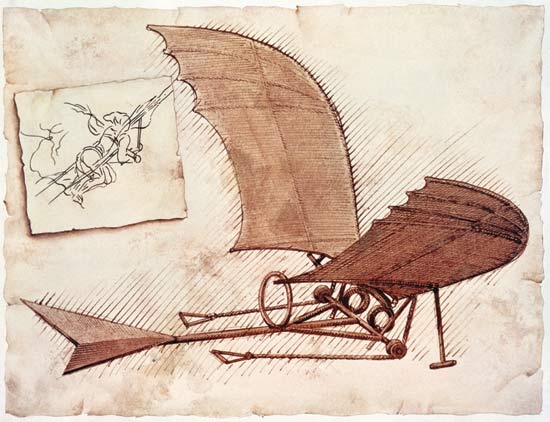
Leonardo was intrigued with the concept of human flight, and spent many years toying with various ideas for flying machines. He produced many studies of the flight of birds and plans for several flying machines When he drew his flying machine, he wrote (backwards, of course):

“A small model can be made of paper with a spring like metal shaft that after having been released, after having been twisted, causes the screw to spin up into the air.”

His drawings of the aeroplane.

Leonardo sketched not only the first aeroplane but also the first parachute, first helicopter, first tank, first repeating rifle, swinging bridge, paddleboat and the first motorcar. . .
He invented the bicycle 300 years before it appeared on the road.

Leonardo the painter:
He had a passion to paint  beautiful women, most of whom  enjoyed being painted secretly.
Leonardo’s first solo painting, completed in 1478, was ‘Madonna and Child’.
In 1481 he left Florence for Milan to offer his service to the local Duke.
In 1481 he began painting ‘Adoration of the Magi’, an unfinished work that reveals his technique of beginning with a dark painting surface and adding elements of light, unlike most painters of his time who started with outlined figures on a white surface.
In 1483 he started to paint the first version of the ‘Virgin’. He completed it in 1485.
Leonardo was famous for the way he used light in his portraits. He drew a self-portrait in 1515.

Mona Lisa:
‘The Mona Lisa’ is perhaps his most famous work. The subject of this portrait is still debated to this day, the most popular current view being that it is of Lisa Gherardini del Giocondo.
Another  of the most unusual hypotheses is that it is a self-portrait of Leonardo as a woman.
It took him about ten years to paint Mona Lisa’s lips.
Monalisa

The Last Supper:
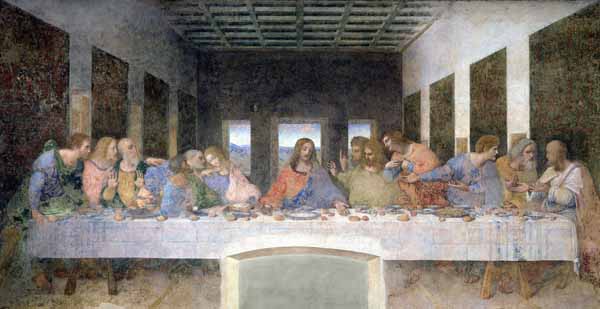
He painted ‘The Last Supper’ at Santa Maria delle Grazie in Milan, a dramatic depiction of the moment Jesus announced that he would be betrayed.
By 1500 AD,  the painting’s deterioration had begun. Since 1726, many attempts have been made to restore it.

The Last Supper

Leonardo the sculptor:
In 1495 Leonardo made a clay model for the statue of Francesco Forza, and put it on display.
Leonardo changed the way people painted and made sculptures.
He was one of the most acclaimed artists of the Renaissance (a period when the arts and sciences flourished). .

Da Vinci, the science illustrator:
Leonardo was constantly sketching out his ideas for inventions.
When it came to drawing illustrations, Leonardo’s work is detailed and precise.
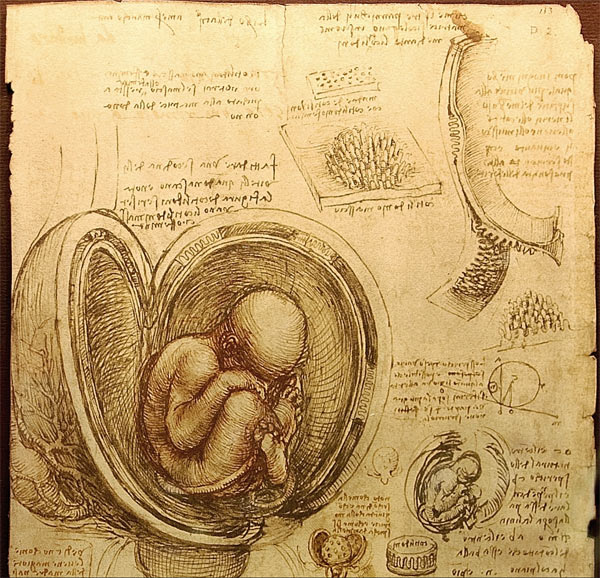
He established modern techniques of scientific illustration with highly accurate renderings such as ‘Embryo in the Womb’.
He made maps of Europe.
He took part as an engineer in the war against Pisa.
He designed a movable bridge for the Duke of Milan.
He drew the plans of the first armored car in 1485.
His drawing of a baby in the womb.

He was undeniably one of the greatest thinkers and well ahead of his time by hundreds of years.
Leonardo died on May 2, 1519 and was buried in San Florentine in Ambrose.

Acknowledgements: Source -Prabhakar Pillai.

HURRAY! I KNEW WE WERE SMARTER


An appetiser…
A STUDY published just last week in the National geographic investigating collective intelligence vs individual intelligence concludes that “Being one smart cookie doesn’t matter much if you’re working in a group, according to the first study to calculate collective intelligence—a group’s ability to succeed at a variety of tasks.”
A series of experiments conducted concluded that in a team an individual’s intelligence has little to do with success in thought –based tasks such as visual puzzles and negotiating over scarce resources.
The article further explains, “Instead, a group is more successful if it contains people who are more “socially sensitive”—in this case meaning they’re better able to discern emotions from people’s faces.”
The study claims that women score higher on tests on social sensitivity—hence groups with more women are more likely to excel. I do not claim that, but Anita Williams Woolley an expert on collective intelligence at Carnegie Melton University in Pittsburgh says so.
The intelligence of the groups is further enhanced when group had more people who took turns speaking. And certainly women are pretty good at that too.

And then……..
while searching on the web for something trivial I come across some vital information that is mandatory on me to share with my fb friends.
I did not know that God too had a page on the web. I stalk His profile and see whats going on. It seems God’s been answering some questions about His creation of men and women. I copy paste some of the questions and answers:
Q. How did God get the idea to name Man and Woman so when he created them?
A., God created man first, when he was completed he said in disgust ‘ugh, man’. So he created woman next… he compliments his work by saying, “woah..man!”(woman).
Q. God, why did you make Man first and then decided to do the Woman??
A.Because everyone knows that first we experiment and then comes perfection.
Q. Why did God create Man first and Woman later, in that order?
A. God made man before woman so the man would have time to think of an answer for the woman’s first question
Q. How did God feel after creating Man and then Woman???
A In the beginning, God created the earth and enjoyed it. Next, He created Man and he rested in peace. Then God created Woman. Since then, neither God nor Man has rested.
Q. What were the main differences God created in Man and Woman?
A. Several differences.The most important being:
a). A woman worries about the future — until she gets a husband.
A man never worries about the future — until he gets a wife.
b). A woman marries a man expecting he will change, but he doesn’t.
A man marries a woman expecting that she won’t change, and she does.
c). A woman knows all about her children. She knows about their best friends, romances, secret hopes and dreams, favourite foods, fears and dental appointments.
A man is vaguely aware of some short people living in the house.
d). Women always have the last word in an argument. Anything a man adds after that is the beginning of a new argument.
e). A successful man is one who makes more money than can be spent by his wife.
A successful woman is one who can find that a man.
Q.So God, if man wasn’t that smart why did You appoint him the ‘head of the family’?
A.You see there is a catch in that—Man is the head of the family but Woman is it’s neck, it can turn the head in any direction.
Q . Any advice God would like to give to Man to stay happy?
A. Married men should forget their mistakes. There is no need for two people to remember the same thing.
Moral of the story: Even the God thinks women are smarter.

Sorry dear men I really understand how do you feel right now….

Ilmana Fasih
2 October 2010

A STANDING OVATION TO A LIONESS


A lioness who roars in the day light , burns in agony and pain all night. Lives her ordeal every day as fresh as if it was today. Pain refuses to lessen even an iota.
Ask why?
“Once upon a time, a pretty lioness cub and a daring tiger cub grow up together. Dreaming of a long life with each other as they sail from innocent childhood to blooming youth. Wedding bells ring at the prime of their youth, vowing to live happily ever after.
Three weeks into matrimony, a herd of blood thirsty hounds pounce on the tender lioness for a game. The tiger pounces into action to shield her. All alone facing a herd of savages.
Alas, the lioness watches with her own eyes, her tiger brutally ripped apart by those insane blood thirsty hounds. With his last breath, come crashing down the castles they had built for years.
He departs but she lives on, a dozen and four years now. Still the same pain, still the same love.”
Daylight appears and she is up and roaring, once again.
No one knows how her nights go.
PS: A saga that puts the Oscar winning The Lion King to shame.
I salute this lioness and so should the whole world…

EARTH IS MY HOMELAND


Why should my free soul

Be bound by imaginary lines.

Oh why should these lines

Be fenced on the land

Be drawn on the maps

Be etched in the minds

Be engraved in the hearts

I rebel against these confines

I leap across these limits

My feet sense no lines

My eyes see no fence

My mind thinks no limits

My heart feels no bounds

It appears an awful sight

To control my free soul

To the confines of geography.

To the whole world it belongs

Compassion is its language.

Mankind its fellow compatriots.

Yes, Earth is my Homeland.

~Ilmana Fasih

12 January 2011

The love of one’s country is a splendid thing. But why should love stop at the border? ~Pablo Casals

Beautiful Minds: Stephen Wiltshire


My Definition of Intrapersonal Relationship


The finest thing in the world is knowing how to belong to oneself. ~Michel de Montaigne, Of Solitude

IN PURSUIT FOR HAPPINESS


Ever since I flipped the page of the new 2011 calendar and hung it beside my study I have been aspiring to tick a day when I will get to hear more of positive news than the negative ones. It hasn’t yet happened in the past 11 days or so. Good news from our part of the world has almost become a rare entity and one always dreads as to what new drama will the coming day unfold.

It makes me wonder, as we are well into the second decade of twenty first century, reached the moon, invaded the space, climbed the Mt Everest, peeped inside an atom, now gearing to reach Mars and further, but we haven’t reached into the core of our own hearts to gain happiness and contentment.

Nations measure prosperity by their GDP which represents countrys income and its economic progress but terribly falls short of capturing other measures needed for prosperity like health,( both mental and physical), personal freedom and security.
I talk to friends and relatives of all kinds—successful, average and not so successful.

Talking to a friend who and her husband are currently laid off—It is valid, of course for them, to staple happiness together with their jobs and hence economic well being. But when I talk to a cousin, who’s husband is in an extremely coveted post and with a fat pay package—she talks of her disgust at the ‘nauseating gap between the rich and the poor’ and that she does not even cherish her own prosperity seeing so much miseries around.In fact she lives in guilt despite doing a lot of charity too.

Talking to relatives back home and they are unhappy for the prevailing socio-politico-economic conditions , but then someone else in US with a settled life talks of the bills, the mortgage payments, the stress at job and the mechanical life which keeps them away from happiness.

You talk to a mediocre student and he is worried about his prospects of making it to a University due to immense competition. Talk to a brilliant student and she harps about the pressure she has to take of being in a world ranking program. It is really a disturbing statistics that a large chunk of university students and people from the general public are on antidepressants in some parts of the developed world.

I look at my own life and compare it to the days when I began my life with my husband with just two suitcases as my possessions and now they have multiplied to many many many more ‘suitcases’ but do these ‘suitcases’ add to my emotional well being? Do I feel any better because of this material gain?. Whatever satisfies me is not my material possessions but my contribution as a health and community worker or as a wife, a mother or even a friend.

Money , of course, is important to lead a comfortable life but only certain amount of money can give you happiness. Anything beyond the threshold does not add to happiness or prosperity but more to greed, discontentment, desire for more, fear of losing it and even guilt at times.
Why is it that the people of the likes of Bill Gates vow to spend a major chunk of their wealth on charity? Is it that he doesn’t
love money or does not need it? Of course not.( Who doesn’t love it!). If he hadn’t loved money he wouldn’t have strived to reach at the top of the Forbes Richest Men list and stayed there for years together. It simply proves that after a certain threshold of economic prosperity money ceases to matter as a source of happiness and contentment. But one has to live the experience to realise how it feels. In general wealthier people are less happy than the less wealthy counterparts, but it takes an awful lot of income to buy happiness that companionship and community provide for free.

We as individuals may very well resolve it by associating prosperity and happiness to family values, interpersonal relationships or even intrapersonal relationship—coming to be one’s own friend.
But the real task lies in incorporating this concept of happiness and contentment when it comes to economies or nations as a whole.
Fortunately enough some economists and a tiny nation have started to associate that ‘true’ prosperity ( which includes happiness) does not limit to only economic prosperity. But still the concept is in its trial stage and infancy.

A tiny nation of BHUTAN in our region through its ex-King Jigmey Singye Wangchuk,proposed an approach to have the idea of GROSS NATIONAL HAPPINESS along with the Gross National Produce (GNP). Bhutan may be a tiny country land locked between two giants India and China, with a rugged Himalayan terrain and harsh alpine climate, but it’s visionary king has made some great strides towards the issue of making his people happy.

A 55 year old man now, educated in UK and US, he ruled Bhutan from 1972 until his abdication in 2006 to his son. He is credited with many modern political and social reforms in the country.

In 1972 he introduced the concept of GNH .The concept of gross national happiness (GNH) was developed in an attempt to define an indicator that measures quality of life or social progress in more holistic and psychological terms than Gross Domestic Product (GDP). The philosophy, which is underlined by four pillars, namely
-equitable socio-economic development;
-conservation of environment;
-preservation of culture;
-promotion of good governance,

The GNH theory seeks to pursue the broader forms of well-being beyond material things. There was no exact quantitative definition of GNH proposed.
The King proved that his actions were louder than the words by:
-transformed Bhutan from a absolute monarchy to a constitutional monarchy.
– stunned the nation by declaring general elections in 2008.
-transferring most of his administrative powers to the Council of Cabinet Ministers and allowing for impeachment of the King by a two-thirds majority of the National Assembly
-on 14 December 2006, he announced that he would be abdicating immediately. This was followed with the first national parliamentary elections. Judicial power is vested in the court of Bhutan. The Chief Justice is the administrative head of the Judiciary. National Election and Anti-Corruption Commissions were also set up in 2006.

Many people term the king orthodox simply because he does not cherish material gains as the source of happiness. So orthodox is he that even to this day, traffic lights do not exist in the country, and by law everyone must wear traditional 14th century clothing. But in 1999, the King lifted a ban on television and the Internet. In his speech, the King said that television was a critical step to the modernisation of Bhutan as well as a major contributor to the country’s Gross National Happiness, but warned that the “misuse” of television could erode traditional Bhutanese values.

Despite being termed orthodox, his country has seen great progress over the past decade. The country has shown a growth rate of 6.5%, annually upto the available stats of 2008, the life expectancy at birth has risen from 48 years in 1984 to 66 years in 1994. And in just one decade from 1990 to 2000, gross enrollment rate at the primary level has jumped from 55% to 72%.

It simply does not mean that ALL IS WELL in Bhutan. They still have to overcome the poverty which grips a third of the nation.
Although being a tiny nation it sets an example for our leadersand teaches a great amny lessonsabout SELFLESS RULE and GENUINE CONCERN for it’s people.

As economic development on the planet pushes the limits of ecosystems to their brink, it calls into question the ability of the planet to sustain further, this civilization. Hence the talk of moving “Beyond GDP” in order to measure progress not as the mere increase in commercial transactions, nor as an increase in specifically economic well-being, but as an increase in general well-being as people themselves subjectively report it.

Inspired by the concept of GNH from the King Wangchuk of Bhutan, a second-generation GNH concept, treating happiness as a socioeconomic development metric, was proposed in 2006 by Med Jones, the President of International Institute of Management. The metric measures socioeconomic development by tracking 7 development area including the nation’s mental and emotional health.
GNH value is proposed to be an index function of the total average per capita of the following measures:( and I paste them from the original document):
1. Economic Wellness: Indicated via direct survey and statistical measurement of economic metrics such as consumer debt, average income to consumer price index ratio and income distribution
2. Environmental Wellness: Indicated via direct survey and statistical measurement of environmental metrics such as pollution, noise and traffic
3. Physical Wellness: Indicated via statistical measurement of physical health metrics such as severe illnesses
4. Mental Wellness: Indicated via direct survey and statistical measurement of mental health metrics such as usage of antidepressants and rise or decline of psychotherapy patients
5. Workplace Wellness: Indicated via direct survey and statistical measurement of labor metrics such as jobless claims, job change, workplace complaints and lawsuits
6. Social Wellness: Indicated via direct survey and statistical measurement of social metrics such as discrimination, safety, divorce rates, complaints of domestic conflicts and family lawsuits, public lawsuits, crime rates
7. Political Wellness: Indicated via direct survey and statistical measurement of political metrics such as the quality of local democracy, individual freedom, and foreign conflicts.
I wonder where would we stand if we apply all these parameters to our part of the world. I dread to even make an attempt to do so.

If only our leaders were as visionary and sensitive as King Wangchuk, we would also aspire to be a happy nation some day.
The idea of linking Happiness factor to Econmic prosperity is still in its infancy and only time will tell if it matures into a reality and our planet attains HAPPINESS along with other innumerable worldy achievements.
Where there is a will there is, for sure, a way .
Lets hope…

Ilmana Fasih
12 January 2011

AAJ SHEHR KI FIZA BAHUT BHAARI HAI


A bitter pill to swallow…
I stay awake all night-that no sounds of cries come.
Look who’s awake—who never stayed up late even in the final exams.
I shiver with fear-that no 1992 history repeats.
Look who’s shivering- who never did, even on seeing the most difficult word problem in the dreadful Physics Exam.
I’m scared inside out-that the humans stay unharmed.
Look who’s scared-who never was so, even when the strictest school Principal reprimanded her in his office.
I pray every minute—that the sanity prevails.
Look who’s praying—who never did so, even before the exam results were due.
Yes, indeed, today I stay awake, shiver, am scared. Not for myself, but for the 1.2 billion who await this dreaded judgement today.
Hence I pray to “God” up in the Heavens and beg to the ”humans” down on the Earth, that let ’sanity prevail in majority’ and ’ human harmony be the order of the day’.
Shahid Bhai ne theek hi to kaha hai: “Na samjhoge to mit jaoge ai Hindositan walon
Tumhari dastan bhi na hogi dastanon men.
Aur Armaan Bhai ka dil rota hai:
दिलों पर इक अजब सा ख़ौफ़ तारी है, Dil par ek ajab sa khof tari hai,
आज शहर की फ़िज़ा बहुत भारी है ! Aj shehr ki fiza bahut bhari hai!
ये ना हो जाये कहीं वो ना हो जाये, Ye na ho jaye kahin woh na ho jaye,
सब मे बेचैनी है , सबको बेक़रारी है! Sab mein bechaini hai sab mein be qarari hai!
सड़कें खाली हैं यूँ, जैसे साहूकार हैं, Sarkein khali hain jaise sahukar ho,
लोग छुपे है, जैसे इन पर उधारी है! Log chupe hain jaise un pe udhari hai!
संगीनो के साये, बूटों की धमक मे, Sangeenon ke saath booton ki damak mein,
हमने देखा , ज़िंदगी बहुत बेचारी है! Hum ne dekha zindagi bahut bechari hai !
नफ़रतो के ठेकेदार अब हमला बोलेंगे, Nafrat ke thekedar ab hamla bolenge,
मुहब्बत वालों तुम्हारी क्या तय्यारी है! Muhabbat waalon tumhari kya tayyari hai!
– अरमान -Armaan.
We need to remind ourselves of what Martin Luther said until his death: ‎”We must learn to live together as brothers, or we are going to perish together as fools.”
We need to revisit what Gandhi ji had told us: My religion is based on truth and non-violence. Truth is my God. Non-violence is the means of realising Him.
We need to open our minds to what Prophet Mohammed (pbuh) taught us : “Do you love your creator? Love your fellow-beings first.”
Let us all have faith in tolerance and live a fraction of Martin Luther, Gandhi and Prophet Mohammed(pbuh) in each one of us.
Let’s pledge for peace…
ILMANA FASIH
30 September 2010