Open up your mind and your potential reaches infinity…

Ashure’ : Noah’s Pudding


Ammi called me early in the morning on Friday, the day of Ashura( 10th Moharram). Ashura commemorates the day of the battle of Karbala for Muslims.
I knew why did she call that early, as it has been a regular practice since years, I have lost count of
“One request beta.”
“Yes Ammi.”

I knew it but still wanted her to say it.
“Please don’t play music today on Ashura.”

This is all she expects from me. But she does a bit more than just not listen to music. One of her routines is to cook a pot of Khichra( Haleem) and not let anyone touch it, or munch any of the ingredients till the Niyaz is done.

South Asians make Haleem on Ashura, a complete food with multiple ingredients in one: whole wheat, lentils, rice, barley, and meat with a host of rich spices in a lengthy procedure.

Along the same lines, the Turks make a sweet Haleem, called Ashure or Noah’s Pudding. The ingredients vary from 7 to 10 to 12 varying from whole wheat, beans ( red and white), chick pea, to dry fruits including figs, peaches and nuts like almonds and raisins.

There are multiple legends associated with it.

It is cooked on the day of Ashura ( 10th Moharram) by all communities in Turkey across different sects: Sunnnis (Balkan Sufis), Shias, Alevis and Kurds.

Ashure is then distributed to all in the neighborhood in small bowls, after performing prayers for health and harmony.

Alevites fast for 12 days, and break it on Ashura with this special dish Ashure. Alevis prepare it with 12 ingredients in their version of the dish. They refrain from killing animals or eating meat in these days of fasting.

There is also a different but popular legend of why it came to be known as Noah’s pudding. According to the legend, it was the day when Noah’s Ark came to the banks of Ararat and Noah’s family cooked a dish from all ingredient leftovers in the Ark.

.
As I asked a Turk friend to confirm my list of ingredients, she added:
“The most important ingredient is the ‘Intention’ and the ‘Will’ to make this dish. In Turkish we say ‘Niyet Etmek.’

Asure – Noah’s Pudding
Ingredients
(can be found at any Whole Food Markets or Middle Eastern Store) –
• 1 cup of barley whole wheat
• 1 can of chick peas,soaked & boiled
• 1 can of white kidney beans
• 3/4 cup of black dried currants & raisins
• 3/4 cup of almonds/pistachios
• 6 dried Turkish Figs – cut into small quarter
• 6 dried Turkish Apricots – cut into small quarter
• 2 cups of brown sugar ( or plain white sugar)
• 1 lemon zest or orange
9– 12 cups of cold water/4 tsp rosewater(optional)
Condiments: salt/cloves/cinnamon sticks
Garnishing: Fresh pomegranate

Preparation:
One day Before: Soak 1 cup of barley whole wheat in 3 cups of water the night before. This will allow the barley to soften.
Day of:
1. Drain the soaked barley, pour into a deep cooking pot fill with 8-10 cups of cold water leaving about 2-3 inches of the top. At this time add in, sprinkle some salt, add in the cloves and cinnamon sticks.
2. Over a medium to high bring the pot to broil fior 30-40 minutes. The barley will have cracked open and have become white and soft to touch and taste.
3. In the mean time into a small sauce pan, boil the black currants and in a cup of cold water. Once the color of the water turns dark, drain the currants through a sieve.
4. Once the barley has softened, add in the washed chick peas and kidney beans and stir.
5. Add in the rest of the ingredients – the drained currants, raisins, apricots, figs, and almonds, stirring each time you add in an ingredient. Let this mixture boil for 8-10 minutes.
6. To thicken fast, in a cup of cold water mix the 4 tablespoons of corn starch, leaving no lumps. Add the corn starch into the boiling barley mixture and give it a thoroughly stir. *the corn starch will act as a thickening agent.
7. Add brown sugar to your liking, and again stir thoroughly, continue cooking over medium heat and allow the sugar to dissolve.
8. Finally add in the zest of the lemon or orange and the rose water and let cook for a 5-7 minutes.
9. Let cool for about 15 minutes, ladle into serving bowls. Top with cinnamon, nuts and pomegranate seeds.
Ashure can be served warm, at room temperature or cold.

Ashure is a vegan dessert too.

NoahPudding1Noah's Pudding2

Ashure served with a traditional touch:

NoahPudding0

Kesariya Baalam by Reshma


Reshma who originally hailed from Bikaner Rajasthan here sings a ‘maand’ or a welcome song in Rajasthani language for the arrival of the beloved.
(Have attempted to translate the verses from my basic knowledge of the language).

Kesariya baalam o’saa,
padhaaro mhaare des rey
Oh my saffron beloved,
Come to my abode.

Thaare aayo dujaan
Barishme mere
Your arrival
shall bring life in me

Saajan aaye o’ sakhi,
Main kayeen manwa vikraan,
Thaari paryo gaj motiyaan,
Aur ooper nayn dharaan.
My beloved shall come my friend
How can I keep my mind sane,
I shall spread pearls on the tray,
And keep my eyes on them.

Kesariya baalam o’saa,
padhaaro mhaare des rey
Oh my saffron beloved,
Come to my abode.

Sajan sajan main karaan
Sajan jeev jari
Choorley per moondshaan
Aur vachaan ghari ghari.
I utter “Beloved, Beloved.”
“Beloved” is embedded on my tongue,
Shall weave his name on my bracelet,
And watch it over and over.

Kesariya baalam o’saa,
padhaaro mhaare des rey
Oh my saffron beloved,
Come to my abode.

Awan saavan keh gayo dhola
Ker gaya khol anek
Bin taagan taa gash gayee
Mhaari anganiya ree rey.
Shall come in the rains, he promised,
Played many cruel jokes on me,
Without the rope of his swing,
My courtyard is deserted.

Kesariya baalam o’saa,
padhaaro mhaare des rey
Oh my saffron beloved,
Come to my abode.


With crisis in Syria affecting me personally, not just for personal friends present there, but also the entire nation, barring none from infants, babies, children, young men, women and the elderly,  and with healthcare destroyed,  I came across this piece of music accidentally:

Echoes of Ugarit composed by a Syrian composer Malek Jandali

It is the composition from the oldest music notation in the world.

Ugarit was an ancient port city in Syria as old as 3400BC.

The Hurrian Hymn (catalogued as Text H6) was discovered in Ugarit, Syria, in the early 1950s, and was preserved for 3400 years on a clay tablet, written in the Cuniform text of the ancient Hurrian language – except from a few earlier Sumarian fragmentary instructional musical texts from c.1950 BCE (Musical Instructions for Lipit-Ishtar, King of Justice) the Hurrian Hymn it is the oldest written song yet known, in History!

The clay tablet from Ugarit:

UgaritTablet.

Moved by the situation back home in Syria, the Syrian American musician Malek Jenadali organized a concert Peace for Syrian Children in US, and is organizing more all over the world.

In a touching program on AlJazeera TV {Here: } he says: “I do not talk politics or faith, I ask for Peace for the Syrian Children.”

Musician turned Peace Activist, on social media he shared this picture of a
message from the children of Syria for the rest of the world:

KidsOfSyria

After a long time, this music sounded tranquil and soulful:

ECHOES OF UGARIT

P.S. Just when he performed in US, his parents in Homs, Syria were assaulted back home by the regime:

DadMomMalek


It is heartbreaking to see an amazing country of beautiful people, ancient cities and rich culture being destroyed more and more each day.

May peace and dignity return to the Children of Syria sooner than later.


“Be just: that is nearer to piety.” (Quran: 5:8)

“Lo! The hearing and  the sight and the heart, of each of these it will be asked.” (Quran: 17:36)

No one would deny that  God resides within our conscience, in our kind deeds, and not merely in our rituals.

This Kabir poem befits that spirit:

Moko kahan DhunDhe re bande, main to tere paas me.
Where do you search me, O seeker? I am with you always.

Na main bakari, na main bherhi, na main chhuri gadaas me.
I am neither in goat nor in sheep (the sacrificial animals)) neither I am in the(sacrificial) knife or sword.

Nahi khal me, nahi ponchh me, na haddi na maans me.
I am not in the skin, in the tail, in bones or meat .

Na mein deval, na mein masajid, na kaabe kailaash me.
I am neither in the temple nor in the masque. I am not in the Kailash or Kaaba.
(They are symbols only)

Na mein kiriya karam me rahata, nahi jog sanyaas me.
 I am not in the worldy rituals nor in the act renunciation. 

Khoji hoy turat mili jaaun, ek pal ki talaash me.
If you seek me in true spirits, I am found in a moment’s search.

Main to raho shahar ke baahar, meri puri mawaas me.
I reside away from the city (Outside the usual places people associate with me) I live in the  real abode.

Kahe Kabir suno bhai saadho, sab sanso ki saans me.
Kabir says – Listen O’ the learned, I live within the breath of all your breaths.
(In your conscience).

Kindness


Depressed and dejected with the ever rising religious extremism, intolerance and hatred in the world at large, helplessness over powers oneself. The only ray of hope left are the few shining stars in this dark sky that shone on our lands several centuries ago. Their golden words still need to be heard and heeded by one and all.

Kabir from India and Bulleh Shah from what is now Pakistan are two voices that spoke of peace and love beyond beliefs and borders. They were shunned in their own times, but if they were reborn now, they would not find much has changed from those days.

Reminscing their poetry, I dare to use them on painting a silk scarf.

The scarf background is black, which represents the dark ages of extremism, intolerance and bigotry that we currently are going through.

The golden messages of the verses are scribbled in golden ink, The verses chosen  relate to the abundance of  knowlege, in this era of information revolution, but the information that still fails to convey the message of peace and tolerance that it should accompany.

The languages have been reversed,
Kabir written in Urdu and Bulleh Shah in Hindi so that both sides are able to read them.

Silk1 001

Bulleh Shah here says:

Parh parh aalim faazil hoya, kadi nafs apne nu parheya ai nayi,
Ja ja werda mandi maseetey, kadi man apne nu wareya ai nayi.

( You read bookes, became learned, but never read (compassion in )your own conscience,
You visited temples and mosques, but never visited (the love)in your own heart.)
KabirBullehShahSilk 003

Kabir says:

Pothi parh parh jag muwa pandit bhaya na koi,
Dhaayi akher prem ka parhe to pandit hoye.

{The whole world read books after books, but no one became learned,
Read two and a half words of love ( peace and compassion), to be a learned}

KabirBullehShahSilk1 001

The peace symbols in the middle of the silk scarf are crisscrossed by chaos and confusion prevalent in our times.
KabirBullehShahSilk 013

KabirBullehShahSilk 014

The edges below the verses represent the hearts interlinked through love and peace, if only we heeded the verses in spirit.

KabirBullehShahSilk 009

It was heartening to see Kabir’s message of love and peace ( coincidentally the same verses that I was scribbling), being presented in another art form, called Dastangoi. I dedicate this piece and the blog to this wonderful  Kabir presentation. 🙂


Mosaic4

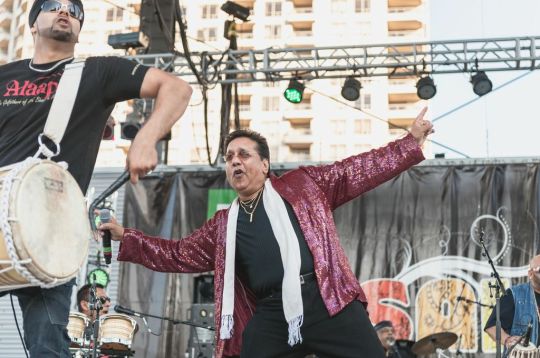
The evening of Saturday, the final day at TD Mosaic Festival 2013 was destined to experience a historic performance by Channi Singh OBE, the founder of Alaap and better known as the Godfather of Bhangra Music.

I could see people of all age groups from young to many from middle aged to seniors from Mississauga, Brampton and as far as from Richmond Hill came to hear their favorite bhangra music hero. The lawns was almost near full capacity from the outset.
Before the show began, I talked to a middle aged lady Harjeet Kaur, who had come early to occupy the front row. “ I have not seen him yet, but I have danced on his music all my life, on weddings, manjas , and other occaisions.”

While introducing Channi Singh on stage, Asma Mahmood, the co-founder of the Mosaic Festival acknowledged to have “danced to his songs on our wedding nearly three decades ago”.
As Channi Singh appeared on stage, I could sense the current of energy run through the crowds. Amidst a roar of applause he began with on of my favorites: “We Wanjareya, karma waareya…”
This was followed by a song from his first album, “Teri Chunni de sitare…” and then his song with Asha Bhonsle: “Main nu chooriyan chara de chan we., main cham cham nachdi phiraan…”, which set the pace for one electrifying song after the other.
“Bhabbhiye ni bhabiye ni sun bhabhiye”, was the song that created history by being the most popular bhangra song, the world over.” Revealed  the Godfather himself, before he began the song. As song is also referred as the Anthem of Bhangra, I could sense that outnumbering the young,  many escited middle aged women, who had begun with tapping their hands and feet, now stood up to dance. The beats were certainly irreristible for anyone in the crowd.
I noticed quite a few nondesi faces dancing too.  I asked Sue, who is from Singapore : “Do you know this music?” She responded while still dancing, “Oh I have heard him a lot in Singapore, everytime on our Indian friends weddings.”
While talking to Channi Singh earlier he told that 90% of the songs are his own lyrics and music compositions. He also mentioned of the few of his songs that were blessed to have been the original tunes on which Bollywood numbers were copied.

An elderly Gurpal Kaur, in her mid sixities, stole the show by coming right to the front of the stage to bhangra on “Nach kuriye ni zara nach kuriye…”
She later shared with excitement, “This took me 40 years back in my life”. And then excitedly asked, “But am I not still young?”
Her husband, a retired brigadier from the Army, teased her, “He is still her hero, not me.”

As he sang “Makhna” , “Soneya” , “Mere Haniya”, “Dil janiya” the electrified crowd went berserk with the chants of “Oye hoye “. The atmosphere was charged beyond words.

“It feels being in Lahore.”  felt Lubna Sami, as she screamed back Oye Hoye.

The energized crowd was finally rewarded with a powerful Damadam Mast Qalander, on which many including Lachman Balani also could not hold their hands and feet still. Nita told of how it is a must to have Damadam Mast Qalander on every Sindhi wedding.

Channi Singh has 26 albums to his credit, in a career spanning 35 years. He has the honor of being bestowed the highest British Award in Music, by the Queen of England, and also to have performed in 10 Downing Street. He also has his name as the most selling Asian Band in the Milleneum Edition of the Guiness Book of World Records.

While talking to him, he shared his belief in unity of humanity beyond regions and religions, and was blessed with being the first Bhangra band to visit Pakistan. He said before he performed in Lahore, he went to the Data Darbar for blessings.

He also performed for several fund raisers for Imran Khan’s Cancer Hospital in UK and some other cities of Europe.
He himself has to his credit many performances for charitable causes like Children in Need, Teenage Cancer. He has a foundation called One Britain One Nation.

I found him a very humble and pleasant person to converse with, and could not hold back my observation that he bore some resemblance to my favorite Singer Jagjit Singh, in both appearance and conversation. He informed that  Jagjit Singh was a close friend, and he too was fond of his Urdu ghazals.

A sample of Channi Singh music ( from his album):

http:// http://www.youtube.com/watch?v=bcds27B9dHE


The early part of TD Mosaic Festival Day 7, the final day saw some beautiful performances by the budding artists and for those craving for a diverse cultural diversity with a good  deviation from the popular flavors.

Bharath Natyam Solo:

mosaic5

Shakthi Sanjana, performed Bharatnatyam dance on a devotional song of Lord Krishna. The song is about welcoming Lord Krishna to Mathura after he kills the demon Madhu with flowers.

Through her abhinaya (facial expressions) and mudras(hand symbols), she honors Lord Krishna applies sandal paste and musk thilaka on his forehead.

She interprets the meaning of every word of the song which describes Lord Krishna as he who killed demon Madhu, wrestlers Mushika and Chanoora and elephant Kuvalaya pita.

Shakthi Sanjana  is a trained classical Bharatnatyam dancer from India.  She is currently studying electrical engineering at University of Toronto and dance is her passion.

Peacock Dance by Sri Lankan Dance Group:

MOSAIC8

Rangara Performing Arts, performed “a beautiful peacock dance with their movements imitating a dancing peacocks who represent peace and harmony with the beauty and nature around them”, told Rashanthi Hettiarchi, the director of the school.

Santoor Recital:

mOSAIC7

Another treat to the ears was the Santoor performance by Shri Shreyas Sanat Ambikar, a disciple of Pandit Shiv Kiuamr Sharma the maestro who popularized Santoor internationally. Though an engineer by profession, for Shreyas it is his passion and love for the musical instrument that led him to be formally trained in Santoor. He has to his credit professional performances as far and wide as Australia, Singapore and Europe.

“One needs to be madly passionate for Santoor to be able to master it. Its 100 strings that need tuning, is an extremetly demanding task in terms of patience and endurance.”

100 strings remind me of the origins of the name SANTOOR. Santoor in the ancient Indian scriptures is mentioned as Shat-tantri Veena (Shat = hundred, tantric= strings, Veena=( implies) musical instrument).

Santoor like instruments date back thousands of years, and similar instruments are seen in other parts of the world.

In China it is called Yang Quin, in Central Asian countries Cimbale, in Iran & Iraq Santoor, in Greece Santoori, in Germany Hackbret, in Hungary Cymbalom and many European Countries and in America Hammer-Dulcimer.

However, the unique character of Kashmiri Santoor is that it has 100 strings, not one less nor more.

Pandit Shiv Kumar Sharma, who is the Guru of Shreyas is credited to introducing the Santoor to international forum. Before this, it was familiar only within the Kashmir valley, and was associated specifically to Sufiyana mausiqi.

Accompanying him on Tabla was an accomplished Toronto based Tabla player Dave Bansraj.

The beautiful raags of Hansdhwani ( the song of the swan) and Mishramaand were performed by the duo instantly transported the audience to the Kashmir Valley, with the images of Swans swimming in the Dal Lake.

Turbinator:

MOSAIC9

Turbinator was another extremely pleasant performance by the brother sister duo Gurpreet Singh Sareen and Soni Sareen . A very friendly, unassuming and humble duo, they enthralled the audience with the flair with which they presented a beautiful combination of East and west.

The siblings have music in their genes. Their great grand father Guru Gyan Singh was a recipient of Tansen Award, the highest music award in India. Since very early, they grew up singing Gurbani in the local and other Gurudwaras in US. Gurpreet, the turbinator is an accomplished Tabla palyer too, apart from being a guitarist. His was trained at home in Indian classical raags, while the outside influence made him interested in Jazz and Blues.

They discovered they could identify similar tunes between the Indian classical raags and the Jazz & Blues.  Hence decided to bring combine them together. As Gurpreet  sang the Blues or Jazz songs with Guitar, Soni responded with  Indian Classical in her beautiful voice in while playing a  Dilruba in what we call in Hindi a jugal bandi.

To Guroreet’s To Love somebody” by Michael Buble,
Soni ethralled with “ Nirmohi harjaiya, ye kaisi teri khudgarzi…”

I was particularly enchanted by One love one heart by Bob Morley
and the Dil hai chhota sa chhoti si asha jugalbandi.

Before inquiring Soni, I was intrigued by the instrument she was playing.  Soni told she chose to play Dilruba because this was given to her by her Nani( maternal grandmother), who used to play it herself, when she sang  Gurbani in India.

Dilruba, which means one who ravishes the heart, is a musical instrument used in North India by the singers who perform kirtans in the Gurudwaras.

It is about 200 hundred years old instrument and thought to have originated around the time between Guru Hargovind and Guru Gobind Singh. It became popular with Sikh warriors as a light weight portable instrument used to play shabads, or the hymns ofGurbani kirtan, accompanied by the tabla.

The dilruba is played by sliding the fingers of the left hand up and down the strings along neck placing them between the frets while the right hand holds the bow sliding it across the main strings in order to produce notes of raag, a classical Indian musical score.

It was heartening to see, how the audiences, including families, and youngsters came to appreciate and applaud the two.

Soni aspires to complete her Masters in  Education to teach music, while Gurpreet is a budding  electronic engineer, however still does not know how will the fate take him , after a popular musical performance in the American Idol.

Gurpreet said he chose to sing western music, to be able to break the stereotype and to prove that a person of his appearance could also play Blues and Jazz.

He narrated an interesting incident in which during the American Idol season the day his name #Turbinator was trending, #OBL was also trending on twitter, and he received few offensive comments as a result.. But as he progressed higher in the program, he saw the same people transform to appreciation.

It was touching to see him mention the reference to unity beyond religions and regions during his interactive performance.

Personally, I was touched by their humility and simplicity, and wish Gurpreet and Soni rise to heights as they go forward in their life.


Paul Khursheed

The sun had set, and so was the stage to bring to the TD Mosiac Festival audience.

Two star performers, Paul DesLauriers, an accomplished renowned Guitarist, singler and composer from Canada’s Blue elite, and Anwar Khurshid ,a renowned Sitar player who has contributed to the music of an Oscar winning film, The Life of Pi, with their mesmerizing communion of the Blues and the Indian Classical Music.

The stage was scintillating as the virtuosos adorned in beautiful Jamdani kurtas positioned themselves with their instruments—Paul DesLauriers on Guitar, Anwar Khurshid on Sitar, Sam Harrison on Drums and Greg Morency on Bass.

I could sense a pin drop silence in the audience, which was just a moment ago, abuzz with noise. The environ for a sensual musical performance was set. I noticed a few enthusiasts come close to sit on the grass, right in front of the stage. I too came as close as I could.

They were to perform from their  Album called Enter the Gate.

Though a music lover, but semiliterate in musical linguistics, I was surprised how, right from the start,  I could sense a deep understanding between Paul’s Guitar and Anwar’s Sitar, as if there was a love conversation going on between them. A similar quiet conversation could be visible between the eyes of Paul and Anwar, as their Guitar and Sitar conversed. And as if the accompanying Drum and Bass, were joining the conversation to applaud their love.

The visuals and the acoustics were mesmerising.

It felt as if I was transcending a step further each time they moved on from one composition to the other, getting more sense of their musical conversation. They played from Enter the Gate, to Midnight on Dorion, upto Silk Route, to a total of six compositions.

Short of words to describe the journey, I found the most appropriate explanation on Paul’s website:  “…it takes the listener on a sensual and exhilarating journey from Delhi to the Mississippi Delta.”

The time flew by swiftly, as they ended with the exhilarating Silk Route. I thought this wasn’t just enough, but then no amount of such therapeutic music is enough.

I was glad I had chosen to speak to them after the sensual experience. Now I was keen to discover how intense would be their feelings as creators, when it was overwhelming to me as a mere listener.

Speaking to them was yet another journey into tranquility.

There’s a  Paul Coelho quote: “We have to stop by and be humble enough to understand that there is something called mystery.”

It was touching to learn  how humble these hearts were, who had created this mesmerizing communion of East and West. I was floored by their simplicity and humility of all four of them, as we sat around a round table to dig out the details.
Paul explained how 8 years ago, he came to learn Sitar from Anwar, which began with a mutual respect, then turned into a stronger friendship and trust, after which coming together of  their musics was the only way forward.

I mentioned to them about my experience of how still being a semiliterate in music I could sense a perfect harmony between the two.

Paul smiled,: “You do not need to e a scholar of music to feel the harmony. It is the heart which senses it.”

They all recalled, how many people in the audience from different ethnic backgrounds actually get emotionally moved by it.

“Sam was crying, the first time we played in a concert.” reollects Paul.

I could not hold back my complements to their colorful sequined Kurtas , digressing from the traditional western formal black and white

 “It’s so liberating.” Paul was spontaneous.

“The communion of East and West music  is not as straightforward fusion as it seems. Of Blues Band playing with Sitar or Sitar playing with Blues Band etc. It is much deeper. It is a spontaneous flow of notes in response like….” Paul  explained.

“It is a symbiosis”, Sam prompted the right word.
( Symbiosis literally means a relationship of mutual benefit ).

Anwar explained how in an Indian Classical Music which has stringent boundaries and limits, which are a taboo to cross. And  moving from one’s own classical music to a fusion with others is like walking on a double edged sword, ”Having crossed your own boundaries, and now trespassing into someone else’s territory. But once you leave your comfort zone, the contentment you get from crossing the boundaries gives a sense of spiritual release.”

“The pleasure is not just in playing with each other, but also listening to each other play.” Said Paul.

Anwar interjected with naughty look: “Yes, you feel as if your music is gone, just gone, as he plays my notes, and steals them.”

 “It’s more of a borrowing and absorbing brother.”Paul smiled.

Do you guys feel possessive about your respective styles of music? I couldn’t help asking this question.

“Music is not about being possessive, it is devoid of ego, it is transcending to a level that is the demand of spirituality.”

“The feeling is to lose the self, and let the music take over.”

Greg explained how while making this album, it was live recorded, without any hundreds of retakes.
We had no road map, we had no rule, we just sat in a friend’s basement to record it. The only rule was to play together. What is recorded on the CD is the first draft. And eachtime we perform, it is spontaneous in itself.” Greg and Sam elaborated.

Anwar explained how the Taans in Kirana Gharana, or Raag Bhopali are similar to the Blues music.

To the query of Canadian Pluralism and mutual respect for differences, Paul responds, “It’s not just the respect, it is the unconditional love and reverence for each other’s music, as ultimately there is a universality of music, like there is of humanity, despite being different ethnically.”

Do they feel, any difference in their lives after this experience?

“Almost everything has changed.” Said Paul

“It is extremely rewarding and most humbling.” Added Sam.

Anwar considered Canada his home, and these three as most trusted friends. “I love them so much that I will eat anything they offer me without question.”( referring to some of the culturally taboo foods for him).

Paul responds, “He is the kindest gentleman I have seen in the world, not just a Pakistani”

We ended the chat realizing how it just takes one good person to  break the stereotype against the whole community.

As I left the conversation, I felt that I had transcended  at a higher plane, realising how it is not just their music, but their souls that play in harmony with each other.

I know now I will relive this tranquilizing experience in my car, each time I will play the CD they gifted, in my car.

It was not for no reason, they had named the Album, “Enter the Gate”


A sample of their mesmerising  music here : 


Just when the two South Asian neighbours, were celebrating their Independence Days with pride, Mosaic International South Asian Film Festival made history by making a World Premiere of a Pakistani Indian collaboration film called Zinda Bhaag.

I had no chance to see the ratings and reviews, before deciding to watch the movie. But then I had no choice either, as I have the task to blog for Mosaic Festival events. To tell you the truth, I had pondered over the last two days, how would it be possible to blog on a movie, as neither am I a film critic nor a journalist. However, decked up in a sari, I was there to watch it.

The theme of the film is no alien to any South Asian who has young loved ones back home. Their burning desire to make it to greener pastures across seas and the himalayas of hurdles that lie ahead of them is no secret either.

Rightly quoted by a character in the movie: “Where there is a hill, there is a will”.

While talking about the Indian Pakistani duo co-directors Meenu Gaur and Farjad Nabi, MISAFF director Arshad Khan related the irony of how the two were unable to attend the World Premiere in Mississauga, as they could not get visas for Canada on time.

In the sparkly eyes of the three young boys Khaldi, Tambi and Chitta, I could identify several of my own lesser fortunate cousins and nephews, who hold visions full of dreams to make it big in life. The (mis)fortunes that life offers these vibrant hearts born in modest homes in the small crowded dark alleys of so called megacities like Lahore or Karachi ( or even Delhi or Dacca) is nothing more than opportunities which metaphorically do not look  much different from these narrow dark alleys themselves. And around them exist the powerful elite shelled in their own cocoons, who not just don’t care but are condescending towards them.

Khaldi and his friends love life, frolic, party, sing, dance, get drunk, fall in love, and even dream ‘big’ of bringing comforts to their families. But limited resources and opportunities bestowed upon them by virtue of their birth, compels them to seek brighter pastures in far off lands.

Rubina is another such youngster, who choses a different modus operandi, owing to her different gender. She does not have the luxury to think of acquiring a visa or taking a trip in a dunky or a container to the land of success. So she attempts to carve her own bumpy road to success, within the same alleys, by putting to test her own skills.

Somewhere in the first half of the film, I lost the feel of sitting in a theatre, watching a movie. It felt overwhelming  enough as if  seeing  real life scenes, picked from day to day lives of not just three nor  thousand, but millions of youth back home.

Inventing shortcuts to make it big has become everyone’s business, whether it is a mother who begs her brother-in-law in UK to call her son to drive a taxi or a father to pays for his son’s fake passport or an aunt who wants her niece to marry an ailing man aboard, or a boy who steals whatever little  jewellery his mother  hides in her closet to pay to the agent.

Kudos to the story writer and the directors who took efforts to show the gory details of the ‘predatory businesses’ that mushroom in places where helplessness thrives – be it gambling houses or fraudulent passport schemes or student visas or the filthiest of them all, the human trafficking.

Naseeruddin Shah’s key role as a pahulwan, who runs one such business, weilding much power and influence in the area, exemplifies thousands of such pehulwans, in the form of corrupt leaders or manipulative bureaucrats or ruthless gangsters who strangle the aspirations of these brilliant youngsters through exploitation.

It is no secret what permutations of possibilities await these youngsters. Few are able to actually live their dreams, others survive as illegal immigrants doing petty jobs, while many  are unable to even arrive at  their dream destinations, and are returned back to their parents  wrapped up in coffins.

Chitta, Khaldi and Tambi have all that one needs to succeed- a vision for a good life, the willpower and the perseverance to go to any length to realize their goals.

Will  they succeed in their dreams? You need to watch that for yourself.

Beyond Zinda Bhaag, looking at a broader picture, there are millions and millions of such Khaldis, Chittas, and Tambis, walking on land we call India and Pakistan. What is tragic is that the countries  fraction in size and population of these South Asian nations, offer them  more hope than their own homelands.

The music in the film was a treat in itself, from Pani ka Bulbula, its English version, to folk song by Arif Lohar  and Qawwali by Rahet Fateh Ali Khan. I shall anxiously hunt to buy its Audio CD, when released.

A big pat to the team’s back to have brought Naseeruddin Shah on board, and hence giving a wonderful opportunity to hear and see him immerse in the role of a Punjabi Pehulwan.

After the show, Producer Mazhar Zaidi narrated how difficult it was for others to identify who was Indian or Pakistani while working as a team, and how the technical skills in production and post production process was taken care by mutual cooperation.

I seriously recommend that  war mongers on both sides of Pakistan and India must sit together and watch this movie. And then look into each other’s eyes, and ask themselves, whether the luxurious nuclear assets that they have piled up, are giving their young men and women the dignity of life they deserve in their homelands.

Should Pakistan and India not be fighting the common enemies of poverty, hunger and helplessness, instead of fighting each other?

I know this is by no means a film review, as I am not technically competent enough to do one. But every word here comes from my heart.

Zinda Bhaag was a not just a nice film, but an eye opener to a grave social issue, which affects our most valuable asset- OUR YOUTH.

Zinda-Bhaag-01


TD Mosaic Festival 2013 day 2 began with the Exhibition of  “Harmony and Peace” series of  paintings by Jimmy Engineer, a renowned Pakistani painter, visiting Canada, especially for the event. The Exhibition shall continue till September, at Promenade Art Gallery.

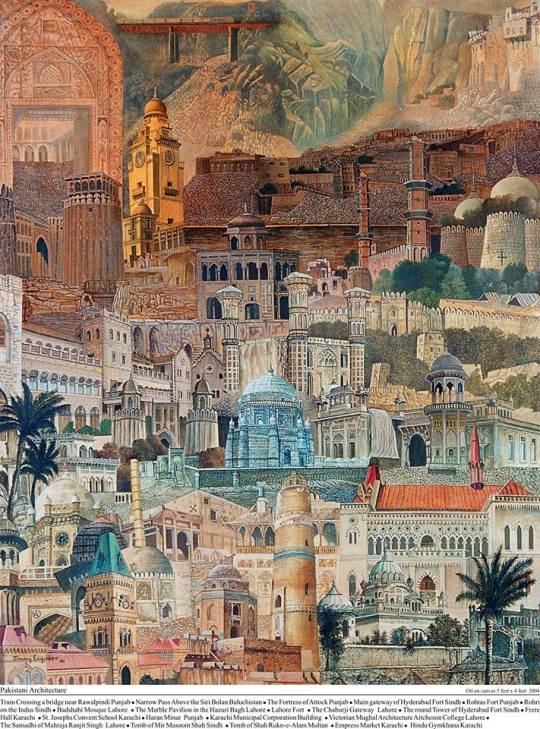
The paintings  by Jimmy Engineer, being showcased in the TD Mosaic Festival 2013 are part of a series of paintings  of Pakistani and world architecture titled as “ Harmony and Peace”.
The idea behind the series is that when different architectural structures from different places in India, Pakistan, Egypt, Uzbekistan, Turkey, China etc can be brought together in one frame, and appear harmonious, why can’t human beings, who possess intelligence, be able to coexist with harmony.

Talking to Jimmy was an enriching experience, to know in depth about the humanist that he is. He prefers to be acknowledged as “a simple mortal who cares for human kingdom with passion.”
His inspiration to Art is Nature, which he considers as his Perfect Master.

Born into a Parsi family, he says he believes in universality of faith. He was inspired by the simplicity and spirituality of Sufi Barkat Ali, from Faisalabad, who he says, bestowed upon him the responsibility to make Pakistan proud, through his Art and social work.

Jimmy says, he meditates, and often gets the visions to paint in his dreams, which he then transforms into canvases.

Jimmy has to his credit 3000 pieces of Art (2000 paintings and 1000 calligraphies), and countless social services, some of which are known, and some he chose to keep unknown. He believes that the highest form of social work is that reaches the needy unseen, devoid of any pomp and show.

As an artist, he has  worked with many mediums including water, oil and pastels be it on canvas, wood or ceramics, and from realism (landscape, still life,) to abstract to calligraphy.

A humble human being that he is, he believes he is extremely blessed, despite never attempting to promote his work. He has received great recognition and respect from the world over, and his art work has made way into private collections in Italy, France, Switzerland, Russia, India, China, England, USA in fact almost in every part of the world, validating his status as an International artist.

Jimmy leads an extremely simple life, and has always directed royalties from his Art work,  including a house, into social causes dear to his heart.

He believes to Walk-a-Cause and has to his credits countless walks to raise awareness on myriad issues, mainly related to helpless and needy individuals, like the special children, widows, orphans, and various health issues.

He walked from Karachi to Khyber all by himself, in one year, which took him through various cities, villages, deserts, and wilderness. He claims that all along the way, people from all walks of lives, supported and helped him, right from Waderas, Chowdharys to dacoits,and the poor. They shared their food and shelters with him. He even encountered poisonous snakes and dangerous animals, but was never harmed by anyone.

“During the walk,” he says, “my fearlessness was challenged by many asking me to enter the cage of lions, which I did, without being harmed by them. “

He says many attributed this to be due to his possession of supernatural powers. But a humble Jimmy thinks, it is his conviction to peace and compassion that leaves him unharmed.

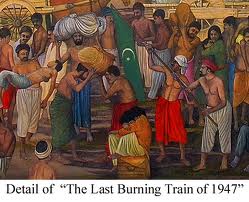
He is a strong believer of Indian Pakistan Peace, and says that he was neither born during the time of partition, nor had read the gory details of it, but sometime in 1973, he had the scenes appear in his dream, which he then painted into the Partition series.

In 2001, he decided to walk for Peace from Islamabad to Delhi, but then stopped at the Wagah border.

“Why did you stop?”  I asked.

“I was walking for the sake of Peace, and to not add more tensions by my act. At reaching the border, and conveying my peace intent, I had conveyed my message.” he replied.

He believes that “Peace between India and Pakistan will come one day, as 99% on both sides are desirous of peace, and it is only 1% or even less do not want it.”

“Amen” , I say aloud, with a firm conviction that the words uttered from such a humble champion of humanity and compassion, will not be left unheard by the God Almighty.

Peace and Harmony series…

Jimmy1

Jimmy2

Partition series…

Jimmy3

Jimmy4

Calligraphy by Jimmy:

Jimmy5

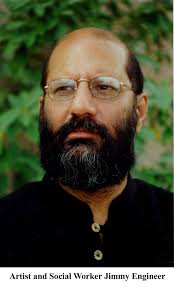
Jimmy Engineer, the artist and social worker par excellance:

Jimmy6