
Very rarely does one feel so overwhelmed and short of words to express one’s feelings.
Today since the past 20 hours or so, I know exactly how it feels to be on ‘Meth’ or Speed’ or whatever you choose to call that amphetamine the psycho stimulant.
Just out of the blue and at a very short notice a darling friend and an old neighbour of mine from Delhi, called to tell me that she has an extra ticket for a show running in Brampton named ISMAT APA KE NAAM by Motley Theatre of Naseeruddin Shah & co.
I had no choice but a “Yes” despite being down with common cold, a -20 degrees outside at 8 pm in the evening, in a city next to mine. I knew it would be a worth the effort experience by the virtue of the name Naseeruddin Shah, but never imagined that it would be to this extent.
Gosh.
Naseeruddin Shah, neither because he is a Bollywood actor nor because of his theatre, but Naseeruddin Shah has been a ‘special’ person in my life since almost two decades and a half.
Being brought up in Delhi, with studying in the elitist of schools, I had missed studying and enjoying the pleasures of Urdu. This is one grudge I held towards my parents, though not anymore.
So miserable was the Urdu of us siblings, despite parents being champions in the language, that once when one our neighbour asked my 20 year old brother if his ‘hamsheera’ was studying medicine, he sheepishly replied,
“ Sorry Uncle I am not married yet.”
Still a butt of joke at home, but we sibs have come a long way from that . Thanks to only one guy—Naseeruddin Shah. His serial Mirza Ghalib which ran on Doordarshan in the mid 80s got me into feeling that I hardly understood a quarter of what Jagjeet Singh was siniging. And hence the journey and the never ending love affair with Urdu poetry began. Rest is all history.
Coincidentally, hearing him speak once, he had the same thing to say—he was a masters in English and learnt Urdu and passion for it after his obsession with performing as Mirza Ghalib.
So the evening began with a mesmerising Naseeruddin introducing the concept of story narration and that it would be in the words exactly as Ismat Apa wrote.
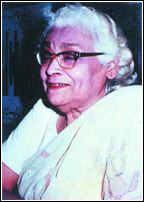
Before he introduced Ismat Khanum Chughtai, my image of this lady was of a white haired, grandmother looking, who wrote plays and screenplays for movies.
What was news to me was the facts that she was a rebel and a feminist of her times and always remained in controversy in life and even after her death in 1991. A multifaceted personality of an educationist, a reformer, a writer, a mother and a grandmother.
SHE LIVED HER WAY AND WROTE HER MIND.
Her writings, he said, were bold enough that people thought she wasn’t a woman—just a man writing with a pseudonym of a woman. “Tauba tauba how can a woman write such things.”
Wikipedia introduces her as:
“She was considered the grand dame of Urdu fiction, as one of the four pillars of modern Urdu short story, the other three being Saadat Hasan Manto, Krishan Chander, and Rajinder Singh Bedi. Her outspoken and controversial style of writing made her the passionate voice for the unheard, and she has become an inspiration for the younger generation of writers, readers and intellectuals.”
Naseeruddin made a passing mention of her most controversial story LEHAAF, which even the British in 1940s had banned. Later I read, it talked about lesbianism. Oops, to talk of it in 1940, she must be gutsy. I can’t write a story on it today.
Later I came to know through net surfing that some of her books are still banned in some Islamic countries for being ‘Fohosh’( lewd) including ours.
Wow, Harold Robins can sell, but Ismat Chughtai is banned.
Three stories were narrated and enacted with excellent sound and music effects. Unfortunately photography was not allowed.
The first, ‘Chhui Mui’, enacted by Heeba Shah, is a story told through the eyes of a young girl observing events in her Bhabhi’s life. It contrasts the difficulty, her rich, spoilt Bhabhi has in giving birth to a child against the calm and dignified manner in which an unknown poor woman gives birth to her baby in a train compartment. The graphic details of a childbirth and its enactment were in no way embarrassing.
It basically, was a satire on the pampered life of the elite where in everything is treated with a fuss while the have-nots go through the same experience in a matter of fact manner. And the latter turn out to be winners in this strife of life.
The second story, ‘Mughal Bachha’, enacted by Ratna Pathak Shah, tells the story of beautiful young flawless lass Gori Bi, who is married to a proud and headstrong youth Kaale Miyan. The story gently pokes fun at the successors of the Mughals at the time when the glorious days Mughal Empire were over– their lifestyle, their extravagant habits and their descent into penury. It also describes the unusual relationship between Gori Bi and Kaale Miyan who, because of the ‘war of egos’, never consummated their marriage.
Being teased by the girls of the contrast between their complexions , he had decided that he will not bow down to her.
Kaale Mian being a Mughal Bacha was determined that he would have her obey his orders of ‘ghoongat uthao’ and will make her lift the veil herself. While Gori Bi firmly believed that it was the prerogative of her dulha to do that. And in this battle of egos, of ‘pehle aap, pehle aap’ they missed their ‘train of a married life’.
Oh boy, the comical acts of Ratna Pathak enacting both as Gori Bi and then Kaale Miyan, gave stomach cramps with hysterical laughter.
The muhawrah: ‘Rassi jal gai magar bal nahin gaya’ befits Kaale Miyaan so well.
And such people are a plenty in our society even to date.
The enactment couldn’t have been done by anyone better than by Ratna Pathak. Her clear shusta Urdu, her flawlessly durust ‘sheen’ ‘qaff’ must have left a lot in the audience, guilty of theirs.
Her gharara and chunna dupatta attire was so reminiscent of the dadi amma times in Jama Masjid in Purani Dilli.
Unfortunately both the stories met with tragic ends.
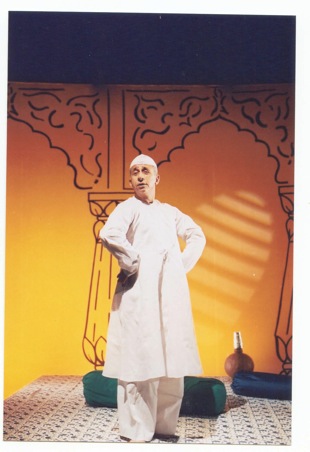
The third story, ‘Gharwali’, was the best and the longest of the three. It had to be so, after all it was narrated and enacted by none other than Naseeruddin Shah.
The story explores the nature of the man-woman relationship, marriage, the status of women, the commodity that a woman is considered in our society. And best of all, the touching truth of how even a ‘bazaroo’ woman aspires to have her own home and a loved one who is possessive of her.
With sufficient doses of social satire, drama and earthy humor – definitely this story too must have raised very many eyebrows and created a furor in the 40s. Although touching on the issues of – ‘love’, ‘lust’ and ‘lived in’ relationships , this story was in no way vulgar or filthy.
It had the audience engrossed throughout. Naseeruddin Shah’s antics and the expressions created a fit of laughter and looked like a stand up comedy at times. Mirza ji’s continual ‘tug of war’ between ‘to have’ Lajjo or not in his life as his beloved, was something words cannot describe.
Never could one afford a moment off focus, to miss the expressions on his face. Naseeruddin sailed so beautifully and comfortably in the multiple roles from a carefree, youthfully spirited, playful, seductive yet innocent maidservant Lajjo to a nervous, old, ever confused, shy yet desirous chronic bachelor Mirza, to various other minor characters. His performance was nothing short of being brilliant and captivating.
I did not want the story to come to an end.
Thankfully, this story despite the turbulent events in the middle, had a happy ending.
All the way back , instead of calling home to check if kids were okay, I was lost in the stories and just kept smiling at Naseeruddin Shah’s antics.
I came home and googled on the net about details of Ismat Chughtai till late night.
Downloaded the story LIHAAF but sadly could get only in English translation. Went to the library today morning to get the Urdu collection of her stories.
I did not even check what was happening to Gaddhafi or Raymond Davis. I am perhaps over them and moved on with Ismat Apa.
Saw a status on Maheen ‘s wall talking about enjoying the short life to the fullest.
Hence, I decide to temporarily bid the much needed Bye Bye to the focus on politics, till I finish Ismats Apa’s stories. No time to waste here.
Naseeruddin Shah has once again made me change my direction of life, with a new found love for Urdu literature and prose—to be specific Ismat Chughtai.
It is not the enactment or the feminist story lines, but the bold, daring and yet so juicy, catchy, common man’s Urdu in which the stories are written by Ismat Apa that has made me fall for her writings.
How could she write such beautiful stories in the mohalle-wali Urdu, loaded with muhawaras, which we so often heard from our own Dadi Ammas ?
And also, I have started to have a secret desire to be able to write in Urdu too.
Will I ever be able to do it?
Not sure.
0.000000
0.000000


 Blind to Bounds
You must be logged in to post a comment.