Open up your mind and your potential reaches infinity…

Archive for the ‘Uncategorized’ Category

Autumn fire


Autumn forests set ablaze in tempestuous fire,
Trees dance in intoxicated  flame  of  desire.

Chilly winds sing farewell with  gusty hiss,
Caressing the twigs, and pines they kiss .

Leaves draped  in scarlet  for the  bonfire,
To bid goodbye before mounting the pyre.

Pleasing Allah


In Kindergarten, my son learned in the Islamic Studies class:

“On Eid Al Azha we please Allah by sacrificing animal in memory of Prophet Ibrahim’s obedience to Allah. “

My son, like other kids, was expected to learn this by heart at the age of 5. But he came back,

“How can Allah be pleased by killing an animal?”

Honestly I had no plausible answer to give to a 5 year old then, so I told him, “Just learn it.”

My Mom warned: “Expain to him Hz Ibrahim’s story. Don’t agree with him, he’ll become a rebel.”

I had no answer, so I preferred to keep shut too.
However, I found some sense in his question. And my conscience pricked.

A few years later, I began to confide in him,”I agree with you.”

“But then why don’t you do anything? “ he questioned.

Again I was clueless.

About the age of 9 years , he was sent to Pakistan in his Hajj Holidays( we lived in Makkah Saudi Arabia),  to witness Baqr Eid firsthand. Probably we thought once he sees this happening everywhere, he would flow with the tide too.

In Pakistan, he had a gala time visiting Bakra Mandi (cattle market) with uncles and cousins. They came back with a fleet of 4 goats. Each boy was assigned to take care of one goat. The fed,  played and raced their goats in the lawn all day.  They even named them after the Ninja Turtles.

They bought accessories like bells and necklaces and adorned the pets with them.

When his cousins were off to school, he looked after all four goats with utmost loving care.

The Bakr Eid came and passed. All the goats were sacrificed, one by one,  in the same lawn where they galloped all day.

We received complaints that our son is timid and he refused to see the animal being sacrificed, when other kids of his age did the ‘throat cutting’ job for their respective animals. He even did not eat the chops and Biryani made out of his pet.

After a two week’s trip he came back home with the memoirs of  Michaelangelo-his bell and the plastic necklace his pet goat wore before it was sacrificed. And along them were loads of complains of how heartlessly were the pets sacrificed, and the stink that persisted for days, by the guts of the goats splattered all over the city.

Along with this came a message for us from  his Grandfather and Uncles:

“He should be a strong man.”

My husband concurred. I disagreed, quietly.

In grade 9, while  learning Islamiat for O levels he came up with an idea, one day:

“Can’t we do an Ijtihad (consensus) on sacrificing on Eid Al Adha ?”

“Okay you try the Ijtihad ( consensus) .” I permitted.

He talked to his friends, and they mocked,”You say this because you can’t see blood.”

Not even one agreed.

“There cannot be Ijtihaad, as in that each and every person must agree.” he had learnt it in the lesson on Islamic Jurisprudence.

“I don’t care what others say or do, but I will never sacrifice a goat on Eid, and that too myself. I will donate as much amount to charity. It will not only help the needy, save an animal’s life but save me from feeling guilty and sick. And I know this will not displease Allah”, he took a firm decision.

This was about four years ago.  And each year he repeats the same view when Baqr Eid approaches.

And to let you know, this is a boy who never missed the Juma ( Friday) prayers in his two years of High School in Canada just because, “the govt has arranged it especially for us Muslims, and if we do not, it would be such a shame that the Canadians care for our religious obligations , but we do not.”

And another thing, he was born just a few days before Hajj, in the month of Zil Hajj, in Makkah and we named him Ismail.

Ba Raftam ~Allama Iqbal sung by Nashenas


Nashenas is an  Afghani singer of yesteryears’ , with an enchanting voice. He   generally sang in Pashto, Dari and Urdu.
Born and lived in Kandahar till Taleban took over, which made a leftist Nashenas to leave Afghanistan.

Here he sings a Farsi piece of poetry by Allama Mohammmed Iqbal:

Hard to write Farsi…I just paste the translation:

I went up to the ocean and, addressing a wave, said:
‘You’re always restless; tell me what is it that troubles you.
You have a million pearls enfolded in your garment’s skirt,
But do you, like me, have a heart – the only pearl that’s true ?
It squirmed, retreated from the shore, and uttered not a word.

I went up to the mountain and said, “O huge heap of stone!
Can you not hear the wailing of a heart in agony?
If in your stones there is a gem which is a drop of blood,
Then speak, O speak, to a sad soul that pines for company.
If it had breathed, it breathed no more, and uttered not a word.

I travelled long in upper space, approached the moon, and said:
“O ceaseless wanderer, is there any rest ordained for you?
Your radiance makes the whole world gleam white like a jasmine field.
But is your breast aglow with a live heart whose light shines through?”
She looked round at the starry crops, and uttered not a word.

Transcending sun and moon, I went up to the Throne of God.
“There’s not a thing,” I said, “I can be friends with, not a thing.
Your world is heartless, while my dust is all of heart’s stuff made.
A pretty garden, but not the kind of place to make one sing.”
He answered with the smile He wore, and uttered not a word.

Son comes before the mother~Kabir


Pahilaa poot pishairee maaee.
Gur laago chele kee paaee.

Ek achanbhou sunahu tumh bhaaee.
Dekhat singh charaavat gaaee

Jal kee mashulee taravar biaaee.
Dekhath kutaraa lai gee bilaaee
Talai re baisaa oopar soolaa.
Tis kai ped lage fal foolaa
Ghorai chari bhais charaavan jaaee.
Baahar bail gon ghar aaee

Kahaat Kabeer ju is pad boojhai.
Raam ramat tis sabh kish soojhai

Translation:

First, the son was born, and then, his mother.
The guru falls at the feet of the disciple

Listen to this strange thing,
O Siblings of Destiny!

I saw the lion herding the cows.
The fish of the water gives birth upon a tree.
I saw a cat carrying away a dog
The branches are below, and the roots are above.
The trunk of that tree bears fruits and flowers
Riding a horse, the buffalo takes him out to graze.
The bull is away, while his load (cart) has come home

Says Kabeer, one who understands this hymn,
and comprehends the Divine words comes to understand everything.

This is a beautiful satirical poem by Bhagat Kabir, taken from Guru Granth Saheb ( the Holy Book of Sikhs), that takes me back instantly to the Hindi class of grade 10, when we read this. I recall with nostalgia of all the discussion that was triggered by the poetry. While the boys at the back benches were busy cracking various mostly crude and a few decent jokes about it, the girls in the front benches, ( that’s where they usually sit) were amused yet trying to squeeze their giggles desperately.

While the very serious Hindi teacher with a twinkle in her eyes, and mind fully immersed in Kabir was engrossed in explaining the spirit of the verses, compleltely oblivious to what was happening in front of her.

Unlike many other Hindi lessons, this poem unknowingly left ‘an impact’ strong enough to keep reading Kabir once the compulsory Hindi subject was over.

I would suggest the readers to first read the verses, it’s translation and then again the verses to get some sense of it’s meaning, and to check whether their brain thinks the way Kabir’s brain did.

The Interpretation:
The whole poem through various interesting examples, cites an open secret of our lives, so aptly described in a quote by Rousseau : “Man is born free but found in chains everywhere.”

What chains him, according to Kabir are not only the society( like Rousseau claims), but ones own hoggish desires and the pursuit of which makes him timid and fearful. And hence instead being fearless, strong yet empathetic, that man by virtue of his higher intellect is destined to be, turns into a timid, selfish and apathetic being .

Pahilaa poot pishairee maaee.
To begin with, the man was as pure as a newborn (poot), devoid of any ego. But with time, by the lure of his senses, he became ‘mother’ of (“Maaee”) ‘worldy desires’ ( the superfluous values existent in the world). Here Maee is being used with a dual meaning, both as the worldly attractions i.e. maya, and as mother.

Gur laago chele kee paaee.
Man who has the capability to be the master (Guru) of infinite knowledge, strength and empathy ( by the virtue if his intellect) becomes the disciple (chela) and bows at petty values like greed, selfishness and apathy.

Ek achanbhou sunahu tumh bhaaee.
This is an amusing contradiction, have you even seen? ( A satire on human aspirations to seek and pursue superficial values).

Dekhat singh charaavat gaaee
A man who should be fearless and strong ( as a lion) , becomes a timid grazing animal (cow), owing to protect his self interests.

Jal kee mashulee taravar biaaee.
Water is the life support of the fish, and it cannot survive without it. What if it starts to dream of living ‘high up’ on the trees. Will it be able to survive ?
So is the humanity who’s life supports are compassion, contentment, empathy and knowledge. What if they too start to fantasize for what they consider as higher pleasures ( a kin to trees) like greed, wealth or other egocentric dreams, will they be able to sustain the purpose of their existence ?

Dekhath kutaraa lai gee bilaaee
The cunning human heart ( the cat– in ‘some’ societies is considered as a cunning animal) , in lure of superficial values, has captured and held hostage the contentment, faith and bravado ( the dog) within him. ( Incidentally, in the times of Egyptian Pharoahs, dog was considered as a symbol of contentment, reliability and bravery.

Talai re baisaa oopar soolaa.
Tis kai ped lage fal foolaa
When we see the image of the tree in a lake, it appears beautiful but upside down. So is the truth of our worldly gratifications, they may appear wonderful, but they are exactly opposite of what the purpose of our existence in the world is.

Ghorai chari bhais charaavan jaaee.
Man’s desires ( as bulky as a buffalo) ride and gallop rapidly on greed ( the horse) to make the mind wander and graze the grass of one’s ego.

Baahar bail gon ghar aaee
Owing to man’s enslavement to lust and instant gratification, his patience and perseverance (bull, which is an embodiment of perseverance) has left him, instead, a cart load full of material cravings have found home in him (“gon ghar aaee”).

Kahaat Kabeer ju is pad boojhai.
Raam ramat tis sabh kish soojhai
Kabir says that whosoever comprehends the verses of this hymn, and remembers the Divine purpose of his existence frees himself from bondage.

William Wordsworth’s famous verse: “Child is the father of man.” may hold the same literal meaning, but here Wordsworth tries to explain how the childhood experiences shape the person he is when he becomes a man. In yet another interpretation,,,some say that here child is referred to as Jesus since both Child and Father are capitalised.

Perhaps in the same way, there may be more than one interpretations of the above poem. I have narrated, what my small mind, which isn’t very spiritually bent, interpreted it as.

I leave it to the readers to let their imaginations soar, and generate their own wonderful interpretations of the Kabir’s verses above.

The above salok (verses) of Sant Kabir are taken from Guru Granth Saheb ( the Holy Book of Sikhs.


Picture of Golden Temple, Amritsar  by night From the album Gateway to Heaven, by Randeep Singh.

Thanks to Naren  @froZENwell for reminding this poem and inciting me to write this blog.

Let the baby survive and grow


Published in AmanKiAsha The News on Oct 5, 2011.

Nirupama Rao, now Indian ambassador to Washington, reportedly said of the Agra Summit at which Vajpayee and Musharraf met: “Though there were midwives, a still-born child was born in Agra”. A healthy baby was born that night, but was replaced by a “still-born”, reportedly retorted a Pakistani delegate.

Whatever the rhetoric or interpretation, the fact remains that the baby could not breathe in the air it needed – of peace and confidence from the two sides. Hence it died. How many such babies have died over so many years after such meetings?

The love-hate relationship between India and Pakistan does not allow the two neighbours to be indifferent to each other. They keep the relationship going by conceiving ideas and dialogues, but the babies somehow never survive. They can’t. The trust deficit kills them.

The parents need two things to nourish the baby and ensure its survival. The first is ‘love’ and the second, ‘trust’.

I know first-hand, that there is no dearth of love amongst the masses on both sides. It is so evident from their interest towards each others arts and cultural affairs. If Pakistanis’ love for Bollywood films and Indian soaps is immense, then Indian craving for Pakistani singers and music groups is no less intense.

Then there’s the curiosity with which we follow each others sport teams. If there are girls in Pakistan swooning over Dhoni, there are lasses in India putting up posters of Afridi in their rooms.
The pairing of Aisam ul Haq and Rohan Bhopana in professional tennis, or Shoaib Malik and Sania Mirza tying the knot, are also living examples of that love. Despite the practical difficulties, non-celebrity cross-border marriages continue to take place. They don’t hit the limelight, but it is the love and bonds between us that makes them possible even after 64 years of separation.

Even when mishaps occur across the border and when some people do indulge in mudslinging, I bear witness to the fact that on both sides, there is a sizable majority who feel a heartache for the sufferings of their brothers and sisters across the border.

Just take the bonds that exist between the media personnel of both sides. If Beena Sarwar from Pakistan speaks through her soul to break the touching story of a Pakistani pilot’s letter to the daughter of an Indian pilot, Barkha Dutt on the other side follows up with a live TV programme that echoes these emotions from the bottom of her heart.

Another pair of journalist friends post the following facebook comments around August 14th and 15th, the Independence Days of the two countries: Shivam Vjj, Delhi: “All the world’s countries are mine. – borders. And Jeevay Pakistan!

Shiraz Hasan, Lahore: “There is a little bit of Indian in every Pakistani and a little bit of Pakistani in every Indian.” – Benazir Bhutto | Happy Independence Day to all Indian friends!

Many of us can cite numerous other such examples of friendship amongst the common folk. With this magnitude of love, there is no reason that the baby should not only survive, but be healthy and develop into the pride of its parents – the entire region of our Subcontinent.

But what do we do about the ‘trust deficit’ at the top, which smothers the baby? What more testimony of reconciliation do the powerful on both sides want, after the heart piercing letter of the Pakistani pilot to the daughter of the Indian pilot he shot down? What could be a greater example of forgiveness than the equally touching reply of the daughter, with the reassurance that she forgave and moved on long ago?

Together we make up 1.4 billion, about a fifth of humanity who aspire to live in peace and harmony in the region. Why does the trust deficit of just a handful keep jeopardising peace and harmony here?

The spirit at the Pakistan-India Parliamentarians Dialogue between the lawmakers of both sides in August was indeed yet another ray of hope. There was much needed discussion on political bones of contentions like Kashmir, Siachen and Sir Creek and the challenge of terrorism, all in a cordial environment.

It was even more encouraging that the issues which really matter to the people on both sides were given the due emphasis – economic ties (related to trade and investment), energy (via Iran-Pakistan-India gas pipeline), agreements to open new transit routes (across the Line of Control in Kashmir and at Khokhrapar-Monabao) or easing travel restrictions.

The idea of the “trusted visitors programme” was indeed a significant step forward for the hundreds of families divided across the border.

The categories laid down for such trusted individuals included senior citizens, businessmen, elected representatives etc. However, an important category was missing which by no means may be considered less trusted – that of couples who are married across the border.

I understand there will be more such meetings of the group. I beg the authorities on both sides to please look into these families, of cross-border couples, as also trustworthy. I belong to one such family, and I promise we will never let you down for having done so.

As for the elected representatives on either side, I beg them to please push in the high corridors of power to reduce the trust deficit, so that next time when an Indo-Pak Treaty starts to be born, it does not die a premature death.

Wednesday, October 05, 2011

Dr Ilmana Fasih is a gynaecologist and health activist of Indian origin,  married to a Pakistani citizen. She blogs at https://thinkloud65.wordpress.com/

When hatred reigns.


It was with helplessness that I read an article in one of the newspapers about how school kids in certain areas of Karachi were not able to attend their school safely because of prevailing tensions between two ethnic groups- both Pakistanis, both Muslims of the same sect. A kid claimed he was friends with his schoolmates from the other ethnic community and they even played together after school, but now the same friends say they could not play with him anymore.

Another article read of how Hindus in Baluchistan who have been living there for centuries were fearful of sending their kids to schools due to escalated kidnappings for ransom and killings of the community. Although they have no animosity with the Muslims in neighborhood,  they all scared to mingle.

In brief, the hatred of a handful prevailed over the helplessness of the lot.

Before I could finish, the news broke of Karachi blast in the DHA where along with others, an innocent passerby mom and her 5 year old son got killed.
What prevailed here too was nothing but hatred.

I know first hand, exactly how it feels to be helpless in the face of hatred.

I was a first year medical student in  Lady Hardinge Medical College, situated in the heart of New Delhi, when Indira Gandhi was assassinated on 31 October 1984. The mayhem spread as faster than the spread of the news. As if a riot button was switched on. Delhi’s panorama was puking smoke of hatred from every direction.

Parents were coming to pick up their daughters, from the college hostel, and narrating the harrowing tales of watching limbs and other body parts splattered across the killing fileds that Delhi roads had turned into. I remember how a Sikh girl from my class sat cautiously frozen in the crowd of girls in the hostel’s TV room.  She broke down when she learnt that her brother had left home an hour ago to pick her up. No one reassured her not to cry or to worry for her brothers safety.  Not a single parent even offered to drop her home. Why would I blame others, when I felt the same helplessness, and feared what will happen when my parents come, will they be reluctant to take her too.

Ultimately, along with her and a few other girls, I ended up staying back to spend the terrible night in the hostel. The city had turned into an open house of looting and rampage. Next day on my way back home,  all I saw was roads stained with fresh blood, a charred and empty shop after every few well preserved shops and selectively  burn’t buildings along the way to home. Though I did not have the courage to give a second look, but I did see a glimpse of most likely a charred body lying inside a burnt shop.

At home everyone shared their eye witness accounts. Our house boy Jung Bahadur described how the shacks(jhuggis) in the slums of Mangolpuri and Sultanpuri were stocked with stacks of VCRs, TVs and other electronics. He even shared how some dead bodies were piled together, doused with kerosene and burnt to ashes. Papa had witnessed a headless body being carried in an autorickshaw.

I do not remember how and when did the Sikh girl go home, but we learnt days later that her brother could neither arrive at the college, nor ever return back home. His body was  identified some days later in the morgue.

Again, amidst the helplessness of us all, hatred prevailed like a king.

The same story was repeated with my parents, as they were left in the cold, during the riots in December 1992, that followed Babri Masjid demolition. Many Muslim houses were chalked in Delhi, including those of IAS officers, doctors, cricketers, poets etc.

In fact some like Bashir Badr’s house in Meerut was actually attacked. It was after this incident that Bashir Badr wrote this shair:
Log toot jaatey hain, ek ghar banane mein
Tum taras nahin khaatey bastiyaan jalane mein.

Being  staunch beleivers of Indian secularism, my parents had proudly built a house in 1977 in a University housing cooperative compound where his colleagues and other University professors resided. We were only 2 Muslim houses in a colony of 238 lots, but that was besides the point. However, that cold and lonely December night none of our neighbors, his University colleagues or friends came forward to even reassure them of support in case of any danger. There was a criminal silence from friends and neighbors.

As my mother narrated later, that was the first time she saw my father cry with tears, not for his life, but at the ‘sudden’ transformation in hearts of trusted and indeological friends for several decades. My parents had packed their car with valuables, in case they had to leave. Once the crisis was over, a few friends did come up, begging their helplessness.

Once again, amidst the intelligentsia of the society, hatred took an upper hand .

My grandfather often narrated of an incident when during the 1947 riots a Sikh boy had come to drop a pregnant Muslim woman to Matia Mahal,  Jama Masjid area, but was not let to go back alive, despite the helpless cries from the woman’s family to spare her saviour.

The helpless family members could do nothing as the hatred reigned.

I know I can never be able to guess from where this business of hatred all began, but can we really dare dream a day when the hatred propagated by a handful of vested interests will not prevail over the helpless masses ?

This reminded me of a discourse I had read about the controversy between Tagore and Gandhi during the non-cooperation movement against the British in 1930s.

Tagore had warned Gandhi by saying: “….besides, hatred of the foreigner could later turn into a hatred of Indians different from oneself.”

Gandhi on the other hand believed that this non-cooperation would dissolve  Hindu-Muslims differences.

Ultimately Tagore was proved right, and Gandhi had to shift his  non cooperation  against the British into a non violent movement.

The same corollary of Tagore’s could easily be applied to the situation in Pakistan, too.

What began as a hatred for the foreign faiths has turned into hatred among Pakistanis different from each other.

And ironically a handful of vested interest first made the helpless common Pakistanis hate the foreign faiths and now have turned the Pakistanis of different sects and ethnicities hate each other.

This business of hate has to stop somewhere. Whether it is for a fellow Indian/ Pakistani of different ethnicity, of a different faith or of a foreigner of different color, we have to shout in the face of hatred: “Enough is enough”.

Or else, as poet E E Cummings lamented: Hatred bounces.

A tale of two kitties


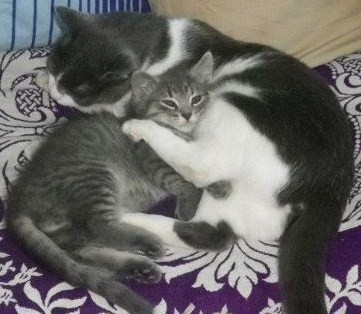
Just a week ago, arrived Taara, a 9 week old kitten, to our home. We were apprehensive what reaction the cat already present at home,  Maaya, would have.
Taara was left in the carrying box in the middle of the living room, while we keenly awaited Maaya’s reaction.

The kids had searched over the Internet about the adjustment process of the new cat at home. Since cats are territorial creatures, the two should be kept separate and it takes a gradual process over several months for them to accept each other.

Maaya’s first reaction to Taara scared us. Her tail got all puffed up and the back curved signalling danger. She smelled the kitten through the cage and roared. Hence, both had to be separated immediately to different rooms.

Since Taara kept crying in the tiny carrier, we let her out and she was allowed to survey the new home. She jumped and bumped like a puff ball smelling every nook and corner of the house. It seemed as if she was hunting for her mother and two siblings who were left behind in the other home.

In the second attempt, when the two felines were made to face each other, Taara seemed unwary of Maaya and in fact followed her everywhere. Having come from a family of cats and being a baby, perhaps she hadn’t yet developed the fear of strangers.

Maaya looked very scared though. She would recede as Taara attempted to get closer. The more she reversed, the faster Taara got to reach Maaya. She climbed over the table and jumped over the frightened, double-sized Maaya with full force. The kids would run to pull Taara away and distract her with a feathery toy.
In another instance, when Maaya was sitting on the chair and wagging her hanging tail, Taara kept playing with it from underneath the chair, until Maaya realised and ran away. Taara was all out to befriend Maaya, but being shrewd and cautious (what we call worldywise) Maaya wouldn’t give her a lift.

Maaya was kept confined to  the bedroom, as Taara was allowed to run around the rest of the house, to make her feel free. But the bundle of naughtiness and hautiness wouldn’t still be happy, and kept mewing non stop sitting outside the closed door.

Different feeding dishes were set for the two cats so that they do not get at logger heads while eating. But as if Taara would let that happen. When Maaya started to eat from her designated dish, Taara shoved her head in to it as well, and with a header pushed poor Maaya away. As soon as we witnessed this, they were separated, and Taara was given a new plate with the same food at the other corner of the space. But with no second thoughts, she abandoned it, and again went where Maaya was eating. My daughter then moved Maaya to the new plate, but then so did Taara, with no delay.

For a few days, life seemed like a referee, always on ‘attention’  for a cease fire.  Taara tried all her pranks to  tease or come in Maaya’s way and she provoked her to get angry.  After having got over as a threat, Maaya became a bit high-handed with Taara. But still she was no match to the little evil monster Taara. Barely less that half the size of Maaya, would she wrestle with Maaya as an equal. In fact, most of the provocations came from Taara.

On one occasion, she even managed to scratch Maaya on her snout, leaving a red mark on the pink ridge between Maaya’s beautiful eyes. But Maaya, being a gentlewoman, did not respond with same aggression.

As Maaya felt at ease with Taara, the scene was worth a witness,  when Taara sat at the door mewing and crying for her friend, while Maaya jutted her arm from the space beneath the door, as if trying to reach her crying friend.

All Taara perhaps saw was a mother figure in Maaya. Once when Maaya was asleep, she managed to push her head into Maaya’s belly attempting to suckle. The sight was so painful that we thought of taking her back to her mother, as she perhaps missed her mom’s suckling. My daughter attempted to feed her milk with a syringe, but knowing very well that this wasn’t the real alternative.

Licking by Taara perhaps kindled the maternal instincts in Maaya too and she started to lick back Taara over her face and neck initially, but eventually over all her body.
This has repeated over several times in the past two days. Now, they walk together, sit together to watch TV, feed together and even sleep together, cuddling each other.
In fact, they even go to loo together. As one is in the litter doing the job, the other sits outside, on guard perhaps.

It has been just a week now, and they seemed to have developed the warmest of relations anyone can imagine.

Still, they do wrestle and pounce on each other and we need to watch that it does not turn ugly…but perhaps it wouldn’t. After all they are not nasty human beings, they are lovely cats.

Daredevil Taara, testing Maaya’s patience.

Maaya and Taara watching TV together


Taara and Maaya sleeping like siamese twins

She is me ( PakFloods a repeat 2011)


With a chulha, a few pots and her life….She is me.
She is deprived of basic dignity of life, I am of empathy,
She is suffering from abject poverty, I am from apathy,
She is half drowned in water, I am soaked in luxuries,
If she passes away with disease, I should die in shame.
She is what she is, because I am what I am.

Donate Blood, change lives including your own !


Every three seconds, someone needs blood in this world. Blood cannot be manufactured and  there is no substitute for human blood. So the needed blood can only come from GENEROUS DONORS.

When you donate blood once you help FOUR people at a time–one of them is you (see below how?) and the other three, who receive red blood cells, platelets and plasma respectively, separated from the donated blood.

You do not lose anything except ONE PINT out of 12 pints of blood in our body. It takes about 10-12 minutes to give the actual blood. The entire process, from the time you arrive to the time you leave, takes about AN HOUR only.

What’s blood donation like?

• Donating blood is a safe process. A sterile needle is used only once for each donor and then discarded. So a donor has no risk of getting HIV or Hepatitis C infections.
• Blood donation is a simple four-step process: registration, medical history and mini-physical, donation and refreshments.
• Every blood donor is given a mini-physical, checking the donor’s temperature, blood pressure, pulse and hemoglobin to ensure it is safe for the donor to give blood.
• A healthy donor may donate red blood cells every 56 days, or double red cells every 112 days.
• A healthy donor may donate platelets as few as 7 days apart, but a maximum of 24 times a year.

Are there any side effects of blood donation?

The donors hardly get any adverse effects except rarely, some dizziness due to low blood pressure. Drinks lots of fluids, eat a full meal within 4 hours of blood donation, do not take alchohol or smoke a cigarette immediately after donation. This may cause dizziness to occur.

How long does it take to replace the given blood?

After donating blood, you replace these red blood cells within 3 to 4 weeks. It takes eight weeks to restore the iron lost after donating.

How is blood concentrate collected?

In general, there are two methods in which blood products are collected: apheresis and whole blood donation.

In the whole blood method, blood product is first collected as whole blood. Using centrifugation, whole blood components become separated and settle in the following order: red cells at the bottom, the “buffy coat” of platelet and white cells in the middle and the plasma on top. This is the method commonly used in places with less resources.

Apheresis is similar to the whole blood collection except only the selected components are drawn off and the remaining components are returned to the donor’s circulation. This method is expensive.

In the end, the blood products collected are red cells, platelets, and plasma. Plasma can be further fractionated into albumin, cryoprecipitate (rich in clotting factors such as fibrinogen, von Willebrand factor, and factor VIII) and intravenous immune globulin.

How can blood donation help you as a donor?

First, before donating blood, everyone must pass a mini-physical and a medical history examination. During the physical, your blood pressure, pulse, temperature and your hematocrit level (the level of red cells in your blood) are checked. Sometimes physical problems such as high blood pressure are found during a blood donation mini-physical. So donating blood can be a way to keep a check on your own health while helping others.
Second, preliminary studies also found that heart attacks and other cardiac problems were less common in men who had donated blood compared to men who had not.

Who can donate blood?

Though rules may vary, but any healthy individual above 17yrs and 110 pounds weight can donate blood.

If you are healthy and began donating blood at age 17, and donated every 56 days ( which is absolutely okay), until you reached 76, you would have donated 48 gallons of blood, potentially helping save more than 1,000 lives!

Of Unity, Discipline and Faith


It is, as always, painful to  watch the news bulletin which on most days begin with news of blasts, target killings, street crime or sectarian hatred. Following all this, in the end usually come the passing mention of  floods, hunger, poverty and other issues that plague our homeland.

The manner with which the TV channel projected the news, marinated with spice,  is perhaps to make it appetizing to the apathetic  masses, who seem to have got immune to such news.

One such evening,  when there were blasts in Quetta and Delhi simultaneously, along with the unabated  target killings in Karachi, the  bulletin  was too spicy  for my liking and I felt severely nauseated.

To get a breath of fresh air, I walked outside in the lawn. It was refreshing to see threesome geese…and saw that  sitting beside the bird feeder. One of them was limping ( I guess was injured) while the other two  were flapping their wings and trying to encircle the injured.

Dejected with my existence as a human being, I looked at the birds in an awe– ” Such free birds and travel over 4500 miles every year from Europe to Central Asian states, to finally arrive in  Pakistani and Indian wetlands for winter. These migratory birds must have flown over awesome Karakorum, Suleiman  and Hindukush Ranges,  along the Indus River, to arrive in Pakistani marshes,”  I pondered.

Sickened and  overflowing with pensive emotions I found their partying in my lawn annoying and irritating. The geese’s a-hink-a-honk appeared unstoppable.

Perhaps I was envious of the research that I had read some years ago which  found that these geese migrate thousands of miles as ‘one’ flock, rising above their individual self and if any bird falls sick or is injured, two geese fall out of formation and follow him down to help and protect him. They stay with him until he is either able to fly or until he is dead. And when done, then they launch out on their own or with another formation until they catch up with their group.

What a show of ‘empathy’, I wondered. And how shameful, we humans claiming  higher brain function have almost forgotten this word.
As I sat to watch and feed them with wheat grains with my hands…I couldn’t resist but to share with them,

“I wish I was one of you.”

”Why? “, asked one. “Aren’t you the most intelligent species created by God?”

“Yes, but I love the way you tiny, pea-brained creatures fly thousands of miles , as free birds, who need no borders, passports or visas…even need no expensive tickets or advance bookings  to travel each year …and there is no one to stop you.”

The goose eyes twinkled with pride, ”Yes indeed. But do you know how do we succeed in braving such distances?”

“Yeah, I read some research–you fly in flocks united as one group, in a V-formation, up to the destination.”

As I spelt the word ‘united’, my heart sank at the absolute disunity that we display being divided as Muslims-Ahmedis-Christians or even Shias-Sunnis  instead of staying in a flock united as Pakistanis.

“Yes, unity and discipline are the foundation stones with which we brave through our arduous journey from Siberia to South Asia”, declared one of the  geese.

“Discipline, that flying in a V you call discipline?” I taunted.

“Your scientists have researched and found out the reason why we fly in that V. Do you know why?”, he asked.

“Yeah I guess because to fly in an S would be tougher, Huhh!”, I mocked.

“Hahaha. You and your twisted human mind.  Staying organised in a V gives us strength. The bird ahead flaps his wings to reduce the air resistance and gives a lift to the next behind it . Thus, the reduced air resistance is passed on to the bird immediately behind and subsequently the whole flock gets the benefit. And this way we are able to add 75% greater flying range than if each bird did it alone. “

Hearing this rang the bells in my mind of that painful High School Physics which taught us that principle of airlift. . But what’s the point, I thought, despite learning through science or through moral science, of the advantages of unity and discipline? Did we humans ever applied it in our real life?

I had no answer to the bird, but so true to my human nature, I made a nasty taunt,

“How mean, you let one bird as a leader do all the hard work. The one at the front does the most labour, ‘alone’ by flapping its wings through the air resistance. How inhuman?”

“You call this inhuman? Being cruel is so ‘human’ I would say”, the goose retorted.

That comment really hurt. I knew the goose was right. What hurt more was that it was a pea-brained goose making that comment about the most intelligent species created by God. (Thanks to the arrogance with which we judge each other too as big or small).

“Do you know we keep changing our leader and we all take turns to lead? When the lead goose gets tired, he rotates back in the wing and another goose flies point.”

“Oh really, that’s strange. How do you elect your leader—like us through elections?”

“Elections? Why? For us each bird gets its turn to be the leader. Do you humans let everyone lead, in turns?” he remarked.

How silly of these birds, I felt. If I was one of them, I would never let anyone else take the lead except me. To hell with turns.Huhh.

“And mind you, our leader really works hard, not like human leaders who live a VVIP life and never are they willing to step down.” replied the bird, as if  he read my thoughts.

“Not only do we stay united and disciplined, we keep our faith in whoever is our leader for that period.”

“What?” I inquired.

“See our leader leads and works hard the most. The ones behind, follow him with complete faith. The ones at the extreme back keep honking all through the journey. They honk ‘Keep going, we are right behind you’. Have you ever experienced how energising it is when someone gives you support and inspiration from behind? It synergises one’s capacity far beyond one’s capability.”

“Faith?” I was confused.

“Exactly, it is a mutual faith between the leader and rest of the flock. This trio of unity, discipline and faith enables us to travel thousands of kilometres braving harsh weather, sometimes even lack of food on the way”, remarked the goose.

My head hung in shame. They understood what was the true meaning of faith–not just the faith in God, but also of faith in the leadership, faith in the people and faith in one’s own abilities. And this faith should make us move forward,  not kill each other. We perhaps have misconstrued ‘faith’ as just religion and keep quarrelling with each other in the name of that faith.

By now, I was feeling embarrassed of how a pea brained bird was singing songs of its greatness. My ego could not hold back and I screamed:
“Do you know this Unity, Discipline and Faith that you follow along the 4500 km journey, was actually a slogan given by our Founding Father?”

All the bird heads turned at me in awe…and after a long silent pause one of them remarked:

“You humans  have heard of  Unity, Discipline and Faith?  Oh really?” 

And with that exclamation, all three of them flew up in the sky, in a small V formation, towards the east , perhaps for their final destination in Bharatpur Bird sanctuary.

I kept staring at them, till they went out of sight. And with them, went out of mind the lesson they taught from their lives.

Why did I need to learn from those pea-brained birds ? Afterall I am the most intelligent species living on Earth.