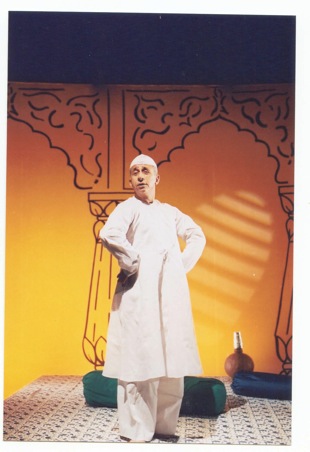
Open up your mind and your potential reaches infinity…


Very rarely does one feel  so overwhelmed and short of words to express one’s feelings.

Today since the past 20 hours or so, I know exactly how it feels to be on ‘Meth’ or Speed’ or whatever you choose to call that amphetamine the psycho stimulant.

Just out of the blue and at a very short notice a darling friend and an old neighbour of mine from Delhi, called to tell me that she has an extra ticket for a show running in Brampton named ISMAT APA KE NAAM by Motley Theatre of Naseeruddin Shah & co.

I had no choice but a “Yes” despite being down with common cold, a -20 degrees outside at 8 pm in the evening, in a city next to mine. I knew it would be a worth the effort experience by the virtue of the name Naseeruddin Shah, but never imagined that it would be to this extent.

Gosh.
Naseeruddin Shah, neither because he is a Bollywood actor nor because of his theatre, but Naseeruddin Shah has been a ‘special’ person in my life since almost two decades and a half.

Being brought up in Delhi, with studying in the elitist of schools, I had missed studying and enjoying the pleasures of Urdu. This is one grudge I held towards my parents, though not anymore.

So miserable was the Urdu of us siblings, despite parents being champions in the language, that once when one our neighbour asked my 20 year old brother if his ‘hamsheera’ was studying medicine, he sheepishly replied,

“ Sorry Uncle I am not married yet.”

Still a butt of joke at home, but we sibs have come a long way from that . Thanks to only one guy—Naseeruddin Shah. His serial Mirza Ghalib which ran on Doordarshan in the mid 80s got me into feeling that I hardly understood a quarter of what Jagjeet Singh was siniging. And hence the journey and the never ending love affair with Urdu poetry began. Rest is all history.

Coincidentally, hearing him speak once,  he had the same thing to say—he was a masters in English and learnt Urdu and passion for it after his obsession with performing as Mirza Ghalib.

So the evening began with a mesmerising Naseeruddin introducing the concept of story narration and that it would be in the words exactly as Ismat Apa wrote.

Before he introduced Ismat Khanum Chughtai, my image of this lady was of a white haired, grandmother looking,  who wrote plays and screenplays for movies.

What was news to me was the facts that she was a rebel and a feminist  of her times and always remained in controversy in life and even after her death in 1991. A multifaceted personality of an educationist, a reformer, a writer, a mother and a grandmother.

SHE LIVED HER WAY AND WROTE  HER MIND.

Her writings, he said, were bold enough that people thought she wasn’t a woman—just a man writing with a pseudonym of a woman. “Tauba tauba how can a woman write such things.”

Wikipedia introduces her as:
“She was considered the grand dame of Urdu fiction, as one of the four pillars of modern Urdu short story, the other three being Saadat Hasan Manto, Krishan Chander, and Rajinder Singh Bedi.  Her outspoken and controversial style of writing made her the passionate voice for the unheard, and she has become an inspiration for the younger generation of writers, readers and intellectuals.”

Naseeruddin made a passing mention of her most controversial story LEHAAF, which even the British in 1940s had banned. Later I read, it talked about lesbianism. Oops, to talk of it in 1940, she must be gutsy. I can’t write a story on it today.

Later I came to know through net surfing that some of her books are still banned in some Islamic countries for being ‘Fohosh’( lewd) including ours.

Wow,  Harold Robins can sell, but Ismat Chughtai is banned.

Three stories were narrated and enacted with excellent sound and music effects. Unfortunately photography was not allowed.

The first, ‘Chhui Mui’, enacted by Heeba Shah, is a story told through the eyes of a young girl observing events in her Bhabhi’s life. It contrasts the difficulty,  her rich, spoilt Bhabhi has in giving birth to a child against  the calm and dignified manner in which an unknown poor woman gives birth to her baby in a train compartment. The graphic details of a childbirth and its enactment were in no way embarrassing.

It basically, was a satire on the pampered life of the elite where in everything is treated with a fuss while the have-nots go through the same experience in a matter of fact manner. And the latter turn out to be winners in this strife of life.

The second story, ‘Mughal Bachha’, enacted by Ratna Pathak Shah, tells the story of beautiful young flawless lass  Gori Bi, who is married to a proud and headstrong youth  Kaale Miyan. The story gently pokes fun at the successors of the Mughals at the time when the glorious days Mughal Empire were over– their lifestyle, their extravagant habits and their descent into penury. It also describes the unusual relationship  between Gori Bi and Kaale Miyan who, because of the ‘war of egos’, never consummated their marriage.

Being teased by the girls of the contrast between their complexions , he had decided that he will not bow down to her.

Kaale Mian being a Mughal Bacha was determined that he would have her obey his orders  of  ‘ghoongat uthao’ and will make her lift  the veil herself.  While Gori Bi firmly believed that  it was  the prerogative of her dulha to do that.  And in this battle of egos, of  ‘pehle aap, pehle aap’   they missed their ‘train of a married life’.

Oh boy, the comical acts of Ratna Pathak  enacting  both as Gori Bi and then Kaale Miyan, gave  stomach cramps with  hysterical laughter.

The muhawrah: ‘Rassi jal gai magar bal nahin gaya’ befits Kaale Miyaan so well.
And such people are a plenty in our society even to date.

The enactment couldn’t have been done by anyone better than by Ratna Pathak. Her clear shusta Urdu, her flawlessly durust  ‘sheen’ ‘qaff’ must have left  a lot in the audience, guilty of theirs.

Her gharara and  chunna dupatta attire was so reminiscent of the dadi amma  times in Jama Masjid in Purani Dilli.

Unfortunately both the stories met  with tragic ends.

The third story, ‘Gharwali’, was the best and the longest of the three. It had to be so,  after all it was narrated and enacted by none other than Naseeruddin Shah.

The story explores the nature of the man-woman relationship, marriage, the status of women, the commodity that a woman is considered in our society.  And best of all,  the touching truth of how even a ‘bazaroo’ woman aspires to have her own home and a loved one who is possessive of her.

With sufficient doses of social satire, drama and earthy humor – definitely this story too must have raised very many eyebrows and created a  furor in the 40s. Although touching on the issues of –  ‘love’,  ‘lust’ and  ‘lived in’ relationships , this story was in no way vulgar or filthy.

It had the audience engrossed throughout. Naseeruddin Shah’s antics and the expressions created a fit of laughter and looked like a stand up comedy at times. Mirza ji’s  continual ‘tug of war’ between ‘to have’  Lajjo  or not in his life as his beloved, was something  words cannot describe.

Never could one afford a moment off focus,  to miss the expressions on his face. Naseeruddin sailed so beautifully and comfortably in the multiple roles from  a carefree, youthfully  spirited, playful, seductive  yet innocent maidservant Lajjo to  a  nervous, old, ever confused, shy yet desirous chronic  bachelor Mirza,  to various other minor characters. His performance  was nothing short of  being brilliant and  captivating.

I did not want the story to come to an end.

Thankfully, this story despite the turbulent events in the middle, had a happy ending.

All the way back , instead of calling home to check if kids were okay, I was lost in the stories and just kept smiling at Naseeruddin Shah’s antics.

I came home and googled on the net about details of Ismat Chughtai till late night.

Downloaded the story LIHAAF but sadly could get only in English translation. Went to the library today morning to get the Urdu collection of her stories.

I did not even check what was happening to Gaddhafi or Raymond Davis. I am perhaps over them and moved on with Ismat Apa.
Saw a status on Maheen ‘s wall talking about enjoying the short life to the fullest.

Hence, I  decide to temporarily bid the much needed  Bye Bye to the focus on politics,  till I finish Ismats Apa’s stories. No time to waste here.

Naseeruddin Shah has once again made me change my direction of life, with a new found love for Urdu literature and prose—to be specific Ismat Chughtai.

It is not the enactment or the feminist story lines, but  the bold, daring and yet so juicy, catchy, common man’s Urdu  in which the  stories are written by Ismat Apa that has made me fall for her writings.

How could she write such beautiful stories in the mohalle-wali  Urdu,  loaded with muhawaras,  which we so often heard from our own Dadi Ammas ?

And also, I have started to have a secret desire to be able to write in Urdu too.

Will I ever be able to do it?

Not sure.


For once for some reasons best  known to me, Raymond Davis issue has failed to catch the appeal of my heart. Just that I know the basic outline of who he is, what he did, where and when and what hue and cry this incident has stirred.I am neither following it nor worried about it’s outcome. I know it has caused a huge furore and taken up the majority of the broadcasting time of the TV channels, and even  costed a PPP stalwart his ministry and probably his political career in PPP.

But I still remain unstirred, unmoved.

Is it because I am fed up of the politics and the  ever changing focus of issues in Pakistan?

Or is it because I am consumed by the happening in Libya, a far flung place, which fascinates me more?

Or is it because I want to keep all my energies reserved for the World Cup Cricket?

No fortunately it is none of these.

The main reason is, I am afraid to reveal, will make me look  cynical and irresponsible. But whatever any one may  think, I feel this event does not deserve all that attention it is getting at the cost of other more important issues.

With due respect to all the blogs, tweets, FB statuses obsessed with Raymond Davis, I have made none except for this off hand blog. And not to mention all those print and elctronic media  who are using up majority  of their print space and broadcasting hours on the issue.  However I do not mean to judge either them or others  those who have been dedicating their energies and time thinking and talking about this  issue. May be they see the angle or twist in the case which I fail to get.

I would rather consume myself up on issues which make a difference to the common man like education, poverty, ignorance, reducing maternal and child mortality. For me it is nothing but a waste of time and energy to harp over who is Raymond Davis, whether he has diplomatic immunity and  what should be his fate in  a poor country like ours. Let the foreign office or the concerned officials or the judiciary  deal with his case, instead of the media, civil society and the common man.

I may be absolutely wrong or gone insane, in the eyes of the emotional Pakistanis, but this is what my calculated guess about this issue is.

Is this the first time we have a CIA agent operating and carrying out his agenda on this Earth?

I have been hearing of CIA doing this and doing that ever since I learned to recite ABC.

Thousands  of agents must  have come to this land and accomplished their mission and gone under cover. Even those who get killed get a ‘nameless place’ in their Memorial Wall of Fallen CIA Agents in the CIA headquarters in Langley Virgina.

No one gets to know who they were or what they did, not  even their families.

The situation with Raymond Davis is that for some stupidity of his, he got caught and couldn’t escape–hence all this exposure of a CIA operative in Pakistan. And hence all this screaming from every nook and corner of Pakistan.

What will happen to his fate, I know not.
But whatever happens to him–extradited or punished or whatever, will not make any difference in the long run.

And even if we imagine the extreme scenario that his native land admits  wrong doing, is it going to make even an iota of a difference to the poor man who fails to get two square meals a day, or that woman who has no rights within her four walls or outside, the child who does get the balanced diet  to escape from malnutrition right from the word ‘go’ in his life.

Many more Raymond Davis’s  will come and go this way without being caught, exactly the way they come and go elsewhere in the world.

Rightly or wrongly this is what every country does against those who’s interest clash with theirs. We do too and we too get caught once in a while.  But does that  stop us ?

After this incident one firmly comes to believe that Ignorance is ‘really’ a bliss.

Only we had remained ignorant of this nth CIA operative on our land, we would have been so much at peace and worry about more worthy of attention issues.

Lastly, what do we do of those CIA agents who are hired locally and live amongst us ?


Sixth day into the turmoil in Libya, with Benghazi and Triopoli burning and hundreds are dead.
“Power not for one day, two days but for 42 years. He  almost started to believe that he  owned Libya.” claim people.

Yes, it is  believable that power corrupts.

Yes, Gaddhafi Sir, you have been in power since 1969  and has it corrupted you too. when you as a  handsome, brave revolutionary with Nasser and Che as your  heroes came to power in Libya,  you wowed to bring a change. You had Ortega, Chavez and Mandela as your best friends.

And in the times when women rolled in the black abayas like the sacks of coal, you did take them out of it. You did bring them into the army. You did make them your personal guards.You did make them pilots, architects, engineers and policewomen.

You made the Libyans living in dark ages get education from 20% to 85 %.

You made the people selfsufficient of food. God gave Libya  black gold, you gave the Libyans blue gold.
Yes the power with which you have done these ruthless things, it has corrupted you.

People accused you of being a debauch or a womanizer. But I did not believe a word of what propaganda the west did against you. I thought they were jealous of your smart Libyan  girls. If you had kept them in Harems like your other colleagues in the region, you wouldn’t be called a womaniser.

You talked of Pan Arab Unity on the lines of Gamal Abdul Nasser. You became the passionate voice of the African Union. You were the ‘best friend ‘of Nelson Mandela in his own words.
Your Green Book  ideology spoke of Socialism and merged it with the moderate Islamic values. You made the bitter word ‘socailism’ palatable to the Muslims.  Yes by  talking of Palestine, Socialism, Unity you have committed offense, a real offense.

As a teenager, I considered you as a Hero. I found you handsome. They said you had a million dollar smile. And I agreed to that too.

As a student activist I even attended, in my youth ,  your International Youth Conference in Tripoli in September 1986. Your youth at that time was so inspired by your work and chanted slogans and songs in love for you.   Some guys back then  did hint that you got  angry at those who did not agree with you. But they said, you were fair too, to each one of the Libyans.
My respect for you increased many folds  when your tent house was ruthlessly bombed by the Americans in April 1986, and your darling baby girl you had adopted from an orphange, had died. Did the world not see that. But why would they remember it now?

You were amongst  the few, who openly and honestly supported the cause of Palestinian Liberation, when others like Saudi Arabia, Jordan, other Gulf monarchies were busy doing lip service and actually obeying the west.

Youth is an age of idealism. But is it that with age you changed ?

As one grows older one faces realities of life and one becomes selfish.
Has the same thing happened to you ?

Sometimes I wonder what”s wrong ?

First time I got disappointed was when you returned all the nuclear enrichment stuff voluntarily in return to appeasement from the West.  Has the revolutionary in you died ?

But still whatever crap the Westrn media or CIA used to talk about you, I never believed and knew it was to defame you.
Or is it as people say,  I am too enamoured by you, being unreasonably naive to believe in your ‘good intentions’.

They say what is  happening now is no  propaganda. It is all in black and white, having had 200 dead in 6 days just because you dont like their demand of democracy.

As the protests grew, texts were sent out over the Libyan mobile network urging “nationalist youths to defend the country’s national symbols.”

Translation of it by the vested interests ” Gaddafi wants thugs to deal with the protestors. This has led to more chaos and civilian deaths. Civilians have been killed at funerals, which just leads to more funerals. Tanks have run people over. Snipers shoot from rooftops and helicopters. There have been reports of machine guns and mercenaries, too.”

You better stop your westernised son to stop threatening the people you loved for all these years. He is so arrogant and heartless.  He has no idea how hard you worked to make Libya a modern and a moderate state. If I could I would have strangulated him by now, for  the way he was talking on TV and threatening the innocent people  with dire consequences. At least give that  ‘thug’ a hard punch from my side.

And then those tweets about “Gaddafi ordered mercenaries to rape Libyan women”

No, I dont believe it. I know you can’t do that. You had so much love and respect for women. I know this from the days I met you as a teenager.

I know this is a blatant lie.


Nothing defines a culture as distinctly as its language, and the element of language that best encapsulates a society’s values and beliefs is its proverbs and Idioms.
Proverbs are short and pithy sayings that express some traditionally held truth. They are usually metaphorical and often, for the sake of memorability, alliterative.

I love idioms whether in English, Hindi or Urdu.
My fascination for the Hindi and Urdu muhavrey and the comical character that our politicians portray ( in the subcontinent), pushed me from within to come up with some Idioms or proverbs which I feel best suit their personalities.(Pakistani politicians  in this blog)

Some may appear to fit the best with the politician( like the choli-daman ka saath) while others may just be just barely applicable for the sake of it.
My apologies in advance if it hurts anyone’s sensitivities.

Sadar Zardari: Andha baante rewri, murr murr apnono ko dey

PM Gilani: Darya mein reh kar magar se bair ( theek nahin)

Shah Mahmood Qureshi: Ghar ka bhedi Lanka dhaaye

Naheed Khan: Pran jaaye per wachan na jaaye

Amin Fahim: Dil cheez kya hai aap meri jaan lijiye

Nawaz Sharif: Bander ke haath mein Naariyal

Shahbaz Sharif: Unchi dukaan pheeke pakwaan

Musharraf: Rassi jal gai per bal nahin gaya.

Altaf Bhai: Sau sunar ki, ek lohaar ki

Mustafa Kamal: Haath bhar ka chokra, gaz bhar ki jeebh

Peer Saheb Pagara: Apna haath Jagannath

Maulana Fazlur Rehman: Jahan dekhi tawa paraat, wahin guzari saari raat.

Imran Khan: Naach na jaane, aangan tedha

Asfandyar Wali: Dum daba kar bhaagna

Sheikh Rasheed: Dhobi ka kutta, na ghar ka na ghat ka.

Qazi Hussain Ahmed: Lakeer ka faqeer

Zulfiqar Mirza: Thotha chana, baaje ghana

Rehman Malik: Andhon mein kaana raja

Faizia Wahab– Phatta baans

Ejaz Butt: Khane ko Bismillah, kaam ko astaghfirullah

Qaim Ali Shah: Paanch poot, pandrah potey, ab bhi baba ghaas khoday.


Can’t think for:

Sherry Rehman

Choudhary Shujaat

Firdous Ashiq Awan

Any suggestions are most welcome.


While researching the muwrey came across some interesting and new ones. Thought I will share:

Zabardast  ki joroo sab ki dadi, ghareeb ki joroo sab ki bhabhi–rich are powerful while poor are always oppressed.

Aag laga paani ko dauri–first create a problem, then look for its remedy.

Bibi nek bakht, chataank daal do waqt–a patient woman

Ek miyan mauj ka, ek saari fauj ka– might is right.

Jithon di khoti, uthay aan khaloti

O tou ki jaane polliyey majjay, anarkali diyan shanan.


Please notice that majority of the Muhawrahs   target  the women.


On 26 November 2007, the United Nations General Assembly decided to observe 20 February annually – starting in 2009 – as the World Day of Social Justice.The pressing need to observe this day was felt by the signing members to promote efforts to tackle issues such as poverty, exclusion and unemployment.
The 192 member signatories unanimously adopted the resolution and also invited the also invited Member States to devote the Day to promoting activities at the national level in support of the objectives and goals of the 1995 World Summit for Social Development.
(http://www.un.org/documents/ga/conf166/aconf166-9.htm).

Governments meeting at that Summit pledged to make poverty eradication, the goal of full employment and the fostering of social integration overriding objectives of development.

In designating the World Day, the Assembly “recognizes the need to consolidate further the efforts of the international community in poverty eradication and in promoting full employment and decent work, gender equality and access to social well-being and justice for all.”

So today is the third year we celebrate the World Day of Social Justice.

How many more years will it take to bring the ‘social justice‘ only time will tell.

Let us not wait for the governments, social activists, media  to arrange elaborate functions for the day.

Let us, instead,  all celebrate this day in our own  little ways, as the bare minimum–being kind to the housemaid, not let anyone in our neighbourhood sleep hungry, giving the due wage to the workers under our employment, treating our girl child as well as the son, looking beyond caste, color and creed.

If not even this, then  at least keep in our thoughts, those less fortunate than us and create a tiny bit of concern and empathy in our hearts,  towards them.

HAPPY CELEBRATIONS!


My definition of life and success may not be all that great and magnanimous. But then so rightly did someone say that a successful life is not an ideal of reason but of imagination:

For me,

to have LIVED means :

Having appreciated all that is beautiful.

Having laughed more than having cried.

Having acknowledged the best in the others.

Having held the head high even when let down.

Having sung the song of prosperity even in adversity.

Having endured the denigration of those we call friends.

Having been blind to the manmade boundaries and prejudices.

And so,

to have SUCCEEDED means:

Having  given up one’s self.

Having made the world bit better

Having   made   a   life  breathe easier

Having chosen for other’s good before mine.

Having   earned  the   respect  of   the  intelligent.

Having  no regrets for whatever I did  in good faith.

Having  won the approbation of  the known and the unknown.


We want change, we want revolution.

We want Pakistan to fly, we want our country to shine and want it to be the best .

Yes, why not. We all want our country to be the best. Nothing wrong. No, not at all.

These are the aspirations of a common man of Pakistan—no Feudal Lord, no bureaucrat, no politician. Yes we ‘the common man’ have aspirations as high as Minar-e-Pakistan but our actions do not even reach upto the roof level of  it’s basement.

We want the corruption to go with a wink—but we do not want to give up our right to use our nepotism skills to get what we can. We do not want our right connections to to go waste, in getting our kids the right job or admission. But still we want Pakistan to be free of corruption, but  not through us.

We want the cities and the towns in Pakistan to be the utopias of law and order. We want to leave our house without fear of being kidnapped. But we do not want to stop breaking the traffic signal whenever there is no policeman at the crossing, or even stop throwing the garbage outside the house shamelessly. But still we want Pakistan to be law abiding, not us.

We want Pakistani  people to be prosperous. We do not want to see encroachments of the shacks in the empty lot near our bungalows, we do not want the maasi who comes to our house  to flick any jewelery kept at the side table. But we do not want to pay the correct amount of taxes, share our massive wealth with the poor around us. We do not want to reduce one extra dish from our daily elaborate meals, what to talk of missing a meal in their honor. We bargain every penny from these maids and show the display of vulgar wealth in our house as they work. Yes we still want her and the whole Pakistan to be honest, not us.

We want to see beautiful schools, hospitals, roads all over Pakistan, we want no beggars on our streets. But we do not want to pay a dignified wage to our employees if we are the bosses, we do not want the tax net to increase, we do not want to even pay the right zakat—we issue a “Shia” certificate to avoid that—but we still want Pakistan to prosper, but without our input.

We want Pakistan to be safe from suicide bombings, from terrorists. But we do not want to give up our hatred for the other sect or the other faith. We do not want to refrain from calling ourselves the’ rightly guided’ and others the ‘misguided’. We want Pakistan to be free from extremism, but not ourselves.

We detest Drone attacks, we hate Raymond Davis, we hate the way our politicians misuse their power. But we just blurt curses on them sitting in our living rooms –the Americans, the Indians, the politicians . We hate to come out on streets and display  the people’s might. If we do come out at all, at the coercion of some forces, we go berserk and end up burning cars, buses, gas stations . But we want our country to be peaceful , not ourselves.

We hate when Veena Malik goes and sells our izzat in the Indian channel. Our ghairat wakes up. We cry for the difference in ‘our’ culture and ‘their’ culture. But when it is time for the Indian soap on Starplus after 8 pm—we waste no time to switch it on, watch it day after day, not missing even a scene , what to talk of the an episode. If the light goes off, we want the cable operator to provide the CD for the missed episode. Yes we want Pakistan to represent our Pakistani culture, but we don’t.

What is this Pakistan, if it is not us.?

“It isn’t enough to talk about peace, one must believe it.
And it isn’t enough to to believe in it, one must work for it.”
– Eleanor Roosevelt

Yes indeed, not just for peace, even for a revolution and asking for a change, the ‘talk’ isn’t just enough, we need to first believe in it and must work for it.

And this talk, belief and action isn’t just the duty of the media, the starlets, the social activists or the leaders—but has to come from the common man.

And the change in the beliefs and actions must first come within oneself before we expect the common man next door to change his.

Revolution never comes by passing the buck to the other, it comes by working on it, oneself.

Probably, we are lucky! Really lucky.
For we really do not need any revolution of the kind that is spreading in the Middle East—we just need “an AWAKENING”.

Awakening from the delusion that some outside forces are behind our ills.

Awakening to the simple fact if we hate others, they will hate us even more.

Awakening from the dream that someone else will bring the change.

Awakening from the illusion that God will save us through some miracle.
God has in fact made himself amply clear in so many words in Quran:
الله انملايغيرمابقواحتىيغيرو  مابانفسهم
“Verily never will God change the condition of a people until they change it themselves (13:11).”

It is high time we wake up from the long sleep of bigotry, ignorance and apathy.

Let’s wake up now…

KAJRI by Rashmi Agarwal


The word Kajri is possibly a derivative of Kajal – meaning Kohl or Black. In a country of sizzling hot summers – the black monsoon clouds bring with them relief and great joy – with a need to sing out loud. This is the moment for the Kajri to be sung.
Even though Kajri is sung in a large region – Mirzapur is considered the real home of the Kajri.