Open up your mind and your potential reaches infinity…

Alive, the son of Awake


It was yet another time that I attempted to read this novel cover to cover. The first time I had tried to read it was as a teenager when I overheard my father mention that the classic Robinson Crusoe was inspired by this very book.

This time the intentions were different as I remembered reading the book earlier, had mentioned in the beginning that there existed a great difference in perception of religion by a common man and by the intelligentsia.

The book in mention is the philosophical novel called ‘Hayy bin Yaqzan’ ( meaning Alive the son of Awake), written in 12th C by Ibn Tufail. This is the third most translated book from Arabic to other languages the first two being Quran and Arabian Nights.

The story in summary is that somehow (these details need another blog in itself) a newborn infant named Hayy,  seems to land on the shores of an uninhabited island. His cries are heard by, a doe (a she-deer), who had recently lost her  newborn kid. Her maternal instincts still afresh, she grabs the baby, suckles him and raises him under her protection, until she dies some seven years later.

The little boy being  exceptionally brilliant, not just acquires survival skills, he begins  to question and investigate things around him. He covers his exposed  private parts with leaves, seeing other animals had them hidden behind fur.

Death of his mother doe perplexes him and he dissects her to realise the all that organs that his Mom was made of, are intact, except for some invisible ‘thing’ that is missing. And hence he gets a hint of the concept of soul.

He learns to light fire that enables him to cook, keep warms and protect  from predatory animals. The  fire also symbolises the ‘fire within him’ for the quest of knowing how things happen.

He notices  animals and plants though being different,  have a common factor, that they were living and need nourishment to survive . He compares the difference between the living and the non living objects around him like rocks, but then they were alike that they all decayed with time.

He was amazed at the interdependence of living and non living objects  on each other, and that all had their  their needs  being fulfilled in  harmony.

It hints to him that he too had a role in helping others around him. He takes care of  the sick and injured animals, saves plants entangled by the parasitic vines and unblocks the streams by removing boulders from their path. He experiences an unprecedented  tranquility in doing so, and realises this attainment of happiness is far beyond his worldly pleasures.

Through various observations he sees  ‘one common reality’ of all existence ( of the living or non living) and that all of them are ultimately passed on to nothingness.

He gradually gets convinced that all the disciplined occurrences governed by  Laws of Nature are controlled by ‘some power’ which perhaps is a Divine Power.

The experiences make him undergo a spiritual awakening which, according to author, is beyond the description in words. The book describes him whirling like the ‘sufi dervishes’ in  spiritual ecstasy.

As he was living and experiencing spirituality in isolation, on a neighbouring island, the inhabitants were practicing religion with all it’s worldly rituals. They had associated material values with their faith and they refrained  to delve deeper into the essence of faith.

However, one man amongst them, not satisfied with this  practice of faith gives up the social life and comes to inhabit the island where Hayy was living. Their encounter enables Hayy to learn the man’s language. The man identifies that Hayy has understood the religion better than those who were socially taught through scriptures. Hayy gets enthusiastic to change them  and  the superfluous practises. He decides to go to the island and convince people.

In the society, Hayy is well received by the people, as long as he agrees with their literal interpretation of their scriptures. But when Hayy attempts to encourage  them to dig deeper to understand —of  ‘one reality’ and  of a ‘peaceful coexistence’  they get aggressive and reject him. Hence after sometime, convinced that their capacity to think beyond what they think, is not possible, he begs sorry to them, gives up on them. He tells them to follow what they think is right and comes back to his solitary world to continues his ‘practice’ of faith.

Reading through the novel, I could not help but think and relate it to the current scenario. The common man has resorted to a certain worldly guidelines and have refused to shake their brains to think ‘indepth’  of the true purpose of faith, which is more to support and help each other, rather than shun or kill anyone who differs.

One lesson that this 12th Century novel conveys is of human mind’s innate capacity to discover Laws of Nature and even the capability of some to discover  abstract mystical secrets unaided by  scriptures or social pressures..

Second lesson that  Ibn Tufail mentions in the beginning but is more clearly put by a commentator of the book Israel Drazin is “…that wise people, philosophers, and religious leaders, must refrain from telling what they understanding to the general population. This is especially true, he states, about religion. Organized religion, as understood by the masses, is necessary for the masses, but wrong for people with understanding because it is not true.”

And I for once is still unsure of the second lesson…

If true then… .. it even sends into me shivers, that will there be the same end to our saga as that of this novel, that those who attempt to think out of the box, shall have to beg them sorry and let them carry on with their business.  And the masses shall remain as ignorant as ever.

At least, knowing Kabir, Bulleh Shah and other mystics’ in history, the same had been their fate so far.


Ek duaa…


Tujhe woh khuloos milay ke jo
Teri zindagi pe muheet ho

Jo mayar tujhe pasand ho
Aur   dil ki jo  umang ho

Tere dil ko jo hara bhara kare
Tere hamsafar ka woh rang ho

Tujhe wo jahan milay jidhar
Ghamon ka koi guzar na ho

Jidhar roshni ho chaah  ki
Aur nafratoon ko khabar na ho

Tera roshan itna naam ho
Jis ki kabhi na shaam ho.


Ralph M. Steinmann MD, a senior physician is the first Nobel Laureatte to get the Nobel Award in Medicineposthumously’.

He was a physiciain who co- discovered ( with Zanvil A Cohn)  Dendritic Cells, in 1973, which are a new class of immune cells, being  important and unique accessories in the onset of several immune responses, including graft rejection, resistance to tumors, autoimmune disease and infections.

Dr. Steinman’s research focused on the mechanisms employed by dendritic cells to regulate lymphocyte function in tolerance and immunity, as well as the use of dendritic cells to understand the development of immune-based diseases and the design of new therapies and vaccines. They can be used to treat a range of diseases from infections, autoimmune diseases and cancers.

A undergrad from McGill University and medical graduate from Harvard Medical School, Dr Steinman was discovered to be suffering from Pancreatic Cancer 4 years ago. Using himself as his own subject, he used his own theory of dendritic cells to prolong his life from this deadly cancer.

However, the cancer overtook and he passed away on September 30, 2011.

On October 3, 2011 he was announced along with two others as the Nobel Prize in Medicine winner for his research on Dendritic Cells.

Since Nobel Committee does not give awards posthumously, they had to take a special meeting and announcement that his award stays valid posthumously.

These findings ( of Dendritic Cells by Dr Steinman & co ) are the intellectual foundation of how to design a good vaccine,” said a senior Scientist .

Dr Steinman missed the reward for his decades long research, however, the world shall benefit from his discovery for all times to come.

I salute you doc. for your service to science and humanity.


Jhini jhini bini chadariya.

kah ke tana, kah ke bharni, kaun taar se bini chadariya
ingla pingla taana bharni, sushumna tar se bini chadariya.

ashta kamal dal charkha doley, panch tatva, gun tini chadariya
saiin ko siyat mas dus lagey, thonk-thonk ke bini chadariya.

so chaadar sur nar muni odhi, odhi ke maili kini chadariya
das Kabir jatan kari odhi, jyon ki tyon dhar deeni chadariya.

The Lord Supreme has woven a very fine and delicate tapestry,free of impurities of any kind!
What refined and subtle yarn, what complex interlacing, He has used to weave it!

Using veins and breath His threads Twenty four hours on end,His spinning wheel turns,
Weaving the tapestry from all five essential elements.

Ten months does it take the Lord to weave his tapestry,
Using the greatest of craftsmanship, care and skill.

That exquisite tapestry is worn by the celestials,by Saints, and by human beings alike.
But they all invariably have defiled it !

Your humble devotee Kabir has worn it scrupulously and meticulously,
And is returning it to You, O’Lord, unblemished and pure !


A little boy goes to his dad and asks, “What is politics?”

Dad says, “Well son, let me try to explain it this way: I’m the breadwinner of the family, so let’s call me capitalism. Your Mom, she’s the administrator of the money, so we’ll call her the Government. We’re here to take care of your needs, so we’ll call you the people. The nanny, we’ll consider her the Working Class. And your baby brother, we’ll call him the Future. Now, think about that and see if that makes sense.”

So the little boy goes off to bed thinking about what dad had said.

Later that night, he hears his baby brother crying, so he gets up to check on him. He finds that the baby has severely soiled his diaper. So the little boy goes to his parents’ room and finds his mother sound asleep. Not wanting to wake her, he goes to the nanny’s room. Finding the door locked, he peeks in the keyhole and sees his father in bed with the nanny. He gives up and goes back to bed.

The next morning, the little boy says to his father, “Dad, I think I understand the concept of politics now.”

The father says, “Good son, tell me in your own words what you think politics is all about.”

The little boy replies, “Well, while Capitalism is screwing the Working Class, the Government is sound asleep, the People are being ignored and the Future is in deep shit.”

Courtesy: As e-mailed by a friend.

Do it anyways


I wasn’t so, not so long ago. But after all the chaos pertaining to hatred, intolerance and self-righteousness all around, I have come to believe that the only way to have real  ‘peace’ is if we donot reciprocate hate with hate or evil with evil.

The following words by Kent M Keith which inspired even Mother Teresa, hold the key to peace in this world, perhaps:

The Paradoxical Commandments

People are illogical, unreasonable, and self-centered.
Love them anyway.

If you do good, people will accuse you of selfish ulterior motives.
Do good anyway.

If you are successful, you win false friends and true enemies.
Succeed anyway.

The good you do today will be forgotten tomorrow.
Do good anyway.

Honesty and frankness make you vulnerable.
Be honest and frank anyway.

The biggest men and women with the biggest ideas can be shot down by the smallest men and women with the smallest minds.
Think big anyway.

People favor underdogs but follow only top dogs.
Fight for a few underdogs anyway.

What you spend years building may be destroyed overnight.
Build anyway.

People really need help but may attack you if you do help them.
Help people anyway.

Give the world the best you have and you’ll get kicked in the teeth.
Give the world the best you have anyway.

When hatred reigns.


It was with helplessness that I read an article in one of the newspapers about how school kids in certain areas of Karachi were not able to attend their school safely because of prevailing tensions between two ethnic groups- both Pakistanis, both Muslims of the same sect. A kid claimed he was friends with his schoolmates from the other ethnic community and they even played together after school, but now the same friends say they could not play with him anymore.

Another article read of how Hindus in Baluchistan who have been living there for centuries were fearful of sending their kids to schools due to escalated kidnappings for ransom and killings of the community. Although they have no animosity with the Muslims in neighborhood,  they all scared to mingle.

In brief, the hatred of a handful prevailed over the helplessness of the lot.

Before I could finish, the news broke of Karachi blast in the DHA where along with others, an innocent passerby mom and her 5 year old son got killed.
What prevailed here too was nothing but hatred.

I know first hand, exactly how it feels to be helpless in the face of hatred.

I was a first year medical student in  Lady Hardinge Medical College, situated in the heart of New Delhi, when Indira Gandhi was assassinated on 31 October 1984. The mayhem spread as faster than the spread of the news. As if a riot button was switched on. Delhi’s panorama was puking smoke of hatred from every direction.

Parents were coming to pick up their daughters, from the college hostel, and narrating the harrowing tales of watching limbs and other body parts splattered across the killing fileds that Delhi roads had turned into. I remember how a Sikh girl from my class sat cautiously frozen in the crowd of girls in the hostel’s TV room.  She broke down when she learnt that her brother had left home an hour ago to pick her up. No one reassured her not to cry or to worry for her brothers safety.  Not a single parent even offered to drop her home. Why would I blame others, when I felt the same helplessness, and feared what will happen when my parents come, will they be reluctant to take her too.

Ultimately, along with her and a few other girls, I ended up staying back to spend the terrible night in the hostel. The city had turned into an open house of looting and rampage. Next day on my way back home,  all I saw was roads stained with fresh blood, a charred and empty shop after every few well preserved shops and selectively  burn’t buildings along the way to home. Though I did not have the courage to give a second look, but I did see a glimpse of most likely a charred body lying inside a burnt shop.

At home everyone shared their eye witness accounts. Our house boy Jung Bahadur described how the shacks(jhuggis) in the slums of Mangolpuri and Sultanpuri were stocked with stacks of VCRs, TVs and other electronics. He even shared how some dead bodies were piled together, doused with kerosene and burnt to ashes. Papa had witnessed a headless body being carried in an autorickshaw.

I do not remember how and when did the Sikh girl go home, but we learnt days later that her brother could neither arrive at the college, nor ever return back home. His body was  identified some days later in the morgue.

Again, amidst the helplessness of us all, hatred prevailed like a king.

The same story was repeated with my parents, as they were left in the cold, during the riots in December 1992, that followed Babri Masjid demolition. Many Muslim houses were chalked in Delhi, including those of IAS officers, doctors, cricketers, poets etc.

In fact some like Bashir Badr’s house in Meerut was actually attacked. It was after this incident that Bashir Badr wrote this shair:
Log toot jaatey hain, ek ghar banane mein
Tum taras nahin khaatey bastiyaan jalane mein.

Being  staunch beleivers of Indian secularism, my parents had proudly built a house in 1977 in a University housing cooperative compound where his colleagues and other University professors resided. We were only 2 Muslim houses in a colony of 238 lots, but that was besides the point. However, that cold and lonely December night none of our neighbors, his University colleagues or friends came forward to even reassure them of support in case of any danger. There was a criminal silence from friends and neighbors.

As my mother narrated later, that was the first time she saw my father cry with tears, not for his life, but at the ‘sudden’ transformation in hearts of trusted and indeological friends for several decades. My parents had packed their car with valuables, in case they had to leave. Once the crisis was over, a few friends did come up, begging their helplessness.

Once again, amidst the intelligentsia of the society, hatred took an upper hand .

My grandfather often narrated of an incident when during the 1947 riots a Sikh boy had come to drop a pregnant Muslim woman to Matia Mahal,  Jama Masjid area, but was not let to go back alive, despite the helpless cries from the woman’s family to spare her saviour.

The helpless family members could do nothing as the hatred reigned.

I know I can never be able to guess from where this business of hatred all began, but can we really dare dream a day when the hatred propagated by a handful of vested interests will not prevail over the helpless masses ?

This reminded me of a discourse I had read about the controversy between Tagore and Gandhi during the non-cooperation movement against the British in 1930s.

Tagore had warned Gandhi by saying: “….besides, hatred of the foreigner could later turn into a hatred of Indians different from oneself.”

Gandhi on the other hand believed that this non-cooperation would dissolve  Hindu-Muslims differences.

Ultimately Tagore was proved right, and Gandhi had to shift his  non cooperation  against the British into a non violent movement.

The same corollary of Tagore’s could easily be applied to the situation in Pakistan, too.

What began as a hatred for the foreign faiths has turned into hatred among Pakistanis different from each other.

And ironically a handful of vested interest first made the helpless common Pakistanis hate the foreign faiths and now have turned the Pakistanis of different sects and ethnicities hate each other.

This business of hate has to stop somewhere. Whether it is for a fellow Indian/ Pakistani of different ethnicity, of a different faith or of a foreigner of different color, we have to shout in the face of hatred: “Enough is enough”.

Or else, as poet E E Cummings lamented: Hatred bounces.


Just a week ago, arrived Taara, a 9 week old kitten, to our home. We were apprehensive what reaction the cat already present at home,  Maaya, would have.
Taara was left in the carrying box in the middle of the living room, while we keenly awaited Maaya’s reaction.

The kids had searched over the Internet about the adjustment process of the new cat at home. Since cats are territorial creatures, the two should be kept separate and it takes a gradual process over several months for them to accept each other.

Maaya’s first reaction to Taara scared us. Her tail got all puffed up and the back curved signalling danger. She smelled the kitten through the cage and roared. Hence, both had to be separated immediately to different rooms.

Since Taara kept crying in the tiny carrier, we let her out and she was allowed to survey the new home. She jumped and bumped like a puff ball smelling every nook and corner of the house. It seemed as if she was hunting for her mother and two siblings who were left behind in the other home.

In the second attempt, when the two felines were made to face each other, Taara seemed unwary of Maaya and in fact followed her everywhere. Having come from a family of cats and being a baby, perhaps she hadn’t yet developed the fear of strangers.

Maaya looked very scared though. She would recede as Taara attempted to get closer. The more she reversed, the faster Taara got to reach Maaya. She climbed over the table and jumped over the frightened, double-sized Maaya with full force. The kids would run to pull Taara away and distract her with a feathery toy.
In another instance, when Maaya was sitting on the chair and wagging her hanging tail, Taara kept playing with it from underneath the chair, until Maaya realised and ran away. Taara was all out to befriend Maaya, but being shrewd and cautious (what we call worldywise) Maaya wouldn’t give her a lift.

Maaya was kept confined to  the bedroom, as Taara was allowed to run around the rest of the house, to make her feel free. But the bundle of naughtiness and hautiness wouldn’t still be happy, and kept mewing non stop sitting outside the closed door.

Different feeding dishes were set for the two cats so that they do not get at logger heads while eating. But as if Taara would let that happen. When Maaya started to eat from her designated dish, Taara shoved her head in to it as well, and with a header pushed poor Maaya away. As soon as we witnessed this, they were separated, and Taara was given a new plate with the same food at the other corner of the space. But with no second thoughts, she abandoned it, and again went where Maaya was eating. My daughter then moved Maaya to the new plate, but then so did Taara, with no delay.

For a few days, life seemed like a referee, always on ‘attention’  for a cease fire.  Taara tried all her pranks to  tease or come in Maaya’s way and she provoked her to get angry.  After having got over as a threat, Maaya became a bit high-handed with Taara. But still she was no match to the little evil monster Taara. Barely less that half the size of Maaya, would she wrestle with Maaya as an equal. In fact, most of the provocations came from Taara.

On one occasion, she even managed to scratch Maaya on her snout, leaving a red mark on the pink ridge between Maaya’s beautiful eyes. But Maaya, being a gentlewoman, did not respond with same aggression.

As Maaya felt at ease with Taara, the scene was worth a witness,  when Taara sat at the door mewing and crying for her friend, while Maaya jutted her arm from the space beneath the door, as if trying to reach her crying friend.

All Taara perhaps saw was a mother figure in Maaya. Once when Maaya was asleep, she managed to push her head into Maaya’s belly attempting to suckle. The sight was so painful that we thought of taking her back to her mother, as she perhaps missed her mom’s suckling. My daughter attempted to feed her milk with a syringe, but knowing very well that this wasn’t the real alternative.

Licking by Taara perhaps kindled the maternal instincts in Maaya too and she started to lick back Taara over her face and neck initially, but eventually over all her body.
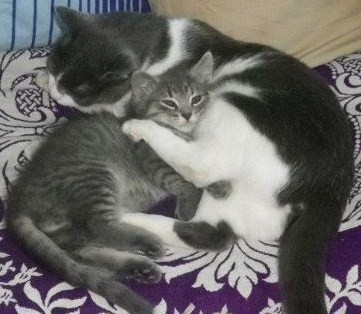
This has repeated over several times in the past two days. Now, they walk together, sit together to watch TV, feed together and even sleep together, cuddling each other.
In fact, they even go to loo together. As one is in the litter doing the job, the other sits outside, on guard perhaps.

It has been just a week now, and they seemed to have developed the warmest of relations anyone can imagine.

Still, they do wrestle and pounce on each other and we need to watch that it does not turn ugly…but perhaps it wouldn’t. After all they are not nasty human beings, they are lovely cats.

Daredevil Taara, testing Maaya’s patience.

Maaya and Taara watching TV together


Taara and Maaya sleeping like siamese twins


Sakhiya Wah Ghar Sabse Nyara,
Jaha Puran Purush Humara
Jaha Nahi Sukh Dukh
Sanch Jhuth Nahi
Pap Na Pun Pasara
Nahin Din Reyn Chand Nahi Suraj,
Bina Jyoti Ujyara

Nahin Tahan Gyan Dhyan
Nahin Jap Tap
Ved Kiteb Na Bani
Karni Dharni Rehni Gehni,
Yeh Sub Jahan Hirani

Ghar Nahin Aghar Na Bahar Bhitar,
Pind Brahmand Kachu Nahin
Panch Tatva Gun Tin Nahin Tahan,
Sakhi Shabd Na Tahin

Mul Na Phul Beli Nahin Bija,
Bina Braksh Phal Sohe,
Oham Soham Ardh Urdh Nahin,
Swasa Lekhan Kou Hai

Jahan Purush Tahwan Kachu Nahin,
Kahe Kabir Hum Jana
Humri Sain Lakhe Jo Koi,
Pawe Pad Nirvana

English Translation

Oh Companion That Abode Is Unmatched,
Where My Complete Beloved Is.

In that Place There Is No Happiness or Unhappiness,
No Truth or Untruth
Neither Sin Nor Virtue.
There Is No Day or Night, No Moon or Sun,
There Is Radiance Without Light.

There Is No Knowledge or Meditation
No Repetition of Mantra or Austerities,
Neither Speech Coming From Vedas or Books.
Doing, Not-Doing, Holding, Leaving
All These Are All Lost Too In This Place.

No Home, No Homeless, Neither Outside or
Inside,
Micro and Macrocosm Are Non-Existent.
Five Elemental Constituents and the Trinity Are Both Not There
Witnessing Un-struck Shabad Sound is Also Not There.

No Root or Flower, Neither Branch or Seed,
Without a Tree Fruits are Adorning,
Primordial Om Sound, Breath-Synchronized Soham,
This and That – All Are Absent, The Breath Too Unknown

Where the Beloved Is There is Utterly Nothing
Says Kabir I Have Come To Realize.
Whoever Sees My Indicative Sign
Will Accomplish the Goal of Liberation.

Kabir


With a chulha, a few pots and her life….She is me.
She is deprived of basic dignity of life, I am of empathy,
She is suffering from abject poverty, I am from apathy,
She is half drowned in water, I am soaked in luxuries,
If she passes away with disease, I should die in shame.
She is what she is, because I am what I am.