Next time,
you are stranded in your car,
in a snow storm,
snail pacing thro the traffic,
Turn on a soft music and,
watch each snowflake closely,
so beautifully crafted,
yet none two identical,
in shape, size or character,
sailing down, leisurely,
in a silent chaos,
trying to speak to you.
And hitting the windscreen,
trying to reach you,
To whisper to you,
“How pure, soft, different are we.
But so short lived as individuals,
While so lasting when together.”
“Interdependence” Day and beyond
First published in Aman Ki Asha on Aug 1, 2012 : http://amankiasha.com/detail_news.asp?id=854
As the dates approach, the excitement is increasing. The event is “Celebrate India, Pakistan Independence Days for Peace, Aug 14-15, 2012” — on Facebook at http://on.fb.me/LcHOeU.
As more people join the event page, those who joined earlier are getting to know each other better. They share common interests in music, culture, poetry. Some discuss pains and pleasures common to India and Pakistan. Many who met as strangers on the event page have added each other as Facebook friends and continue their exchanges elsewhere.
The idea is based on the “Pray for Peace between India and Pakistan Day” initiated by Swati Sharan in Toronto, asking Indians and Pakistanis to “Save the Date! Pray for 30 seconds in your own style for peace between India and Pakistan”, on December 18, 2011 (randomly picked). This led to some 200,000 souls around the world praying for this cause, not only via social media but at community centres and ashrams.
Inspired by the idea, a discussion began on twitter about celebrating Aug 14-15 together as “Interdependence Days”, instead of just wishing each other for Independence. “What is this celebration for if we can’t party together?” asked Shivam Vij, an IndoPak peace voice from Delhi, almost a year ago.
The Pakistan Youth Alliance, inspired by the prayers and their own Peace Parade in Lahore on August 14 last year which ended with wishing their friends in India at midnight on August 15, decided to take it further. The idea caught on and within a few days, many groups joined with more ideas and support.
Some have been going to Wagah border on Aug 14-15 for years, lighting candles to wish their neighbours for Independence Day. The Confederation of Voluntary Organisations (COVA) based in Hyderabad, Deccan has been organising events in different parts of India. This year they will celebrate Aug 14-15 with interfaith prayers and a video conference between youth across the border.
The Internet and Facebook allows those who are not physically able to join an event to participate virtually. And so, with leadership and support from Aman ki Asha, other groups and individuals have joined in this year.
Swati Sharan of Pray for Peace between India and Pakistan continues her quest through meditation and prayer. “I hope that wherever people are, they will take this power (of prayer) that they have in their hands and use it,” she says.
The Pakistan Youth Alliance (PYA), with its team leader Shumail Zaidi in Karachi plans an iftar with orphans and physically challenged children, along with a fun packed evening of imaginary India and Pakistan teams playing tug of war, Antakshari, and other games, followed by a prayer.
“We at PYA want the youth bulge on both sides of the borders to understand the importance of sustainable peace based on common ground. Enough of wars and hatred; let’s move forward to make one-fifth of humanity an epitome of progress, prosperity and equality,” says Ali Abbas Zaidi who heads PYA. Believing that his generation, youth on both sides of the border, can be ‘game-changers’ towards a better South Asia, “together we can, and together we must,” he insists.
Another youth initiative, Romancing The Border, is working to build a movement to increase positive engagement between India and Pakistan. It includes innovative tools such as e-cards with positive messages. “We don’t know if RTB will make a difference, but it brought 80 of us together from around the globe. We cared. We will continue to do so. We all came for a peaceful South Asia,” says one message.
For Independence day this year, RTB is planning a “Google Hangout” between Indians and Pakistanis aiming to set a world record for the longest running virtual meet-up between conflict boundaries.
The Journal for Pakistan Medical Students plans a teleconferenced get-together for volunteer editors on both sides, to take forward for the idea of peace and cooperation in healthcare through medical research.
“There is no other option but peace between India and Pakistan, if we are to fight mutual enemies like malaria, cholera, dengue, hepatitis, maternal mortality…,” says Dr Anis Rehman, a JPMS co-founder.
The South Asian community in Canada, including eminent professors from the University of Toronto at Mississauga (UTM) and Mc Master University are celebrating Aug 14-15 with the launch of Pledge for Peace – a website to provide an ongoing, long-term platform for Indians and Pakistanis, aiming for “lasting peace and friendship between the two peoples”. The website will invite pledges from around the world to make a chain of peace and launch an online game for youth, Cricket for Peace, to be inaugurated jointly at UTM by the Hindu Students Council and PYA.
Other joint collaborations beyond Aug 14-15 are planned. Mumbai Marathon is organising the “Every Step Counts” run between Amristar and Lahore on November 9, 2012, to commemorate the birthday of Allama Mohammad Iqbal, Pakistan’s national poet. Runners will start from Golden Temple, Amritsar and end at Iqbal’s tomb at Badshahi Mosque, Lahore, to commemorate the man “who gave us the beautiful song Sare Jahan Sey Acha,” says team leader Swaminathan Subramanyam. “Why do we do this? Because as we look for peace between our two countries, EVERY STEP COUNTS.”
Pakistan’s Pedal for Peace group are organising their Lahore to Amritsar bicycle tour to coincide with Every Step Counts’ November 9 event. “We cycle from one city to another in order to spread the message of peace, tolerance and to urge people to solve social issues hampering our growth” says Abdul Basit Khwaja of Pedal for Peace.
Those who are unable to physically join an event are invited to dedicate some time to peace on Aug 14-15 this year, wherever they may be: light a candle, meditate, pray, fly a kite, cook a meal, make a piece of artwork or write a poem dedicated to peace between the two countries.
Let’s make peace more visible than conflict, this Independence Day. Happy India Pakistan Peace celebrations!
Dr Ilmana Fasih is an Indian gynaecologist and health activist married to a Pakistani. She blogs at Blind to Bounds https://thinkloud65.wordpress.com
A Forbidden Dream?
This is a story from my life and dreams, in three short episodes.
Episode ONE:
Location: Amritsar
Time: 8AM on a lazy Sunday.
Suddenly my husband declares, “I won’t eat boiled egg today for breakfast. Enough of calorie count.”
“I can’t make Nihari in a few minutes. You should have told me yesterday, you want to eat something else.”
“Idea, lets go to Lahore for a Paaye-Nihari naashta at Gawaal Mandi. It’ll take us less than an hour by car. Keep my passport also in your purse.”
Within 10 minutes we were on the PEACE ROAD to Lahore, and just an hour later sitting in Gawal Mandi under the open skies in a mild cold breeze, as my husband was ordering two plates of Paaye Naan with doodh-patti chai.
Episode TWO:
Location : Karachi
Time: 1:00 PM Lunch time in the office with friends.
“What are you wearing on the Annual Celebration for our Office.”
“Oh, I don’t have any decent dress to wear, I wish I could wear an Indian saree for a change.” (Yes every woman, almost never has a decent dress to wear.)
“Heyy, you know I saw on TV there is a bumper sale in Rana Sarees in Jodhpur, on bandhnis, leheriyas etc. Even I want to buy one.”
“Idea! Why don’t we plan, take train on Friday, to Jodhpur and come back on Sunday.”
“Yes, brilliant idea. Rana Sarees is closed on Mondays only.”
Thursday evening, we pack our small trolley bags, and off we are, on Friday morning in the PEACE TRAIN from Karachi to Jodhpur on Khokrapaar-Munabao Railway track.
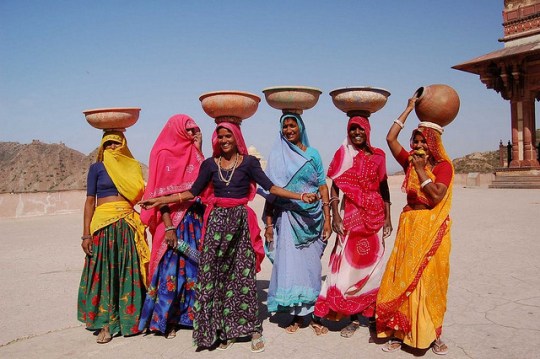
As the train winds through the golden sands of Thar Desert, we see Thari men and women in their colorful clothes busy with their daily work. A group of women stop by, turn at us and wave back at our train.
I look at the woman in a white and red saree, and scream excitedly, “I will buy a saree of this design.”
In 5 hours we are in Jodhpur. With a shopping spree all Saturday, on Sunday morning, we set off with loaded bags, on the train back home.
Episode THREE:
Location: Mississauga, ON , Canada.
Time: Early morning on a cold Saturday on a long weekend.
“Winters are depressing, Are we going to spend all three days sitting in the home in front of a fire place?”, my husband.
“No, we can go to America, to have an ice cream in -20 degrees C.” I remark sarcastically.
“Hey, why ice cream, lets go to Buffalo, for cheese cake?”
The idea hits home. And in 5 minutes, we were on QEW Highway heading down South and East to Buffalo. In an hour we were at the border, and 8 minutes later, which included clearance from the US Homeland Security of our Pakistani Passports, we were on the PEACE BRIDGE, built over Niagara River, between Fort Erie ( Canada) and Buffalo ( USA).
In two hours after a lunch and an order of cheese cake, we ere driving back home to Canada.
Do the stories sound wierd?
Or perhaps for some, “So what’s there to blog about them? Isn’t that normal. ”
Indeed, for many across the world, such adventures are normal. They travel cross countries which even speak different languages( as in Europe), without much fuss, just for a cup of coffee or even go to work across border.
As you may have guessed, only Episode THREE was a real one, while the Episodes ONE & TWO are still far fetched dreams.
The fact that Peace Bridge is a reality, it hurts even more to know that Peace Road or Peace Train have to still remain a dream, a far fetched one.
They do occasionally become a reality, but for the VVIPs (only). For instance, when one fine weekend the Head of the State on one side decides to go to the other side for a visit to a shrine, or for a cricket match. But it still remains a dream, and a forbidden one, for the ordinary.
Even when the ordinary have relations, loved ones or friends on the other side, all they are entitled to is to dream like the way I dreamt in episodes ONE and TWO.
I know of a true story of a friend, who planned a year in advance to be with her parents, on their Golden Jubilee Wedding Anniversary. But the visa did not arrive on time. And when it did arrive, 15 months later, her father was in the hospital, struggling for life. She fortunately made it, to see him, and then he passed away two days later in her arms. She felt fortunate to have met her father, and held him in his last minutes of his life.
This wasn’t her dream, but a true story.
I cant even call myself that lucky. I reached two days after my father was buried. Now I dread for my ageing mother. May she live long, and every time I part with her, I wonder in what circumstances would the next meet be. Would it be possible at all or not?
With months of excitement about the much publicized NEW VISA REGIME, I had anxiously awaited ( and tweeted) for the arrival May 25, 2012, when the document was expected to be signed. But it was postponed in the last minute, by a Minister from Pakistan for ‘some’ reason I didn’t care to explore. For me it was a delay in realization of part of my dreams, for whatever reason-valid or lame.
{However, the divided families did not have much to rejoice from the new agreement, but I still thought this a great step in the right direction.}
Finally in December, when the Ministers met in New Delhi, the agreement was sealed and signed.
Alas, with no jinx, we apprehensively took a sigh of relief.
But then, as feared, the tensions at LOC and the beheading incident put the implementation on hold. Again, the ‘not so big’ dream which had come so close to realization had again receded afar.
The dream to cross the Indo Pak Border is not for Nihari or for a Saree. We can get it on the same side of the border too. They are simply the symbolic magnets of common love and heritage, that the ordinary people on both sides have not been able to ignore, despite years of deliberately created rifts and barriers between them.
Some have outrightly called my Nihari-Saree dream as cynical one, but when few millions ordinary citizens between the US-Canada or within the EU can see this as a reality, why cant the 1.4 billion( a seventh of humanity) across India and Pakistan?
When 3 wars, and countless hostilities have not resolved the differences why can’t peace and cooperation be given a real chance?
Like every sovereign nation, India and Pakistan too have the right to ensure, that no miscreants are let to cross the border, but why should the whole population of wellmeaning people be held hostage to the whims and fancies of few vested interests?
Let the people interact through easy Visa for the ordinary.
Let prejudices whither and sanity & reasoning prevail.
Please, let the people meet.
Please #MilneDo
Lambee chaal
Ek bahut hi ghareeb mulk tha, naam tha uska Dammocracy.
Wahan per ek aqlmand shakhs ki hukumat thi, jiska naam tha Zorbhaari. Uss mulk ka ye tareeqa tha, ke her 2-5 saal mein hukumat badal jaati thi.
Ye pehla sadr tha jisne apni danishmandi se 5 saal khench liye. Pher jab kuch maheene reh gaye to uska dil lalachaya, ke aur kuch saal raj ker loun. Bahut dimagh per zor diya.
Udher door pariyon ke mulk mein ek Pir rehta tha, behad saaf, doodh jaisa dhula safed.
Zorbhaari ne socha is Pir se koi dua ya hull nikalwaya jaaye.
Usne Pir ko Dammocracy me bulwaya. Uske aamad per apni riyasat ke chappey chappey ko uskee tasveeron se sajaaya.
Pher ek din uss ne Pir se ilteja ki:
Zorbhaari: Pir Saheb aap jo kahengey jitna maangengey main doonga. Buss mera kaam ker dein.
Pir: To pher meri baat ghaur se suno. Tum Bholewal House me paani ke kinare baith ker mera wird karo. Mujhe ek lambi chaal chalni paregi. Pher main 3 din mein Zaalimabad sambhal loonga. Jaisa kahoon, waise kerna.
Zorbhaari: Jee Baba ji, aap ulta latakne ko bhi kahenge to ker loonga.
Pir: Ager tum se isteefa mangoon, to teesre din de dena. Dobara isee assembly se 5 saal ke liye waapas aa jaogey. Haan thora see Qurbani deni hogi.
Zorbhaari(dartey huwe): Woh kaun see?
Pir: Ho sakta hai Baja Rental ka balidaan dena parey. Lekin sabr karo, aur mera bataaya wird karo. Allah tak tumhari arzee pahuncha dee hai.
Zorbhaari: (falls on the feet): Baja Rental ki khair hai, who to waise bhi dimagh ka khaali hai, mujhe hi sab kuch samjhana perta hai. Beshak uska balidaan le lein. Buss mera kaam ker dein Pir sahib.
Pir: Ek aur bahut zaroori baat hai. Mere mureedon per koi bomb ka hamla nahin hona chahiye. Khoon baha to wird ulta ho jaayega.
Zorbhaari: Aap fikr hi mutt karein, nahin hoga. Main honey hii nahin doonga, to kaise hogaa. Intezaam sakht hoga, nigrani pakki hogi. Iski main gaurantee leta hoon. Aap tou buss mera kaam ker dein huzoor. ( haath jortey huwe)
Pir: Tou pher fikr mutt karo, Allah tak tumhari arzee bhej dee hai. 3 din mein Kaam ho jaayega. Buss mujhe der hai iss Tsunami Khan ka, isska Pir kaheen koi ulta wird na ker dey.
.
Zorbhaari: Pir Saheb kuch pakka intezaam kijeeye, ye Tsunami Khan mere peechey para huwa hai. Is per koi kala jadoo bhi nai chaltaa.
Pir: Allah ko arzi bhej di hai, ke Tsunami Khan ki aankh per parda per jaaye, aur woh bhi hamari chaal ko na pehchaane sakey. Ooper wala hamari darkhwast kabhi nahin taalega. Kam pakka hoga. Kuch ho na ho, lekin fatah tumhari hi hogi.
Tum buss Parhtey raho….Haan aur mera muawaza poora milna chahiye. Khabardar mere saath koi chaal mut chalna. Mujhe ghaib se khaber mil jaayegi ?
Zorbhaari: Pir Pir mujh per rehem farmayein…(aur pher Pir ke wird mein madhosh ho jaata hai…).
*Only pun intended*
Sometimes calamities unite us more
First published here: http://amankiasha.com/detail_news.asp?id=1018
The conscience-shaking brutal rape and subsequent
death of the anonymous student from Delhi is not India’s issue alone and the grief is not for one case alone
By Ilmana Fasih
As thousands of people on both sides of the India Pakistan border mourned the death of the Delhi gang rape victim, someone commented on Aman ki Asha Facebook group: “Well, the Delhi rape proceeds from a common mindset. The negatives unite us just as well as the positives.”
“Sometimes, calamities unite us more,” came a response.
The conscience-shaking brutal rape and subsequent death of the anonymous student from Delhi (who is referred to by different names by various sections of the media) has made us rethink how common our pains are.
Beyond this tragic incident, looking through the e-newspapers from the subcontinent, there is hardly a day without some incident of rape being reported.Be it the gruesome gang-rape of a medical student at a bus stop in a megacity, or a six-year-old girl raped by local goons in a village, or a girl raped while partying with friends in the posh area of another city, or a teenager gang-raped and then asked to patch up by accepting money or marrying one of the rapists in a town. Can you guess which side of the border each case belongs to? The scenarios differ, cities differ, but the crime remains the same. The mindset stays identical. Age is no bar. Infancy upwards, one finds women and children of all age groups being subjected to rape and sexual abuse.
Unfortunately this is one situation where the human race seems to have achieved a “no barriers of age, color, creed or class”, the world over.
Hard to digest, but rapes are on a steep rise in the subcontinent.
In 2011, 568 rape cases were reported in Delhi, and 459 in 2009 (National Crime Reports Bureau) .The figures given by Delhi Police reveal that a woman is raped every 18 hours or molested every 14 hours in the capital.
Similarly in Pakistan, Human Rights Commission of Pakistan, estimates that “every two hours a woman is raped in Pakistan and every eight hours a woman is subjected to gang-rape”.
The Additional Police Surgeon, quoted in a 2008 newspaper report, estimated that at least 100 rapes are committed in Karachi alone every 24 hours, although most are un-reported.
If these are the statistics of two megacities, one can fathom what would be the situation in the other smaller towns and villages. It is well known that the majority of the rapes in India, Pakistan and other South Asian countries are never reported, and just a handful of the perpetrators are ever punished.
The tragedy is amplified when inane solutions are offered like: “Women should not go out late at night” or “Women going out late night should be accompanied by a male.” In the ‘Delhi gang rape’ case, the solution of an accompanying man clearly failed.
Women are advised not to wear western clothes, or more ridiculous “not to eat chow mein” or “not to carry mobile phones with cameras”. Some even advise women to not report the attack “if there are not enough witnesses”.
But none of this well-meaning advice takes into account why rapes occur. It is not because the woman was dressed so, or walked alone on the street late at night, or was attending a party with her friends or ate a certain kind of food. No. Rape occurs because some men want to rape. And why do ‘some’ men want to rape and not others? Rape is the culmination of a series of systematic experiences that a man is exposed to, from infancy to manhood- in which he is told, with or without so many words, that he is stronger, and a woman is not just weaker, but a commodity at his disposal. Rape is a way to display power and superiority.
So long as this mindset persists, legislation and punishment will never be enough of a deterrent. This tends to get overlooked in all the outrage at the gruesome details of the Delhi gang rape, that has led to demands for the severest of punishments, even public hanging for the perpetrators.
Without undermining that tragedy it is important to remind ourselves of the countless cases of rape and sexual harassment that are routine on both sides of the divide. Those who survive suffer psychological trauma, often far from the media limelight, mostly in silence.
Rape survivors are often pressured by the police or local goons to hush up the matter either, to accept money, or worse still, marry the rapist. Many commit suicide, or live with permanent scars. The rapists often roam scot free, posing a threat to the survivor who does not even dare to raise her head for justice.
Insisting on the death penalty in an isolated case that has shaken people cannot be a solution. Studies have shown that the certainty of punishment, rather than its severity, is a greater deterrent to crime.
We also need to look towards at preventing this crime rather than just push for a punishment after a case gets highlighted.
Foremost, each of us, irrespective of gender, which empathises with the Delhi student who was gang-raped, or any other faceless rape victim, needs to strive to ensure every woman in our sphere of influence feels secure and gets due respect. One of the signs of evolution in human beings is the neo cortex which enables us to restrain behaviour and train our minds. We need to use it to ensure that we don’t force anything upon any woman – or indeed anyone in a more vulnerable position.
Secondly, we need to empower girls with the right information and stop making rape a taboo issue for their ‘innocent’ minds. It is more important to teach a girl to be assertive than to try and ‘protect’ her. “Look up as you walk and stand up straight; pretending as though you have two big panthers on either side of you as you walk may sound silly, but it can help boost confidence,” suggests a self help site on rape prevention. “Attackers are more likely to go for those who they think cannot defend themselves.”
Given that over 90% of the perpetrators are known to the victims, girls (and boys) must be taught that if they feel uncomfortable with anyone’s touch – even if it is an uncle, a cousin or a friend – they must trust their gut and not let it continue. Thirdly, if we cannot change the mindset of some grown men, we can at least guide our sons, right from babyhood, to respect women and not consider them a commodity that is ‘available’. Last but certainly not the least, for those who cannot change their mindsets, a real need for certainty and not the severity of punishment to the rapist, as a mode of deterrence, is mandatory.
Shocked after the demise of the Delhi paramedical student, I tweeted: “Her sacrifice must no go in vain. Let us rise to make violence against women a history.” Knowing the scale of the menace, this may be wishful thinking, but we need to keep striving to make it a reality.
The writer is an Indian gynaecologist married to a Pakistani, a proud Indian Pakistani dreaming of a peaceful, healthy and prosperous South Asia.
ilmana_fasih@hotmail.com.
She tweets @zeemana
Wednesday, January 02, 2013
A tribute to Delhi gang raped girl, inititially known as Amanat, Nirbhaya or Damini:
Pizza Pakistania
Pizza is Italian and everyone knows it. However, as remarked by a cousin from Italy, what Pizza Hut and other pizza brands make are delicious foods, but they are not Pizzas. A typical Italian Pizza is extremely thin crust with a crispy base.
What is interesting are the legends associated with its origins. Not sure how authentic or true are they, because one does not find them documented in books.
One is that Pizza used to be a poor man’s food in Ancient Greeks, who made a flat loaf of bread and spread it with onions, garlic and herbs.
In the 1st century BCE, the Latin poet Virgil refers to the ancient idea of bread as an edible plate from his Latin epic poem, the Aeneid (trans. A. S. Kline ):
When the poor fare drove them to set their teeth
into the thin discs, the rest being eaten, and to break
the fateful circles of bread boldly with hands and jaws,
not sparing the quartered cakes, Iulus, jokingly,
said no more than: ‘Ha! Are we eating the tables too?’
Another is that in 1800s Italian Royality commissioned a cook to make Pizza, in honor of Queen Margherita. Out of the three, the Queen picked up the one made with tomatoes, olives and mozzarella cheese, because it had the three colors of Italian flag–red green and white. And so this is how it came to be known as Pizza Margherita. Not sure if Italy had the same flag then too.
Interestingly, when you ask some friends who make pizza at home, they share that they add many ingredients into the base including eggs, powder milk, baking powder, baking soda, butter etc. Yet many of them fail to make the necessary sponge, or the crisp the base made from shops get.
However, the recipe that a cousin shared from Italy was surprisingly simple, yet fail-proof. Never ever has my pizza base, after following her instructions, failed to rise.
The ingredients are simple– flour, yeast, a pinch of salt, a teaspoon sugar, some lukewarm water and Olive oil. It is the method of making the dough that makes the real difference.
Fond of homemade Pizza, as it comes steaming hot from the oven with its appetizing aroma, the grown up kids, take active part in custom designing the toppings. Having tried almost all the renowned and strange combinations, they are now fond of green and white topping which includes– pesto sauce at the base, baby spinach leaves, fresh basil leaves, green olives, feta & mozzarella cheeses.
Nostalgic with the green and white colors of the Pakistani flag, they call this (originally a Greek recipe) Pizza Pakistania.
Following is the making of the Pizza Pakistania from the scratch:
First and the most important step: To let yeast ( I teaspoon), a fist of flour( half a cup), and sugar ( 1 teaspoon) froth with lukewarm water ( 2 cups) for 15-30 minutes

The kneading of dough. Add gradually the remaining flour ( total 3 cups) , olive oil( half a cup) and pinch of salt. Knead it well and leave it to rise for half an hour in a warm place.
Rolling out a leavened dough. The more leavened it is, the more it gets tough to roll out as it keeps recoiling back:
Base spread with Pesto paste, which if homemade needs basil leaves, pine nuts, fresh garlic made into a paste with olive oil:
{Homemade Pesto sauce: Take a cup of fresh basil leaves(tulsi leaves), half a cup of pine nuts( chilghoza), half cup extravirgin olive oil, 4 cloves of garlic and salt to taste. Grind them coarsely in a chopper or a mortar}.
Our fresh supply of basil leaves, which adds aroma to the pizza:
Assembling together baby spinach leaves(2 cups), basil leaves( half a cup), feta cheese( 1 cup) and mozzarella cheese(1 cup):
Bake it in a preheated oven at 225 degrees C, for 15-20 minutes, until cheese and the crust is golden brown.
Hot and crispy pizza, just out of the oven:
And it took just a quarter of an hour for two pizzas to vanish from the dining table:
Moral of the story: Its simple to make ( with less cumbersome toppings), loads of green healthy stuff, and a pleasant change of taste from the usual pizzas.
Don’t miss the close look at the fine sponge and the crisp of the base bread. 😀
How I wish, these Christmas vacations are forced upon us, every few months !!!
Defying stereotypes–my new taxi driver friend.
I needed to take a taxi and hence I called one.
As I slid the rear door open, and slipped into the back seat, I saw a sweet face smiling back at me. I was taken aback. It was the first time I saw a woman sitting in the drivers seat, and that too with a desi face.
I presumed, almost instantly, she must be an Indian, but on conversation she turned out to be a Pakistani from Lahore. She was a school teacher. Her husband who also drives a taxi, was a senior Vice President of a top bank in Pakistan, before they immigrated to Canada.
She found no hazard in working as a cab driver, except that she did not do late night shifts. According to her, there are a few women taxi drivers in Toronto, but she is the first one in Mississauga.
What was interesting was not their transition from white collar to a blue collar jobs. The real issue was ridicule she received from her own desi community.
Many of the families fake a family discord, with women shown as ‘single mothers’ are receiving welfare support from govt.
The same people she said, have the audacity to tell her: “Ghalat auratein taxi chalati hain”. ( The bad women drive taxi).
To which she replies: “Achi auratein hi mehnat ker ke rizq-e-halal kamati hain, buri auartein jhoot ki buniyad pe financial assistance leti hain”. ( Good women work hard to earn money, bad women get welfare through falsehood).
After hearing her words I did not have the guts to add a tip to her bill, for it might offend her. So I paid, only the amount that I was billed to.
We parted, with a hug and exchanging cell phone numbers. I told her, I will blog on her. Her eyes twinkled.
A couple of hours later, she called me up on my cellphone, saying “thank you”.
I salute this new friend on mine, for her honesty & bravery.
( Her identity has not been revealed on her request, to save her from further ridicule from the community, for speaking the truth).
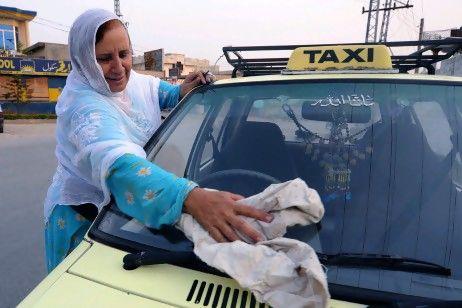
Below is the picture of another lady taxi driver, Zahida Kazmi, the first and only ( I am surprised though) taxi driver in Pakistan, who began this work after her husband died, leaving her to be the sole gaurdian of her 6 children.


You must be logged in to post a comment.