Open up your mind and your potential reaches infinity…


comedynight684x250

What more could one ask for at the opening of TD Mosaic Festival 2013, through Comedy Night on August 11, 2013 at Novotel Hotel.

It was an hilarious evening, packed with laughter, more laughter and even more laughter, for a straight two hours. Three Stand up Comedians lined up, wonderfully represented the diaspora of North American, Canadian, desi mix.

Ali Hassan, a Canadian Stand Up comedian, host of Laugh Out Loud, and Lead Comedy Panelist on George Stroumboulopoulos Tonight set the funny ball rolling, as he shared his own hilarious experiences as a Dad of three, before introducing the guest Comedians: Nitin Mirani and Azhar Usman.

Nitin Mirani is a Dubai based Indian stand up comedian, who calls himself a ‘glocal comic’: Talking global issues with local flavor.

Laughing at the stereotyping of his own Sindhi roots (which are associated with finance),  he mentions: “”My mother said, “Get a 9-5 job in a bank like your Dad and brother, otherwise people will laugh at you. And that is what they are doing now.”

Watching how interactive and spontaneous he was to the reactions from his audience, I asked: “How do you manage to tread on the thin line between humor and mockery?”

He was prompt: “Humour connects everyone. Life is fast and nowadays everyone wants a one-hour massage in 10 minutes. One has to gauge in the first few minutes, what is the pulse of the audience to humor. And sometimes, some people do get offended, and I simply go and apologize if they feel offended.”

Nitin brought back the nostalgic memories of India by mentioning of  cows that sit on the middle of a busy city road, and how we accommodating Indians, make them instantly as our traffic roundabouts.

And also of the litmus test of the desis, when you travel with them in the elevator: “They will scan you with their eyes, from head to toe.”

Nitin is the founder of Komic Sutra with the motto of : “Laugh and let laugh.”

“Compared to the Egyptians who are famed for their sense of humor, how do you place desi sense of humor?” I inquired.

“We too have an old tradition of humor since the Mughals, when the courts used to have Nautanki. And Birbal in Akbar’s Court was a great example of an intellectual who also had great sense of humor. Intelligent Akbar-Birbal jokes are so famous.”

Nitin has to his credit various titles of: ‘The King of U.A.E comedy’, ‘Best Personality’ at the 2012 Best in Dubai Awards, being named as one of the funniest people of 2012 by Rolling Stone M.E.

Nitin, is not just extremely hilarious, he is seriously a Bollywood material too.

Having laughed mad already, I had no idea what the Headliner, Azhar Usman, the Ayatollah of Comedy had in store for us. Sporting a large beard, and a skull cap, Azhar is best known for his comedy tour, ‘Allah Made me Funny’, a theatrical production that ended up as a movie.
Living up to his title of “Bin Laughin”, he again split the whole crowd into non stop laughter,. My cheeks had by the end, started to cramp.
He begins: “I have travelled all over the globe, and have realized that despite appearances, attires and skin color, we are all so alike.”

Possessed with a unique sense of humor, he gives the grave issues of racial profiling and stereotyping a humorous twist, making them all sound so ridiculous. He treads on to these sensitive and serious topics with great maturity and responsibility.

To prove his point he narrates a typical desi Auntie’s Telephone conversation:
“Jee haa, jee jee, theek hai, okay, Jee bilkul theek, jee jee. Okay Allah Hafiz.”
And how would this be taken be interpreteted by the Homeland Security
“Yes, yes, , yes, yes, alright, okay, yes, absolutely, Okay. May Allah be with you.”
Heyy, we found it, this is Al Qaida,

Talking to him after the show, I find him  very positive, who holds no malice or anger towards the reactions he and other Muslims face in their day to day lives, owing to a handful of Extremists who have hijacked the community’s image.,

Humor is a way you can share with the audience your bitter experiences, and make them realize the ridiculousness of it all. We must have no anger if we realize, it is all a reaction to fear, and a reaction to that reaction most of the times.”

He believes through comedy and humour, we can begin difficult and serious conversations, which do not offend anyone.

“Humour is a way to bridge gaps of bias and intolerance that have existed way before Sept. 11, 2001.” Usman elaborates.

Usman concludes the brief chat with me with the mention of two quotes from his favorite British humorist, Peter Ustinov:
Comedy is simply a funny way of being serious.”
: “Terrorism is the war of the poor and the War is terrorism of the rich. “
“Killing of any innocent civilians, whether from a dark cave or white house, is Terrorism. “ he ends.

Later going through his website, I found this touching of his introduction on his website:
“He considers himself a “citizen of the world,” and describes himself variously as follows: Intellectually White; Emotionally Japanese; Spiritually Indian; Psychically Persian; Physically Arab; Artistically Southeast Asian; Romantically Latino; and Psychologically Black. Today, Azhar is a global standup comedian who makes people laugh by telling the truth.”

And a few quotes on him:
“Allah Made Me Funny is an idea whose time has come.”(Russell Peters).
“Turns fear into funny.”( The New York Times)
“America’s Funniest Muslim!”(CNN).


barbaad tamannaa pe ataab aur zyaadaa
haanmeri mohabbat kaa javaab aur zyaadaa

roye na abhi ahal-e-nazar haal pe mere
honaa hai abhi mujh ko Kharaab aur zyada

aavaara-va-majanun hi pe maukoof nahin kuchh
milane hain abhi mujh ko khitaab aur zyaada

uthenge abhi aur bhi tufaan mere dil se
dekhunga abhi ishq ke khvaab aur zyaada

tapake ga lahu aur mere dida-e-tar se
dhadakegaa dil-e-khanaa-kharab aur zyaada

ai mutrib-e-bebaak koi aur bhi naghma
ai saaqi-e-fayyaz sharaab aur zyaada.

He is  Keats of Urdu poetry.
He was a darling of Urdu poetry lovers of his age.

Ismat Chughtai recounts,” Girls college mein ladkiyan usse shaadi ke liye qura nikaalti theen”[it was a pastime among hostel girls to draw lots, to decide which girl will marry him].

He belonged to the era of progressive and revolutionary  poets, leading the Progressive Writers’ Movement of Aligarh with Sahir, Josh and Ali Sardar Jafri.

Jalaal-e-aatish o barq-e-sahaab paida kar,
ajal bhi kaanp uthe tu woh shabaab paida kar
Tu inquilab ki aamad ka intezar na kar,
jo ho sake to inquilab paida kar”

He was hopelessly romantic:

Khub pehchan lo asrar hun main
jins-e-ulfat ka talabgar hun main

ishq hi ishq hai duniya meri
fitana-e-aql se bezar hun main

chedati hai jise mizarab-e-alam
saz-e-fitarat ka wohi tar hun main

aib jo hafiz-o-khayyam mein tha
han kuch is ka bhi gunahgar hun main

zindagi kya hai gunah-e-adam
zindagi hai to gunahgar hun main

meri baton mein masihai hai
log kahate hain ki bimar hun main

ek lapakata hua shola hun main
ek chalati hui talavar hun main

And on his unsuccessful love:

Na ayaa’n hui un se, na bayaa’n hui hum se,
Bus suljhi hui aankhon mein, uljhi rahi muhabbat..
Yeh merey ishq ki majbooriyan ma’az Allah,
Tumhara raaz tumhi sey chhupa raha houn mein.

Heartbroken not just in love, but of the prevailing social conditions in those days, he took refuge in heavy drinking,

“Bahut mushkil hai duniya ka sanvarnaa,
Teri zulfon ke pech-o-kham nahin hain.”

Friend and contemporary poet Josh Malihabadi advise him to control his drinking: Majaz ghadi rakh kar piya karo’
A maverick Majaz laughed:,”Josh sahab main ghada rakh kar peeta hoon.”

Another friend, Jigar Moradabadi begged him to quit drinking like he did. Majaz’s response was:“Tum ne to ek baar chhori hai, main to kaee baar chhorr chuka huun.” (You left it just once, I have left it several times).

He died in Lucknow due to  heavy drinking at the age of 44.

Josh remarked on his death: ” Majaz took 75%of his poetry to grave because of early death, otherwise he may have surpassed everyone else.”

“Ab iskey baad subah hai aur subah-e-nau Majaz,
Hum Per hai khatam Sham-e-Gariban-e-Lucknow.”

My favorite couplets of Majaz:

Is mahfil-e-kaif-o-masti me, is anjuman-e-irfaani me
Sab jaam-bakaf baithe hi rahe, hum pee bhi gaye chahlka bhi gaye.
(This gathering of fun and frolic, the erudites all around
All merely sat with the goblets, but I drank to the full).

Sab ka madawa kar daala apna madawa kar na sake
Sab ke gireban see daale apna hi girebaan bhool gaye.

Ghazal sung by Jagjit Singh


This content is password-protected. To view it, please enter the password below.


While the rest of the world, including me shuddered at the premature demise of democracy in Egypt, my Egyptian colleague sitting next to me in the office was bouncing in her chair. Opened in front of her was her Face book page and Twitter account, receiving and sending congratulatory messages.
I walk into her cabin and before I could ask she rejoiced:
“We have got our country back.”

Me: “But isn’t this a demise of democracy, and army is back?”
Her: “Why? You think Morsi was ruling? Is elections democracy? He was running the Islamist, Salafi agenda?”
Me: “Yes, but in democracy, he would be routed out next elections. Democracy is a painfully slow process, we know.”
Her: “No this is not democracy. Do you know how he had won the elections? He had got the petro-dollars to the poor in rural Egypt , and taken their ID cards numbers for the vote.”
Me: “Yes I can totally relate to that, but still, democracy takes time to work.”

She hardly even listened to my democracy rant, and continued….
Her: “He was not working for Egypt, and was carrying an outside agenda. He even disowned our history. The Muslim Brotherhood had declared Pyramids and Pharoahs, our history and heritage as Haram. Do you know, they even reduced the age of marriage for girls to below 18?”
Me: “I know, but I will still think that a military coup is not a good idea.Democracy may have it’s ills but world still has to discover a better form of rule”
Her: “My dear, this is not a coup. This is people’s will, peoples power. This is a revolution.”
There was an unshakable belief in her tone.
Me: Hmmm…

I still disagreed. But she was hardly paying any attention to my views, and was drunk in her own ecstasy.
Her: “Okay, if you have Talebans elected in Pakistan sometime, the same way, through an external power, will you accept them as democracy? “

She knew she had cornered me, and that I would not agree to that at any cost.

She continued: “See this, I will show you my Hijabi friends in Tahreer Square, sending me congratulatory notes, that “We have won our country back.:”

And she actually showed me her friend’s profiles, who were so.

“It was an external agenda that Morsi was working for, not Egyptian. We have conservative Egyptians, but they don’t support the extremists. Do you know they were giving a quite support to the killings of Shias in Egypt in the past one year?”

I fired her the last question that was knocking in my head: “Do you think with the departure of Morsi, the Brotherhood agenda will go? Will they not organize themselves for revenge, and get violent now?”

For the first time in this discourse my friend gave a pause, and was thinking..

“NOOO,” she said firmly with …”yes they are there, but…. You know they are a tiny minority………. And now they are much less popular.”

There was a long explanation from her, but without much substantial argument and even lacked conviction now.

Going through Twitter there were myriad of interesting pictures depicting the glorious revolution making rounds.
Picture #1 attached Military heart.

Military Heart.

There was a deluge of tweets with hashtag #EgyptianRevolutionNotMilitaryCoup

This tweep was sure it wasn’t a coup, even when she didn’t know how to spell it correctly;
Sara Ameer ‏@EngSarAm 15m
Message from #Egypt to the whole world, this is not a Military Queue #Morsi #EgyptianRevolutionNotMilitaryCo

Military Queue

Hany Sadekk @HanySadekk 6h
“@NevineZaki: Another very interesting perspective on why this is not a coup. pic.twitter.com/ztThc6e501” #EgyptianRevolutionNotMilitaryCo

Coup de'tat.

And those who knew it all…

sweetsammora ‏@sweetsammora 3h
For those who say it’s a Military Coup, I dare you to say that to 33 millions! #EgyptianRevolutionNotMilitaryCoup

Those asking the rest of the world to mind their business:

Mido ‏@midoahm 7h
#EgyptianRevolutionNotMilitaryCoup This is our Msg to the World!! Dont get involved! !

@Esraa2008 6h
#EgyptianRevolutionNotMilitaryCoup @BarackObama U r worry now about Egypt, but you weren’t worry when the head power of Egypt was terrorism

And the cartoon:

Obama: I am worried about the situation in Egypt.
Egypt: Fear not, sweet heart.
Egypt

Egyptian Gothika \m/ ‏@Raven_Angelika 17h
“There is nothing new in Egypt, Egyptians are making history as usual..” #Egypt #EgyptianRevolutionNotMilitaryCoup

And at the same time we heard in News of Journalists being arrested and TV channels including Al Jazeera being shut down in Egypt, I really wondered and tweeted on the same hashtag:

Ilmana Fasih ‏@ZEEMANA 13h
When TV stations are shut down, is it a revolution or a coup? #EgyptianRevolutionNotMilitaryCoup

We had the most horrified and concerned tweets coming from Pakistan, on the demise of democracy in Egypt.

Umar Cheema ‏@UmarCheema1 3h
Military takeover has nowhere been able to fix democracy. Problems have been fixed with more and more democracy. #Egypt

Raza Rumi ‏@Razarumi 7h
Deja vu RT @vali_nasr: #Egypt generals say their soft coup is meant to restore democracy. That is what both Zia and Musharraf said in #Pak

Amidst the euphoria on twitter, I tweeted my worst fear:

Ilmana Fasih ‏@ZEEMANA 17h
Morsi may be gone but Muslim Brotherhood is still there. Will it not get stronger now in #Egypt? #MyFear

Instant comes a reply from an Indian friend:
Reena Satin ‏@ReenaSatin 7h
@ZEEMANA Yes, people should have let them complete their tenure, and reveal their true identity.

Honestly do we blame Egyptians for their euphoria? How many times have we in the past rejoiced at military take over?

As aptly commented by a Pakistani friend Kamran Rehmat on Facebook:

“I’m not at all surprised your Egyptian friend has the views she has. What would Egypt know of democracy, whom democracy does not know!”

And then the same friend remarks:

“Looking at Egypt today, I feel like a million dollars being a Pakistani, warts and all. The fauj cannot dream of doing this in Pakistan anymore.”

Ilmana Fasih
4 July 2013


While strolling in a Pakistani Mela,  Khyber to Mehran, in Mississauga I was attracted to a giant canvas partly filled with vibrant colors. As we got closer, we saw a man with was effortlessly making strokes with a brush creating flawless images. Without the initial sketch, even the symmetry was perfect.

That’s truck art.” Screamed my daughter. I stood watching him in awe…not just the perfection, but the speed and the choice of colors. He turned back and in response to our questioning smile, introduced himself as ‘truck artist Haider Ali’ from Karachi. ( The stress was on the first two words).

Haider Ali is visiting Canada on the special sponsorship of the Pakistani Consulate and represented Pakistani Truck Art  in the South Asian Heritage Celebrations called RUNG, at Royal Ontario Museum, Toronto, and Carrasauga Festival in Mississauga in May. Last week he also painted a panel at the Canadian Parliament at Ottawa.

I had a million questions to ask about the Truck Art, so I followed him at the exhibition Moving Art  arranged by a  friend Asma Mahmood at her Promenade Gallery

First of all I wanted to know the history of the origin of truck art:

“It all developed very gradually. In 1950s after partition, the Karachi Port ( Keamari Port) became the main source of trade. It was mainly the camel carts and the donkey carts that carried the goods. The camel carts being bigger, brought goods from the port upto wide roads and then transferred the good were carried on smaller donkey carts, to navigate through the narrow lanes leading to the City Station from where trains carried them to the rest of Pakistan. The painters painted camel, donkey and horse carts , while their animals were adorned with intricate accessories and ornaments made out of beads and wool.
In 1960s, Bedford trucks started to arrive from Luton, England. So the trucks gradually replaced the camel carts. Three  painters which included his father, started to comply to the demands by the truck drivers’ demands to paint the names of their cities, and sometimes for their kids mention on the truck.

  • Mera Sona sheher Chakwal
  • Aao sanam Kashmir chalein
  • Sonu tey Billo di gaddi.

Like the animal cart owners, they considered their trucks as their companions. Perhaps ( speculates Haider Ali), the more imaginative ones wanted their trucks also to be more ornately adorned like these animals. Hence the idea of more detailed motifs developed. The idea got better, and better. The painters started to add more colors, and designs like flowers, birds, scenes, and human figures on the truck. This inspired a competitive spirit, not just between the truck owners but also between the painters, who boasted of their  newer and more creative designs. Thus the art kept evolving, and it still is.”

“In the 60s and 70s the Garden area, which is the hub of truck art in Karachi, used to look like an artists street from Italy or Spain”. says Haider Ali.  Many foreigners used to come and appreciate the art. Many wrote articles on it, as they went back.

Haider ali began learning from his father at the age of 7. After school he used to play around the place where his father painted, and sometime out of curiosity for colors, his father let him put dots or lines on the truck. He learnt mixing of colors, contrasts, and how to make strokes. Seeing his interest and flair in strokes, his father sent him to a friend who used to paint posters for films.

At the age of 22 he decorated a truck for the Smithsonian Institute, Washington D.C. one of the most detailed piece he has painted, The truck still stands there at the institute.

HyderAliSmithsonian

He has exhibited his art on a truck &  vans in London and Luton too:

hyderAliUK

HyderAlivansUK

A bus and a friend ship car in Turkey. The doors of the car below show King Faisal Mosque(Pakistan) on the left  and Blue Dome mosque(Turkey) on the right.

HyderAliTurkey

HyderAliTurkeyBus

There are so many  colors and details to be added. Isn’t it very complicated?

“Each truck is worked by 6-7 group of artists specializing in different areas.When it is our turn to paint,  start from a white painted background, the add details over details. Once painted, a sticker paper is added in lines to reflect the light, called the chamak patti. Then the electrician adds the electric fitting like colorful bulbs , metal workers add the colored chains, and metallic frames to make it more intricate. Even the interiors are explicitly detailed, including the faux leather seats, which  match the motif designs.”

The play of color begins:

HyderAliColors

HyderAliWhiteTruck

HyderAliPredetailsHyderAliDetails

The explicitly detailed interiors:

Elaborate Truck Art Of Pakistan
Asking him about the details of the kind of motifs the truck drivers demand, he says.

The image that stands most popular since time immemorial is Ataullah EsaKhel.  They love his songs, and he has been painted thousands time over.
Ayub Khan was also one of the popular figure among the drivers from KPK na they often comes with: Teri yaad aayi tere jaane ke baad.”
Are there any demands for politicians? Yes few have aslked for Baloch sardars, but mostly it is Ayub Khan. Some have now started to paint

Imran Khan, but I guess now this demand will increase. He has painted the famous Shaheed Benazir Bhutto’s  photo for a few:

HyderAliBB

Film stars?

“Yes Mustafa Qureshi was very much in demand some time ago. Amongst the Bollywood, Mamta Kulkarni with a unique picture of a chain in her mouth( I have asked Haider to look for the picture) is much in demand. He has also made a few of Rani Mukherjee, and one of Aishwarya Rai”.

Any male stars? Shahrukh or Amitabh Bachan?

And he smiles, “No. Not yet.”

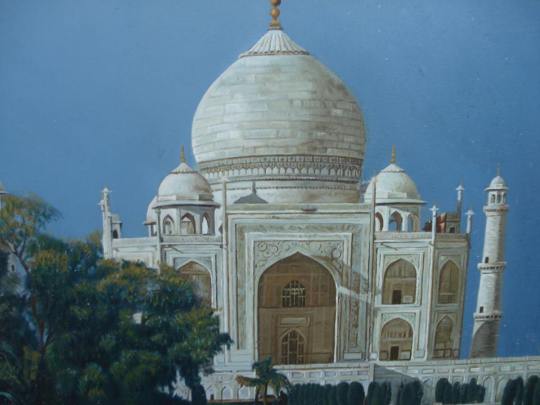
Among the monuments, Minar-e-Pakistan, Faisal Mosque and Khyber Gate are the most popular. Taj Mahal is also demanded by many.( That was a surprise, indeed.)

HyderAliMinarePakistan

HyderAliTaj

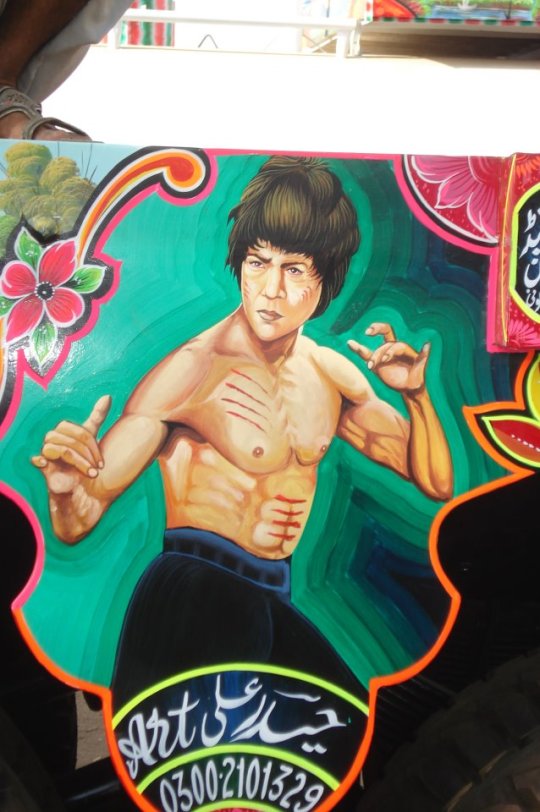
“One driver demanded Bruce Lee on his truck.” smiles Haider Ali.
HyderAliBruceLee

Many want birds, or even sher ( for which he paints a tiger).

HyderAliSher

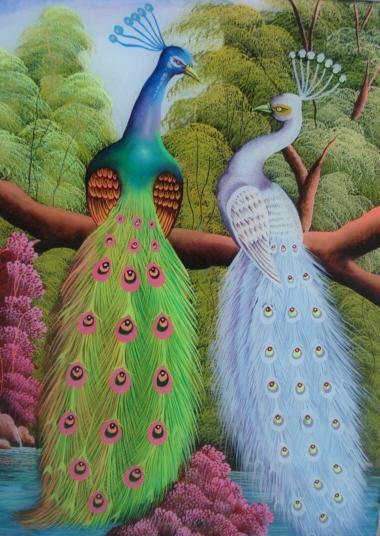
Haider Ali loves drawing all kinds of birds and their details including falcon, peacocks, partridges, eagles etc.

HyderAliMacawsHyderAliDove

HyderAliPeacocks

Are there any unusual themes that you worked for?

The demand for themes and designs vary with changing times.
For example, in the times of war, in 60s and 70s, there were patriotic slogans with missiles and jet planes.”

HyderAli6

While in the last elections, he painted a truck on demand for Pak Election 2013, by SAMAA TV channel.

hyderAli5

Talking of the slogans, he said calligraphy on trucks is another field and many artists do it as a separate. He loves to do the calligraphy too.

What are your favorite slogans:

Anything that a truck driver demands. Almost all trucks adorn a Masha Allah on the head. If they leave on us, we choose for them.

  • Dekho fasla rakho, warna pya ho jaaega.( Keep distance, otherwise we’ll fall in love)
  • Hum chalein, dushman jalein( As we roll, our rivals envy)
  • Na ghabra ai zaalim paas aney sey, Khuda bhi rooth jata hai kisi ka dil dukhane sey.
    (Don’t be afrais of coming close, even God is displease by those who hurt others.).

Most who get their trick repainted the favorite is:

  • “Waqt ne pher sey dulhan bana diya.” (Time has turned us into a bride again).

Haider Ali’s favorite shair being:

  • Tum ney aisa rabta rakha, na paas aye na door rakha. ( You kept such a relationship, neither came close, nor went too far apart).
  • Zid na ker, assi aap barey ziddi aan. ( Don’t be stubborn, I am the same too).

HyderAli8

Among the famous in Pakistan Tapu Javeri the photographer, had commissioned him to make a panel for his house. Ever since they became friends. Haider Ali pays tribute to his friend by at times changing the famous slogan to:

  • “Tapu yaar tang na ker.”

HyderAliTapu

Can truck art be used to promote Peace for India Pakistan Peace friendship?

Haider says he went to Museum of Peace in India  just 1.5 km from Atari and painted an India Pakistan friendship van. He again has been called to Calcutta this September for a yet undisclosed Project.

HyderAliIndoPakdostiVan

My daughter was curious: “Does NCA or Indus Valley have Truck Art’ in their course? Have yuo ever been to those places?”
He smiles: They don’t consider truck art as an art. However, thanks to Sabeen Mahmood, I have my works on display all the time at T2F. And Lok Virsa.  In Pakistan we are a moving exhibition, 24X7, spreading the message of peace and harmony through colors and slogans. You will not find any hateful message on any truck or bus. Like our designs, our location of exhibit have no bounds.( “Hamre art ko koi qaid nahin hai.” ( Our art knows no bounds neither of ideas, nor of locations).

People copy your ideas?

“Yes, though our art is not considered an art, many designers have copied them on dresses, furniture, crockery etc. They can copy our designs, but can’t copy our ideas and skill. I don’t feel offended. Infinite is the limit of ideas for a ‘truck artist’. No two motifs are identical, no two trucks are same. And they are what they call in art world, ‘custom designed.’. .”

If not painting on truck, Haider Ali loves to make painting depicting stories( owing to his interest and training in painting the film posters when young.

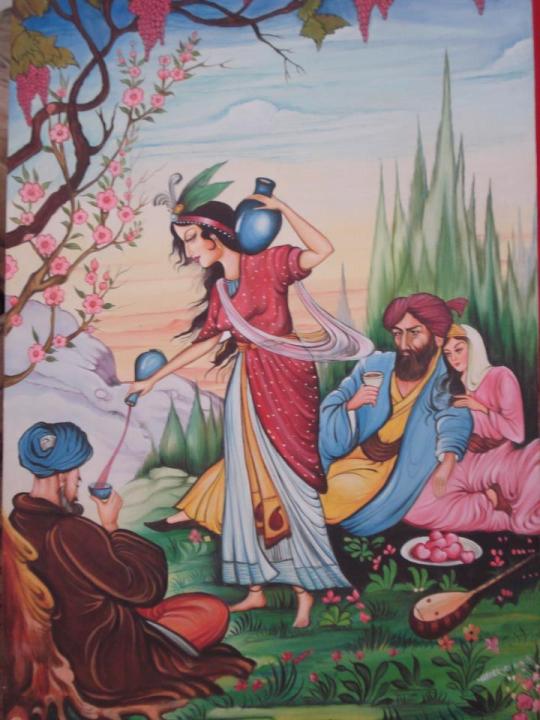
I particularly liked the one of Omar Khayyam:

HyderAliOmarKhayyam

And the Sohni Mahiwal

HyderAliSohniMahiwal

He has a two year old son, who he aspires to be a ‘truck artist’ too, but also wants him to first complete his education, which Haider Ali missed out on. If educated person will come in the truck art, we will get more recognition.

My daughter pointed out how in film BOL the place where trucks are painted was shown as the place where the transgender boy was raped. Haider Ali retorted, “There are good and bad everywhere.” Though there is no dearth of respect and recognition we get world over, wish our Pakistani films and dramas showed the positive side of lives too.

Some more of Haider Ali’s works:

hyderali1

hyderAli0

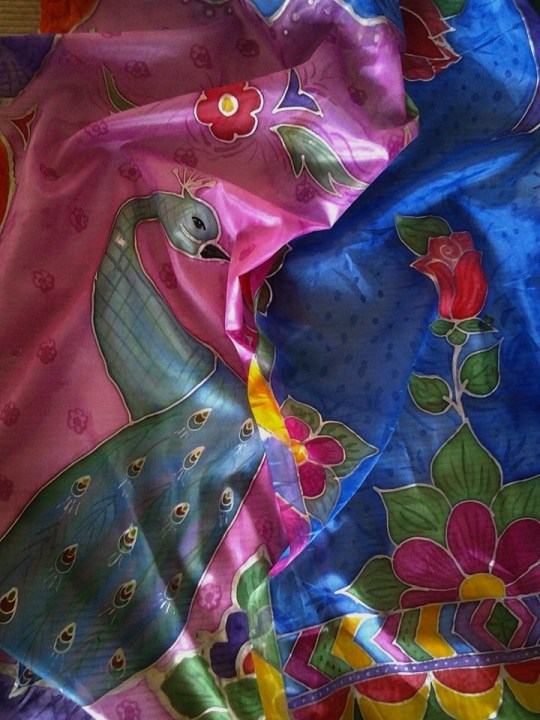
He invited me to his work shop in Karachi to learn the swift and  steady brush strokes that fascinates me so much. But before I seriously go and master them, I practiced them out on the ‘truck art’ inspired  silk scarves the same evening.
(One in Hindi & the other in Urdu)

TruckArtScarves

TruckArtScarves1


First published in Express Tribune, Pakistan on June 10, 2013 : http://blogs.tribune.com.pk/story/17620/samras-story-when-marital-abuse-did-not-break-her/


Attending the graduation ceremony of students at the prestigious University of Toronto, my daughter pointed out Samra Zafar, saying

“She topped in Economics and she is a Pakistani!”

Samra was flanked not by parents, but two daughters, aged 12 and seven. I wanted to know more about her, and hence invited her over to our house next evening.

At home, while sipping tea, Samra shared her 14 year journey with me and I was absolutely floored by her story.

In 1999, in Abu Dhabi, Samra was a brilliant 16-years-old student of grade 11, dreaming to go to a foreign university to pursue higher studies. Her only fault was that she was tall and extremely good looking – she was a dream bride. Hence when the proposal from a ‘well settled boy in Canada’ arrived, it was difficult for her working class parents to refuse. Eldest of four daughters, the parents thought this would give her a great opportunity to go aboard and pursue her dream, under the safety of her husband and in-laws.

The in-laws reassured their support too.

However, once married and in Canada, things changed. She was told,

“The atmosphere in high schools is not good, and hence it is better to not be thankless and stay happy at home.”

Samra refused to give up though and completed her high school courses through distance learning.

Despite being a mom at the age of 18, she excelled in her high school exams and got accepted to the University of Toronto. Her husband, however, refused to support her and his good financial status left her ineligible for university loans. She tried to convince her in laws for three years but to no avail.

It was not just her education; she was under strict vigil all the time. She was not allowed to leave the house, had no cell phone and was not allowed to learn how to drive. She never had a penny on herself and was constantly abused and neglected.

Samra had not visited her parents for five years. The first time she went back was when her father sent tickets for Samra and her daughter. When she was leaving, she asked her husband fora meagre $10 so that she could have some coffee and buy some chocolate for her daughter during their transit stop at Heathrow Airport. He just snarled at here and said,

“Ask your father for that too.”

She had left and did not intend to come back, but her husband begged her to return with a promise that he would change and that she will be allowed to study this time; he said that he realized he could not live without her. Reassured, Samra returned, only to know that once she got pregnant the second time, the physical abuse was to became worse.

Samra stated that,

“A bruise on my upper arm was a permanent fixture, as in every bout of anger, he would grab my arm really hard and squeeze. Often he pushed me, pulled my hair and spit in my face, even in front of my daughters.”

Again disheartened, she went back to her father’s home, pregnant with her second daughter. Within a couple of months her father suddenly fell ill and passed away. Samra recalls the day before his death and the advice her father gave her when he said,

“My life is uncertain, I may not live to look after you. You have to be strong and pull yourself out of this. I have always envisioned seeing you at the top of a world ranking University.”

Things had changed. Her mother was alone now and had two other unmarried daughters to support.

Samra, accepting it as fate, returned to her husband. To earn her own money, she began baby sitting in her house. As consolation to continue her work, she would give her husband some pocket money from which he would buy his cigarettes and a share to her mother in law, too, to earn their approval.

In 2008, she applied again and got accepted to the University of Toronto. This time she did not have to look to her husband for financial assistance, as her child care business could enable her to pay her own fees. However, this led to escalation of physical abuse. She was instructed by her husband on a daily basis,

“Don’t talk to your male professors, don’t talk to anyone on campus and don’t go to the library.”

The abuse was so severe, that she had to take a break after the first year. Several times she had suicidal thoughts and her self-confidence had completely shattered. That led her to a meeting with the Psychological Counselor at the university campus. She attended the sessions in secrecy and there she was informed that what she was going through was a typical cycle of domestic abuse. And that it was not her fault, or her destiny to bear it.

She reveals;

“It was my daily routine to beg my husband and ask him, ‘Why do you do this? Why don’t you love me?’”

And all he replied with each time was,

“Because you deserve this.”

The psychological counselling at the university, gave her the strength to get back to university. By the second year, the abuse had become worse but she had been told that she could call 911 if need be.

“I will call the cops, if you hit me again.” She uttered once, while her husband raised his hand. That is what triggered him to say,

“Talaq, talaq, talaq.”

(I divorce you, I divorce you, I divorce you.)

Samra says,

“I was shattered, and I did not know what to do next. If I left the house, I would not have childcare income. How would I continue to study? I had two young girls to support.”

Samra’s husband and in-laws ran from pillar to post to get Fatwas to invalidate the divorce. Samra laughs,

“Once my mother-in-law even brought a person for the necessary Halala to rectify the Talaq.”

However, by now Samra had, despite many weak moments, gathered enough strength to move out of this cyclical abuse and face what came her way.

She shifted to a residence at the university campus. Her husband and in-laws then tried threatening her; they said either return or they would malign her in the local Pakistani community of her ‘living’ with men at the university. Her husband often told their daughter,

Do you think your mother goes to university to study only?”

Samra revealed that,

“After a decade of physical, financial, psychological and emotional, abuse it was only in the summer of 2011, that I finally had the courage to go to the cops and give a detailed, date by date account of the abuse I faced, along with the evidence.”

As a result, her husband was arrested on four counts of assault. Despite two court cases, three jobs and two children, she continued to excel in her studies and became head teaching assistant.

Today, Monday June 10, 2013, at the official convocation of the prestigious University of Toronto, Samra will not only be awarded a Bachelors degree in Economics, but she will also be awarded the prestigious Top Student Award in Economics. She also has to her credit a dozen more awards given to her for her academic excellence in the past four years, including the prestigious John H Moss Scholarship, which is awarded annually to a single student in the entire university (all three campuses). She has also been admitted to the PhD program in Economics at the University of Toronto, with a full scholarship.

When not studying or working, Samra loves cooking for her girls and gives them all the free time she gets.

“We are now the happiest we have ever been.”

I asked her how she would advise other girls who are trapped in the same scenario and to that she said,

“Do not let anyone disrespect you. Believe in yourself. You are the only one who can change your situation. It is not easy, but it isn’t impossible either. I had all the disadvantages any girl could have.”

She refers to the myth of needing a man as a support,

I have no father, brother, son, or husband to support me. But I have done it, all by myself. If I can do it, anyone can.”

Read more by Ilmana here or follow her on Twitter @Zeemana


Published in Express Tribune Blogs here > http://blogs.tribune.com.pk/story/33221/you-can-play-holi-too-even-if-you-are-muslim/


Phagwa, more commonly known as Holi, celebrated on the full moon day of Phalgun, is a festival that heralds the arrival of spring. Played with dry and wet color, it is a symbolic expression for the changing temperatures and the blossoming fields.

Since very young, on the morning of Holi, I saw my Muslim parents being called at the gates of our house in Delhi, by a group of faces immersed in colors, who all looked almost identical. As my parents walked out, they were enthusiastically smeared with color by the crowd, and they too lost their identity with crowd.  It left no clue as to who was who, when they roared together with laughter and excitement.  As we siblings grew up, we joined in too, with our set of friends.

Holi, as I envision it,  is a perfect way to depict a spirit of universal brotherhood beyond color, creed, caste or social status.

If  taken in it’s true spirits, Holi never was and never is meant to be a religious festival to be celebrated by a select faith.

Though, like other religious festivals, it too claims a legend with a victory of the good over the evil ( The Story of Holika). However, from the context of its current celebration, it is said to have begun by the love duo Krishna and Radha.
Krishna as a young boy, being extremely dark complexioned, complained to his mother Yashoda, why was he dark, while his beloved Radha fair?

The conversation between a complaining son, and  his doting mother,  is  narrated beautifully, in a famous folk song:

Yashomati mayya sey bole Nand Lala,
Radha kyun gori, main kyun kala?
Boli muskaati Mayya, Sun merey pyaare,
Gori gori Radhika ke, nain kajrare,
Kaale nainon waali ney, aisa jadu dala,
Tuu isee liye  kaala.

(Krishna asks mother Yashoda: “Why am I dark, while Radha is so fair?”
Mother  smiles and replies: “Listen my dear, the fair Radha’s kohl eyes have swept you with their magic, and hence are you so dark.)

And one day teasingly to console Krishna she is said to have told him: “What’s in a color? Go and smear Radha’s face with any color you like.”
And Krishna out of love for Radha, smeared her with red color( gulaal).

Legend claims that  thus began  the playing of colors ( Holi khelna), between Krishna and Radha along with her friends referred to as Gopis.

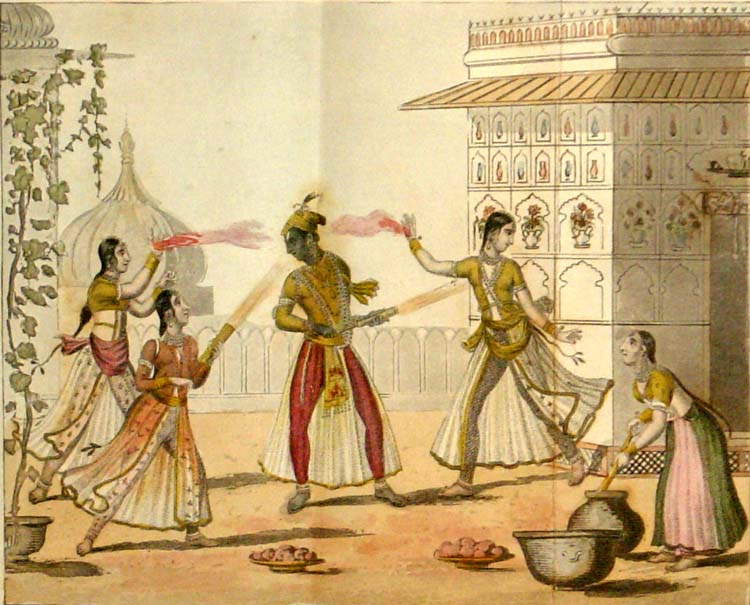
Their romance with playing Holi has been immortalized in many miniature painting s:
HoliRadhaKrishna1

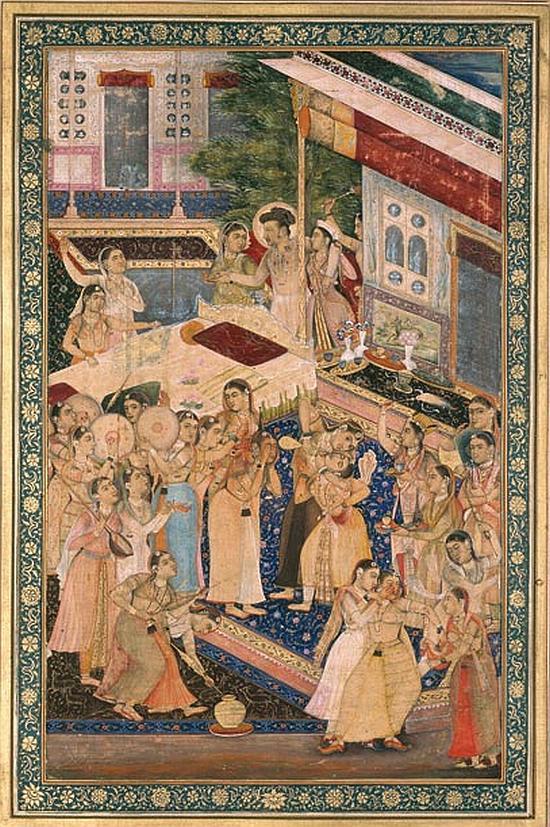
Another one, with in Mughal art:
HoliRadhaKrishna2

Mughal Emperors  too fancied Holi, for its association with color and romance. They brought the practice of playing Holi to their courts and palaces.

Akber is no surprise, knowing his secular conviction and a Hindu Queen, Joda Bai.

Jehangir, the romantic art connoisseur, is documented to have played Holi with his Queen Noor Jehan in his palace and called it Eid-e-Gulabi. It isnt hard to imagine the ecstatic aroma and aura that must have been created in the palace by red gulaal,  rose petals ( gulab paashi) and   rose water (aab paashi) being sprinkled during the royal play.

Auranzeb’s fancy for the colors of Holi came as a surprise to me. Writes Lane Poole in biography Auranzeb: “During his time there used to be several groups of Holi singers who besides reciting libertine lyrics also indulged in salaciousness, accompanied by various musical instruments.”

Bahadur Shah Zafar’s verses on Holi now are sung as part of the phaag ( folk songs of Holi). One of the most sung verses being:

Kyo Mo Pe Rang Ki Maari Pichkaari
Dekho Kunwar Ji Doongi Mein Gaari
(Why drench me with color spray,
now my prince, I will swear at you)

Bahut Dinan Mein Haath Lage Ho Kaise Jane Doon
Aaj Phagwa To Son Ka Tha Peeth Pakad Kar Loon.
(
After long have you come in my hands, how will I let you go?
Today is Holi, and perfect time to catch hold of you)

This is Mughal Emperor Jehangir playing Holi in his palace:
HoliJehangir

Sufi poets too eulogized the Radha Krishna romance and Holi, when expressing their love for their revered Sufi Saints or even God.

To begin with  Sufi poets, it is Shah Niaz’s ‘s Hori Ho Rahi hai, (immortalized by Abida Parveen):

Holi hoye rahi hai Ahmad Jiya ke dwaar
Hazrat Ali ka rang bano hai Hassan Hussain khilaar
Aiso holi ki dhoom machi hai chahoon or pari hai pukaar
Aiso anokho chatur khiladi rang deeyon sansaar
“Niaz” pyaara bhar bhar chidke ek hi raang sahas pichkaar.

(Holi is happening at beloved, Ahmed’s (saww) doorsteps.
Color has become of Hazrat Ali (as) and Hasan (as), Hussain (as) are playing.
It has become such a bustling scene of Holi that it has become talk of the town,
people are calling others from all over,
What unique and clever players (Hasan and Hussain) that they colored the entire world.
Niaz (the poet) sprinkles bowlfuls of color all around,
the same color that comes out of thousands of pichkaaris ( spray guns).)
{Thanks to Ali Rehman @Baahirezaman for the translation}.

Bulleh Shah also played Holi with his Master:

Hori khailoongi keh kar Bismillah
Naam nabi ki rattan charhi, bond pari Illalah
Rang rangeli ohi khilawe, jo sakhi howe fana fi Allah

(I shall play Holi, beginning with the name of Allah.
The name of Prophet is enveloped with light,
He only makes us play with colors, who annihilates with Allah)

Amir Khusro  relates to  Holi through multiple fascinating ways, in various places. Khusrau refers  not just to the color, or the play but of  the birth place of Krishna Mathura in the famous Aaj Rung hai rey:

Gokal dekha, Mathra dekha,
par tosa na koi rang dekha
Ey main dhoond phiri hoon
Des bides mein dhoond phiri hoon,

Purab dekha pacham dekha
uttar dekha dakkan dekha
Re main dhoond phiri hoon
Des bides mein dhoond phiri hoon,

Tora rang man bhaayo Moinuddin
Mohe apne hi rang mein rang le Khwaja ji
Mohe rang basanti rang de Khwaja Ji
Mohe apne hi rang mein rang de

{In summary: I saw Gokul, Mathura ( bith place of Krishna) and even East to West I roamed, but I did not find anyone with a color like yours. My heart is enamored by your color, hence color me in your shade, my master.}

Another lesser know verse I came across is:

Khelooongi Holi, Khaaja ghar aaye,
Dhan dhan bhaag hamarey sajni,
Khaaja aaye aangan merey..
( I shall play Holi as Khaaja has come to my home,
Blessed is my fortune, O’ friend,
as Khaaja has come to my courtyard.)

Needless to repeat, there are ample such examples.  No matter how much one may attempt, it is impossible to separate the two inter-meshed   cultures coexistent for centuries in the subcontinent. These celebrations of culture are all about love and inclusion, and absolutely nothing about hate and discrimination.

Let’s celebrate then, with an open heart !

Holi pic

Here is the link to Amir Khusrau’s Kheloongi Holi, Khaaja ghar aaye:


Behari Kababs !

Which meat loving South Asian  doesn’t relish them ? In fact, Maulana Abul Kalam Azad has called them, the ‘finest’ kebabs in his food memoirs.

I grew up watching on very special occasions, my mother prepare and barbeque these Kebabs very diligently on and with much effort, on a charcoal grill. All I remember was that it was a great hard work. And hence, for many, Behari Kebabs is a delicacy to be eaten in restaurants, as cooking them at home is very cumbersome.

I too believed so, till once, I thought of experimenting them in the convenience of my kitchen, in the electric oven. I made them with wooden skewers, and the first attempt wasn’t bad at all. Second time, it was for a dinner party, and the guests could not believe they were homemade, till my husband showed them the oven, tray and the wooden skewers on which they were made.

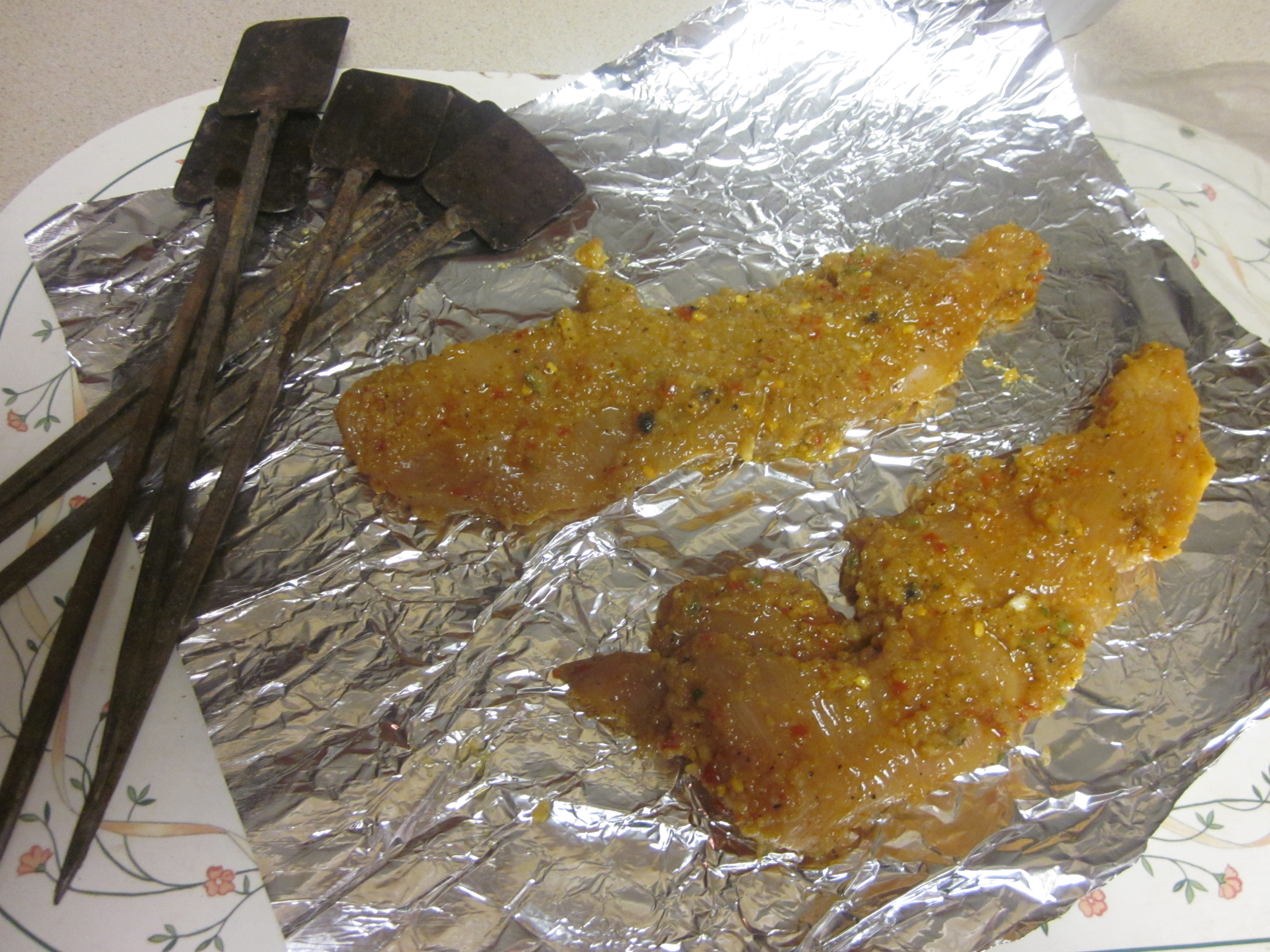
I moved on, more confident. Got  custom made, iron skewers that fit my tray size in the oven. As I have moved cities, these iron skewers have obediently moved with me too.

Warning: Instead of red meat, I make them here with white meat, and instead of a charcoal grill, I grill them in an oven. Nevertheless, can assure you, they are a different delicacy in their own right.

Ingredients:
Chicken breasts 1 kg
( each sliced into 4 thin fillet)
Onions: 4 medium sized
Ginger : 100gms
Garlic: One whole,
(peeled into cloves)
Green Papaya: 100gms.
Spices: Cumin, coriander, and red chilli powders, and salt to taste.
Mustard Oil- 1 Cup
Fried Browned onions: 2tbsp
(P.S. Some add yogurt, but I don’t.)

Method: 
All the ingredients except the chicken breasts are made into a paste in the grinder. Pour the paste into a wide bowl, and mix in Mustard oil.

Add the chicken fillet in the paste and marinate them for preferably overnight to 24 hours.
IMG_0184

As they are ready to be cooked, spread out each marinated fillet inside a plastic bag, one by one.
IMG_0187

Once arranged 4-5 fillets, fold to close the open end of the plastic bag, And pound them with a wooden pound to make them softer, and such that the spice paste seeps into the fillet..

IMG_0189

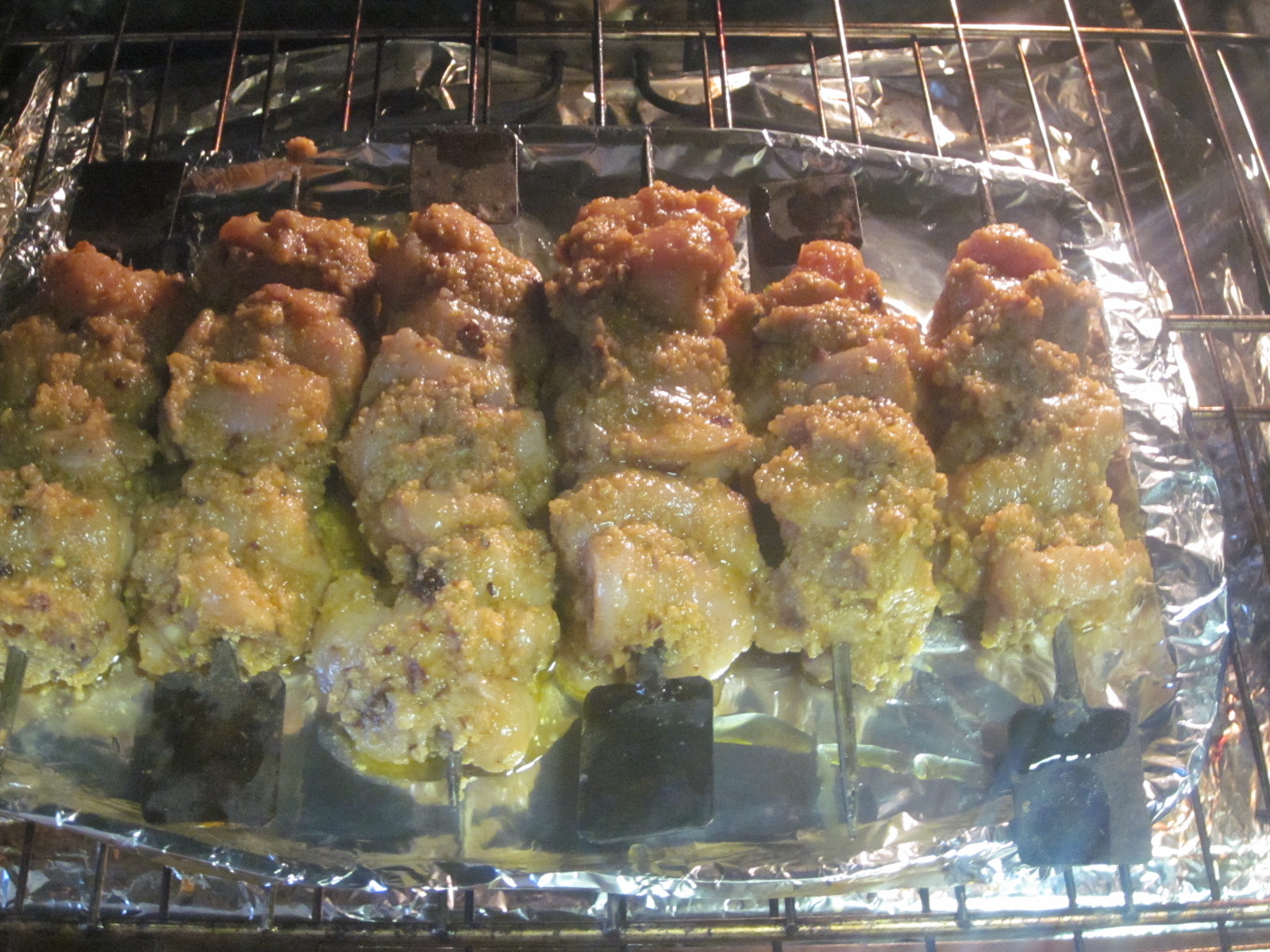
Take them out of the plastic bag, one by one, to mount on the iron skewers. My skewers seen here are about a feet long, specially made to fit my baking tray.

IMG_0186

Mount the fillets on the skewers, piercing the iron rod, through the flesh of the fillets at 2-3 inches apart, then gathering them closer.

Kababs 402

Arrange the skewers on the baking tray adjacent to each other.

Kababs 403

When completed, place them in a preheated oven, at 225 degrees C for 30 minutes.
Kababs 407

Once ready, place a burning coal on the side of the tray, and douse it with oil to bellow smoke. Cover the tray, and close the oven, immediately, for the smoky aroma to be absorbed in the Kebabs.
Kababs 408

When ready, serve them hot, with pickled onions, yogurt sauce and chutneys. Naans and parathas go equally well with these Kebabs.

Kababs 410

The children are fond of taking the left overs to school, rolled in a naan as Kebab rolls.

P.S. The blog has been diligently made for a Kebab loving and Kebab cooking fellow Delhiite Parshu Narayanan. 🙂

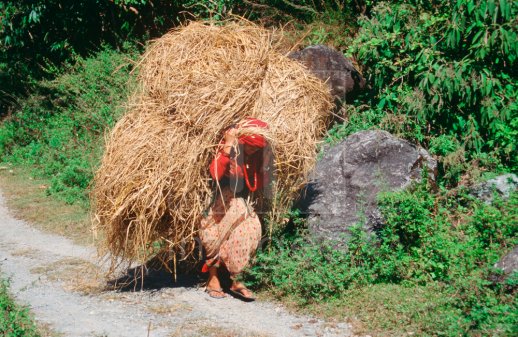
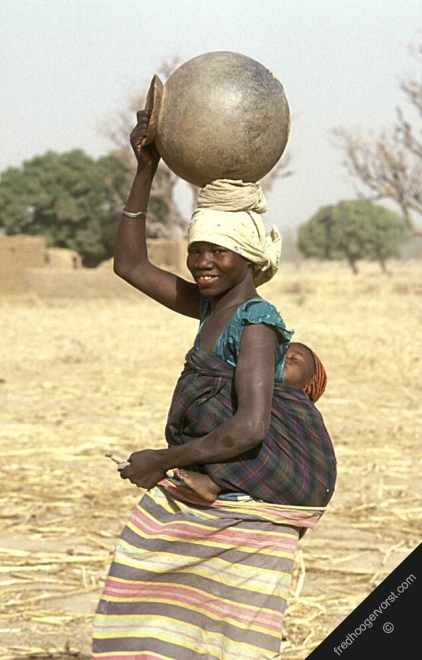
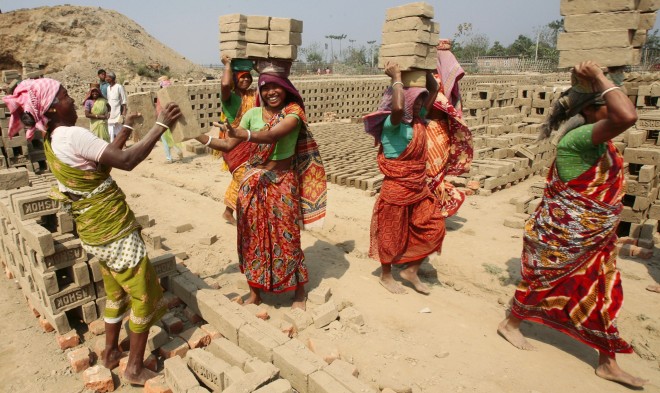
The Weaker Sex


None can match her psychological resilience,  but it is  for her physical strength, that the world calls her a ‘weaker’ sex.

Women wood

Women Nepal

women water1

Women China

women water baby

women africa

women labor1

endofmen

women India

Only if they saw the truth behind the Chinese proverb ” Women hold half the sky.”


A tribute to a ‘home maker’ on International Women’s Day. She is a woman who works 24×7, with no offs, no fixed working hours, no weekends, no vacations, no salary, no promotions and not even a recognition. And even then, when you ask her what does she do, she replies: “I am not a working woman.” 

Mansoor Khan office se ghar thak ke aye aur ate hi dhupp sofe per baith gaye.
“Begum TV ka remote kahan hai? Kahan rakhti ho”

“Main kaun sa TV dekhti hoon din mein. Bachey pata nahin kahan rakh dete hain. Roz dhoondna parta hai.”

“Khabron ka time ho raha hai. Ek glass pani bhi pila do.”

“Dhoondti hoon, pehle roti utaar loun, warna jal jaayegi.”

Salma Begum pani ka glass thamate huwe , remote ko sofey ke neechey se jhuk ker nikalti hai. “Yeh leejiye.’

“Begum, ek chaaye to pila do, adha chamcha cheeni ke saath. Sir mein dard ho raha hai.”

“Arrey, pher bad parhezi ker rahe hain. Doctor ne kaha hai, ab sakhti se parhez karein, warna pher se sugar aur blood pressure donon out of control ho jaayenge.”

“Haan, mager sara din office mein dhang ki chaaye nahin milti. Khana bhi thanda khana perta hai.”


News khatm hui to, Begum awaz lagati hain,
“Suniye khana laga diya hai, kha lein, mera serial shuru hone wala hai, pher main nahin uthoongi.”

“Kya pakaya hai?”

“Aloo palak aur dal.”

“Pher sabzi, dal. Gosht khaaye muddat ho gai.”

“Arrey kal to karhai gosht banaya tha. Lekin apko wazan kum kerna hai, heart specialist ne pichli baar mujhey kaha tha, inko sabzi khilaya karein.”

Shauhar hazrat moonh banate huwe dining table ki taraf barhte hain.
“Bachon ne kha liya?”

“Haan, unko bhi sabzi dekh ker bhook urr gayi. Main kya karoon, mere buss mein nai hai, her ek ki pasand ka khana banaoon. Khana hai to khaayein, warna roza rakh lein.”

Begum ne shauhar ki plate ke baraber mein unki sugar ki dawa bhi rakh dee.
“Glass mein paani nikal do take dawa kha loun”

Shauhar khane mein masroof ho jata hai, aur begum apni plate lekar TV ke samne baith ker serial mein magan.

Serial mein waqfa ata hai, to shauhar taqaza kerta hai, “Mere blood pressure ki dawa kahan hai.”

Salma begum, apna guthna pakarte huwe uthti hai, aur dard se karah ker kehti hai…”Reh gayi, acha le ker aati hoon”.

“Kya huwa, abhi tak guthne ka dard theek nahin huwa?”

“Kaise hoga, rest ka time kahan milta hai, na hi doctor ke pas wapas jana huwa. Dawa bhi khana bhool jaati hoon'”

“Kyun nahin khaati. Yad rakha karo. Tum per burhape ke asaar aane lage hain.” Usney biwi ko cherne ki koshish ki.

“To aur kya ab bhi nahin ayega. Aap khizaab lagane se kya jawan ho gaye hain?” Begum ne tanz kiya.
“Tum apne aap per bilkul dhyan nahin deti, dekho pet bhi latak gaya hai.”

“Zahir hai, teen bache paida kiya hain.” Pher TV serial mein lag jaati hai aur ek haath se apne guthne ko malish kerne lagti hai.

Drama serial khatm hone se pehle hi, shauhar sahib pher kehte hain…”Main kamre mein dafter ka kaam poora ker raha hoon, Mujhe chaaye udher hi la dena.”
“Buss 5 minute, ye drama khatm ho jaaye to banati hoon.”

Drama  khatm hi hota hai, to Salma begum table per se bartan uthaati hai, aur chaaye ka pani rakh deti hain.

Ander se awaz aati hai, “Chaaye ho gai?”

Salma jaldi se chaaye le ker jaati hai, to shauhar sahib, ooper sey neechey tak us per nazer daurate hain, aur pher   muskura ker cherte huwe bare pyar se kehtey hain, “Begum, naa to tum apna khayal rakhti ho, aur naa hi mera, lagta hai koi doosri dhoondni paregi.”

Salma suni ansuni kerte huwe, moonh bana ker, kitchen me wapas aa ker bartan samet te huwe khud hi barbarati hai, “Uth ke paani to piya nahin jata, lekin doosri ka shauq khatm nahin hota inka.”

Aur halki si muskan ke saath pher bartan dhoney mein lag jaati hai.
Housewife1