Open up your mind and your potential reaches infinity…

Archive for the ‘Poetry’ Category

ABC of Qawwali


A small irritant from a dear friend, a westernised desi, who kept calling Qawwali as ‘Qawwali song’ got me to make a polite request to her call it only Qawwali. She probably thought I was an expert in the field and with innocent curiosity started to fire questions at me about Qawwali.

I really felt cornered and actually regretted for having made the silly request to her. And I realised that beyond the ABC of Qawwali I had no idea of what qawwali really was made of.

Her basic questions made me wonder that I was equally ignorant of the indepth details. Probably except for calling it Qawwali instead of qawwali ‘song’ there wasnt much difference between me and her. So I began to dig deeper.
It was indeed a wonderful journey to flip through the e-searches learning about Qawwali details.

All I knew earlier was this bit:

The word Qawwali was derived from the arabic word Qaul which means the utterance ( of Prophet).

Qawwali, a Sufi devotional music is unique to north India. It arrived in the subcontinent in the 14th Century. Amir Khusau, known as the ‘Father of Qawwali’ developed this form by incorporating Farsi and Arabic in the Indian music centered on the classical structure of taal and raag.

The word Sama is used in Central Asia and Turkey to refer to forms very similar to Qawwali, and in the subcontinent, the formal name used for a session of Qawwali is Mehfil-e-Sama.
I had known that the singers are called: Qawwal and those group of singers who sing a qawwali chorus in unison are called Humnawan.
I had heard, long ago in Delhi that Qawwals are also called Qawwal bacche.

I began to hunt for what was the reason why they were called so. What I learned was this:

“There is a renowned tale frequently told by qawwals- that of the ‘Qawwal Bachche’. Hazrat Amir Khusro wished to do something extraordinary for his ‘sheikh’ (spiritual mentor) Nizamuddin. So he discovered twelve gifted young men and educated them to render the ragas he had created. The sheikh was thrilled with their performance and these twelve lads went on to be recognized as the ‘Qawwal Bachche’.This ancestry of qawwali singers, the sons of the initial qawwal or Qawwal Bacche, was begun by a man who, as fable goes, was hearing impaired and mute. Inexplicably healed by a Sufi saint, he converted to become one of the earliest disciples of Amir Khusro. Qawwali has been handed down from father to son over generations, with weight on the children memorizing the poetry and precise elocution of the words because several of the songs are in Persian.”
(Source: http://www.planetradiocity.com/musicopedia/music_decade.php?conid=2362).

During Googling I came across a list of qawwwali vocabulary, on ‘bohotkhoob’ blog, which I thought was a must share:

Alap = Introductory phrases of a raga sung without rhythm to create a background for the raga used in the composition.
Anga = Aspects of singing which bring out the main style followed by the singer.
Baja = Instrument, chiefly harmonium. Strangely though Harmonium was introduced into qawwali only in mid 19th Century. Earlier instruments used were: double-headed drum (dholak) and a bowed lute (sarangi, dilruba) and an earthenware pot(ghara).
Band = A verse of more than two lines — inserted from a longer poem.
Band sama = A closed or an exclusive performance in which a special song-repertoire is rendered without any instrumental accompaniment.
Badhana = To extend, or elaborate the melodic theme.
Bari ka gana = To sing by turns in an assembly of Qawwal-singers.
Bol = Utterance, the repeatable part of the song-text sung by the chorus.
Bol samjhana = To convey the meaning of the text through musical variations, etc.
Chachar = Metric pattern of 14 beats frequently employed in the genre.
Chal = Gait, the specific melodic contour of the song.
Chalat phirat = Melodic improvisation mostly in a faster tempo and intricate in design.
Cheez = A complete, original song without additions etc.
Chaoki = A performing group of qawwal named after the leader or his ancestor.
Dhun = A tune which is satisfyingly complete and yet may not be in a codified raga.
Doha = A couplet making a complete, rhyming poetic statement in common metre employed by the singers at the beginning or as insertions.
Dohrana = To repeat.
Girah = A knot, i.e. inserted verse in a qawwali.
Hamd = Poem in Urdu/Farsi in praise of God.
Hawa = Archaic Sufi song in Farsi said to be composed by Amir Khusro.
Khas tarz = Special tune.
Makhsus tarz = Special tune.
Manqabat = Poem in praise of a great religious personage, especially Sufi saints.
Munajat= means secret conversation, whispering, prayer, longing or yearning. Sung in Farsi and was invented by Rumi.
Masnavi = Extended Farsi poem with rhyming couplets
Matra = Durational unit in music making.
Misra = Verse line.
Misra kholna = ‘to open the verse line’.
Misra ula = First verse line, especially the opening line of a couplet.
Mukhra = The opening refrain line of the song.
Murki = Melodic ‘turn’ — a specific musical embellishment.
Mushtar ka gana = Mixed i.e. communal singing.
Naghma = Melody, tune, played as a prelude to the qawwali, usually based on a tune derived from the Zikr Allahu.
Panchayati gana = communal singing.
Padhna = Recite, read or chant without instrumental accompaniment.
Phailav = Melodic spreading, expansion.
Qata = Four line aphoristic poetic form in Urdu/Farsi used in introductory section of the qawwali.
Qaul = The basic ritual, obligatory song either as opening or closing hymn with the text based on sayings of the Prophet.
Rang = The second principal ritual, obligatory song after Qaul celebrating the saints (Nizamuddin) spiritual guidance (colouring) of his disciple Amir Khusro.
Rubai = Aphoristic four-line poetic form in Farsi/Urdu in qawwali. It refers to the recitative preceding the qawwali often based on a Rubai.
Sany bolan = Saying it as second, singing a verse line to the tune section of the second concluding line of a couplet.
Sargam = Sol-fa passage.
Sher = Couplet, literally the strophic unit of the ghazal poem.
Takrar = Multiple repetition.
Tali = clapping.Clapping by the performers in the second row complements the instruments.
Tarana = A genre of songs with meaningless auspicious words, often derived from Sufi invocations.
Tazmin = A poem incorporating famous verses around Sufi classics in Farsi.
Thap = An accented drum beat.
Tiyya = A triad of a rhythmic/melodic cadence.
wajd = Ecstacy, invoked by any particular shair or couplet of poetical composition, which is common scene in such mahfils,that particular couplet is repeated continuously by the Qawwal until the thirst of the ecstatic ‘subject’ is fully satisfied and he returns to his normal condition
Zatnin = Poetic metre of the song-text.
Zarb = Accent, rhythmic stress.

It has now somewhat made me understand the rendition beyond just the words sung. The ups and downs, the repeats, the style of singing, punctuated by narration, the claps etc in the middle of the rendition, now seem to make a lot more fascination.

I am sure many of the Qawwali lovers would be far above my baseline of knowledge, but anyhow Happy listening!

(Source: Music contexts: A Concise dictionary of Hindustani Music. By Ashok Damodar Ranade
http://meheralisherali.com/history.html).

The Violin


The bow of my thoughts,
Glides hard
on the strings
Within the chest.
Triggers a convulsion
Fatal fibrillations ensue.
‘In arrest’ go
The pulsations of peace.
The notes scatter
helter skelter
Vexing with cramps
Of violent agony.
Music, is it?
Or cacophony perhaps?
Even I can’t decipher
From the violin
Of my heart.

Kabir a day keeps radicalism at bay


First published in english daily, The Islamabad Dateline on 26th June, 2011

Almost 700 years ago, when religious polarisation in the Indian subcontinent was at its helm, a preacher was born. He was named Kabir and he spent the rest of life trying to bind Hindus and Muslims together. Today, as religious hatred is bred into masses and intolerance is injected into young minds one finds it necessary to bring forth Kabir, the champion of religious tolerance and interfaith harmony.

The mystics from united India are more relevant to us than Persian or Turkish voices as they spring from the culture we own. For a relatively more radicalized society in Pakistan, these pluralistic and tolerant voices need to be disseminated vehemently. These great men seemed to be far ahead of their times and Kabir is no exception. Kabir stands tall, in the line of greatest mystics of all time with St. Augustine, Ruysbroeck, Buddha, Rumi, Emre and Hallaj

Kabir’s vision, though timeless in its essence when transformed into simple poetry addresses the basic problems humanity faces today. His message was simple and straightforward — that God is perceived in different forms by different people, but in essence they all talk of One supreme power.

Koi bole Ram Ram, koi Khudai

(Some call him Ram, some name him Khuda)

His honest message offended both Mullahs and Purohits for it challenged their stakes. He was persecuted by both to which he screamed:

Sadhu dekho jag baurana / Sanchi kaho to maran dhawe /Jhoote jag patiyana

(O gentleman, see the world has got mad / I say truth but they run to beat me and believe the fake.)

His intent was not to offend anyone and he made it clear:

Kabira khada bazaar mein mange sab ki khair / na kahoo se dosti, na kahoo se bair

(Kabira Stands in the market place( the world) / Asks for everyone’s prosperity. Neither special friendship nor enmity for anyone).

His mission, through his vision was to promote brotherhood, unity, love and forgiveness beyond regions and religions.

The Hindu says Ram is beloved, the Muslim says Rahim / They fight and kill each other, no one gets the point.

And the point that no one got was:

Maatii Aik Anaik Bhaanth Ker Saaji Sajan Haray
(The Clay Is The Same, But The Designer Has Designed It In Various Ways)

Kabir through his words challenged the authority our society has given to clerics quite audaciously:

The spiritual athlete often changes the color of his clothes
& his mind remains gray and loveless.
Or he drills holes in his ears, his beard grows enormous
People mistake him for a goat.
He shaves his skull & puts his robe in an orange vat,
Reads the Book & becomes a terrific talker.
Kabir says: the truth is, you are riding in a hearse to the country of
death, bound hand & foot.

He even warned against the mindless following of religious preachers and to use one’s own conscience to decide what is right or wrong:

Jaka guru hai andhla, chela hai ja chandh / Andhe andha theliya, dunyu koop parent
(If the preacher is blind (unrealized) and the disciple is also blind, how can they progress further? If a blind shows the path to the other blind, they both are bound to fall in some dead well at some time).

To those bigoted who would not understand this, he remarked:

Phootee aankh vivek kee, lakhe na sant asant
(People have their inner eyes of conscience blind; they don’t see who is real and who is fake)

“What can one do, if, with lamp in hand, one falls in the well”

Bura jo dekhan main chala bura na milya koi / Jab man khoja aapna mujh se bura na koi.

(I went on the search for the Bad Guy, Bad Guy I couldn’t find. / When I searched my mind, Non one is Nastier then Me)

He lived to restore the confidence in the common man against the elite clergy or the rulers, who claimed their superiority by virtue of their status. He explained:

Bada hua to kya hua jaise ped khajoor / Panthi ko chhaya nahin phal laage ati door.

(If You are Big so what? Just like a date tree / No shade for travelers, fruit is hard to reach).

He used simple vernacular language, with metaphors from common examples to engage the people around him. People were fascinated by the deep moral messages contained in his simple poetry.

Kabira Garv Na Keejiye, Uncha Dekh Aavaas / Kaal Paron Punyah Letna, Ouper Jamsi Ghaas

(Kabi , Don’t be so proud and vain, Looking at your high mansion / Tomorow you’ll lie under feet, On top will grow Grass).

Ab Tun Aaya Jagat Mein, Log Hanse Tu Roye / Aise Karni Na Kari, Pache Hanse Sab Koye

(When you came in to this world, Everyone laughed while you cried / Don’t do such work, That they laugh when you are gone)

And that it’s not one’s status but one’s deeds which pay off ultimately:

Ek daal do panchi re baitha kaun guru kaun chela / Guru ki karni guru bharela, chele ki karni chela.

(Both the preacher and the follower are together / but both will be dealt according to their deeds.).

The Purohits and Mullahs could not tolerate his audacity, and how he influenced the common man. His words had already penetrated into masses and exposed the self-righteous claims of every clergy. He got expelled from Kashi. He roamed around Benaras preaching his message and passed away in Maghar.

After his death both the Hindus and the Muslims both claimed ownership over him. There are a few legends but one wonders how was the matter resolved. As for now, there exists a Hindu shrine and a Muslim Dargah adjacent to each other at the place where he died.

Kabir’s words are very pertinent to current Pakistan, where religion is manipulated for political ends and justify acts of violence. Voice of Kabir needs to be resonated in our academia and society being the need of time. Why did not we own Kabir like India? – I leave this question to be answered by the reader.

Co written: Ilmana Fasih with Syed Ali Abbas Zaidi.

Koi to Suno…


Ek duaa, mere shehr ke liye…t

Sukoon se jaagti subhein
Qahqahon se goonjti shaamein
Bekhauf o khatr sotee raatein
Suno, ab laut aao na…

Hansee jo rooth gai lab se
Khushi jo naraz hai sab se
Raunaq jo udaas hai kab se
Dekho, ab maan jaao na…

Khauf jis se na aam ho
Zulm jis se na zabt ho
Umeed jis se na khatm ho
Koi aisi dawa batao naa…

Nafrat koi bikherne naa paaye
Khushi itni ke sameti na jaaye
Aman aye to phir lautke na ja paaye
Kabhi aisa din bhi laao naa…

Things~ A Poem by Ayaz Sheikh


Picture: By Abro Khuda Bux

THINGS

Can you hear?

Things speak.

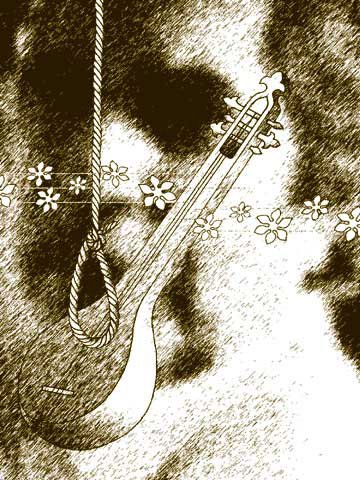
This is the tanboora
on which Bhittai played,
From its strings
bloomed flowers,
Showering their fragrance on all.

This is the spindle-wheel
which Kabir spun
And the entire land
was woven into its texture.

This is the rope
with which Nana Sahib was hung
and which still swings
Waiting for goodness knows
who else’s head.

You are trying to make sense of my poetry,
Listen,
In history’s museum
Things speak.

(Translation by Asif Farrukhi)

About the Poet: Sheikh Ayaz:
Shaikh Ayaz (Sindhi: شيخ اياز) was one of the major Sindhi poets of Pakistan. He was born in Shikarpur Sindh. By profession he was a lawyer but he also served as the vice chancellor of Sindh University. His poetry brought new trends into Sindhi literature.He wrote short stories, novel, essays, poetry, travelogues, diaries, an autobiography and the translation of Shah jo Risalo in Urdu. He also composed poetry in Urdu and two of his anthologies, “Booye Gul, Nala-i-dil” and “Neel Kanth Aur Neem Ke Pate” were highly acclaimed.[citation needed] He portrayed the miseries of suffering humanity, the sorrows of the deprived and the wretched conditions of the exploited masses who had been suffering at the hands of an unjust system for centuries.

P.S. My special thanks to Abro Khuda Bux for making me aware of this great poet of Sindhi language and hence in making this blog possible.

Source about the author: Wikepedia on Sheikh Ayaz

God shall wake up, Someday !


With my brain immersed in pool of ignorance,
With my heart beating in rhythm of indifference,
With my senses numbed with vaccine of bigotry
With my eyes enveloped in curtains of darkness,
With my ears stuffed with plugs of apathy,
With my mouth gagged with grips of denial,
With my hands tied in chains of cowardice,

I see no light at the end of the tunnel
I think no dream shall come true
I feel no dawn shall break
I hear no music of hope

So, I sleep again
into a deep slumber
To dream a dream that
God shall wake up
SOMEDAY !

PS: Mentally shaken, morally crushed, neurally stunned I know not where am I heading…And with an illusion that  it’s not me, but God who will bring a change.

Who Am I ?


Who Am I?

I am a bit of everyone who crossed my path,
I am a trace of each who traversed my mind,
I am a mark of all those who touched my heart,
I am a streak from tracks where my life has jogged,
I am a speck of stain from those who bruised my effigy,
I am even a bitsy dent from those who jolted my mettle,
Altogether, I am a flavor of all the sweet n bitter I’ve savored.
Nevertheless, I’m a grain that stays put in life’s harshest storms.


A video I found while searching for a pic for the above words ‘Who Am I ?’

Irresistibly captivating. Simple yet so meaningful.

High hopes, Some hope, Hopelessness


“It shall pass.”
“Dawn shall break.”
“Light shall shine.”

Hearts sang songs
Minds saw dreams
Hopes stood tall.

It hasn’t yet passed.
Dawns hasn’t yet arrived.
Light hasn’t yet shone.

Hearts are silent.
Minds have shrunk.
Hopes’ backs are bent.

Will it ever pass?
Will dawn ever break ?
Will light ever shine?

Hearts shall stop.
Minds shall fail.
Hopes shall rest in graves.

Generation after generation
Has passed in this cycle of–
High hopes, some hope, hopelessness.

How I still wish:
It would pass.
Dawn would break.
Light would shine
SOME DAY.

Penned to echo the feelings of 180 million Pakistanis living in ‘hope’ for the last 6 decades and over. The streak of hope still sparks off and on amid hopelessness.

What’s Hell, if not this ?


I know what’s hell, I live right there,
It’s darkness, despair, depression everywhere.
In heat of hatred and flames of bigotry I burn
Where injustice and intolerance are all I discern

Tall, dark, ugly shadows walk all over my mind,
Looking around, graves, just fresh graves are all I find.
Graves filled with quiet remains, of voices who cared,
Ruthlessly were they silenced, because they dared.

Is there anything to live for? Any hope? Any light?
Where chirpy birds are preyed, to vampire bats’ delight.
Air gets scant, scantier with each following breath,
As if getting close and closer to a smothered death.

What’s there to live for, with throats all gagged?
Better to pass myself, before to my grave I’m dragged.
They say dawn shall break, and the long night shall pass,
Have you ever seen a morning, where souls sleep enmasse?

Dedicated to the sad sad kidnapping and murder of Syed Saleem Shahzad.

On Being Master of Emotions


In the emotional universe we inhabit.
Each of us make our own weather,
Paint our own rainbows of imagination
Determine the color of our dreams
Create our own seasons in the heart
Control the temperatures of our mind
Divert the direction of our life’s storms

If I feel depressed I will sing.
If I feel sad I will laugh.
If I feel ill I will double my labor.
If I feel fear I will plunge ahead.
If I feel inferior I will wear new garments.
If I feel uncertain I will raise my voice.
If I feel poverty I will think of wealth to come.
If I feel incompetent I will think of past success.
If I feel insignificant I will remember my goals.
Today I will be the master of my emotions.
~Og Mandino

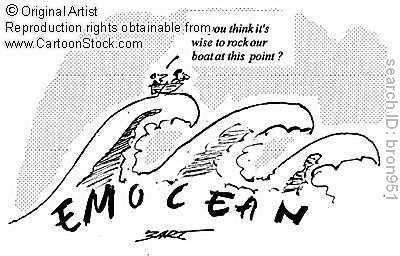
Emotions are like waves.We cannot do much to control their flow. But we can choose which ones to surf..