Written in the context of Rimsha Masih, the 11 year old accused for blasphemy, and sent to jail for that:
In the Land of the Pure, A minor has dared an act impure. Her feeble mind, designed a devil, Her tiny hands, enacted an act so evil. Divine here are the laws that reign, Virtuous is the blazing anger insane. Swords of revenge are laid bare, Dream to live, she better not dare.
Forgotten, is the kindness to minors, That Prophet(pbuh) had preached. Ignored, is the lesson of forgiveness. The Holy Book has revealed. Dismissed, is the spirit of mercy, The Supreme Power upholds. For in the Land of the Pure, A minor has dared an act impure.
Nafrat ki gathri ko mein ney Phenk diya hai gireh laga ker Hasrat se ab khol rahi hoon Yaadon bharey iss thailey ko Pyaar ki taaza hawa lagaane Aman ki roshan dhoop dikhane.
Tum bhi aao, kholo apni Saari gaanthein, saare bull Tum bhi apne jholey mein se Bujhe huwe woh deep nikalo Un yaadon ke, un baaton ke Un qisson ke, jo itne zyada Dohratey the jab Nana Dada Chehre unke damka jaate the Ankhein unki chamka detey the.
Usee dhamak ki roshni mein tar Usee chamak ki lau ko lekar Mein bhi apna deep jalaaoon Tum bhi apna diya jalaao
Roshan phir se rahon ko ker dein Taaron se khwabon ko bher dein.
Apna apna diya jalaa ker Saare apne dard bhulaker Mil ker jab sub saath chalenge Haath me lekar haath chalenge Dhal jayegi ghurbat ki sham Ho paayegi khush haali aam.
Lekin saw nahin, hazaar nahin, Saath her ek ko chalna hogaa. Sirf mera ya tumhara nahin,
Diya her ek ka jalna hogaa. Karoron diye jo saath jalenge,
Dil mein nai umang bharenge. Pher door jab andhera hogaa, To kya nirala yeh SAWERA hoga.
Kabir has hardly spared any animate and inanimate examples to ridicule the bigots who have great illusions about their self image and through their beliefs repeatedly, make a fool of themselves.
In the same spirit, I came across yet another simple yet interest verses.
Poem 1:
Apanpo aap hi bisaro. Says Kabir, they fall prey to their own illusions and forget the essence of our existence.
Jaise sonha kaanch mandir me, bharamat bhunki paro. Just as dog who enters the house of mirrors, goes crazy barking at the images, considering them different. This is a very curious satire on those bigots who bark at other bigots, thinking they are different, but in essence are reflections of each other.
Jyo kehari bapu nirakhi koop jal, pratima dekhi paro. A lion looks deep into the well, and mistakes his own reflection as another lion, and jumps into it. This also satires on the ‘lions’ of different faiths, who are such egoists, that they destroy themselves, in challenging other ‘lions’ in the business. The current sectarian bigots could be appropriate here.
Aisehi madgaj phaTik sila par, dasanani aani aro. An elephant, so proud of its strength, bangs his head against the rock, and hits it with his teeth. Here rocks could be interpreted as hard, rock like beliefs which they bang their heads against.
MarakaT muThi swad na bisare, ghar-ghar naTat phiro. A greedy monkey for whom the food in the pot is not enough, and goes from home to home asking for more. This is perhaps reference to looking outwards, though we could easily content with what is with us.
Kah Kabir lalani ke suwana, tohi kaune pakaro. Says Kabir, their logic is as impossible to catch as the parrot of a village girl. Here he gives a satire of those who keep repeating mindlessly like a parrot, with no logic what so ever.
And then in contrast to the satire, many verses of Kabir bring home the message through simple, day to day examples, of how should we be viewing our beliefs, and the essence of our existence.
Poem 2:
Man tu maanat kyu na mana re. O’ the wandering mind, why don’t you understand?
Kaun kahan ko, kaun sunan ko, dooja kaun jana re. Who is worth to speak or to listen, when there is ONE truth. Here he refers to perhaps the various claimants of ONE, and give it different names and forms.
( The next verse makes it clearer)
Darapan me pratibimb jo bhase, aape chahu disi soi. He is all round in every atom, the way there is a reflection in every mirror. ( This could be compared to the idea of sheesh mahal—made of tiny mirrors all around one image is seen in each and every tiny mirror)
Dubidha mite, ek jab howe, tau lakh paawe koi. If you get ONE truth, you will get contentment worth a million, and the confusion of mind will go away.
Jaise jal se hem banat hai, hem ghoom jal hoi. The way ice is first made of water, then returns back to the same water.
Taise yah tat wahu tat so, phir yah aru wah soi. In the same way, we are all come from that truth, and unto the same truth we have to return to.
Jo samajhe so khari kahat hai, na samajhe to khoTi. Those who get this, call this a stark truth. Those ignorant who don’t get this, consider it falsehood.
Kah Kabir khara pakh tyaage, waaki mati hai moTi. Says Kabir, one who gives up the essence of truth, his brain is thick ( stubborn).
It is remarkable how Kabir talks of evils of bigotry, unity of mankind and the true spirit of secular spirits, rising above the superfluous divisions in the dark ages.
Or perhaps, we are living in darker ages.
Indeed, it is a long road, before Kabir’s examples and teachings become irrelevant to the current times.
The Kabir bhajan below, again, gives some more examples through which he challenges the bigots. Note the translation subtitles. This is my favourite tranquillising Kabir song.
On 27th January, 2012 India celebrates Basant panchami.
In Pakistan, it is celebrated towards the end of February.
Towards the end of January till early March, the golden harvest of wheat stand tall ready to be harvested sometime in early April. And wheat is our staple crop.
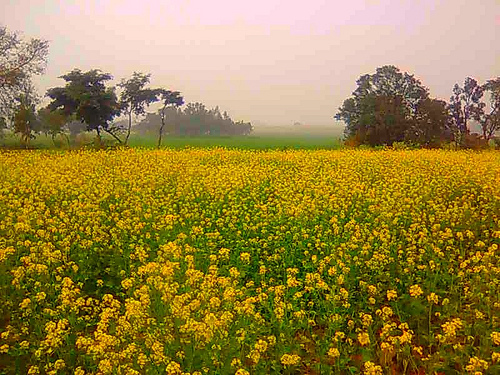
At the same time in Januray February the yellow blooms of mustard ( better known as sarson) sway in the fields, as far as eyes can see. And mustard is a cash crop whose seeds are pressed to extract mustard oil.
To celebrate these awesome blooms as a reward for the fields ploughed and the seeds sown in October, the farmers rejoice, sing, dance and make merry.
Some of them wear yellow turbans, and their women folk adorning yellow ‘odhnis’ come out to join in the celebrations. It is not hard to imagine that they must be celebrating the blooms, ever since they learnt to farm these crops dating back to centuries.
This is the basic root and the spirit of the tradition of Basant in parts of Indian subcontinent where these crops are grown.
Are wheat, or mustard crops Hindu, Muslim or Sikh?
Vasant in Sanskrit or Basant in Urdu mean ‘spring’, which heralds the departure of winter and arrival of spring. It symbolizes the time of rejuvenation and arrival of happiness as flowers start to smile through their blossoms.
Yellow, the color of Basant, inspired by mustard blossoms, which matches the shade of sun rays, signifies life and radiance.
Do rays of sun or radiance of happiness differentiate between Hindus, Muslims or Sikhs ?
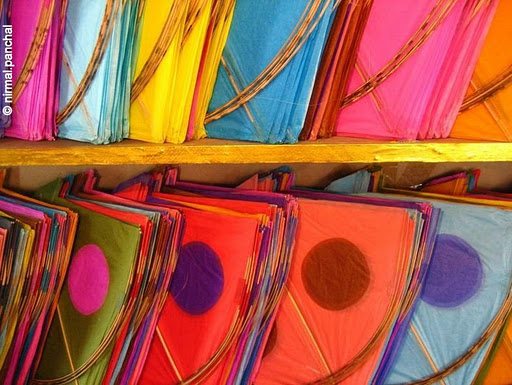
Kite flying , another component of basant, has it’s own interesting tale to tell.
“Kite flying also reveals how the tradition evolved over centuries and in a Ganga Jamuni way. Kite flying was introduced to the Indian subcontinent by the Chinese traveller Heun Tsang in the 4th Century. Evolving for centuries, it s modification into its current form and popularisation as a sport was made possible by the Nawabs of Avadh. The kite flying during basant celebrations is believed to have been introduced by Maharaja Ranjit Singh in the 18th century.”
Yet another evidence of centuries old and secular celebration of Basant come from poets, Kalidas and Amir Khusro, who have written about the celebrations of Basant in their own unique styles.
Kalidas in a poem Spring writes:
द्रुमाः सपुष्पाः सलिलं सपद्मं
स्त्रियः सकामाः पवनः सुगन्धिः ।
सुखाः प्रदोषा दिवसाश्च रम्याः
सर्वं प्रिये ! चारुतरं वसन्ते “Oh, dear, in Vasanta, Spring, trees are with flowers and waters are with lotuses, hence the breezes are agreeably fragrant with the fragrance of those flowers, thereby the eventides are comfortable and even the daytimes are pleasant with those fragrant breezes, thereby the women are with concupiscence, thus everything is highly pleasing…
AmirKhusro pens down:
Aaj basant manaalay suhaagun, Aaj basant manaalay; Anjan manjan kar piya mori, Lambay neher lagaaye; Tu kya sovay neend ki maasi, So jaagay teray bhaag, suhaagun, Aaj basant manalay…..; Rejoice, my love, rejoice, Its spring here, rejoice. Bring out your lotions and toiletries, And decorate your long hair. Oh, you’re still enjoying your sleep, wake-up. Even your destiny has woken up, Its spring here, rejoice.
There is an Indian classical music tune called Raag Basant Bahaar.
Not to forget, basant in the subcontinent is also associated with a special sweet prepared specially for the occaision –the kesar halwa, It is a suji ( semolina) halwa with a soft aroma and yellow shade from saffron and garnished with cashew nuts.
Neither the dessert, nor the poetry above nor the music below suggest if Basant is Hindu or Muslim or Sikh.
The same spirit is also replicated by this beautiful ghazal by Malika Pukhraj and Tahira Syed
Lo phir basant aayee…
P.S. Special thanks to Sandeep@stwta a twitter pal for the devnagiri text of Kalidas poetry.
Listening to the stories and anectodes of Mehboob-e-Ilahi( Beloved of God) was a norm as kids. A Mamoo, an ardent follower of Sufism, who lived in Jaipur was the source. If he ever happened to pass by Delhi, visit to the ‘Dargah’ was a mandatory. And when in Delhi, he had to visit his sister too i.e. my mother.
He brought meethi kheels (sugar coated puffballs) every time he came from Dargah, and was ever willing to narrate to us the stories of love between Mehbub-e-Ilahi and his favourite disciple.
On the other hand I saw my not so religious father’s( who also hailed from a Maulvi family) love for Amir Khusrau’s Persian poetry, and a tall tower of audio cassettes he had piled up next to his music system.
Honestly for years until early teens I did not know who Mehboob-e-Ilahi or that disciple were and where the Dargah was. We never visited. All I knew, Ammi went with Mamoojan a few times.
Once , when during a story time, Mamoojan was corrected by my father, about a Persian verse by Amir Khusro, did I realise that there was a correlation.
“Such a great poet had a Pir?” was my instant jerky reaction. Pirs in my mental dictionary had a negative meaning and image.
Equally instant was my father’s reaction: “ Hazrat Nizamuddin was a great scholar, it’s the people later who made him a Pir, and now have opened a whole business in his name.”
Mamoojan just gave a slight smile, and as always drowned again in his love for Mehboob-e-Ilahi, continued the story.
It was then to reinforce the great bond that existed between Hazrat Nizamuddin and Amir Khusrau, did he tell of these incidents, which now I can quote with the Persian verses he might have mentioned.
Just to make it clear, most of the stories have been passed on as word of mouth, and hence I call them anectodes.
Anectode 1:
When Hazrat Nizamuddin passed away Amir Khusrau was away, in some other city, attending to the orders of a King. As he learnt of the sad news he rushed back and went straight to the fresh grave of his master.There he rolled in the mud and tore off his clothes in agony. Then came these words:
Gori sove sej par mukh per dale kes Chal Khusro ghar aapne, rain (not saanjh) bhaee chahu des. The lovely maiden lies finally on a wreath of flowers, her tresses covering her face, O Khusro, turn back home now, dusk has set in all over.”
Amir Khusrau was never the same after his Pir’s death. And it was only in six months that Amir Khusrau also passed away.
He was, as per the desire of the disciple and Pir both, buried close by. This is now known as a “chabootra-e-yaar’ ( the pedestal of friend).
One can see this as a raised platform with red sandstone carved fence, around the grave.
The Pir also reciprocated his disciple’s love and affection, and is believed to have remarked: “If shariyat would allow me, I would want Khusrau and I to be buried in the same grave.”
His followers believe that Hz Nizamuddin instructed that “Those who visit my grave should first pay respect at Khusrau’s .”
Anectode 2:
Amir Khusrau was away for a royal trip. A disciple of Hz Nizamuddin came to him asking for some souvenir from his Pir. Since the Pir had nothing to offer, he asked the disciple to take away his slippers.
Incidentally, on the way the disciple and Amir Khusrau’s paths crossed each other. And Khusrau remarked:
Shaikh mi aayad, Bu-e Shaikh mi aayad”.
(I smell my master, I smell my master).
On knowing that the man had in possession the slippers of his Pir, Khusrau gave away all his wealth that he had on him and bought back those slippers.
Anectode 3:
The two were sitting at the bank of river Yamuna in Delhi when Hz Nizamuddin (wearing a cap crooked way), saw some men taking a dip in the river with a reverence as a worship. He remarked: Har qaum raast raahay, deenay wa qibla gaahay (Every sect has a faith, a qibla which they turn to.)
Pat came the reply from Khusrau: Men qibla raast kardam, ber terf-e kajkulaahay. (I have straightened my qibla in the direction of this crooked cap)
Anectode 4:
It is the most interesting of all anectodes, and if true (I do not doubt, but these stories have been passed through word of mouth), then it is remarkable to have this quality of Persian and Brij Bhasha poetry from an eight year old.
It is said that Khusrau’s mother brought her eight year old son to the place where Hazrat Nizamuddin ( a renowned scholar and respectable man) resided.
Instead of entering the premises Khusrau sat outside and narrated: Tu aan shahi ke ber aiwan-e qasrat Kabutar gar nasheenad, baaz gardad Ghareeb-e mustamand-e ber der aamed Be-yaayad andaroon, ya baaz gardad You are a king at the gate of whose palace, even a pigeon becomes a hawk. A poor traveller has come to your gate, should he enter, or should he return?
And that Hazrat Nizamuddin who himself was 23 then, came out (some say he sent out servants) and replied: Be-yaayad andaroon mard-e haqeeqat Ke ba ma yek nafas hamraaz gardad Agar abla buvad aan mard-e naadan Azaan raah-e ke aamad baaz gardad Oh you the man of reality, come inside, so you become for a while my confidant, but if the one who enters is foolish , then he should return the way he came.
Hearing this Khusrau knew that he has come to the right place and hence entered into his guidance.
Having reread Khusrau, several times over since then, I have came across some of the records, which go further to say that- telling his mother of his excitement to have found the Pir, Khusrau composed these beautiful verses: Aaj rung hai hey maa rung hai ri Moray mehboob kay ghar rang hai ri Sajan milaavra, sajan milaavra, Sajan milaavra moray aangan ko Aaj rung hai…….. Mohay pir paayo Nijamudin aulia Nijamudin aulia mohay pir payoo Des bades mein dhoondh phiree hoon Toraa rung man bhayo ri……, Jag ujiyaaro, jagat ujiyaaro, Main to aiso rang aur nahin dekhi ray Main to jab dekhun moray sung hai, Aaj rung hai hey maan rung hai ri. What a glow everywhere I see, Oh mother, what a glow; I’ve found the beloved, yes I found him, In my courtyard; I have found my pir Nizamuddin Aulia. I roamed around the entire world, looking for an ideal beloved; And finally this face has enchanted my heart. The whole world has been opened for me, Never seen a glow like this before. Whenever I see now, he is with me, Oh beloved, please dye me in yourself; Dye me in the colour of the spring, beloved; What a glow, Oh, what a glow.
In my ignorance, I bluntly asked Mamoojan,”What was so great in Hazrat Nizamuddin that even an accomplished man like Amir Khurau revered him so much?”
I remember Mamoojan reply, “He was a great pious man, a Wali. That is why he was called Mehboob-e-Ilahi ( the beloved of Allah)”.
To tell you the truth, I wasn’t entirely convinced then, but then years later, while getting into the colors of Amir Khusrau’s poetry, I did my own research.
I found that Hazrat Nizamuddin was a great scholar of Quran. He was truly a very pious man, who prayed a lot and fasted each day of the week.
There were free meals ( langar) at his residence, each day, in which Amir Khusrau actively took part.
He led a very simple, austere life, wore at times torn clothes, and ate extremely simple food.
But what really convinced me of why Amir Khusrau revered him so much was this incident of Hazrat Nizamuddin , which so speaks volumes of the greatness of this Pir of Amir Khusrau:
Once some of the staunchest of enemies of Hazrat Nizamuddin, threw thorn on the way he was to pass. He walked over them, bare feet, without any complaint. And with his sole bleeding, he prayed that every thorn that had pierced him become a red rose( like the color of his oozing blood) in the grave of the thrower.
Mehboob-e-Ilahi that he was, he is said to have remarked: “If a man places a thorn in your way, and you place a thorn in his way, soon there will be thorns everywhere.”
With all this in the background, now this poetry by Amir Khusrau sounds even more melodious…
Kabir leaves no examples to teach and stress to human beings, in his own simple ways, the lessons of humility, tolerance and open mindedness.
In other verses, as in previous post, he gives examples from the living world, like animals, or even from trees, rivers and oceans.
In the verses mentioned below, he picks the most modest of examples, to highlight their good traits. But realisng that they too have downsides, moves on to gentler ones among them. And ultimately makes us realise, it is only ‘the ONE’ truly devoid of flaws.
In a way, there is a subtle message here, that in one’s pursuit to be better, there is always room for further betterment, and despite all our efforts in the direction, it is only the ONE who is perfect.
Rorha hoi rahu baat ka, taji paakhand abhimaan. Aisa je jana hoi rahe, taahi mile bhagwaan.
O dear, be as humble as the pebble on the path. Giving up all snobbery and ego. Only if you are humble can you realise Him.
Rorha bhaya to kya bhaya, panthi ko dukh deh. Harijan aisa chahiye, jyoon dharani ki kheh.
Kabir rethinks. What if you are a pebble, as it too can get unkind and hurt the feet of the fellow travellers on the path. So be like the soil on Earth, soft and gentle.
Kheh bhayi to kya bhaya, urhi-urhi laage ang. Harijan aiasa chahiye, jyu paanee sabrang.
Again Kabir rethinks. What if you become soil? It flies with slight breeze and spoils others ( a little adversity may cause our evil nature to surface and cause harm to others). So just be like water – it is without color (without prejudice), but it can take whatever color easily ( be open minded).
Panee bhaya to kya bhaya, taataa-seeraa hoy. Harijan aisa chahiye, Hari jaiasa hi hoy.
Once again Kabir rethinks. What if you are water? The water gets furious with heat and even becomes too cold with indifference.
So just strive to be as Tolerant, Kind and and Merciful, always as your Lord.
While looking for more of Bulleh Shah’s poetry in an attempt to make a comparative list of Verses between Bulleh Shah and Kabir, I came across a new fascinating piece of his poetry.
In this Kaafi he presents the truth of life on Earth, beyond the temporal day to day life. In the last verse he challenges the riddle of life, to be solved.
Maati maati nu(n) maaran lag-gee, maati de hathiyaar. Jis maati par bahutee maati, so maati hankaar; Maati baagh bagheechaa maati, maati dee gulzaar. Maati maati nu (n) vekhan aayee, maati dee a bahar;
“The soil is in ferment, O friend Behold the diversity. The soil is the horse, so is the rider The soil chases the soil, and we hear the clanging of soil The soil kills the soil, with weapons of the soil. That soil with more on it, is arrogance The soil is the garden so is its beauty The soil admires the soil in all its wondrous forms After the circle of life is done it returns to the soil Answer the riddle O Bulleh, and take this burden off my head.”
Pahilaa poot pishairee maaee. Gur laago chele kee paaee.
Ek achanbhou sunahu tumh bhaaee. Dekhat singh charaavat gaaee
Jal kee mashulee taravar biaaee. Dekhath kutaraa lai gee bilaaee Talai re baisaa oopar soolaa. Tis kai ped lage fal foolaa Ghorai chari bhais charaavan jaaee. Baahar bail gon ghar aaee
Kahaat Kabeer ju is pad boojhai. Raam ramat tis sabh kish soojhai
Translation:
First, the son was born, and then, his mother. The guru falls at the feet of the disciple
Listen to this strange thing, O Siblings of Destiny!
I saw the lion herding the cows. The fish of the water gives birth upon a tree. I saw a cat carrying away a dog The branches are below, and the roots are above. The trunk of that tree bears fruits and flowers Riding a horse, the buffalo takes him out to graze. The bull is away, while his load (cart) has come home
Says Kabeer, one who understands this hymn, and comprehends the Divine words comes to understand everything.
This is a beautiful satirical poem by Bhagat Kabir, taken from Guru Granth Saheb ( the Holy Book of Sikhs), that takes me back instantly to the Hindi class of grade 10, when we read this. I recall with nostalgia of all the discussion that was triggered by the poetry. While the boys at the back benches were busy cracking various mostly crude and a few decent jokes about it, the girls in the front benches, ( that’s where they usually sit) were amused yet trying to squeeze their giggles desperately.
While the very serious Hindi teacher with a twinkle in her eyes, and mind fully immersed in Kabir was engrossed in explaining the spirit of the verses, compleltely oblivious to what was happening in front of her.
Unlike many other Hindi lessons, this poem unknowingly left ‘an impact’ strong enough to keep reading Kabir once the compulsory Hindi subject was over.
I would suggest the readers to first read the verses, it’s translation and then again the verses to get some sense of it’s meaning, and to check whether their brain thinks the way Kabir’s brain did.
The Interpretation:
The whole poem through various interesting examples, cites an open secret of our lives, so aptly described in a quote by Rousseau : “Man is born free but found in chains everywhere.”
What chains him, according to Kabir are not only the society( like Rousseau claims), but ones own hoggish desires and the pursuit of which makes him timid and fearful. And hence instead being fearless, strong yet empathetic, that man by virtue of his higher intellect is destined to be, turns into a timid, selfish and apathetic being .
Pahilaa poot pishairee maaee.
To begin with, the man was as pure as a newborn (poot), devoid of any ego. But with time, by the lure of his senses, he became ‘mother’ of (“Maaee”) ‘worldy desires’ ( the superfluous values existent in the world). Here Maee is being used with a dual meaning, both as the worldly attractions i.e. maya, and as mother.
Gur laago chele kee paaee.
Man who has the capability to be the master (Guru) of infinite knowledge, strength and empathy ( by the virtue if his intellect) becomes the disciple (chela) and bows at petty values like greed, selfishness and apathy.
Ek achanbhou sunahu tumh bhaaee.
This is an amusing contradiction, have you even seen? ( A satire on human aspirations to seek and pursue superficial values).
Dekhat singh charaavat gaaee
A man who should be fearless and strong ( as a lion) , becomes a timid grazing animal (cow), owing to protect his self interests.
Jal kee mashulee taravar biaaee.
Water is the life support of the fish, and it cannot survive without it. What if it starts to dream of living ‘high up’ on the trees. Will it be able to survive ?
So is the humanity who’s life supports are compassion, contentment, empathy and knowledge. What if they too start to fantasize for what they consider as higher pleasures ( a kin to trees) like greed, wealth or other egocentric dreams, will they be able to sustain the purpose of their existence ?
Dekhath kutaraa lai gee bilaaee
The cunning human heart ( the cat– in ‘some’ societies is considered as a cunning animal) , in lure of superficial values, has captured and held hostage the contentment, faith and bravado ( the dog) within him. ( Incidentally, in the times of Egyptian Pharoahs, dog was considered as a symbol of contentment, reliability and bravery.
Talai re baisaa oopar soolaa. Tis kai ped lage fal foolaa
When we see the image of the tree in a lake, it appears beautiful but upside down. So is the truth of our worldly gratifications, they may appear wonderful, but they are exactly opposite of what the purpose of our existence in the world is.
Ghorai chari bhais charaavan jaaee.
Man’s desires ( as bulky as a buffalo) ride and gallop rapidly on greed ( the horse) to make the mind wander and graze the grass of one’s ego.
Baahar bail gon ghar aaee
Owing to man’s enslavement to lust and instant gratification, his patience and perseverance (bull, which is an embodiment of perseverance) has left him, instead, a cart load full of material cravings have found home in him (“gon ghar aaee”).
Kahaat Kabeer ju is pad boojhai. Raam ramat tis sabh kish soojhai
Kabir says that whosoever comprehends the verses of this hymn, and remembers the Divine purpose of his existence frees himself from bondage.
William Wordsworth’s famous verse: “Child is the father of man.” may hold the same literal meaning, but here Wordsworth tries to explain how the childhood experiences shape the person he is when he becomes a man. In yet another interpretation,,,some say that here child is referred to as Jesus since both Child and Father are capitalised.
Perhaps in the same way, there may be more than one interpretations of the above poem. I have narrated, what my small mind, which isn’t very spiritually bent, interpreted it as.
I leave it to the readers to let their imaginations soar, and generate their own wonderful interpretations of the Kabir’s verses above.
The above salok (verses) of Sant Kabir are taken from Guru Granth Saheb ( the Holy Book of Sikhs.
Picture of Golden Temple, Amritsar by night From the album Gateway to Heaven, by Randeep Singh.
Thanks to Naren @froZENwell for reminding this poem and inciting me to write this blog.
kah ke tana, kah ke bharni, kaun taar se bini chadariya ingla pingla taana bharni, sushumna tar se bini chadariya.
ashta kamal dal charkha doley, panch tatva, gun tini chadariya saiin ko siyat mas dus lagey, thonk-thonk ke bini chadariya.
so chaadar sur nar muni odhi, odhi ke maili kini chadariya das Kabir jatan kari odhi, jyon ki tyon dhar deeni chadariya.
The Lord Supreme has woven a very fine and delicate tapestry,free of impurities of any kind! What refined and subtle yarn, what complex interlacing, He has used to weave it!
Using veins and breath His threads Twenty four hours on end,His spinning wheel turns, Weaving the tapestry from all five essential elements.
Ten months does it take the Lord to weave his tapestry, Using the greatest of craftsmanship, care and skill.
That exquisite tapestry is worn by the celestials,by Saints, and by human beings alike. But they all invariably have defiled it !
Your humble devotee Kabir has worn it scrupulously and meticulously, And is returning it to You, O’Lord, unblemished and pure !









 Blind to Bounds
You must be logged in to post a comment.