Open up your mind and your potential reaches infinity…

Archive for the ‘Personal’ Category

Hear the snowflakes speak…


Snow storm

Next time,
you are stranded in your car,
in a snow storm,
snail pacing thro the traffic,
Turn on a soft music and,
watch each snowflake closely,
so beautifully crafted,
yet none two identical,
in shape, size or character,
sailing down, leisurely,
in a silent chaos,
trying to speak to you.
And hitting the windscreen,
trying to reach you,
To whisper to you,
“How pure, soft, different are we.
But so short lived as individuals,
While so lasting when together.”

snowflakes2

A Forbidden Dream?


This is a story from my life and dreams,  in three short episodes.

Episode ONE: 

Location: Amritsar

Time: 8AM on a lazy Sunday.

Suddenly my husband declares, “I won’t eat boiled egg today for breakfast. Enough of calorie count.”

 “I can’t make Nihari in a few minutes. You should have told me yesterday, you want to eat something else.”


“Idea, lets go to Lahore for a Paaye-Nihari naashta at Gawaal Mandi. It’ll take us less than an hour by  car. Keep my passport also in your purse.”

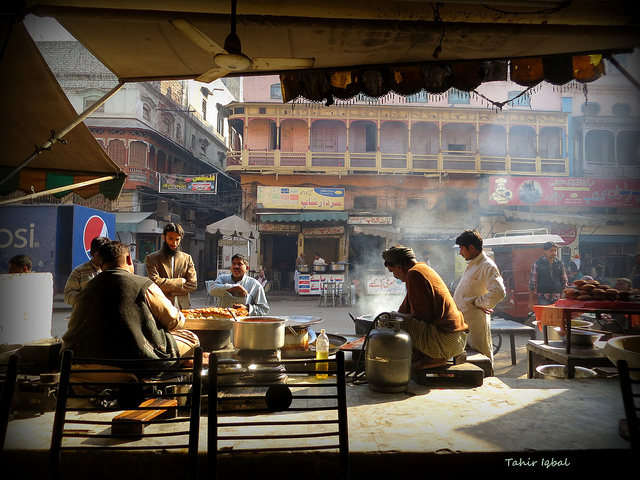
Within 10 minutes we were on the PEACE ROAD  to Lahore, and just an hour later sitting in Gawal Mandi under the open skies in a mild cold breeze, as my husband was ordering two plates of Paaye Naan with doodh-patti chai.


gawal mandi

Episode TWO:

Location : Karachi
Time: 1:00 PM Lunch time in the office with friends.

“What are you wearing on the Annual Celebration for our Office.”

“Oh, I don’t have any decent dress to wear, I wish I could wear an Indian saree for a change.” (Yes every woman, almost never has a decent dress to wear.)

“Heyy, you know I saw on TV there is a bumper sale in Rana Sarees in Jodhpur, on bandhnis, leheriyas etc. Even I want to buy one.”

“Idea! Why don’t we plan, take train on Friday,  to Jodhpur and come back on Sunday.”

“Yes, brilliant idea. Rana Sarees is closed on Mondays only.”

Thursday evening, we pack our small trolley bags, and off we are, on Friday morning in the PEACE TRAIN from Karachi to Jodhpur on Khokrapaar-Munabao Railway track.

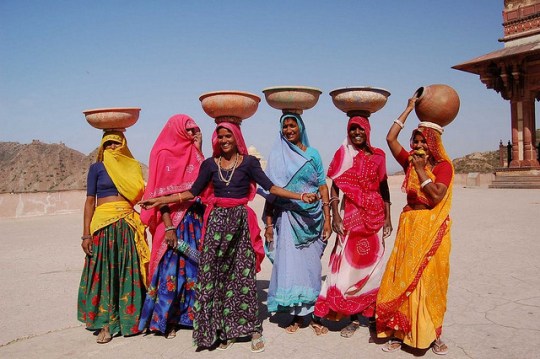
As the train winds through the golden sands of Thar Desert, we see Thari men and women in their colorful clothes busy with their daily work.  A group of women stop by, turn at us and wave back at our train.

I  look at the woman in a white and red saree,  and scream excitedly, “I will buy a saree of this design.”

In 5 hours we are in Jodhpur. With a shopping spree all Saturday, on Sunday morning, we set off with loaded bags, on the train back home.
Thar women

Episode THREE:

Location: Mississauga, ON , Canada.
Time: Early morning on a cold Saturday on a long weekend.


“Winters are depressing, Are we going to spend all three days sitting in the home in front of a fire place?”, my husband.

“No, we can go to America, to have an ice cream in -20 degrees C.”  I remark sarcastically.

“Hey, why ice cream, lets go to Buffalo,  for cheese cake?”

The idea hits home.  And in 5 minutes, we were on QEW Highway heading down South and East to Buffalo. In an hour we were at the border, and 8 minutes later, which included clearance from the US Homeland Security of our Pakistani Passports, we were on the PEACE BRIDGE, built over Niagara River, between Fort Erie ( Canada) and Buffalo ( USA).

In two hours after a lunch and an order of cheese cake, we ere driving back home to Canada.

???????????????????????????????

Do the stories sound wierd?

Or perhaps for some, “So what’s there to blog about them? Isn’t that normal. ”

Indeed, for many across the world, such adventures are normal. They travel cross countries   which even speak different languages( as in Europe), without much fuss,  just for a cup of coffee or even go to work across border.

As you may have guessed, only Episode THREE was a real one, while the Episodes ONE & TWO are  still   far fetched dreams.

The fact that Peace Bridge is a reality, it hurts even more to know that Peace Road or Peace Train have to still remain a dream, a far fetched one.

They do occasionally become  a reality, but  for the VVIPs  (only).  For instance, when  one fine weekend the Head of the State on one side  decides to go to the other side for a visit to a shrine, or for a cricket match. But it still remains a dream, and a forbidden one,  for the ordinary.

Even when the ordinary have relations, loved ones or friends on the other side,  all they are entitled to is to dream like the way I dreamt in episodes ONE and TWO.

I know of a true story of a friend, who planned a year in advance to be with her parents, on their Golden Jubilee Wedding Anniversary.  But the visa did not arrive on time.  And when it did arrive, 15 months later, her father was in the hospital, struggling for life.  She fortunately made it,  to see him, and then he passed away two days later in her arms. She felt fortunate to have met her father, and held him in his last minutes of his life.

This wasn’t  her dream, but a true story.

I cant even call myself that lucky. I reached two days after my father was buried. Now I dread for my ageing mother. May she live long, and every time I part with her, I wonder in what circumstances would the next meet be.  Would it be possible at all or not?

With months of excitement about the much publicized NEW VISA REGIME, I had anxiously awaited ( and tweeted) for the arrival  May 25, 2012,  when the document was expected to be signed.  But it was postponed  in the last minute, by a Minister from Pakistan for ‘some’ reason  I didn’t care to explore. For me it was a delay in realization of part of my dreams, for whatever reason-valid or lame.

{However, the divided families did not have much to rejoice from the new agreement, but I still thought this a great step in the right direction.}

Finally in December, when the Ministers met in New Delhi,  the agreement was sealed and signed.
Alas, with  no jinx, we apprehensively took a sigh of relief.

But then, as feared, the tensions at LOC and the beheading incident put the implementation on hold. Again, the ‘not so big’ dream which had come so close to realization had again receded afar.

The dream to cross the Indo Pak Border  is not for Nihari or for  a Saree.  We can get it on the  same side of the border too. They are simply the symbolic magnets of common love and heritage, that the ordinary people on both sides have not been able to ignore, despite years of deliberately created rifts and barriers between them.

Some have outrightly called my Nihari-Saree dream as cynical one, but when few millions ordinary citizens between the US-Canada or within the EU can see this as a reality, why cant the 1.4 billion( a seventh of humanity) across India and Pakistan?

When 3 wars, and countless hostilities have not resolved the differences  why can’t peace and  cooperation be given a real chance?

Like every sovereign nation, India and Pakistan too have the right to ensure, that no miscreants are let to cross the border, but why should the whole population of wellmeaning people be held hostage to the whims and fancies of  few vested interests?

Let the people  interact through easy Visa for the ordinary.  

Let prejudices whither and sanity & reasoning  prevail.

Please, let the people meet.

Please #MilneDo

Whatever IS will be WAS.


The above heading is a Buddhist saying by Monk Ñanamoli. The  in depth meaning of its essence could not be more powerfully conveyed than by an ancient  Buddhist ritual called dul-tson-kyil-khor ( Mandala of colored powders).

Sometime ago in search for an idea for silk painting I accidentally bumped into a beautiful  handmade creation, which in first hand looked like an intricate colorful geometrical design, called Sand Mandala.

As the name implies, it is a creation made from colored sand. Mandala means a palace. There is much more to it than the eyes can see.

From the Tibetan Buddhist tradition, this is not just a creation of a beautiful sand castle, but a spiritual journey, for which requires a great practice and meditation before embarking on it. Even during the creation , which usually requires 4 monks (bhikkus) who keep chanting hymns and focus all their minds and actions into its creation.

The sand mandala for them is a three dimensional Palace of Imagination in which they enter, and each dot, line, shape and color that they create in it stands for a specific aspect of Buddhist Philosophy. There are many types of Mandalas, and each stand for a unique symbol.

The creation has to be accurate, and the work  between the 4 creators, working on each quadrant,  has to be well coordinated.

Billions of grains of colored sand powder are carefully and accurately placed in its specific location, using two copper conical pipes called chapku, which are gently tapped over the other, to release controlled amount of sand.

The colors for the painting are usually made with naturally colored sand, crushed gypsum (white), yellow ochre, red sandstone, charcoal, and a mixture of charcoal and gypsum (blue). Mixing red and black can make brown, red and white make pink. Other coloring agents include corn meal, flower pollen, or powdered roots and bark. In the ancient times they used colored dust from the lapiz lazulli, emerald, ruby, and corals and other precious stones to get colored dust powder.

It takes from few days to few weeks to create a mandala.

However, the most mind boggling part arrives when the whole intricately built sand mandala is undone ( yes, you read it correct) from outside-in in a rotas wheel movement, never to exist again, by the very monks who created it. This metaphorically implies the impermanence of things.

The dust collected is immersed in a flowing water ( river nearby) symbolizing the transference of the energy of goodwill ( imparted to it during its creation)  and compassion, to the rest of the world. {The whole idea gave me shivers and goose bumps}

Hence, when even  at first look it appears to be an end of a creation, but in the real sense, nothing is ever destroyed forever, just that it is returned to the nature, to rejoin elements.

And this does happen to all animate and inanimate objects on earth, be they complicated  humans,  simple plants, soft clouds or  even lofty mountains.

When Buddha passed away, one of his disciples remarked:

Aniccaa vata sa”nkhaaraa — uppaada vaya dhammino
Uppajjitvaa nirujjhanti — tesa.m vuupasamo sukho.

Impermanent are all component things,
They arise and cease, that is their nature:
They come into being and pass away,
Release from them is bliss supreme.

It compels me to be reminded of Kabir’s doha:

Mati kahe kumar se tu kya rondey mohe,
Ik din aisa ayega main rondoonga tohe.
(The clay says to the Potter: What will you maul me, a day shall come, when I shall maul you).

Or yet in another doha he reminds:

Kaya nahin teri nahin teri,
Mat ker meri meri.
(This existence isn’t yours, don’t call it “It’s mine, it’s mine.”)

And of Bulleh Shah’s kaafi:

Na Kar Bandeya  
Meri Meri
Na Teri Na Meri
Char Dinan Da Mela
Duniya Fair Mitti Di Dheri.
(O people, why  be obsessed with me, mine. Its neither yours nor mine. Its for a while, then we all shall be but a pile of dust).

Indeed, “from dust we were born, and to dust we shall return.”.

Bread pakorey ki kasam


If seeing this ^^^ picture, your eyes twinkled, lips curved into a wide grin, your mouth began to water and it flashed back the awesome memories of your alma mater, please stand up !

And to those who find the above sentence a gross exaggeration, and cynical, I don’t blame you. For you are an alien to this experience.

To the first group, know you are a Delhiite and more specifically went to DU as a student. And you don’t even need to be explained what DU stands for. But for the latter, btw, it stands for Delhi University .

What fish n chips is to London, or hamburger is to Mc Donalds, this luscious snack is to Delhi. This is the  finger food we all relished ( I wonder if they still do) in cramped Delhi University cafetarias, without realising its awesomeness.

Being away from Delhi now for over two decades, the gold test for me to check whoever claims “I am from Delhi.” is the mention of the clue word “Bread Pakora”. If instead of a wide eyed expression screaming ‘wierdo’, the return expression is an instant wholesome grin, you know the claim is authentic. You don’t even need to double check them.

To give you another evidence of my cynical attachment to a bread pakora, it was only for the ‘Bread pakore ki kasam’ tag line, that got me watch, Band Baja Baraat twice.

In the good old simple days of limited pocket money, and even more limited options in the DU cafes, this large sized, yummy snack with a hot cup of chai came in handy and filling in the lunch hour, for an affordable Rs 5/-

Just as in some other part of the world, mustard compliments hotdogs, our austere bread pakora came proudly partnered to even more austere yet yummy Kaddu Ketchup (Pumpkin ketchup).  And the two stayed married to each other, no matter how much the arrogant branded ketchups belittled it , on TV ads of our days:
“Thora ketcup try karo?”
“Ketchup hota kaddoo bhara”
“Is mein kaddoo nahin zara,
Raseele tamataron se tayyar,
Volfarm .”
( If I still remember it correctly) .

Whenever I get into my “Ayy mere pyaare watan, tujh pe dil qurban” mode, all I do is take two slices of bread, spread one with hot chilli sauce, other with green mint coriander chutney, sandwich them with mashed potatoes, or even cottage cheese, cut them in two triangles,  coat each of them in a chick pea batter, and fry them. And with a steaming cup of tea, I transport myself back to the DU student days.

Find it weird? No worries, most of my family too, quietly radiates that subtle expression of Whats so great about bread pakora?”.

But I have learnt to not take notice of them, and not even take any offense.
They  know not what they are missing !

Believe it or not, I find it the awesomest finger food, for it carries with it a flavour of my past memories too.

Bread pakorey ki kasam !

King of fruits~ a twist with the taste !


Hindu Gods claimed it to be the Food of Gods, the emperors and nawabs called it the King of fruits, poets like Ghalib called it pots with honeyed juice , scientist call it Magnifera indica, with all the special names given by special beings.

To the ordinary, however,  it remains a simple ‘Aam’ ( which itself means ‘ordinary’).

What generous qualities is this wonder fruit not bestowed with—soft silky texture, gorgeously golden color, a mesmeric aroma for the olfaction, and a heavenly sweet delight to the taste buds. And not just the quality, in the peak of its season, it comes in abundance, making Aam ( mango), yet another symbol of generosity. And as if these qualities weren’t enough, it comes in hundreds of varieties.

I love the way, when in abundance, mango sells at a reasonable price making it affordable to many if not all the poor.
“Till last week, in Delhi, some variety of mangoes were being sold at as low as Rs 30 per kg,”, tells my Mom. Still in this world of commerce and trade, India though  the greatest producer and remains the largest consumer of mangoes too, with 99% being consumed locally and only 1% is exported.

Thinking of mangoes, mind goes instantly to a few cues—of mango orchards in Rataul,  where one went to eat just mangoes, or of childhood visits to grandparents where buckets of mangoes soaked in cool water waited for our arrival, and of mangoes being brought home by parents in pettis( wooden boxes) and tokras (baskets) not polybags.  Abundance was common to all.

Beyond eating them as it is, mango shake or mango lassi are universal favorites too.

Right from unripe green to a pulpous ripe fruit, mangoes are worthy of being used in a variety of recipes. The strong mango flavour that obstinately stays even after cooking or mixing with other ingredients, makes it stand out and still remain the main ‘hero’ of any recipe.

The itch to break the monotony and use them in different recipes had always been quite intriguing. Having experimented with various recipes, there are some which have hit really well with my folks at home. And now each mango season, their demand is refreshed.

I share here those  household favorites

Aam Panna:  An age-old traditional drink, that elderly claim beats the heat stroke or LOO (in the desi jargon. Made from unripe or semi ripe mangoes, boiled and pulp sieved, which can be used as either sweet (with sugar) or sour ( without sugar). Adding a dash of chunky chaat masala( desi spices), and a twig of mint leaves makes it a great delight. The resultant sweet n sour drink is a great thirst quencher.

Mango-Avocado-Crab Salad: Layered as avocado cubes with crushed garlic at the bottom, mango cubes with ginger juice in the middle, and crab meat sitting on top. The outcome is pretty cool, with much economy of labor and time.

Mango Salsa &  mango chutney with barbecued chicken:
Mango salsa includes tomato and mango cubes, red onion and jalepino pepper with lemon juice and mint or cilantro garnished. The resultant is a colorful, crunchy mix that is hot, sweet and sour.
Mango chutney is made from green mango pulped, and cooked with sugar and achar masala (pickle spices). Vinegar is added as preservative, after it cools.

Mango Crepes &  Waffles: Hot Crepes or waffles with mango cubes and whipped cream or custard.  Kids love it for a weekend breakfast.

Mango Rose: This is almost a decade long favorite dessert  in the house, a must inclusion in the parties arranged in  mango season. The recipe is an in-house creation and hence kept secret :). Got to eat before ask for the recipe.

Happy mango season !

Nirala Sawera


Dedicated to the events :  

Pledge for Peace Launch in UTM, Mississauga, ON.  https://www.facebook.com/events/398846800175596/

Aug 14-15, 2012 Pakistanis, Indians, celebrate Independence Day for Peace
https://www.facebook.com/events/185174041611282/

https://www.facebook.com/groups/amankiasha1/#!/events/243690589069619/

Nafrat ki gathri ko mein ney
Phenk diya hai gireh laga ker
Hasrat se ab khol rahi hoon
Yaadon bharey iss thailey ko
Pyaar ki taaza hawa lagaane
Aman ki roshan dhoop dikhane.

Tum bhi aao, kholo apni
Saari gaanthein, saare bull
Tum bhi apne jholey mein se
Bujhe huwe woh deep nikalo
Un yaadon ke, un baaton ke
Un qisson ke, jo itne zyada
Dohratey the jab Nana Dada
Chehre unke damka jaate the
Ankhein unki chamka detey the.

Usee dhamak ki roshni mein tar
Usee chamak ki lau ko lekar
Mein bhi apna deep jalaaoon
Tum bhi apna diya jalaao
Roshan phir se rahon ko ker dein

Taaron se  khwabon ko bher dein.

Apna apna diya jalaa ker
Saare apne dard bhulaker

Mil ker jab sub saath chalenge
Haath me lekar haath chalenge
Dhal jayegi ghurbat ki sham
Ho paayegi khush haali aam.

Lekin saw nahin, hazaar nahin,
Saath her ek ko chalna hogaa.
Sirf mera ya tumhara nahin,
Diya her ek ka jalna hogaa.
Karoron diye jo saath jalenge,
Dil mein nai umang bharenge.
Pher door jab andhera hogaa,

To kya nirala yeh SAWERA hoga.

Ilmana Fasih
June 6, 2012

Pangs of an Indian Pakistani


On departure at Indira Gandhi Airport, New Delhi her father, a man with steel nerves, exclaimed with a mask face, in a matter of fact manner,
“Now that you are going across, own the place, own the people, and own the problems the way you have owned the man from there.”

Without a trace of extra humidity in his eyes, he turned back towards the exit, without waiting for her to cross the immigration line for the last time as an Indian. The daughter, with a heavy heart, stopped to watch till the silhouette of her father, her mentor, blurred into the fog of the pre dawn.

Half a day later, the same day, in the same time zone (with a mere difference in half an hour), the same season, she stepped onto a ‘different’  land she was advised to “own”.

The faces, the attires, the language, the snail-pace of the custom officials was quite similar, with only minor difference in salutation of “Namasteji “ there on departure, while “Assalam Aleikum” here at arrival at Jinnah Terminal, Karachi.

But for her the smell at the airport was distinctly different, so was the taste of water she drank from the cooler, and as she moved out, the afternoon breeze that slapped her for the first time was quite hot and humid, unlike the cool breeze she had felt early morning in Delhi. The feeling within was weird, impossible to explain. It was neither regret nor its antonym.

The details of experience that each of the five senses from smell to touch went through, are still afresh as of today.

Today, it is a bit over 22 years from that day of February 19, 1990. A couple of years from now, she would have lived almost as many years as a Pakistani, as she lived as an Indian. A lot has happened in these 22 years. A lot means a lot.

From a dogged patriotic Indian, who cried hysterically on even a hint of anti Indian sentiments from the countless paroxismally patriotic Pakistanis, she gradually graduated into someone who now feels as hurt or happy for Pakistan as for India.

It did not happen overnight.

“You will find a plethora of stupid reasons to with fight each other, and to vent outside anger at home, but for heaven’s sake, never make India-Pakistan as one of those silly reasons. This will neither make India nor Pakistan any Heaven, but will certainly make your home a Hell.”

This singular advice from a cousin uncle in Karachi, in the same situation, did not mean much to her, when it was said. However the golden words found numerous occasions to rebroadcast themselves in her head, pleading reason to maintain sanity.

More than anything else, what must have really transformed her was perhaps the dignity and poise with which her Pakistani spouse literally faced and braved the reciprocal mocking and even bullying from patriotic Indians, relatives or otherwise. If she got perturbed and came to his rescue, he would set her aside with a whisper: “Oral diarrhoea, beyond their control.”

For those who wished to discuss India Pakistan with a level of objectivity, and understanding, they both reversed their roles. They were, and in fact still are, the unsaid ambassadors of the other side in their countries of birth, attempting to bust the myths, and distortions piled up over decades.

However, they still find a sizable ‘visionaries’ on both sides, which never seem to budge from unseen prejudices. Their dogged convictions tend to take comical discourse…

“I know it. I am telling you….”
“How can you be so sure? You haven’t been there. I have lived there.”
“No, but I am sure. I know.”

One wonders if she has still learnt to laugh it off, like her husband. But certainly the pangs of the pain are a lot less.

Not only did they not fight at home on this, they even gave their children the space to choose their preferences through experience. Unlike a typical mother, who would glorify her mother’s side, while demonise her in laws place; it was a conscious effort on her part not to confuse the identity of her kids. It was perhaps as a concerned mother, that she wanted her children to love their homeland as much as she loved hers as a kid.

Seeing is believing, and her two grownups now take pride to announce “We love India, but we own Pakistan” not just in words, but in their actions too.(The wrath the two of them have faced since childhood, because of their parents identities,  till date, would be another saga, best narrated by themselves).

However, not being a super human, what she has really not learnt to laugh off is the message of ‘not’ belonging to Pakistan or to India, which she receives, off and on, bluntly or subtly.

Cricket matches, which boil passions on each side, almost always place her on a pedestal where her allegiance is questioned, at every expression verbal or facial, both home and abroad.

Having strong opinions on political and social issues and a compulsion to vocalize critical views has its own price to pay, if you happen to be a ‘fortunate’ Indian Pakistani. Objectivity is not your prerogative, and to presume “You’re being biased”,  is everyone else’s.  They are always right, and you are always wrong.

“We thought you became a Pakistani”, “Didn’t you give up your nationality?”, “Does it not happens in your India?” “Worry about your Pakistan.” are just few of the judgements that are hurled at her, time and again.

Is it that being a Pakistani by birth, better than being a Pakistani by choice?

Is it that the passport being taken away makes her twenty four years of being born, grown up and groomed as Indian meaningless? Does the soul to be an Indian, also needs a passport?

Or is it that possession of passport of one side bars one to belong to the other side by virtue of birth.

Or is it  being both an Indian Pakistani at the same time, an anathema, worthy of being distrusted?

She would be lying, if she said she accepted these meaningless comments with a big heart. It pains, it really pains. Sometimes it pains a lot more.

Time and again, such off hand comments serve as a reality check for her that ‘no matter how much she may boast that she belongs to both the lands, she is owned by none’.

Going back to her seemingly emotionless father, she was later told by her Mom, on the way back home, he had remarked in a heavy voice:

“The loud mouth that she is, she will certainly be a loss to us, but she will not be a gain, and more of a pain for the other side.”

P.S. This cry is not directed at any single person or incident, but at a pattern of reactions that shoot, off and on, owing to an identical mindset which many many on both sides share. However, it is  the  understanding & acceptance from  friends both ‘real or ‘virtual’ who make our ordeal worthwhile.

Baisakhi in Kashmir~ a tryst with nature.


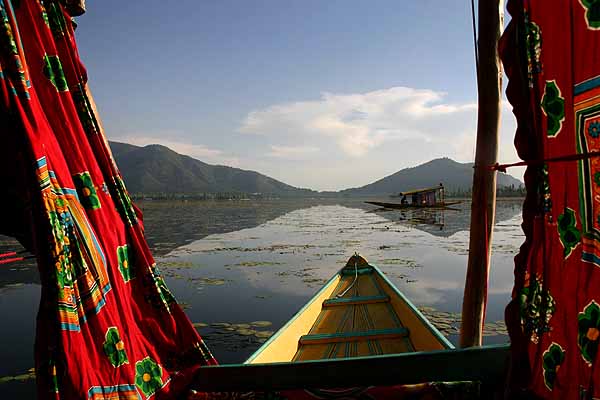
“Woken up with the slightest of hint, we jumped out of our warm beds excitedly and got ready without much fuss. Ammi packed food in a four tiered brass tiffin carrier, placed plates, spoons, a stove, Samovar and other needful in a cane basket, and by 8:00 AM we were heading for the Hazratbal end of the Dal Lake. The mission was to take a shikara( a boat) and have a daylong picnic in Nishat Bagh.”
This is how I remember we began the Baisakhi day,  April 13th, each year without fail.

This ritual was as religiously followed as the morning Namaz on every Eid Ul Fitr.

The shikara took us in half an hour to the other side, right in front of the gates of Nishat Bagh, built by Moghuls at the bank of Dal Lake.


The picnic began the moment we stepped into a shikara, vying to sit at the side, so that we would be able to splash our hands in the water, or  to watch the flora and fauna beneath the surface- the weeds, fishes, tadpoles, or to catch lilies, lotuses as the shikara waded through thick of green round leaves floating on the surface.


It was as if Nishat Bagh, the host location on Baisakhi, welcomed and embraced every family residing in Srinagar, into its lap generously, allocating each a piece of Heaven  to sit.

Life was extremely simple yet beautiful.


It feels weird now, but our parents never fussed over capturing these precious moments in camera, very often. I remember the bulky camera ceremoniously coming out of Papa’s closet mostly on our Birthdays. Video camera was a far cry, and I wonder if it really existed then.

Imagine all the Dads did not have the cell phones , to keep them connected to the world they had left behind on a daylong picnic, or to discuss the latest models of smart phones or palm tops. They still had a treasure of knowledge to discuss on books, poetry or politics. I remember Papa sparing no occasion to sing his all time favourite Kajri “Kaise khelan jayyo savan”.

And Moms? What to talk of channels, or soaps, there wasn’t a TV station in Kashmir until 1975. But yes, I remember Ammi often talk of Meena Kumari, and the film Pakeezah she and Papa had gone to see as a late night show, leaving us kids asleep with a house nanny. They talked about their knitting projects and shared recipes of how to make jams, or chutneys of the apples, plums or strawberries that grew in each of our backyards.

Providing a completely home-made lunch was one of their prime purposes in life, even on a picnic day. They would light the stoves; they brought along, to serve a hot lunch. Since we stayed there till the dusk, even pakoras were fried right at the spot, and served along with the evening tea, poured out steaming hot from the Samovar.

I wonder if I had known till then, what disposable plates or cutlery was? The melamine plates would come out of the cane basket. There were no soda pops to go with the food on picnics. Once the lunch was done, the women folk would walk up to the spring or the fountain at the top end of the spot, to rinse the utensils before packing up. There was barely any stuff to litter, except perhaps the biodegradable bones, skins and seeds from eatables consumed.

For us kids, there were no rides, no vendors selling balloons, no ice cream vans standing by to make us have a valid reason to cry and spoil the fun for our merrying ( Pardon my English!) parents.

Running up and down the length of the Bagh, balancing at the edges of flower beds, high jumping over the bushes, rolling in the grass slopes for a race, were our austere yet brilliant ideas of a day out. We referred to them not ‘flowers’ but by their names as pansies, nargis, dog flowers, dahlias, nasturtiums, asters, roses etc. I remember Papa taking pride that we were more knowledgeable about the nomenclature than him.

Picking dandelions and blowing them on friend’s faces or pressing open the jaws of dog flowers and whoww whowwing at each other was our idea of fun. The meanest we got was when we hit each other with the hard seeds of acorn.
Chasing  butterflies to catch them by bare hands, only release them later was perhaps the height of our useful play.

In summary, picnics on any occaision, and a tryst with nature on each picnic was a way of life in Kashmir. Baisakhi was just one.

One couldn’t have asked for a better childhood.

As remarks a friend, who too lived in Kashmir: “I have a hole in my heart as big as the size of Kashmir.”

As I tweeted about memories of Baisakhi picnic, a friend who still resides in Jammu replied: ” Memories, memories, a lot has changed now but Kashmir is still there – shattered & tattered.”

A deep sigh !  was all I could offer to him in reply.

Please pray for us too, Mr President !


Just a few weeks ago I was moved to hear an ex Indian Chief Election Commissioner say to Najam Sethi:

“Hamara Makkah Medina to aap ke paas hai.”
(Our Mecca and Madina are with you).

After retirement he had come to visit the holy places of Sikh in Pakistan, the Nankana Sahib and other holy shrines in Pakistan.

Now we hear our  President Zardari  is going to pay a private visit to the Dargah of Hazrat Khwaja Moinuddin Chishti,( RA) at Ajmer on April 8, 2012. This Dargah is an important Holy place for those revering Sufi saints. It is a shrine where 12,000 devotees from all faiths and sects visit each day.

It is a destination that was held in high esteem by the most secular of all Mughal kings, Emperor Akbar. It is said that once Akbar, passing by a village near his capital Agra, heard some minstrels chanting ditties about the glories and virtues of Khwaja Moinuddin Chishti “May his grave be hallowed, who sleeps in Ajmer.”

He expressed his desire to visit the shrine of this great man whose songs were being sung. From then on, he made it a routine to visit the shrine every year.

Not only did he visit to ask for prayers, he even paid visit of thanks to the Dargah for his important military victories.
The most moving expression of his devotion was the journey of this great Mughal King, when he walked bare foot from Agra to Ajmer (346 kms) just to express his gratitude on the birth of his son, who later became Jehangir. He had named him Salim after another sufi saint who was enshrined in Fatehpur Sikri.

Knowing Akbar as not only a great King whose kingdom extended from Kandahar in the west to Bay of Bengal in the East, his most revered quality was his extreme tolerance and acceptance of other religions. He eyed and treated all his subjects which included Hindus, Sikhs, Jains, Buddhists, Zoroastrians and Muslims with an ‘equal tolerance’ policy. Not only did Akbar have Man Singh as his Chief Military Commander, but his Finance Minister was Raja Todar Mal.

With this historical background in perspective, and the fact that the lines across culture and history of India and Pakistan cannot be divided as clearly as the lines that have been drawn across the political border, we can only hope that in his private visit to the Dargah, President Zardari will not only pray for himself, but also for the peace and amity between various ethnic groups and sects that have taken against each other from Karachi to Gilgit in Pakistan.

We also hope and beg to Mr President to please also pray for peace and cooperation between India and Pakistan, and for the greater good of the whole subcontinent. With the unofficial news of business agreements being talked between the two neighbours, one can rejoice with hope that these prayers will be listened at the Dargah soon, and the region where a billion and a half humanity resides, shall see its potential better put to use through trust and trade, rather than through hatred and hindrance.

I am sure as a courtesy, Mr President, during the private lunch with Prime Minister Man Mohan Singh, will suggests to him to pay a visit to his ‘Makkah Medina’ in Pakistan.

How I also wish that they both also think and discuss that the ordinary people too, on both sides, not just hold great reverence to these holy places, but also have burning desires in their hearts to visit with ease, their friends and kin living across the border.


How I wish a day comes when even an ordinary citizen from either side, is able to decide like Mr President, that he needs to make a private visit across the border at the coming weekend, and there he goes with his plans without having to bother about visa, or police inquiry.


These may just be my dreams today, but don’t dreams come true too?


Lawn ki kahani, meri zubani ( The story of Lawn in my words)


Published in TheNews Blog : http://blogs.thenews.com.pk/blogs/2012/03/21/story-of-a-lawn-hater/

Designer lawn, designer lawn, designer lawn!

Every Sana, Nida and Hina is coming out with designer lawns.

Thankfully never a fan of lawn as a material, it does not awaken the woman in me.

However I remember my mother, who lives in Delhi, where summers are really biting, once came back from a trip to Pakistan in mid 80s, all excited, for having discovered a wonder cloth. She is a woman with sensitive skin, and sweat rash (garmee daaney, as we call it in desi jargon) was what she had to struggle with each Delhi summer.
Fed up of wearing starched Khadis (hand spun cotton) and malmals (muslin) in the sweltering heat, she said she found something which was soft, low maintenance, colorfast and did not need any starching. The picture she painted with her descriptions and expressions got me really curious to open up her suitcase and dig out the jewel, basically to choose which one was mine.

The result that came out of that digging was so befitting to the Hindi idiom “Khoda pahaar per nikla chooha aur woh bhi mara hua”
(From the digging came out a dead rat).

The first look of it was totally unappealing –bold designs on the shirt piece, with its giant replicas on the dupatta. Didn’t need to check the third of the half a dozen three piece suits she brought.

“What’s wrong with your taste? Ammi you’ll wear this?”

“They are so comfortable. And most of all they are so reasonable. One suit costs just Rs 225.”


She didn’t even bother to comment about my ‘taste’ rant.

From then on, I saw her pass all the worst days of summers in lawn suits. And when I got married in Pakistan (perhaps she must have prayed for this secretly for her own vested interests) all she wanted from me each visit was…”bring lawn ke suits, so that meri garmiyaan nikal jaayein.”

I remember from 1990 onwards, buying them for Ammi from Rs 250, Rs 450, Rs500, then Rs1000,  1200, 2500, and last I got for her was Rs 3500. Agree that with time, along with the prices, the designs evolved too. And they certainly got better.

But each time, Ammi felt uneasy with the price escalation. At the 3500 one she told me, “Enough, I don’t need a dress at this exorbitant price just to soak my sweat.”

And now with the advent of designer tag they have graduated to even five digit prices (at the higher end). And they usually begin from 4,000 going upto 12,000, I am told.

I remember some 2 years ago, hearing two cousins talking of outlets where they got the same designs as the big brands copied at much lower prices.

“The original is so expensive, so I buy the duplicate ones.”

“Even the previous year’s designs are available at cheaper price,” said the other.

Yes, but you know there is a teacher in my school who thinks she is very  smart. She instantly recognizes, ‘ye to pichle saal ka design hai’. So I can’t wear that. But woh kaminee tou isko bhi pehchaan jaati hai, ke ye duplicate hai.’

“Why do you need to copy? Or in fact wear designer lawn at all”, I asked.

She rubbished my question and moved on to some other topic.

This is certainly not to act snobbish, but I certainly find it hard to fathom the compulsion to owe one’s allegiance to these ‘disposable’ pieces of cloth which are so short term that they become obsolete the next season.

If I have so much money to spare( 5-7,000+ on a dress) , I will perhaps invest in a piece I can cherish for longer, and if you ask my secret desire, it would be on something I can pass on to my daughter. And indeed I have done exactly by getting hold of  some beautiful pieces with  Baluchi, Afghani or Sindhi hand embroideries.

Dump my hard earned money into a casual wear lawn suit which won’t last the next summer—no way.

In the background of so much disinterest for the designer fad, I was made to see this disgusting ad ( see the bottom pic) by a twitter pal.

And this perhaps was the boiling point of my emotions,  for the ‘designer lawn’ and hence I decided to blog my disdain for them.

With all the designer hype or price escalation, the brand had the audacity to show their product with coolies in the background.

What did they wish to relate to?

Was it the quality of attire in comparison? Oh ! Theirs is so simple, non designer unlike mine. Yet in my two dim visioned eyes, the poor men’s is the rawest of  cottons.

Or

Was it about the worth of one’s labour? Oh look at us, how much we get for the every drop of sweat we shed in the labor for those ‘designs’. 

Or

Was it about the matching colors?

But then, Buddhist monks and  Hindu sadhus too wear the color similar to the woman’s. With ‘Muslims’ as their major market, it was too much of a risk to take.

Oh,  yes, the coolies do not prick anyone’s sensitivity, so were  pretty risk free to have as a background.

Kudos to the imaginative  Advertising Company that thought of this ad and flexibility of the Designer Textile Company that approved of it and owned it.

To me personally this was absolutely nauseating…akin to showing middle finger to the poor fellows in the background.

So rightly had someone commented: “Thank you for hiding their faces with your brand name.”

Hats off to the Feudal mindset, yet another common man’s commodity, the lawn, has turned into an elitist product. Of course in business jargon this is called as ‘value addition’. So what if it gets unaffordable to the vast majority, at least it looks coool ( with a triple o) !

How I wish we did some value addition to Islam too, in Pakistan?

On a second thought, haven’t we?

With the  tags of suicide bombs, Ahmedi hate, Shia kafir rants, we have made it a brand which ordinary Muslims like me find hard to afford.