Open up your mind and your potential reaches infinity…

Archive for the ‘International’ Category

A lifetime encounter with Sain Zahoor~Part 1


Life is really simple, but we insist on making it complicated. ~Confucius

I had read this quote very many times, but had never realised the real essence of it until I met Sain Zahoor.
Little did I know that the two days of my interaction with him would be like a refresher course on Bulleh Shah and would make me so enamoured by his simplicity that all starstudded concerts or hi fi music orchestras, would appear meaningless.

It was the annual RBC Mosaic Festival 2011, in Mississauga. I was given the task to look after the VIP lounge for the artists and other VIPs. I skimmed through the likely VIP list—just one name was enough for me to feel elated–Sain Zahoor. The excited preteen in me actually waited with impatience the moment when I would interact with him.

He arrived on the Gala opening of the festival with his entourage of four modest men. Instantly all the designer clad guests, the ministers, the VVIPS lost their shimmer. All heads turned to see this barely five feet few inches tall, clad in shimmery robe, black turban, a bunch of turquoises and agates around his neck. The aura of his simplicity was mesmerising. His eyes had a mystical depth and serenity in them.

The next evening, before the performance, he walked on the stage, modestly with folded hands, amidst a roar of applause from the spectators, who had come to watch him, sing live, from far flung locales of Ontario.
He began, most humbly, “ I am neither an artist nor a star, I am a faqir (devotee) like my master, Hazrat Hazur Baba Bulleh Shah and I sing to please Allah and to spread the message of peace.”

The instrument he held was the simplest that a musical instrument could be- with a single string, and hence the name Ektara.His ektara is uniquely festooned with mutlicolored tassels of wool, which remind of the memories of back home. And not to forget, he had adorned a bunch of ghungroos ( ankle bells) , which jingled during his whirling and swinging during the performance.

His orchestra, exemplifying simplicity, comprised of four of the most basic instruments —a chimta ( metal tong), a dholak (a desi double headed hand drum) a table( a set of two drums) and a harmonium( a desi accordion). One could hardly believe before he began that this brief ensemble of ‘desi’ instruments would be more than enough to wreck a havoc on the psyches of the listeners.

Needless to say of Bulleh Shah’s poetry that flowed through his intense voice, simply pouring magic into the air. No sooner had he begun that the listeners were transcended into the heights of ecstasy.
As remarked by one of my friends who drove 2 hours to listen to him, “It appears more of a mystical call, than a mere singing of a sufi song.”

We all lost our sense of time, song after song, a span of three hours seemed to have flown in three moments. The magnetised audience did not let him stop. Nor did one notice any fatigue in his voice or spirit, and he went on.

Sain Zahoor’s reverence to his master Baba Bulleh Shah was glaringly obvious through the life he brings to the verses and also by the effort he takes each time to refer to him with a complete “Hazrat Hazur Baba Bulleh Shah.”

With so much of love and devotion, why would he not have that aura and mysticism in his eyes, I told myself.

[To those who do not know him: Sain Zahoor or Saeen Zahur Ahmad is a Sufi singer from Pakistan. He spent his life singing in the Sufi shrines, and had not cut a record until 2006, when he was nominated for the BBC World Music awards based on word of mouth. He emerged as the “best BBC voice of the year 2006”]
Contd…Part 2

Sain Zahoor – BBC 2006 World Music Award – Allah Hoo

“O God, to those who have hunger, give bread, and to us who have bread, give the hunger for justice.” ~ Prayer from Latin America


A PLEDGE:
Let us make this Ramadan,
special,
by making our Iftars,
simple,
So that we may,
share
with the hungry and the poor
some food
and loads of love.


FOOD FOR THOUGHT:

“Eating alone is a disappointment.
But not eating matter more,
is hollow and green,
has thorns like a chain of fish hooks,
trailing from the heart,
clawing at your insides.
Hunger feels like pincers,
like the bite of crabs;
it burns, burns,
and has no fur.
Let us sit down soon to eat
with all those who haven’t eaten;
let us spread great tablecloths,
put salt in lakes of the world,
set up planetary bakeries,
tables with strawberries in snow,
and a plate like the moon itself
from which we can all eat.
For now I ask no more than the justice of eating.”

~ Pablo Neruda, Chilean Poet

“A hundred years from now
it will not matter
what your bank account was,
the sort of house you lived in,
or the kind of clothes you wore,
but the world may be much different
because you were important
in the life of a hungr
y child.”
~ Author Unknown

“To a man with an empty stomach food is God” — Gandhi

The real fight we need to fight


First published in Aman Ki Asha, The News, 29 June 2011
http://www.amankiasha.com/detail_news.asp?id=483


The news didn’t cause much of a stir. After all, it wasn’t a buzz about Bollywood beauties — say Katrina, Kareena or even Veena — or about an Afia Siddiqui, or even a Baba Ramdev or some other ‘hot’ icon that triggers off all-day media coverage. This news report was all about the faceless, nameless women, not one, not two, but millions. But who cares, when there is no nametag, or brand associated with them? Perhaps not many will guess what I am referring to.

Perhaps ignorance is bliss.

I noticed a few tweets, even fewer facebook statuses, a handful blogs that made a passing mention of this ‘news’ which perhaps for many was not much newsworthy in Pakistan, although on the Indian side it was mentioned in quite a few articles and caused relatively more concern.

The news item in question was the recent Thomson Reuters Foundation report according to which Pakistan and India were ranked third and fourth respectively as the world’s most unsafe places for women. If it wasn’t for war-torn Afghanistan and Congo, we would have topped the list. The fifth country in the club was Somalia.

Is it not ironic that India and Pakistan, which also belong to the elite club of the world’s ‘nuclear powers’, also find membership in a club of countries like Afghanistan, Congo, Somalia, and that too on the issue of mistreating women?

The Thomson Reuters Foundation surveyed 213 experts from around the globe, on the five continents, to decide the ranking of the most dangerous nations based on six parameters — health threats, sexual violence, non-sexual violence, cultural or religious factors, lack of access to resources and trafficking.

According to the report some 90 percent of Pakistani women are subjected to domestic violence, a further tragedy being that not even a quarter of them are aware that what they go through is a crime and that there are laws to protect them. They are taught from childhood to bear the marital violence and pressures as culturally appropriate or in the name of religion. Talking in terms of numbers in a populated country like Pakistan, this means a huge figure, to the tune of 80 million or so.

The situation is not much different in India where, despite all the development and booming economy, 100 million poor women are subjected to sex trafficking. The myth is that most of them go into the sex trade voluntarily; the dark truth is that most are lured or kidnapped, and forced into it. The target girl is from the low castes, from the poorest of the poor families — families that can ‘dispense’ with a missing daughter (not a son) and do not make much effort to track her down after she goes missing. What the report did not mention is that 40 percent women trafficked are minor girls.

In both India and Pakistan, rape, dowry deaths, acid attacks, kidnapping, and domestic violence continue unabated and gender inequality persists, although the degrees may vary. And in both, only a handful of such crimes get reported and even fewer are punished.

Both countries can boast of having elected women prime ministers to office decades ago, but in both tens of millions of women today, lead lives worse than cattle. The health and education statistics from India and Pakistan speak volumes for the plight of their women. Their female literacy rates are 54 percent and 35 percent respectively (compare Iran: 73 percent and Sri Lanka: 90 percent) while maternal mortality rates are 230 and 260 per 100,000 respectively (Iran: 37 and Sri Lanka: 60) (Source: http://www.mrdowling.com/800literacyfemale.html).

These statistics follow reports of a 12 percent rise in the defence budgets in both countries. India and Pakistan already spend about 18.6 percent and 23.1 percent, respectively, of their allocated annual budget on military expenditures. Compare this to their budgets on health — 3.5 percent and 13 percent — and on education, 12.7 percent and 7.8 percent respectively (Source: http://www.visualeconomics.com/how-countries-spend-their-money/).

What is the point of harbouring illusions about being secure from the ‘enemy’ neighbour, when one’s own house remains unsafe for millions of one’s own women?

For its part, Pakistan is embroiled in a war situation rife with extremism and violence — but India has a booming economy, and is considered part of the BRIC club (Brazil, Russia, India and China, all deemed to be at a similar stage of newly advanced economic development). What will it take to understand that the key to a real development lies in three words: ‘INVEST IN GIRLS’.

Investing in nuclear warheads for “deterrence” is a poor investment. They shall never be used.

But investing in girls’ education and health will bring phenomenal returns, going a long way towards improving the social and health indicators of the region. The link of women education and empowerment to population control and reduction in poverty is well documented.

According to the WHO website: “There are several compelling benefits associated with girls’ education, which include the reduction of child and maternal mortality, improvement of child nutrition and health, lower fertility rates, enhancement of women’s domestic role and their political participation, improvement of the economic productivity and growth, and protection of girls from HIV/AIDS, abuse and exploitation. Girls’ education yields some of the highest returns of all development investments, yielding both private and social benefits that accrue to individuals, families, and society at large. Girls’ education and the promotion of gender equality in education are vital to development, and policies and actions that do not address gender disparities miss critical development opportunities.”

Perhaps the key to the peace and prosperity of the region lies in prioritising in the empowerment of the women through education and better health, rather than through piling up arms. That might also save us from the international embarrassments like this.

The real fight that the two neighbours, India and Pakistan, desperately need to fight is not with each other, but together — for peace, prosperity, and women’s development.

Dr Ilmana Fasih is gynecologist and health activist of Indian origin, married to a Pakistani

Wednesday, June 29, 2011
Link: http://www.amankiasha.com/detail_news.asp?id=483

Kabir a day keeps radicalism at bay


First published in english daily, The Islamabad Dateline on 26th June, 2011

Almost 700 years ago, when religious polarisation in the Indian subcontinent was at its helm, a preacher was born. He was named Kabir and he spent the rest of life trying to bind Hindus and Muslims together. Today, as religious hatred is bred into masses and intolerance is injected into young minds one finds it necessary to bring forth Kabir, the champion of religious tolerance and interfaith harmony.

The mystics from united India are more relevant to us than Persian or Turkish voices as they spring from the culture we own. For a relatively more radicalized society in Pakistan, these pluralistic and tolerant voices need to be disseminated vehemently. These great men seemed to be far ahead of their times and Kabir is no exception. Kabir stands tall, in the line of greatest mystics of all time with St. Augustine, Ruysbroeck, Buddha, Rumi, Emre and Hallaj

Kabir’s vision, though timeless in its essence when transformed into simple poetry addresses the basic problems humanity faces today. His message was simple and straightforward — that God is perceived in different forms by different people, but in essence they all talk of One supreme power.

Koi bole Ram Ram, koi Khudai

(Some call him Ram, some name him Khuda)

His honest message offended both Mullahs and Purohits for it challenged their stakes. He was persecuted by both to which he screamed:

Sadhu dekho jag baurana / Sanchi kaho to maran dhawe /Jhoote jag patiyana

(O gentleman, see the world has got mad / I say truth but they run to beat me and believe the fake.)

His intent was not to offend anyone and he made it clear:

Kabira khada bazaar mein mange sab ki khair / na kahoo se dosti, na kahoo se bair

(Kabira Stands in the market place( the world) / Asks for everyone’s prosperity. Neither special friendship nor enmity for anyone).

His mission, through his vision was to promote brotherhood, unity, love and forgiveness beyond regions and religions.

The Hindu says Ram is beloved, the Muslim says Rahim / They fight and kill each other, no one gets the point.

And the point that no one got was:

Maatii Aik Anaik Bhaanth Ker Saaji Sajan Haray
(The Clay Is The Same, But The Designer Has Designed It In Various Ways)

Kabir through his words challenged the authority our society has given to clerics quite audaciously:

The spiritual athlete often changes the color of his clothes
& his mind remains gray and loveless.
Or he drills holes in his ears, his beard grows enormous
People mistake him for a goat.
He shaves his skull & puts his robe in an orange vat,
Reads the Book & becomes a terrific talker.
Kabir says: the truth is, you are riding in a hearse to the country of
death, bound hand & foot.

He even warned against the mindless following of religious preachers and to use one’s own conscience to decide what is right or wrong:

Jaka guru hai andhla, chela hai ja chandh / Andhe andha theliya, dunyu koop parent
(If the preacher is blind (unrealized) and the disciple is also blind, how can they progress further? If a blind shows the path to the other blind, they both are bound to fall in some dead well at some time).

To those bigoted who would not understand this, he remarked:

Phootee aankh vivek kee, lakhe na sant asant
(People have their inner eyes of conscience blind; they don’t see who is real and who is fake)

“What can one do, if, with lamp in hand, one falls in the well”

Bura jo dekhan main chala bura na milya koi / Jab man khoja aapna mujh se bura na koi.

(I went on the search for the Bad Guy, Bad Guy I couldn’t find. / When I searched my mind, Non one is Nastier then Me)

He lived to restore the confidence in the common man against the elite clergy or the rulers, who claimed their superiority by virtue of their status. He explained:

Bada hua to kya hua jaise ped khajoor / Panthi ko chhaya nahin phal laage ati door.

(If You are Big so what? Just like a date tree / No shade for travelers, fruit is hard to reach).

He used simple vernacular language, with metaphors from common examples to engage the people around him. People were fascinated by the deep moral messages contained in his simple poetry.

Kabira Garv Na Keejiye, Uncha Dekh Aavaas / Kaal Paron Punyah Letna, Ouper Jamsi Ghaas

(Kabi , Don’t be so proud and vain, Looking at your high mansion / Tomorow you’ll lie under feet, On top will grow Grass).

Ab Tun Aaya Jagat Mein, Log Hanse Tu Roye / Aise Karni Na Kari, Pache Hanse Sab Koye

(When you came in to this world, Everyone laughed while you cried / Don’t do such work, That they laugh when you are gone)

And that it’s not one’s status but one’s deeds which pay off ultimately:

Ek daal do panchi re baitha kaun guru kaun chela / Guru ki karni guru bharela, chele ki karni chela.

(Both the preacher and the follower are together / but both will be dealt according to their deeds.).

The Purohits and Mullahs could not tolerate his audacity, and how he influenced the common man. His words had already penetrated into masses and exposed the self-righteous claims of every clergy. He got expelled from Kashi. He roamed around Benaras preaching his message and passed away in Maghar.

After his death both the Hindus and the Muslims both claimed ownership over him. There are a few legends but one wonders how was the matter resolved. As for now, there exists a Hindu shrine and a Muslim Dargah adjacent to each other at the place where he died.

Kabir’s words are very pertinent to current Pakistan, where religion is manipulated for political ends and justify acts of violence. Voice of Kabir needs to be resonated in our academia and society being the need of time. Why did not we own Kabir like India? – I leave this question to be answered by the reader.

Co written: Ilmana Fasih with Syed Ali Abbas Zaidi.

Arduous Journey for Tender Feet


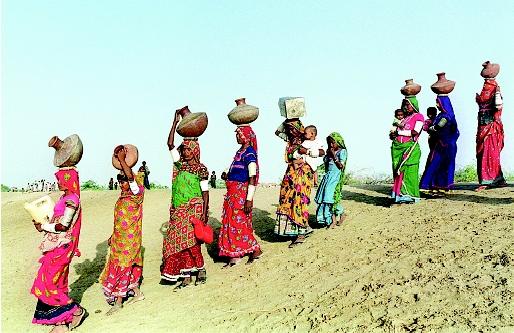
In the poorest communities around the world, women and girls walk to collect water, firewood or other basic necessities of life. They walk on average 6 kilometres a day – 8,000 steps while carrying the equivalent of a suitcase. This leaves little time to attend school, access health services or earn money to support their family.

Women are largely responsible for collecting and managing water resources in developing countries, especially in rural areas, reports from the United Nations Development Fund for Women (UNIFEM) show. Without a ready source of freshwater they may have to walk for several hours every day to find it. The U.N. estimates that 1.2 billion people lack access to safe water and about 2.5 billion are without access to proper sanitation.It is common for girls in rural areas of the world to drop out of school, so as to help carry out the burden of moving water. Girls as young as ten contribute to household tasks. Eventually, they miss classes and lag behind enough in school to abandon their education.
Collecting wood from forests for fuel is a difficult task that falls largely on the shoulders of the world’s women. A survey found that collecting firewood was one of the greatest burdens for many women and that it had a significant impact on their quality of life (Green & Erskine, 1998; 1999). .Pic credits: Basankusu collecting firewood by Francis Hannaway

Collecting firewood is extremely tiring as the women often have to walk long distances in search of wood which then has to be carried back to the homestead. Rural Tanzanian women, for example, walk 5-10 km a day collecting firewood, carrying loads between 20kg – 38kg. In rural India, the average is over three hours each day. The time-consuming nature of this task often causes young girls to be kept out of school. Girls going for firewood collection have been known to be subjected to sexual abuse too (UNDP).
AND THINK.

Would their life be the same if they had the opportunity to be educated like YOU and me?

Educated girls grow into women who tend to have healthier and better nourished babies, who most likely will do everything to have their own children attending school as well, thus breaking the vicious cycle of poverty. Educated girls can better protect themselves against HIV, trafficking and abuse.

Educating a girl also means that as a woman, she is empowered and more likely to participate in development efforts and in political and economic decision-making. Women who went to school usually manage to increase the household income. The advantages of girls’ education thus do not stop at the boundaries of a single child, but ripple through families, communities, and nations.

I Have a Dream…


I have a dream of…

A war
That’s played not fought,
To invade, not lands,
But hearts
Of disheartened souls
To heal not injure
With guns that shoot
Bullets of harmony.
Lay landmines, when stepped
Blast into goodwill.
Drop bombs,
Explode splinters of amity,
Taking captives in heart
To enslave in love
With chains of unity.
Being victorious
With an everlasting cheer.

I have a dream of …

An earth quake of sanity
Buries bigotry deep
Beneath the rubble of tolerance.
A flood of awakening
Drowns the ignorance,
And never recedes.
A volcano that
Burns hatred to ashes.
That spews
The lava of love
Which hardens as rock
Within the chambers
Of a caring heart.
And that never cools.
A tsunami of charity
Sweeps away greed,
That afflicts the globe.
A tornado named ‘Prosperity’
Blows off,
Roof tops from
Houses of hunger and poverty
A geyser that exudes
Steam of justice
Generates energy of hope
That runs the windmill
Of empathy
Relaying without Resistance
A ‘direct’ current of equality
That illuminates the world
With an everlasting PEACE

Indo-Pak Express on a high


http://www.jang.com.pk/thenews/jun2011-weekly/nos-19-06-2011/spo.htm#6
( Published in The News, Sunday Page on 19 June 2011).

The victory of Indo-Pak Express, Aisam-ul-Haq Qureshi and Rohan Bhopanna, at the Gerry Weber Open Tournament in Halle (Germany) brings a cool breeze amidst the summer heat, to all of us from India and Pakistan. After winning the match they reach to their seats adjacent to each other where their white jackets hang, embellished with the four magical words: ‘Stop War Start Tennis’.

The message is simple and brief, yet has far-reaching implications. The message holds the key to the prosperity of one fifth of the Earth’s population.

They are best friends, both on and off the court, and say that they complement each other’s style of play. Ever since they paired up in 2007, their careers have been marching uphill.

It is not just their game but their spirit to rise above religious and political differences that makes usall proud. They may have yet to fulfill their dream of Wimbledon doubles title, but they have already lifted the biggest trophy of Peace and Sanity.

After one of the tournaments, Aisam had remarked: “There were a lot of Pakistanis and Indians in the crowd cheering for us. And you couldn’t tell the difference, who was Pakistani and who was Indian, they were all mixed together and supporting the same team.”

And indeed this is the truth, no matter what skeptics may say. We have more in common than in differences, whether it be our appearances, our histories or our geographical location.

These talented young men are a living example to the 1.4 billion Indians and Pakistanis that ‘United, we shall stand’.

The duo echo the feelings of millions of hearts that throb in the chests of the people, who aspire for peace and prosperity for themselves, as well as for their neighbours. Like Aisam and Rohan, these millions too could become the real ambassadors of peace in their own right. Together they could reckon to be a Peace Force large enough to defeat any force of hateful extremists or other vested interests that leave no stone unturned to sow hatred and differences between the two neighbours.

History, with three wars and years of tensions, cannot be changed and borders cannot be erased. But these young men have shown us that by ‘being friends’, we can avoid the waste of energies in hatred and blame games, and instead, harness the same energy towards progress and prosperity for the entire region. Let the borders be just on the land, not in our hearts is what the pair teaches.

It does not need rocket science, but just a flicker of change in one’s thinking to turn this hatred into love. It does not even need too many bureaucratic visits, MOUs or anti-war treaties if one and a half billion people of this subcontinent decide to make Aman ki Asha into a real everlasting peace.

Indians and Pakistanis are 1.4 billion people together, sitting beneath the noose of nuclear weapons in the region. True, that the possibility of these being used is negligible, but then why such a hefty expenditure in developing, maintaining and improving their ‘killing’ capabilities in the name of big meaningless words like ‘nuclear deterrence’?

We do not deny that there aren’t serious differences and contentious issues, but three wars and numerous tensions have failed to solve them. Nor will the missiles and nuclear weapons resolve them in future. There is no issue which cannot be settled through peaceful negotiations. So for the sake of the well being of the huge numbers of people at stake, it is time we give lasting peace a real chance. Tensions and wars benefit few, but peace shall benefit each one of us across the subcontinent.

The political tensions provide an excuse to the vested interests (outside the region) to continue getting both sides to buying arms and building arsenal for ‘safety’, amidst poverty, hunger, ignorance, illiteracy for millions on both sides. What if this money was used for development and not arms build up?

Let us ask for our ‘safety’ not through arms and ammunition, but through regional cooperation in education, health, alleviation of poverty and economic activity. This is only possible if both sides are at peace with each other.

Is this asking for ‘lasting peace not tensions’ that farfetched a dream? Maybe the idea looks a dream, but then dreams do come true too.

And Aisam and Rohan have shown us just that. Congratulations Indo-Pak Express. You make us proud.

ilmana_fasih@hotmail.com

MF WE SHALL MISS YOU !


A lot has been said and written in tributes to MF Hussain, the 'Picasso of India' (as coined by the Forbes).

It would be a mere formality to repeat all that. I write this blog to Offer my admiration for this great icon and whatever little I know about him through some direct and a lot of in direct contact with him.

First thing that comes to my mind when thinking of MF is his silver hair and bare feet, with a rough, white khadder kurta hanging on a lanky, tall skeleton with a brush in his hand. Ninety percent of the times I saw him in this state, whether in the streets of Jama Masjid area or at the airport or in an art gallery.

In his days of struggle, he lived for years in a no star hotel meant for pilgrims called Haji Hotel in Jama Masjid area of Old Delhi .

He began life painting hoardings for cinema for which he recieved few annas per square feet.
As this wasn't enough to make his ends meet, he worked in a toy factory designing toys for a living.

Born in Pandharpur Maharashtra he lost his mother at the age of one and a half years.
The void in his life by the demise of his mother so early, left him searching for a mother figure in beautiful and strong women.
His Mother

As wrote a blogger Shiv Vishvanathan, "For him the mother was the source of reverence, which combined the erotic and the everyday, which gave meaning to his work. Husain saw that eternal feminine in polyphony of people – Indira Gandhi, Mother Teresa, Madhuri Dixit, Tabu and Anushka Sharma. They were stunning women who evoked eternal archetypes".


Mother Teresa

He loved painting women of substance, in all forms -from Goddess Durga, Saraswati to Politician Indira Gandhi to a nun Mother Teresa to actress Madhuri Dixit.


Goddess Saraswati

He did not finish school and his works were his certificates of achievement. Though later he graduated with the top national honours of Padm Shree and Padma Bhushan Awards

He fell for the poise and grace of Madhuri Dixit and watched her film 'Hum Apke hain Kaun” 67 times. After which he immortalised her in his oil canvas. But that wasnt enough for him, so he went on to make a film with her in the lead called Gaj Gamini.

‘Gaja Gamini is a timeless film that explores the woman. The central figure of the film is represented by a mysterious figure called "Gaja Gamini" (Madhuri Dixit), who inspires, arouses, and confuses the common man.’ mentions Wikepedia on Gaj Gamini.

Madhuri plays the roles of 4 awe-inspiring women, two of them well known in history as –Mona Lisa( Leonardo da Vinci) and Shakuntala( Kalidas). Naseeruddin Shah is Leonardo de Vinci.

MF is in'famous' for paintings of women in 'objectionable' forms by some and they made him controversial.

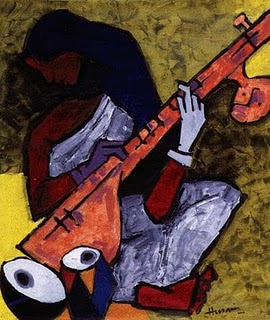
But few people are aware of his Sufi Series of paintings which he painted in the 1970s.

Sufi 1

Sufi 2

Sufi 3

Sufi 4


Sufi 5

Unfortunatley the controversial paintings Naked India, Rape of India and of some Goddesses which though he had painted in the 70s led to his exile to Qatar in the fag end of his life, IN 2010. He took it in a stride and continued his expression through brush unabated.

Such icons are born once in thousand years. Although, Leonardo da Vinci or Picasso did not live in our times but we are lucky that MF Hussain did.

We shall miss you MF.

Denial isn’t just a river in Egypt !


Courtesy: Faking News

Poor ostrich is often associated with the belief that it sticks its head in the sand during times of trouble. Of course this is a myth and no ostrich is foolish enough to do that. Thanks to the mankind, and his state of denial that he has attributed this term to the poor ostrich. I am sure ostriches and other animals must be calling this as ‘human effect.

(Ostrich effect is a term used in behavioural finance for the avoidance of apparently risky financial situations by pretending they do not exist.).

We human beings are the masters of denial. Whether it is health, finance, social, political situation—personal, or public we live in denial. We bury our heads in sand of denial of and on.
Who would know the bitter effects of denial than I myself. I still suffer from its guilt now almost a decade on.

On visiting my parents in Delhi in July 1997, I clearly remember how my mom begged to me that she felt that my Papa wasn’t well and he needed a thorough medical checkup. I took heed to her concern and talked to my father, that he needs to see a doctor. He scoffed off the idea that the sweating he gets while walking has nothing to do with his heart but due to humidity in the monsoon season. We went on long walks together, where his pace at 64 years of age was still faster than mine.

I continued to watch him with a side gaze, off and on, to see if I could get a trace of some unwell signs in him. He was radiant as ever, with barely few hair grey in the sideburns and and intact zest for life.

How can my Papa be having a ‘serious’ problem ? I questioned myself several times..

He convinced me that my mom was obsessed. We went for a basic blood test which was all well. Mom wasn’t convinced. But my confident Papa, shooed her idea of an echocardiography for the heart.

Twenty days after I left, I got the news that my Papa passed away, hale and hearty, while working on a computer, typing a chapter for his new book. He had a massive heart attack.

I have not forgiven myself ever since, for having lived in denial, to escape harsh reality. Had I faced the truth head-on, life would have been different.

In a wider context, all human beings live in denial—with just the difference in the degree. We deny everything and then wrap it in the garb of ‘conspiracy theory’.

A quote goes: ‘The abuse dies in a day, but the denial slays the life of the people, and entombs the hope of the race’.

On one extreme end are those who deny Holocaust, the landing of man on Moon, the 9/11 incident, even the  Abbotabad operation in which Osama Bin Laden was nabbed and killed. The other milder extreme are those who express “ We have stopped watching news because it is very depressing.”

How can anyone close their eyes to what’s happening around? My mind often tickles.

In the local context, one sees that denial has become a way of life  in Pakistan. There are many who refuse to accept the problems of Pakistan and pass the buck on others—most favoured excuse being America or India.

Twenty years ago when I was new to Pakistan, first ‘conspiracy theory’ hurled at me was that Pakistan’s big or small problems are because it wasn’t given the ‘right’ piece of land during partition. I remember having had frantic arguments, with myself as a new bride alone on one side, and many old and young, mostly men on the other.

And after that for whatever happened in Pakistan, some  of my  ‘friends’ and kin, in Pakistan made sure that I knew that all that was happening was due to India.

The latest being the PNS Mehran incident—in which a ‘friend’ of mine took pains to mail to me in India that it all happened because of the involvement of RAW agents and that the proof she had was that those men who came there were uncircumcised. I did not shock me, for I had heard the same explanation when the armed men had attacked the Sri Lankan team in Lahore. And worse of all, many among my other kin and friends did not disagree with her.

I do not find these stories amusing any more. Mass denial has become a “National Sickness”. And conspiracy theory is it’s outward symptom. I fear that the way things are moving this sickness may lead to our demise as ‘thinking’ and ‘reasoning’ individuals.

So aptly has the following quote by Meredith Grey summed up ‘denial’ :
Sometimes reality has a way of sneaking up and biting us in the ass. And when the dam bursts, all you can do is swim. The world of pretend is a cage, not a cocoon. We can only lie to ourselves for so long. We are tired, we are scared, denying it doesn`t change the truth. Sooner or later we have to put aside our denial and face the world. Head on, guns blazing. De Nile. It`s not just a river in Egypt, it`s a freakin` ocean. So how do you keep from drowning in it?

If I was a Concorde…


If I was a concorde, I would:

Fly with the turbojet of myriad aspirations,
And takeoff to the skies of fathomless imagination.
With supersonic pace, soaring in blissful thoughts,
Reaching to heights where no one could ever get caught,
Into  the tornadoes of bigotry, hate and intolerance,
To an altitude beyond darkness of misery, chaos, ignorance.
Supercruising over the clouds of dreams, desires and hope,
Beaming to have left behind the slow walk on life’s tight rope.
True to my name that spells nothing but ‘unity’ and ‘harmony’,
Vowing to not crashland on a strip metalled with woe and agony.
Hovering over the hills where kindness and love are nourished
Yearning to touchdown where everlasting PEACE is cherished.

PS: Concorde jet’s name, it’s meaning ( means harmony, unity), appearance, speed, and numerous other details have fascinated me since very young. Clearly remembering the first commercial flight in 1976 from Paris to Rio (in my preteens), the crash in 2000 at De Galle Airport, and finally it’s grounding, the fascination fails to wane.