Open up your mind and your potential reaches infinity…

Archive for August, 2011

Ilmoun bas kari oo yaar~Bulleh Shah by Sain Zahoor


Translation:
by Kartar Singh Duggal

Ilmoun bas kari oo yaar
Eko Alif terey darkar

Enough of learning, my friend!
An alphabet should do for you

Ilm n awey wich shumar
Jandi umer, Nahi aytebar
Eko Alif terey darkar
Ilmoun bas kari oo yaar

To it there is never an end
An alphabet should do for you
It’s enough to help you fend.
Enough of learning, my friend!

Ilmoun bas kari oo yaar
Enough of learning, my friend!

Parh parh, likh likh ladain dher
Dher kitabaan, cho pheyr
Kerdey chanan, Wich unheyr
Pecho: “Rah?” tey khabar n satar

You’ve amassed much learning around
The Quran and its commentaries profound
There is darkness amidst lighted ground
Without the guide you remain unsound

Ilmoun bas kari oo yaar
Enough of learning, my friend!

Parh perh shekh mashaikh khawein
Ultey masley gharoon bata dein
Bey ilmaan noon lut lut khawein
Jhotey Sachey karain aqrqr

Learning makes you Sheikh or his minion
And thus you create problem trillion
You exploit oyhers who know not what
Misleading them with wild opinion

Ilmoun bas kari oo yaar
Enough of learning, my friend!

Parh parh nafal namaz guzarien
Achian bangaan changha mari
Manber tey chaRRh waaz pukarein
Keeta teeno ilm khawar

You meditate and you say your prayers
You go and shout at the top of the stairs
You cry reaching the high skies
It’s your avarice which ever belies

Ilmoun bas kari oo yaar
Enough of learning, my friend!

Jed main sabaq Ishq da parhaya
Derya dekh Wahedat da warria
Ghuman gheraan dey wich uRRia
Shah Inayat laya paar

The day I learnt love’s lesson
I plunged into the river of devine passion
An overwhelming gale. I was confused and lost
When Shah Inayat cruised me across

Ilmoun bas kari oo yaar
Enough of learning, my friend!

Avval Allah, Nur upaya, qudrat de sab bandey…


This blog post is a tribute to the bravado of my#Sikh brothers, who stood up in respect for humanity beyond faith during the #UKriots.

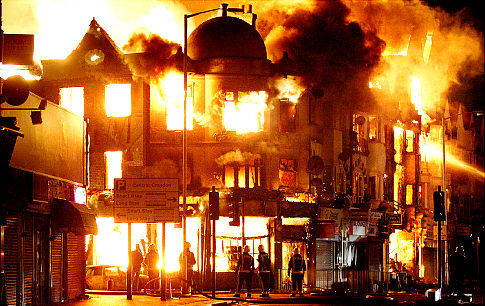
It was devastating to see the peoples power gone berserk in UK riots, as the  arson and looting carried on unabated into the fourth night . Unfortunately against the sheer numbers, the police seemed helpless to control the unruly mob.
While following the  #UKriots on Twitter and BBC News, hashtag #Sikhs started to trend—first World wide and then in UK, London.

A tweet was seen:

Remroum Remi Kanazi
Was afraid #Sikhs trending was going to be some bigoted stream. Thankfully it was this: Sikhs protecting people while they prayed #UKRiots

They came pouring, tweets one after the other with speed getting faster:

Prandha_Swag Harpreeeeezyf.baby
#Sikhs is trending.

Nagra18 Jasraj Nagra
#Sikhs is trending, never thought i’d see the day #proud.

KavelKaur Kavel Kaur
#Sikhs are a world wide trend!!!!

GDS1ngh GD singh
#sikhs trending, fantastic. doing what we do best.

moneyspinner MONEYSPINNER
#sikhs nanak naam chardi kala, tere baane sarbat dha bhala

I googled to check the details and saw Mail Online quote:

Some armed with swords, some carrying hockey sticks, defiant Sikhs stood guard outside their temples last night.
More then 700 men, some in their 80s, took to the streets to protect the homes, businesses and places of worship in Southall, West London.

The tweets went on:

Goggi_Rana Goggi Rana
Sikhs of Britain have displayed the same traits of fearlessness, as their ancestors of yesteryear #Sikhs #SangatTV

UncleWail Wail Al Aun
Thumbs Up for the #Sikhs protecting their #Temple in Toxteth #Liverpool #UKRiots

MissssChrissy Chrissy
Singh Is King… Yep I think so! #sikhs doing it real big today. #LondonRiots #ukriots

Then we heard that they had not only protected their temples but also stood at the mosque guarding while the Muslims prayed ther Taraweeh prayers of Ramadan in South Hall mosque:

A google message read :

Muslims prayed their Tarawee prayers while Sikhs protected he Masjid
Got this from a friend in London.
In a Masjid in Southall London, Muslims were praying their Taravee prayer as the riots were going on, a bunch of Sikhs stood outside the Masjid and protected the Masjid.
The similar thing happened when Sikhs were inside their Gurduwara and some Muslim youngster guarded it on the gate
Great experience, a cousin and a friend of mine reported the same incident.
May ALLAH bless people like them, humanity still remains here, despite the problems

Tweets loaded with emotions, from Muslims and people from other faiths,  too poured in with ovelwhelming enthusiasm:

PMGenerals PMG Anj
Today was an historic day for #hindus #sikhs and #muslims. #unitedwestand all religions teach us to have morals and respect dis proved it! X

dj_aNomAli ∀ℓι . ᄊ乇尺cんለռէ
Sikhs protect Southall mosque while Muslims pray Taraweeh in peace. Much respect to our brothers!! #LondonRiots #Southall #Sikhs #MashAllah

DNSDj Davinder Singh
Actually brings a tear to my eye seeing the #unity between #Sikhsand #Muslims in the fight against this madness. #proudtobesikh

akchishti akchishti
Great sight in my #Birmingham where #Pakistani lads are protecting temples while Sikh lads protecting the mosques

Muslimerican Peter
Imagine a group of rioters turning down a street and suddenly seeing 400 #Sikhs standing in the distance. #wrongturn #ohshit #londonriots

AdamPatel2 Adam Patel
I hear the #sikhs are even protecting the #mosques in Southall so #muslims can read our Tarawih in peace.”>>> BIG LOVE –

And dishearted tweeps begain to take a sigh of relief

xcrimsonstarx Vicki Langfield
The #Sikhs are giving me faith in humanity

Indeed, everyone who followed this trend must have rekindled their faith in humanity. Thanks you my Sikh brothers.

MumzyStranger Mumzy Stranger
Love out to the #Sikh brothers who protected the mosque during prayer time. If we all unite we can and WILL put a STOP to this chaos! M x

And  with these tweets millions or billions of eyes gleamed with hope.

We hope and pray this display of unity and humanity extends to all faiths and communities beyond borders and beliefs…

My mind recalled the verses of Sant Kabirdas which  along with 500 other verses which are included in to the Guru granth Sahib,  are  often heard from  Gurudwaras as Shabad Kirtan :

Avval Allah Noor upaya Qudrat ke sab bandey
(God created light of which all the things were born)
Aik nor ke sab jag upajaya kaun bhale ko mandhe
(From the light, the universe. So who is good and who is bad).

Indeed, I hail my Sikh brothers for living up to the spirits of their faith, their Gurus and their Book.

In return many Muslims also stood up with the Sikhs and helped them form groups which defended their communities and boroughs. Hail Sikh Muslim Solidarity. 

Let this be the beginning of Sikh-Hindu-Muslim-Christian-Jew –other faiths unity for  all faiths believe in one Supreme Power and all faiths belong to  one Humanity’

I dedicate  this tribute to my Sikh brothers with the greeting, which in Punjabi means exactly what Allah u Akbar stands for :

Vaheguru ji ka khalsa, vaheguru ji ki fateh.
(God’s pure and God’s victory )

My brothers,  Rabb Raakhaa

Ilmana Fasih, Aug 10, 2011

P.S.: Please scroll down in the comment box to see the reaction of the Muslim community after 3 Pakistani boys were killed in Birmingham.

Buss ker ji hun buss ker ji~Bulleh Shah


This post is dedicated to the inseparable cultures of India and Pakistan. A great example of how India’s Sufi singers (of one faith) sing with devotion the Kafi of a Sufi saint ( of another faith) who’s origins were in what is now Pakistan.

Bulleh Shah is considered as the greatest mystic poet of the Punjab, his compositions have been regarded as “the pinnacle of Sufi literature.” Scholars and dervishes have called him “The Sheikh of Both the Worlds,” “The man of God,” “The Knower of Spiritual Grace” and by other equally edifying titles.

Kartar Singh Duggal, a renowned writer and author of The Mystic Muse: Sain Bulleh Shah writes:
“Bulleh Shah was an evolved soul, a perfect faqir and a true lover. Through the love for his Master he realized the Lord. In his love one finds poignancy, ardor and longing besides sincerity, sacrifice and renunciation. Under the canopy of love he made his offerings of caste and learning. His love for his Master never wavered for a moment despite the fire of separation and longing through which he passed. His writings, as also his life, manifest transcendence of physical love ( of the Master) to divine love ( of the Lord).”

It is said that once Bulleh Shah annoyed his Master due to some indiscretion and he was thrown out of the his Master’s circle( called Daira).

Several months passed; Bulleh begged forgiveness, repented, had other devotees speak to the master,  who would not relent. Suffering the pangs of separation, Bulleh sang soulful Kafis. There are many of them, and the pain in each of them increased, with the passage of time.

One such kafi which is my favourite is :
Bas kar ji hun bas kar ji,
Ik baat asaan naal has kar ji.

Tuseen dil mere vich vasde ho,
Aeven saathon door kyon nhasde ho.
Naale ghat jaadu dil khasde ho,
Hun kit val jaaso nhas kar ji.
Bas kar ji hun bas kar ji.

Tuseen moiyaan nu maar na mukde si,
Khido vaang khoondi nit kutde si.
Gahl kardiyaan da gal ghutde si,
Hun teer lagaaiyo kahs kar ji.
Bas kar ji hun bas kar ji.

Tuseen chapde ho asaan pakare ho,
Asaan naal zulf de jakre ho.
Tusi aje chapan nu takre ho,
Hun jaan na milda nas kar ji.
Bas kar ji hun bas kar ji.

Bulha shauh maen teri bardi haan,
Tera muhk vekhan nu mardi haan.
Nit sau sau mintaaN kardi haan,
Hun baeth pinjar vich ghass kar ji.
Bas kar ji hun bas kar ji.

Enough! Now enough!
Smile! Speak to me!
You inhabit my heart.
Enough! Now enough!

You do not tire of killing the already-slain.
You play with me, a ball thrown over and over again at a stump.
If I speak, you gag me,
You might as well just pierce the arrow right into me!
Enough! Now enough!

If you hide, I will catch you.
I will tie you in my tresses.
You are able to stay hidden for now,
But you will not be able to escape from me.
Enough! Now enough!

Says Bulha, I am your slave.
I die to see your face.
I plead with you a thousand times,
O enter this cage. Occupy it.
Enough! Now enough!
~Translation BY Suman Kashyap

The same Bulleh Shah Kafi sung by Wadali brothers:

Where the mind is without fear and the head is held high.


Just yesterday was the 70th death anniversary of Rabindranath Tagore, and I remember his Nobel winning poetry which begins as :
“Where the mind is without fear and the head is held high”

Incidentally, today I found myself reading something similar in  spirit of this poem while , enjoying  Kamran Rehmat’s eloquent note  on simplicity of the office of Norwegian PM and the minimal security he keeps.(Kamran Rehmat is  a Pakistani newspaper editor based in Islamabad, who’s writings  are like a new lesson in English language, and each time  leaves one richer in vocabulary).

His note led me to the memory  of the news in 1986, when Olof Palme, was murderd while walking back from a cinema at night, in Sweden. Prime Ministers walk back home, was my reaction then. There is reason why Nordic countries are considered as the safest places to live on Earth. (I wonder if the recent Norwegian incident and it’s  root cause will change that, but that’s beside the point here)

Reading through,  one instantly compares them to the traffic standstills or detours one has to face when our politicans are  passing.

The instant pop up  in my Third World  mindset is–” Come on, those are developed nations and we are merely ‘developing’.”

It takes me back to the peice of knowledge I gained from a movie called The Last Emperor, in 1990,  where they showed that when the King passed through the streets of ancient China, the common man was asked to turn away their gaze because their poor eyes weren’t worthy of seeing the Emperor.

Perhaps our politicians in power too are emperors in their own right who live not in forts or castles by name.  But their abodes are bedecked no less than castles and protected no less than fortresses. And  the feet of the poor  common man arent worthy of treading  the same street when the emperors  pass through it.

But hold on.

I suddenly remember two personal experiences from this very  Third World where their persons in authority navigated with  same freedom and with minimal security as the Norwegian or Swedish PMs.

One of them is none other than Mahathir Mohammed of Malaysia. ( You might just say, that of course Malaysia not all that a developing country. But the reason why they have gone far ahead is because of this very man about whom I will narrate a personal anectode.)

We had been visiting Malaysia as tourists in 2002 . It was the last days of Ramadan and we  chose to travel to Malaysia to see how their Muslims celebrate Eid.On the Eid day we went to the Central Mosque in Kuala Lampur for the Eid prayers. Not sure of the timings, we reached the mosque way early and my husband and son sat in the very first row, right behind the Imam’s seat. While I settled with my daughter in the first row of women’s area , ensuring that our men were well in our sight.

After an hour or so, when the mosque had been reasonably full, ( no mad rush), a few men walked upto the front rows and some others staretd to make place for them. My husband was asked to move a little to the side, which he did. But to his utter surprise, the man for whom his place was being vacated was none other than the President Mahathir Mohammed. Having seen that my husband gave place to him, he smiled at him. So my husband stepped forward, shook hands with him and introduced himself as a Pakistani who had come to see the Eid in Malaysia.

After the prayers, he again turned to my husband and told him, to visit his place called Putrajaya ( president’s residence) and join the open feast which the President hosted each year for his compatriots.

Our joy had no bounds. We almost thought that we were invited to a personal lunch with the President.
After a few hours of strolling on the Eid bazars in  Bukit Bintang (street), listening to the beautiful melodies of Salamat Hariraya( that’s Malaysian way of saying Eid Mubarak) we dressed our best and headed for Putrajaya.

It was a huge congragation there, with tents put up and thousands of Malaysians, of all ethnicities in a picnic mood and enjoying the ethnic food the Malays serve on Eid. We were told by someone that this was the last time this would be held as Mahathir Muhammed has announced to step down,  and  he wouldnt be there next Eid.

We saw a horrendously long queue lined up on one side of the tent leading to a door. We were told, this was  for those who would like to meet the first couple and give their Eid wishes to them. We joined the queue. Living upto the Pakistani style, my husband told one of the gaurds that we are from Pakistan, and the President himself had invited us, in an attmept that this would help us jump the queue. But the policeman just gave a hospitable smile,  his eyes speaking to us to stay put in the queue.

It was a two hour wait, and my kids used it well to make a small card out some  paper envelope, with a blue ball point drew a flag of Pakistan and wrote an Eid card for them.

Finally our turn came, we shook hands with the first couple, and to our utter surprise, he himself told his wife, “They are Pakistanis and have come to see our Eid.” Kids gave them the card. We hugged them in a Pakistan Eid greeting. We were handed over a plastic tiffin box on top of which “Thanks from Putrajaya” while the inside had  Malaysian sweets. We got exactly the same box as everyone else, and roughly the same two or three minutes of chat as other locals.

In Summary, in our two weeks stay in Malaysia, we happened to meet  their President twice, and that too without much difficulty.( Not to speak of how many times we have bumped into any of ours in the whole life).

The second incident was in Calcutta, in late 1979, when I had been visiting the city with my parents, who were  attending some conference. My parents chose to commute in bus , as that was the most  convenient mode  to travel in an overcrowded Calcutta.

In the middle of one journey,  my father turned our attention towards a lean and thin dhoti clad man who had climbed the bus. And this man was Jyoti Basu who had become the Cheif Minister of West Bengal just an year or so ago.

My father mentioned it to some of his friends, but they weren’t surprised, for this was common knowledge that he sometimes boarded the bus just to stay connected with the poeple who elected him.

And then this man carried on to be the elected ChiefMinister of West Bengal for next two decades ( from 1977 TO 2000).  A CPI(M) member, he went on to make land reforms giving opportunity to the poor to have their own lands. He brought political stability to the state and so much so that when the whole of India was burning twice– once after Indira Gandhi’s death in 1984, and the other at the demolition of Babri Masjid in 1992, his heavy handed administration did not let any rioting in his state.

As Wickepedia quotes, “West Bengal became an oasis of communal harmony and secular values under his leadership”
Although a CPI (M) member, in an obituuary published by BBC on his death in 2010, it remarked:
“A Fabian Socialist rather than an orthodox Communist, Jyoti Basu worked by consensus, successfully managing coalitions, while showing a healthy respect for the viewpoints of others.”

“He made Communism look respectable,” according to Sabyasachi Basu Roy Choudhuri, a Calcutta-based political analyst.
Analyst Ashis Chakrabarti said Mr Basu’s success indicated social democracy had a future that Communism did not .
( http://news.bbc.co.uk/2/hi/south_asia/8151230.stm)

Hence, it was not just a coincidence that we saw these men roaming free in public, there were years of commitment, and hard labour for the common man, which made them be  so fearless.

With racing chain of thoughts, my mind shifts to the recent switch on and off, that goes on in Karachi’s killings. It does not need a vision of 6/6 to see who ALL are behind these killing fields. By all I mean ALL, none  is above it. I wonder with this track record and with the mess that the stake holders of  “peace’ create, can they gather the audacity to sail freely among their own public like the above men.

No wonder our streets from Islamabad to Karachi come to a standstill when they sail ‘fearfully’ on them.

And tragically, it is the common man who recieves the blame of being labelled hateful, narrowminded and divided on ethnic or sectarian lines.

I close this note with the closing lines of Tagore’s poem , which may serve as a prayer to us:

“Into that heaven of freedom, my Father, let my country awake.”

Ilmana Fasih

Tumi robe nirobe~Rabindrasangeet. Music without borders


In my heart, thou shall, in peace, alight…
Like the glowing moon and the Dame of the Night.

My life, my youth…
My world absolute;
Thou shall draw bright…
Like the Dame of the Night…

Alone shall rise, eyes of thee,
Thy billowing drapes shall protect me.

My pain, my screams,
My success dreams;
Thou shall delight,
Like the Dame of the Night.


About the author, composer of this song:

Rabindranath Tagore (1861-1941) was a Poet, Philosopher, Musician, Writer, Educator, and the first Indian Nobel Laureate for Literature (1913). Tagore has been labelled the “King of Poets” for his beautiful and exquisite poetry. In particular Tagore had a deep love and reverence for nature which he was able to express through lyrical poetry.

Tagore was awarded the Nobel Prize in 1913 for his book Gitanjali. W.B.Yeats in particular was deeply impressed with this work and wrote an introduction. With this honour Tagore became famous in both India and the West. In 1915 Tagore was knighted by King George, however Tagore was to return his knighthood in protest of the Amritsar massacre (1919)

Although Tagore stayed out of politics he remained a good friend of Gandhi. In fact it was Tagore who would often persuade Gandhi to give up his fasts in the interest of the nation.

As a writer, Tagore primarily worked in Bengali, but after his success with Gitanjali, he translated many of his other works into English. He wrote over one thousand poems; eight volumes of short stories; almost two dozen plays and play-lets; eight novels; and many books and essays on philosophy, religion, education and social topics.

As well as literature Tagore had a great love of music, in particular Bengali music. He composed more than two thousand songs, both the music and lyrics. Two of them became the national anthems of India and Bangladesh.

That the truth has a tongue…~a poem


Just a minute long poem narrates the decades of pain and suffering of innocent kids who have no reason to bear this.

All your armies ..
all your fighters ..
all your tanks ..
and all your soldiers ..
against a boy ..
holding a stone ..
standing there ..
all alone ..
in his eyes ..
I see the sun ..
in his smile ..
I see the moon ..
and I wonder ..
I only wonder ..
who is weak ? ..
and who is strong ? ..
who is right ? ..
and who is wrong ? ..
and I wish ..
I only wish ..
that the truth ..
has a tongue :

Little Terrorist~a short Film


Little Terrorist tells the moving story of a Pakistani Muslim boy who accidentally crosses the Pakistani-Indian border which is riddled with landmines. He ends up in a strange country that regards him as a terrorist. The old orthodox Hindu Bhola takes him in and hides him from the Indian soldiers. However, traditions and prejudices about Muslims remain an obstacle in the relationship between Bhola and the boy. Ultimately, humanity triumphs over prejudice when Bhola risks his own life to help Jamal cross the border again. This symbolic story of hope is a tale of human solidarity conquering all artificial boundaries.
Ashvin Kumar, the director, was nominated for an Oscar in the Best Live Action Short Film category.
Ashvin Kumar’s Little Terrorist also won first prize for best short film at the Montreal Film Festival.

And was nominated and selected for various other prizes.

I am a Woman~by Helen Reddy~Music without borders


I Am Woman

-Artist: Helen Reddy from “Helen Reddy’s Greatest Hits”: EMI ST 11467
-peak Billboard position # 1 for 1 week in 1972
-Words and Music by Helen Reddy and Ray Burton

I am woman, hear me roar
In numbers too big to ignore
And I know too much to go back an’ pretend
’cause I’ve heard it all before
And I’ve been down there on the floor
No one’s ever gonna keep me down again

CHORUS
Oh yes I am wise
But it’s wisdom born of pain
Yes, I’ve paid the price
But look how much I gained
If I have to, I can do anything
I am strong (strong)
I am invincible (invincible)
I am woman

You can bend but never break me
’cause it only serves to make me
More determined to achieve my final goal
And I come back even stronger
Not a novice any longer
’cause you’ve deepened the conviction in my soul

CHORUS

I am woman watch me grow
See me standing toe to toe
As I spread my lovin’ arms across the land
But I’m still an embryo
With a long long way to go
Until I make my brother understand

Oh yes I am wise
But it’s wisdom born of pain
Yes, I’ve paid the price
But look how much I gained
If I have to I can face anything
I am strong (strong)
I am invincible (invincible)
I am woman
Oh, I am woman
I am invincible
I am strong

FADE
I am woman
I am invincible
I am strong
I am woman

History of the song:

“I am Woman” reached #1 on the Billboard charts in December 1972. The song was the first #1 hit on the Billboard chart by an Australian-born artist and the first Australian-penned song to win a Grammy Award .In her acceptance speech for Best Female Performance, Reddy famously thanked “God, because She makes everything possible”.

It sold more than a million copies, and has been played more than a million times on US radio.

National Organization for Women founder Betty Friedan was later to write that in 1973, a gala entertainment night in Washington DC at the NOW annual convention closed with the playing of “I Am Woman”. “Suddenly,” she said, “women got out of their seats and started dancing around the hotel ballroom and joining hands in a circle that got larger and larger until maybe a thousand of us were dancing and singing, ‘I am strong, I am invincible, I am woman.’ It was a spontaneous, beautiful expression of the exhilaration we all felt in those years, women really moving as women.”

To Reddy, the song’s message reaches beyond feminism. “It’s not just for women. It’s a general empowerment song about feeling good about yourself, believing in yourself. When my former brother-in-law, a doctor, was going to medical school he played it every morning just to get him going.”

Source: http://en.wikipedia.org/wiki/I_Am_Woman

The cost of crossing the ‘love’ border ~Indo-Pak Visa Part 2


Published in Aman Ki Asha blog by The News/Jang Group on August 03, 2011 http://www.amankiasha.com/detail_news.asp?id=509

For years after the Indian Consulate in Karachi was closed down, a cousin of mine (an Indian married to a Pakistani) whose parents live in Jaipur, followed the following trail year after year. She would travel from Karachi where she lives, to Islamabad to obtain an Indian visa. If successful, she would travel back to Karachi to pack up. She and her family would then travel to Lahore by train, and cross the Wagah-Atari border. They would then take a train from Amritsar to Delhi and then another to Jaipur. With 3 children, she could not afford air travel every year. 

The entire ordeal required her to travel over 4600 kilometres and several days in summer vacations, when in reality, the smallest distance between Jaipur and Karachi is only 1066 kilometres (through Khokrapar Munabao) and the train journey is just a 3-4 hours long.

I understood the real nightmare of this struggle some years ago when I had to travel from Karachi to Islamabad to get a visa for my father-in-law for his medical treatment in India.

My husband and I sat outside the Indian consulate in Islamabad for two days, sharing benches with people who had mostly come all the way from Karachi or Hyderabad. Most had been sitting there every day from 9 am to 5 pm for as long as 15 to 20 days at a stretch. The majority appeared to be daily wage earners, the poor and with no resources to take short cuts, like us, to obtain a visa – we had the parchi (‘slip’) that would expedite the visa process.

A lady and her husband, a carpenter hailing from Lalukhet in Karachi, had been sitting there every day for almost 20 days, from morning till the consulate closed in the evening, without any clue about whether they would be granted a visa or not. The embassy issues a limited number of visas each day. Names come up on a given day, their luck as unpredictable as a lottery. The more resourceful among the applicants jump the line, pushing these poor people to the back of the queue.

This couple had spent so much money on the travel from Karachi to Islamabad that they could not afford even a cup of tea from the tea stall outside the embassy, which caters to visa seekers. Every day the carpenter and his wife brought with them homemade rotis and pickle for lunch. I asked the woman how long she would sit there, and she replied with certainty: “When the money runs out, I will go back home whether I get the visa or not”.

She had applied after hearing that her mother was on her deathbed and had asked to see her one last time. She had been married for over twenty years but had been able to visit her native Hyderabad, Deccan, only once, and that too 12 years ago.

Her marriage had been a stroke of fate when her husband, a cousin from Pakistan, visited them. The poor family had been facing tough times, and found this as opportunity to make their daughter’s life better, as the cousin’s family was more prosperous. (How was she duped into marrying an already married man is another story for another time). 

This story is all too common to many families in the lower middle class strata who marry across the border; their girls are hardly able to visit their parents a handful of times in their lifetime, mostly due to not being able to afford the time, expenses and resources involved in obtaining the visa.

They resign themselves to their fate and learn to live with just memories of home. It is only when another sibling is about to get married; or a parent is ill; or dying, that they gather all their means and courage to try to obtain a visa to go to their erstwhile homeland.

The procedure has been somewhat modified now, so that people in other cities can apply for Indian visas through a courier service, without having to travel to Islamabad. But applicants still have no idea how long the process will take. A friend who wanted to attend her parents’ 50th wedding anniversary celebrations in India received a reply after an anxious six month wait, saying that her application papers were incomplete. Some don’t hear any news for a year or more; others don’t get any response at all.

Over the last two decades I have seen a see-saw situation. Things seem to move towards easing the procedure, then suddenly something occurs and the whole change is reset from the start.
A silver lining is that the Khokrapar-Munabao line, suspended since 1965, has been revived, reducing unnecessary distance for many.

I hope and wish that the latest news about easing of the borders does not remain restricted to the artists who travel on exchange programmes or businessmen attending conferences, but is extended to this voiceless, resigned group of poor, invisible women who marry across borders. I am afraid they are the group most likely to be forgotten when the categories are laid down for easing visa procedures.

Most will never be able to raise their own voice and will resign to their fate of seeing their parents or first of kin, barely a few times in their entire lives, after they cross the ‘love’ border in matrimony.
On their behalf, I beg the authorities concerned to hear the silent wails of these women and to ease the visa process making it easier for them too, so that they may see their parents and families more often.

Ilmana Fasih

The writer is an Indian gynaecologist and women’s health activist, married to a Pakistani. She blogs at https://thinkloud65.wordpress.com/

Cross-border couples and their visa travails ~Indo-Pak Visa Part 1


Published in Aman ki Asha blog The News/Jang Group on July 27, 2011

“A marriage license doesn’t come with a job description or a set of instructions. There is definitely some ‘assembly’ required. In fact, putting together a marriage can be likened to assembling an airplane in flight” – Patricia Love

Every marriage needs a lot of reassembling in social, psychological and emotional terms. But when marriages take place across the Indo-Pak border they also involve a lot of political reassembling.

Indo-Pak marriages are different from other cross-border marriages – such unions between people from these two neighbouring countries are far tougher and more challenging than marriages across oceans between people with vast cultural differences. The distance between India and Pakistan does not entail crossing oceans or even cultures but one has to cross huge mountains of hurdles in terms of legal and bureaucratic formalities.

With the pendulous political love-hate relationship that exists between the two countries, marrying and staying happily married across the border (‘pyar border paar’) is no small feat. It takes a tough mind and resilient heart to brave the challenges.

There are personal challenges involved in every marriage. But the additional challenges in Indo-Pak marriages include taking certain decisions which may be painful. As a patriotic and a proud Indian, it was hard for me to surrender my Indian passport and apply for a Pakistani. Not that I had any grudges against the latter, but to give up your national identity is an experience you have to live, to know how it feels.

You might ask why would an educated woman change her nationality? The answer is simple. No one coerced me. I did it for the desire to have a peaceful family life and for the sake of our children (who were to arrive later).

My British, Canadian and Filipino friends married to Pakistanis live without any problems in Pakistan, using their original passports. But for an Indian this is not possible.
I did quite a bit of homework before taking this life-changing decision. I knew of instances where people in this situation had retained their nationalities, leading to many practical and political challenges. Most of them advised me to swallow this bitter pill and make the change, but finally, it was entirely my own decision.

In Pakistan, the ID cards of both parents are required to obtain documents for children like B-form, passport, and ID card. A mother with an Indian passport would mean inviting trouble, with more errands from office to office, or one section officer to another, to get ‘no objection certificates’ or NOCs.

Obtaining a visa to visit family across the border is any case a Herculean task if you don’t have connections in the high offices. And for a family like ours living in a third country I would, if I had maintained my Indian nationality, have to go through the gruelling process of obtaining a Pakistani visa each time we were to visit Pakistan. By giving up my nationality and becoming a Pakistani, I thought at least we have to struggle for the visa on one side only, when my children and husband want to visit India.

Unfortunately, my having been a born Indian, lived there for 23 years, and having parents still living there, does not mean that my husband and children will be given any extra consideration when they apply for an Indian visa. I know this is also the case for Pakistani women who are married and live in India. The visa policies work on a reciprocal basis.

Our visa troubles are not a once in a while exercise, but an annual struggle. The struggle which I have been undertaking for the past twenty years, almost each year, to visit my ageing parents exactly the way any married woman aspires to visit her family. As the time nears for the visa application, I always shudder with the apprehension of “What if…”

Families like ours have no choice but to face this ordeal every time they want to visit ‘home’. Visas may be sometimes facilitated and expedited for artists going on a cultural exchange or for businessmen but the procedure, the requirements, the scrutiny, the hurdles are all exactly the same for people like us. We have to stand in the same queue as those applying for a visit visa for a conference or meeting (there is no ‘tourist’ visa between our two countries), to visit to meet distant relatives once or maybe twice in a lifetime.

Each time I stand in front of the visa submission window of the Consulate of the country where I was born, which I still love and own as I did then, I feel as if I am being punished for my audacious decision to marry across border. My counterparts across the border must be feeling the same, I am sure.

Once, I was exceptionally lucky: I obtained an Indian visa while sipping a cup of coffee in the office of the Consul General, when the Consulate was in Karachi. The CG turned out to be my father’s student. We followed the usual application procedure of course, but he expedited it. Then, as we left, a plainclothes official intercepted my husband and asked for our purpose of having visited the CG’s room. He said that our car’s plate number had been noted and that we must not repeat this again.

All told, in the 21 years of my marriage I have been lucky that despite the hurdles and the painful waiting times, I have not faced any serious disappointments in ultimately obtaining a visa for India.

The only time I faced a major setback was after the Kargil war, when tensions were so high that I could not visit my parents for three years, despite running from pillar to post, pulling various influential strings. Then, not even ‘high connections’ were willing to go out of their way to help me. However, for a vast majority of women from India married to Pakistanis, especially those living in Pakistan, it is by no means a smooth sailing.

Ilmana Fasih

The writer is an Indian gynaecologist and women’s health activist, married to a Pakistani. She blogs at https://thinkloud65.wordpress.com/