Open up your mind and your potential reaches infinity…


Published in TheNewsBlog >> http://blogs.thenews.com.pk/blogs/2012/03/06/farewell-humsafar-with-a-style/

It was destined that I had to watch it. Yes nothing but destiny could do that, knowing how averse to dramas I am. Overwhelmed with the real life political and social dramas that go around us, fiction has never touched my heart.

However, the imaginative FAREWELL TO HUMSAFAR potluck party called by a group of friends, with an invitation page on Facebook, was too attractive to refuse. I made it clear that I do not watch, knowing very well how much of emotional investment there is in the serial by all and sundry. The reply I got was: “No problems, it will be fun, but no asking questions during the episode.”

My daughter, a Humsafar fan herself, had warned me enough times.“Don’t you pass any derogatory comments on the drama.” On the way she briefed me with the story, so that I did not make a fool of myself, which she probably thought that I already was.

Two hours after the episode had been relayed in Pakistan, we were sitting facing the idiot box, with all techie girls busy streaming the HD episode on you tube.

As it began, almost at the spur of the moment I blurted: “Is this Asher?”

And all, almost a dozen and half heads turned with shock towards me. I knew I had announced my idiocy.

He was the only character I actually knew. How and why, is pretty interesting.

A few weeks ago I saw a status of my daughter on Facebook:

“Asher ♥.”
There were 64 ‘likes’ on it.

My heart almost missed a beat, wondering if this isn’t any cricketer, or any friend of hers I know, who is he? And then, 64 of her friends already know about him. How could she keep her friendly Mom so oblivious to this Asher in her life? It was then that I learnt about Humsafar, with a sigh of relief.

In barely less than ten minutes of watching, I could guess what the story was, minus the unnecessary details. It was a typical Mills & Boons in Urdu. My guess was later confirmed by the fact that the novel was first published in Khawateen Digest in several parts.

It even had the Starplus touch in its dialogues especially when Asher tell his mother, “So how do I know if I am also my father’s son?” in reply to his mother’s remarks “How can you say that is your child? How do we know where all had she been?”

It was a love story with all the essential desi elements- marriage by parental pressure, wicked mother in law’s conspiracy against daughter in law, an all loving, all sacrificing wife and finally a happy ending. And not to miss the other women in the extended family and another cousin, in love with the boy, all hell bent to make the marriage fail. As the end approached, all the puzzles fell in the right place, with the child finally proving to be the reuniting factor. So very filmi !

Half way through what really intrigued me : ‘Was it this boy, Asher, so manipulable, ( first by his emotional father into a marriage to a cousin, and then by a possessive mother who managed to kick his wife out of his life), is to whom my daughter and 64 other friends giving their hearts out to?
Thank my stars, this wasn’t a real Asher!

Luckily, my second silly question was interrupted by some head in the dark room, with, “You’re just allowed to take breaths, no talking please.”


There is no denial that the serial swept Pakistani women with age, class, and even location on the globe NO BAR.

Perhaps every woman saw a part of herself in Khirad- a woman who despite being strong, intelligent and with self respect bows down to other’s dictations in the major decision of her life, and then invests all her heart, mind and soul into that marriage. And once a mother, she resets her priorities.

I particularly liked how she did not beg proving her innocence and chose not to explain how ‘cleanly’ she spent the 4 years away from her husband, despite being blatantly questioned of her character by the ‘social worker’ mother in law. Indeed, to be trusted is a greater compliment than being loved.

I recollected having once overheard my daughter joking to her brother “No matter how much Ammi is a woman’s rights advocate, she is going to be a harsh mother in law.” Now I knew who she had in her mind, when she said this.

Having said all that, it was a pleasure to know that amidst all the real life tragic dramas of Maya Khans or Waheeda Shahs, the 52% of Pakistan had some respite and diversion with a love story that had a happy ending.

May Asher, Khirad live happily ever after…


Published in TheNews Blog : http://blogs.thenews.com.pk/blogs/2012/02/13/%E2%80%9Cgimme-all-your-worries%E2%80%9D/

“What if my boss doesn’t like my work?”

What if I get cancer?

What if I don’t pass the exam?

What if my friends don’t like my dress?

What if Mommy doesn’t come back from work?

Worries! Age, gender and ethnicity, is no bar. From babies to youth to middle aged to the elderly, we all have our share of them – a few valid, some too trivial to warrant a worry but we still do – but loads and loads of them are simply imaginary ones that never become real.

Some of us must have read the famous self help book by Dale Carnegie How to Stop Worrying and Start Living.

Some technologically savvy might have googled ‘How to deal with anxieties’ and got the tips:

  • Prepare for the worst, hope for the best
  • Practice relaxation
  • List your blessing
  • Distract yourself, keep busy
  • Get support

Quite a few of us Moms and Dads must have dealt with worrying kids and must have used our own tools either as healing words, “I understand your concern, but be strong “, or simply giving a tight reassuring hug without saying “I’m beside you.”

Perhaps many of us may even have trivialised “That’s nothing to worry about?” without realising that it adds to their worries rather than help them.

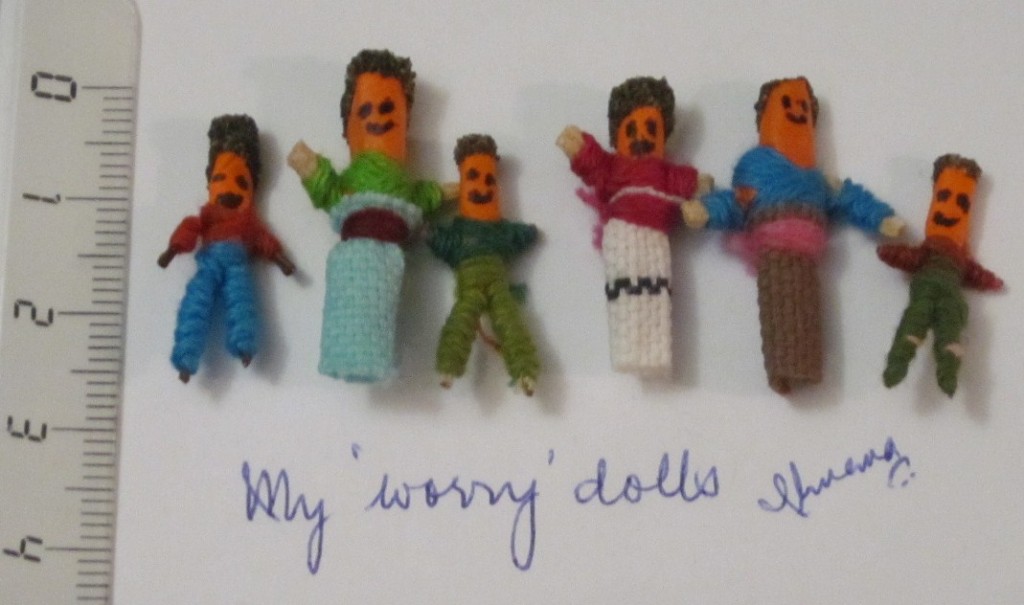
A few days ago while visiting a museum for the Mayan Civilization Exhibition in Toronto; I came across a very simple yet unique and fascinating way of dealing with worries. My attention was drawn to the tiny, barely 2.5- 3cm long set of six miniature dolls placed with a name: “Guatemalan worry dolls”.

On a closer look, they were tiny dolls made out of wrapping cloth or wool over tiny wires shaped as dolls and each one had faces with eyes and a smile drawn on them.

Later as I dug into the details, I learnt that they are an ancient Mayan tradition which is still being practiced by the surviving descendants of the ancient Mayans which live in Central America, specifically in Guatemala.

The dolls usually come in a pack of six handmade dolls and a tiny bag to carry them.

It is said that if the children who worry are told to share their worry with the ‘worry doll’ and place it under the pillow imagining that the doll will take care of that worry. Each doll is told one worry at a time. Many a times parents take away the doll from below the pillow, so that when the kids wake up in the morning thinking that with the doll, the worry too has disappeared. However, sometimes if the worries are recurrent, not removing the doll implies that the doll is working on the ‘worry’ to disappear.

The tradition has been claimed to be scientifically sound and helps kids learn to ‘speak out’ their worries instead of internalising them into long lasting fears. It also gives a subtle message that ‘someone’ cares. It is also know to work as a good tool to inculcate a habit of sound sleep. However, this may work only in those with mild or moderate worries, but not so much in situations of extreme anxiety.

It is claimed that ‘worry dolls’ have also been used in the hospitals, for young and old, to allay anxiety in patients while they undergo surgeries or cancer treatments. Some claim to have used them in class rooms in schools and meeting rooms in offices to cope with stress, and to boost creativity. They are even used for emotional healing in incurable illnesses, dealing with deaths or even heart breaks. I think with the potential they have, there is no dearth of situations where ‘worry dolls’ can be used. Imagination is the limit to utilize them as calming companions.

Though not mentioned in the information on dolls, their ‘tiny’ size taking up seemingly ‘big’ worries must be playing its part in the process of relaxation too.

Apart from the therapeutic value, what fascinated me was the art of making these miniature dolls by wrapping up wool or cloth on wire and giving them a resemblance to someone who ‘cares’.

So aptly was it mentioned in the literature: “Make your own worry dolls at home, just give them a dress, two pairs of limbs and a smiley face? And see them in action. You needn’t be a Picasso or a Freud.”

Horse ‘art’


Horse and man has been friends and companions since time immemorial.

It is said that their association dates back to almost 5,500 years ago. Initially used to carry loads, was later used as the main means of transportation, for wars and then for recreation.

The horse when used in wars needed protected gear like the knight or the soldier mounted on it.

For this horse armour was needed.


In ancient China, relevant to the local culture, the armour had its dragon look:


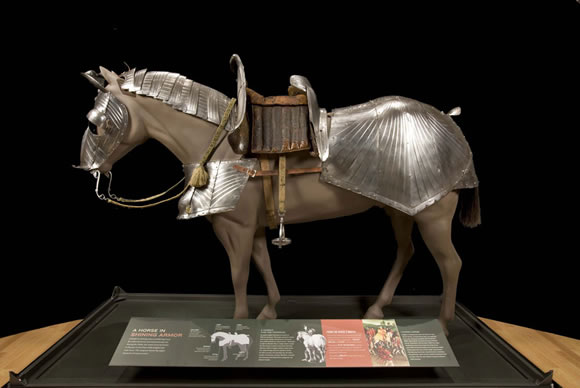
As came the middle ages, and Europeons  used horses for wars as well as transportation their armours were metallic carved plates which  rided on each other to give flexibility:


As times changed, horse use in the wars reduced.  The horse remained as man’s companion and their decorations became less protective and more decorated.

The Arabian horses ( here Moroccan)  had their touch of  embroidered decor:

European decorations differed, thus:

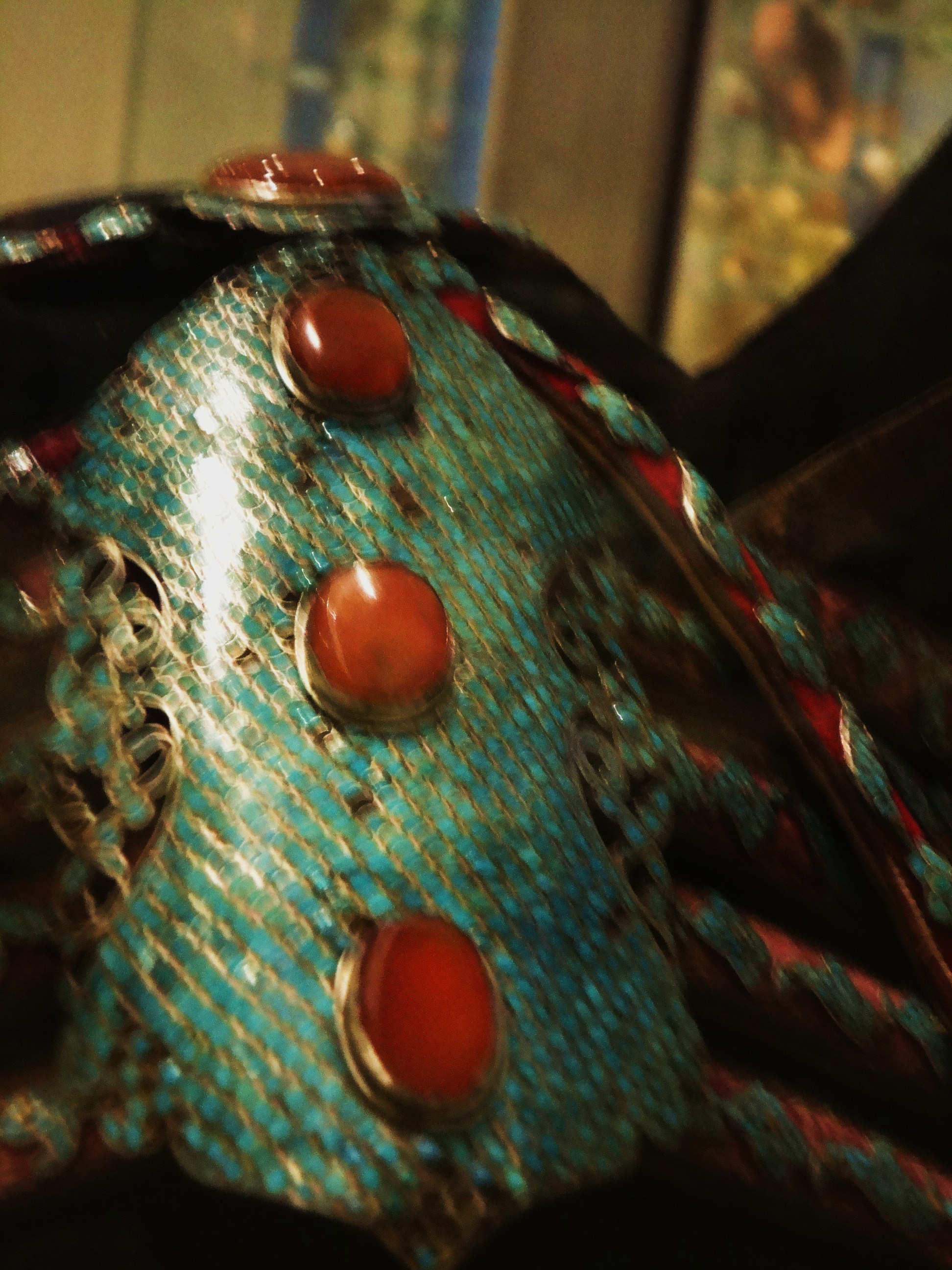
In a recent visit to Royal Ontario Museum I was stunned to see the horse decoration from Iran, which could easily put to envy any woman’s jewellary. This elaborate set of straps and coverings were made of silver, with gold plating,

and inlaid with Iranian turqoise.

The head dress had huge agates giving it a more terrific contrast.


The details of the design were mesmerising:


The austere decorations seen in South Asia using beads, colorful threads and wool tassels have their own charm:


While the Bedoiun horse decor from Egypt still uses  tassles of wool and bead work:

The art of decoration does not end here. The places where other aanimals like camel, ponies are used, they are similarly adorned.

And as buses, trucks and  rickshaws replace animals as the mode of transportation, even they too are as  ferviously bedecked with decorations.
(Details  later…)  


Do you smoke and are in no mood to quit?  Fine, this blog is for you.

The intention here is to give you some information without any strings attached. There won’t be any lecture, any pressure or any judgmental statements

The blog also means to support the person in you, and to give you some tips on how to relieve stress from your life which arises as a result of others reactions to your smoking. The blog shall not trick you to make you quit, I promise.

You are the only one in your life to decide whether you wish to smoke or to quit.

Although as a health activist, I would wish no one smoked, but we have to recognise that each person has a right to make his own choice. Anyone forcing it upon you will make it give a sense of deprivation and is bound to fail.

The blog will mainly discuss
1. How to deal with people who nag you to quit
2. Understand your own smoking habit
3. Get some new facts about smoking
4. Why would you not want to quit?

Before we begin with these points know that the fact that you smoke and don’t even want to quit smoking does not make you a devil.

POINT 1: How to deal with people who nag you to quit

“How many cigarettes do you smoke each day? Can’t you just stop this nuisance.”

“Listen, I know it is harmful. Don’t preach me, okay. I’ll quit when I want.”

I am sure these are the usual dialogues that you may be exchanging day in and day out.

The people around you must have told politely or at times harshly or even without words through their body language that they don’t approve of your smoking.

If they are your loved ones—relatives, friends or well wishers, they say because they care.
Remember that their intentions aren’t evil. But the problem is that they do not know how to convey it, or perhaps don’t know that their reminders or nagging won’t be of any benefit.

They know not that it puts you at a defensive and  can’t make you quit, for sure.

So what’s the way out?

Understand that they are well meaning. Appreciate their concern in words. Then, explain to them politely that their constant reminders would make you more annoyed and that their nagging will make your chances to quit harder.

And tell them that if they eased off, perhaps you will be less defensive, and it might make you think to quit one day.

As for those unknown who judge you in public places:


I know you may be feeling bad when people who don’t matter judge with words or make faces on smokers. You may be aware that those who do not smoke do not hold a great image of smoking.

It’s the smoke they disapprove, not you.

Also, most public places have gone smoke free. The truth is that not only are they to stay, but shall spread wider.

This is not to stigmatise smokers. Just as you have the right to smoke in your own private domain, others who do not smoke have the right to worry about their health and of the community at large.

So it isn’t to shun smokers, but to ensure a safe environment for non smokers.

POINT 2: Understand your own smoking habit:

Think of the reason why do you smoke? Probable answers would be:

  • “It helps me relax from the stress.”

Yes, many smokers believe so. But the truth is that smoking makes your heart beat fast, your breathing gets quicker and raises your blood pressure.

It is not the smoking that calms you.

You relax because
1. the cigarette stops the craving caused by nicotine addiction
2. The mere habit to reach and light a cigarette when tense make one feel better. ( a learned response)
3. Having a cigarette diverts the mind from worries.

It may calm you down for a while but the level of stress builds up over time and reduces the energy levels.

  • “It is my choice; I am hurting myself, not anyone.”

Well , your argument is valid only and only if you smoke in a bubble, where no one else exists and where it is not spilled over to the air shared by others.

POINT 3: Get some new facts about smoking:

We won’t  share the information here which all doctors say: “Smoking has 4000 harmful chemicals, and they cause lung cancer blah blah blah…. .”
I know we all know this by now.

The only thing that I would like you to know is when you smoke out, you dump these chemicals in the air which is shared by others too:
Acetone (paint stripper)/ Arsenic (poison element)/ Hydrogen Cyanide (poison of gas chambers)/ Naphthalene (in moth balls)/ Pesticides (insect killers)/ Carbon monoxide (car exhaust) etc. See more in the picture below.


And all these chemicals get inhaled by kids, women and men around you who do not smoke.

I am sure you know how dangerous second hand smoke is?

It causes some serious health issues in children like allergies, chest infections, poor attention span, hyperactivity and even increased chances of sudden death in the first year of life called SIDS.

In men and women who take in second hand smoke are 5 times more likely to die of lung cancer for no fault of theirs.

This is just not to make you feel guilty, get stressed and smoke more.  Please, don’t misunderstand.

This is just to let you know that you may not choose to quit smoking, you may at least make a choice not to smoke in your home or car where others especially children are present.

The smokers get certain other health problems too, which Respirologists don’t talk about.

Women smokers develop hormonal problems, find it 3 times more difficult to conceive and have an early menopause.

During pregnancy, whether it is a Mom smoker or a Dad smoker, the baby born is likely to be low birth weight, cranky and has very high chances to develop a serious lung disease. His chances of SIDS are 5 times high.

Men smokers have both poor quality and quantity of sperms . Smokers develop sexual dysfunction after 10-15 years of smoking,( e.g those who start to smoke in teenage, may face such problems in their thirties and forties). The chances of such problems increase with the number of cigarettes smoked per day.

Link: http://www.acsh.org/healthissues/newsID.646/healthissue_detail.asp

POINT 4: Why is it that you don’t want to quit?

  • “I don’t feel like quitting.”

Well valid enough, your life, your choice. But please, just one tiny bit of suggestion:

‘Keep your mind open, it might just click to you one day that you want to quit.  After all if you’re not an angel that people expect you to become, you’re not a devil either.’

  • “I am too addicted?”

Correct. Smoking is very addictive and very hard to quit even to those who intend to quit. It is the nicotine not the cigarette that makes you hold on to it.

And for nicotine addiction there are several options in Nicotine Replacement Therapy: patch, gum, inhalers, and lozenges.

Just keep these options in mind, in case you ever decide to change your mind at a later date.

  • “I’ve been smoking for years.”


Fine it’s your choice. You want to do it probably because you know the benefits smoking gives to you-to relax and feel good.

How about having a look, just a look at what benefits would it gives you if you stopped smoking:
Day1: Your lungs work better, and you don’t feel out of breath
Day2: Your sense of taste and smell starts to return. You may cough up more mucus, but only to clear the lungs
A week after: Blood flow to your hand and feet will increase, and you won’t feel as cold
Within 6 months: Less of coughing, less of sinus congestion, less of shortness of breath will occur.
After an year: Your risk of dying from a heart attack will be reduced to half.
There are many many more benefits …
Well, I know after this you must be wondering: “The blog didn’t work. It did not trick you to change your mind.”

Well friends, this wasn’t at all meant to change your mind, though the blog would be very happy if you did.

But then know it’s not easy and the decision is entirely yours.

Remember one thing…all those who care for you, wished you would change your mind ONE DAY, and SOON.

Just keep your mind OPEN. You might just one fine day decide to say QUITS. Imagine !  🙂

But take your time.

Just relax, and feel there’s one place in this world which does not judge you even as a smoker.

And if you ever wish to quit….refer to the next blog >>>

“Smoker and want to kick off the habit?.”
https://thinkloud65.wordpress.com/2012/03/15/smoker-and-want-to-kick-off-the-habit-come-on/


*Warning: Smoking is injurious to health. *

Content courtesy: Canadian Cancer Society & Credit Valley Hospital Anti Smoking Unit.

Do not call them mad, please!


Published in The News Blog on February 22, 2012 :http://blogs.thenews.com.pk/blogs/2012/02/22/do-not-call-them-mad-please/

When I feel feverish, lethargic, sneeze and have a runny nose, all know I suffer from common cold, and that I am infected with a virus. If I tell them that I went to see my GP and am taking meds, they all know medications will take care of me. No one will judge me. All will empathise, give an extra advice to take rest. Some will even hug me for support, without realising that I might be transferring the virus to them. Even if they get one next day, it will be just a passing mention, “Oh I too got your flu”.

If I feel low, lethargic, don’t feel happy, lose my appetite and cry for no reason, they all ‘know’ I am an ungrateful person, who has got everything from a good family to a good home to a good carrier and is still being thankless. Not many will hug me to say, Yes we know you are depressed and there has to be no reason for it. It is because of imbalance of chemicals in your brain.”

And if I tell them I am trying to help myself by going to a psychiatrist, and am on medications or psychotherapy, they would give a stunned look and say nothing. Not many will hug me or tell me “You did the right thing”.

I also know behind my back tongues will wag and eyes will roll. Some may even diagnose “I have gone mad.”

Yes they would give me advice to read scriptures to be thankful. Or to go to some Aalim or Pir and get my “nazar jhaaroed”.

According to the fifth edition of the Diagnostic and Statistical Manual of Mental Disorders ,  almost 78 per cent of people are suffering from some kind of psychological disorder.

Indeed, 78% of us are affected with one form of psychiatric disorder or the other. It could be a mild anxiety with minor worries, on one end, to a full blown schizophrenia, on the other, where one is cut off from the reality of this world, which in medical terminology is called “loss of insight.”

However, none of them is madness. In fact there is no such thing as madness.
Going through the 954 page document, above mentioned, I did not find any mention of an ailment called ‘madness’. I even looked up into the index at the end, the  M section  began with Major Depressive Disorder, then after Mathematics disorder, the next mention was Medication induced disorder.

Thanks to the advances of medical sciences, we now know there is always a chemical basis of psychiatric diseases. This is the reason they are quite capable of being corrected by medications. Some may be completely corrected, while some partially.

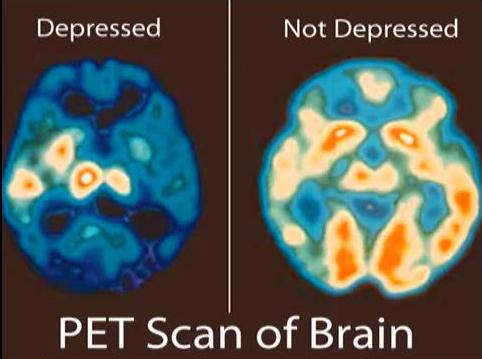
Thanks also to the sophisticated PET brain scanning techniques, we can now see with our own two eyes that Depressive Disorder or Anxiety Disorders or any other psychiatric disorders are real ailments and not mere myths.

Perhaps, our scientific knowledge of psychiatric ailments needs to cross a lot more frontiers, to be able to understand and treat all these disorders more efficiently.

Exactly  as in a common cold there are triggers like exposure to cold, or exhaustion which cause them to come again, there are environmental triggers in the psychiatric disorders too—usual ones like stress, troubled relationships, or as trivial as some taunts or sometimes as subtle as winter season.

Do we ridicule those who have fever, or cancer, or diabetes or heart attack? But we do ridicule, poke fun or bad mouth about those suffering from Depressive disorders, Anxiety Disorders, Eating Disorders, ADHD , Personality Disorders or Learning Disorders etc.

We empathise with those who do have their sight, hearing or physical ability missing and often remark that nature compensates them with some other strength or skill.

Same is true of the various Psychiatric Disorders. The people affected by them are endowed with some other skills. World’s best writers are known to be Bipolar, and many of the inventors were known to have either Obsessive Compulsive Disorder or Learning Disorder.

We all love ourselves. No one wants to fall sick, whether with common cold or with depression or of any ailment, no matter how trivial.

With the statistics of 78% affected with some psychiatric disorder, we may be definitely seeing four- fifths of our near and dear ones affected by some psychiatric disorder, ranging  from a very mild to a very serious one. Some of them may be in need of a professional help too.

So next time you see anyone you would wish to label ‘mad’,  just understand them and don’t be a trigger for them to get worse.

Know that they didn’t want to be unwell either.
And please, I beg you, do not call them mad.  

Chemical basis of some mental disorders. 

P.S. This blogpost was written in response to the @ExpressTribune ‘s article:

Celebs with mental disorders: Lock up the crazy

Beautifully meaningful


These are colourful bits with each of a unique shape, size, yet so purposeless, resembling a pile of multicoloured rubble, until….

..magic happens.

And they all   find their right roles in the right places.

Which piece fits best next to the other isn’t necessarily of the same shade or same shape.

What is worth a notice is that they are all connected to each other, someway.

What matters most is that, together, they all make a beautifully meaningful existence.

Arent we all as individuals like the first picture?

*Correction: The magic above did not happen, it was made to happen.

Tiffany lamps have always been my favorites, for they being  beautifully handcrafted, colorful pieces of art, and at the same time  so purposeful too.

P.S. This blog post was inspired by a vibrant and transparent  soul called Geetali Tare, knowing whom is so  beautifully meaningful !


PART-I

The tsunami wave of diabetes mellitus and its health and economic consequences is threatening much of the world. The need to prevent and control this debilitating chronic disease is urgent, before desperation sets in.” Journal of Royal Society of medicine.


How does this  matter to us South Asians?
Indian Subcontinent (which includes India, Pakistan, Nepal, Bangladesh and Sri Lanka) is the epicentre of this Diabetic pandemic. By 2025, over 2/3rds of the diabetics would be living in our subcontinent.
Link:  http://171.66.127.115/content/100/3/115.full

How are we more vulnerable as compared to other ethnicities?
We South Asians get Diabetes:
• 10 years earlier
• At lower levels of obesity
• Suffer longer with more complications
• Have 3-8 times higher risk of dying from Diabetes than Europeans..

Why are we more vulnerable than other ethnicities?
Again the same answer as for the Heart Disease—Our genetic makeup coupled with our unhealthy lifestyle i.e. faulty diet, obesity, sedentary habits and lack of health awareness.

Can we really do anything?
Yes, research proves that we can avert or at least postpone Diabetes and improve our quality of life through various lifestyle modifications.


What should we know?
First, know that Diabetes is no more the disease of the affluent; even the poor have it.

Second, it is no more a disease of the middle aged. Diabetes Type 2 which was earlier called the Maturity onset diabetes has now been seen to occur amongst the South Asians in early 20s and many get in their 30s.

Thirdly, in order to live a life without Diabetes we need to start early and change our life style. However, it is better late than never.

PART-II

What should we do?

If you are not a Diabetic

Step 1 : Know whether you are at high risk of Diabetes Mellitus or not.

Check your risk from the risk-factors chart:

Or better see YOUR RISK OF DIABETES  from  the  Diabetic Risk Calculator at the link below.
Link:  http://www.diabetes.org/diabetes-basics/prevention/diabetes-risk-test/

(ADV*** : Dont skip this ^^ step!!)

Important: In case you are a high risk group, please consult your doctor and ask him to screen for Diabetes. He will do some blood test on you while fasting and after meals to check your blood sugar levels.

Step 2: Get more physically active :

Benefits of exercise:
• You will lose weight
• It will lower your blood sugar
• Boost your sensitivity to insulin –which will keep your blood sugar in the normal range.

More, refer to Blog 1 : https://thinkloud65.wordpress.com/2011/12/31/living-a-healthy-lifestyle/)

Step 3: Lose the extra weight.

Obesity is one of the main culprits in causing Insulin resistance and hence Diabetes- Abdominal fat is the real culprit.


Tip: If you are obese or over weight, loss of every kilo will reduce the risk by 16%. And if you lose 10% of your body weight, you will cut the risk of developing diabetes by 60%.

Step 4: Make long term dietary changes.

Add fibre to your diet. This simply means eat more of fruits, vegetables, beans, whole grains, nuts and seeds as they are rich source of fibre. 

Benefits: Fibre reduces the risk of Diabetes, of Heart disease and risk of colon cancers. They also promote weight loss.

Check Glycemic Index of the foods you eat. Choose foods with low Glycemic Index as this maintains more constant blood sugar levels.

Tip: Print out a chart of foods by Glycaemic Index and put it over the fridge, so that it is easy to refer to them while selecting food.

For more on Glycaemic Index : http://www.diabetes.ca/for-professionals/resources/nutrition/glycemic-index/

Step 5 ; Try to manage your stress:  Stress increases hormones in the body which predispose to Diabetes.

IMPORTANT NEWS: The research has shown that if one follows the above measure, at least 50 % postponement of DM is possible.

PART-III

For those who are already Diabetic

Remember:

Diabetes is a lifelong responsibility.

You may not feel unwell in the initial years but persistently raise blood sugar levels can gradually harm each and every organ of the body, more seriously the organs essential for life-heart and kidneys.

To the Diabetic, I would just give a few outline tips here, as  it is important for you to be under a regular care of a QUALIFIED DIABETOLOGIST   to manage your health:

Step 1: Make a promise to yourself that you will take care of your diabetes by being FULLY INFORMED  of the disease. (Just google ‘Diabetes Mellitus’ and there you are).

Step 2: Try to keep the blood sugar in normal range through diet,  exercise, weight control, medications and regular smedical consultations.  A normal sugar levels maintained are as good as being non diabetic.

Step 3: DIET: Diabetics should be very watchful of their calorie intake, and must take meals LOW  in SUGAR, FAT and SALT content. You must consult a DIETICIAN to make meal plan, ideally.

See  links for dietary guidance: http://www.diabetes.ca/files/JTB17x_11_CPGO3_1103.pdf

Try  this SOUTH ASIAN DIABETIC MEAL PLAN BOOK :http://www.diabetes.ca/documents/about-diabetes/Recipe_Booklet_high_res.pdf

Other SA recipes: http://www.pamf.org/southasian/healthy/recipes/

Step 4: Get blood sugars checked at regular intervals…at home and by the doctor.
Through your doctor: Make sure you have HbA1c tested every 3-6 months. The test that shows the average amount of sugar in your blood over 3 months. It tells how well you are controlling your diabetes.

An HbA1c of 6% or less is normal. See the other levels:

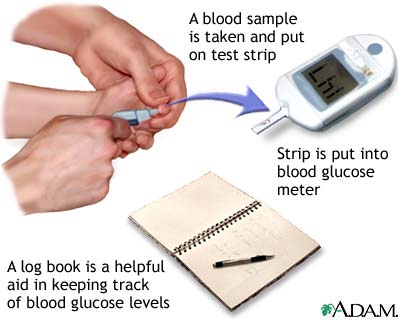
Home Glucose Monitoring : Home sugar testing is also important. You must have a glucometer for this.  Ask your doctor how frequently and when should you check your  blood sugar yourself at home.

Step 5: Keep your Blood Pressure and Cholesterol under control.


Step 6: Regular health checkups to assess complications of diabetes—Have your KIDNEYS, HEART, NERVES and EYE check ups EVERY YEAR .

Ask your doctor by name —> to check for COMPLICATIONS of Diabetes.

Warning*: Long periods of uncontrolled Diabetes can cause painless Heart Attack,  Kidneys to fail,  Nerves to get numb and Eyes with loss of Vision. (This is intended not to scare you, but inform you of the seriousness of the problem).

Step 7: Take care of your FEET: Diabetes causes nerve damage which can cause injuries to feet without being noticed due to loss of pain sensation.


IMPORTANT: 

  • Check your feet everyday for cuts, blisters, redness or swelling. Consult the doctor is any such thing is seen.
  • Keep the feet clean, dry and moisturized everyday to prevent any infections.

Step8: Brush your teeth and floss them everyday. Have dental checkups every year and mention to the doctor that you are a diabetic.

Step 9: Ask your doctor if you need to take a Aspirin tablet everyday to prevent heart attack and stroke.

See the benefit of aspirin in Diabetes in this link: http://www.diabeticlive.com/diabetes-101/diabetes-news/new-study-on-aspirin-and-diabetes/#.TzwKiE4gf1k

Step 10: DO NOT SMOKE as it accelerates all the diabetic complications. If you drink, do it in moderation.

Step 11: Manage  STRESS: Stress increases Blood Sugar levels , increases food indiscretions and one tends to neglect the health. Hence manage your stress smartly.

Last but not the least, maintain a sense of humor. You may not ‘delete’ Diabetes from your life but you can ‘minimize’  it by knowing and following the right steps.

🙂 

Leaving your heart prints


Valentine’s Day isn’t just about expensive gifts, teddy bears, chocolates or red roses to girlfriends. It’s about  making any of your loved ones ( whosoever they may be)  feel that they matter.

And to make anyone feel  that you care, fortunately does not take loads of money. In fact it does not  cost anything but  a tender caring heart.

I planned to write a humorous blog on the ‘extortion day’ that  men generally call Valentines day, with a few jokes.

But when a friend sent in an email mentioning about the idea of  ‘heart  prints’, it was too touching to just shoo off this day in a joke. Hence without adding any of my non serious words I share the sentimental caring words a friend wrote in her email.

Sharon  shared:
We leave fingerprints on whatever our hands touch.  On walls, on furniture, on doorknobs, dishes and books, as we touch we leave our identity.  Each day we have the wonderful opportunity to leave prints on the hearts of those who are entrusted to our care.”  

Elizabeth Barrett Browning wrote in one of her famous poems:  “How do I love thee?  Let me count the ways.”  

We might say:  “How can we touch hearts?  Show us the ways.”  

The ways that we leave heart prints can be summed up in the word LOVE.

In his meditations, St. La Salle was very fond of quoting St. Paul.  In his First Letter to Corinthians, St. Paul describes love.  He writes of a love that touches hearts.

How might we describe this love?  We might say:

“May we leave heart prints by dealing patiently with others.
May we leave heart prints by being kind to others.
May we leave heart prints by never being jealous or boastful, or arrogant or rude.
In our dealings with others, may we leave heart prints by not insisting on our own way.”
When we are not irritable or resentful or rejoice at wrong, but rejoice in the right, we leave heart prints.

So, in all of our dealings with others, let us leave heart prints.

And if someone should say: “I felt your touch,” that might be miracle enough. “

Continuing with a  serious note,  perhaps  an look of concern, a nod that we  understand,  a bend  to lend an ear,  a few words of  compassion or just a caring glance that turns a grimace into a grin  are all ways to leave heart prints.

Coming back to my not so serious  words, well I wouldn’t  leave this page without  caring  words for my  men friends  for whom this day proves to be more of an extortion day. Here goes my empathy for the impoverished pockets:

  Conversation during an expensive candle light dinner on Valentine’s Day:

Girl (blushing) : “Do you love me with all your heart and soul?”

Boy (”the bill’ on his mind): “Mmm hmm.”

Girl( flushing ): “Do you think I’m the most beautiful girl in the world?”

Boy( still thinking of the ‘ the bill’) : “Mmm hmm.”

Girl(slushing): “Do you think my cheeks are like rose petals & my eyes like gazelle’s?”

Boy( ” the bill’ thoughts persist) : “Mmm hmm.”

Girl( gushing) : “Oh dear, you say the most beautiful things in the world!”

With no  offence meant to anyone, but I hope to  leave some grins on the grimaced faces  :).

Dilemma of duty vs compassion


Having a background from the medical profession, it is not difficult to understand the dilemmas that erupt between professional ethics  and compassion, when they, at times, seem  to clash. Doctors are often accused of ‘compassion fatigue’ which I find is a completely misplaced myth.  However, at times, one’s hands are tied through requisites of an  ‘ethical’ behaviour.

This painful story also deals with the same conflict albeit in the life of a journalist.

This is a  Pulitzer Prize 1994,  winning photo taken by  Kevin Carter a South African photo journalist. The picture was clicked, in March 1993,  during a visit to the famine struck Sudan.

The picture depicts a famine stricken child being stalked by a vulture. The child is crawling towards a United Nations food camp, located a kilometer away.

He is said to have taken the picture because  it was his ‘job title’.

Soon after the picture was published in New York Times on March 26, 1993, hundreds of people from all over the globe started to inquire about the fate of the girl.

The newspaper reported: No one knows what happened to the child, including the photographer who left the scene as soon as the photo was taken.

The photographer came under  fire for being insensitive and a publication wrote:

“The man adjusting his lens to take just the right frame of her suffering, might just as well be a predator, another vulture on the scene.”

Kevin  later confided to friends that he wished he had intervened.

Journalists at the time were warned never to touch famine victims for fear of disease.

According to another photographer, Joao Silva, accompanying Kevin, they had only 30 minutes to take pictures before flying out of the area.  And according to him, Kevin was shocked to see the children of  famine for the first time and started taking pictures of the kids, as their parents were busy collecting food from the nearby food camp.

“He carefully came close to the child to take a picture of the baby with the vulture and then after taking a few shots chased away the vulture.”

Months later, and only weeks after being awarded with the Pulitzer Prize, Kevin Carter, 33, drove up to the place where he used to play as a kid, and  committed suicide.

Portions of Carter’s suicide note read:
“I am depressed … without phone … money for rent … money for child support … money for debts … money!!! … I am haunted by the vivid memories of killings and corpses and anger and pain … of starving or wounded children, of trigger-happy madmen, often police, of killer executioners…I have gone to join Ken [recently deceased colleague Ken Oosterbroek] if I am that lucky.

His story was made into a documentary ” The Death of Kevin Carter: Casualty of the Bang Bang Club ” which was nominated for the Academy Award in 1996.

A tribute to Kevin Carter : 


Published in TheNewsBlog February 7, 2012. http://blogs.thenews.com.pk/blogs/2012/02/07/sights-and-sounds-may-disappear-but-smell-shall-linger/


“When I miss her, I go to her closet to sense my daughter’s fragrance.” Arfa Karim‘s Mom said on her 17th birthday.

The words from the teary eyed mother gave me goose bumps.

She was certainly not talking about the perfumes that Arfa adorned, but the odour that she inherently possessed by virtue of her HLA (genetic) type. This was the smell Arfa’s mom associated her with ever since she held her in her arms soon after her birth (even though the mother may not be aware of it, consciously.)

This reminded me of a research paper I read years ago which said the first bond that a mother and child have after birth is through the sense of smell. Babies from the time of birth learn to identify their mother through a strong sense of smell. It is said that within 24 hours, a mother is able to identify her baby’s odour too. A research claims that within 50 hours, infants were able to differentiate between the smell of their mother’s nipple from that of another lactating woman. Studies have shown that when a mother’s nipple from one breast was washed off, 22 out of 30 babies chose to suckle the unwashed side, because of the familiar odour.

Little toddlers, unaware of relationships, differentiate their siblings from friends subconsciously through odours.

It is common knowledge that animals identify and claim their territory through the sense of smell. Dogs smell their masters, and cannot be deceived even by a look alike.

Each one us is endowed with a unique fragrance or scientifically an ‘odour’ type. Our smells are coded by the genes of a group of molecules called the HLA Complex. Our odour type determines the various social cues we receive in the society in the form of attractiveness, favourable or unfavourable social reactions, and even sexual arousal. Furthermore the role of pheromones, the odour producing hormones in animals and humans as a medium for sexual attraction is also well known.

In an interesting study a group of women were asked to smell men’s T-shirts and choose the odour they liked. Majority of them chose the odour type which was different from theirs, hence from a different genetic pool. Perhaps this is nature’s way to create more variation.

In another similar study, women were asked to smell men’s T-shirts and were asked to rate them according to pleasantness. The men who had infectious diseases, (most probably sexually transmitted disease’) were in more than half of the cases labelled ‘putrid’. That’s another one of nature’s ways to minimise the transmission of infections.

My kids often mention:

‘Oh this smell reminds me of Karachi’, or of Delhi or even of ‘that’ person. Though never a subject of research perhaps every place along with its unique sights and sounds, has its own distinct set of smells too. The smells could be related to its fauna or even the food habits there. My mother often remarks; ‘The soil at every place smells different while the water in every place tastes different.’

A Vietnamese friend who recently visited her native place remarked, Hanoi has its unique smell, and it’s even funny how their embassy here smelt the same. Perhaps it’s the fish sauce!

We do spend a handsome amount on buying scents. And many rich and famous spend a fortune in creating a ‘signature’ smell of their own.

Ironically the sense of smell – though a subtle and powerful sense of perception – is subconsciously the least significant in our lives. We may feel empathy for those who are deprived of a sense of sight or sound, but often either ignore or even mock those with loss of smell. Not many of us even know that some people are born with their sense of smell missing. This condition is known as Anosmia. How incomplete their lives must be. We all have experienced small periods of Anosmia or Hyposmia when our noses get blocked during the common cold. We all know how tasteless even the most delicious of foods seem, with a blocked nose. This simply reinforces the hidden fact that before actually tasting, it is the smell which judges the true taste of food.

Hence, our sense of smell and the odours of others, animate or inanimate creates a great bond and sense of belonging.

One can very well imagine how much Arfa’s Mom must be feeling the presence of Arfa in everything that is associated with her. Though Arfa’s sight and sound may have left, her smell shall linger in the place and possessions she has left behind.