Open up your mind and your potential reaches infinity…


First published in The Express Tribune here > http://blogs.tribune.com.pk/story/25569/will-2015-spare-our-children-from-the-violence-of-2014/

A Syrian child cries as he waits to be registered by the United Nations High Commissioner for Refugees (UNHCR) in Arsal, in Lebanon’s Bekaa valley, on November 19, 2013. PHOTO: AFP

Thousands of miles away, in a candle vigil for the children of the Peshawar attack, the Mayor of Mississauga, Ontario, Canada, Bonnie Crombie said,

“The children lost in Peshawar were not just Pakistani kids; they were our children, the children of this planet.”

I shuddered to imagine the paranoia of millions of parents in Pakistan on the day that their children will have to go back to school after winter break. And along with them, my mind wandered to the other children on the planet – the children who have lost their lives and so much more.

I couldn’t help but think of the 200 plus school girls that Boko Haram kidnapped in Nigeria. Will these girls ever be able to return to school again?

Last September, Gaza was short of almost 490 school-going children, as schools reopened after a 50-day war with Israel during the summers. Many of the kids who survived had lost their homes and family members. The Israeli kid who died after rockets were fired from Gaza was also a child of the same planet.

How can one not think of the millions of displaced children of Syria currently spending their fourth winter in refugee shelters, attending makeshift schools in the camps, while nearly 14,000 have perished?

My heart aches for the children who have been brutally beheaded by Islamic State of Iraq and Syria (ISIS) for not converting. Hearing the spine-chilling stories of Yazidi minor girls who are being sold as sex slaves makes me tremble.

“They will sell my girl for $10.”

This cry of a Kurd father from Sinjar haunts me to date. So does the recount of a 19-year-old Yazidi girl who managed to escape:

“One day we were given clothes that looked like dance costumes and were told to bathe and wear them. One girl killed herself in the bathroom. She cut her wrists and hanged herself.”

In a lesser heard Central African Republican, almost 6,000 to 10,000 children have been snatched of their school lives and have been forcibly recruited as child soldiers, some being as young as eight-years-old. There are child soldiers recruited by Iraqi militias and ISIS too. Amnesty International reports there are 250,000 child soldiers world over.

Closer to home, around the time of Malala Yousafzai’s incident, 12-year-old Mehzar Zehra was shot on her way to school and while her father became the victim of target killing for being Shia. I also think of little Rimsha Masih, who had to languish in jail, and Aitzaz Hasan from Hangu, who lost his life while averting a bomb attack in his school. Let’s not forget the Hazara kids who either perished or were injured in Mastung and other attacks on the Hazara community. Let’s not forget the hudreds of children who have died during the drone attacks in Waziristan.

Forgive me for not being able to enumerate every child who was lost to meaningless wars happening around us. Echoing Mayor Bonnie, each of these are children of the same planet. And it is incumbent upon humanity to ensure them a safe childhood.

According to a UN report,

“More than one billion children under the age of 18 were living in areas in conflict or emerging from war. Of these, an estimated 300 million were under age five and more than 18 million children were refugees or internally displaced.”

As the calendar flips to 2015, there will hardly be anything new for these children. Those who have perished shall sleep below heaps of earth with their innocent dreams buried in their hearts. Those alive will continue to bear the trauma of bare survival, feeling lucky to have lived another day, no matter how.

This is not all.

Beyond active warfare, vested interests in media, state or faith-based groups also subject children to psychological abuse by preaching warmongering and hatred. A child’s video on Memri TV telling tender Palestinian children about evil Jews, a seven-year-old boy from a madrassa who sings jihad against infidels, or a 10-year-old boy from a Gurukul who spews hate and desires to combat Muslims – these are just a few examples, and not a concoction of my mind. Even on social media, we violate war-torn kids by sharing gory pictures of disfigured or dead children to evoke emotional propaganda.

Is this the quality of life the children of our planet deserve?

Why are we so disgustingly insensitive about how detrimental something like this could be to a child’s health and potential? Would you put your child through this physical or psychological politics of hate and violence? Why do we fail to think of the long-lasting adverse consequences of violence on their tender minds and bodies in the form of post-traumatic stress disorder (PTSD)?

Do these children even have an idea of the geopolitics, war on resources or hegemony of sects or tribes, for which they are subjected to the worst form of violations?

The hope kindled by voices like Kailash Satyarthi or Malala or Edhi is only momentary. The scale of the war industry is too huge to be countered by a few sincere souls. UN reports reveal a change of war tactics in current conflicts that have made children even more directly exposed to warfare. This only makes the future grimmer.

Violence and hatred are not inborn. They are learned behaviours, and we, as adults, are the culprits who have taught our kids through words, actions and inactions. Even if we can’t create a world without conflicts, can we at least be civilised enough to spare children from being caught in this crossfire of hate and violence?

Garcia Machel, UN’s Secretary-General, correctly stated,

“It is unforgivable that children are assaulted, violated, murdered and yet our conscience is not revolted nor our sense of dignity challenged. This represents a fundamental crisis of our civilisation.”

Indeed.

But yes, yes, do wish each other a happy new year.


First published in The News Aman Ki Asha here >  http://amankiasha.com/detail_news.asp?id=1496

A special prayer: Special needs children pray for Pakistani children. PTI photo

By Ilmana Fasih

December 16, 2014 was the darkest day in Pakistan’s history. Over a hundred young, bright lives were barbarically extinguished at the hands of hate and bigotry. I switched on the television and there was a man wailing, “We took 20 years to raise our kids, and they did not even take 20 minutes to finish them”.

Adjectives strong enough to express my pain seemed non-existent.

I went to office, wondering who would ask the first question and what it would be. As I entered the office, I learnt that Peel District School board in Mississauga, several thousand miles away from Peshawar had decided to lower its flag at half-mast till December 19.

On Twitter, Indian Prime Minister Nartendra Modi tweeted with a heart touching message appealing to schools across India to observe two minutes of silence the following day as a mark of solidarity.
It was evident that the pain was not just of the Pakistanis. It had travelled across borders and seas. Sympathies started to pour from all corners of the world.

A friend responded quoting a verse from Kabir: “Heart goes out to beautiful Pakistan. Sadho dekho jag baurana!”

Then there was this dream tweet with the thoughtful hashtag #IndiaWithPakistan from Tehseen Poonawalla:

These could so easily be our kids. Nothing justifies harming these innocent children.#IndiawithPakistan

Oh and then another, with the same hashtag, then another. There was a treasure of tweets and every single one was coming straight from their hearts.

A. Dhanvantri Prayers for our brothers & sisters from Pakistan. #IndiaWithPakistan

Rituparna Chatterjee IndiaWithPakistan today as one nation, one tragedy, one voice. Terror will not break us. Will not drown our voice.

IndiaSpeaks Some days overwhelm years of painful history. Today is one such day. Politics & battles can sit this one out #IndiawithPakistan

Arun Nambiar When you lose family, the only shoulders you want to cry on is family. We are one with our family in Pakistan! #IndiawithPakistan

Priyashmita Guha Hearing the wail of parents on TV. How do u even make sense of this? How do u tell parents it will be ok #IndiawithPakistan

In no time, was trending at the top on Twitter after Peshawar Attack.

With re-tweets, tears rolled down my eyes. Bewildered, one moment I was sobbing in grief, the other smiling at the empathy that every tweet of 140 characters or less carried.

When I reached this tweet, I could not hold back anymore and began to cry aloud.
Chandan Bharti Aaj padosi ka choolha thhanda pada hai, bhookh hamaree bhee mar gayee #PeshawarAttack #IndiawithPakistan

I kept scrolling down my timeline. There was an ocean of compassionate messages of solidarity and of grief from Indians as if it was their own tragedy.

Even the remote corners of India had responded with a testimony of a picture:
Nitin Jaunpuri Tears from the remotest disaster hit area of India #Uttarakhand #IndiawithPakistan #PakSchoolSiege #PeshawarAttack

Overwhelmed by the deluge of love and empathy, I tweeted: “I am so proud of #India I grew up in. Compassionate and tolerant. United with #IndiawithPakistan as #Pakistan is shaken by #PeshawarAttack”

The most amazing thing was that the outpouring of emotion was largely un-orchestrated. Prime Minister Modi did provide it a framework but its expression came not just from the usual peace activists but also from the man on the street. The rickshaw-wallahs, the tea vendors, teachers, children, housewives and every other section of the society you can think of. It was unscripted and uninhibited.

That brings us to the question, where was this camaraderie when India and Pakistan were at each other’s throats after the infamous jockey match in the Champions Trophy semi-finals? The Indian media and public went from being a sore loser to overwhelmingly magnanimous in a matter of three days. Pakistan went from being aggrieved and counter-attacking to humble and receptive.

Another week later, as the sympathy recedes, the conspiracy theories, the lecturing, sarcasm and stereotyping are making their way back into the public narrative.

What we need is consistency and maturity of behavior on both sides of the border. Pakistan is not a monochromatic hotbed of bearded ‘mullahs’ perpetually plotting, planning and executing violence against India. There are some rabid and regressive elements but when has the public ever voted for them? Similarly, India may have its share of preachers of hate and some of them may have tasted political power but any objective assessment would indicate a largely tolerant society.

It is time the silent tolerant majority in both countries kicks the troublemakers out of the limelight and asserts itself. It would help if the authorities in both countries took necessary steps to allow a free people-to-people contact through a liberal visa regime. #MilneDo

The writer is an Indian gynaecologist and health activist married to a Pakistani. She blogs at www.thinkloud65.wordpress.com

Wednesday, December 24, 2014


Published in Express Tribune Blogs on 25 December, 2014 > http://blogs.tribune.com.pk/story/25528/there-is-nothing-wrong-in-wishing-someone-a-merry-christmas/#disqus_thread

Pakistan saw its darkest hour when innocent kids were brutally massacred in Peshawar by terrorists last week. As every single Pakistani was in mourning, the whole world beyond borders and beliefs stood by us. Thousands of miles away here in Canada, Peel District School Board lowered its flag to half-mast for a whole week. In India, every school observed two minutes silence and Twitter trended #IndiaWithPakistan.

The Christian community in Karachi sang prayers for the children of Peshawar. I hear now that the Christian community in Pakistan has decided not to celebrate Christmas this year.

When I heard about this, it took me down memory lane, a decade and a half ago, to the time when I was working in an institution in Saudi Arabia encompassing 27 other nationalities. An Irish Catholic nurse worked with us too. She used to fast in the month of Ramazan with us out of respect for her Muslim colleagues. We loved her for her understanding nature and for respecting Islam.

A few months later came December. It was only a few days before Christmas when Muslim employees quietly circulated a memo. The memo, which each of us was to sign, stated that Muslims were to refrain from wishing Christians on Christmas.

This upset me terribly.

In an effort to understand why such a memo would be circulated, I decided to talk to a Muslim friend. While she tried to avoid discussing this with me, because the decision not to wish our Christian brethren was ‘the right thing to do’, she reluctantly came up with an excuse, which, in my opinion, was meant to placate me. She said,

“Actually, they add rum to the Christmas cake. So if we wish them, we will have to eat the cake too.”

This absolutely ridiculous explanation upset me even further.

I couldn’t understand why saying Merry Christmas had become such a taboo.

Still restless, I came home and decided to search for answers. Hours later I couldn’t find one, neither in favour of it nor against it. All that came up again and again was,

“Allah judges you by your intentions.”

I felt even worse on Christmas Eve. Since Christmas was not a statutory holiday, the nurse came into work. Knowing that Christmas is an important day and she probably wanted to celebrate the day, I went up to her in an effort to alleviate the tension,

“Merry Christmas! How come you are at work today?”

She ignored my wishing her and said,

“Yes I couldn’t take off.”

I could see in her eyes that she knew I had signed the memo not to wish her. I felt horrible. My eyes could not lie. She patted me on my shoulder, and I began to cry.

“I am so sorry, Carol.”

She hugged me and smiled. I tried to change the topic,

“Carol, where is my Christmas cake?”

She said,

“It’s at home, I will bring it tomorrow. You can actually eat it. I don’t put rum in the cake. I haven’t done that in many years.”

I smiled sheepishly and said,

“Let’s meet over lunch in the cafeteria. Lunch is on me today.”

We met at the café that afternoon and chatted for an hour where she shared a touching story about an incident.

“In Dublin, some 10 years ago, I used to see an Arab man selling souvenirs on the footpath. When it would be time for prayers, he would pack up his stuff, turn his back on the pile and pray. I was curious. He said he was a Muslim from Tunisia. On asking why he does not keep the pile in front of him, he told me that his God will protect his stuff while he prostrated for Him.

He was an illegal immigrant, yet had so much positivity. Being a Catholic, I thought it was Christianity which preached peace, but he himself was so much at peace, that I was touched.

On my way to the grocers, we used to exchange greetings regularly. He would always ask me how I was doing. Once, on Halloween, I took some pumpkin pie for him. He said he was fasting, but would take it home and eat it when he breaks his fast at sunset. That is when I began to fast, in support for a young man who stood hungry all day, selling things. It was then that I learnt that fasting teaches us self-control. I developed a deep respect for him and for Muslims. Hence, I decided to travel to the Middle East.”

I thought she would continue, but she did not. Instead she said,

“I learnt from this young man how to stay positive even in the toughest of situations.”

This young woman, in her deep respect and curiosity about our religion, travelled all the way to the Middle East to know more about us. She observed Ramazan and displayed many qualities that Islam preached to its followers, so then why was it taboo for us to merely wish them on Christmas?

Recently, a Christian couple was burnt alive for allegedly having committed blasphemy, yet we see the generosity of our Christian community to forego their celebrations for the kids massacred in the Peshawar school attack.

Did we even think of not celebrating Eid when the Peshawar church was burnt down?

Close your eyes, look into your heart and really think, would God really approve of you hurting another person’s feelings? Are kindness, compassion and respect not virtues that Islam endorses? Can we not be grateful to another human for their compassion towards us? Can we not return the favour?

While you ponder over those few questions, I would like to wish all my Christian friends, in Pakistan and the world over, a very happy Christmas.

ilmana.fasih

Dr Ilmana Fasih

An Indian gynaecologist, married to a Pakistani, Ilmana is a health activist, and m-Health entrepreneur, who writes on social and health issues as a passion. She dreams of a world without borders and wars.


My humble tribute to ‪#‎ReclaimYourMosques‬:

Aoo masjidon me jalaein shamein,
Haulnak andheron ko door karein

Ho Allah ke ghar pe na qaabiz  koi
Falaah-o-sukoon ka markaz banein,

Na rahe koi khauf, na tafreek koee
Aman ki azaan per labbaik kahein,

Ikhlaas ke khutbe, ittefaq ke dars,
Jo zehnon ko sabke kushada karein

Bardasht ki safon me ho Allah-o-Akber
Mohabbat ke jazbon se sajde karein,

Parh ke janaza nafrat ke buton ka,
Maazi mein unko pher dafn karein,

Aao masjidon me jalaein shamein,
Haulnak andheron ko door karein.

Rough English translation:

Come, lets illuminate our mosques,
To drive away the fearful darkness.

Let no one take hostage the (essence of) mosque,
May they become centres of service & tranquility.

Let there remain no fear, and no discrimination,
As on the call of Peace we say, “Yes we come.”

Sermons of goodness, and lessons of harmony,
That widen up the horizons of our thoughts.

In the spirit of tolerance let us say “God is Great”,
And  go into prostration with love in our hearts.

Let us make funeral prayers for idols of hate,
And bury them deep  into our pasts.

Come, lets illuminate our mosques,
To drive away the fearful darkness.

mosque


Pakistan saw it’s darkest hour when innocent kids were brutally massacred in Peshawar by terrorist last week. As every single Pakistani was in mourning, the whole world beyond borders and beliefs stood by us. Thousand miles away here in Canada, Peel District School Board lowered it’s flag half mast for whole week. In India every school observed 2 minutes silence. Twitter trended #IndiaWithPakistan.

Christian community in Karachi sang prayers for Peshawar kids. I hear now that the Christian community in Pakistan has decided not to celebrate Christmas this year.

This takes me down to my memory lane, a decade and a half ago, when I was working in Saudi Arabia in an institution which employed 27 other nationalities.

An Irish Catholic nurse worked with us. She used to fast in the month of Ramadan,  out of respect for Muslim colleagues. We all loved her for her understanding of our feelings and for respecting Islam.

A few months later came the last week of December, days before Christmas. Muslim employees quietly circulated a memo, which was mandatory for all Muslims to sign, mentioning that “Muslims are to refrain from wishing Christians on Christmas.”

I was upset. I approached Muslim friend, who reluctantly avoided discussion, as this was the right thing to do.
She tried to explain, “Actually they add rum to the Christmas cake, and hence if we wish, we will have to eat the cake too.”
I was upset even more at her lame explanation.
I came home and searched for answers. Honestly I couldn’t find one, either in favor or against it.
All that was coming up again and again was: “Allah judges you by your intentions.”

On Christmas eve, since it was not a statutory holiday, she was there for work.
Knowing Christmas is an important day for them, and it felt even worse.
I went up to her, “Merry Christmas, how come you are at work today.”
She ignored my Merry Christmas and said, “Yes I couldn’t take off.”
Her silence could tell she knew I had signed the memo not to wish her.
I felt horrible. My eyes could not lie. She patted on my shoulder, and I began to cry. She hugged me and just smiled.
“I am sorry Carol.”
She was not sorry at all. She smiled and tried to change the topic.
I asked her, “Carol, where is my Christmas cake?”
She said she has it at home, and will bring it tomorrow. “Actually you can eat it. I don’t put Rum in the cake since many years.”
I smiled.
She said, “Lets meet over lunch in the cafeteria. Today’s lunch is on me.”

We met at café at noon and chatted for an hour.

She shared a touching story.
In Dublin, some 10 years ago, I used to see an Arab man selling souvenirs on the footpath. I saw him several times pack up his stuff, turn his back on the pile and pray.
I was curious. He said he was a Muslim from Tunisia.
On asking, why does he not keep the pile in front of him, he replied, “Sister my God will protect my stuff, while I am prostrating for Him.”
He was an illegal immigrant, yet had so much positivity in him.
Being a Catholic, I thought it was Christianity who preached peace, but he himself was so much at peace, that I was touched.
“On my way to the grocers, we used to exchange greetings. He always asked, “Hello sister, how are you? Hope all is well with you.””
Once on Halloween, I took some pumpkin pie for him. He said he was fasting, and will take it home and eat when he breaks the fast at sunset.
“Since then I began to fast, in support for a young man who stood all day hungry selling things. I learnt fasting teaches us self control. I developed a deep respect for him and for Muslims. Hence I wanted to travel to Middle East.”

I thought she will continue, “But….”.

But she did not. Instead she said, “I learnt from this young man how to stay positive even in tough situations.”

“I trust Allah will not be offended if I wish her back for her respect for Muslims?” I reminded myself silently.
Are being kind and grateful not Islamic virtues?

Just recently a Christian couple was burnt for a false charge of blasphemy in Pakistan, yet we see the generosity of our Christian community to fore go their celebrations for kids massacred in Peshawar.
Did we even think of not celebrating Eid when the church was burnt down in Peshawar for no reason?

In an event where I was sharing the table with Canadian MP Brad Butt, he mentioned, “I have to go to Pakistan Consulate for their Christmas celebrations with the Canadian Pakistani community.” It felt incredibly good.

Allah knows what is in our minds and hearts. If this is to be grateful to our Christian brothers and sisters, for their solidarity with Pakistani kids, I know what is right thing to do.

And if this will open their hearts for a Muslim me, I know my Allah will love my action.

Merry Christmas !!

xmas


It is dark, and quiet,
She is alone,
She is young and beautiful,
Yet she is spontaneous and warm
Because she feels safe.
Doesn’t that feel good?
Whether you are a man or a woman,
to see a fellow human feel secure in your company?
Age, place, dress, time do not matter,
Secure and safe space is everyone’s right.
Can you give that space menfolk?
Yes, you can, and you must.
I know womenfolk will have that space one day,
And I know that day is not too far.

Creating safe space for women
Is not a rocket science.
Its not just possible,
but is very simple
Watch this:
A lovely short film by Vikas Bahl #GoingHome


There is an elephant in the room, and it’s LOVE.


elephant cushion

{Elephant in the room is an idiom referring to an obvious truth that is ignored.}


In words of Hafez Shirazi :

The subject tonight is Love
And for tomorrow night as well,
As a matter of fact
I know of no better topic
For us to discuss
Until we all
Die!


shiraz tile


Once a man came to me and spoke for hours about
His great visions of God” he felt he was having.
He asked me for confirmation, saying,
“Are these wondrous dreams true?”
I replied, “How many goats do you have?”
He looked surprised and said,
“I am speaking of sublime visions
And you ask
About goats!”
And I spoke again saying,
“Yes, brother – how many do you have?”
“Well, Hafiz, I have sixty-two.”
“And how many wives?”
Again he looked surprised, then said,
“Four.”
“How many rose bushes in your garden,
How many children,
Are your parents still alive,
Do you feed the birds in winter?”
And to all he answered.
Then I said,
You asked me if I thought your visions were true,
I would say that they were if they make you become
More human,
More kind to every creature and plant
That you know.”
‪#~ Hafez‬ Shirazi


Diwan-e-HafezDiwan-e-Hafez


Sadeqain needs no introduction to South Asians and to art connoisseurs the world over.

This slideshow requires JavaScript.

Born as Syed Sadeqain Ahmed Naqvi  in Amroha, India in 1930, Sadeqain rose to became the most accomplished painter and calligrapher Pakistan has ever seen.

A self taught painter,  who still beholds the world with an awe by his quality and volumes of his artwork. It is estimated that Sadequain painted more than 15,000 pieces of artwork consisting of murals, paintings, drawings and calligraphies.

A man who possessed incredible passion and energy for art, donated most of his works to many friends and places. Though priceless as art treasures, his paintings stand a worth of over $1 billion now.

He is credited to have brought a renaissance, ( the reawakening) in the art of Calligraphy. Calling himself a faqir, and belonging to a family of calligraphers he considered calligraphy as a divine gift to him.

This slideshow requires JavaScript.

Asked many times about when did he begin painting, he often said he did not remember how early he started painting. In one of his interviews he remarked, “Perhaps I must be moving my fingers to paint in my mothers womb too.”

His murals cover an area larger than the murals created by Michelangelo and Diego Riviera combined.

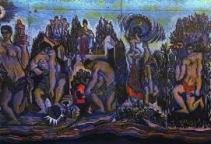
The mural titled “Saga of Labor” located at Mangla Dam is credited to be his largest work (approximately 180 x 35 feet). Saga of Labour is Sadeqain’s tribute to the working men and women since early life on Earth. The mural illustrates mankind’s journey from food gatherer to the development of agriculture, handicrafts and machinery. Beginning with Iqbal’s verse on Farhad, this majestic mural ends with Iqbal’s reference to other worlds beyond the stars. It is known to be one of the largest murals in the world.

sadlab2

Sadlab1sadlab3

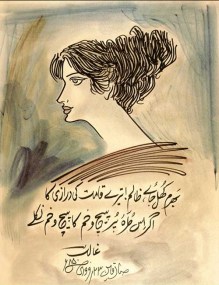
Sadeqain painted on the poetry of Ghalib, Iqbal and Faiz.

sadeqainghalibSadeqainFaiz

He was also a poet, who composed Rubaiyat (quartains),  then inscribed, and illustrated them. There are over 200 such illustrations collected in Rubaiyat-e-Sadeqain.

A recipient of numerous national and international awards like  Tamgha-e-Imtiaz, Pride of Performance, Sitara-e-Imtiaz, Australian Cultural Award, and Gold Mercury Award, he  won the first prize at the prestigeous Laureate Biennale de Paris.

Sadeqain was described by Le Monde, Paris in 1964 as,  “The multiplicity of Sadequain’s gifts is reminiscent of Picasso.”

He painted till the last days of his life. When he passed away in 1986, he was worjking on the “Arz-o-Samawat” (Earth and the Heavens)  for the ceiling of the Frere Hall, Karachi. With 100 panels spanning an area of 3,200 square feet, Sadeqain could only complete 87 of them.

SadFrere1

sadfrere2

Sadeqain was immensely popular in India and his work is currently graces many locations in India including Delhi, Aligarh, Benaras and Hyderabad.

His painting are the prized possession of New York Metropolitan Museum, Royal Ontario Museum in Toronto, Museum of Modern Art in Paris, and many other locales.

Dr Salman Ahmed, Sadeqain’s nephew has formed Sadeqain Foundation in 2007  with the mission to Discover, Preserve and Promote Sadeqain’s immense works.

I ask him what does he mean by discover Sadeqain’s work?

He responds that the painter was extremely generous and gifted away thousands of works to friends and places where he painted. Hence alot of his art sits with individuals, and many of their heirs do not understand the value of it, or are unable to maintain it. Moreover in the words of Anwar Maqsood, “Sadeqain is one painter who has painted even after his death.” implying that a lot of fake  artwork has been created attributed to him. He envisions to create a Museum of Sadeqain’s art.

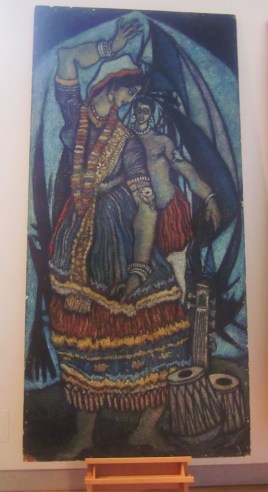
We at Rung Festival at ROM were fortunate to have two panels of the original mural by Sadeqain on May 31, and June 1, 2014. The mural called Pakistan was painted by Sadeqain in 2 weeks at a Pakistani Expo in Lusanne, Switzerland in 1966. The mural depicted the cultures of various provinces of Pakistan. In 1975 they were brought to Canada for a Pakistani Expo, and since then 7 of the 9 pieces of the mural reside in the Pakistan Embassy in Ottawa.

The exhibit became the focal point of all visitors to Rung Festival.

RUNG PICS 125RUNG PICS 126


Information & pictures: Courtesy Dr. Salman Ahmed. Sadequain Foundation USA.


Like the languages spoken and the faiths that exist, South Asia is a treasure of countless arts and crafts both ancient and modern.
RUNG at ROM presents some of these crafts in their original forms, but also attempts to make them interactive to enable the art lovers attending the festival get a hands on experience on it.

Arabic Calligraphy
Arabic Calligraphy is a much revered art form, which is extremely well developed for the script that Urdu, Persian and Arabic languages use. Despite a developed curriculum for the art of Calligraphy by a Turkish calligrapher almost 550 years ago, Calligraphy does not find its place in the curriculum of major institutions of the world, and manages to survive by the love of individuals who take it as a personal mission.
Arabic Calligraphy is envied by other scripts for being so fluid and flexible that one can create images through its writings.
We will have calligraphers demonstrate the art at ROM, write book marks and names for the visitors, and also let those interested to try their skill of writing in the calligraphic fonts like Naskhi, Kufic etc.


This slideshow requires JavaScript.

Block Printing

Hand block printing is a centuries-old tradition in India, and is alien to none
Every region from Sindhi Ajrak  to animal motifs block printed in Jharkhand and Bihar, from Rajasthani Sanganeri print to Kalamkari in South India, each style has their own unique designs and themes. 

Originating from Sanganer in Rajasthan, block printing reached great heights during the 16th and 17th century in European countries and became one of the major exports of the East India Company. Almost 500 years old, it can be rightly categorized as a heritage craft.

The craft has traditionally been practiced by local  artisan community, none of whom have ever received formal training. They watch and learn as a matter of daily routine. The whole process, from printing to dyeing, is executed manually at home involving family members in most places. The dyes used in almost all types are traditionally organic dyes.

RUNG at ROM shall have  stall with collection of wooden blocks and ink for the visitors to experience block printing and take away their printed designs on cards.

Blocks1


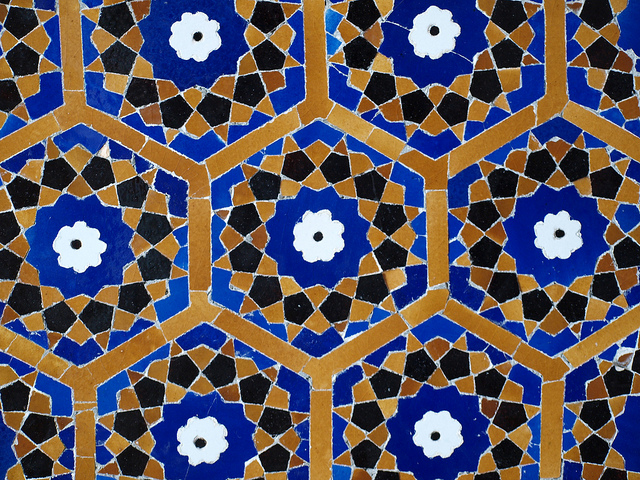
Hala Tiles

Hala is a small town 35 miles north of Hyderabad in Sindh known for its master craftsmen of  colorful wooden furniture and blue ceramics.

The craft of blue ceramic making known as Kashikari originates came from Iran almost 300 years ago, but was given a local touch by varying the designs.

The craft of making blue tiles, called Kashi Kari dates back to 300 years ago when women made the clay dough at home, turned them into shapes, dried them, painted and then glazed them. Many such tiles were used to adorn the shrines and mosques built in those times. Like the shrine of Shah Abdul Lateef Bhitai at Bhit Shah.

Kashikari is spread across the Thar desert  from Thatta, Hala in Sindh to  Multan in South Punjab to  Rajasthan in India.

Henry Cousens in his book ‘”The Antiquities of Sind’ of 1929, he wrote:
“The brickwork…is very superior, the bricks, or, at least, those on the surface, being made of the best pottery clay, perfectly formed and dense, having cleanly-cut sharp edges, and of a rich dark red. The enameled bricks are glazed, upon their outer surfaces, in light and dark blue and white…The colored dadoes are an especially fine feature…A single design, without duplication, will sometimes cover several square yards of surface…Then, again, some tiles are as small as half an inch square, and over a hundred are used in a square foot, of mixed sizes, forming a perfect mosaic…”

Sadly the art has not seen much improvisation over the years, and are unable to compete the durability of ‘imported’ tiles. 😦

RUNG Festival will indeed showcase a few beautiful mosaic of tiles brought from the tile makers from Hala.

This slideshow requires JavaScript.

Kites

Kite flying originated in China as early as 5 C BC. As it came to India in the medieval times, it took over as a sport, with Patang baazi as a fight between kite flyers to cut the string of the opponent. Festivals like Makar Sankranti and Basant are traditional occaisions for kite flying and holding Kite-fighting. Kites with specific  designs curiously bear names like Kup, Patang, Guda, Nakhlaoo, Pan, Tukal, Muchal, Farfarata etc. Lahore is known as the Kite Capital of South Asia, with a full fledged kite industry existent there.

How could Rung Festival  miss an ensemble of kites?

Kites

These were just a sampler of the crafts at Rung Festival. There shall be a lot more pleasant surprises awaitngthe visitors at Rung Festival on May 31 and June 1 at Royal Ontario Museum.