Open up your mind and your potential reaches infinity…

Archive for the ‘Social Issues’ Category

Rabindranath Tagore ~If they answer not to thy call WALK ALONE,


Rabindranath Tagore was a larger than life personality –  poet,  philosopher, playwright, novelist, essayist, painter, composer and educator.

He was the first non Europeon to get a  Nobel Prize in 1911, which he  received as Nobel Prize in Literature for his collection of poems which were initially written in Bengali, but later translated in English by himself.

He is the only person who has the honour of being the lyricist of National Anthems of two countries –namely Jana Gana Mana of India and Shonar Bangla of Bangladesh.

He translated Shakespeare from English to Bengali in his teens. He also translated 100 poems of  saint Kabirdas from Hindi to English in 1930s , hence familiarising Kabir as the most read Indian poet to the west in  those times.

Rabindranath Tagore, was knighted with the title of ‘Sir’ when he won the Nobel Prize in Literature in 1911. However, after the Jallianwala Bagh massacre in 1916, he gave up the knighthood in protest.

He, thrice, refused invitation to visit Canada in protest against the massacre of 376 native Indians in Komagat Maru incident in 1914. However, when he visited Canada at the invitation of National Council of Education to address at the triennial conference, Vancouver he made it a point to make his statement as follows:

“Canada must believe in great ideals. She will have to solve . . . the most difficult of all problems, the race problem.”

Tagore also had the opportunity to interact one on one with another ‘great’ of his times, namely Einstein. Their highly intellectual conversations are documented word to word. An  excerpt from the dialogue of one of the three meetings is as follows:

TAGORE: Melody and harmony are like lines and colors in pictures. A simple linear picture may be completely beautiful; the introduction of color may make it vague and insignificant. Yet color may, by combination with lines, create great pictures, so long as it does not smother and destroy their value. 
EINSTEIN: It is a beautiful comparison; line is also much older than color. It seems that your melody is much richer in structure than ours. Japanese music also seems to be so.

Y B Yeats another Nobel Laureatte oet who later wrote the Introduction of Tagore’s Geetanjili had the chance to read Tagore before he met him. He commented, ” I have carried these manuscripts with me for days, reading it in railway trains, on top of  omnibuses, inrestaurants and often had to close it lest some stranger see how much it moved me.”

Gandhi and Tagore’s differences are famous and still debated. While Gandhi started a non cooperation movement against the British, Tagore remarked,” …there was a thin line between nationalism and xenophobia —besides, hatred of the foreigner could later turn into a hatred of Indians different from oneself.”

He was particularly sceptical of the claim that non-co-operation had or would dissolve Hindu-Muslim differences. And ultimately Tagore was proved right on this issue.

The two  personalities met only twice, but kept a regular communication through articles and letters. And like two great human beings, they kept high regard for each other, despite differences.

Gandhi remarked:  “Gurudev and I early discovered certain differences of outlook between us. Our mutual affection has, however, never suffered by reason 0 f our differences … ” 

Another Nobel Peace Laureatte Aun San Su Kyi is another person who derives inspiration from Tagore. And claims her “most precious lesson” had been from Tagore: “If no one answers your call, walk alone.”( the above poem).

Apart from being a eastern mystic, Tagore was a visionary who articulated ideals of humanism, equality and freedom long before the League of Nations or the Universal Declaration of Human Rights of 1948.  Tagore was  one of the strongest critics of war and colonialism, fascism, and the dangers of narrow-minded nationalism.

In the 1920s, he had already identified racism as the greatest problem in a fast globalizing world.

Perhaps looking at today’s world he was accurate in his prediction, sadly though. 

The following is a popular poem written by Rabindranth Tagore.  The music for the song was also composed by him.

Jodi Tor Dak Soone Keu Na Asse
Tobe Ekla Chalo re
Ekla Chalo Ekla Chalo Ekla Chalore

Jodi Keu Katha Na Kai Ore Ore O Abhaga
Jodi Sabai Thake Mukh Firae Sabai Kare Bhay
Tabe Paran Khule
O Tui Mukh Fute Tor Maner Katha Ekla Balo re

Jodi Sabai Fire Jai Ore Ore O Abhaga
Jodi Gahan Pathe Jabar Kale Keu Feere Na Chay
Tobe Pather Kanta
O Tui Rakta Makha Charan Tale Ekla Dalo re

Jodi Alo Na Dhare Ore Ore O Abhaga
Jodi Jharr Badale Andhar Rate Duar Deay Ghare
Tobe Bajranale
Apaan Buker Panjar Jaliey Nieye Ekla Jalo re

English translation: *Touching words*

If they answer not to thy call WALK ALONE,

If they are afraid and cower mutely facing the wall,
O you unfortunate,
open thy mind and SPEAK OUT ALONE.

If they turn away, and desert you when crossing the wilderness,
O you unfortunate,
trample the thorns under thy tread,
and along the blood-lined track TRAVEL ALONE

If they do not hold up the light when the night is troubled with storm,
O you unfortunate,
with the thunder flame of pain ignite thy own heart
and let it BURN ALONE.

Avval Allah, Nur upaya, qudrat de sab bandey…


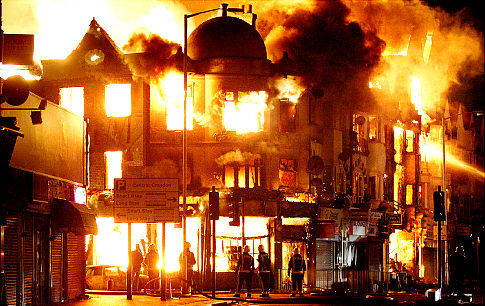
This blog post is a tribute to the bravado of my#Sikh brothers, who stood up in respect for humanity beyond faith during the #UKriots.

It was devastating to see the peoples power gone berserk in UK riots, as the  arson and looting carried on unabated into the fourth night . Unfortunately against the sheer numbers, the police seemed helpless to control the unruly mob.
While following the  #UKriots on Twitter and BBC News, hashtag #Sikhs started to trend—first World wide and then in UK, London.

A tweet was seen:

Remroum Remi Kanazi
Was afraid #Sikhs trending was going to be some bigoted stream. Thankfully it was this: Sikhs protecting people while they prayed #UKRiots

They came pouring, tweets one after the other with speed getting faster:

Prandha_Swag Harpreeeeezyf.baby
#Sikhs is trending.

Nagra18 Jasraj Nagra
#Sikhs is trending, never thought i’d see the day #proud.

KavelKaur Kavel Kaur
#Sikhs are a world wide trend!!!!

GDS1ngh GD singh
#sikhs trending, fantastic. doing what we do best.

moneyspinner MONEYSPINNER
#sikhs nanak naam chardi kala, tere baane sarbat dha bhala

I googled to check the details and saw Mail Online quote:

Some armed with swords, some carrying hockey sticks, defiant Sikhs stood guard outside their temples last night.
More then 700 men, some in their 80s, took to the streets to protect the homes, businesses and places of worship in Southall, West London.

The tweets went on:

Goggi_Rana Goggi Rana
Sikhs of Britain have displayed the same traits of fearlessness, as their ancestors of yesteryear #Sikhs #SangatTV

UncleWail Wail Al Aun
Thumbs Up for the #Sikhs protecting their #Temple in Toxteth #Liverpool #UKRiots

MissssChrissy Chrissy
Singh Is King… Yep I think so! #sikhs doing it real big today. #LondonRiots #ukriots

Then we heard that they had not only protected their temples but also stood at the mosque guarding while the Muslims prayed ther Taraweeh prayers of Ramadan in South Hall mosque:

A google message read :

Muslims prayed their Tarawee prayers while Sikhs protected he Masjid
Got this from a friend in London.
In a Masjid in Southall London, Muslims were praying their Taravee prayer as the riots were going on, a bunch of Sikhs stood outside the Masjid and protected the Masjid.
The similar thing happened when Sikhs were inside their Gurduwara and some Muslim youngster guarded it on the gate
Great experience, a cousin and a friend of mine reported the same incident.
May ALLAH bless people like them, humanity still remains here, despite the problems

Tweets loaded with emotions, from Muslims and people from other faiths,  too poured in with ovelwhelming enthusiasm:

PMGenerals PMG Anj
Today was an historic day for #hindus #sikhs and #muslims. #unitedwestand all religions teach us to have morals and respect dis proved it! X

dj_aNomAli ∀ℓι . ᄊ乇尺cんለռէ
Sikhs protect Southall mosque while Muslims pray Taraweeh in peace. Much respect to our brothers!! #LondonRiots #Southall #Sikhs #MashAllah

DNSDj Davinder Singh
Actually brings a tear to my eye seeing the #unity between #Sikhsand #Muslims in the fight against this madness. #proudtobesikh

akchishti akchishti
Great sight in my #Birmingham where #Pakistani lads are protecting temples while Sikh lads protecting the mosques

Muslimerican Peter
Imagine a group of rioters turning down a street and suddenly seeing 400 #Sikhs standing in the distance. #wrongturn #ohshit #londonriots

AdamPatel2 Adam Patel
I hear the #sikhs are even protecting the #mosques in Southall so #muslims can read our Tarawih in peace.”>>> BIG LOVE –

And dishearted tweeps begain to take a sigh of relief

xcrimsonstarx Vicki Langfield
The #Sikhs are giving me faith in humanity

Indeed, everyone who followed this trend must have rekindled their faith in humanity. Thanks you my Sikh brothers.

MumzyStranger Mumzy Stranger
Love out to the #Sikh brothers who protected the mosque during prayer time. If we all unite we can and WILL put a STOP to this chaos! M x

And  with these tweets millions or billions of eyes gleamed with hope.

We hope and pray this display of unity and humanity extends to all faiths and communities beyond borders and beliefs…

My mind recalled the verses of Sant Kabirdas which  along with 500 other verses which are included in to the Guru granth Sahib,  are  often heard from  Gurudwaras as Shabad Kirtan :

Avval Allah Noor upaya Qudrat ke sab bandey
(God created light of which all the things were born)
Aik nor ke sab jag upajaya kaun bhale ko mandhe
(From the light, the universe. So who is good and who is bad).

Indeed, I hail my Sikh brothers for living up to the spirits of their faith, their Gurus and their Book.

In return many Muslims also stood up with the Sikhs and helped them form groups which defended their communities and boroughs. Hail Sikh Muslim Solidarity. 

Let this be the beginning of Sikh-Hindu-Muslim-Christian-Jew –other faiths unity for  all faiths believe in one Supreme Power and all faiths belong to  one Humanity’

I dedicate  this tribute to my Sikh brothers with the greeting, which in Punjabi means exactly what Allah u Akbar stands for :

Vaheguru ji ka khalsa, vaheguru ji ki fateh.
(God’s pure and God’s victory )

My brothers,  Rabb Raakhaa

Ilmana Fasih, Aug 10, 2011

P.S.: Please scroll down in the comment box to see the reaction of the Muslim community after 3 Pakistani boys were killed in Birmingham.

Little Terrorist~a short Film


Little Terrorist tells the moving story of a Pakistani Muslim boy who accidentally crosses the Pakistani-Indian border which is riddled with landmines. He ends up in a strange country that regards him as a terrorist. The old orthodox Hindu Bhola takes him in and hides him from the Indian soldiers. However, traditions and prejudices about Muslims remain an obstacle in the relationship between Bhola and the boy. Ultimately, humanity triumphs over prejudice when Bhola risks his own life to help Jamal cross the border again. This symbolic story of hope is a tale of human solidarity conquering all artificial boundaries.
Ashvin Kumar, the director, was nominated for an Oscar in the Best Live Action Short Film category.
Ashvin Kumar’s Little Terrorist also won first prize for best short film at the Montreal Film Festival.

And was nominated and selected for various other prizes.

The cost of crossing the ‘love’ border ~Indo-Pak Visa Part 2


Published in Aman Ki Asha blog by The News/Jang Group on August 03, 2011 http://www.amankiasha.com/detail_news.asp?id=509

For years after the Indian Consulate in Karachi was closed down, a cousin of mine (an Indian married to a Pakistani) whose parents live in Jaipur, followed the following trail year after year. She would travel from Karachi where she lives, to Islamabad to obtain an Indian visa. If successful, she would travel back to Karachi to pack up. She and her family would then travel to Lahore by train, and cross the Wagah-Atari border. They would then take a train from Amritsar to Delhi and then another to Jaipur. With 3 children, she could not afford air travel every year. 

The entire ordeal required her to travel over 4600 kilometres and several days in summer vacations, when in reality, the smallest distance between Jaipur and Karachi is only 1066 kilometres (through Khokrapar Munabao) and the train journey is just a 3-4 hours long.

I understood the real nightmare of this struggle some years ago when I had to travel from Karachi to Islamabad to get a visa for my father-in-law for his medical treatment in India.

My husband and I sat outside the Indian consulate in Islamabad for two days, sharing benches with people who had mostly come all the way from Karachi or Hyderabad. Most had been sitting there every day from 9 am to 5 pm for as long as 15 to 20 days at a stretch. The majority appeared to be daily wage earners, the poor and with no resources to take short cuts, like us, to obtain a visa – we had the parchi (‘slip’) that would expedite the visa process.

A lady and her husband, a carpenter hailing from Lalukhet in Karachi, had been sitting there every day for almost 20 days, from morning till the consulate closed in the evening, without any clue about whether they would be granted a visa or not. The embassy issues a limited number of visas each day. Names come up on a given day, their luck as unpredictable as a lottery. The more resourceful among the applicants jump the line, pushing these poor people to the back of the queue.

This couple had spent so much money on the travel from Karachi to Islamabad that they could not afford even a cup of tea from the tea stall outside the embassy, which caters to visa seekers. Every day the carpenter and his wife brought with them homemade rotis and pickle for lunch. I asked the woman how long she would sit there, and she replied with certainty: “When the money runs out, I will go back home whether I get the visa or not”.

She had applied after hearing that her mother was on her deathbed and had asked to see her one last time. She had been married for over twenty years but had been able to visit her native Hyderabad, Deccan, only once, and that too 12 years ago.

Her marriage had been a stroke of fate when her husband, a cousin from Pakistan, visited them. The poor family had been facing tough times, and found this as opportunity to make their daughter’s life better, as the cousin’s family was more prosperous. (How was she duped into marrying an already married man is another story for another time). 

This story is all too common to many families in the lower middle class strata who marry across the border; their girls are hardly able to visit their parents a handful of times in their lifetime, mostly due to not being able to afford the time, expenses and resources involved in obtaining the visa.

They resign themselves to their fate and learn to live with just memories of home. It is only when another sibling is about to get married; or a parent is ill; or dying, that they gather all their means and courage to try to obtain a visa to go to their erstwhile homeland.

The procedure has been somewhat modified now, so that people in other cities can apply for Indian visas through a courier service, without having to travel to Islamabad. But applicants still have no idea how long the process will take. A friend who wanted to attend her parents’ 50th wedding anniversary celebrations in India received a reply after an anxious six month wait, saying that her application papers were incomplete. Some don’t hear any news for a year or more; others don’t get any response at all.

Over the last two decades I have seen a see-saw situation. Things seem to move towards easing the procedure, then suddenly something occurs and the whole change is reset from the start.
A silver lining is that the Khokrapar-Munabao line, suspended since 1965, has been revived, reducing unnecessary distance for many.

I hope and wish that the latest news about easing of the borders does not remain restricted to the artists who travel on exchange programmes or businessmen attending conferences, but is extended to this voiceless, resigned group of poor, invisible women who marry across borders. I am afraid they are the group most likely to be forgotten when the categories are laid down for easing visa procedures.

Most will never be able to raise their own voice and will resign to their fate of seeing their parents or first of kin, barely a few times in their entire lives, after they cross the ‘love’ border in matrimony.
On their behalf, I beg the authorities concerned to hear the silent wails of these women and to ease the visa process making it easier for them too, so that they may see their parents and families more often.

Ilmana Fasih

The writer is an Indian gynaecologist and women’s health activist, married to a Pakistani. She blogs at https://thinkloud65.wordpress.com/

Cross-border couples and their visa travails ~Indo-Pak Visa Part 1


Published in Aman ki Asha blog The News/Jang Group on July 27, 2011

“A marriage license doesn’t come with a job description or a set of instructions. There is definitely some ‘assembly’ required. In fact, putting together a marriage can be likened to assembling an airplane in flight” – Patricia Love

Every marriage needs a lot of reassembling in social, psychological and emotional terms. But when marriages take place across the Indo-Pak border they also involve a lot of political reassembling.

Indo-Pak marriages are different from other cross-border marriages – such unions between people from these two neighbouring countries are far tougher and more challenging than marriages across oceans between people with vast cultural differences. The distance between India and Pakistan does not entail crossing oceans or even cultures but one has to cross huge mountains of hurdles in terms of legal and bureaucratic formalities.

With the pendulous political love-hate relationship that exists between the two countries, marrying and staying happily married across the border (‘pyar border paar’) is no small feat. It takes a tough mind and resilient heart to brave the challenges.

There are personal challenges involved in every marriage. But the additional challenges in Indo-Pak marriages include taking certain decisions which may be painful. As a patriotic and a proud Indian, it was hard for me to surrender my Indian passport and apply for a Pakistani. Not that I had any grudges against the latter, but to give up your national identity is an experience you have to live, to know how it feels.

You might ask why would an educated woman change her nationality? The answer is simple. No one coerced me. I did it for the desire to have a peaceful family life and for the sake of our children (who were to arrive later).

My British, Canadian and Filipino friends married to Pakistanis live without any problems in Pakistan, using their original passports. But for an Indian this is not possible.
I did quite a bit of homework before taking this life-changing decision. I knew of instances where people in this situation had retained their nationalities, leading to many practical and political challenges. Most of them advised me to swallow this bitter pill and make the change, but finally, it was entirely my own decision.

In Pakistan, the ID cards of both parents are required to obtain documents for children like B-form, passport, and ID card. A mother with an Indian passport would mean inviting trouble, with more errands from office to office, or one section officer to another, to get ‘no objection certificates’ or NOCs.

Obtaining a visa to visit family across the border is any case a Herculean task if you don’t have connections in the high offices. And for a family like ours living in a third country I would, if I had maintained my Indian nationality, have to go through the gruelling process of obtaining a Pakistani visa each time we were to visit Pakistan. By giving up my nationality and becoming a Pakistani, I thought at least we have to struggle for the visa on one side only, when my children and husband want to visit India.

Unfortunately, my having been a born Indian, lived there for 23 years, and having parents still living there, does not mean that my husband and children will be given any extra consideration when they apply for an Indian visa. I know this is also the case for Pakistani women who are married and live in India. The visa policies work on a reciprocal basis.

Our visa troubles are not a once in a while exercise, but an annual struggle. The struggle which I have been undertaking for the past twenty years, almost each year, to visit my ageing parents exactly the way any married woman aspires to visit her family. As the time nears for the visa application, I always shudder with the apprehension of “What if…”

Families like ours have no choice but to face this ordeal every time they want to visit ‘home’. Visas may be sometimes facilitated and expedited for artists going on a cultural exchange or for businessmen but the procedure, the requirements, the scrutiny, the hurdles are all exactly the same for people like us. We have to stand in the same queue as those applying for a visit visa for a conference or meeting (there is no ‘tourist’ visa between our two countries), to visit to meet distant relatives once or maybe twice in a lifetime.

Each time I stand in front of the visa submission window of the Consulate of the country where I was born, which I still love and own as I did then, I feel as if I am being punished for my audacious decision to marry across border. My counterparts across the border must be feeling the same, I am sure.

Once, I was exceptionally lucky: I obtained an Indian visa while sipping a cup of coffee in the office of the Consul General, when the Consulate was in Karachi. The CG turned out to be my father’s student. We followed the usual application procedure of course, but he expedited it. Then, as we left, a plainclothes official intercepted my husband and asked for our purpose of having visited the CG’s room. He said that our car’s plate number had been noted and that we must not repeat this again.

All told, in the 21 years of my marriage I have been lucky that despite the hurdles and the painful waiting times, I have not faced any serious disappointments in ultimately obtaining a visa for India.

The only time I faced a major setback was after the Kargil war, when tensions were so high that I could not visit my parents for three years, despite running from pillar to post, pulling various influential strings. Then, not even ‘high connections’ were willing to go out of their way to help me. However, for a vast majority of women from India married to Pakistanis, especially those living in Pakistan, it is by no means a smooth sailing.

Ilmana Fasih

The writer is an Indian gynaecologist and women’s health activist, married to a Pakistani. She blogs at https://thinkloud65.wordpress.com/

The Paradox of Our Time ~Dr Bob Moorehead


A beautiful piece of  ‘food for thought’  which has served for years as a constant reminder to me to introspect my life and values. Whenever I feel I begin to digress from my purpose of life, I look back at this writing. Not sure if I have really found myself steadfast on it.

Finally, I decided to post it in my blog and share with others.

“The paradox of our time in history is that we have taller buildings but shorter tempers; wider freeways, but narrower viewpoints. We spend more, but have less; we buy more, but enjoy less.

We have bigger houses and smaller families; more conveniences, but less time. We have more degrees but less sense; more knowledge, but less judgment; more experts, yet more problems; more medicine, but less wellness.

We drink too much, smoke too much, spend too recklessly, laugh too little, drive too fast, get too angry, stay up too late, get up too tired, read too little, watch TV too much, and pray too seldom. We have multiplied our possessions, but reduced our values. We talk too much, love too seldom, and hate too often.

We’ve learned how to make a living, but not a life. We’ve added years to life not life to years. We’ve been all the way to the moon and back, but have trouble crossing the street to meet a new neighbor. We conquered outer space but not inner space. We’ve done larger things, but not better things.

We’ve cleaned up the air, but polluted the soul. We’ve conquered the atom, but not our prejudice. We write more, but learn less. We plan more, but accomplish less. We’ve learned to rush, but not to wait. We build more computers to hold more information, to produce more copies than ever, but we communicate less and less.

These are the times of fast foods and slow digestion; big men and small character; steep profits and shallow relationships. These are the days of two incomes but more divorce; fancier houses but broken homes. These are days of quick trips, disposable diapers, throwaway morality, one night stands, overweight bodies, and pills that do everything from cheer, to quiet, to kill. It is a time when there is much in the showroom window and nothing in the stockroom. A time when technology can bring this letter to you, and a time when you can choose either to share this insight, or to just hit delete.

Remember,
*spend some time with your loved ones, because they are not going to be around forever.

*to say a kind word to someone who looks up to you in awe, because that little person soon will grow up and leave your side.

*to give a warm hug to the one next to you, because that is the only treasure you can give with your heart and it doesn’t cost a cent.

*to say “I love you” to your partner and your loved ones, but most of all mean it. A kiss and an embrace will mend hurt when it comes from deep inside of you.

*to hold hands and cherish the moment for someday that person will not be there again.

Give time to love, give time to speak, and give time to share the precious thoughts in your mind.

AND ALWAYS REMEMBER:
Life is not measured by the number of breaths we take, but by the moments that take our breath away.”

Author:  Dr. Bob Moorehead is former pastor of Seattle’s Overlake Christian Church. He retired in 1998 after 29 years in that post. The essay appeared in ‘Words Aptly Spoken,’  Dr. Moorehead’s 1995 collection of prayers, homilies, and monologues used in his sermons and radio broadcasts.
However, it has many a times attributed in e-rumours to be written by George Carlin, a stand up comedian known for his foul mouth and four-lettered words. He himeslf denied having written this.

Mr Edhi, I know what you mean.


I am really perplexed at the naivety of some of us interpreting Edhi’s statement.

They just choose to pick up the punch line of “killing the politicians” and preferred to ignore the other valid statements he made in which he said, “Political parties are in the opposition or in power, both of which are sides of the same coin. They have been involved in killing thousands of citizens.”
“All tax thieves and zakat thieves live freely in the country. All killers are free, 95 percent of Pakistanis are living in miserable conditions,”

He even made clear, that he has no ambition to come into politics or power, but he would continue to serve the people of Pakistan.

Whatever little I know of Edhi, he is a simple man who knows no mincing of words. He is neither a diplomat with polished demeanour nor is he a politician with twists and turns. Neither does he have any hidden agenda in life. His life is an open book. And above all he has nothing to fear.

It is needless to narrate, but I shall to remind ourselves how noble yet down to earth the man Edhi is.

In a country infested with apathy, he is a man who keeps oceans of empathy for the common man. I stress on the word “common man’. He is the one who has gives shelter to the homeless. He and his wife are the ones who receive illegitimate abandoned new born kids with open hands.

He is a man who does not vie for any foreign funds, or high positions in the pretext of philanthropy. He does not call for press conferences or photo shoots when he launches any project for the poor and the needy. If you ever happen to visit his place on Rashid Minhas road, Karachi, you would find him sitting outside with the drivers, in his simple attire. Anyone unaware of the man would not be able to pick him out from the group sitting there.

The point that I want to make with all this is that if such harsh words come from a man with these above credentials, then there must be some plausible explanation behind it. Anyone with an iota of common sense knows that what he said is undoable.

These words simply reverberate the pulse of the common man, with whom Edhi deals with 24X7. It is his ambulances who reach the site of a blast and keep the unknown bodies for days and months in his morgue. It is he who shelters the orphans from the families whose father dies in the blast or target killings. It is he who shelters the women, young or old, who are left helpless when their husbands, sons, or brothers get killed. He actually witnesses every day what it means when a nameless and faceless poorest of the poor is killed. Most of us just hear it as a statistic on the TV sets. He is a man who is more in touch with the ground realities and common man than even the smallest of politicians.

His words should not be taken in the literal sense. Nor should they be flouted or ignored as insane. These harsh words are the wails of all the dead who fell prey to the violence and of those alive who lead a life worse than death . This is the voice of the pain, frustration and helplessness of the 95% of the people he mentions, who see no hope and respite from the corruption, lawlessness and the injustice.

His words are a red flag for the current situation prevailing in the whole of Pakistan. They speak volumes of the impatience that the masses now have against the corrupt politicians. It signals the lava that is boiling in the volcanoes within each Pakistani.

In fact, this is his simple way to caution the politicians to mend their ways, or else it will be too late. He chooses such cacophony because he knows very well that any words less acrid than this would fall on deaf ears.

I am afraid, Mr Edhi, even these harsh words would fall on deaf ears too.

Reference: http://www.pakistantoday.com.pk/2011/07/kill-all-politicians-edhi-demands-of-kayani/

Dreaming of a world without hatred


The day for me, yesterday, began with the news of Mumbai blasts. Being an Indian origin who migrated after having married a Pakistani 20 years ago, first thing that occurred to me on hearing the blasts was that again the Indo-Pak peace talks shall be stalled and the same cascade of blame game, public statements from both sides, mudslinging, demanding ‘do more’ shall start. All it will serve to do is to reset the peace talks from the scratch. Spurts of cortisol laden with anxiety were rushing through my veins. As the mound of dead in the blasts were piling up, so was my fear in me, that a statement would come blaming Pakistan directly or implying of some group trained there. I knew it would be a sleepless night for me, following every minute of the TV coverage.

Later in the evening, Mumbai incident instantly vanished. There was an instant focus on the venomous words wagged by a rabid tongue. What was tragic was the cascade of events that took place, not just on land but on the walls of various Face Book friends.

It was not just the streets and the vehicles which were torched in anger, but many of the FB friends came out in the open, on their walls, in agreement with these insane words and splattered their share of fuel to the fire, against a whole community.

Within a couple of hours, one could see virtual borders drawn between the various ethnic groups, on a borderless virtual world of Face Book.

The frenzy of mindless hate did not spare me either. As I heard the statement, there was a severe convulsion of the ethnic Urdu speaking aka Muhajir in me. As if all of a sudden a sleeping immigrant woke up overpowering the ‘me’ in me, who till a moment ago took pride in rising above all kinds of differences. I never felt so much rage in me as at that moment. The hate in me wanted to avenge him.
I could sense the positivity drained out of me and replaced by an intense negative feeling of hate and loathing for this man. I would be lying if I would say that my mind did not wander trying to attempt hate for the community to which this mad man belonged. But thankfully, I still had intact memories of wonderful friends and great personalities from the same community and they kept my hateful sentiments in check. However hateful thoughts of this man kept jolting my head. I wanted him and all the ‘virtual’ friends on FB, who agreed with him, to be taught a ‘real’ lesson.
As if commenting on their walls wasn’t enough, I wanted to burn down their walls. In a couple of hours there was so much of energy drained out of me that instead of having spent this night in insomnia ( which is generally the rule when anything like the Mumbai blasts occurs) that I lay listless, and did not realise when was I lost into sleep. It was a restless sleep with visions of fire and blood splattered all over , on streets, on the FB walls. For a change these images did not make me sick. It did not make me feel good either, but it certainly wasn’t a sick feeling.

As I woke up in the morning, I reflected on my thoughts. I did not feel myself. This certainly was not me,.The monster of hate had engulfed me, last night.
After ages, I wept like a child. I cried how 25 years of my upbringing by staunchly secular parents and the rest 20 years of my own strong conviction in humanity as one were undone in a fraction of a second by the blurting of thoughtless statements by an insane man. I could see clearly now that it was a racist slur by a singular man not a community. I was grateful to my conscience, that the ‘me’ in me , who is blind to any color or creed, is taking control of me again.

I now realise exactly of what we read in history, of how passions go out of control, when incited with hateful words.

I also know now, first hand, how the feeling of intense loathing weakens a person physically and mentally in contrast to the strength of soul one gets in loving the whole humanity.

I also know now, first hand, how much of a sense of right vs wrong is blurred when one is overwhelmed with hatred.

I know now that my dream of a world without borders and a world without wars, on which I grew up, shall only be realised if we dream of a world without hatred.

I know exactly what do Pakistanis need, they need to shun hatred of all sorts.

Ilmana Fasih
July 14, 2011

Tell me why?~Music Without borders


This post is dedicated to these beautiful little angels who could be our role models and teach us lessons in many many ways.

Childhood is the world of miracle or of magic: it is as if creation rose luminously out of the night, all new and fresh and astonishing. Childhood is over the moment things are no longer astonishing. When the world gives you a feeling of “déjà vu,” when you are used to existence, you become an adult.
~Eugene Ionesco.

Singer: Declan John Galbraith (born 19 December 1991). More than his own country, Englnd, he is famous in China, where his songs were chosen as part of the Chinese education curriculum for learning English. Galbraith’s songs are used to help Chinese children learn English as his songs are easy to remember and suitable for children.
He was not even 14 when he sang this song.
Tell me why?
(Lyrics)

In my dream children sing a song of love for every boy and girl
The sky is blue and fields are green and laughter is the language of the world
Then I wake and all I see is a world full of people in need

Tell me why (why) does it have to be like this?
Tell me why (why) is there something I have missed?
Tell me why (why) cos I don’t understand.
When so many need somebody we don’t give a helping hand.
Tell me why?

Everyday I ask myself what will I have to do to be a man?
Do I have to stand and fight to prove to everybody who I am?
Is that what my life is for to waste in a world full of war?

Tell me why (why) does it have to be like this?
Tell me why (why) is there something I have missed?
Tell me why (why) cos I don’t understand.
When so many need somebody we don’t give a helping hand.
Tell me why?

(children) tell me why? (declan) tell me why?
(together) just tell me why, why, why?

Tell me why (why) does it have to be like this?
Tell me why (why) is there something I have missed?
Tell me why (why) cos I don’t understand.
When so many need somebody we don’t give a helping hand.

Tell me why (why,why,does the tiger run)
Tell me why (why why do we shoot the gun)
Tell me why (why,why do we never learn)
Can someone tell us why we let the forest burn?

(why,why do we say we care)
Tell me why (why,why do we stand and stare)
Tell me why (why,why do the dolphins cry)
Can some one tell us why we let the ocean die ?

(why,why if we’re all the same)
tell me why (why,why do we pass the blame)
tell me why (why,why does it never end)
can some one tell us why we cannot just be friends?

Personal Note: Few things in life have made me cry like a kid, and this song was one of them.

The real fight we need to fight


First published in Aman Ki Asha, The News, 29 June 2011
http://www.amankiasha.com/detail_news.asp?id=483


The news didn’t cause much of a stir. After all, it wasn’t a buzz about Bollywood beauties — say Katrina, Kareena or even Veena — or about an Afia Siddiqui, or even a Baba Ramdev or some other ‘hot’ icon that triggers off all-day media coverage. This news report was all about the faceless, nameless women, not one, not two, but millions. But who cares, when there is no nametag, or brand associated with them? Perhaps not many will guess what I am referring to.

Perhaps ignorance is bliss.

I noticed a few tweets, even fewer facebook statuses, a handful blogs that made a passing mention of this ‘news’ which perhaps for many was not much newsworthy in Pakistan, although on the Indian side it was mentioned in quite a few articles and caused relatively more concern.

The news item in question was the recent Thomson Reuters Foundation report according to which Pakistan and India were ranked third and fourth respectively as the world’s most unsafe places for women. If it wasn’t for war-torn Afghanistan and Congo, we would have topped the list. The fifth country in the club was Somalia.

Is it not ironic that India and Pakistan, which also belong to the elite club of the world’s ‘nuclear powers’, also find membership in a club of countries like Afghanistan, Congo, Somalia, and that too on the issue of mistreating women?

The Thomson Reuters Foundation surveyed 213 experts from around the globe, on the five continents, to decide the ranking of the most dangerous nations based on six parameters — health threats, sexual violence, non-sexual violence, cultural or religious factors, lack of access to resources and trafficking.

According to the report some 90 percent of Pakistani women are subjected to domestic violence, a further tragedy being that not even a quarter of them are aware that what they go through is a crime and that there are laws to protect them. They are taught from childhood to bear the marital violence and pressures as culturally appropriate or in the name of religion. Talking in terms of numbers in a populated country like Pakistan, this means a huge figure, to the tune of 80 million or so.

The situation is not much different in India where, despite all the development and booming economy, 100 million poor women are subjected to sex trafficking. The myth is that most of them go into the sex trade voluntarily; the dark truth is that most are lured or kidnapped, and forced into it. The target girl is from the low castes, from the poorest of the poor families — families that can ‘dispense’ with a missing daughter (not a son) and do not make much effort to track her down after she goes missing. What the report did not mention is that 40 percent women trafficked are minor girls.

In both India and Pakistan, rape, dowry deaths, acid attacks, kidnapping, and domestic violence continue unabated and gender inequality persists, although the degrees may vary. And in both, only a handful of such crimes get reported and even fewer are punished.

Both countries can boast of having elected women prime ministers to office decades ago, but in both tens of millions of women today, lead lives worse than cattle. The health and education statistics from India and Pakistan speak volumes for the plight of their women. Their female literacy rates are 54 percent and 35 percent respectively (compare Iran: 73 percent and Sri Lanka: 90 percent) while maternal mortality rates are 230 and 260 per 100,000 respectively (Iran: 37 and Sri Lanka: 60) (Source: http://www.mrdowling.com/800literacyfemale.html).

These statistics follow reports of a 12 percent rise in the defence budgets in both countries. India and Pakistan already spend about 18.6 percent and 23.1 percent, respectively, of their allocated annual budget on military expenditures. Compare this to their budgets on health — 3.5 percent and 13 percent — and on education, 12.7 percent and 7.8 percent respectively (Source: http://www.visualeconomics.com/how-countries-spend-their-money/).

What is the point of harbouring illusions about being secure from the ‘enemy’ neighbour, when one’s own house remains unsafe for millions of one’s own women?

For its part, Pakistan is embroiled in a war situation rife with extremism and violence — but India has a booming economy, and is considered part of the BRIC club (Brazil, Russia, India and China, all deemed to be at a similar stage of newly advanced economic development). What will it take to understand that the key to a real development lies in three words: ‘INVEST IN GIRLS’.

Investing in nuclear warheads for “deterrence” is a poor investment. They shall never be used.

But investing in girls’ education and health will bring phenomenal returns, going a long way towards improving the social and health indicators of the region. The link of women education and empowerment to population control and reduction in poverty is well documented.

According to the WHO website: “There are several compelling benefits associated with girls’ education, which include the reduction of child and maternal mortality, improvement of child nutrition and health, lower fertility rates, enhancement of women’s domestic role and their political participation, improvement of the economic productivity and growth, and protection of girls from HIV/AIDS, abuse and exploitation. Girls’ education yields some of the highest returns of all development investments, yielding both private and social benefits that accrue to individuals, families, and society at large. Girls’ education and the promotion of gender equality in education are vital to development, and policies and actions that do not address gender disparities miss critical development opportunities.”

Perhaps the key to the peace and prosperity of the region lies in prioritising in the empowerment of the women through education and better health, rather than through piling up arms. That might also save us from the international embarrassments like this.

The real fight that the two neighbours, India and Pakistan, desperately need to fight is not with each other, but together — for peace, prosperity, and women’s development.

Dr Ilmana Fasih is gynecologist and health activist of Indian origin, married to a Pakistani

Wednesday, June 29, 2011
Link: http://www.amankiasha.com/detail_news.asp?id=483