Open up your mind and your potential reaches infinity…

Archive for the ‘Social Issues’ Category

Learning the art of peaceful protest from Gandhi’s Dandi (Salt) March


This is a unique and simple story that changed the course of Indian Independenc movement. No destruction, no chaos, just a peaceful protest for a cause.
Though it is impossible to summarize it in a few words…

‘On March 12, 1930, Gandhi along with the protesters set out, on foot, for the coastal village of Dandi some 240 miles from their starting point in Sabarmati, to protest against salt-tax.

He issued a warning before he began: “Those who fear the government can leave, only those who are prepared for jail going and receiving bullets should follow me tomorrow morning.”

The procession was at least two miles in length.

On April 6th he picked up a lump of mud and salt (some say just a pinch, some say just a grain) and boiled it in seawater to make the commodity which no Indian could legally produce–SALT.

He implored his thousands of followers to begin to make salt wherever, along the seashore, “was most convenient and comfortable” to them.

There was also simultaneous boycotts of imported cloth and asked to wear khaddar.

The effects of the salt march were felt across India. Thousands of people made salt, or bought illegal salt.

Gandhi was later arrested.

This incident is considered to be the apex of Gandhi’s political appeal, as the march mobilized many new follwers from all of Indian society and the march came to the world’s attention.’

Today is the 82nd Anniversary of the Dandi Salt March.

The original footage of the March ( Courtesy Geetali Taare)

Celebrate the woman inside you !


Published in TheNewsBlog:  http://blogs.thenews.com.pk/blogs/2012/03/08/celebrate-the-woman-inside-you/

While discussing how one should celebrate International Women’s Day this year, a friend said:

“It is not just the abuse outside that we women need to fight, but we have to fight an inside war too.”

I did not quite understand what she really meant, but before I could ask she went on:

“You know what, this Women’s Day I am going to work without make up and jewellery. Just to be with myself.”  

Although I’m not someone who shuns make up and I consider every piece of good jewellery, a work of art, I without getting my friends point completely also agreed with her completely.

Men, women, young or old, who does not want to feel good. But to attach strings to ones external appearance with the feeling of goodness is when the trouble starts.

If the ‘feel good’ feeling is within one’s self esteem, the outer accessories will be for a mere change, not ‘improvement’.

I am often surprised why many agree to Marylyn Monroe’s quote “Every girl should be told that she looks beautiful. I was never told this in the childhood.”  I do not concur.

What every girl should be told is not that her face or pony tail or frock looks pretty but that her mind is beautiful or courage is awesome.

I have never heard someone tell a boy that his shirt or knickers look beautiful, instead they are told that they are strong or courageous. And thus comes the difference in perception of self as one grows up.

Apart from your upbringing, the fault also lies within how a woman is projected in the media as a commodity.  Fairness creams, slimming diets, cosmetic companies, and aesthetic clinics reap profits at the cost of a woman’s battered self esteem.

Is it not ironic that whether we get positive or negative comments on physical appearance, both induce the same anxiety to look better?

I learnt from a teacher who once said, if you compliment someone’s looks, is it not a silent statement to someone who you are not complementing that ‘you are not good looking.”  Hence if you can’t compliment everyone, it is better refrain from complementing at all.

I have a friend’s whose self esteem is so high that she often jokes:

“If anyone ridiculed me saying ‘ugly’ referring to my not so perfect looks I tell them, ‘I wish to hug you; because I know how hard life is for the visually impaired’.”

For many old school feminists wearing makeup and jewellery is anti-feminist and oppressive.  Yes the idea of not being able to leave the house without make up is anti-feminist, and to associate ‘make-up is beauty’ is anti-feminist. What also makes it oppressive is when one’s self worth is tied to one’s looks, hair, skin or size number.

Women who choose to wear or not wear makeup or jewellery are making a decision about how they wish to be perceived. If not conforming to the dictates and demands of society on appearance empowers women, then so be it. A feminist, who goes without make up, is no more or less feminist than a woman who does.

Feminism in my eyes is all about expression of one’s femininity in one’s own unique way. It certainly does not overlap with the standards laid down by someone else.

Adorning jewellery and makeup is an art form of self expression and not a tool to hide one’s flaws in order to look like the model that appears on the cover page of a magazine.

Self image has no bearing on one’s physical appearance. Obsessed with looking better, some women (who may even be extremely beautiful by world’s standards) and even some men get very insecure and suffer from poor self image. In extreme cases it may even be manifested as Body Dimorphic Disorder. The underlying depression and anxiety leads them to resort to dysfunctional eating disorders or unnecessary plastic surgery procedures.

So let people say or think whatever, know that you are beautiful. For beauty isn’t skin deep.

As for me, not just to support my friend, but to support the woman that lives inside me, my external self too will go without   jewellery and make up on International Women’s Day. It is not to show down my good old friends, jewellery or makeup, but to tell them that they may be dear to me but they are not indispensible.

Tip : Celebrate this International Women’s Day in a  way that makes  the inner woman  in you  feel empowered and beautiful.

FAREWELL TO HUMSAFAR with style.


Published in TheNewsBlog >> http://blogs.thenews.com.pk/blogs/2012/03/06/farewell-humsafar-with-a-style/

It was destined that I had to watch it. Yes nothing but destiny could do that, knowing how averse to dramas I am. Overwhelmed with the real life political and social dramas that go around us, fiction has never touched my heart.

However, the imaginative FAREWELL TO HUMSAFAR potluck party called by a group of friends, with an invitation page on Facebook, was too attractive to refuse. I made it clear that I do not watch, knowing very well how much of emotional investment there is in the serial by all and sundry. The reply I got was: “No problems, it will be fun, but no asking questions during the episode.”

My daughter, a Humsafar fan herself, had warned me enough times.“Don’t you pass any derogatory comments on the drama.” On the way she briefed me with the story, so that I did not make a fool of myself, which she probably thought that I already was.

Two hours after the episode had been relayed in Pakistan, we were sitting facing the idiot box, with all techie girls busy streaming the HD episode on you tube.

As it began, almost at the spur of the moment I blurted: “Is this Asher?”

And all, almost a dozen and half heads turned with shock towards me. I knew I had announced my idiocy.

He was the only character I actually knew. How and why, is pretty interesting.

A few weeks ago I saw a status of my daughter on Facebook:

“Asher ♥.”
There were 64 ‘likes’ on it.

My heart almost missed a beat, wondering if this isn’t any cricketer, or any friend of hers I know, who is he? And then, 64 of her friends already know about him. How could she keep her friendly Mom so oblivious to this Asher in her life? It was then that I learnt about Humsafar, with a sigh of relief.

In barely less than ten minutes of watching, I could guess what the story was, minus the unnecessary details. It was a typical Mills & Boons in Urdu. My guess was later confirmed by the fact that the novel was first published in Khawateen Digest in several parts.

It even had the Starplus touch in its dialogues especially when Asher tell his mother, “So how do I know if I am also my father’s son?” in reply to his mother’s remarks “How can you say that is your child? How do we know where all had she been?”

It was a love story with all the essential desi elements- marriage by parental pressure, wicked mother in law’s conspiracy against daughter in law, an all loving, all sacrificing wife and finally a happy ending. And not to miss the other women in the extended family and another cousin, in love with the boy, all hell bent to make the marriage fail. As the end approached, all the puzzles fell in the right place, with the child finally proving to be the reuniting factor. So very filmi !

Half way through what really intrigued me : ‘Was it this boy, Asher, so manipulable, ( first by his emotional father into a marriage to a cousin, and then by a possessive mother who managed to kick his wife out of his life), is to whom my daughter and 64 other friends giving their hearts out to?
Thank my stars, this wasn’t a real Asher!

Luckily, my second silly question was interrupted by some head in the dark room, with, “You’re just allowed to take breaths, no talking please.”


There is no denial that the serial swept Pakistani women with age, class, and even location on the globe NO BAR.

Perhaps every woman saw a part of herself in Khirad- a woman who despite being strong, intelligent and with self respect bows down to other’s dictations in the major decision of her life, and then invests all her heart, mind and soul into that marriage. And once a mother, she resets her priorities.

I particularly liked how she did not beg proving her innocence and chose not to explain how ‘cleanly’ she spent the 4 years away from her husband, despite being blatantly questioned of her character by the ‘social worker’ mother in law. Indeed, to be trusted is a greater compliment than being loved.

I recollected having once overheard my daughter joking to her brother “No matter how much Ammi is a woman’s rights advocate, she is going to be a harsh mother in law.” Now I knew who she had in her mind, when she said this.

Having said all that, it was a pleasure to know that amidst all the real life tragic dramas of Maya Khans or Waheeda Shahs, the 52% of Pakistan had some respite and diversion with a love story that had a happy ending.

May Asher, Khirad live happily ever after…

Gimme all your worries


Published in TheNews Blog : http://blogs.thenews.com.pk/blogs/2012/02/13/%E2%80%9Cgimme-all-your-worries%E2%80%9D/

“What if my boss doesn’t like my work?”

What if I get cancer?

What if I don’t pass the exam?

What if my friends don’t like my dress?

What if Mommy doesn’t come back from work?

Worries! Age, gender and ethnicity, is no bar. From babies to youth to middle aged to the elderly, we all have our share of them – a few valid, some too trivial to warrant a worry but we still do – but loads and loads of them are simply imaginary ones that never become real.

Some of us must have read the famous self help book by Dale Carnegie How to Stop Worrying and Start Living.

Some technologically savvy might have googled ‘How to deal with anxieties’ and got the tips:

  • Prepare for the worst, hope for the best
  • Practice relaxation
  • List your blessing
  • Distract yourself, keep busy
  • Get support

Quite a few of us Moms and Dads must have dealt with worrying kids and must have used our own tools either as healing words, “I understand your concern, but be strong “, or simply giving a tight reassuring hug without saying “I’m beside you.”

Perhaps many of us may even have trivialised “That’s nothing to worry about?” without realising that it adds to their worries rather than help them.

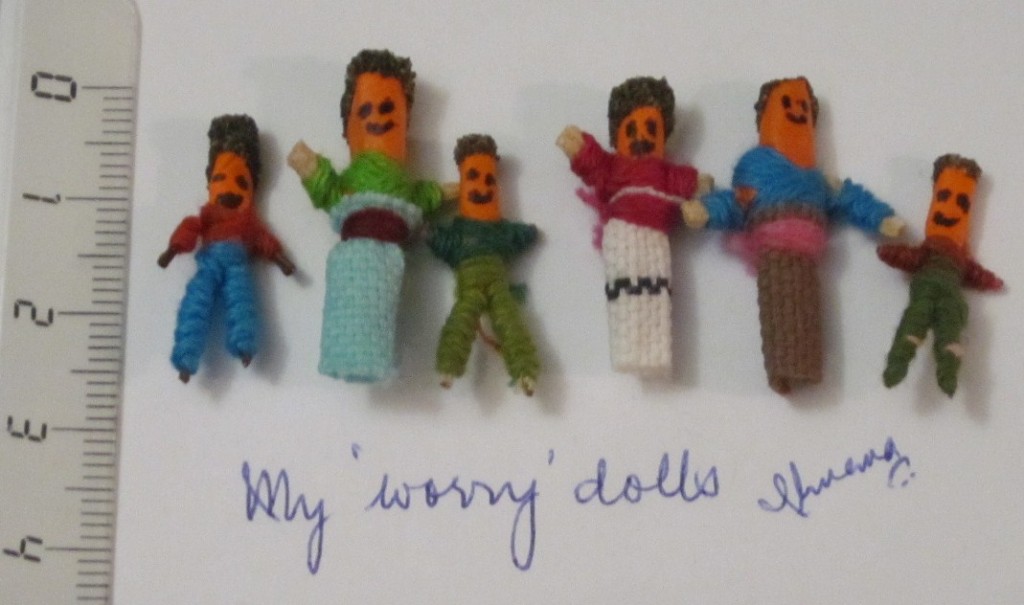
A few days ago while visiting a museum for the Mayan Civilization Exhibition in Toronto; I came across a very simple yet unique and fascinating way of dealing with worries. My attention was drawn to the tiny, barely 2.5- 3cm long set of six miniature dolls placed with a name: “Guatemalan worry dolls”.

On a closer look, they were tiny dolls made out of wrapping cloth or wool over tiny wires shaped as dolls and each one had faces with eyes and a smile drawn on them.

Later as I dug into the details, I learnt that they are an ancient Mayan tradition which is still being practiced by the surviving descendants of the ancient Mayans which live in Central America, specifically in Guatemala.

The dolls usually come in a pack of six handmade dolls and a tiny bag to carry them.

It is said that if the children who worry are told to share their worry with the ‘worry doll’ and place it under the pillow imagining that the doll will take care of that worry. Each doll is told one worry at a time. Many a times parents take away the doll from below the pillow, so that when the kids wake up in the morning thinking that with the doll, the worry too has disappeared. However, sometimes if the worries are recurrent, not removing the doll implies that the doll is working on the ‘worry’ to disappear.

The tradition has been claimed to be scientifically sound and helps kids learn to ‘speak out’ their worries instead of internalising them into long lasting fears. It also gives a subtle message that ‘someone’ cares. It is also know to work as a good tool to inculcate a habit of sound sleep. However, this may work only in those with mild or moderate worries, but not so much in situations of extreme anxiety.

It is claimed that ‘worry dolls’ have also been used in the hospitals, for young and old, to allay anxiety in patients while they undergo surgeries or cancer treatments. Some claim to have used them in class rooms in schools and meeting rooms in offices to cope with stress, and to boost creativity. They are even used for emotional healing in incurable illnesses, dealing with deaths or even heart breaks. I think with the potential they have, there is no dearth of situations where ‘worry dolls’ can be used. Imagination is the limit to utilize them as calming companions.

Though not mentioned in the information on dolls, their ‘tiny’ size taking up seemingly ‘big’ worries must be playing its part in the process of relaxation too.

Apart from the therapeutic value, what fascinated me was the art of making these miniature dolls by wrapping up wool or cloth on wire and giving them a resemblance to someone who ‘cares’.

So aptly was it mentioned in the literature: “Make your own worry dolls at home, just give them a dress, two pairs of limbs and a smiley face? And see them in action. You needn’t be a Picasso or a Freud.”

Do not call them mad, please!


Published in The News Blog on February 22, 2012 :http://blogs.thenews.com.pk/blogs/2012/02/22/do-not-call-them-mad-please/

When I feel feverish, lethargic, sneeze and have a runny nose, all know I suffer from common cold, and that I am infected with a virus. If I tell them that I went to see my GP and am taking meds, they all know medications will take care of me. No one will judge me. All will empathise, give an extra advice to take rest. Some will even hug me for support, without realising that I might be transferring the virus to them. Even if they get one next day, it will be just a passing mention, “Oh I too got your flu”.

If I feel low, lethargic, don’t feel happy, lose my appetite and cry for no reason, they all ‘know’ I am an ungrateful person, who has got everything from a good family to a good home to a good carrier and is still being thankless. Not many will hug me to say, Yes we know you are depressed and there has to be no reason for it. It is because of imbalance of chemicals in your brain.”

And if I tell them I am trying to help myself by going to a psychiatrist, and am on medications or psychotherapy, they would give a stunned look and say nothing. Not many will hug me or tell me “You did the right thing”.

I also know behind my back tongues will wag and eyes will roll. Some may even diagnose “I have gone mad.”

Yes they would give me advice to read scriptures to be thankful. Or to go to some Aalim or Pir and get my “nazar jhaaroed”.

According to the fifth edition of the Diagnostic and Statistical Manual of Mental Disorders ,  almost 78 per cent of people are suffering from some kind of psychological disorder.

Indeed, 78% of us are affected with one form of psychiatric disorder or the other. It could be a mild anxiety with minor worries, on one end, to a full blown schizophrenia, on the other, where one is cut off from the reality of this world, which in medical terminology is called “loss of insight.”

However, none of them is madness. In fact there is no such thing as madness.
Going through the 954 page document, above mentioned, I did not find any mention of an ailment called ‘madness’. I even looked up into the index at the end, the  M section  began with Major Depressive Disorder, then after Mathematics disorder, the next mention was Medication induced disorder.

Thanks to the advances of medical sciences, we now know there is always a chemical basis of psychiatric diseases. This is the reason they are quite capable of being corrected by medications. Some may be completely corrected, while some partially.

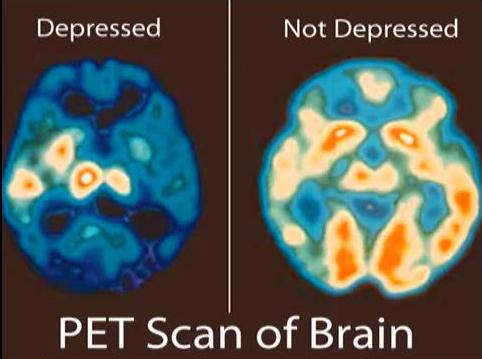
Thanks also to the sophisticated PET brain scanning techniques, we can now see with our own two eyes that Depressive Disorder or Anxiety Disorders or any other psychiatric disorders are real ailments and not mere myths.

Perhaps, our scientific knowledge of psychiatric ailments needs to cross a lot more frontiers, to be able to understand and treat all these disorders more efficiently.

Exactly  as in a common cold there are triggers like exposure to cold, or exhaustion which cause them to come again, there are environmental triggers in the psychiatric disorders too—usual ones like stress, troubled relationships, or as trivial as some taunts or sometimes as subtle as winter season.

Do we ridicule those who have fever, or cancer, or diabetes or heart attack? But we do ridicule, poke fun or bad mouth about those suffering from Depressive disorders, Anxiety Disorders, Eating Disorders, ADHD , Personality Disorders or Learning Disorders etc.

We empathise with those who do have their sight, hearing or physical ability missing and often remark that nature compensates them with some other strength or skill.

Same is true of the various Psychiatric Disorders. The people affected by them are endowed with some other skills. World’s best writers are known to be Bipolar, and many of the inventors were known to have either Obsessive Compulsive Disorder or Learning Disorder.

We all love ourselves. No one wants to fall sick, whether with common cold or with depression or of any ailment, no matter how trivial.

With the statistics of 78% affected with some psychiatric disorder, we may be definitely seeing four- fifths of our near and dear ones affected by some psychiatric disorder, ranging  from a very mild to a very serious one. Some of them may be in need of a professional help too.

So next time you see anyone you would wish to label ‘mad’,  just understand them and don’t be a trigger for them to get worse.

Know that they didn’t want to be unwell either.
And please, I beg you, do not call them mad.  
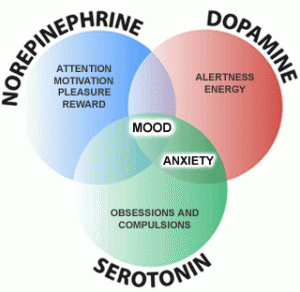
Chemical basis of some mental disorders. 

P.S. This blogpost was written in response to the @ExpressTribune ‘s article:

Celebs with mental disorders: Lock up the crazy

Beautifully meaningful


These are colourful bits with each of a unique shape, size, yet so purposeless, resembling a pile of multicoloured rubble, until….

..magic happens.

And they all   find their right roles in the right places.

Which piece fits best next to the other isn’t necessarily of the same shade or same shape.

What is worth a notice is that they are all connected to each other, someway.

What matters most is that, together, they all make a beautifully meaningful existence.

Arent we all as individuals like the first picture?

*Correction: The magic above did not happen, it was made to happen.

Tiffany lamps have always been my favorites, for they being  beautifully handcrafted, colorful pieces of art, and at the same time  so purposeful too.

P.S. This blog post was inspired by a vibrant and transparent  soul called Geetali Tare, knowing whom is so  beautifully meaningful !

Leaving your heart prints


Valentine’s Day isn’t just about expensive gifts, teddy bears, chocolates or red roses to girlfriends. It’s about  making any of your loved ones ( whosoever they may be)  feel that they matter.

And to make anyone feel  that you care, fortunately does not take loads of money. In fact it does not  cost anything but  a tender caring heart.

I planned to write a humorous blog on the ‘extortion day’ that  men generally call Valentines day, with a few jokes.

But when a friend sent in an email mentioning about the idea of  ‘heart  prints’, it was too touching to just shoo off this day in a joke. Hence without adding any of my non serious words I share the sentimental caring words a friend wrote in her email.

Sharon  shared:
We leave fingerprints on whatever our hands touch.  On walls, on furniture, on doorknobs, dishes and books, as we touch we leave our identity.  Each day we have the wonderful opportunity to leave prints on the hearts of those who are entrusted to our care.”  

Elizabeth Barrett Browning wrote in one of her famous poems:  “How do I love thee?  Let me count the ways.”  

We might say:  “How can we touch hearts?  Show us the ways.”  

The ways that we leave heart prints can be summed up in the word LOVE.

In his meditations, St. La Salle was very fond of quoting St. Paul.  In his First Letter to Corinthians, St. Paul describes love.  He writes of a love that touches hearts.

How might we describe this love?  We might say:

“May we leave heart prints by dealing patiently with others.
May we leave heart prints by being kind to others.
May we leave heart prints by never being jealous or boastful, or arrogant or rude.
In our dealings with others, may we leave heart prints by not insisting on our own way.”
When we are not irritable or resentful or rejoice at wrong, but rejoice in the right, we leave heart prints.

So, in all of our dealings with others, let us leave heart prints.

And if someone should say: “I felt your touch,” that might be miracle enough. “

Continuing with a  serious note,  perhaps  an look of concern, a nod that we  understand,  a bend  to lend an ear,  a few words of  compassion or just a caring glance that turns a grimace into a grin  are all ways to leave heart prints.

Coming back to my not so serious  words, well I wouldn’t  leave this page without  caring  words for my  men friends  for whom this day proves to be more of an extortion day. Here goes my empathy for the impoverished pockets:

  Conversation during an expensive candle light dinner on Valentine’s Day:

Girl (blushing) : “Do you love me with all your heart and soul?”

Boy (”the bill’ on his mind): “Mmm hmm.”

Girl( flushing ): “Do you think I’m the most beautiful girl in the world?”

Boy( still thinking of the ‘ the bill’) : “Mmm hmm.”

Girl(slushing): “Do you think my cheeks are like rose petals & my eyes like gazelle’s?”

Boy( ” the bill’ thoughts persist) : “Mmm hmm.”

Girl( gushing) : “Oh dear, you say the most beautiful things in the world!”

With no  offence meant to anyone, but I hope to  leave some grins on the grimaced faces  :).

Sights and Sounds May Disappear, but Smell Shall Linger.


Published in TheNewsBlog February 7, 2012. http://blogs.thenews.com.pk/blogs/2012/02/07/sights-and-sounds-may-disappear-but-smell-shall-linger/


“When I miss her, I go to her closet to sense my daughter’s fragrance.” Arfa Karim‘s Mom said on her 17th birthday.

The words from the teary eyed mother gave me goose bumps.

She was certainly not talking about the perfumes that Arfa adorned, but the odour that she inherently possessed by virtue of her HLA (genetic) type. This was the smell Arfa’s mom associated her with ever since she held her in her arms soon after her birth (even though the mother may not be aware of it, consciously.)

This reminded me of a research paper I read years ago which said the first bond that a mother and child have after birth is through the sense of smell. Babies from the time of birth learn to identify their mother through a strong sense of smell. It is said that within 24 hours, a mother is able to identify her baby’s odour too. A research claims that within 50 hours, infants were able to differentiate between the smell of their mother’s nipple from that of another lactating woman. Studies have shown that when a mother’s nipple from one breast was washed off, 22 out of 30 babies chose to suckle the unwashed side, because of the familiar odour.

Little toddlers, unaware of relationships, differentiate their siblings from friends subconsciously through odours.

It is common knowledge that animals identify and claim their territory through the sense of smell. Dogs smell their masters, and cannot be deceived even by a look alike.

Each one us is endowed with a unique fragrance or scientifically an ‘odour’ type. Our smells are coded by the genes of a group of molecules called the HLA Complex. Our odour type determines the various social cues we receive in the society in the form of attractiveness, favourable or unfavourable social reactions, and even sexual arousal. Furthermore the role of pheromones, the odour producing hormones in animals and humans as a medium for sexual attraction is also well known.

In an interesting study a group of women were asked to smell men’s T-shirts and choose the odour they liked. Majority of them chose the odour type which was different from theirs, hence from a different genetic pool. Perhaps this is nature’s way to create more variation.

In another similar study, women were asked to smell men’s T-shirts and were asked to rate them according to pleasantness. The men who had infectious diseases, (most probably sexually transmitted disease’) were in more than half of the cases labelled ‘putrid’. That’s another one of nature’s ways to minimise the transmission of infections.

My kids often mention:

‘Oh this smell reminds me of Karachi’, or of Delhi or even of ‘that’ person. Though never a subject of research perhaps every place along with its unique sights and sounds, has its own distinct set of smells too. The smells could be related to its fauna or even the food habits there. My mother often remarks; ‘The soil at every place smells different while the water in every place tastes different.’

A Vietnamese friend who recently visited her native place remarked, Hanoi has its unique smell, and it’s even funny how their embassy here smelt the same. Perhaps it’s the fish sauce!

We do spend a handsome amount on buying scents. And many rich and famous spend a fortune in creating a ‘signature’ smell of their own.

Ironically the sense of smell – though a subtle and powerful sense of perception – is subconsciously the least significant in our lives. We may feel empathy for those who are deprived of a sense of sight or sound, but often either ignore or even mock those with loss of smell. Not many of us even know that some people are born with their sense of smell missing. This condition is known as Anosmia. How incomplete their lives must be. We all have experienced small periods of Anosmia or Hyposmia when our noses get blocked during the common cold. We all know how tasteless even the most delicious of foods seem, with a blocked nose. This simply reinforces the hidden fact that before actually tasting, it is the smell which judges the true taste of food.

Hence, our sense of smell and the odours of others, animate or inanimate creates a great bond and sense of belonging.

One can very well imagine how much Arfa’s Mom must be feeling the presence of Arfa in everything that is associated with her. Though Arfa’s sight and sound may have left, her smell shall linger in the place and possessions she has left behind.

Painfully Humane


Published in TheNewsBlog on January 31, 2012. http://blogs.thenews.com.pk/blogs/2012/01/31/painfully-humane/

A couple of days ago I met a neighbour outside the house, walking her two cute cocker spaniels. We exchanged New Year Greetings and as a ritual I asked: “So how did you spend your new years eve?”

“Oh I spent my evening feasting with my girls.” she replied

“Lovely, so they all came over to be with you.”

Her face changed color, “Oh no, these girls Sasha and Mori pointing at the two cocker spaniels, picking up the little ones in her arms.

Embarrassed I replied: “Yeah couldn’t be a better new years eve than with one’s pets. I did it too, when the rest of my family went to see the fireworks at midnight, I sat with my cats on the sofa watching TV.”

This triggered off the talk on how we undermine animals and use terms like ‘animal’ or ‘beast’ with a derogatory hint while using words like ‘humane’ as a symbol of compassion.

“I see those TV anchors calling suicide bombs that go off in Pakistan as ‘inhumane’ acts, when in reality they’ve been done by humans themselves, especially those who aspire to be superhuman so that they get a special place in Paradise.”

I could just nod in agreement.

She went on, “Isn’t this all very ‘human’ to kill, for no rhyme or reason?”

Her words echoed for hours. Don’t we use the same terms ‘insaniyat’ for compassion while ‘janwar’ or ‘haiwaaniyat’ for cruelty in Urdu too.

Although, it is common knowledge that even the most dangerous of animals do not harm unless they are hungry or provoked.

Perhaps our ‘hunger’ has gone beyond filling our stomachs. We ‘attack’ others to fill our egos, the egos which never get filled, because there is no bottom. Yes no bottom, because, we do not have any limit to how low we can stoop to gratify our egos.

Often we see and hear of stories where two pets that could have naturally been predator-prey, coexist as friends and in fact the predator acts as a protector of its erstwhile prey.

I saw this live for years in my own home between our cat Nelson and the grey parrot Shakespeare. Shakespeare learnt to mimic the mewing and growl of Nelson. And Nelson would come running to him. They would simply mew, looking into each other’s eyes. No t even once did the cat attempt to attack or touch the grey parrot. The day Nelson passed away and went missing from home, Shakespeare mewed for hours, as if calling out for him, adding to the gloom and shedding tears like a bereaved kid.

It is a bigoted myth that empathy is a higher cognitive function that only apes and humans are blessed with. Perhaps we are more loaded with narcissism than with empathy. Studies on whales show they are extremely emotional. Whale brains have specialised spindle cells which are important for empathy, and rapid gut reactions. Previously, only humans and apes were considered to possess them. An interesting practical example of this is when a 50-foot, 50-ton humpback whale was caught in a net off California’s coast. After rescuers untangled it, the whale swam up to each one of the rescuers, and winked before swimming off. The researchers confirmed this was a gesture of gratitude from the whale.

To study empathy, neuroscientists in McGill University injected acetic acid in the paws of mice causing them pain. The mice who watched their friend writhing in pain became more sensitive and reacted more violently to pain, when injected with the same chemical.

Studies on animals called ‘humans’ show that children who are cruel to animals, are likely to turn to violence later in life. 75% of prison inmates are known to have past history of animal cruelty, says a study.

We need to revisit or swap the meanings of ‘humane’ and ‘beastial’, or ‘insaniyat’ and ‘haiwaniyat’.

It is a saving grace that we do not understand animal language, otherwise it would be very embarrassing to know that every time a suicide bomb, target killing or even animal poaching occurs we would have heard animals scream “What a painfully humane act!”

Basant, a festival beyond beliefs


On 27th January, 2012 India celebrates Basant panchami.
In Pakistan, it is celebrated towards the end of February.  

Towards the end of January till early March, the golden harvest of wheat stand tall ready to be harvested sometime in early April.  And wheat is our staple crop.

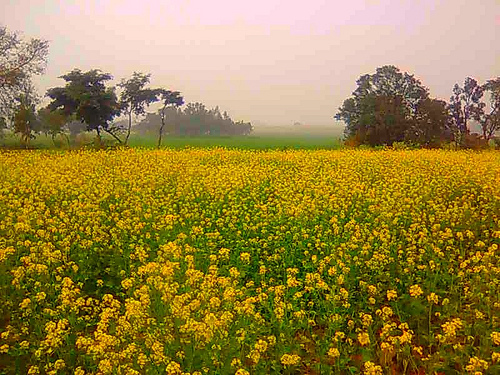
At the same time in Januray February the yellow blooms of mustard ( better known as sarson) sway in the fields, as far as eyes can see. And mustard is a cash crop whose seeds are pressed to extract mustard oil.

To celebrate these awesome blooms as a reward for the fields ploughed and the seeds sown  in October, the farmers rejoice, sing, dance and make merry.

Some of them wear yellow turbans, and their women folk adorning yellow ‘odhnis’ come out to join in the celebrations. It is not hard to imagine that they must be celebrating the blooms, ever since they learnt to farm these crops dating back to centuries.

This is the basic root and the spirit of the tradition of Basant in parts of Indian subcontinent where these crops are grown.

Are wheat, or mustard crops Hindu, Muslim or Sikh?

Vasant in Sanskrit or  Basant in Urdu mean ‘spring’, which heralds the departure of winter and arrival of spring. It symbolizes the time of rejuvenation and arrival of happiness as flowers start to smile through their blossoms.

Yellow, the color of Basant, inspired by mustard blossoms, which matches the shade of sun rays, signifies life and radiance.

Do rays of sun or radiance of happiness differentiate between Hindus, Muslims or Sikhs ?

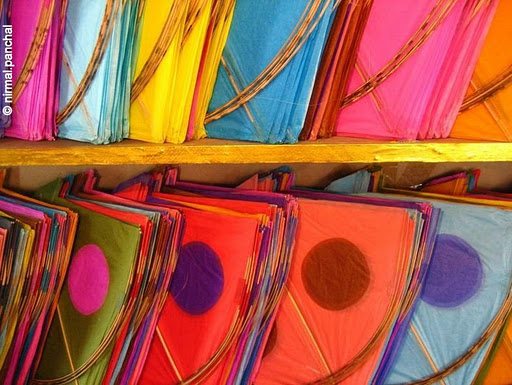
Kite flying , another component of basant, has it’s own interesting tale to tell.

“Kite flying also reveals how the tradition evolved over centuries and in a Ganga Jamuni way.
Kite flying was introduced to the Indian subcontinent by the Chinese traveller Heun Tsang in the 4th Century. Evolving for centuries, it s modification into its current form and popularisation as a sport was made possible by the Nawabs of Avadh. The kite flying during basant celebrations is believed to have been introduced by Maharaja Ranjit Singh in the 18th century.”

Yet another evidence of centuries old and secular celebration of Basant come from poets, Kalidas and Amir Khusro, who have written about the celebrations of Basant in their own unique styles.

Kalidas in a poem Spring writes:
द्रुमाः सपुष्पाः सलिलं सपद्मं
स्त्रियः सकामाः पवनः सुगन्धिः ।
सुखाः प्रदोषा दिवसाश्च रम्याः
सर्वं प्रिये ! चारुतरं वसन्ते
Oh, dear, in Vasanta, Spring, trees are with flowers and waters are with lotuses, hence the breezes are agreeably fragrant with the fragrance of those flowers, thereby the eventides are comfortable and even the daytimes are pleasant with those fragrant breezes, thereby the women are with concupiscence, thus everything is highly pleasing…

AmirKhusro pens down:

Aaj basant manaalay suhaagun,
Aaj basant manaalay;
Anjan manjan kar piya mori,
Lambay neher lagaaye;
Tu kya sovay neend ki maasi,
So jaagay teray bhaag, suhaagun,
Aaj basant manalay…..;
Rejoice, my love, rejoice,
Its spring here, rejoice.
Bring out your lotions and toiletries,
And decorate your long hair.
Oh, you’re still enjoying your sleep, wake-up.
Even your destiny has woken up,
Its spring here, rejoice.

There is an Indian classical  music tune  called Raag Basant Bahaar.

Not to forget, basant in the subcontinent is also associated with a special sweet prepared specially for the occaision –the kesar halwa,
It is a suji ( semolina) halwa with a soft aroma and yellow shade from saffron and garnished with cashew nuts.

Neither the dessert, nor the poetry above nor the music below suggest if Basant is Hindu or Muslim or Sikh.


The same spirit is also replicated by this beautiful ghazal by Malika Pukhraj and Tahira Syed

Lo phir basant aayee…

P.S. Special thanks to Sandeep@stwta a twitter pal for the devnagiri  text of Kalidas poetry.