Open up your mind and your potential reaches infinity…

Archive for the ‘Pakistan’ Category

When hatred reigns.


It was with helplessness that I read an article in one of the newspapers about how school kids in certain areas of Karachi were not able to attend their school safely because of prevailing tensions between two ethnic groups- both Pakistanis, both Muslims of the same sect. A kid claimed he was friends with his schoolmates from the other ethnic community and they even played together after school, but now the same friends say they could not play with him anymore.

Another article read of how Hindus in Baluchistan who have been living there for centuries were fearful of sending their kids to schools due to escalated kidnappings for ransom and killings of the community. Although they have no animosity with the Muslims in neighborhood,  they all scared to mingle.

In brief, the hatred of a handful prevailed over the helplessness of the lot.

Before I could finish, the news broke of Karachi blast in the DHA where along with others, an innocent passerby mom and her 5 year old son got killed.
What prevailed here too was nothing but hatred.

I know first hand, exactly how it feels to be helpless in the face of hatred.

I was a first year medical student in  Lady Hardinge Medical College, situated in the heart of New Delhi, when Indira Gandhi was assassinated on 31 October 1984. The mayhem spread as faster than the spread of the news. As if a riot button was switched on. Delhi’s panorama was puking smoke of hatred from every direction.

Parents were coming to pick up their daughters, from the college hostel, and narrating the harrowing tales of watching limbs and other body parts splattered across the killing fileds that Delhi roads had turned into. I remember how a Sikh girl from my class sat cautiously frozen in the crowd of girls in the hostel’s TV room.  She broke down when she learnt that her brother had left home an hour ago to pick her up. No one reassured her not to cry or to worry for her brothers safety.  Not a single parent even offered to drop her home. Why would I blame others, when I felt the same helplessness, and feared what will happen when my parents come, will they be reluctant to take her too.

Ultimately, along with her and a few other girls, I ended up staying back to spend the terrible night in the hostel. The city had turned into an open house of looting and rampage. Next day on my way back home,  all I saw was roads stained with fresh blood, a charred and empty shop after every few well preserved shops and selectively  burn’t buildings along the way to home. Though I did not have the courage to give a second look, but I did see a glimpse of most likely a charred body lying inside a burnt shop.

At home everyone shared their eye witness accounts. Our house boy Jung Bahadur described how the shacks(jhuggis) in the slums of Mangolpuri and Sultanpuri were stocked with stacks of VCRs, TVs and other electronics. He even shared how some dead bodies were piled together, doused with kerosene and burnt to ashes. Papa had witnessed a headless body being carried in an autorickshaw.

I do not remember how and when did the Sikh girl go home, but we learnt days later that her brother could neither arrive at the college, nor ever return back home. His body was  identified some days later in the morgue.

Again, amidst the helplessness of us all, hatred prevailed like a king.

The same story was repeated with my parents, as they were left in the cold, during the riots in December 1992, that followed Babri Masjid demolition. Many Muslim houses were chalked in Delhi, including those of IAS officers, doctors, cricketers, poets etc.

In fact some like Bashir Badr’s house in Meerut was actually attacked. It was after this incident that Bashir Badr wrote this shair:
Log toot jaatey hain, ek ghar banane mein
Tum taras nahin khaatey bastiyaan jalane mein.

Being  staunch beleivers of Indian secularism, my parents had proudly built a house in 1977 in a University housing cooperative compound where his colleagues and other University professors resided. We were only 2 Muslim houses in a colony of 238 lots, but that was besides the point. However, that cold and lonely December night none of our neighbors, his University colleagues or friends came forward to even reassure them of support in case of any danger. There was a criminal silence from friends and neighbors.

As my mother narrated later, that was the first time she saw my father cry with tears, not for his life, but at the ‘sudden’ transformation in hearts of trusted and indeological friends for several decades. My parents had packed their car with valuables, in case they had to leave. Once the crisis was over, a few friends did come up, begging their helplessness.

Once again, amidst the intelligentsia of the society, hatred took an upper hand .

My grandfather often narrated of an incident when during the 1947 riots a Sikh boy had come to drop a pregnant Muslim woman to Matia Mahal,  Jama Masjid area, but was not let to go back alive, despite the helpless cries from the woman’s family to spare her saviour.

The helpless family members could do nothing as the hatred reigned.

I know I can never be able to guess from where this business of hatred all began, but can we really dare dream a day when the hatred propagated by a handful of vested interests will not prevail over the helpless masses ?

This reminded me of a discourse I had read about the controversy between Tagore and Gandhi during the non-cooperation movement against the British in 1930s.

Tagore had warned Gandhi by saying: “….besides, hatred of the foreigner could later turn into a hatred of Indians different from oneself.”

Gandhi on the other hand believed that this non-cooperation would dissolve  Hindu-Muslims differences.

Ultimately Tagore was proved right, and Gandhi had to shift his  non cooperation  against the British into a non violent movement.

The same corollary of Tagore’s could easily be applied to the situation in Pakistan, too.

What began as a hatred for the foreign faiths has turned into hatred among Pakistanis different from each other.

And ironically a handful of vested interest first made the helpless common Pakistanis hate the foreign faiths and now have turned the Pakistanis of different sects and ethnicities hate each other.

This business of hate has to stop somewhere. Whether it is for a fellow Indian/ Pakistani of different ethnicity, of a different faith or of a foreigner of different color, we have to shout in the face of hatred: “Enough is enough”.

Or else, as poet E E Cummings lamented: Hatred bounces.

Bulleh Shah, the daring secularist!


In the times when  the whole world is going through an era of hatred, intolerance and extremism and Pakistan seems to be synonymous to all these words, what could be a better tribute to Bulleh Shah but to show to the world that there existed a daring secularist on this land almost 250 years ago.

Here I make a feeble attempt to write about Bulleh Shah, from  what little I know of him as a secularist : 


Bulleh Shah (1680-1757), was a sufi, who  lived in the heart of  Punjab, in Kasur,  as a  contemporary of Guru Gobind Singh, a reformer and mystic in his own right. Both of them had to face the wrath of a radical Muslim Mughal Emperor Aurangzeb in their life.

Not very different from the state of our current world, ridden with extremism and hatred towards other faiths , even 250 years ago, the subcontinent  was plunged in deep turmoil.  But Bulleh Shah, who thought far ahead of his times, dared to challenge the prevailing hatred and religious bigotry.  

He lamented:

“Ulte hor zamane aaye,
Hun asaan bhed sajjan de paaye.
kaa(n) laggad nun maaran lagge, 
chiriyan jurre khaaye 
iraqiyan nun chabuk paunde, 
gade khood khavaye
aapneyan vich ulfat naahee,
ke-he chaachche taaye 
piyo putran ittfaak naa kaahee, 
dheeyan naal naa maaye 
sachcheyan nun hun milde dhakke, 
jhoothe kol bahaaye 
agle jaaye bankaale baithe, 
pichliyan farash vichaye 
Bullah jina hukam hazooron andaa, 
tina nun kaun hataaye.” 

“Perverse times have come,
I know the mystery of the beloved
crows have begun to hunt hawks, 
and sparrows feed on falcons
horses bear the whipping, 
while donkeys graze on lush green
no love is lost between relatives, 
be they younger or elder uncles
There is no accord between fathers and sons,
Nor any between mothers and daughters
The truthful ones are being pushed about,
the tricksters are seated close by
The front liners have become wretched,
the back benchers sit on carpets
Those in tatters have turned into kings,
the kings have taken to begging
O Bulleh, that which is His command
who can alter His decree.” 

Despite being a terror that Aurangzeb was, Bulleh Shah audaciously defied him not once but several times :

When Aurangzeb banned the music and dance, declaring it  as haram in Islam–Bulleh Shah, following instructions from his teacher, defiantly  went from village to  village in Punjab, singing and dancing to his Kafis.

As Aurangzeb beheaded Guru Tegh Bahadur, Bulleh Shah dared to call the slain Sikh leader as Ghazi, a religious warrior.

” Kitay Tegh Bahadur Ghazi hay ” 

Bulleh Shah hailed the revolutionary spirit of Guru Gobind Singh, calling him  a ‘protector’ of those who believed in right to follow their religious belief. He said in a subtle satire:

Nah Karoon Ab Kee,
Nah Karoon Baat Tab Kee.
Gar Na Hotey Guru Gobind Singh,
Sunat Hoti Sab Kee.

I talk about neither yesterday nor tomorrow;
I talk about today.
Had Gobind Singh not been there,
They would all be under Islamic sway.

Hence, mentioning that had the tenth Guru not been there, Auranzeb would’ve forced all to convert to Islam( implying Sunnat as circumcision).

Not only did he oppose the persecution of Sikhs in his times, he also advised Banda Bahadur not to avenge Auranzeb’s cruelty by killing innocent muslims.

Referring to the plight of his times in Punjab, and referring to the apathy of the onlookers, he wrote:

The Mughals quaff the cup of poison.
Those with coarse blankets are up.
The genteel watch it all in quiet,
They have a humble pie to sup.
The tide of the times is in spate.
The Punjab is in a fearsome state.
We have to share the hell of a fate.

(According to KS Duggal here ‘coarse blankets’ is referred to Sikhs) .

Bulleh Shah, in solidarity with Sikhs,  is said to have visited a Sikh temple at  Makhowal  at the time of Guru Tegh Bahahdur. He saw people engrossed in ‘ Kar Seva’ (service to the temple,  construction etc), ‘Kirtan’ (the morning singing of prayer) and ‘Langar’ ( the free distribution of meals ) by the devotees. Impressed by their devotion through service,  he remarked:

Ett khrikka ( sound of bricks during construction work)
Duppar vajje ( sound of dholaki during kirtan)
Nale balle chulla (langar).
Enhi galin Rabb raji rehanda
Nale rehanda Bulleh.

Aurangzeb  was  arrogant  not just to non Muslims, he even did not attempt to hide his hatred towards his own  brother Dara Shikoh for following the Shia sect of Islam. And he had heartlessly got  GuruTeghBahadur killed in public, in Delhi and also eliminated his brother DaraShikoh for his beliefs.

Bulleh Shah , on the contrary,  being a true and fearless secularist, rejected  the discrimination between faiths- be Hindu-Muslim -Sikhs or sects- Shia-Sunnis ,and wrote:

Neither Hindu nor Muslim,
Sacrificing pride, let us sit together.
Neither Sunni nor Shia,
Let us walk the road of peace.
We are neither hungry nor replete,
Neither naked nor covered up.
Neither weeping nor laughing,
Neither ruined nor settled,
We are not sinners or pure and virtuous,
What is sin and what is virtue, this I do not know.
Says Bulhe Shah, one who attaches his self with the lord.
Gives up both hindu and muslim. 

While he did not spare those who monopolised their faith:

“Lumpens live in the Hindu temples
And sharks in the Sikh shrines.
Musclemen live in the Muslim mosques
And lovers live in their clime.”

And even dared to compare their clergy to ‘barking dogs’ and ‘crowing roosters’.

Not very different from the current times, wherein ‘secularism’ is still perceived as  Ladeeniyat ( atheism)), he too was labelled as an apostate for his secualr stance. To which he taunted:

Bulleh-a aashiq hoyiyon Rabb da,
Hoai Malamat Lakh Tenon Kafir Kafir aakhdey,
toon aaho aaho aakh
A lover of God?
They’ll make much fuss;
They’ll call you a Kafir 
You should say -yes, yes.

Learning from Bulleh Shah and  Kabirdas, and knowing the history of subcontinent,  today I too gather courage to defy Iqbal’s  verses :

Juda ho deen siyasat se tou reh jati hai Changezi .
When religion is separated from politics, it is reduced to brutality.

I say: Jurey jo  deen siyasat se tou ho jata hai Changezi…
When religion enjoins politics, it becomes brutal.

If after this you call me a traitor: I should say yes, yes.


 P.S. My two penny: 

Recently talking to a friend from Bhopal, about extremism in Pakistan,  I felt disheartened to know that all she knew Bulleh Shah was that  Abida Parveen sang him and that too in the context of his love poetry. And was oblivious to his humanist and secularist stance.

It is so unfortunate that even today, many in India ( besides Punjab) and elsewhere in the world, people who know Kabirdas and Amir Khusrow backwards,  have barely heard of Bulleh Shah except in context of  his love poetry.

Even my  first exposure to Bulleh Shah’s poetry was through the verses…Bulleh ki jana main kaun...that too as a song sung by Rabbi Sher Gill. And I wondered and found the words wierd…not aware of the context. However, after having read some ‘bit’ of his history and his Kafis, it all makes sense now.

What wonders me most is that though in India, we read Kabirdas from grade Six, I never ever heard of  Bulleh Shah’s mention in any Indian history text books. What is more unfortunate that even in Pakistan, school text books never taught Bulleh Shah whether in history or in literature.

I still  consider Rabbi Sher Gill as the one who let me be familiar with Bulleh Shah’s name, to begin with. Besides many other sources…my special thanks to KSDuggal’s Mystic Muse,  Saeen Zahoor for telling stories of Bulleh Shah, the blogs Sufi Poetry, of Raza Rumi ‘s and Syed Ali Abbas Zaidi’s, who I stalked to learn about Bulleh Shah’s poetry and history.

Na maen momin vich maseet aan
Na maen vich kufar diyan reet aan
Na maen paakaan vich paleet aan
Na maen moosa na pharaun.

Bulleh! ki jaana maen kaun

Na maen andar ved kitaab aan,
Na vich bhangaan na sharaab aan
Na vich rindaan masat kharaab aan
Na vich jaagan na vich saun.

Bulleh! ki jaana maen kaun.

Na vich shaadi na ghamnaaki
Na maen vich paleeti paaki
Na maen aabi na maen khaki
Na maen aatish na maen paun

Bulleh!, ki jaana maen kaun

Na maen arabi na lahori
Na maen hindi shehar nagauri
Na hindu na turak peshawri
Na maen rehnda vich nadaun

Bulla, ki jaana maen kaun

Na maen bheth mazhab da paaya
Ne maen aadam havva jaaya
Na maen apna naam dharaaya
Na vich baitthan na vich bhaun

Bulleh , ki jaana maen kaun

Avval aakhir aap nu jaana
Na koi dooja hor pehchaana
Maethon hor na koi siyaana
Bulla! ooh khadda hai kaun

Bulla, ki jaana maen kaun

Not a believer inside the mosque, am I
Nor a pagan disciple of false rites
Not the pure amongst the impure
Neither Moses, nor the Pharoh

Bulleh! to me, I am not known

Not in the holy Vedas, am I
Nor in opium, neither in wine
Not in the drunkard`s craze
Niether awake, nor in a sleeping daze

Bulleh! to me, I am not known

In happiness nor in sorrow, am I
Neither clean, nor a filthy mire
Not from water, nor from earth
Neither fire, nor from air, is my birth

Bulleh! to me, I am not known

Not an Arab, nor Lahori
Neither Hindi, nor Nagauri
Hindu, Turk (Muslim), nor Peshawari
Nor do I live in Nadaun

Bulleh! to me, I am not known

Secrets of religion, I have not known
From Adam and Eve, I am not born
I am not the name I assume
Not in stillness, nor on the move

Bulleh! to me, I am not known

I am the first, I am the last
None other, have I ever known
I am the wisest of them all
Bulleh! do I stand alone?

Bulleh! to me, I am not known

Dengue Fever Awareness


Dengue Fever aka ‘Break bone fever’

Dengue fever is a flu kind of illness spread by bites of female Aedes mosquito. This mosquito bites the infected person and then bites someone else who is not affected thus transmitting the infection. These mosquitoes are active during the day time and at night when the lights are on. These mosquitoes live among human beings and breed in discarded tyres, flower pots, water stores etc.

The mosquito can be easily recognised by it’s black and white ‘zebra’ stripes.

The symptoms are as follows:

Treatment for Dengue and Dengue Hemorrhagic fever

• As far as the treatment is concerned there is no specific medication or vaccine,
• The affected person is treated with Paracetamol to bring down the fever. But one must avoid self prescription and consult the doctor, to prevent complications.
• The person is usually adviced to drink lots of fluids.
• The infected person should be isolated until recovery from the rest of the family to prevent further infections. The infected person as such cannot spread the infection but can be a source to spread it.

Although there is no vaccine to prevent this epidemic certain preventive measures as specified below can be taken to control the epidemic.

Preventive Measures to control Dengue Fever

• Use mosquito repellents.
• Discard all unwanted items  getting gathered around the living area to avoid stagnant water that assists in breeding of mosquitoes. Eliminate the places where the mosquito lays her eggs, like artificial containers that hold water in and around the home.
• Keep the water stores clean and closed.
• keep yourself well covered when outside-with full sleeves and long trousers.
• Take prompt medical advice once fever starts.

P.S. There are emails speculating the goodness of papaya leaf juice for raising platelet count in Dengue Fever. It suggest to take 2 tablespoon papaya leaf juice per serving once a day, prepared from using 4 pieces papaya leaf (without stem or sap) after cleaning, pound and squeeze with filter cloth. There is no scientific proof of this recommendation, but papaya leaf is known to contain very high amounts of vitamins A, C, E, K, B Complex.

However, one must not stop following the medical advice for Dengue Fever prevention or treatment.

IMPORTANT WARNING:

The health researchers claim that if you have suffered from dengue in the past be more careful as theSECOND ATTACK OF DENGUE CAN BE MORE DANGEROUS than the first attack.
The body develops antibodies the moment a person is sick with dengue. However, when that person gets well and is afflicted with dengue again, the antibodies that were developed the first time the person got dengue will mix with the new virus strain, causing abnormalities in the blood vessels and in the body’s immune system, causing Haemorrhagic Dengue.
Haemorrhagic dengue might lead to bleeding from the eyes, nose and through urine or stool.

Watch out for repeat infections!

And the only way is to prevent mosquito bite from the methods mentioned above or told by your doctor.

Take a couple of minutes to see this important information on Dengue causing mosquito:

Sources: WHO, CDC.

Erasing psychological borders


Published in The News @AmanKiAsha on September 2, 2011

Panchee nadiya aur pawan ke jhonke, koi sarhad inhen na roke;
Sarhad to insanon ke liye hai, socho tumne aur meine kya paya insaan ho ke

Birds, rivers & gusts of wind, no borders inhibit,
Borders are for us, think what have we gained being Humans ?

This couplet by Javed Akhtar from a Bollywood blockbuster entered my ears and shook my soul.
“Wow! Javed Sahib  knows how I feel each time I go to the Indian consulate in Pakistan to apply for visas for my family to visit my parents in New Delhi.”

“In January 1990, a girl in her mid-twenties in New Delhi ties the knot with a Pakistani man in his late twenties. Happy, but quite unsure how the things in her life would unfold after that. She wasn’t a poor small-town girl getting married to a well-off cousin in Karachi in compliance with her parents’ decision. She was a typical city girl, who made it to a premier medical school in Delhi and was full of patriotic fervour for her homeland. Her parents did not become a hurdle, but advised that she decide it with full insight, and not regret later. It took her four painful and paranoid years to come to this decision. The young man across the border, putting aside his ego in the face of repeated refusals for years, convinced her that they could make it.”

Twenty years on, I can confidently say that we have made it. Our life together hasn’t been all tulips and roses of course. We’ve had our share of ups and downs, in addition to the usual hurdles any usual couple faces. Both of us being passionately patriotic about our respective homelands, it hasn’t been easy. What helped us was the erasing of psychological borders, knowing that humanity on both sides of the border has the same needs and aspirations. We promised to uphold sanity in our heads and not spew patriotic venom against each other. Not that outsiders spared us. Any bitter comment against the other side by a “patriotic acquaintance” from either side affected me more than my husband.
At times I would be reduced to tears after such taunts, to be comforted by my husband with a “mitti pao” attitude. It is not easy when someone passes a snide remark about your homeland. Any news of a bomb blast or riots in my city, would have me sitting paranoid, glued to the TV, wondering about the safety of my parents and siblings.

In kindergarten our children faced questions from curious friends – like,
“Do your have fights at home during a cricket match between India and Pakistan?”

My son would come home crying that his friends teased him about having an Indian mother, saying,
“Your mom is a traitor!”
It took him some years to feel confident that his mom wasn’t a traitor.

But the only time I really, if ever, regretted my decision was when I had to queue up outside the visa window at the consulate of a country I called my homeland. Miserable is an understatement of how I felt when the man behind the counter looked at my children, asking for details, as if I was taking little terrorist recruits with me to my beloved city.

And then on our return to Pakistan, my husband would be pulled aside by the airport security, questioning him about the frequency of his visits across the border. One has to live it to feel it.

My siblings and I grew up with our eyes open to the world issues, with parents who taught international politics at a university.
We were trained to look beyond our boundaries and feel for the suffering of others be it in Palestine, apartheid in South Africa, or Gen Zia’s martial Law in Pakistan. I salute my parents for raising us as “human” beings with a wide horizon.
Some attribute my “Indian roots” to my comments on news blogs or Face book regarding political matters in Pakistan. Yes, I am proud of my roots. But I also have a husband and two kids who are passionately patriotic Pakistanis. They love both places. And so do I. I claim that I own both countries, and love both too. Karachi is mine as much as Delhi is.

We know there is good and bad on both sides. We don’t indulge in mutual blame games. We have erased the psychological borders at home and we respect our political borders. And we love this feeling.
What if the one and half billion across both the borders could also erase the psychological borders? After all, people on both sides of the border are made of the same flesh and bones, we share the same genetic pool. I wonder if I will live to see that day.

Dr Ilmana Fasih is a gynaecologist and health activist of Indian origin, married to a Pakistani. Contact her via amankiasha@janggroup.com.pk
Friday, September 02, 2011

Nihari, here and there


The story goes back to two decades ago, when as newlywed and I had just arrived in Karachi.
An aunt ( Phuphi) of my husband invited us for a dinner on some ‘special’ delicacy (in her own words). There were a few other dishes, but all the focus was on the ‘special’ dish.

In the first glance, it looked like a thick curry with some extra large pieces of boneless meatloaves lying in it. Garnished with greens and some baghar, the aroma was appetising, I must admit.

While eating my Phuphi-in-law asked; “Do you know what this is?”
I said, “Some salan (curry) I guess.”

That must have really hurt her. She twisted her mouth with a wicked smile. My husband, too, looked wide eyed at me. So did everyone else present there. They all had that ‘poor her’ expression on their face, which generally Pakistanis had in 1970s, when their austere Indian cousins visited them.

“You don’t know this?” someone asked.
I was regretting to have guessed. It wasn’t the regret of having annoyed the aunt, but of those piercing eyes that were focussed on my ignorance of the dish.

My husband came to my rescue, “Phupho Amma, she isn’t very fond of non vegetarian food. So perhaps she doesn’t have any idea.”

My younger brother in law and a friend teased: “Yeah, bechare Indians don’t get to eat gosht so often, and beef is absolutely a taboo for them. ”

PhuphoAmma charged on me in a mother-in-law tone, “Tum kaisi Dilliwali ho, tum Nihari nahin janteen” (What sort of Delhiite are you, you are not aware of Nihari?)

I screamed before I could check my volume, “Nihari? This is not Nihari.”

Before I could blurt something else, I saw my husband giving me a look to shut up. And like an obedient new wife, I did, but with a huge turmoil within.

Back to our room, my husband assured me that perhaps this was homemade and hence not as delicious as the Khan ki Nihari famous in Karachi. Over a period of few months, we tried Niharis at several places, but I could not find what we in Delhi called  Nihari.

I admit I wasn’t very fond of Nihari till then, nor was I really conscious of Nihari being associated with Delhi. In Delhi, I had heard from my father that Nihari is a Avadhi delicacy, from Lucknow.

Anyways I wasn’t a foodie especially for non vegetarian delicacies, nor a culinary expert, nor did I have any ambitions to be one. It was an open secret at home that I had chosen to be a medical professional, so that it would save me from domestic responsibilities, especially cooking. (It turned out to be an illusion, though. But, that’s another story to tell, anyways)

Knowing very well that I was marrying a goshtkhor( meat-eater) Pakistani who was fond of good food, and who’s mother was a culinary expert, I had made it pretty clear to him that I don’t like to cook.
He had in all sincerity reassured, Anda to fry karna ata hai na? Kaafi hai.”

But as we hunted for the real Nihari, my craving for Dilli ki Nihari became stronger.

After an year and a half when I first visited my parents in Delhi, apart from the million other things on list, one on the top was to go to Jama Masjid and relish ‘the’ Nihari, which is sold right at the corner of Matia Mahal, just a furlong from Dadi Amma’s house.

As the tradition goes, Nihari is cooked  from the special shank meat of the beef, with trots in over two dozen spices, the most dominant being the saunf (anise seeds) which gives it the aroma. on slow heat and takes  several hours to get tender.  Hence usually over night as shab degh. The degh( a giant round bottomed pot)  is opened at certain times only –mostly at dawn around 7am or now, even at dusk (at Maghrib). And one has to be there at the right period of time to be able to grab it, otherwise degh lut chuki hoti hai.(It gets sold out fast).

 True to its name ‘nihari’ means pertaining to daytime, it is usually eaten at breakfast, at dawn.
Many a times I had seen Dadi Amma or any of the phuphis in the household send one of the shagirds ( disciples who come to her for learning Quran), a night earlier, to keep the pan with the shopkeeper. And as the cook would  the degh early next morning, the he would kept aside some in  her reserved pot.

The mere mention on phone of my desire to eat Nihari was enough, Dadi Amma promised to keep it reserved for me. I remember her doing the same for us with Shaadi ka Qorma and sheermal whenever any left overs arrived from a kin’s wedding, knowing that we craved for it. (Aah Dilli ka Qorma is another delicacy, not seen anywhere, which deserves another blog).

At first opportunity, we went to see Dadi Amma and others at our ancestral home in Purani Dilli.

Dadi Amma’s place, is a  house, typical  in the walled city. There is a sehan ( courtyard) at the entrance which leads to a room inside another , both of which used to have spic white chandnis spread wall to wall, and no sign of any furniture.

In addition to sleeping over, eating at Dadi Amma’s place had always been a fascinating experience. With a dastarkhwan( sheet to lay the food)  laid on chandni( the spotless white spread on the floor to sit) covered floor across the length of the room. I wonder why, but as kid, I remember vying for a place at the corner of the spread. Some of the senior family members, referred to the plates, in salees-shusta Urdu, as rakabis. And although it had since long become a routine to use glasses for water, there would always be a couple of silver plated copper katoras sitting on dastarkhwan. (Drinking water in katoras (wide bowl) was an old tradition of purani dilli).

That day too, we sat at the dastarkhwan all set to enjoy Nihari. My agenda was personal, while others were eager to see my husband’s response to Nihari. (Thanks to my negative publicity of Karachi Nihari)

With red glazing, aromatic nihari in sight, we waited till the boy brought in hot crispy nans wrapped in newspaper straight from the tan door in the gali, just a few steps away.

The first bite was like a dream come true to the nerve endings of my olfactory and taste buds. But in just a couple of seconds to my tongue, it was a reign of terror unleashed. The poor tastebuds caught fire and laid their arms in the next few bites. As if in a bid to dampen the fire, the eyes started to pour water. But I had to put a brave front, and no matter how hot the tongue burned, the ego stood firm to confirm, this is the  true “Nihari”.

All ears, including my red hot ones, were dying to hear my ‘Pakistani’ husband’s reaction on the ‘Indian’ dish. Being courteous, he remarked, It is delicious, but a bit hot for my liking.”

However, later when we went home, he revealed lightly, that he still preferred his Karachi ki maghaz Nihari. I was devastated, absolutely.  But soon rationalised that, perhaps his tastebuds, and his brain cells were conditioned to call that thick curry as Nihari. His loss not mine, I consoled myself.

My ego wanted to have this Nihari more often, though a bit less spicy, so I got keen to get its exact recipe. My mother could not believe her ears that a cooking rebel like me was asking for a recipe. She and a phuphi had their recipes to offer, but they all admitted not being experts in the dish.

It is generally a tradition in purani Dilli that women do not cook Nihari at home and when needed, they just get it ready made from outside. Probably apart from convenience, it is because of the non availability of beef and also that it needs to be cooked overnight. In Delhi we have gas cylinders, not gas through a pipeline like in Pakistan. (In the days I lived there, cylinders too were rationed).

My Dadi Amma’s wisdom guided me to go to Rehmatullah (the cook and owner of the restaurant) and get the recipe from him.

Being in a flourishing business, Rehmatullah, was unwilling to part with his secret recipe. However, knowing that I wasn’t living there, he was kind enough to offer some from the readymade mixture of spice powder, that he prepared for his recipe. He was generous, and his masala lasted almost an year, till my mom found a place which sold indigenous masala.

Repeated cooking over the years for friends and family has given enough expertise and repute of being able to cook what most taste buds recognise as good Nihari.

Now I can claim to have mastered the details of the difference between the maghaz nihari they make in Karachi and the nalli nihari that we Dilliwalas have in Delhi. (However, I wonder, if there was any difference in them, earlier).

And now that the froth of my ego has flattened quite a bit, I am able to accept the Karachi one as a different version of Nihari, which acquired its own distinct character after crossing the border.

Unfortunately, now in Delhi, even the Muslims residing outside purani Dilli do not seem to yearn for Nihari during the breakfast, while in Karachi, Nihari seems to have taken the place of a national dish which is available at any hour of the day and at every corner of the city. But it still manages to retain the tag of being a Delhi dish.

Interestingly, instead of suspecting some secret readymade masala, most of my kin and friends from Pakistan attribute ‘my’ Nihari flavour to my Dilliwala origins.

Even more interesting is the secret, that it was in Pakistan that I was made to realise for the first time that I was a Dilliwali. And thanks to the Dilliwala tag that was thrust upon me , I now love it and quite often brag about it.

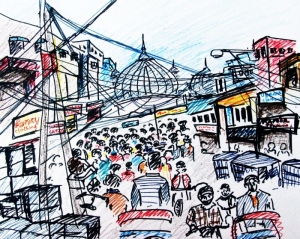
PuraniDilli- sketch by Shilpa Wadhwa

Footprints, theirs and ours


Published in two parts in  Dateline Islamabad  as an Op-Ed  on 12 and 13 August 2011

Part 1

AUGUST 7 was the 70th death anniversary of Rabindranath Tagore, and I remember his Nobel winning poetry which begins thus:
Where the mind is without fear and the head is held high

Incidentally, I found myself reading something similar in the spirit of this poem — Kamran Rehmat’s eloquent piece Meeting Jens Stoltenberg on the simplicity of Norwegian PM’s life and the minimal security he keeps (Dateline Islamabad, July 28). His rendezvous led me to the memory of the news in 1986, when Olof Palme was murdered while walking back from a cinema at night in Sweden.

“Prime Ministers walk back home?” — that was my instant reaction, then.
There is a reason why Nordic countries are considered the safest places to live. (I wonder if the recent Norwegian episode and its root cause will change that, but that’s beside the point here)

Reading through, one instantly compares them to the traffic standstills or detours one has to face when our politicians are passing.

The instant pop-up in my Third World mindset is — “Come on, those are developed nations and we are merely ‘developing’.”

It takes me back to what I gleaned from the movie The Last Emperor, in 1990, where they showed when the king passed through the streets of ancient China, the common man was asked to turn away their gaze  because their poor eyes weren’t worthy of seeing the emperor.

Perhaps, our politicians in power, too, are emperors in their own right, who live not in forts or castles by name — but their abodes are bedecked no less than castles and protected no less than fortresses. And the feet of the poor common man aren’t worthy
of treading the same street when the emperors pass through it.

But hold on.

I have two personal experiences from this very Third World where the high and mighty navigated with the same freedom and minimal security as the Norwegian or Swedish premiers.

One of them is none other than Mahathir Mohammed of Malaysia. (You might say that Malaysia is not much of a developing country but the reason why they have surged ahead is because of this very man about whom I will narrate a personal
anecdote.)

My family had been visiting Malaysia as tourists in 2002. This is during the last days of Ramadan and we chose to travel to Malaysia to see how their
Muslims celebrated Eid.

On the day of the festival, we went to the Central Mosque in Kuala Lumpur for prayers. Not sure of the timings, we reached the mosque way early and  my husband and son sat in the very first row, right behind the imam.

Meanwhile, I settled with my daughter in the first row of women’s area — ensuring that our men folk were well in sight.

After an hour or so, when the mosque had been reasonably full — no mad rush, mind you — a few men walked up to the front rows and some others started to make way for them. My husband was asked to move a little to the side, which he did. But to his utter surprise, the man for whom his space was being vacated was none other than President Mahathir Mohammed.

Having seen that my husband gave space to him, Mahathir smiled at him. My husband stepped forward, shook hands with him and introduced himself as a Pakistani, who had come to see Eid festivities in Malaysia.

After the prayers, he again turned to my husband and invited him to visit Putrajaya (president’s residence) and partake the open feast which the president hosted each year for his compatriots.

Our joy had no bounds — we almost thought that we were invited to a personal lunch with the president.
After a few hours of strolling in the Eid bazaars in Bukit Bintang (street), listening to the beautiful melodies of Salamat Hariraya (Malaysian Eid greeting), we dressed in our best and headed for Putrajaya.

It was a huge congregation, with tents put up and thousands of Malaysians, of all ethnicities, in a picnic mood and enjoying the ethnic food the Malays serve
on Eid. (To continue)

 Part 2 : 

MY family and I arrived at the Putrajaya (president’s house) and were told by someone that this was the last time the open Eid feast, which enabled the commoners to meet the president, would be held as Mahathir Mohammed had announced to step down.

We saw what looked like a hopelessly long queue on one side of the tent, leading to a door. We were told this was for those who would like to meet the first couple and give their Eid wishes to them. We joined the queue.

My husband told one of the guards that we were from Pakistan and President Mahathir himself had invited us, in an attempt to jump the queue. But the policeman just gave a hospitable smile and no more, which was signal enough for us to stay in the queue. It was a two-hour wait and my kids used it to make a small card out of some paper envelope, with a blue ball point sketching a flag of Pakistan and an Eid greeting.

Finally, our turn came. We shook hands with the first couple and to our utter surprise, he himself told his wife, “They are Pakistanis and have come to see our Eid.”

My kids gave them the card. We hugged them, Pakistani-style and were handed a plastic Tiffin on top of which was inscribed “Thanks from Putrajaya” with traditional Malaysian sweets inside. We got exactly the same box as everyone else and approximately, the same two or three minutes of chat as other locals.

To cut a long story short, in a fortnight’s stay in Malaysia, we happened to meet their president twice, and that, too, without much difficulty.

The second incident was in Kolkata (then- Calcutta), in late 1979, when I had been visiting the city with my parents, who were attending some conference. My parents chose to commute in bus as that was the most convenient mode to travel in the overcrowded metropolis.

In the middle of one journey, my father turned our attention towards a lean and thin dhoti-clad man who had climbed the bus. That man was Jyoti Basu, who had become the chief minister of West Bengal, just a year or so ago.

My father mentioned it to some of his friends but they weren’t surprised, for it was common knowledge that Basu sometimes boarded buses just to stay connected with hoi polloi.

Basu continued to win the people’s confidence for the next two decades (from 1977 to 2000). A CPI(M) member, he went on to introduce land reforms, giving opportunity to the poor to have their own lands. He brought political stability to the state to the extent when the whole of India was burning— once after Indira Gandhi’s assassination in 1984 following the Operation Blue Star, and the other at the demolition of Babri Masjid in 1992, his administration did not allow any rioting in his state.

Hence, it was not just a coincidence that we saw these men roaming free in public — years of commitment for the common man had made them fearless.

With this chain of thoughts, my mind shifts to the recent switch on-and-off that goes on in the killing fields of Karachi. It does not need a vision of 6/6 to see who all are behind these killing fields.

By all I mean ALL — none is above it. I wonder, with this track record and with the mess that the stake holders of ‘peace’ create, can they have the courage to sail freely among their own public like Mahathir and Basu?

No wonder our streets from Islamabad to Karachi come to a standstill when they sail fearfully on them.

And tragically, it is the common man, who gets labeled as hateful, narrow-minded and divided on ethnic and sectarian lines.

In conclusion, I want to revert to the closing lines of Tagore’s poem, which may serve as a prayer to us:

Into that heaven of freedom, my Father, let my country awake.

The writer is a gynecologist, health activist,
and m-Health entrepreneur, of Indian origin,
married to a Pakistani

Avval Allah, Nur upaya, qudrat de sab bandey…


This blog post is a tribute to the bravado of my#Sikh brothers, who stood up in respect for humanity beyond faith during the #UKriots.

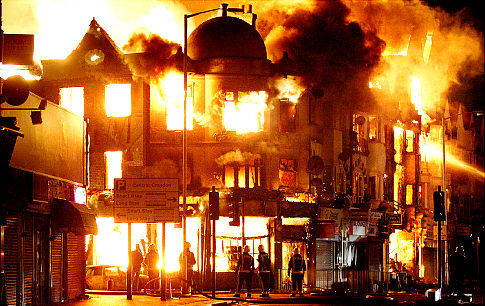
It was devastating to see the peoples power gone berserk in UK riots, as the  arson and looting carried on unabated into the fourth night . Unfortunately against the sheer numbers, the police seemed helpless to control the unruly mob.
While following the  #UKriots on Twitter and BBC News, hashtag #Sikhs started to trend—first World wide and then in UK, London.

A tweet was seen:

Remroum Remi Kanazi
Was afraid #Sikhs trending was going to be some bigoted stream. Thankfully it was this: Sikhs protecting people while they prayed #UKRiots

They came pouring, tweets one after the other with speed getting faster:

Prandha_Swag Harpreeeeezyf.baby
#Sikhs is trending.

Nagra18 Jasraj Nagra
#Sikhs is trending, never thought i’d see the day #proud.

KavelKaur Kavel Kaur
#Sikhs are a world wide trend!!!!

GDS1ngh GD singh
#sikhs trending, fantastic. doing what we do best.

moneyspinner MONEYSPINNER
#sikhs nanak naam chardi kala, tere baane sarbat dha bhala

I googled to check the details and saw Mail Online quote:

Some armed with swords, some carrying hockey sticks, defiant Sikhs stood guard outside their temples last night.
More then 700 men, some in their 80s, took to the streets to protect the homes, businesses and places of worship in Southall, West London.

The tweets went on:

Goggi_Rana Goggi Rana
Sikhs of Britain have displayed the same traits of fearlessness, as their ancestors of yesteryear #Sikhs #SangatTV

UncleWail Wail Al Aun
Thumbs Up for the #Sikhs protecting their #Temple in Toxteth #Liverpool #UKRiots

MissssChrissy Chrissy
Singh Is King… Yep I think so! #sikhs doing it real big today. #LondonRiots #ukriots

Then we heard that they had not only protected their temples but also stood at the mosque guarding while the Muslims prayed ther Taraweeh prayers of Ramadan in South Hall mosque:

A google message read :

Muslims prayed their Tarawee prayers while Sikhs protected he Masjid
Got this from a friend in London.
In a Masjid in Southall London, Muslims were praying their Taravee prayer as the riots were going on, a bunch of Sikhs stood outside the Masjid and protected the Masjid.
The similar thing happened when Sikhs were inside their Gurduwara and some Muslim youngster guarded it on the gate
Great experience, a cousin and a friend of mine reported the same incident.
May ALLAH bless people like them, humanity still remains here, despite the problems

Tweets loaded with emotions, from Muslims and people from other faiths,  too poured in with ovelwhelming enthusiasm:

PMGenerals PMG Anj
Today was an historic day for #hindus #sikhs and #muslims. #unitedwestand all religions teach us to have morals and respect dis proved it! X

dj_aNomAli ∀ℓι . ᄊ乇尺cんለռէ
Sikhs protect Southall mosque while Muslims pray Taraweeh in peace. Much respect to our brothers!! #LondonRiots #Southall #Sikhs #MashAllah

DNSDj Davinder Singh
Actually brings a tear to my eye seeing the #unity between #Sikhsand #Muslims in the fight against this madness. #proudtobesikh

akchishti akchishti
Great sight in my #Birmingham where #Pakistani lads are protecting temples while Sikh lads protecting the mosques

Muslimerican Peter
Imagine a group of rioters turning down a street and suddenly seeing 400 #Sikhs standing in the distance. #wrongturn #ohshit #londonriots

AdamPatel2 Adam Patel
I hear the #sikhs are even protecting the #mosques in Southall so #muslims can read our Tarawih in peace.”>>> BIG LOVE –

And dishearted tweeps begain to take a sigh of relief

xcrimsonstarx Vicki Langfield
The #Sikhs are giving me faith in humanity

Indeed, everyone who followed this trend must have rekindled their faith in humanity. Thanks you my Sikh brothers.

MumzyStranger Mumzy Stranger
Love out to the #Sikh brothers who protected the mosque during prayer time. If we all unite we can and WILL put a STOP to this chaos! M x

And  with these tweets millions or billions of eyes gleamed with hope.

We hope and pray this display of unity and humanity extends to all faiths and communities beyond borders and beliefs…

My mind recalled the verses of Sant Kabirdas which  along with 500 other verses which are included in to the Guru granth Sahib,  are  often heard from  Gurudwaras as Shabad Kirtan :

Avval Allah Noor upaya Qudrat ke sab bandey
(God created light of which all the things were born)
Aik nor ke sab jag upajaya kaun bhale ko mandhe
(From the light, the universe. So who is good and who is bad).

Indeed, I hail my Sikh brothers for living up to the spirits of their faith, their Gurus and their Book.

In return many Muslims also stood up with the Sikhs and helped them form groups which defended their communities and boroughs. Hail Sikh Muslim Solidarity. 

Let this be the beginning of Sikh-Hindu-Muslim-Christian-Jew –other faiths unity for  all faiths believe in one Supreme Power and all faiths belong to  one Humanity’

I dedicate  this tribute to my Sikh brothers with the greeting, which in Punjabi means exactly what Allah u Akbar stands for :

Vaheguru ji ka khalsa, vaheguru ji ki fateh.
(God’s pure and God’s victory )

My brothers,  Rabb Raakhaa

Ilmana Fasih, Aug 10, 2011

P.S.: Please scroll down in the comment box to see the reaction of the Muslim community after 3 Pakistani boys were killed in Birmingham.

Where the mind is without fear and the head is held high.


Just yesterday was the 70th death anniversary of Rabindranath Tagore, and I remember his Nobel winning poetry which begins as :
“Where the mind is without fear and the head is held high”

Incidentally, today I found myself reading something similar in  spirit of this poem while , enjoying  Kamran Rehmat’s eloquent note  on simplicity of the office of Norwegian PM and the minimal security he keeps.(Kamran Rehmat is  a Pakistani newspaper editor based in Islamabad, who’s writings  are like a new lesson in English language, and each time  leaves one richer in vocabulary).

His note led me to the memory  of the news in 1986, when Olof Palme, was murderd while walking back from a cinema at night, in Sweden. Prime Ministers walk back home, was my reaction then. There is reason why Nordic countries are considered as the safest places to live on Earth. (I wonder if the recent Norwegian incident and it’s  root cause will change that, but that’s beside the point here)

Reading through,  one instantly compares them to the traffic standstills or detours one has to face when our politicans are  passing.

The instant pop up  in my Third World  mindset is–” Come on, those are developed nations and we are merely ‘developing’.”

It takes me back to the peice of knowledge I gained from a movie called The Last Emperor, in 1990,  where they showed that when the King passed through the streets of ancient China, the common man was asked to turn away their gaze because their poor eyes weren’t worthy of seeing the Emperor.

Perhaps our politicians in power too are emperors in their own right who live not in forts or castles by name.  But their abodes are bedecked no less than castles and protected no less than fortresses. And  the feet of the poor  common man arent worthy of treading  the same street when the emperors  pass through it.

But hold on.

I suddenly remember two personal experiences from this very  Third World where their persons in authority navigated with  same freedom and with minimal security as the Norwegian or Swedish PMs.

One of them is none other than Mahathir Mohammed of Malaysia. ( You might just say, that of course Malaysia not all that a developing country. But the reason why they have gone far ahead is because of this very man about whom I will narrate a personal anectode.)

We had been visiting Malaysia as tourists in 2002 . It was the last days of Ramadan and we  chose to travel to Malaysia to see how their Muslims celebrate Eid.On the Eid day we went to the Central Mosque in Kuala Lampur for the Eid prayers. Not sure of the timings, we reached the mosque way early and my husband and son sat in the very first row, right behind the Imam’s seat. While I settled with my daughter in the first row of women’s area , ensuring that our men were well in our sight.

After an hour or so, when the mosque had been reasonably full, ( no mad rush), a few men walked upto the front rows and some others staretd to make place for them. My husband was asked to move a little to the side, which he did. But to his utter surprise, the man for whom his place was being vacated was none other than the President Mahathir Mohammed. Having seen that my husband gave place to him, he smiled at him. So my husband stepped forward, shook hands with him and introduced himself as a Pakistani who had come to see the Eid in Malaysia.

After the prayers, he again turned to my husband and told him, to visit his place called Putrajaya ( president’s residence) and join the open feast which the President hosted each year for his compatriots.

Our joy had no bounds. We almost thought that we were invited to a personal lunch with the President.
After a few hours of strolling on the Eid bazars in  Bukit Bintang (street), listening to the beautiful melodies of Salamat Hariraya( that’s Malaysian way of saying Eid Mubarak) we dressed our best and headed for Putrajaya.

It was a huge congragation there, with tents put up and thousands of Malaysians, of all ethnicities in a picnic mood and enjoying the ethnic food the Malays serve on Eid. We were told by someone that this was the last time this would be held as Mahathir Muhammed has announced to step down,  and  he wouldnt be there next Eid.

We saw a horrendously long queue lined up on one side of the tent leading to a door. We were told, this was  for those who would like to meet the first couple and give their Eid wishes to them. We joined the queue. Living upto the Pakistani style, my husband told one of the gaurds that we are from Pakistan, and the President himself had invited us, in an attmept that this would help us jump the queue. But the policeman just gave a hospitable smile,  his eyes speaking to us to stay put in the queue.

It was a two hour wait, and my kids used it well to make a small card out some  paper envelope, with a blue ball point drew a flag of Pakistan and wrote an Eid card for them.

Finally our turn came, we shook hands with the first couple, and to our utter surprise, he himself told his wife, “They are Pakistanis and have come to see our Eid.” Kids gave them the card. We hugged them in a Pakistan Eid greeting. We were handed over a plastic tiffin box on top of which “Thanks from Putrajaya” while the inside had  Malaysian sweets. We got exactly the same box as everyone else, and roughly the same two or three minutes of chat as other locals.

In Summary, in our two weeks stay in Malaysia, we happened to meet  their President twice, and that too without much difficulty.( Not to speak of how many times we have bumped into any of ours in the whole life).

The second incident was in Calcutta, in late 1979, when I had been visiting the city with my parents, who were  attending some conference. My parents chose to commute in bus , as that was the most  convenient mode  to travel in an overcrowded Calcutta.

In the middle of one journey,  my father turned our attention towards a lean and thin dhoti clad man who had climbed the bus. And this man was Jyoti Basu who had become the Cheif Minister of West Bengal just an year or so ago.

My father mentioned it to some of his friends, but they weren’t surprised, for this was common knowledge that he sometimes boarded the bus just to stay connected with the poeple who elected him.

And then this man carried on to be the elected ChiefMinister of West Bengal for next two decades ( from 1977 TO 2000).  A CPI(M) member, he went on to make land reforms giving opportunity to the poor to have their own lands. He brought political stability to the state and so much so that when the whole of India was burning twice– once after Indira Gandhi’s death in 1984, and the other at the demolition of Babri Masjid in 1992, his heavy handed administration did not let any rioting in his state.

As Wickepedia quotes, “West Bengal became an oasis of communal harmony and secular values under his leadership”
Although a CPI (M) member, in an obituuary published by BBC on his death in 2010, it remarked:
“A Fabian Socialist rather than an orthodox Communist, Jyoti Basu worked by consensus, successfully managing coalitions, while showing a healthy respect for the viewpoints of others.”

“He made Communism look respectable,” according to Sabyasachi Basu Roy Choudhuri, a Calcutta-based political analyst.
Analyst Ashis Chakrabarti said Mr Basu’s success indicated social democracy had a future that Communism did not .
( http://news.bbc.co.uk/2/hi/south_asia/8151230.stm)

Hence, it was not just a coincidence that we saw these men roaming free in public, there were years of commitment, and hard labour for the common man, which made them be  so fearless.

With racing chain of thoughts, my mind shifts to the recent switch on and off, that goes on in Karachi’s killings. It does not need a vision of 6/6 to see who ALL are behind these killing fields. By all I mean ALL, none  is above it. I wonder with this track record and with the mess that the stake holders of  “peace’ create, can they gather the audacity to sail freely among their own public like the above men.

No wonder our streets from Islamabad to Karachi come to a standstill when they sail ‘fearfully’ on them.

And tragically, it is the common man who recieves the blame of being labelled hateful, narrowminded and divided on ethnic or sectarian lines.

I close this note with the closing lines of Tagore’s poem , which may serve as a prayer to us:

“Into that heaven of freedom, my Father, let my country awake.”

Ilmana Fasih

Little Terrorist~a short Film


Little Terrorist tells the moving story of a Pakistani Muslim boy who accidentally crosses the Pakistani-Indian border which is riddled with landmines. He ends up in a strange country that regards him as a terrorist. The old orthodox Hindu Bhola takes him in and hides him from the Indian soldiers. However, traditions and prejudices about Muslims remain an obstacle in the relationship between Bhola and the boy. Ultimately, humanity triumphs over prejudice when Bhola risks his own life to help Jamal cross the border again. This symbolic story of hope is a tale of human solidarity conquering all artificial boundaries.
Ashvin Kumar, the director, was nominated for an Oscar in the Best Live Action Short Film category.
Ashvin Kumar’s Little Terrorist also won first prize for best short film at the Montreal Film Festival.

And was nominated and selected for various other prizes.

The cost of crossing the ‘love’ border ~Indo-Pak Visa Part 2


Published in Aman Ki Asha blog by The News/Jang Group on August 03, 2011 http://www.amankiasha.com/detail_news.asp?id=509

For years after the Indian Consulate in Karachi was closed down, a cousin of mine (an Indian married to a Pakistani) whose parents live in Jaipur, followed the following trail year after year. She would travel from Karachi where she lives, to Islamabad to obtain an Indian visa. If successful, she would travel back to Karachi to pack up. She and her family would then travel to Lahore by train, and cross the Wagah-Atari border. They would then take a train from Amritsar to Delhi and then another to Jaipur. With 3 children, she could not afford air travel every year. 

The entire ordeal required her to travel over 4600 kilometres and several days in summer vacations, when in reality, the smallest distance between Jaipur and Karachi is only 1066 kilometres (through Khokrapar Munabao) and the train journey is just a 3-4 hours long.

I understood the real nightmare of this struggle some years ago when I had to travel from Karachi to Islamabad to get a visa for my father-in-law for his medical treatment in India.

My husband and I sat outside the Indian consulate in Islamabad for two days, sharing benches with people who had mostly come all the way from Karachi or Hyderabad. Most had been sitting there every day from 9 am to 5 pm for as long as 15 to 20 days at a stretch. The majority appeared to be daily wage earners, the poor and with no resources to take short cuts, like us, to obtain a visa – we had the parchi (‘slip’) that would expedite the visa process.

A lady and her husband, a carpenter hailing from Lalukhet in Karachi, had been sitting there every day for almost 20 days, from morning till the consulate closed in the evening, without any clue about whether they would be granted a visa or not. The embassy issues a limited number of visas each day. Names come up on a given day, their luck as unpredictable as a lottery. The more resourceful among the applicants jump the line, pushing these poor people to the back of the queue.

This couple had spent so much money on the travel from Karachi to Islamabad that they could not afford even a cup of tea from the tea stall outside the embassy, which caters to visa seekers. Every day the carpenter and his wife brought with them homemade rotis and pickle for lunch. I asked the woman how long she would sit there, and she replied with certainty: “When the money runs out, I will go back home whether I get the visa or not”.

She had applied after hearing that her mother was on her deathbed and had asked to see her one last time. She had been married for over twenty years but had been able to visit her native Hyderabad, Deccan, only once, and that too 12 years ago.

Her marriage had been a stroke of fate when her husband, a cousin from Pakistan, visited them. The poor family had been facing tough times, and found this as opportunity to make their daughter’s life better, as the cousin’s family was more prosperous. (How was she duped into marrying an already married man is another story for another time). 

This story is all too common to many families in the lower middle class strata who marry across the border; their girls are hardly able to visit their parents a handful of times in their lifetime, mostly due to not being able to afford the time, expenses and resources involved in obtaining the visa.

They resign themselves to their fate and learn to live with just memories of home. It is only when another sibling is about to get married; or a parent is ill; or dying, that they gather all their means and courage to try to obtain a visa to go to their erstwhile homeland.

The procedure has been somewhat modified now, so that people in other cities can apply for Indian visas through a courier service, without having to travel to Islamabad. But applicants still have no idea how long the process will take. A friend who wanted to attend her parents’ 50th wedding anniversary celebrations in India received a reply after an anxious six month wait, saying that her application papers were incomplete. Some don’t hear any news for a year or more; others don’t get any response at all.

Over the last two decades I have seen a see-saw situation. Things seem to move towards easing the procedure, then suddenly something occurs and the whole change is reset from the start.
A silver lining is that the Khokrapar-Munabao line, suspended since 1965, has been revived, reducing unnecessary distance for many.

I hope and wish that the latest news about easing of the borders does not remain restricted to the artists who travel on exchange programmes or businessmen attending conferences, but is extended to this voiceless, resigned group of poor, invisible women who marry across borders. I am afraid they are the group most likely to be forgotten when the categories are laid down for easing visa procedures.

Most will never be able to raise their own voice and will resign to their fate of seeing their parents or first of kin, barely a few times in their entire lives, after they cross the ‘love’ border in matrimony.
On their behalf, I beg the authorities concerned to hear the silent wails of these women and to ease the visa process making it easier for them too, so that they may see their parents and families more often.

Ilmana Fasih

The writer is an Indian gynaecologist and women’s health activist, married to a Pakistani. She blogs at https://thinkloud65.wordpress.com/