Open up your mind and your potential reaches infinity…

Archive for the ‘Pakistan’ Category

“Rationality ka janaza hai, zara dhoom se nikley”


The heading was the best tweet, I found on #waterkit. ( Courtesy: Urooj Zia).

There have been few moments in my ‘virtual’  life, when Tweets have been so hilarious.

#waterkit hashtag was  tragically comical.

Based upon the dialogues exchanged in an epic  TV program on this invention, I could not help summarise it this way:

Ye qissa hai Physics key balatkar ka
Aur Waterkit se chalne waali ek car ka
Jab mil baithe syaane chaar
Do minister, ek scientist, ek Engr Waqar

Dikhaya aisa duniya ko chamatkar
Petrol , Bijli sub huwe bekaar
Karwayein kyun Auto-specialists se inspection
Kya kee hai kisi ne pehle aisee invention

Mamoo ban gaye anchors Talat-o-HamidMir
Aur Dr AtaUrRehman huwe lakeer ke faqeer
PhDiyaan sabki ho gayein fuzool
Koora huwe Thermodynamics ke usool

Theory nahin hum practical ko maante hain
“Water is H20”, kya aap ye raz jaante hain
Wikipedia se hum ne kiya hai confirm
H2O se Hydrogen nikalne ka irada hai firm.

Faqat jahalat ki rail-pail hai
Sub moh-maya ka khel hai.
Duniya hansegi to hansti rahey,
Gumrahi ki gari buss chalti rahey.

I dream of a Polio free Pakistan


In January 2012, India was declared to have not reported a single case of Polio for over a year. Knowing its vast area, huge population, diverse terrain and socio economic disparity, to have achieved this was a mammoth achievement. My joy of the news was terminated, before it began, when I realised how far Pakistan was from this goal, especially after 173 cases being diagnosed in the past year , and a few almost recently. My heart shuddered to question, “How long would this take Pakistan to reach that goal of being Polio free?”

However June 2012 and early July brought forth a new wave of hope, when the UNICEF’s Regional Director, Karin Hulshoff, wrote in a newspaper of her excitement and optimism with which the work of Polio eradication was progressing in Pakistan. According to a report by a scientific group, there were only 22 cases in the past six months as compared to 58 the same time last year. Owing to the introduction of a new bivalent vaccine, there have been better results, with Pakistan approaching the hopeful day of eradication faster. She stressed that now more emphasis should be given to the coverage of missed cases, or those never vaccinated earlier. “Even one child missed is a lost opportunity to eradicate polio from Pakistan forever”. Hence to not miss any case, the program was geared up everywhere and in the FATA too.

The same time was the case of Dr Afridi for spying came to light. It is sad, media also misreported, and many among the common masses still believe that Dr Afridi was associated with Polio campaign, though the truth remains that he was collecting samples for the hepatitis C virus.

The coincidental increase in the activities of Polio campaign to speed up the Polio eradication, and Dr Afridi’s spying mission led many to misunderstand that there was some conspiracy against the tribal region, through Polio vaccination. There could be no two opinions about abusing the trust of the people on health workers for one’s vested interests. It is extremely deplorable. But should one or more such Dr Afridis succeed in putting the health of 240,000 innocent children at risk?

How about the tribal elders instead, recruit their own trusted workers to give the two drops of Polio to their innocent kids and secure not just the future of kids, but also their own reputation as being concerned and caring for the humanity?

However, the ban by the tribal elders for the July16-18 Polio drive was to ask for a total stop of drones. Drones are a tragedy, and are inhuman, especially the loss of innocent lives of children are deplorable, but to use one’s own children as a first line of defence, and deprive them of their right to be safe from a crippling disease, is as unfortunate. I wish the tribal elders who are genuinely concerned about the lives of their common people killed by drones, understood, if their community stays burdened with ill health, they shall be unable to defend themselves either from extremism or any outside aggression, but also get more isolated in the international community.

Can there be no stronger, yet humanitarian ways to protest for stopping of drones, which does not tarnish the image of the tribal men and women?

Shahid Afridi’s inclusion into the Polio campaign is a welcome, and rekindles the hope to see the dream of a Polio free Pakistan come true, sooner than I had feared. Shahid Afridi has stood up for a great service to his own tribal children. He is a true hero and a true humanist; who has roots from the tribal area. In a tweet he remarked:

Afridi vs Polio ‏@AfridivsPolio
#Pakistan is my country and to #SpeakUpAgainstPolioBan is my duty.

At the same time it is hurting to see people of tribal areas being ridiculed ( though rightly so)  internationally for their decision

“Oh yes, I see it, polio vaccines for kids and drone attacks, there is a close relation. CRAZY! #speakupagainstpolioban.”

Or see the decision as illogical:

“Its like cutting your own hand as your protest against a theft, or lashing yourself against the fornication by a foe.”

Another tweep saw how the decision is ultimately going in favour of the aggressors who are being protested against:

They are killing children through drone attacks and these people are trying to make their children crippled for life. It is fulfilment of aggressor’s interests both ways.

Children from the tribal areas are as dear to us as anywhere else in Pakistan. We dream of seeing them Polio free too, and be healthy in every way. We are equally hurt at the drones attacks on the innocent.

I repeat, there can be innumerable stronger ways of protest to make international community notice the aggression and causalities caused by drones, instead of making innocent humanity, whether by killing the health personnel or innocent human beings, or depriving the children of Polio vaccine, a symbol of their protest. This simply leads to tragic loss of credibility and lack of sympathy from the international community. The image of the fellow Pakistanis living in tribal areas, including their elders being tarnished by such decisions hurts, because we know they are as human as any one of us, in Pakistan.

At the same time politicians across the board, remain criminally silent to the issue. Even the kids are not spared now, from being used as  bait for political agendas.

However, I insist I still dream for a Polio free Pakistan from Karachi to FATA.

Please do not play politics with the health of innocent kids !


Published in @ETribune : http://blogs.tribune.com.pk/story/12865/dont-play-god-with-the-lives-of-innocent-children/

As the rest of the world is sprinting forward, we in Pakistan seem to be walking backwards. One used to get this sense sometimes, but now with passage of time, it comes more often. With the fact that most of the difficult places like India having grappled with a serious health issue like Polio, and are at the turn of calling themselves polio free, we in Pakistan are not just not close to that, but even retreating fast to make sure we get further away from this dream.

The news of North Waziristan deciding to impose Polio drops ban in their area as a protest against the drones, or the boycotting of Polio campaign in Drazinda village while protesting against the load shedding, brings in not just shivers to the health conscious on this globe, but also gives yet another reason for Pakistan to be a focus in the international circles for a ridiculous reason.

They have a right to register their protests against drone’s attacks, or of Dr Afridi’s betrayal or even against load shedding. But how is this justified by turning ones guns against the innocent kids who are in no way directly or indirectly responsible for any of these unfair actions.

How is banning of Polio drops to the kids going to make a difference to the drones? Is it not akin to hitting your own foot with an axe, crippling yourself even more, making your own children, who are the youth of tomorrow, be burdened with more illhealth and handicap? How will this help them stop drone attacks, or generate more electricity or prevent more Dr Afridis being recruited?

How are risking one’s own children to a crippled life, a way of avenging the atrocities of the aggressors?

As said by a twitter friend: “Taliban want to kick US outta Afghanistan/Pakistan but they never know kicking with polio affected legs is quite impossible ‪#PolioBan‬”

No atrocity is large enough to avenge the innocent kids, be they are from any ethnic community or faith or nationality. And to our horror, the Taleban are putting to risk their very own kids.

A tweep justifying the Polio ban remarks: “But people from your profession (referring to Dr Afridi) for betraying the Polio campaign”.

Does one or a few insincere health professionals justify you to make your own children risk being crippled with Polio. Who are you hurting by this? The health professionals or your own kids?

They argue the drones kill more children than from Polio? Yes this is true, and killing of children by drones is criminal like risking the health of innocent children by Polio ban is criminal too. They harm and kill your children, but you in return risk crippling your own children. Is there any commonsense in this logic?
Those who continue and justify drones by all means, will they stop by your threat of Polio ban? Who will it hurt the drones or your own kids?

Or is it because this is the easiest way out, to kick out the unarmed sincere medical personnel, and lash out at unaware innocent children, both of whom will not be able to defend back, this extremely  unfair decision, with equal force.

As a medical professional, I can only scream loud and cry that they have no right to aggressively jeopardise the health of the innocent, at the cost of another aggression.

Which sect of Islam, or which moral value of humanity or which aspect of the hospitality of the large hearted tribals justify for avenging a wrong action with usurping the rights of the meek and the powerless , innocent kids?

Avenging an injustice, by risking the health and crippling your own children for life?
What kind of courage and valour is this?

I am aghast to see that there are educated on Twitter who are justifying‪ the polio vaccination ban, what to talk of those who give it a silent support. ‪

Polio vaccination ‬ campaign should not be used as a shield against drones. It wont help, but be counterproductive. Will it harm the aggressors or the innocent Pakistani kids?

Polio isn’t petty politics for which politicians, civil society, liberals or conservatives, or general public should not speak up. For the health of Pakistani kids, and for the sake of humanity, please speak up.

I beg you all, please speak up against the Polio Vaccination ban.

This appeal was in response to this news :

http://articles.cnn.com/2012-07-17/asia/world_asia_pakistan-taliban-polio-vaccine_1_polio-vaccines-polio-campaign-drone-strikes


Pangs of an Indian Pakistani


On departure at Indira Gandhi Airport, New Delhi her father, a man with steel nerves, exclaimed with a mask face, in a matter of fact manner,
“Now that you are going across, own the place, own the people, and own the problems the way you have owned the man from there.”

Without a trace of extra humidity in his eyes, he turned back towards the exit, without waiting for her to cross the immigration line for the last time as an Indian. The daughter, with a heavy heart, stopped to watch till the silhouette of her father, her mentor, blurred into the fog of the pre dawn.

Half a day later, the same day, in the same time zone (with a mere difference in half an hour), the same season, she stepped onto a ‘different’  land she was advised to “own”.

The faces, the attires, the language, the snail-pace of the custom officials was quite similar, with only minor difference in salutation of “Namasteji “ there on departure, while “Assalam Aleikum” here at arrival at Jinnah Terminal, Karachi.

But for her the smell at the airport was distinctly different, so was the taste of water she drank from the cooler, and as she moved out, the afternoon breeze that slapped her for the first time was quite hot and humid, unlike the cool breeze she had felt early morning in Delhi. The feeling within was weird, impossible to explain. It was neither regret nor its antonym.

The details of experience that each of the five senses from smell to touch went through, are still afresh as of today.

Today, it is a bit over 22 years from that day of February 19, 1990. A couple of years from now, she would have lived almost as many years as a Pakistani, as she lived as an Indian. A lot has happened in these 22 years. A lot means a lot.

From a dogged patriotic Indian, who cried hysterically on even a hint of anti Indian sentiments from the countless paroxismally patriotic Pakistanis, she gradually graduated into someone who now feels as hurt or happy for Pakistan as for India.

It did not happen overnight.

“You will find a plethora of stupid reasons to with fight each other, and to vent outside anger at home, but for heaven’s sake, never make India-Pakistan as one of those silly reasons. This will neither make India nor Pakistan any Heaven, but will certainly make your home a Hell.”

This singular advice from a cousin uncle in Karachi, in the same situation, did not mean much to her, when it was said. However the golden words found numerous occasions to rebroadcast themselves in her head, pleading reason to maintain sanity.

More than anything else, what must have really transformed her was perhaps the dignity and poise with which her Pakistani spouse literally faced and braved the reciprocal mocking and even bullying from patriotic Indians, relatives or otherwise. If she got perturbed and came to his rescue, he would set her aside with a whisper: “Oral diarrhoea, beyond their control.”

For those who wished to discuss India Pakistan with a level of objectivity, and understanding, they both reversed their roles. They were, and in fact still are, the unsaid ambassadors of the other side in their countries of birth, attempting to bust the myths, and distortions piled up over decades.

However, they still find a sizable ‘visionaries’ on both sides, which never seem to budge from unseen prejudices. Their dogged convictions tend to take comical discourse…

“I know it. I am telling you….”
“How can you be so sure? You haven’t been there. I have lived there.”
“No, but I am sure. I know.”

One wonders if she has still learnt to laugh it off, like her husband. But certainly the pangs of the pain are a lot less.

Not only did they not fight at home on this, they even gave their children the space to choose their preferences through experience. Unlike a typical mother, who would glorify her mother’s side, while demonise her in laws place; it was a conscious effort on her part not to confuse the identity of her kids. It was perhaps as a concerned mother, that she wanted her children to love their homeland as much as she loved hers as a kid.

Seeing is believing, and her two grownups now take pride to announce “We love India, but we own Pakistan” not just in words, but in their actions too.(The wrath the two of them have faced since childhood, because of their parents identities,  till date, would be another saga, best narrated by themselves).

However, not being a super human, what she has really not learnt to laugh off is the message of ‘not’ belonging to Pakistan or to India, which she receives, off and on, bluntly or subtly.

Cricket matches, which boil passions on each side, almost always place her on a pedestal where her allegiance is questioned, at every expression verbal or facial, both home and abroad.

Having strong opinions on political and social issues and a compulsion to vocalize critical views has its own price to pay, if you happen to be a ‘fortunate’ Indian Pakistani. Objectivity is not your prerogative, and to presume “You’re being biased”,  is everyone else’s.  They are always right, and you are always wrong.

“We thought you became a Pakistani”, “Didn’t you give up your nationality?”, “Does it not happens in your India?” “Worry about your Pakistan.” are just few of the judgements that are hurled at her, time and again.

Is it that being a Pakistani by birth, better than being a Pakistani by choice?

Is it that the passport being taken away makes her twenty four years of being born, grown up and groomed as Indian meaningless? Does the soul to be an Indian, also needs a passport?

Or is it that possession of passport of one side bars one to belong to the other side by virtue of birth.

Or is it  being both an Indian Pakistani at the same time, an anathema, worthy of being distrusted?

She would be lying, if she said she accepted these meaningless comments with a big heart. It pains, it really pains. Sometimes it pains a lot more.

Time and again, such off hand comments serve as a reality check for her that ‘no matter how much she may boast that she belongs to both the lands, she is owned by none’.

Going back to her seemingly emotionless father, she was later told by her Mom, on the way back home, he had remarked in a heavy voice:

“The loud mouth that she is, she will certainly be a loss to us, but she will not be a gain, and more of a pain for the other side.”

P.S. This cry is not directed at any single person or incident, but at a pattern of reactions that shoot, off and on, owing to an identical mindset which many many on both sides share. However, it is  the  understanding & acceptance from  friends both ‘real or ‘virtual’ who make our ordeal worthwhile.

Osteoporosis ~ a silent thief


Before reading the information on Osteoporosis below, please take this Pre-Test : https://thinkloud65.wordpress.com/2012/04/15/osteoporosis-the-silent-thief-pre-test/

Osteoporosis literally means porous bones, or thinning of bones.

Calcium is laid down in the bones for strength. However, for various reasons, calcium deposition may becomes less, leading to thinning of bones.

Why a silent theif?

Bones are weight bearing organs.
The thinning of bones can go on for years quietly, without any apparent symptoms, and hence will not be known by the person.  However, the thin bone may suddenly create problem as it breaks. This beginning of  the complications will occur years or decades later. Therefore, it is important to know the thinning of bones well ahead of time, so that the risk of fracture can be prevented.

Gender difference? 

There is  a sudden decrease in bone density in women after menopause, while in men it is gradual with age and with slow fall in male hormone testosterone. Prevalence of Osteoporosis is 1 in 4 in women while 1 in 8 in men.
Especially men who have had certain medical conditions, on medications, chronic smokers and chronic drinkers may be specially vulnerable to Osteoporosis.

MYTH: It is just a myth  that osteoporosis  is a problem only in women. 

Which are the most common sites of fracture?

The three most common sites to fracture from tinning of bones are: are neck of femur( thigh bone), wrist and vertebrae ( back bone).

THE WRIST : Fracture of wrist is the commonest, but not life threatening, but can serve as a warning sign for those who are not aware of their bone density.

THE BACKBONE : The fracture of the vertebrae may give unsightly hump, may reduce the height or have back ache to begin with. And if progressive can make one unable to lead active life.

THE THIGH BONE : As obvious from the picture below, the neck of femur acts like the steel bridge, bearing weiight of the body. If it gets weak, it can fracture easily. This is the most serious of all the three fractures. These fracture immediately make a person bedridden, and about 30% of then die in first year and another 25% remain bed ridden for rest of the life.

How do you assess your Osteoporosis risk ?

Check  if it applies:

• Am I 65 or older?
• Have I broken a bone from a simple fall or bump since age 40?
• Has either my mother or father had a hip fracture?
• Do I smoke?
• Do I regularly drink three or more alcoholic drinks per day?
• Do I have a condition that requires me to use a steroid medication for over 3 months duration?
• Did I have an early menopause, i.e. before age 45?
• Have my periods ever stopped for several months or more (other than for pregnancy or menopause)?
• Have I ever suffered from impotence, lack of sexual desire or other symptoms related to low levels of testosterone (male sex hormone)?
• Do I currently weigh less than 60 kg or 132 lbs?
• Have I lost more than 10% of my body weight since age 25?
• Have I recently had an X-ray that showed a spinal fracture?
• Have I had an X-ray that showed low bone mineral density?
• Do I take any medication that can cause osteoporosis such as an aromatase inhibitor for breast cancer or hormonal treatment (androgen deprivation therapy) for prostate cancer?
• Do I have a medical condition that can cause bone loss or fractures? Eg rheumatoid arthritis, celiac disease, gastric bypass surgery, COPD (chronic obstructive pulmonary disease) or chronic liver disease.

IMPORTANT ADVICE: If you are over 50 and have checked ONE or MORE of the above, most Osteoporosis guidelines recommend that you talk to your DOCTOR  to see if you need a bone mineral density test and about doing a comprehensive fracture risk assessment (with FRAX or CAROC).

REASSURANCE: And in case you are told to have osteoporosis ( significantly low bone density) or osteopenia ( slightly low bone density), it is not a matter to panic but to thank your stars that you have come to know this before any serious fractures or disabilities occurred.  Know that  the problem can  be controlled by advice and medications from a specialist Endocrinologist or Gynecologist.


How can you avoid Osteoporosis ?

• Adequate amounts of calcium
• Adequate amounts of vitamin D
• Regular exercise

Calcium Requirement:

Foods high in Calcium

Milk, cheese and other dairy products are good sources of calcium.

Other foods high in calcium include vegetables like broccoli, kale, chickpeas, French beans, baked beans and red kidney beans as well as dried fruits and nuts like almonds, walnuts, Brazil nuts, hazelnuts and sesame seeds. Fruits like oranges, grapefruits, figs and apricots are also rich in calcium.

Fish like sardines in oil, fried whitebait and tinned salmons contain high amounts of calcium. You will get plenty of calcium from desserts like fruit cheesecake, ice cream, milk custard and canned rice pudding as well as breads and grains like pasta, wholemeal bread, white bread and white rice. Some other sources of calcium are eggs, soybean tofu, cheese macaroni, cheese omelet and lasagna.

If not completed through foods, Calcium requirement should be met with Calcium supplements like Calcium Carbonate or Calcium Phosphate.
You may use the chart below to calculate your calcium intake, roughly.

Vitamin D

 Vitamin D is necessary for your body to absorb calcium. Many people get adequate amounts of vitamin D from sunlight, but this may not be a good source if you live in high latitudes, if you’re housebound, or if you regularly use sunscreen or you avoid the sun entirely because of the risk of skin cancer. Scientists don’t yet know the optimal daily dose of vitamin D. A good starting point for adults is 600 to 800 international units (IU) a day.

Exercise

Exercise can help you build strong bones and slow bone loss. Combine strength training exercises with weight-bearing exercises.

Strength training helps strengthen muscles and bones in your arms and upper spine, and weight-bearing exercises — such as walking, jogging, running, stair climbing, skipping rope, skiing and impact-producing sports — mainly affect the bones in your legs, hips and lower spine.

Swimming, cycling and exercising on machines such as elliptical trainers can provide a good cardiovascular workout, but because such exercises are low impact, they’re not as helpful for improving bone health as weight-bearing exercises are.

Please pray for us too, Mr President !


Just a few weeks ago I was moved to hear an ex Indian Chief Election Commissioner say to Najam Sethi:

“Hamara Makkah Medina to aap ke paas hai.”
(Our Mecca and Madina are with you).

After retirement he had come to visit the holy places of Sikh in Pakistan, the Nankana Sahib and other holy shrines in Pakistan.

Now we hear our  President Zardari  is going to pay a private visit to the Dargah of Hazrat Khwaja Moinuddin Chishti,( RA) at Ajmer on April 8, 2012. This Dargah is an important Holy place for those revering Sufi saints. It is a shrine where 12,000 devotees from all faiths and sects visit each day.

It is a destination that was held in high esteem by the most secular of all Mughal kings, Emperor Akbar. It is said that once Akbar, passing by a village near his capital Agra, heard some minstrels chanting ditties about the glories and virtues of Khwaja Moinuddin Chishti “May his grave be hallowed, who sleeps in Ajmer.”

He expressed his desire to visit the shrine of this great man whose songs were being sung. From then on, he made it a routine to visit the shrine every year.

Not only did he visit to ask for prayers, he even paid visit of thanks to the Dargah for his important military victories.
The most moving expression of his devotion was the journey of this great Mughal King, when he walked bare foot from Agra to Ajmer (346 kms) just to express his gratitude on the birth of his son, who later became Jehangir. He had named him Salim after another sufi saint who was enshrined in Fatehpur Sikri.

Knowing Akbar as not only a great King whose kingdom extended from Kandahar in the west to Bay of Bengal in the East, his most revered quality was his extreme tolerance and acceptance of other religions. He eyed and treated all his subjects which included Hindus, Sikhs, Jains, Buddhists, Zoroastrians and Muslims with an ‘equal tolerance’ policy. Not only did Akbar have Man Singh as his Chief Military Commander, but his Finance Minister was Raja Todar Mal.

With this historical background in perspective, and the fact that the lines across culture and history of India and Pakistan cannot be divided as clearly as the lines that have been drawn across the political border, we can only hope that in his private visit to the Dargah, President Zardari will not only pray for himself, but also for the peace and amity between various ethnic groups and sects that have taken against each other from Karachi to Gilgit in Pakistan.

We also hope and beg to Mr President to please also pray for peace and cooperation between India and Pakistan, and for the greater good of the whole subcontinent. With the unofficial news of business agreements being talked between the two neighbours, one can rejoice with hope that these prayers will be listened at the Dargah soon, and the region where a billion and a half humanity resides, shall see its potential better put to use through trust and trade, rather than through hatred and hindrance.

I am sure as a courtesy, Mr President, during the private lunch with Prime Minister Man Mohan Singh, will suggests to him to pay a visit to his ‘Makkah Medina’ in Pakistan.

How I also wish that they both also think and discuss that the ordinary people too, on both sides, not just hold great reverence to these holy places, but also have burning desires in their hearts to visit with ease, their friends and kin living across the border.


How I wish a day comes when even an ordinary citizen from either side, is able to decide like Mr President, that he needs to make a private visit across the border at the coming weekend, and there he goes with his plans without having to bother about visa, or police inquiry.


These may just be my dreams today, but don’t dreams come true too?


The story of Siachen


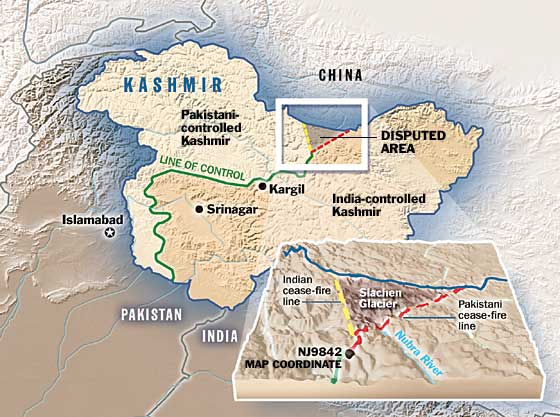
With the tragic news of 150 Pakistani soldiers buried alive in an avalanche in the Pakistan base camp at Siachen, it brings back to memory the bitter truths about this conflict.

The glacier:

  • Siachen means ‘the place of wild roses’.
  • Siachen glacier is the great Himalayan watershed that demarcates central Asia from the Indian sub-continent, and that separates Pakistan from China in this region.
  • It is the world’s second longest non-polar glacier, and thus is sometimes referred to as the third pole.
  • It is 70 km long and flows from an altitude of 5750 meters to 3620 meters above sea level.

The conflict:

  • Siachen is known as the world’s highest battlefield between #India & #Pakistan. Troops are deployed at elevations of up to 6,700 metres (22,000 feet) at minus 60 degrees C.
  • Siachen conflict began in 1984 when both India and Pakistan, began sending mountaineers, in an attempt to lay their claims over the area. Several skirmishes took place till 2003 when a cease fire was declared.
  • The roots of the conflict over Siachen lie in the non-demarcations on the map northward to the China boundary beyond NJ9842, which is the line’s “dead end” in the India-Pakistan line of control agreement.
  • The 1949 Karachi agreement and the 1972 Simla agreement presumed that it was not feasible for human habitation to survive north of NJ9842.
  • UN officials presumed there would be no dispute between India and Pakistan over such a cold and barren icy wasteland.
  • The contentious area is only 900 square miles (2,300 km2)
  • Indians control the length and heights of the glacier including the three passes, while the Pakistanis control the glacial valley. As a result, Pakistanis cannot climb up, and Indians cannot come down.
  • Together, the two nations have about 150 manned outposts along the glacier, with some 3,000 troops each.
  • Over 2,000 Pakistani & 4,000 Indian soldiers have died at Siachen conflict. More soldiers have died or handicapped from frost bites, cold and avalanche i.e. harsh weather than combat.
  • Official annual figures for maintaining these outposts are put at $300 and $200 million for India and Pakistan respectively.

The strategic importance:

No matter what India and Pakistan may claim about its strategic importance, Dr. Stephen Cohen, a well-known and respected Washington-based South Asia analyst, considers,

“Siachen conflict is a fight between two bald men over a comb.”

In his view, “Siachen… is not militarily important… They (Indian and Pakistani armies) are there for purely psychological reasons, testing each other’s ‘will’.”

The talks for demilitarisation of Siachen did take place between India and Pakistan in May 2011, but fialed to reach any agreement.

The truth remains that this stretch of icy wasteland holds no political or economic importance to the billion and a half residing on both sides of the border.

Instead of being a battle ground, Siachen should be demilitarized, and to evade the unresolved dispute of AGPL ( actual ground position line) the area could be seen as a ‘common ground’ precious enough to study and conserve the glacier which is under threat due to the climate change. This can easily stand as a symbolic Peace Park. And the billions of rupees used to maintain its cost as outpost for armies should be directed at improvement of the plight of the impoverished peoples on both sides.

Or better still let ordinary youth from both sides of the border play kabaddi in snow.

It’s just a Menopause !


Menopause simply means:
*A woman will not be having periods anymore. Hence she will not be able to get pregnant. It certainly does not mean that she has lost her womanhood or feminity.

Menopause is that point in time when periods stop forever. You can know that you had a menopause, only after a year has passed, and the period has not resumed.
Usual age for menopause is 51 years. (But it can be upto 55 years. Those who have before 40 have early menopause.)
Before the period actually stops, a woman undergoes some change in life symptoms. This period of transition is called PERIMENOPAUSE

Why is it important for you to know about menopause?

The change in menopause can be divided into Short term and Long term.

In the short term:

It is important to know in advance that while approaching menopause a woman undergoes certain physical and psychological symptoms, whose awareness helps her and her family (especially the spouse) to understand her situation and tackle it better.
• Periods start to get more and more irregular about 4-5 years prior to menopause. Some get it scanty, while in some they become heavy due to hormonal imbalance.
• Woman may feel sudden feeling of a heat wave and then sweating, called Hot Flashes. They can come anytime in the day, at night f during sleep, and can be very annoying to the woman. It is mainly because of the fluctuating hormone levels in the body.
• Mood swings may occur, with crying spells and even depression in some.
• Dryness and thinning in the vaginal walls, difficulty in holding capacity of urine,
• Stress, trouble sleeping, forgetfulness and feeling of laziness- if you are not prepared for the menopause mentally and physically.

MYTH 1: That menopause will make a woman less interested in her sexual life. It may happen with some, but for some others, they feel more relaxed as there is no fear of getting pregnant.

MYTH 2: In the late forties when the periods get irregular, many women think they will not get pregnant anymore and get relaxed on using birth control. This often causes them to get pregnant unexpectedly. Hence, do not stop contraception unless periods have completely stopped.

In the long term:


It is very important to  realise that with the present life span of 70+ years now the woman spends at least ( if not more) a third or 40% of their life after menopause. Hence it is important to know how to stay healthy in this period of life.

• A woman becomes as vulnerable to heart disease as any man, as high oestrogens previously protected her from heart attacks or stroke.

• With menopause the bone density goes down rapidly and a woman after some years may develop thinning of bones called Osteoporosis
(Osteoporosis is a serious problem. If not taken care this can have serious after effects. Check for it in the next blog).

What should you do?


Know that menopause is a normal change in a woman’s life and it has to come when you are around 50. Hence better be mentally and physically prepared for it.

What preparations do you need to do?


EASY: If not earlier, when you enter into forties, MAKE A CHANGE IN YOUR LIFESTYLE.

STEP 1: Exercise, exercise, exercise:

Benefits of exercise are too many:
• This make menopausal symptoms less severe
• It will keep heart healthy after menopause
• Prevent bone loss or osteoporosis after the menopause
• Will prevent weight gain after menopause.

STEP 2: Stop smoking, reduce on tea and coffee- as they all increase bone loss, smoking increases risk of heart disease.

STEP 3: Take Vitamin supplements, especially Calcium and Vitamin D. The daily dose required for women around 50 is Calcium 1200 mgs and Vitamin D 800 micrograms.

STEP 4: Keep reminding yourself, menopause hasn’t taken your womanhood away or that you are old. Keep a good sense of humour and consider it a good change.

TIP: It is likely the time when children are older, or may even leave home …so empty nest syndrome can make you feel more depressed. Develop hobbies which will keep you stimulated and stress free. If the children have grown up and you have fewer responsibilities, do think of dedicating some time to public service and giving back to the society.
Hint: teach a poor child, join a social work, etc.

Is there any treatment of menopausal problems?

If tolerable, the symptoms may need no treatment and just reassurance. But if unbearable, you need to SEE A DOCTOR  for advice or medications.
The most immediate problem during the menopause to most women is HOT FLASHES. To minimize them:

• Try to avoid things that may trigger hot flashes, like spicy foods, alcohol, caffeine, stress, being in a hot place.
• Dress in layers, and remove some when you feel a flash starting.
• Use a fan in your home or workplace.
• Try taking slow, deep breaths when a hot flash starts
• There are medications too to help in hot flashes, but for that you need to see a doctor.

For vaginal dryness or discomfort there are water based gels or oestrogen creams, which help, and can v be asked from a doctor’s advice.

The main problem is however the long term bones loss. But this can be prevented too.

  • To keep your bones strong, you need weight-bearing exercise, suchas walking, climbing stairs, or using weights.
  • You can also protect bone health by eating foods rich in calcium and vitamin D, or by taking calcium and vitamin D supplements.
  • Not smoking also helps protect your bones.

Are there Alternative Therapies?  

There are certain herbal and natural remedies too. eg Soy which contain natural phyto oestrogens in foods like Tofu, soya milk, soya beans. There are other names too like black cohosh, Oil of evening primrose etc, but they have not n been well researched. Do talk to your doctor before taking them, in case they clash with your medications.

CAUTION: After you have had a menopause, if ever the period returns, it is not a normal period. It could be something serious causing the bleeding. Hence do not ignore and show to your doctor as soon as possible.

Last of all: Maintain high spirits, and good sense of humor. Do not think this as a negative change in life. Return to your childhood, playfulness is possible. 

O’ the wandering mind ~Kabir


Kabir has hardly spared any animate and inanimate examples to ridicule the bigots who have great illusions about their self image and through their beliefs repeatedly,  make a fool of themselves.
In the same spirit, I came across yet another simple yet interest verses.

Poem 1: 

Apanpo aap hi bisaro.
Says Kabir, they  fall prey to their  own illusions and forget the essence of our existence.

Jaise sonha kaanch mandir me, bharamat bhunki paro.
Just as dog who enters the house of mirrors, goes crazy barking at the images, considering them different. This is a very curious satire on those bigots who bark at other bigots, thinking they are different, but in essence are reflections of each other.

Jyo kehari bapu nirakhi koop jal, pratima dekhi paro.
A lion looks deep into the well, and mistakes his own reflection as another lion, and jumps into it. This also satires on the ‘lions’ of different faiths, who are such egoists, that they destroy themselves, in challenging other ‘lions’ in the business. The current sectarian bigots could be appropriate here.

Aisehi madgaj phaTik sila par, dasanani aani aro.
An elephant, so proud of its strength, bangs his head against the rock, and hits it with his teeth. Here rocks could be interpreted as hard, rock like beliefs which they bang their heads against.

MarakaT muThi swad na bisare, ghar-ghar naTat phiro.
A greedy monkey for whom the food in the pot is not enough, and goes from home to home asking for more. This is perhaps reference to looking outwards, though we could easily content with what is with us.

Kah Kabir lalani ke suwana, tohi kaune pakaro.
Says Kabir, their logic is as impossible to catch as the parrot of a village girl. Here he gives a satire of those who keep repeating mindlessly like a parrot, with no logic what so ever.

And then in contrast to the satire, many verses of Kabir bring home the message through simple, day to day examples, of how should we be viewing our beliefs, and the essence of our existence.

Poem 2: 

Man tu maanat kyu na mana re.
O’ the wandering mind, why don’t you understand?

Kaun kahan ko, kaun sunan ko, dooja kaun jana re.
Who is worth to speak or to listen, when there is ONE truth.
Here he refers to perhaps the various claimants of ONE, and give it different names and forms.
( The next verse makes it clearer)

Darapan me pratibimb jo bhase, aape chahu disi soi.
He is all round in every atom, the way there is a reflection in every mirror.
( This could be compared to the idea of sheesh mahal—made of tiny mirrors all around one image is seen in each and every tiny mirror)

Dubidha mite, ek jab howe, tau lakh paawe koi.
If you get ONE truth, you will get contentment worth a million, and the confusion of mind will go away.

Jaise jal se hem banat hai, hem ghoom jal hoi.
The way ice is first made of water, then returns back to the same water.

Taise yah tat wahu tat so, phir yah aru wah soi.
In the same way, we are all come from that truth, and unto the same truth we have to return to.

Jo samajhe so khari kahat hai, na samajhe to khoTi.
Those who get this, call this a stark truth. Those ignorant who don’t get this, consider it falsehood.

Kah Kabir khara pakh tyaage, waaki mati hai moTi.
Says Kabir, one who gives up the essence of truth, his brain is thick ( stubborn).

It is remarkable how Kabir talks of evils of bigotry, unity of mankind and the true spirit of secular spirits, rising above the superfluous divisions in the dark ages.

Or perhaps, we are living in darker ages.

Indeed, it is a long road, before Kabir’s examples and teachings become irrelevant to the current times.

The Kabir bhajan below, again, gives some more examples through which he challenges the bigots. Note the translation subtitles. This is my favourite tranquillising Kabir song. 

Lawn ki kahani, meri zubani ( The story of Lawn in my words)


Published in TheNews Blog : http://blogs.thenews.com.pk/blogs/2012/03/21/story-of-a-lawn-hater/

Designer lawn, designer lawn, designer lawn!

Every Sana, Nida and Hina is coming out with designer lawns.

Thankfully never a fan of lawn as a material, it does not awaken the woman in me.

However I remember my mother, who lives in Delhi, where summers are really biting, once came back from a trip to Pakistan in mid 80s, all excited, for having discovered a wonder cloth. She is a woman with sensitive skin, and sweat rash (garmee daaney, as we call it in desi jargon) was what she had to struggle with each Delhi summer.
Fed up of wearing starched Khadis (hand spun cotton) and malmals (muslin) in the sweltering heat, she said she found something which was soft, low maintenance, colorfast and did not need any starching. The picture she painted with her descriptions and expressions got me really curious to open up her suitcase and dig out the jewel, basically to choose which one was mine.

The result that came out of that digging was so befitting to the Hindi idiom “Khoda pahaar per nikla chooha aur woh bhi mara hua”
(From the digging came out a dead rat).

The first look of it was totally unappealing –bold designs on the shirt piece, with its giant replicas on the dupatta. Didn’t need to check the third of the half a dozen three piece suits she brought.

“What’s wrong with your taste? Ammi you’ll wear this?”

“They are so comfortable. And most of all they are so reasonable. One suit costs just Rs 225.”


She didn’t even bother to comment about my ‘taste’ rant.

From then on, I saw her pass all the worst days of summers in lawn suits. And when I got married in Pakistan (perhaps she must have prayed for this secretly for her own vested interests) all she wanted from me each visit was…”bring lawn ke suits, so that meri garmiyaan nikal jaayein.”

I remember from 1990 onwards, buying them for Ammi from Rs 250, Rs 450, Rs500, then Rs1000,  1200, 2500, and last I got for her was Rs 3500. Agree that with time, along with the prices, the designs evolved too. And they certainly got better.

But each time, Ammi felt uneasy with the price escalation. At the 3500 one she told me, “Enough, I don’t need a dress at this exorbitant price just to soak my sweat.”

And now with the advent of designer tag they have graduated to even five digit prices (at the higher end). And they usually begin from 4,000 going upto 12,000, I am told.

I remember some 2 years ago, hearing two cousins talking of outlets where they got the same designs as the big brands copied at much lower prices.

“The original is so expensive, so I buy the duplicate ones.”

“Even the previous year’s designs are available at cheaper price,” said the other.

Yes, but you know there is a teacher in my school who thinks she is very  smart. She instantly recognizes, ‘ye to pichle saal ka design hai’. So I can’t wear that. But woh kaminee tou isko bhi pehchaan jaati hai, ke ye duplicate hai.’

“Why do you need to copy? Or in fact wear designer lawn at all”, I asked.

She rubbished my question and moved on to some other topic.

This is certainly not to act snobbish, but I certainly find it hard to fathom the compulsion to owe one’s allegiance to these ‘disposable’ pieces of cloth which are so short term that they become obsolete the next season.

If I have so much money to spare( 5-7,000+ on a dress) , I will perhaps invest in a piece I can cherish for longer, and if you ask my secret desire, it would be on something I can pass on to my daughter. And indeed I have done exactly by getting hold of  some beautiful pieces with  Baluchi, Afghani or Sindhi hand embroideries.

Dump my hard earned money into a casual wear lawn suit which won’t last the next summer—no way.

In the background of so much disinterest for the designer fad, I was made to see this disgusting ad ( see the bottom pic) by a twitter pal.

And this perhaps was the boiling point of my emotions,  for the ‘designer lawn’ and hence I decided to blog my disdain for them.

With all the designer hype or price escalation, the brand had the audacity to show their product with coolies in the background.

What did they wish to relate to?

Was it the quality of attire in comparison? Oh ! Theirs is so simple, non designer unlike mine. Yet in my two dim visioned eyes, the poor men’s is the rawest of  cottons.

Or

Was it about the worth of one’s labour? Oh look at us, how much we get for the every drop of sweat we shed in the labor for those ‘designs’. 

Or

Was it about the matching colors?

But then, Buddhist monks and  Hindu sadhus too wear the color similar to the woman’s. With ‘Muslims’ as their major market, it was too much of a risk to take.

Oh,  yes, the coolies do not prick anyone’s sensitivity, so were  pretty risk free to have as a background.

Kudos to the imaginative  Advertising Company that thought of this ad and flexibility of the Designer Textile Company that approved of it and owned it.

To me personally this was absolutely nauseating…akin to showing middle finger to the poor fellows in the background.

So rightly had someone commented: “Thank you for hiding their faces with your brand name.”

Hats off to the Feudal mindset, yet another common man’s commodity, the lawn, has turned into an elitist product. Of course in business jargon this is called as ‘value addition’. So what if it gets unaffordable to the vast majority, at least it looks coool ( with a triple o) !

How I wish we did some value addition to Islam too, in Pakistan?

On a second thought, haven’t we?

With the  tags of suicide bombs, Ahmedi hate, Shia kafir rants, we have made it a brand which ordinary Muslims like me find hard to afford.