Open up your mind and your potential reaches infinity…

Archive for the ‘Music’ Category

O’ the wandering mind ~Kabir


Kabir has hardly spared any animate and inanimate examples to ridicule the bigots who have great illusions about their self image and through their beliefs repeatedly,  make a fool of themselves.
In the same spirit, I came across yet another simple yet interest verses.

Poem 1: 

Apanpo aap hi bisaro.
Says Kabir, they  fall prey to their  own illusions and forget the essence of our existence.

Jaise sonha kaanch mandir me, bharamat bhunki paro.
Just as dog who enters the house of mirrors, goes crazy barking at the images, considering them different. This is a very curious satire on those bigots who bark at other bigots, thinking they are different, but in essence are reflections of each other.

Jyo kehari bapu nirakhi koop jal, pratima dekhi paro.
A lion looks deep into the well, and mistakes his own reflection as another lion, and jumps into it. This also satires on the ‘lions’ of different faiths, who are such egoists, that they destroy themselves, in challenging other ‘lions’ in the business. The current sectarian bigots could be appropriate here.

Aisehi madgaj phaTik sila par, dasanani aani aro.
An elephant, so proud of its strength, bangs his head against the rock, and hits it with his teeth. Here rocks could be interpreted as hard, rock like beliefs which they bang their heads against.

MarakaT muThi swad na bisare, ghar-ghar naTat phiro.
A greedy monkey for whom the food in the pot is not enough, and goes from home to home asking for more. This is perhaps reference to looking outwards, though we could easily content with what is with us.

Kah Kabir lalani ke suwana, tohi kaune pakaro.
Says Kabir, their logic is as impossible to catch as the parrot of a village girl. Here he gives a satire of those who keep repeating mindlessly like a parrot, with no logic what so ever.

And then in contrast to the satire, many verses of Kabir bring home the message through simple, day to day examples, of how should we be viewing our beliefs, and the essence of our existence.

Poem 2: 

Man tu maanat kyu na mana re.
O’ the wandering mind, why don’t you understand?

Kaun kahan ko, kaun sunan ko, dooja kaun jana re.
Who is worth to speak or to listen, when there is ONE truth.
Here he refers to perhaps the various claimants of ONE, and give it different names and forms.
( The next verse makes it clearer)

Darapan me pratibimb jo bhase, aape chahu disi soi.
He is all round in every atom, the way there is a reflection in every mirror.
( This could be compared to the idea of sheesh mahal—made of tiny mirrors all around one image is seen in each and every tiny mirror)

Dubidha mite, ek jab howe, tau lakh paawe koi.
If you get ONE truth, you will get contentment worth a million, and the confusion of mind will go away.

Jaise jal se hem banat hai, hem ghoom jal hoi.
The way ice is first made of water, then returns back to the same water.

Taise yah tat wahu tat so, phir yah aru wah soi.
In the same way, we are all come from that truth, and unto the same truth we have to return to.

Jo samajhe so khari kahat hai, na samajhe to khoTi.
Those who get this, call this a stark truth. Those ignorant who don’t get this, consider it falsehood.

Kah Kabir khara pakh tyaage, waaki mati hai moTi.
Says Kabir, one who gives up the essence of truth, his brain is thick ( stubborn).

It is remarkable how Kabir talks of evils of bigotry, unity of mankind and the true spirit of secular spirits, rising above the superfluous divisions in the dark ages.

Or perhaps, we are living in darker ages.

Indeed, it is a long road, before Kabir’s examples and teachings become irrelevant to the current times.

The Kabir bhajan below, again, gives some more examples through which he challenges the bigots. Note the translation subtitles. This is my favourite tranquillising Kabir song. 
Basant, a festival beyond beliefs


On 27th January, 2012 India celebrates Basant panchami.
In Pakistan, it is celebrated towards the end of February.  

Towards the end of January till early March, the golden harvest of wheat stand tall ready to be harvested sometime in early April.  And wheat is our staple crop.

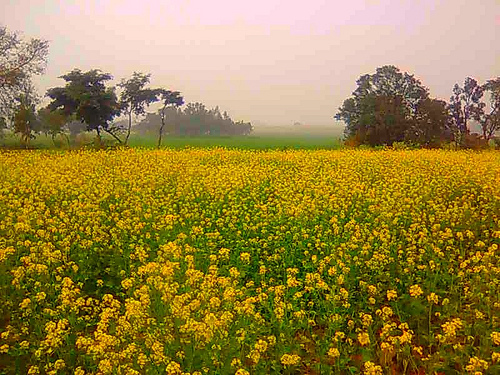
At the same time in Januray February the yellow blooms of mustard ( better known as sarson) sway in the fields, as far as eyes can see. And mustard is a cash crop whose seeds are pressed to extract mustard oil.

To celebrate these awesome blooms as a reward for the fields ploughed and the seeds sown  in October, the farmers rejoice, sing, dance and make merry.

Some of them wear yellow turbans, and their women folk adorning yellow ‘odhnis’ come out to join in the celebrations. It is not hard to imagine that they must be celebrating the blooms, ever since they learnt to farm these crops dating back to centuries.

This is the basic root and the spirit of the tradition of Basant in parts of Indian subcontinent where these crops are grown.

Are wheat, or mustard crops Hindu, Muslim or Sikh?

Vasant in Sanskrit or  Basant in Urdu mean ‘spring’, which heralds the departure of winter and arrival of spring. It symbolizes the time of rejuvenation and arrival of happiness as flowers start to smile through their blossoms.

Yellow, the color of Basant, inspired by mustard blossoms, which matches the shade of sun rays, signifies life and radiance.

Do rays of sun or radiance of happiness differentiate between Hindus, Muslims or Sikhs ?

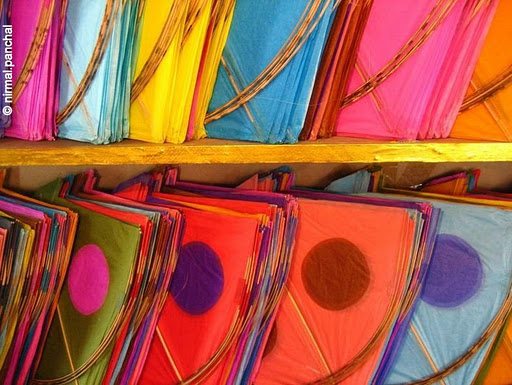
Kite flying , another component of basant, has it’s own interesting tale to tell.

“Kite flying also reveals how the tradition evolved over centuries and in a Ganga Jamuni way.
Kite flying was introduced to the Indian subcontinent by the Chinese traveller Heun Tsang in the 4th Century. Evolving for centuries, it s modification into its current form and popularisation as a sport was made possible by the Nawabs of Avadh. The kite flying during basant celebrations is believed to have been introduced by Maharaja Ranjit Singh in the 18th century.”

Yet another evidence of centuries old and secular celebration of Basant come from poets, Kalidas and Amir Khusro, who have written about the celebrations of Basant in their own unique styles.

Kalidas in a poem Spring writes:
द्रुमाः सपुष्पाः सलिलं सपद्मं
स्त्रियः सकामाः पवनः सुगन्धिः ।
सुखाः प्रदोषा दिवसाश्च रम्याः
सर्वं प्रिये ! चारुतरं वसन्ते
Oh, dear, in Vasanta, Spring, trees are with flowers and waters are with lotuses, hence the breezes are agreeably fragrant with the fragrance of those flowers, thereby the eventides are comfortable and even the daytimes are pleasant with those fragrant breezes, thereby the women are with concupiscence, thus everything is highly pleasing…

AmirKhusro pens down:

Aaj basant manaalay suhaagun,
Aaj basant manaalay;
Anjan manjan kar piya mori,
Lambay neher lagaaye;
Tu kya sovay neend ki maasi,
So jaagay teray bhaag, suhaagun,
Aaj basant manalay…..;
Rejoice, my love, rejoice,
Its spring here, rejoice.
Bring out your lotions and toiletries,
And decorate your long hair.
Oh, you’re still enjoying your sleep, wake-up.
Even your destiny has woken up,
Its spring here, rejoice.

There is an Indian classical  music tune  called Raag Basant Bahaar.

Not to forget, basant in the subcontinent is also associated with a special sweet prepared specially for the occaision –the kesar halwa,
It is a suji ( semolina) halwa with a soft aroma and yellow shade from saffron and garnished with cashew nuts.

Neither the dessert, nor the poetry above nor the music below suggest if Basant is Hindu or Muslim or Sikh.


The same spirit is also replicated by this beautiful ghazal by Malika Pukhraj and Tahira Syed

Lo phir basant aayee…

P.S. Special thanks to Sandeep@stwta a twitter pal for the devnagiri  text of Kalidas poetry.

Let’s celebrate for Peace–in South Asia and in the whole World


What a beautiful song with lyrics by Nida Fazili, music by Jagjit Singh, and  singers from India ( Jagjeet Singh, Sonu Nigam etc.), Pakistan ( Ghulam Ali, Mehdi Hasan, Iqbal Bano) and Bangladesh( Runa Laila), and rest of the World singing together for the New Year.

Naya saal ho aisaa ab ke
Rang bhare jeewan mein sab ke
Sooraj ghar ghar dhoop bikhere
Chand sajaye sab ke andhere

Kheton mein faslein lehraayein
Nadiya sab ki pyaas bujhayein
Jurey rahein sabke rishtey
Juda na ho bhai se bhai
Naya saal ho sabko Mubarak
Naye saal ki sabko badhaii..

Urein kabooter khuli hawa mein
Naache chham chham more ghata mein
Seemaon mein bante na dhartee
Faujon mein kam kam ho bhartee

Sona jhoomer ban ker damke
Chandi payal ban ker barse
Naye saal ki sabko badhai

Chhape kitaabein, khulein dukanein
Chire kahin na aur laraiii
Naye saal ho sabko Mubarak
Naye saal ki sabko badhai

Celebrate, make it a special one
Let’s speak -one promise,
Let’s celebrate, for our future
For our children’s sake , let’s celebrate.

WISHING YOU ALL A VERY HAPPY NEW 2012 FOR THE PEACE IN SOUTHASIA, IN THE WHOLE WORLD

Continuation of a joint heritage


Published in Aman Ki Asha , in TheNews on December 14, 2011. http://amankiasha.com/detail_news.asp?id=584

Ilmana Fasih recounts some examples of the ‘Ganga Jamuni Tehzeeb’ and centuries’ old, peaceful coexistence beyond religious divides

An otherwise sane looking person I met at a party recently started to spew venom laced with conspiracy theories about “Hindu Muslim animosity”. To top it all, he tried to use my own life to justify his views, insisting that my going

to live in Pakistan after marrying a Pakistani was proof of the natural divide. He refused to accept my views that a peaceful coexistence between people of different faiths is possible or that my going to Pakistan from India was not based on religious reasons.

His hate-filled thoughts kept me sleepless for hours that night. But talking over the phone to my mother in Delhi later, I was cheered up by her mention of Ganga Jamuni Tehzeeb. Our conversation triggered off thoughts about this beautiful, fluid culture that refuses to be boxed up and compartmentalised.

The name Ganga Jamuni Tehzeeb is as beautiful as its spirit. It refers to the centuries’ old, peaceful coexistence between Hindus and Muslims of the subcontinent. Not only did the two faiths borrow cultural practices from each other, but they also exchanged each other’s vocabularies. So much so that now one is hardly able to find any difference between spoken Urdu and spoken Hindi.

The Nawabs of Awadh in north India in the 1700s are considered the pioneers of Ganga Jamuni Tehzeeb. At least, the term was coined in their times. But on ground it existed well before that era.

The starkest example of this syncretic culture is the Purana Hanuman Mandir in Lucknow, which is crowned by an Islamic symbol, a crescent. According to legend, the temple was built by Nawab Saadat Ali Khan to honour the wish of his mother, who had dreamt of building a temple. The tradition of honouring the Nawab’s gesture still continues when the Muslims in the area put up stalls of water during the Bada Mangal festival at the temple, and Hindus manage sabeels (stalls) of sherbet and water during Muharram in reverence for Imam Hussain.

Not far from Lucknow, the rulers of the Hindu holy city of Kashi (also known as Benaras or Varanasi) observed the Azadari (the mourning) during Muharram, wearing black on Ashura. Ustad Bismillah Khan, the renowned Shehnai maestro, began his career as a shehnai player in Vishwanath temple, Kashi. In fact, many of the musicians, Hindu and Muslim, who play in the temples, fast during Ramazan and also observe Vrat during the Hindu Navratras.

Even today, Muslim artisans in Kashi/Varanasi who make Taziyas for Muharram also make effigies of Ravan for Dussehra, a friend tells me. Hindus too participate in Muharram processions and make Taziyas in many cities, notably Lucknow.

Similarly a Sindhi friend talks of the centuries-old peace and harmony between the Hindus and Muslims of Sindh. Adherents of both faiths revere and pray together at the shrine of Jhuley Lal, she says. The shrine walls are inscribed

with Arabic verses as well as Hindu names of Gods. An age-old common greeting of Sindhi Hindus and Muslims is “Jhulelal Bera-Hee-Paar”.

Karachi’s 150-year old cremation ground for Hindus has a Muslim caretaker, although there are many Hindus in the city. This caretaker is responsible for cleaning the statues and lighting the lamps in the temple, and takes care of the urns that contain the ashes of the dead after cremation, until their loved ones immerse the ashes in water.

Cultural practices in Sindh are a fusion of the two cultures. If the Hindus, fervently use Allah as the reference to God, the Muslims touch the feet of their elderly as traditions borrowed from each other’s cultures.

The contribution of Sufi poetry towards this peaceful coexistence, from Kabirdas and Amir Khusro, to Bulleh Shah on the other side, is well known.

Beyond faith, at the cultural level, the Ganga Jamuni Tehzeeb has seen some beautiful creations like the Ghazal style of singing and the classical dance form Kathak.

Kathak’s journey from ancient times to its present form merits a walk-through. The word “katha” comes from “katha” or story telling. It has its roots in ancient times, when storytellers narrated epics or mythological stories like Shakuntala, and the Mahabharata through dance forms in temples. However with the arrival of Mughals, the dance, enticed to come to the courts, developed into a more Persianised form. The Kathak dancers adopted the whirling

from the dervishes to the ‘chakkars’. The rhythm of the footsteps found harmony with the beat of the tabla recently discovered by Amir Khusro. The female Kathakaars (storytellers) abandoned the sari of ancient times for the angarkha and churidar pyjama. The language of narration also transformed from Sanskrit to Brij Bhasha and then Urdu.

There may be more examples of such coexistence and development in other regions of the subcontinent too.

Those who propagate conspiracy theories and narrate stories of hate and disharmony need to know that even with the physical separation between India and Pakistan, the spirit of Ganga Jamuni Tehzeeb lives on. The lack of communication between the two countries, particularly after the 1965 and 1971 wars, has not managed to dampen the natural instincts of sharing these cultures.

Farid Ayaz and Abu Muhammed, the renowned Qawwals from Pakistan continue to sing Bhajans which their gharana has been singing for the last 300 years. On the other side are Wadali brothers who sing Bulleh Shah Kaafis and Naats with the same devotion. Despite all odds, Sheema Kermani and her students in Pakistan have continued to keep the dance forms, not only of Kathak, but also Bharatnatyam and Odissi, alive and known in Pakistan.

The recent collaboration between Zeb and Haniya from Pakistan and Shantanu and Siwanand Kirkire of India yielded the soft melody “Kaho kya khayal hai” in a beautiful blend of Dari and Hindi. I could not help relate it to the Zehaal-e-Miskeen composition by Amir Khusro which was a beautiful fusion of Persian and Brij Bhasha.

And now another peacenik in the form of Shahvar Ali Khan makes a music video titled ‘No Saazish No Jang’ (No Conspiracy, No War). It is heartening to see the visuals, and hear the voices of Quaid-e-Azam Mohammed Ali Jinnah and Bapu Mahatama Gandhi together in the backdrop.

It is not possible to list all collaborations between the two countries and across religious divides, particularly in fields of films, music, health (the most significant being the Heart to Heart initiative by Rotary and Aman ki Asha). But all these initiatives testify to the desire for peace, not hate.

As for me, convinced that each of these efforts towards peaceful coexistence is based on foundations going back centuries, I slide into my bed, comforted by the faith that peace, not hate, will ultimately prevail.
It’s just a matter of time.

Dr Ilmana Fasih is an Indian gynaecologist and health activist married to a Pakistani. Her blog is Blind to Bounds https://thinkloud65.wordpress.com/

Tansen, the legend.


Tansen, the father of Hindustani Music, was a music genius since early childhood. He became a court musician and one of the nine gems of Emperor Akbar. He not only composed music, but wrote the lyrics too. Impressed by his exceptional musical talent he was given the title of Miyan Tansen by the Emperor Akbar.

Tansen is known to have polished and popularised the oldest form of Indian music called Dhrupad( which could be traced back to Vedic times). It was his times that Dhrupad reached it’s peak.

Most of the music composed by him are referred with a “ Miyan ki”prefix, eg Miyan ki Todi, Miyan ki Malhar, Miyan ki Mand and Miyan ki Sarang. He is also credited to have created certain other court ragas( traditional melody) like Darbari Kanada, Darbari Todi, and Rageshwari.

Tansen performed in the courts of Akber. He also performed for the emperor alone. At night he sang ragas that would soothe and help the emperor sleep. In the morning he would sing morning ragas to awaken the emperor fresh and cheerful.

There are various legends attached to Tansen.

It is believed that his music was so captivating that even animals and birds would stop to listen to him. There is an interesting story of a white elephant being caught for the Emperor to ride. But the animal was uncontrollable and untameable. So Tansen sang to the elephant and calmed it down, so that the Emperor could ride.

It is said that his created ragas  would cause different effects e.g. such as cool the environment and attract clouds  that it would induce rain ( Rag Megh Malhar) or heat up the environment to cause fire ( Rag Deepak).

Once Emperor Akber insisted that he sing Rag Deepak in the court to prove that his music had the said effect. Tansen begged a fortnight before he would sing the raga. In this duration he made his daughter Saraswati, learn the Rag Megh Malhar.

And then the day arrived when he began to sing Rag Deepak in the Emperor’s court.

Unlit lamps were placed in the court.

As Tansen began to sing, the air around started to get warm, then warmer. The audience started to perspire. The flowers dried; including the famous rose bud that Akber is famed to have held in his hand in court. The water fountain in the courtyard began to steam up and the flames of fire could be seen flashing in the air, while the lamps lit up.

As this happened, his disciple and daughter, was directed by him to start singing Rag Megh Malhar ( the music that induced rain).

In a few minutes the cold breeze started to blow. The clouds came and overcast the sky. The music waves caused the clouds to thunder and while the rag Deepak induced lightening. And soon the heavy showers began to pour over the place, and put off the flames.

How it is said that this down pour could not put down the internal fire that was lit within Tansen while he sang Rag Deepak. And he fell ill, with very high fever, and in a few months died of the ailment.

Grieved by his death, his son Bila Khan began to sing Bilas ki Todi, based on his raga Miyan ki Todi. He sang so well that the dead Tansen’s hand rose to signal praise for the son.

One wonders not only at the likelihood of these legends being true, but also at how did these legends , which have now become part of Tansen history, come into being.

Below is the song based on Rag Deepak, picturised in an Indian movie made on Tansen.

Beshno az ney (O’Listen to nay)~Rumi


So far this is one  the best music post on my blog: 

A Masnawi by Rumi 

Jelaluddin Rumi was a Sufi mystic poet originally from Balkh Afghanistan, but his family travelled west. First performing Hajj they moved further west to finally settle down in Konya, Anatolia( now Turkey). He spent rest of his life there, composing  poetry.

Farsi ( Persian):

Beshno az ney chon hekaayat mikonad
Az jodaayee ha shekaayat mi-konad

Kaz neyestaan ta maraa bebrideh and
Dar nafiram mardo zan naalideh and

Sineh khaaham sharheh sharheh az faraagh
Ta begooyam sharheh dardeh eshtiyaagh

Har kasi ku door maand az asleh khish
Az jooyad roozegareh vasleh khish

Man be har jamiyati naalaan shodam
Jofteh bad haalaano khosh haalaan shodam

Har kasi az zanneh khod shod yaareh man
Az darooneh man najost asraareh man

Serreh man az naaleyeh man door nist
Lik chashmo goosh ra aan noor nist

Tan zeh jaano jaan zeh tan mastour nist
Lik kas ra dideh jaan dastour nist

Aatash ast in baangeh naayo nist baad
Har keh in aatash nadaarad nist baad

Aatasheh ishq ast kandar ney fetaad
Jooshesheh ishq ast kandar mey fetaad

Ney, harifeh har keh az yaari borid
Pardeh hayash pardeh hayeh ma darid

Hamcho ney zahri o taryaqi keh did?
Hamchon ney damsaaz o moshtaqi ke did?

Ney hadiseh raheh por khoon mikonad
Qesseh hayeh eshq e majnoon mikonad

Mahrameh in hoosh joz bihoosh nist
Mar zaban ra moshtari joz goosh nist

Dar ghameh ma rooz ha bigaah shod
Rouz ha ba souz ha hamraah shod

Rouz ha gar raft gu ro baak nist
To bemaan , ey aankeh chin to paak nist

Har keh joz maahi zeh aabash dir shod
Har keh bi roozist, roozash dir shod

Dar nayaabad haaleh pokhteh hich khaam
Pas sokhan kootaah baayad, vassalaam

English translation

O’ listen to the grievances of the reed
Of what divisive separations breed
From the reedbed cut away just like a weed
My music people curse, warn and heed
Sliced to pieces my bosom and heart bleed
While I tell this tale of desire and need

Whoever who fell away from the source
Will seek and toil until returned to course
Of grievances I sang to every crowd
Befriended both the humble and the proud
Each formed conjecture in their own mind
As though to my secrets they were blind

My secrets are buried within my grief
Yet to the eye and ear, that’s no relief
Body and soul both unveiled in trust
Yet sight of soul for body is not a must
The flowing air in this reed is fire
Extinct, if with passion won’t inspire

Fire of love is set upon the reed
Passion of love this wine will gladly feed
Reed is match for he who love denied
Our secrets unveiled, betrayed, defied
Who has borne deadly opium like the reed?
Or lovingly to betterment guide and lead?

Of the bloody path, will tell many a tale
Of Lover’s love, even beyond the veil
None but the fool can hold wisdom dear
Who will care for the tongue if not ear?
In this pain, of passing days we lost track
Each day carried the pain upon its back

If days pass, let them go without fear
You remain, near, clear, and so dear
Only the fish will unquenchingly thirst
Surely passing of time, the hungry curst
State of the cooked is beyond the raw
The wise in silence gladly withdraw

Cut the chain my son, and release the pain
Silver rope and golden thread, must refrain
If you try to fit the ocean in a jug
How small will be your drinking mug?
Never filled, ambitious boy, greedy girl
Only if satisfied, oyster makes pearl

Whoever lovingly lost shirt on his back
Was cleansed from greed and wanton attack
Rejoice in our love, which would trade
Ailments, of every shade and every grade
With the elixir of self-knowing, chaste
With Hippocratic and Galenic taste

Body of dust from love ascends to the skies
The dancing mountain thus begins to rise
It was the love of the Soul of Mount Sinai
Drunken mountain, thundering at Moses, nigh

If coupled with those lips that blow my reed
Like the reed in making music I succeed;
Whoever away from those lips himself found
Lost his music though made many a sound
When the flower has withered, faded away
The canary in praise has nothing to say

All is the beloved, the lover is the veil
Alive is the beloved, the lover in death wail
Fearless love will courageously dare
Like a bird that’s in flight without a care
How can I be aware, see what’s around
If there is no showing light or telling sound?

Seek the love that cannot be confined
Reflection in the mirror is object defined
Do you know why the mirror never lies?
Because keeping a clean face is its prize
Friends, listen to the tale of this reed
For it is the story of our life, indeed!

Another version by Farid Ayaz & co which has it’s own desi touch and charm:

Aalu Anday etc.


If you churn the ingredients-adversity, endurance, sense of humour,  imagination and hope into a machine at one end, you will receive Pakistani youth at the other end. Hammered with adverse circumstances one after the other, the hardy rocks of youngsters are  carving themselves into idols of the future.

Endurance is not just the ability to bear an adversity, but to turn it into glory. And laced with sense of humour, their creativity becomes their crowning glory.

Remarks a friend Kamran, “ I’m both amazed and proud of this younger generation of Pakistanis who refused to cow down, who continue to eke out a good time against all odds and do their thing. It’s almost as if nothing’s happening around them when everything is.”

There could not be a more artsy way to show their disdain for the prevailing politicosocial circumstances than through this master piece by the Beygairat Brigade .

There a lot more to this song, than just funny lyrics or catchy music …and is pleasing to know how these ‘kids’ get them conveyed through the briefest of  audios and  visuals. In fact, the name of the band says it all.

It was extremely imaginative of them to depict aalu andey (potatoes & eggs,  the current offering ) what  these youngsters are getting from their Mom( Pakistan), while they wish  Chicken ( their desire for a better deal).

As an  FB friend Rashid aptly describes  the song ( in fewest possible words) , “Song worth thousand articles by sages.”

I salute thee, the Brigade.


Sometime ago, yet another hilarious piece of creation pertaining to the burning issue of load shedding brought a cool breeze to the sufferers through the composition by Load Shedding Studio. They did a superb job in sketching the biography of a load shedding victim aka Pakistan.

Bijli ji !  Great  ji .


“There is no defense against adverse fortune which is so effectual as an habitual sense of humor”,  quotes Thomas Higginson.

And,  when the adverse fortunes become as habitual as they have in Pakistan, then humor becomes  a compulsion. Had there not been the knack in Pakistanis, in general, to laugh at themselves,  who would have been their saviour ? I wonder.

Youngsters, keep scoffing  off  your miseries  through melodious satire, till the true happiness sprouts from the seeds of your efforts.

“Satire, indeed,  like a polished razor keen,
Wounds with a touch that’s scarcely felt or seen.
Thine is an oyster knife, that hacks and hews
With  talent and not  rage, to shun abuse.”

Bravo, keep it up !

Alf Leila O’Leila ~Um Kulthoom


The opening lines of this 45 minute song are:

Ya Habeebi,
My sweetheart.
Illeil wi samah, wi ingomo iw amaro, amaro wi saharo.
The night and its sky, its stars, its moon, moon and keeping awake all night.
Winta wana, ya habeebi ana, ya hayati ana.
You and me my sweetheart, my life.

-And the closing lines:

Ya habeebi yalla in3eish fi 3yoon illeil, . Winool lilshams ta3ali, ta3ali ba3di sana, mosh abli sana.
My sweetheart let us live in the eyes of the night and tell the sun come over, come after one year not before.
Fi leilate hob hilwa, bi alfi leila iw Leila, 
In a sweet night of love, in one thousand and one nights.
Bikolli il3omr, howa il3omri eih ghair Leila zayyi illeila.
They say it is the life. What is life, but a night like tonight, like tonight.

Fortunatley I grew up listening to Umm Kulthoom  and the tales of her live performances from my Professor father. I saw my father 90% times surrounded by books, but whenever he played Umm Kulsoom’s audios on the deck, in his leisure time, it was hard to envision he was the same man. I feel the poverty of expression to describe my feelings…

He would often exclaim that he got three things from his stay in Cairo in the early sixties—his PhD, a knowledge of Arabic, in the flawless Egyptian accent and love for Umm Kulsoom.

In the  1950s and 60s her concerts were broadcast once a week  on Radio.

“On Thursday nights, the streets of Cairo would empty as people gathered around radio sets to hear the great singer.”  I heard my father repeat this a countless times said with a twinkle in his eyes.

And infact, in honour of those broadcasts, Radio Egypt still broadcasts her songs every first Thursday at 10 pm.

It is hard in words to describe her charisma.  But listening to her enchanting Enta Omri,  Alf Leila o Leila and other songs over and over,  it wasn’t hard to imagine the euphoria that was created in her concerts.

Umm Kulthum was, indeed, a master at casting a spell over her audiences.

Maker of a documentary on her, ‘A Voice Like Egypt ’ Virginia Danielson says “Umm Kulthum’s concerts were famous for the spontaneous cheers that would break out whenever her performance seemed to close the gap between poetry and emotion. Poetry is a deeply revered art form in the Middle East.”

She gives an example. “When you hear Umm Kulthum sing, “I’m afraid your heart belongs to somebody else,” in the song “Ana Fe Entezarak,” she nails that anguish.  And the way she treats the word ‘somebody else,’ which is ‘inse’en,’ is just heartrending. You can hear the feeling of the poem come through in the way that she sings it.”

Her music had a unique quality called ‘tarab’ ( best translated as enchantment).

“Tarab is a concept of enchantment,” Danielson says. “It’s usually associated with vocal music, although instrumental music can produce the same effect, in which the listener is completely enveloped in the sound and the meaning in a broad experiential sense, and is just completely carried away by the performance.”

Part of tarab is the idea that listeners are as important as singers; that there’s a powerful, spiritual exchange between them that is crucial to the performance.

“But what it refers to is the experience of really being carried away by the music. People would tell preposterous stories about getting up and leaving the house and not knowing where they were going, and just all kinds of experiences of completely forgetting your troubles, completely being outside yourself, having been transported by the experience.”

Bob Dylan remarked; “She’s great. She really is. Really great.”

She was referred to as the Lady by  Charles de Gaulle and  Salvadore Dali, Jean Paul Satre, Bono were among  her fans.

Lastly, do envy me for having been nourished on this music since very young :).

Jhini jhini bini chadariya…~Kabir


Jhini jhini bini chadariya.

kah ke tana, kah ke bharni, kaun taar se bini chadariya
ingla pingla taana bharni, sushumna tar se bini chadariya.

ashta kamal dal charkha doley, panch tatva, gun tini chadariya
saiin ko siyat mas dus lagey, thonk-thonk ke bini chadariya.

so chaadar sur nar muni odhi, odhi ke maili kini chadariya
das Kabir jatan kari odhi, jyon ki tyon dhar deeni chadariya.

The Lord Supreme has woven a very fine and delicate tapestry,free of impurities of any kind!
What refined and subtle yarn, what complex interlacing, He has used to weave it!

Using veins and breath His threads Twenty four hours on end,His spinning wheel turns,
Weaving the tapestry from all five essential elements.

Ten months does it take the Lord to weave his tapestry,
Using the greatest of craftsmanship, care and skill.

That exquisite tapestry is worn by the celestials,by Saints, and by human beings alike.
But they all invariably have defiled it !

Your humble devotee Kabir has worn it scrupulously and meticulously,
And is returning it to You, O’Lord, unblemished and pure !

Wah ghar sab se nyara~Kumar Gandharv ~Kabir


Sakhiya Wah Ghar Sabse Nyara,
Jaha Puran Purush Humara
Jaha Nahi Sukh Dukh
Sanch Jhuth Nahi
Pap Na Pun Pasara
Nahin Din Reyn Chand Nahi Suraj,
Bina Jyoti Ujyara

Nahin Tahan Gyan Dhyan
Nahin Jap Tap
Ved Kiteb Na Bani
Karni Dharni Rehni Gehni,
Yeh Sub Jahan Hirani

Ghar Nahin Aghar Na Bahar Bhitar,
Pind Brahmand Kachu Nahin
Panch Tatva Gun Tin Nahin Tahan,
Sakhi Shabd Na Tahin

Mul Na Phul Beli Nahin Bija,
Bina Braksh Phal Sohe,
Oham Soham Ardh Urdh Nahin,
Swasa Lekhan Kou Hai

Jahan Purush Tahwan Kachu Nahin,
Kahe Kabir Hum Jana
Humri Sain Lakhe Jo Koi,
Pawe Pad Nirvana

English Translation

Oh Companion That Abode Is Unmatched,
Where My Complete Beloved Is.

In that Place There Is No Happiness or Unhappiness,
No Truth or Untruth
Neither Sin Nor Virtue.
There Is No Day or Night, No Moon or Sun,
There Is Radiance Without Light.

There Is No Knowledge or Meditation
No Repetition of Mantra or Austerities,
Neither Speech Coming From Vedas or Books.
Doing, Not-Doing, Holding, Leaving
All These Are All Lost Too In This Place.

No Home, No Homeless, Neither Outside or
Inside,
Micro and Macrocosm Are Non-Existent.
Five Elemental Constituents and the Trinity Are Both Not There
Witnessing Un-struck Shabad Sound is Also Not There.

No Root or Flower, Neither Branch or Seed,
Without a Tree Fruits are Adorning,
Primordial Om Sound, Breath-Synchronized Soham,
This and That – All Are Absent, The Breath Too Unknown

Where the Beloved Is There is Utterly Nothing
Says Kabir I Have Come To Realize.
Whoever Sees My Indicative Sign
Will Accomplish the Goal of Liberation.

Kabir