
Posting an excellent article on KABIR by Maalok.
Kabir was one of India’s leading spiritual saints who lived in the northern part of India in (and around) the holy city of Benares (also called Varanasi). He is widely renowned for his pithy couplets and songs that connect life and spirituality in a simple yet powerful way. Kabir’s genius has been in that he has inspired the scholars/poets like Rabindranath Tagore and the common masses. His words were in a universal language that, literally and figuratively, broke down barriers to experiencing the divine.
It is intriguing that there continues to be many unknowns about Kabir’s life despite the extensive and global awareness of his verses and sayings. In fact, even basic information on his life – for instance, when he was born, who his parents were, what his family life was like, and when he died – is shrouded in mystery. Indeed, very little appears to be known about him with any degree of certainty. Perhaps, these controversies can be attributed partly to the parochial manipulation of his life history by various religious sects. Hindus want him to be a representative of their religion. They claim that he was born to a Hindu woman, even though he was raised by a Muslim family and that he was a disciple of a Hindu Guru, Ramananda. Some dismiss theories of Kabir’s illegitimate birth by claiming that his birth-mother, even though unmarried, had an Immaculate Conception. Muslims tend to emphasize his Muslim upbringing and his initiation into the Sufi traditions. The celibate/ascetic sects claim that Kabir never married and if evidence of his marriage is presented, they retort that he never had an intimate relationship with his wife. Proponents of tantric traditions point to Kabir’s songs to show that he was influenced very much by the Kundalini practices. Sikh and Shabad-based traditions say that the essence of Kabir’s practice was based on tuning in to the internal sounds, even though they vehemently deny that Guru Nanak was Kabir’s disciple and tend to support the theory that Kabir died before the birth of Guru Nanak. In summary, each sect’s claim on Kabir appears to be self-serving and, hence, cannot be considered as providing reliable information on his life. Indeed, it is likely that divergent viewpoints and claims on Kabir’s life will continue to exist despite the efforts of historians, philosophers and literary scholars to reach consensus.
In my opinion, it is ironic but no coincidence that such conundrums on Kabir’s physical existence persist. Perhaps, Kabir would have liked it that way? He was quite unimpressed and even irreverent to the dogmas of organized religion and society. His essence was far more subtle, pervasive, unconstrained and universal – in short, beyond the boundaries laid down by religious, sectarian and social traditions. In this article, I attempt to humbly share with you my personal understandings and experiences of Kabir that, despite my own biases and limitations, continue to have a life of their own within me.
Kabir, The Man
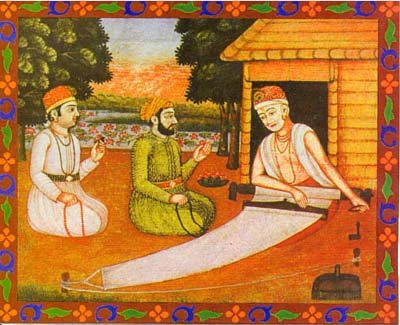
We can safely say that Kabir lived during the 15th or 16th century. Even though his exact birth and death times cannot be ascertained reliably, it is quite likely that he lived beyond the age of 50. It would be reasonable to assume that he was not formally educated because his songs and couplets lack the erudite tone and have a refreshing rustic quality. That he may have been a weaver is evident from his songs and couplets that draw inspiration and metaphors from the weaving profession. It is also likely that he was born and brought up poor and continued to work throughout his life as he strongly upheld the working-to-earn way of life.
It is clear from his songs and teachings that he was a very observant and thoughtful person, who questioned everything that was taught or presented to him. It is likely that he spent considerable time observing nature, as his teachings also draw inspiration and learning from the trees, animals, birds and the ocean. Long-standing traditions of Kabir in the states of Gujarat, Maharashtra, Bengal, Punjab and Madhya Pradesh1 indicate that either Kabir or his leading disciple(s) traveled to those parts, and/or his popularity drew seekers from these parts to come and learn from him and later returned to establish a following in their native areas.
What distinguished Kabir from other “gurus” were his inner conviction and an undying trust in his own self and experience. He seems to have questioned and challenged all scriptural teachings, traditions and rituals, until he himself was able to validate their truth. This, however, should not be taken to imply that he rejected all teachings and practices. To the contrary, given his familiarity with, and his use of stories/teachings from, a variety of traditions, he appears to have openly embraced and accepted any path that could be validated by his own experience. Perhaps, this is why it is so difficult to typecast Kabir into this or that faith or tradition. Sometimes, he was this, sometimes he was that and at other times he was neither this nor that!
What is clear is that Kabir was courageous enough to speak his truth even in face of societal pressures and coercion. From his work, we know that he was quite critical of hypocrisy especially among religious leaders. Even though we cannot ascertain whether he was tolerant of genuine devotees who worshipped physical forms of God, we can be reasonably confident that his own spiritual path was focused more on an internal form of devotion to God and Guru – terms that he often used interchangeably to convey the cosmic force. In essence, the core of Kabir’s life and teachings are based on honesty, truth, conviction and simplicity, renewed continuously by inner experience and propelled by an unceasing detachment from the web of physical and mental realities.
Kabir, The Myth
As we discussed earlier, many controversies exist about Kabir’s birth, upbringing, family life, teachings, practices and death. In my opinion these “myths” are irrelevant to the essence of Kabir. Indeed, I would say that those who are enamored or engaged by these myths are, probably, missing the point. Still, for the record, I would now like to propose clarifications on a few other widely-held beliefs about Kabir.
Kabir is often considered to be a social or religious reformer who tried to bridge the gap among various castes and religious sects. Even though Kabir showed a healthy disregard for conventional boundaries of society and organized religion, his intrinsic pursuit was rooted in spirituality and spirituality alone. In the process of conveying the innate spirituality of all of creation, Kabir, in all likelihood, had to deal with and overcome prevalent parochial barriers. But this ought not to be misconstrued to imply that his intent was to reform society or religion.
Another prevalent myth is that Kabir was primarily a literary figure, a poet and an orator. But, Kabir’s life was deeply ingrained in spirituality, and in the process of conveying his teachings he probably used poetry and metaphors. Therefore, his magnificent contribution to Hindi literature is only secondary and, indeed, a testimony to the fundamental spiritual message of his teachings.
Finally, there are many written or sung verses attributed to Kabir in circulation in the commercial/spiritual marketplace. It is my opinion that many of these are altered, modified, embellished or corrupted. After an extensive study of Kabir’s work, it is my understanding that Kabir did not use the name “Ram” to imply the deity, Rama. Rather, to Kabir, Ram is a symbolic representation of the inner sound or experience. Similarly, it is unlikely that Kabir used any reference to Krishna or any of the other Hindu gods, as his practices were primarily inwardly directed2. Indeed, we should be careful not to mistake the use of the signature line “Kahat Kabir Suno Bhai Sadho…” to imply authenticity. In fact, this signature line makes it easy to create “believable” altered/corrupted writings.
One could lament, “What a pity! We can’t really ascertain the truth from the untruth”. But, isn’t this exactly what Kabir is really trying to teach us here? Wasn’t his life about not taking anybody’s word as the truth until we could validate it ourselves? The experience of Kabir is likely to unfold when we are impelled to put aside the irrelevant myths and instead, focus on an honest and intense quest for the truth.
Kabir, The Mystic
Kabir’s uniqueness and ingenuity is that he communicates his message through the use of easy-to-understand metaphors, drawing inspiration from day-to-day life. Whether it is comparing God to a weaver, body to a cloth, Guru to a washerman, ignorance to a crow, cosmic experience to the ocean, senses to the deer, humility and steadfastness to the tree, grace and beauty of solitude and completeness to a swan, longing for God to the longing of a newly-wed bride, he is able to establish a very vivid and instantaneous channel of communication with his audience. Perhaps, this is one of the reasons why Kabir’s followers and admirers come from a wide array of backgrounds.
However, Kabir’s true mysticism becomes apparent only when one starts living the words. The authenticity of Kabir’s words is rooted in the depth of his own experience that has a seed-like latent quality to it. That is, through one’s care and nurturing, Kabir’s words have the potential to flower into a variety of experiences that are not immediately obvious in the first engagement. For instance, it is one thing to intellectually understand the meaning of “Chalti Chaaki Dekh Kar Diya Kabira Roye, Dui Pataan Ke Beech Mein Saabat Bacha Na Koi”3, but totally a different thing to experience the truth of that statement. I have found that if a couplet or song of Kabir engages me, it is likely to have much more in store if I further introspect on it. In other words, what is obvious in Kabir’s words is often suggestive, but what’s veiled is significant. Kabir himself describes this mystical instruction as – “Gunge Ki Sain Jin Jani Un Mani” (Those who recognized the indication of the mute, found the truth).
Besides his more obvious teachings, Kabir sometimes poses (seemingly) illogical riddles to his audience (e.g., A child was born before the mother’s birth, the Guru is touching the feet of the disciple, the fish are swinging on the trees, or the lion is riding the waves of the ocean), challenging them to find a solution. In my opinion, these riddles do not necessarily have any solutions or meaning per se, but, perhaps, are intended to draw us into a deepened state of introspection. They may make one question the direction of flow of time. They may enable us to experience the ability of the human mind to create any reality. Or, they may make one realize suddenly that the flow-based creativity within us is like a fish. In my limited experience, the meaning of these riddles or words is exactly and precisely the experience they generate within us, and it is futile and even counterproductive to look for the right answer.
Kabir’s true mysticism is in his personalized instruction for each one of us – which is likely to reveal in its fullness when we abandon ourselves to the search for the ultimate truth that Kabir so completely personified.
Kabir, The Master
Kabir speaks to us in a direct and uninhibited tone that invariably shakes us out of our slumber-like existence. His candid and frank style is so beautiful and refreshingly crisp. The instructions are simple yet deep, obvious yet multi-layered, challenging yet caring, powerful yet empowering, irreverent yet deeply devotional. Indeed, Kabir, lived what he preached, or, more accurately, preached what he lived. Like a true master, he always spoke the highest truth regardless of the circumstances. Kabir’s completeness and humility becomes obvious in how he addresses every seeker as a Sadhu and himself as the commoner, Kabira. Sometimes one gets the feeling that the conversational teachings of Kabir, are actually a dialog between Kabir, the Master and Kabir, the disciple, inside of him. Despite his open criticism of dogmas and sects, Kabir is very embracing of every seeker and includes himself in that category. It’s a bond of friendship that Kabir extends to everybody by his simple calling – “Kahat Kabir Suno Bhai Sadho…”4. In this simple way he affirms the intrinsic divinity in each of us and opens up an intimate and direct channel of communication with each one of us.
In conclusion, I would like to share with you my personal encounter with Kabir – one that changed me profoundly:
I was visiting my parents in India on vacation. One of Kabir’s songs was playing in the background on the portable boom box. I walked into the kitchen and noticed that the middle-aged maid, who was cleaning the utensils, was using her saree to wipe her tears. I could not understand why she was crying and I did not feel it appropriate for me to ask her. After a few minutes she herself spoke softly in her village Hindi dialect – “Bhaia, yeh theek hi toh bolta hai. Bhagwan ka kare jab hum hi bhul gai usko?” [Brother, he (referring to Kabir’s words) is speaking the truth. What can God do if I myself have forgotten him?]. Intrigued by her comment, I asked her if she understood the meaning of what he was saying. She simply replied, “Haan bhaiya, theek bolta hai” [Yes brother, he speaks the truth]. Her simple reply instantaneously threw my intellectual understanding into insignificance. The words of Kabir became less important than the truth of her realization. Kabir had manifested himself through her. In that moment Kabir Das taught me Truth-101 through that divine lady. I got a true introduction and initiation to the experience of Kabir.
May 20, 2002
(Maalok is a PhD in Engineering and is currently on the faculty at a large public university. His passions are teaching and self-discovery.)



 Blind to Bounds
You must be logged in to post a comment.