Open up your mind and your potential reaches infinity…

Archive for the ‘International’ Category

NO WOMAN NUH CRY


Pearls of Wisdom from Bob Marley

“Don’t Gain The World & Lose Your Soul, Wisdom Is Better Than Silver Or Gold.”

“Live for yourself and you will live in vain;
Live for others, and you will live again.”

SATAN LAUGHS, GOD CRIES


Dedicated to Dr Binayak, Salman Taseer, Wali Khan Baber, Julian Assange who suffer for their right cause and the scores of nameless target killed souls who pay the price of their mere existence.

When:
Standing for the oppressed turns you a rebel
Speaking for the repressed calls you an infidel
Seeking for the facts shows you the grave
To gag the truth these bigwigs crave
Born a different sect gets you killed
City’s morgues, with bodies, get filled

Then:
The good takes a backseat, the evil drives
Truthfulness suffers, falsehood thrives
Corruption becomes a vice, honesty a sin
The common man loses, the powerful win
And Barbarism lives, as Humanity dies
Alas! The Satan laughs, and God cries.

Ilmana Fasih
17 January 2010

MUSIC WITHOUT BORDERS 3: LOTUS FEET ON GUITAR + TABLA+ FLUTE


MUSIC WITHOUT BORDERS 2


Steven Siro “Steve” Vai (born June 6, 1960) is a three time Grammy Award-winning Italian-American rock guitarist, songwriter, vocalist and producer. After starting his professional career as a music transcriptionist for Frank Zappa, Vai recorded and toured in Zappa’s band for two years, from 1980 to 1982. The guitarist began a solo career in 1983 and has released 13 solo albums as of 2008. Apart from his work with Frank Zappa, Vai has also recorded and toured with Public Image Ltd., Alcatrazz, David Lee Roth, and Whitesnake. Vai has been a regular touring member of the G3 Concert Tour which began in 1996. In 1999 Vai started his own record label, Favored Nations, intending to showcase, as Vai describes, “…artists that have attained the highest performance level on their chosen instruments.”

TUNISIA and it’s CODE OF PERSONAL STATUS


Seeing the developments that occur in Tunisia, I notice that after having written about Bhutan, Tunisia appears to be yet another ‘tiny’ nation which puts some of the ‘BIG’ countires on the globe to shame. And this time it puts to shame the ARAB as well as MUSLIM countries.

A brief introduction to get a visual idea of how tiny this nation is:
Tunisia is a tiny country located at the northern border of the continent of Africa sandwiched between two giants Algeria and Libya. It has an area of 165,000 sq km coming at 89th in the world in size slightly larger than Nepal.( while Pakistan is 35th and almost 4 times as large as Tunisia in area) with about 10 million population ( half of the estimated population of Karachi and one-eighteenth of Pakistan’s population.). It is the smallest nation along the south of Mediterranean.

Having befriended a lot of Tunisians as colleagues and neighbours, I found them strikingly different from the rest of the Arabs. They are simple and poor like us, yet very secular and modern in their outlook. Tunisians have a beautiful blend of Islamic and Westernised life style mainly due to their French colonisation. And most of them strike a very neat balance between the two supposedly diametrically opposed cultures.

Here I do not repeat the glories of it’s Jasmine revolution or the way their youth fought on streets bravely to drive President Ben Ali out of not only power, but out of their continent. It is about a unique personal issue which we muslim countries are struggling at—namely the status of women, polygamy, divorce laws etc.

Thanks to a very dear friend of mine, Ali Boubakri, from whom I learned a lot about the Tunisian culture, and came to possess their beautiful handicrafts. But more than anything else what information really fascinated me was about the existence of THE CODE OF PERSONAL STATUS in Tunisia which is unique to TUNISIA in the whole of Arab and Muslim World. I could not, initially, believe the existence of this Law in a Muslim country and that too since 1956.
THE CODE OF PERSONAL STATUS in Tunisia remains one of the most progressive civil codes in the Middle East and the Muslim world which was enacted just five months after Tunisia gained its independence in 1956. The brain behind the code being their Independence leader and the first President Habib Bourguiba.
The code was meant to end GENDER INEQUALITY and update family law, to enable greater social and economic progress and make Tunisia a fully modern society. Highlight of the Law are and I copy the original text mostly in order to avoid distortions:

– the principle of the CONSENT of the two spouses as a requirement for the validity of all marriages.

– an obligatory MINIMUM AGE for marriages, fixed first at eighteen years(18) for men and fifteen (15) years for women, the precise text that: “Below this age marriage cannot be contracted, except by the special authorization of a judge who may not grant it, except for serious reasons and in the well understood interests of both spouses. In this same case, consent for the marriage of a minor must be given by the closest parent who must fulfil three conditions, namely being of sound mind, adult and masculine.” It has now been amended to 20 years for males and 17 years for females.

-POLYGAMY is FORBIDDEN , even if the second union is not “formal “. Whosoever being engaged in the bonds of matrimony shall contract another before the dissolution of the preceding shall be liable to A YEAR’S IMPRISONMENT t and to a FINE.” Bourguiba referred to a Sura of the Koran to justify this measure:
“We have abided by the spirit of the Holy Book… which indicates monogamy. Our decision in the matter contradicts no religious text and is found to be in agreement with mercy and justice and the equality of the sexes.”

-The code also prescribes that , “ Each of the two spouses must treat each other with kindness, live in good rapport, and avoid all prejudice,” thus ABOLISHING THE WIFE’S OBLIGATION TO OBEDIENCE to her husband.

-At the same time , the text obliged the wife who was in possession of goods to CONTRIBUTE to the family’s expenses, so that the husband not have the powers of administrationover the wife’s possessions.
– It expanded the right of mothers to have custody of their children. It made the registration of marriages and divorces mandatory, something that was not systematically the case earlier. It made adoption legally valid.

– The Code, to the contrary, instituted a DIVORCE procedure that “COULD NOT TAKE PLACE EXCEPT BEFORE A COURT” which decided “the dissolution of the marriage.”

– It is also stated that: “material harm would be RECOMPENSATED (to the woman) in the form of a MONTHLY ALIMONY payment… to the level of life to which she was accustomed during married life, here including residence”. Once more, Bourguiba justified himself by the decree of the Koran.

-The Code also instituted the principle of the equality of men and women in relation to CITIZENSHIP. Moreover, if a child did not possess his own goods, the necessary costs of his upbringing were PREDICATED on those of the FATHER.

Reference: http://www.answers.com/topic/tunisia-personal-status-code#ixzz1B9Hwsvte

And after my firsthand interaction with my Tunisian friends, I can say with confidence that this is not just a law that exists in the books only, but is actually been practiced. A colleague of mine who had divorced his first wife for some personal reasons still paid her the monthly alimony.

It is important to note that their leader Habib Bourgeba had this vision in 1956 and the law is enforced since then. Unfortunately we in 2011, and calling ourselves the leaders of Islam and Muslim countries, possess nuclear weapons, but still struggle with the extremist mindset at the general level.

Hope we too get at least one BOURGUIBA amongst us now in 2011, from the 180 million who rises above the *talking mode* and does something concrete, when one could be born in Tunisia from just 10 millions almost 45 years ago in 1956.

Only time will tell.

But the hope remains…

IlmanaFasih
15 Jan 2011

CHILEAN MINE FIASCO— PAKISTAN STYLE


Written by Agha Mehr Gul.
The rescue of the Chilean miners trapped 600 feet below the earth for almost 70 days was really dramatic. Life still has value in some countries.
It got me thinking, what the situation might have been had these miners been Pakistanis…..
To start off, of the 30 odd miners, half of them would have been killed within the first 48 hours by the other half over arguments as to who among them was responsible for the collapse of the mine. And if rescue did come, they would be pulling each other down to be the first one out!
Meanwhile, on the surface…
Rehman Malik would have announced within the first few moments of the incident that all the miners were dead, only to retract his statement later.
Zardari would have flown abroad to muster diplomatic support from France and be enjoying life wining and dining in his chateau.
The Prime Minster could have come out with his usual statement that if such an incident had taken place, he was not aware of it, but such things happen everywhere, his govt just Inherited Old practices of mines collapsing…..
Nawaz Sharif would first join hands with the PPP in saving the lives of the miners and then turn against his “bhai” alleging that this was a plot to gain votes.
Imran Khan would be blaming the Americans and then Pak Army for the collapse of the mine.
Altaf Hussain would want the government to hand over the rescue operation to the army.
Ejaz Butt would be trying to figure out who would lead the rescue team.
A Geo reporter would be the first person to reach the miners.
Hamid Mir would have uncovered corruption and mismanagement of funds allocated to the rescue plan.
Iftkhar Chaudhry would take a suo motto and then launch an investigation to find out if any of the miners had benefited from the NRO.
The police would try to stop the miners lawyers from reaching the site, resulting in a clash and “the law” of the country would beat the crap out of each other.
And while the rescue shuttle, which would probably be a rusted barrel tied with a worn out rope being pulled (remember it’s load shedding time) by an old undernourished overworked donkey with flies on his wounds, is lowered into the ground, an American drone bombs the place, killing not only the miners but their families as well. US govt would announce, Mission accomplished. Saying, Militants who were trying to dig their way into Europe before swimming to the USA were happily all killed!!!The World led by David Cameron and UN would applaud the US action.
Rehman Malik : “The miners were already dead before the drone

30,NOVEMBER 2010

A 21ST CENTURY MARRAIGE OF TECHNOLOGY AND HUMAN ENDEAVOUR


Alas!

The day arrives when the world awaits the most pleasant news of my lifetime. Despite the delay in 3 hours from the schedule the actual rescue begins at 11 pm instead of 8 pm on 12 October, 2010. It had been 68 days since the Chilean miners were trapped 700 mts below the ground in the copper and gold mine.

The saga had started on 5 August when the roof of the mine had collapsed. No contact with the miners was there and it was just a wild guess if they were alive, until Aug 22 , when it was discovered that they were indeed alive and surviving on a tiny ration of milk, eating two spoonful of tuna and a biscuit each, 48 hourly, for the previous 17 days.

The task to drill shaft into the rocky earth’s crust was a huge challenge and in two days a hole of the diameter of a grapefruit was made to get in touch with these brave bunch of 33. In the mean time they were supplied with food , other necessities and contact with their loved ones through letters and camera through this narrow tube.

Next was the gigantic task to drill a larger diameter 700 metre long tunnel to make the rescue possible. It was estimated that the rescue tunnel would take upto the end of December, for these men to emerge from the mine. A mere idea had made me shiver not only two months ago but every time I followed it up on net or through TV news.Many of their loved ones chose to camp on the surface right above the mine until their men were rescued.

The red, white and blue capsule called Phoenix which was a metallic cage developed in assistance with NASA, was tested twice with no one inside, as it faced a twisty uncertain ride. On its journey from the bowel of the earth to the surface, the capsule had to twist up to a dozen times through the curves of 28 inches (78 cm). Video inspections showed the shaft’s lower walls to be firm, smooth rock, eliminating the need to line them, which would have taken days and risked blockages.

Before anyone was brought up, a rescuer was lowered down. He entered the capsule to the applause from rescue workers. President Pinera wishesd him luck.

This was the start of the rescue proper. The capsule was loaded with oxygen tanks. As the capsule hits the floor of the mine and the cage opened (the world witnessed this through the cameras ). It was estimated, it will take about an hour per miner and about 36 hours to bring them all up. And instead of the predicted two days it took them merely 22 hours to come up..And instead of the predicted 4 months it took them just over two months to see the sun light, feel the fresh breeze and the embrace of their waiting loved ones after 10 weeks of this heroic ordeal .

Once the Hugs were over, the newly arrived rescuer started instructing the miners on what to do.
A very well designed, well rehearsed rescue plan was set up. The men were classified as three groups—the able, the weak and the strong. The order of rescue was already decided and conveyed to the miners. They were rescued in that order with perfect disciplie and order down below. The first group of healthy able men were lifted to test the rescue plan.

This was followed by the weakest. The strongest who had to wait for almost a day to hit the surface.
With each rescue my pulse wained and waxed. It had to go unfailed till the very end. And to the very determination of the world, it indeed went unfaltered right through to the very end.

The first decision taken was to decide who would be the last to be evacuated. And Luis Urzua,was that man. A shift foreman, he had become a hero for commanding the team on miners down below. He was the brain behind having the miners able to survive the first 17 uncertain days of the miners when the world above had no contact with them. It is told that he managed a sense of order and purpose underground. He had volunteered to be the last to be rescued.

“We had to be strong, all the workers in the mine fulfilled their roles, as journalists, as spokesmen, and we worked hard for our own rescue,” said Urzua, when asked how he managed to keep the 33 men organised.

Florencio Ávalos, 31, was the first miner to arrive up in the rescue capsule. His brother and a brother in law too were with him down below. Florencio had been acting as cameraman and second-in-command to shift leader Luis Urzúa. Florencio Avalos entered the capsule under the camera’s eye and reached the surface in the longest 20 minutes of my life. And the f irst miner came out. So strong and confident, as if nothing had happened. Man of steel nerves. He had co-led the shift of the miners along with Urzua for 68 days, fully composed.

The next turn to go down was a paramedic and as he exit the second miner got in. A union activist he used his video commentaries to criticise the owners of the mine. His wife described her husband as a born leader. “He’s a braveheart. He is never ashamed to say anything to anyone… He never trusted this mine.”

And then the third, a 52-year-old former soldier who liked mending cars. His brother said he had a strong character formed by his time in the military. He was credited with maintaining discipline in the mine.
The fourth to arrive was a Bolivian, the only non-Chilean in the group. He had only been working at the mine for four days when the accident happened. There was some thought of making the Bolivian the first to go up. But he was bumped back for political reasons.

“We can’t put him first because then the Bolivians will think we are using him, as a test of the system”
Chile and Bolivia have witnessed a long animosity,( much more than the Indo-Pak love hate relationship) which goes back all the way to the war of the Pacific in the late 19th century. There are hopes that this ordeal may finally be the reason to forget this rift for all times to come.

Someone had tweeted during his rescue:  ”We are waiting for you brother Carlos Mamani. You are now a Chilean.

Next to him, the fifth was the youngest of the lot.-an 18 year old who worked as an environmental assistant.
Those following these, fit and healthy were the weakest —one being a diabetic, another with pneumonia.
Then one after the other came out the miners, it soon became a pleasant routine and I lost count.

However, it was still not monotonous . Each ascent had its own charm and thrill. Each time the capsule Phoenix ascended on to the Earth’s surface, it’s cargo was saluted by a siren and an applause from the onlookers whether on the location or sitting thousands of miles across oceans watching through their televisions.

Finally after a 22 hour long minute to minute trail, came the moment when the last miner was ascending to the surface. The first couple wiped their tears of joy as the scale showed it neared the zero meter depth. Cheers grew louder and there was ecstasy in the aroma. Each eye twinkled.

A hero was ascending to his pinnacle of glory. Luis Alberto Urzua was hoisted to safety in a joyous climax to a flawless rescue that captivated the world.He was wrapped in the Chile flag the way a newly born baby is wrapped in a ‘receiving cloth’.
“We have done what the entire world was waiting for,” Mr Urzua told President Pinera as he walked out fit and fine from the cage, “The 70 days that we fought so hard were not in vain. We had strength, we had spirit, we wanted to fight, we wanted to fight for our families, and that was the greatest thing.”

He was hugged tight by the President exactly the way a mother holds affectionately her newborn baby.
The president told him: “You are not the same and the country is not the same after this. You were an inspiration. Go hug your wife and your daughter.”

Some of the heroes waved Chilean flags, some waved their hands, some dropped to their knees in front of God, one chanted for Chile and then all of them embraced their loved ones, who anxiously waited for their first glance.

Each brave man wore fresh green shirt with a Chilean flag, each one looked so radiant, handsome, clean shaven, well dressed, in dark sun glasses and so macho. Seemed as if they had a saloon down below. The dignity with which they were brought up is unprecedented.

It reminds me of a beautiful quote by Marcus Aurelius Antoninus:
Remember this-that there is a proper dignity and proportion to be observed in the performance of every act of life.

Indeed the will to uphold dignity of every mankind irrespective of his altitude, is an ideal worth striving for and worth dying for.

President Piniera like a true leader stood outside the hole, all day and night, embracing each one of the hero with a tight and warm embrace. He remarked ,”We had promised to look until we found them. We can feel proud to be Chilean.”

The president and his wife personally oversaw the rescue of the miners. He claimed the Chilean government sought the best technology when the tragedy first occurred. Time and again he kept on praising the faith and bravery of the miners.

He said it is the marriage of the best technology and human endeavour , that had made “this miracle possible” and that ”will not be the same people they were before the accident”, and was sure the people of Chile were the same.

The country has learnt from the challenges, he said. The speech became more wide-ranging, as clad in a red jacket with his white hard hat set in front of him, and his wife stood beside him – said he hoped Chile will “move mountains”, becoming the first South American country to defeat poverty.

The president said he wanted to thank God for being with the men all through the last 68 days.
On being asked by a journalist about the cost of its’ operation he retorts, “It doesn’t matter how much it cost. It was worth the expenditure.” When on insistence of the journalist’s lead question: Millions? He said, ”Many many millions” with a streak of simplicity on his face.

Along with the family members, and the the first couple stood the 1,500 journalists from 39 nations to capture this unprecedented act enabling it to glare on each and every TV screen across the globe.

No-one in recorded history has survived as long trapped underground. This becomes an epic for all times to come which compelled a tiny me to transfix my eyes on to the TV screen for 22 hours, without a blink.

My brother sends a comment on my FB status on the rescue:  Miracle is some thing which happens when it is not expected and when people have given up hope.The Chilean story is a story of hope, endurance, courage and dignity. This reminds me of my junior school motto – “In all things be Men”.

They were the most contented 22 hours of my life. Chile is transformed in many ways- from a Chile of Pinochet to a Chile of Piniera, Urzua and the 32 brave men.

My world has changed too, in one more sense—in the sense that a middle aged woman like me has fallen instantly in love with a macho called CHILE.

Oh I love you Chile…
13 October 2010

LEONARDO DA VINCI—THE DYSLEXIC GENIUS


“I love those who can smile in trouble, who can gather strength from distress, and grow brave by reflection. ‘Tis the business of little minds to shrink, but they whose heart is firm, and whose conscience approves their conduct, will pursue their principles unto death.”
~Leonardo Da Vinci

Who was  Leonardo Da Vinci?
Da Vinci was born on April 15, 1452 in the small town of Vinci, in Tuscany (Toscana), near Florence (Italy). He was  Italian.
He was an illegitimate progeny of Messer Piero Fruosino di Antonio da Vinci, a Florentine notary, and Caterina, a peasant.

Leonardo was raised by his single father. He never married or had children.

Leonardo would wear pink to make his complexion look fresh.
Leonardo had, by the standards of  those days,  a reputation of being a man of high character.
As a dinner guest, would monopolize all conversation, enjoy the soup, linger long enough that all would beg him to stay and leave to a loud chorus of “Come back soon!”, whilst misappropriating a wine glass and forgetting his hat.

Leonardo is considered by many as the Father of Modern Science. Sternly, he believed  only in that which he could observe. He began his career as an apprentice to Florentine artist Andrea del Verrochio.

Leonardo was an architect, a musician, an engineer, a scientist and an inventor.
He was also a  a great painter, a sculptor, a designer of costumes, a scientist, a mathematician, a botanist, a futurist and a thinker.

Leonardo, the dyslexic:
He had the gift of dyslexia.
Most of the time, he wrote his notes backwards, ‘ in mirror writing’ i.e. they can be easily readas normal , as a reflection in the mirror. (Some ‘suspected’  that this was to keep his ideas secret).
Leonardo’s spellings  are also  erratic and strange.

His handwriting

Why did he write from right-to-left, in mirror image?
Although rare, this is a trait shared by many left-handed dyslexics.
Most of the time, dyslexic writers are not  consciously aware that they are writing this way.

Was he an ADD?
He  started many more projects then he ever finished – a characteristic which is now often considered to be a symptom of  ‘A.D.D.’( Attention Deficit Disorder).

Da Vinci’s love for ‘flight’ and locomotion :
Leonardo was intrigued with the concept of human flight, and spent many years toying with various ideas for flying machines. He produced many studies of the flight of birds and plans for several flying machines When he drew his flying machine, he wrote (backwards, of course):

“A small model can be made of paper with a spring like metal shaft that after having been released, after having been twisted, causes the screw to spin up into the air.”
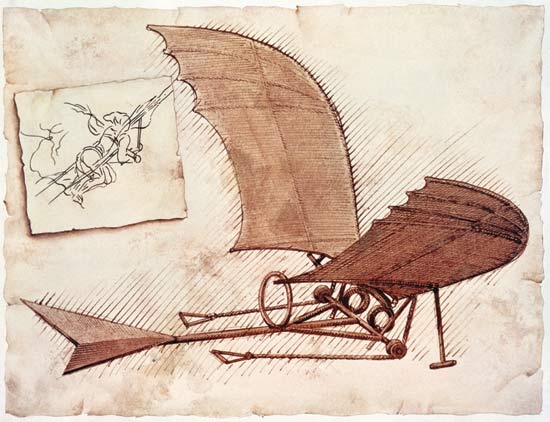
His drawings of the aeroplane.

Leonardo sketched not only the first aeroplane but also the first parachute, first helicopter, first tank, first repeating rifle, swinging bridge, paddleboat and the first motorcar. . .
He invented the bicycle 300 years before it appeared on the road.

Leonardo the painter:
He had a passion to paint  beautiful women, most of whom  enjoyed being painted secretly.
Leonardo’s first solo painting, completed in 1478, was ‘Madonna and Child’.
In 1481 he left Florence for Milan to offer his service to the local Duke.
In 1481 he began painting ‘Adoration of the Magi’, an unfinished work that reveals his technique of beginning with a dark painting surface and adding elements of light, unlike most painters of his time who started with outlined figures on a white surface.
In 1483 he started to paint the first version of the ‘Virgin’. He completed it in 1485.
Leonardo was famous for the way he used light in his portraits. He drew a self-portrait in 1515.

Mona Lisa:
‘The Mona Lisa’ is perhaps his most famous work. The subject of this portrait is still debated to this day, the most popular current view being that it is of Lisa Gherardini del Giocondo.
Another  of the most unusual hypotheses is that it is a self-portrait of Leonardo as a woman.
It took him about ten years to paint Mona Lisa’s lips.
Monalisa

The Last Supper:
He painted ‘The Last Supper’ at Santa Maria delle Grazie in Milan, a dramatic depiction of the moment Jesus announced that he would be betrayed.
By 1500 AD,  the painting’s deterioration had begun. Since 1726, many attempts have been made to restore it.
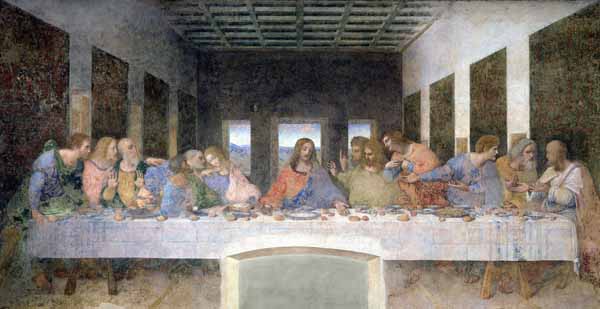
The Last Supper

Leonardo the sculptor:
In 1495 Leonardo made a clay model for the statue of Francesco Forza, and put it on display.
Leonardo changed the way people painted and made sculptures.
He was one of the most acclaimed artists of the Renaissance (a period when the arts and sciences flourished). .

Da Vinci, the science illustrator:
Leonardo was constantly sketching out his ideas for inventions.
When it came to drawing illustrations, Leonardo’s work is detailed and precise.
He established modern techniques of scientific illustration with highly accurate renderings such as ‘Embryo in the Womb’.
He made maps of Europe.
He took part as an engineer in the war against Pisa.
He designed a movable bridge for the Duke of Milan.
He drew the plans of the first armored car in 1485.
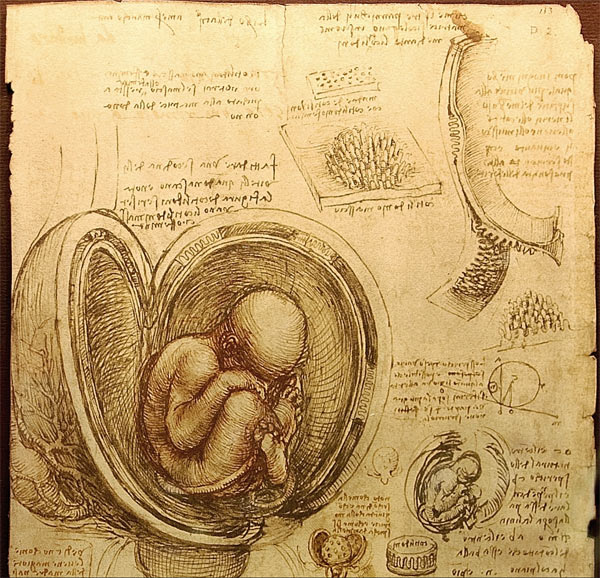
His drawing of a baby in the womb.

He was undeniably one of the greatest thinkers and well ahead of his time by hundreds of years.
Leonardo died on May 2, 1519 and was buried in San Florentine in Ambrose.

Acknowledgements: Source -Prabhakar Pillai.

EARTH IS MY HOMELAND


Why should my free soul

Be bound by imaginary lines.

Oh why should these lines

Be fenced on the land

Be drawn on the maps

Be etched in the minds

Be engraved in the hearts

I rebel against these confines

I leap across these limits

My feet sense no lines

My eyes see no fence

My mind thinks no limits

My heart feels no bounds

It appears an awful sight

To control my free soul

To the confines of geography.

To the whole world it belongs

Compassion is its language.

Mankind its fellow compatriots.

Yes, Earth is my Homeland.

~Ilmana Fasih

12 January 2011

The love of one’s country is a splendid thing. But why should love stop at the border? ~Pablo Casals

IN PURSUIT FOR HAPPINESS


Ever since I flipped the page of the new 2011 calendar and hung it beside my study I have been aspiring to tick a day when I will get to hear more of positive news than the negative ones. It hasn’t yet happened in the past 11 days or so. Good news from our part of the world has almost become a rare entity and one always dreads as to what new drama will the coming day unfold.

It makes me wonder, as we are well into the second decade of twenty first century, reached the moon, invaded the space, climbed the Mt Everest, peeped inside an atom, now gearing to reach Mars and further, but we haven’t reached into the core of our own hearts to gain happiness and contentment.

Nations measure prosperity by their GDP which represents countrys income and its economic progress but terribly falls short of capturing other measures needed for prosperity like health,( both mental and physical), personal freedom and security.
I talk to friends and relatives of all kinds—successful, average and not so successful.

Talking to a friend who and her husband are currently laid off—It is valid, of course for them, to staple happiness together with their jobs and hence economic well being. But when I talk to a cousin, who’s husband is in an extremely coveted post and with a fat pay package—she talks of her disgust at the ‘nauseating gap between the rich and the poor’ and that she does not even cherish her own prosperity seeing so much miseries around.In fact she lives in guilt despite doing a lot of charity too.

Talking to relatives back home and they are unhappy for the prevailing socio-politico-economic conditions , but then someone else in US with a settled life talks of the bills, the mortgage payments, the stress at job and the mechanical life which keeps them away from happiness.

You talk to a mediocre student and he is worried about his prospects of making it to a University due to immense competition. Talk to a brilliant student and she harps about the pressure she has to take of being in a world ranking program. It is really a disturbing statistics that a large chunk of university students and people from the general public are on antidepressants in some parts of the developed world.

I look at my own life and compare it to the days when I began my life with my husband with just two suitcases as my possessions and now they have multiplied to many many many more ‘suitcases’ but do these ‘suitcases’ add to my emotional well being? Do I feel any better because of this material gain?. Whatever satisfies me is not my material possessions but my contribution as a health and community worker or as a wife, a mother or even a friend.

Money , of course, is important to lead a comfortable life but only certain amount of money can give you happiness. Anything beyond the threshold does not add to happiness or prosperity but more to greed, discontentment, desire for more, fear of losing it and even guilt at times.
Why is it that the people of the likes of Bill Gates vow to spend a major chunk of their wealth on charity? Is it that he doesn’t
love money or does not need it? Of course not.( Who doesn’t love it!). If he hadn’t loved money he wouldn’t have strived to reach at the top of the Forbes Richest Men list and stayed there for years together. It simply proves that after a certain threshold of economic prosperity money ceases to matter as a source of happiness and contentment. But one has to live the experience to realise how it feels. In general wealthier people are less happy than the less wealthy counterparts, but it takes an awful lot of income to buy happiness that companionship and community provide for free.

We as individuals may very well resolve it by associating prosperity and happiness to family values, interpersonal relationships or even intrapersonal relationship—coming to be one’s own friend.
But the real task lies in incorporating this concept of happiness and contentment when it comes to economies or nations as a whole.
Fortunately enough some economists and a tiny nation have started to associate that ‘true’ prosperity ( which includes happiness) does not limit to only economic prosperity. But still the concept is in its trial stage and infancy.

A tiny nation of BHUTAN in our region through its ex-King Jigmey Singye Wangchuk,proposed an approach to have the idea of GROSS NATIONAL HAPPINESS along with the Gross National Produce (GNP). Bhutan may be a tiny country land locked between two giants India and China, with a rugged Himalayan terrain and harsh alpine climate, but it’s visionary king has made some great strides towards the issue of making his people happy.

A 55 year old man now, educated in UK and US, he ruled Bhutan from 1972 until his abdication in 2006 to his son. He is credited with many modern political and social reforms in the country.

In 1972 he introduced the concept of GNH .The concept of gross national happiness (GNH) was developed in an attempt to define an indicator that measures quality of life or social progress in more holistic and psychological terms than Gross Domestic Product (GDP). The philosophy, which is underlined by four pillars, namely
-equitable socio-economic development;
-conservation of environment;
-preservation of culture;
-promotion of good governance,

The GNH theory seeks to pursue the broader forms of well-being beyond material things. There was no exact quantitative definition of GNH proposed.
The King proved that his actions were louder than the words by:
-transformed Bhutan from a absolute monarchy to a constitutional monarchy.
– stunned the nation by declaring general elections in 2008.
-transferring most of his administrative powers to the Council of Cabinet Ministers and allowing for impeachment of the King by a two-thirds majority of the National Assembly
-on 14 December 2006, he announced that he would be abdicating immediately. This was followed with the first national parliamentary elections. Judicial power is vested in the court of Bhutan. The Chief Justice is the administrative head of the Judiciary. National Election and Anti-Corruption Commissions were also set up in 2006.

Many people term the king orthodox simply because he does not cherish material gains as the source of happiness. So orthodox is he that even to this day, traffic lights do not exist in the country, and by law everyone must wear traditional 14th century clothing. But in 1999, the King lifted a ban on television and the Internet. In his speech, the King said that television was a critical step to the modernisation of Bhutan as well as a major contributor to the country’s Gross National Happiness, but warned that the “misuse” of television could erode traditional Bhutanese values.

Despite being termed orthodox, his country has seen great progress over the past decade. The country has shown a growth rate of 6.5%, annually upto the available stats of 2008, the life expectancy at birth has risen from 48 years in 1984 to 66 years in 1994. And in just one decade from 1990 to 2000, gross enrollment rate at the primary level has jumped from 55% to 72%.

It simply does not mean that ALL IS WELL in Bhutan. They still have to overcome the poverty which grips a third of the nation.
Although being a tiny nation it sets an example for our leadersand teaches a great amny lessonsabout SELFLESS RULE and GENUINE CONCERN for it’s people.

As economic development on the planet pushes the limits of ecosystems to their brink, it calls into question the ability of the planet to sustain further, this civilization. Hence the talk of moving “Beyond GDP” in order to measure progress not as the mere increase in commercial transactions, nor as an increase in specifically economic well-being, but as an increase in general well-being as people themselves subjectively report it.

Inspired by the concept of GNH from the King Wangchuk of Bhutan, a second-generation GNH concept, treating happiness as a socioeconomic development metric, was proposed in 2006 by Med Jones, the President of International Institute of Management. The metric measures socioeconomic development by tracking 7 development area including the nation’s mental and emotional health.
GNH value is proposed to be an index function of the total average per capita of the following measures:( and I paste them from the original document):
1. Economic Wellness: Indicated via direct survey and statistical measurement of economic metrics such as consumer debt, average income to consumer price index ratio and income distribution
2. Environmental Wellness: Indicated via direct survey and statistical measurement of environmental metrics such as pollution, noise and traffic
3. Physical Wellness: Indicated via statistical measurement of physical health metrics such as severe illnesses
4. Mental Wellness: Indicated via direct survey and statistical measurement of mental health metrics such as usage of antidepressants and rise or decline of psychotherapy patients
5. Workplace Wellness: Indicated via direct survey and statistical measurement of labor metrics such as jobless claims, job change, workplace complaints and lawsuits
6. Social Wellness: Indicated via direct survey and statistical measurement of social metrics such as discrimination, safety, divorce rates, complaints of domestic conflicts and family lawsuits, public lawsuits, crime rates
7. Political Wellness: Indicated via direct survey and statistical measurement of political metrics such as the quality of local democracy, individual freedom, and foreign conflicts.
I wonder where would we stand if we apply all these parameters to our part of the world. I dread to even make an attempt to do so.

If only our leaders were as visionary and sensitive as King Wangchuk, we would also aspire to be a happy nation some day.
The idea of linking Happiness factor to Econmic prosperity is still in its infancy and only time will tell if it matures into a reality and our planet attains HAPPINESS along with other innumerable worldy achievements.
Where there is a will there is, for sure, a way .
Lets hope…

Ilmana Fasih
12 January 2011