Open up your mind and your potential reaches infinity…

Archive for the ‘Indo-Pak’ Category

Please pray for us too, Mr President !


Just a few weeks ago I was moved to hear an ex Indian Chief Election Commissioner say to Najam Sethi:

“Hamara Makkah Medina to aap ke paas hai.”
(Our Mecca and Madina are with you).

After retirement he had come to visit the holy places of Sikh in Pakistan, the Nankana Sahib and other holy shrines in Pakistan.

Now we hear our  President Zardari  is going to pay a private visit to the Dargah of Hazrat Khwaja Moinuddin Chishti,( RA) at Ajmer on April 8, 2012. This Dargah is an important Holy place for those revering Sufi saints. It is a shrine where 12,000 devotees from all faiths and sects visit each day.

It is a destination that was held in high esteem by the most secular of all Mughal kings, Emperor Akbar. It is said that once Akbar, passing by a village near his capital Agra, heard some minstrels chanting ditties about the glories and virtues of Khwaja Moinuddin Chishti “May his grave be hallowed, who sleeps in Ajmer.”

He expressed his desire to visit the shrine of this great man whose songs were being sung. From then on, he made it a routine to visit the shrine every year.

Not only did he visit to ask for prayers, he even paid visit of thanks to the Dargah for his important military victories.
The most moving expression of his devotion was the journey of this great Mughal King, when he walked bare foot from Agra to Ajmer (346 kms) just to express his gratitude on the birth of his son, who later became Jehangir. He had named him Salim after another sufi saint who was enshrined in Fatehpur Sikri.

Knowing Akbar as not only a great King whose kingdom extended from Kandahar in the west to Bay of Bengal in the East, his most revered quality was his extreme tolerance and acceptance of other religions. He eyed and treated all his subjects which included Hindus, Sikhs, Jains, Buddhists, Zoroastrians and Muslims with an ‘equal tolerance’ policy. Not only did Akbar have Man Singh as his Chief Military Commander, but his Finance Minister was Raja Todar Mal.

With this historical background in perspective, and the fact that the lines across culture and history of India and Pakistan cannot be divided as clearly as the lines that have been drawn across the political border, we can only hope that in his private visit to the Dargah, President Zardari will not only pray for himself, but also for the peace and amity between various ethnic groups and sects that have taken against each other from Karachi to Gilgit in Pakistan.

We also hope and beg to Mr President to please also pray for peace and cooperation between India and Pakistan, and for the greater good of the whole subcontinent. With the unofficial news of business agreements being talked between the two neighbours, one can rejoice with hope that these prayers will be listened at the Dargah soon, and the region where a billion and a half humanity resides, shall see its potential better put to use through trust and trade, rather than through hatred and hindrance.

I am sure as a courtesy, Mr President, during the private lunch with Prime Minister Man Mohan Singh, will suggests to him to pay a visit to his ‘Makkah Medina’ in Pakistan.

How I also wish that they both also think and discuss that the ordinary people too, on both sides, not just hold great reverence to these holy places, but also have burning desires in their hearts to visit with ease, their friends and kin living across the border.


How I wish a day comes when even an ordinary citizen from either side, is able to decide like Mr President, that he needs to make a private visit across the border at the coming weekend, and there he goes with his plans without having to bother about visa, or police inquiry.


These may just be my dreams today, but don’t dreams come true too?


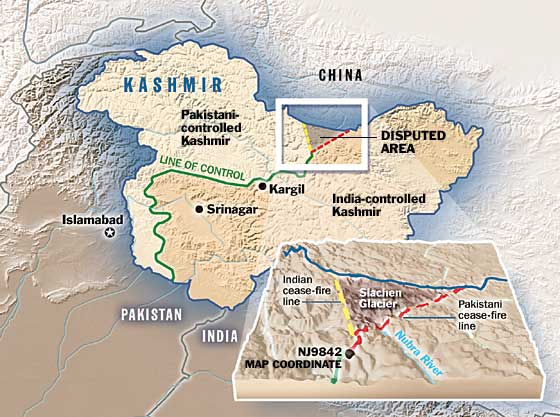
The story of Siachen


With the tragic news of 150 Pakistani soldiers buried alive in an avalanche in the Pakistan base camp at Siachen, it brings back to memory the bitter truths about this conflict.

The glacier:

  • Siachen means ‘the place of wild roses’.
  • Siachen glacier is the great Himalayan watershed that demarcates central Asia from the Indian sub-continent, and that separates Pakistan from China in this region.
  • It is the world’s second longest non-polar glacier, and thus is sometimes referred to as the third pole.
  • It is 70 km long and flows from an altitude of 5750 meters to 3620 meters above sea level.

The conflict:

  • Siachen is known as the world’s highest battlefield between #India & #Pakistan. Troops are deployed at elevations of up to 6,700 metres (22,000 feet) at minus 60 degrees C.
  • Siachen conflict began in 1984 when both India and Pakistan, began sending mountaineers, in an attempt to lay their claims over the area. Several skirmishes took place till 2003 when a cease fire was declared.
  • The roots of the conflict over Siachen lie in the non-demarcations on the map northward to the China boundary beyond NJ9842, which is the line’s “dead end” in the India-Pakistan line of control agreement.
  • The 1949 Karachi agreement and the 1972 Simla agreement presumed that it was not feasible for human habitation to survive north of NJ9842.
  • UN officials presumed there would be no dispute between India and Pakistan over such a cold and barren icy wasteland.
  • The contentious area is only 900 square miles (2,300 km2)
  • Indians control the length and heights of the glacier including the three passes, while the Pakistanis control the glacial valley. As a result, Pakistanis cannot climb up, and Indians cannot come down.
  • Together, the two nations have about 150 manned outposts along the glacier, with some 3,000 troops each.
  • Over 2,000 Pakistani & 4,000 Indian soldiers have died at Siachen conflict. More soldiers have died or handicapped from frost bites, cold and avalanche i.e. harsh weather than combat.
  • Official annual figures for maintaining these outposts are put at $300 and $200 million for India and Pakistan respectively.

The strategic importance:

No matter what India and Pakistan may claim about its strategic importance, Dr. Stephen Cohen, a well-known and respected Washington-based South Asia analyst, considers,

“Siachen conflict is a fight between two bald men over a comb.”

In his view, “Siachen… is not militarily important… They (Indian and Pakistani armies) are there for purely psychological reasons, testing each other’s ‘will’.”

The talks for demilitarisation of Siachen did take place between India and Pakistan in May 2011, but fialed to reach any agreement.

The truth remains that this stretch of icy wasteland holds no political or economic importance to the billion and a half residing on both sides of the border.

Instead of being a battle ground, Siachen should be demilitarized, and to evade the unresolved dispute of AGPL ( actual ground position line) the area could be seen as a ‘common ground’ precious enough to study and conserve the glacier which is under threat due to the climate change. This can easily stand as a symbolic Peace Park. And the billions of rupees used to maintain its cost as outpost for armies should be directed at improvement of the plight of the impoverished peoples on both sides.

Or better still let ordinary youth from both sides of the border play kabaddi in snow.

When hate or peace become a business


In my last trip to India, I was strolling for window shopping, in one of my favourite spots in New Delhi, when I heard some loud speaker announcements nearby.

I saw a Yogi on a big screen, speaking with utmost tranquility. Some of the words I could recall are:
“Want is always hanging on to the I. When the I itself is dissolving, want also dissolves, disappears.”
And
“How far to heaven? Just open your eyes and look. You are in heaven.”

There were a few other things he spoke. At the first instance all I could think was, ‘Had Kabir been alive, he would have said the same thing.’


As I attempted to take a picture from my mobile phone, a boy intercepted. Wondering if photography was not allowed, I told him “Okay I won’t.”

But he said, “No Didi, there are so many people in the way, I’ll have you take it from a better angle.”

I was quite surprised at his generosity.

While returning, I collected some leaflets from the Art of Living ( Sri Sri’Ravi Shanker’s Organisation) stall, one of which said:

To love someone whom you like is insignificant.
To love someone because they love you is of no consequence.
To love someone whom you do not like means you have learned a lesson in life.
To love someone who blames you for no reason shows that you have learned the Art of Living.

Back home, talking to an old college friend who still lives in Delhi, I mentioned the incident.

She said, “Yes it’s nice, but this is business. Pay fees and attend the classes. What you saw was their marketing section.”

When I heard of his trip to Pakistan and the news about his offer to teach peace to Taleban, I was intrigued, wondering:

‘How would it be taken as an offer by the ilk of Zaid Hamid, Gen Hamid Gul, or the Taleban themselves? Would they again rant of the Hindu agenda or the greater Zionist agenda.’

Instead of the Hindu agenda rant, I saw a couple of positive FB statuses and some tweets on the issue. A tweet worth the mention is:

“Sri Sri has already had a Positive Effect on Taliban! Mullah Omar is now calling himself Mullah Mullah Omar.”
Thankfully, instead of an offence,  it was taken in lighter vain 🙂

Incidentally I happened to chat with the same friend on Facebook , and told her of his trip to Pakistan, and the Taliban offer story.

She said: “Oh come on, he is there to promote his AOL centres, one of which I know is located in the capital city. And again this is the marketing department at work.”

I again muttered to myself, ‘Well nothing wrong with it. One could consider this a social enterprise. We do have an epidemic of hatred in the world and he has provided a therapy for it, but at a price, which will work if it is cost effective.’

He did tour the AOL offices and camps in Karachi, Islamabad and Lahore. But to my utter dismay, before I could start to keep track of his Pakistan trip, and his talks with Taleban, I heard that he was back in India.

Wonder is he wasn’t allowed to approach Taleban, or was it not on the agenda?
I have no clue.

Anyways he did repeat his offer after coming back “There is a lot of violence in Pakistan and people are fed up, they want to live peacefully. If I could be of any help in bringing an end to the vicious cycle of violence, I am ready to talk to the Taliban,”

And that “We are all sufferers of stress, tension, violence and hatred – and small ways of easing out are all that you need,”

There is no doubt that the techniques which he uses for de-stressing are scientifically based.

The primary exercise, which they call Sudarshan Kriya is basically a deep breathing exercise which any psychologist you visit asks you to begin with, on de-stressing. There is a proper technique for it.

I can’t help being amused by the mere visual imagination of Mullah Mullah Omar sitting in a Padma Asana (lotus pose), with hands stretched over the knees, and breathing-in through nose and breathing-out through mouth. 🙂

How I wish that my friend is still proven wrong and some miracle asana (yoga position) comes up which exhales all hatred out of the heads of these radicals.

If that so happens, then I would also secretly whisper in Sri Sri’s ears to develop some Yoga position (asana) in which our politicians extend their arms  in service of  the masses, who vote them in, instead of flexing them, with hands reaching their own pockets.

And so will I also pray to Sri Sri to apply some tilak ( teeka) on the foreheads of our uniformed (on both the sides), so that they start seeing each other as friends and not enemies, and start piling books and medicines for the masses on both sides, instead of arsenals.

I would also beg Sri Sri with folded hands to ‘please please’ make some vibhuti ( spiritual ash) for our diplomats ( on both sides) which when touches their tongues gets them addicted to the taste of peace and makes them feel nauseated just at the sight of visa, passports, police verification etc etc.

Be it a profitable business or social enterprise, there’s no offence, if it is all intended to bring real peace, beyond just a marketing tool.

After all,  all the  chaos and divisions on ground, are also a result of the seeds of intolerance sown by those who consider hatred as their business.

O’ the wandering mind ~Kabir


Kabir has hardly spared any animate and inanimate examples to ridicule the bigots who have great illusions about their self image and through their beliefs repeatedly,  make a fool of themselves.
In the same spirit, I came across yet another simple yet interest verses.

Poem 1: 

Apanpo aap hi bisaro.
Says Kabir, they  fall prey to their  own illusions and forget the essence of our existence.

Jaise sonha kaanch mandir me, bharamat bhunki paro.
Just as dog who enters the house of mirrors, goes crazy barking at the images, considering them different. This is a very curious satire on those bigots who bark at other bigots, thinking they are different, but in essence are reflections of each other.

Jyo kehari bapu nirakhi koop jal, pratima dekhi paro.
A lion looks deep into the well, and mistakes his own reflection as another lion, and jumps into it. This also satires on the ‘lions’ of different faiths, who are such egoists, that they destroy themselves, in challenging other ‘lions’ in the business. The current sectarian bigots could be appropriate here.

Aisehi madgaj phaTik sila par, dasanani aani aro.
An elephant, so proud of its strength, bangs his head against the rock, and hits it with his teeth. Here rocks could be interpreted as hard, rock like beliefs which they bang their heads against.

MarakaT muThi swad na bisare, ghar-ghar naTat phiro.
A greedy monkey for whom the food in the pot is not enough, and goes from home to home asking for more. This is perhaps reference to looking outwards, though we could easily content with what is with us.

Kah Kabir lalani ke suwana, tohi kaune pakaro.
Says Kabir, their logic is as impossible to catch as the parrot of a village girl. Here he gives a satire of those who keep repeating mindlessly like a parrot, with no logic what so ever.

And then in contrast to the satire, many verses of Kabir bring home the message through simple, day to day examples, of how should we be viewing our beliefs, and the essence of our existence.

Poem 2: 

Man tu maanat kyu na mana re.
O’ the wandering mind, why don’t you understand?

Kaun kahan ko, kaun sunan ko, dooja kaun jana re.
Who is worth to speak or to listen, when there is ONE truth.
Here he refers to perhaps the various claimants of ONE, and give it different names and forms.
( The next verse makes it clearer)

Darapan me pratibimb jo bhase, aape chahu disi soi.
He is all round in every atom, the way there is a reflection in every mirror.
( This could be compared to the idea of sheesh mahal—made of tiny mirrors all around one image is seen in each and every tiny mirror)

Dubidha mite, ek jab howe, tau lakh paawe koi.
If you get ONE truth, you will get contentment worth a million, and the confusion of mind will go away.

Jaise jal se hem banat hai, hem ghoom jal hoi.
The way ice is first made of water, then returns back to the same water.

Taise yah tat wahu tat so, phir yah aru wah soi.
In the same way, we are all come from that truth, and unto the same truth we have to return to.

Jo samajhe so khari kahat hai, na samajhe to khoTi.
Those who get this, call this a stark truth. Those ignorant who don’t get this, consider it falsehood.

Kah Kabir khara pakh tyaage, waaki mati hai moTi.
Says Kabir, one who gives up the essence of truth, his brain is thick ( stubborn).

It is remarkable how Kabir talks of evils of bigotry, unity of mankind and the true spirit of secular spirits, rising above the superfluous divisions in the dark ages.

Or perhaps, we are living in darker ages.

Indeed, it is a long road, before Kabir’s examples and teachings become irrelevant to the current times.

The Kabir bhajan below, again, gives some more examples through which he challenges the bigots. Note the translation subtitles. This is my favourite tranquillising Kabir song. 

Lawn ki kahani, meri zubani ( The story of Lawn in my words)


Published in TheNews Blog : http://blogs.thenews.com.pk/blogs/2012/03/21/story-of-a-lawn-hater/

Designer lawn, designer lawn, designer lawn!

Every Sana, Nida and Hina is coming out with designer lawns.

Thankfully never a fan of lawn as a material, it does not awaken the woman in me.

However I remember my mother, who lives in Delhi, where summers are really biting, once came back from a trip to Pakistan in mid 80s, all excited, for having discovered a wonder cloth. She is a woman with sensitive skin, and sweat rash (garmee daaney, as we call it in desi jargon) was what she had to struggle with each Delhi summer.
Fed up of wearing starched Khadis (hand spun cotton) and malmals (muslin) in the sweltering heat, she said she found something which was soft, low maintenance, colorfast and did not need any starching. The picture she painted with her descriptions and expressions got me really curious to open up her suitcase and dig out the jewel, basically to choose which one was mine.

The result that came out of that digging was so befitting to the Hindi idiom “Khoda pahaar per nikla chooha aur woh bhi mara hua”
(From the digging came out a dead rat).

The first look of it was totally unappealing –bold designs on the shirt piece, with its giant replicas on the dupatta. Didn’t need to check the third of the half a dozen three piece suits she brought.

“What’s wrong with your taste? Ammi you’ll wear this?”

“They are so comfortable. And most of all they are so reasonable. One suit costs just Rs 225.”


She didn’t even bother to comment about my ‘taste’ rant.

From then on, I saw her pass all the worst days of summers in lawn suits. And when I got married in Pakistan (perhaps she must have prayed for this secretly for her own vested interests) all she wanted from me each visit was…”bring lawn ke suits, so that meri garmiyaan nikal jaayein.”

I remember from 1990 onwards, buying them for Ammi from Rs 250, Rs 450, Rs500, then Rs1000,  1200, 2500, and last I got for her was Rs 3500. Agree that with time, along with the prices, the designs evolved too. And they certainly got better.

But each time, Ammi felt uneasy with the price escalation. At the 3500 one she told me, “Enough, I don’t need a dress at this exorbitant price just to soak my sweat.”

And now with the advent of designer tag they have graduated to even five digit prices (at the higher end). And they usually begin from 4,000 going upto 12,000, I am told.

I remember some 2 years ago, hearing two cousins talking of outlets where they got the same designs as the big brands copied at much lower prices.

“The original is so expensive, so I buy the duplicate ones.”

“Even the previous year’s designs are available at cheaper price,” said the other.

Yes, but you know there is a teacher in my school who thinks she is very  smart. She instantly recognizes, ‘ye to pichle saal ka design hai’. So I can’t wear that. But woh kaminee tou isko bhi pehchaan jaati hai, ke ye duplicate hai.’

“Why do you need to copy? Or in fact wear designer lawn at all”, I asked.

She rubbished my question and moved on to some other topic.

This is certainly not to act snobbish, but I certainly find it hard to fathom the compulsion to owe one’s allegiance to these ‘disposable’ pieces of cloth which are so short term that they become obsolete the next season.

If I have so much money to spare( 5-7,000+ on a dress) , I will perhaps invest in a piece I can cherish for longer, and if you ask my secret desire, it would be on something I can pass on to my daughter. And indeed I have done exactly by getting hold of  some beautiful pieces with  Baluchi, Afghani or Sindhi hand embroideries.

Dump my hard earned money into a casual wear lawn suit which won’t last the next summer—no way.

In the background of so much disinterest for the designer fad, I was made to see this disgusting ad ( see the bottom pic) by a twitter pal.

And this perhaps was the boiling point of my emotions,  for the ‘designer lawn’ and hence I decided to blog my disdain for them.

With all the designer hype or price escalation, the brand had the audacity to show their product with coolies in the background.

What did they wish to relate to?

Was it the quality of attire in comparison? Oh ! Theirs is so simple, non designer unlike mine. Yet in my two dim visioned eyes, the poor men’s is the rawest of  cottons.

Or

Was it about the worth of one’s labour? Oh look at us, how much we get for the every drop of sweat we shed in the labor for those ‘designs’. 

Or

Was it about the matching colors?

But then, Buddhist monks and  Hindu sadhus too wear the color similar to the woman’s. With ‘Muslims’ as their major market, it was too much of a risk to take.

Oh,  yes, the coolies do not prick anyone’s sensitivity, so were  pretty risk free to have as a background.

Kudos to the imaginative  Advertising Company that thought of this ad and flexibility of the Designer Textile Company that approved of it and owned it.

To me personally this was absolutely nauseating…akin to showing middle finger to the poor fellows in the background.

So rightly had someone commented: “Thank you for hiding their faces with your brand name.”

Hats off to the Feudal mindset, yet another common man’s commodity, the lawn, has turned into an elitist product. Of course in business jargon this is called as ‘value addition’. So what if it gets unaffordable to the vast majority, at least it looks coool ( with a triple o) !

How I wish we did some value addition to Islam too, in Pakistan?

On a second thought, haven’t we?

With the  tags of suicide bombs, Ahmedi hate, Shia kafir rants, we have made it a brand which ordinary Muslims like me find hard to afford.

Abida Parveen, the therapeutic


If music is a mountain range, its Mt Everest is Abida Parveen. A summit of Sufi music, which no soul can surmount.

The Queen not only drowns herself in the music she sings, but she sweeps along her listeners too, in the tides of the overpowering words that flow out her throat. After the plunge, to rise up to the surface banal  isn’t easy.

She is mesmerising, she is addicting, she is tranquillising.

A true flag bearer of Ganga Jamuni Tehzeeb, she immortalizes the words of  Bulleh Shah, Kabir and Amir Khusrau with just the same devotion.

Beyond music, pearls of abundant wisdom  she spilled, in this interview (which was taken before she enthralled the Delhi audience by the performance on March 5, 2012) reflected nothing but her rock solid conviction on which her life and music stand – of peace and love. Though thoroughly therapeutic, her words shook me.

In an interview esewhere she said:  “In Sufism there are no barriers, mine or yours, old and new. It belongs to all and connects hearts and souls. It’s power unites the singer and listener in a divine communion with the creator.”

From its very inception till this year’s Jahan e Khusrau Festival, she has been present in each of the ten held so far. “The festival is unique because it has no nationality or religion and is sacred to all of us.”

Overwhelmed, and still shaken by the genuine grief that Ali Zafar expressed over the hatred sweeping across the globe, but more so in our subcontinent, I could not hold back my own tears listening to her firm belief  that there are indeed “no internal barriers”.

The interview itself is a journey to the sublime, I would wish to take again and again. Hence, I have captured it in my blog, to preserve it as a shrine to which I shall keep returning to, in times of deep internal turmoil.

In these times of despair when we keep embracing hopelessness off and on, she lives with her heart, mind and soul steadfast on every word and verse of truth and love  she sings. 

Kudos to Barkha Dutt for immortalising these priceless pearls of wisdom.

(Click to the number below for the must watch interview)

225251 or http://www.ndtv.com/video/player/the-buck-stops-here/singer-abida-parveen-talks-about-the-power-of-sufi-music/225251

Know the bitter truth of Diabetes


PART-I

The tsunami wave of diabetes mellitus and its health and economic consequences is threatening much of the world. The need to prevent and control this debilitating chronic disease is urgent, before desperation sets in.” Journal of Royal Society of medicine.


How does this  matter to us South Asians?
Indian Subcontinent (which includes India, Pakistan, Nepal, Bangladesh and Sri Lanka) is the epicentre of this Diabetic pandemic. By 2025, over 2/3rds of the diabetics would be living in our subcontinent.
Link:  http://171.66.127.115/content/100/3/115.full

How are we more vulnerable as compared to other ethnicities?
We South Asians get Diabetes:
• 10 years earlier
• At lower levels of obesity
• Suffer longer with more complications
• Have 3-8 times higher risk of dying from Diabetes than Europeans..

Why are we more vulnerable than other ethnicities?
Again the same answer as for the Heart Disease—Our genetic makeup coupled with our unhealthy lifestyle i.e. faulty diet, obesity, sedentary habits and lack of health awareness.

Can we really do anything?
Yes, research proves that we can avert or at least postpone Diabetes and improve our quality of life through various lifestyle modifications.


What should we know?
First, know that Diabetes is no more the disease of the affluent; even the poor have it.

Second, it is no more a disease of the middle aged. Diabetes Type 2 which was earlier called the Maturity onset diabetes has now been seen to occur amongst the South Asians in early 20s and many get in their 30s.

Thirdly, in order to live a life without Diabetes we need to start early and change our life style. However, it is better late than never.

PART-II

What should we do?

If you are not a Diabetic

Step 1 : Know whether you are at high risk of Diabetes Mellitus or not.

Check your risk from the risk-factors chart:

Or better see YOUR RISK OF DIABETES  from  the  Diabetic Risk Calculator at the link below.
Link:  http://www.diabetes.org/diabetes-basics/prevention/diabetes-risk-test/

(ADV*** : Dont skip this ^^ step!!)

Important: In case you are a high risk group, please consult your doctor and ask him to screen for Diabetes. He will do some blood test on you while fasting and after meals to check your blood sugar levels.

Step 2: Get more physically active :

Benefits of exercise:
• You will lose weight
• It will lower your blood sugar
• Boost your sensitivity to insulin –which will keep your blood sugar in the normal range.

More, refer to Blog 1 : https://thinkloud65.wordpress.com/2011/12/31/living-a-healthy-lifestyle/)

Step 3: Lose the extra weight.

Obesity is one of the main culprits in causing Insulin resistance and hence Diabetes- Abdominal fat is the real culprit.


Tip: If you are obese or over weight, loss of every kilo will reduce the risk by 16%. And if you lose 10% of your body weight, you will cut the risk of developing diabetes by 60%.

Step 4: Make long term dietary changes.

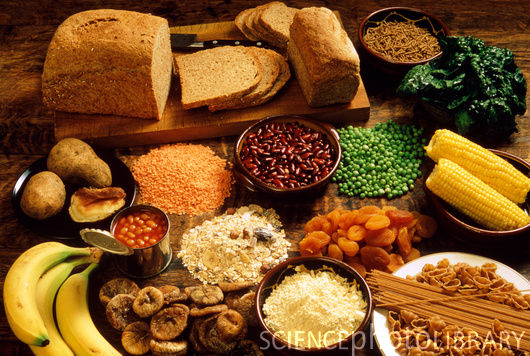
Add fibre to your diet. This simply means eat more of fruits, vegetables, beans, whole grains, nuts and seeds as they are rich source of fibre. 

Benefits: Fibre reduces the risk of Diabetes, of Heart disease and risk of colon cancers. They also promote weight loss.

Check Glycemic Index of the foods you eat. Choose foods with low Glycemic Index as this maintains more constant blood sugar levels.

Tip: Print out a chart of foods by Glycaemic Index and put it over the fridge, so that it is easy to refer to them while selecting food.

For more on Glycaemic Index : http://www.diabetes.ca/for-professionals/resources/nutrition/glycemic-index/

Step 5 ; Try to manage your stress:  Stress increases hormones in the body which predispose to Diabetes.

IMPORTANT NEWS: The research has shown that if one follows the above measure, at least 50 % postponement of DM is possible.

PART-III

For those who are already Diabetic

Remember:

Diabetes is a lifelong responsibility.

You may not feel unwell in the initial years but persistently raise blood sugar levels can gradually harm each and every organ of the body, more seriously the organs essential for life-heart and kidneys.

To the Diabetic, I would just give a few outline tips here, as  it is important for you to be under a regular care of a QUALIFIED DIABETOLOGIST   to manage your health:

Step 1: Make a promise to yourself that you will take care of your diabetes by being FULLY INFORMED  of the disease. (Just google ‘Diabetes Mellitus’ and there you are).

Step 2: Try to keep the blood sugar in normal range through diet,  exercise, weight control, medications and regular smedical consultations.  A normal sugar levels maintained are as good as being non diabetic.

Step 3: DIET: Diabetics should be very watchful of their calorie intake, and must take meals LOW  in SUGAR, FAT and SALT content. You must consult a DIETICIAN to make meal plan, ideally.

See  links for dietary guidance: http://www.diabetes.ca/files/JTB17x_11_CPGO3_1103.pdf

Try  this SOUTH ASIAN DIABETIC MEAL PLAN BOOK :http://www.diabetes.ca/documents/about-diabetes/Recipe_Booklet_high_res.pdf

Other SA recipes: http://www.pamf.org/southasian/healthy/recipes/

Step 4: Get blood sugars checked at regular intervals…at home and by the doctor.
Through your doctor: Make sure you have HbA1c tested every 3-6 months. The test that shows the average amount of sugar in your blood over 3 months. It tells how well you are controlling your diabetes.

An HbA1c of 6% or less is normal. See the other levels:

Home Glucose Monitoring : Home sugar testing is also important. You must have a glucometer for this.  Ask your doctor how frequently and when should you check your  blood sugar yourself at home.

Step 5: Keep your Blood Pressure and Cholesterol under control.


Step 6: Regular health checkups to assess complications of diabetes—Have your KIDNEYS, HEART, NERVES and EYE check ups EVERY YEAR .

Ask your doctor by name —> to check for COMPLICATIONS of Diabetes.

Warning*: Long periods of uncontrolled Diabetes can cause painless Heart Attack,  Kidneys to fail,  Nerves to get numb and Eyes with loss of Vision. (This is intended not to scare you, but inform you of the seriousness of the problem).

Step 7: Take care of your FEET: Diabetes causes nerve damage which can cause injuries to feet without being noticed due to loss of pain sensation.


IMPORTANT: 

  • Check your feet everyday for cuts, blisters, redness or swelling. Consult the doctor is any such thing is seen.
  • Keep the feet clean, dry and moisturized everyday to prevent any infections.

Step8: Brush your teeth and floss them everyday. Have dental checkups every year and mention to the doctor that you are a diabetic.

Step 9: Ask your doctor if you need to take a Aspirin tablet everyday to prevent heart attack and stroke.

See the benefit of aspirin in Diabetes in this link: http://www.diabeticlive.com/diabetes-101/diabetes-news/new-study-on-aspirin-and-diabetes/#.TzwKiE4gf1k

Step 10: DO NOT SMOKE as it accelerates all the diabetic complications. If you drink, do it in moderation.

Step 11: Manage  STRESS: Stress increases Blood Sugar levels , increases food indiscretions and one tends to neglect the health. Hence manage your stress smartly.

Last but not the least, maintain a sense of humor. You may not ‘delete’ Diabetes from your life but you can ‘minimize’  it by knowing and following the right steps.

🙂 

Painfully Humane


Published in TheNewsBlog on January 31, 2012. http://blogs.thenews.com.pk/blogs/2012/01/31/painfully-humane/

A couple of days ago I met a neighbour outside the house, walking her two cute cocker spaniels. We exchanged New Year Greetings and as a ritual I asked: “So how did you spend your new years eve?”

“Oh I spent my evening feasting with my girls.” she replied

“Lovely, so they all came over to be with you.”

Her face changed color, “Oh no, these girls Sasha and Mori pointing at the two cocker spaniels, picking up the little ones in her arms.

Embarrassed I replied: “Yeah couldn’t be a better new years eve than with one’s pets. I did it too, when the rest of my family went to see the fireworks at midnight, I sat with my cats on the sofa watching TV.”

This triggered off the talk on how we undermine animals and use terms like ‘animal’ or ‘beast’ with a derogatory hint while using words like ‘humane’ as a symbol of compassion.

“I see those TV anchors calling suicide bombs that go off in Pakistan as ‘inhumane’ acts, when in reality they’ve been done by humans themselves, especially those who aspire to be superhuman so that they get a special place in Paradise.”

I could just nod in agreement.

She went on, “Isn’t this all very ‘human’ to kill, for no rhyme or reason?”

Her words echoed for hours. Don’t we use the same terms ‘insaniyat’ for compassion while ‘janwar’ or ‘haiwaaniyat’ for cruelty in Urdu too.

Although, it is common knowledge that even the most dangerous of animals do not harm unless they are hungry or provoked.

Perhaps our ‘hunger’ has gone beyond filling our stomachs. We ‘attack’ others to fill our egos, the egos which never get filled, because there is no bottom. Yes no bottom, because, we do not have any limit to how low we can stoop to gratify our egos.

Often we see and hear of stories where two pets that could have naturally been predator-prey, coexist as friends and in fact the predator acts as a protector of its erstwhile prey.

I saw this live for years in my own home between our cat Nelson and the grey parrot Shakespeare. Shakespeare learnt to mimic the mewing and growl of Nelson. And Nelson would come running to him. They would simply mew, looking into each other’s eyes. No t even once did the cat attempt to attack or touch the grey parrot. The day Nelson passed away and went missing from home, Shakespeare mewed for hours, as if calling out for him, adding to the gloom and shedding tears like a bereaved kid.

It is a bigoted myth that empathy is a higher cognitive function that only apes and humans are blessed with. Perhaps we are more loaded with narcissism than with empathy. Studies on whales show they are extremely emotional. Whale brains have specialised spindle cells which are important for empathy, and rapid gut reactions. Previously, only humans and apes were considered to possess them. An interesting practical example of this is when a 50-foot, 50-ton humpback whale was caught in a net off California’s coast. After rescuers untangled it, the whale swam up to each one of the rescuers, and winked before swimming off. The researchers confirmed this was a gesture of gratitude from the whale.

To study empathy, neuroscientists in McGill University injected acetic acid in the paws of mice causing them pain. The mice who watched their friend writhing in pain became more sensitive and reacted more violently to pain, when injected with the same chemical.

Studies on animals called ‘humans’ show that children who are cruel to animals, are likely to turn to violence later in life. 75% of prison inmates are known to have past history of animal cruelty, says a study.

We need to revisit or swap the meanings of ‘humane’ and ‘beastial’, or ‘insaniyat’ and ‘haiwaniyat’.

It is a saving grace that we do not understand animal language, otherwise it would be very embarrassing to know that every time a suicide bomb, target killing or even animal poaching occurs we would have heard animals scream “What a painfully humane act!”

Daring to cross the love border


Published in Aman Ki Asha, The News on January 24, 2012.

Ilmana Fasih shares some stories of building cross-border bridges through the social media

A world without borders was my childhood dream. The desperation and the need for this dream to realise, came out in the open when I embarked on my ‘pyar border paar’ journey, after deciding to tie the knot across the border. I’ve been on two decades of a topsy-turvy ride riddled with visa travails, with the hope-hopelessness cycle going round in vicious circles. Not had I ever dreamt in my wildest of dreams that my hope for a borderless world could be realised in my lifetime. By a ‘borderless’ world, I mean erasing psychological rather than physical borders.

Perhaps on ground it still remains a dream, but on the virtual terrain it has turned into a reality, with the booming world of social media, especially twitter. It is a visa free, passport free utopia where no one is asked their colour, creed or credentials.
It does not take long for one to get addicted to this borderless terrain. The most fascinating thing for me is to see Indo-Pak friendships burgeoning through social media. Thanks to this factor, we can all be a family beyond borders and beliefs, tied with passions common on both sides of the Indo-Pak border.


Indians and Pakistanis wish each other on Eid and Diwali via Twitter and Facebook, and send virtual firecrackers, mithai and biryani across the border.
The #shair hashtag which ‘trended’ on twitter some time back merits a mention. Every day, it attracts Urdu poetry loving twitterati in India and Pakistan. As Rana Safvi , who started this trend, begins to tweet the topic or the poet of the day, other #shair fans start to contribute their tweets with unmatched enthusiasm. So common is the passion for #shair on both sides, that it is almost impossible to identify which side of the border the tweep belongs to.
Rana tweets: “Twitter ne nikamma ker dia, warna aadmi hum bhi aadmi the kaam ke.” #shair
Comes the reply: “140 characters mein baat ker lete hain, DP to DP borderpaar, mulaqat samajh lete hain.
Political differences and arguments also emerge on twitter, but more than anger, what trumps are the vibes of friendship and harmony. The same thrill is felt on facebook too, with some limitations.
Some time back I was approached by two sets of people keen to tell their story of cross-border friendship developed through social media.
One was Ram, a boy in his mid twenties, from West Bengal, India who became friends with Maria, a girl in Punjab, Pakistan through facebook. As their friendship led to a better understanding and respect for each other’s cultures and beliefs, the vibes spilled over to thaw any cold feelings that their families had for the other side. When Ram’s father fell ill and was admitted to hospital, Maria’s mother and sister prayed for his recovery. He recovered, and Ram’s family attributed the recovery to Maria’s family’s prayers (duas).
Now, as Maria is about to be married, Ram’s family is sending her a present as a token of their friendship and gratitude for her family’s prayers. Ram explained that their families had no links to anyone the other side, and hence had no other reason to be warm, but for their friendship.
Maria and Ram have vowed to keep up their friendship even getting married to their respective spouses, and one day, when they can obtain visas, they hope to meet and ensure that any children they have are able to meet each other.


The second story is that of a love-struck couple who prefers to keep their identity and respective nationalities confidential. They contacted me with a request that I should intervene, (having gone through a similar ordeal), and convince the girl’s parents that tying a knot across the border can work out.
Like many others, they ‘met’ through an incidental chat on twitter some six months ago. They then added each other as friends on facebook. The exchange of pictures and other information led them to develop a better understanding of each other, until they reached a point when they decided they needed to share their lives. Both are in their early or mid twenties, and feel they are mature enough to embark on this journey.
The hope and enthusiasm that they had attached to my help made it hard for me to explain that I would prefer to stay away, and that they needed to deal with the situation themselves. Life is as such a struggle, and with a cross-border union, it gets tougher. Hence, let this be the first hurdle they need to cross together, before embarking on the real lifelong journey.
The couple cited the Shoaib Akhtar-Sania Mirza marriage as an example, but the girl’s parents pointed out that they were ordinary people, not stars. Hence they chose me, an ordinary Indian woman married to an ordinary Pakistani man to plead their case.
With this borderless world of twitter and face book, it is easy to predict that in future, there will be more virtual friendships which people will want to turn into real relationships.
As I explained to them, I would want everyone to appreciate that such decisions are never taken either in a haste or without realising the pros and cons of this life changing decision. Life is tough in any case, it gets tougher, and more so, after an Indo-Pak adventure. Since there are decisions which when taken can effectively be non-reversible. The decision of one of the spouses to forego his or her passport for the other side cannot be reversed, whether the marriage works or not. Secondly, when the couple has children, their nationality is one or the other. So if the marriage fails, the woman may have to suffer a lot in terms of losing her children, if the children happen to have the father’s nationality (or vice versa).
I have personally seen a couple of cases in which things did not work out and the mother and children were left stranded across the border, unable to meet again at all. I also know a woman, who is bearing all her husband’s abuses including his second marriage, only because she does not want to lose the children who have the father’s nationality. Moreover, her children are very young, and she can’t think of separation, as she has no family support or financial standing in her husband’s country, for which she left her own.
All this is certainly not intended to dissuade anyone from daring to cross the love border. But those who think of it should be fully informed of all the issues involved before embarking on this toughest exam of one’s real life.
The young twitter couple I mentioned is adamant that they want to tie the knot and transition their relationship from the virtual to the real world. I wish them good luck in their future journey.

The writer is an Indian gynaecologist and health activist married to a Pakistani. She blogs at
//thinkloud 65.wordpress.com/

Basant, a festival beyond beliefs


On 27th January, 2012 India celebrates Basant panchami.
In Pakistan, it is celebrated towards the end of February.  

Towards the end of January till early March, the golden harvest of wheat stand tall ready to be harvested sometime in early April.  And wheat is our staple crop.

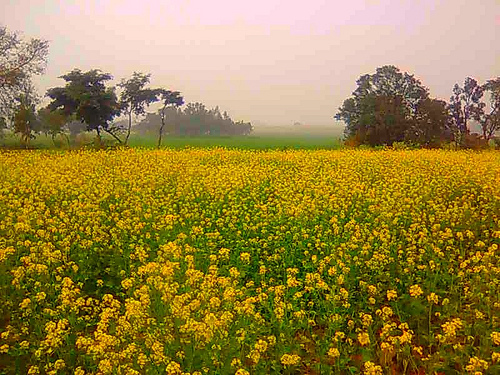
At the same time in Januray February the yellow blooms of mustard ( better known as sarson) sway in the fields, as far as eyes can see. And mustard is a cash crop whose seeds are pressed to extract mustard oil.

To celebrate these awesome blooms as a reward for the fields ploughed and the seeds sown  in October, the farmers rejoice, sing, dance and make merry.

Some of them wear yellow turbans, and their women folk adorning yellow ‘odhnis’ come out to join in the celebrations. It is not hard to imagine that they must be celebrating the blooms, ever since they learnt to farm these crops dating back to centuries.

This is the basic root and the spirit of the tradition of Basant in parts of Indian subcontinent where these crops are grown.

Are wheat, or mustard crops Hindu, Muslim or Sikh?

Vasant in Sanskrit or  Basant in Urdu mean ‘spring’, which heralds the departure of winter and arrival of spring. It symbolizes the time of rejuvenation and arrival of happiness as flowers start to smile through their blossoms.

Yellow, the color of Basant, inspired by mustard blossoms, which matches the shade of sun rays, signifies life and radiance.

Do rays of sun or radiance of happiness differentiate between Hindus, Muslims or Sikhs ?

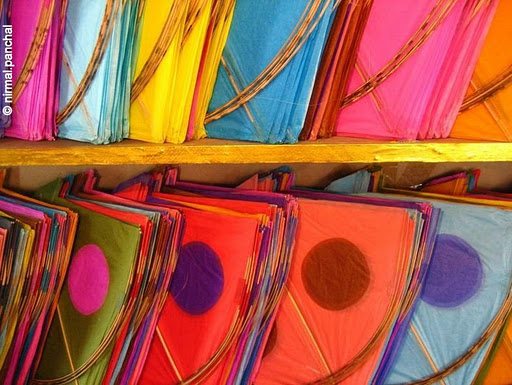
Kite flying , another component of basant, has it’s own interesting tale to tell.

“Kite flying also reveals how the tradition evolved over centuries and in a Ganga Jamuni way.
Kite flying was introduced to the Indian subcontinent by the Chinese traveller Heun Tsang in the 4th Century. Evolving for centuries, it s modification into its current form and popularisation as a sport was made possible by the Nawabs of Avadh. The kite flying during basant celebrations is believed to have been introduced by Maharaja Ranjit Singh in the 18th century.”

Yet another evidence of centuries old and secular celebration of Basant come from poets, Kalidas and Amir Khusro, who have written about the celebrations of Basant in their own unique styles.

Kalidas in a poem Spring writes:
द्रुमाः सपुष्पाः सलिलं सपद्मं
स्त्रियः सकामाः पवनः सुगन्धिः ।
सुखाः प्रदोषा दिवसाश्च रम्याः
सर्वं प्रिये ! चारुतरं वसन्ते
Oh, dear, in Vasanta, Spring, trees are with flowers and waters are with lotuses, hence the breezes are agreeably fragrant with the fragrance of those flowers, thereby the eventides are comfortable and even the daytimes are pleasant with those fragrant breezes, thereby the women are with concupiscence, thus everything is highly pleasing…

AmirKhusro pens down:

Aaj basant manaalay suhaagun,
Aaj basant manaalay;
Anjan manjan kar piya mori,
Lambay neher lagaaye;
Tu kya sovay neend ki maasi,
So jaagay teray bhaag, suhaagun,
Aaj basant manalay…..;
Rejoice, my love, rejoice,
Its spring here, rejoice.
Bring out your lotions and toiletries,
And decorate your long hair.
Oh, you’re still enjoying your sleep, wake-up.
Even your destiny has woken up,
Its spring here, rejoice.

There is an Indian classical  music tune  called Raag Basant Bahaar.

Not to forget, basant in the subcontinent is also associated with a special sweet prepared specially for the occaision –the kesar halwa,
It is a suji ( semolina) halwa with a soft aroma and yellow shade from saffron and garnished with cashew nuts.

Neither the dessert, nor the poetry above nor the music below suggest if Basant is Hindu or Muslim or Sikh.


The same spirit is also replicated by this beautiful ghazal by Malika Pukhraj and Tahira Syed

Lo phir basant aayee…

P.S. Special thanks to Sandeep@stwta a twitter pal for the devnagiri  text of Kalidas poetry.