Open up your mind and your potential reaches infinity…

Archive for the ‘India’ Category

MF WE SHALL MISS YOU !


A lot has been said and written in tributes to MF Hussain, the 'Picasso of India' (as coined by the Forbes).

It would be a mere formality to repeat all that. I write this blog to Offer my admiration for this great icon and whatever little I know about him through some direct and a lot of in direct contact with him.

First thing that comes to my mind when thinking of MF is his silver hair and bare feet, with a rough, white khadder kurta hanging on a lanky, tall skeleton with a brush in his hand. Ninety percent of the times I saw him in this state, whether in the streets of Jama Masjid area or at the airport or in an art gallery.

In his days of struggle, he lived for years in a no star hotel meant for pilgrims called Haji Hotel in Jama Masjid area of Old Delhi .

He began life painting hoardings for cinema for which he recieved few annas per square feet.
As this wasn't enough to make his ends meet, he worked in a toy factory designing toys for a living.

Born in Pandharpur Maharashtra he lost his mother at the age of one and a half years.
The void in his life by the demise of his mother so early, left him searching for a mother figure in beautiful and strong women.
His Mother

As wrote a blogger Shiv Vishvanathan, "For him the mother was the source of reverence, which combined the erotic and the everyday, which gave meaning to his work. Husain saw that eternal feminine in polyphony of people – Indira Gandhi, Mother Teresa, Madhuri Dixit, Tabu and Anushka Sharma. They were stunning women who evoked eternal archetypes".


Mother Teresa

He loved painting women of substance, in all forms -from Goddess Durga, Saraswati to Politician Indira Gandhi to a nun Mother Teresa to actress Madhuri Dixit.
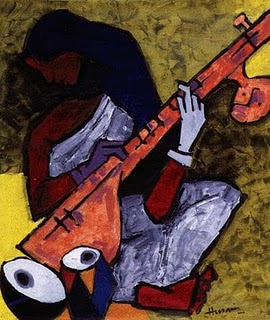

Goddess Saraswati

He did not finish school and his works were his certificates of achievement. Though later he graduated with the top national honours of Padm Shree and Padma Bhushan Awards

He fell for the poise and grace of Madhuri Dixit and watched her film 'Hum Apke hain Kaun” 67 times. After which he immortalised her in his oil canvas. But that wasnt enough for him, so he went on to make a film with her in the lead called Gaj Gamini.

‘Gaja Gamini is a timeless film that explores the woman. The central figure of the film is represented by a mysterious figure called "Gaja Gamini" (Madhuri Dixit), who inspires, arouses, and confuses the common man.’ mentions Wikepedia on Gaj Gamini.

Madhuri plays the roles of 4 awe-inspiring women, two of them well known in history as –Mona Lisa( Leonardo da Vinci) and Shakuntala( Kalidas). Naseeruddin Shah is Leonardo de Vinci.

MF is in'famous' for paintings of women in 'objectionable' forms by some and they made him controversial.

But few people are aware of his Sufi Series of paintings which he painted in the 1970s.

Sufi 1

Sufi 2

Sufi 3

Sufi 4


Sufi 5

Unfortunatley the controversial paintings Naked India, Rape of India and of some Goddesses which though he had painted in the 70s led to his exile to Qatar in the fag end of his life, IN 2010. He took it in a stride and continued his expression through brush unabated.

Such icons are born once in thousand years. Although, Leonardo da Vinci or Picasso did not live in our times but we are lucky that MF Hussain did.

We shall miss you MF.

Denial isn’t just a river in Egypt !


Courtesy: Faking News

Poor ostrich is often associated with the belief that it sticks its head in the sand during times of trouble. Of course this is a myth and no ostrich is foolish enough to do that. Thanks to the mankind, and his state of denial that he has attributed this term to the poor ostrich. I am sure ostriches and other animals must be calling this as ‘human effect.

(Ostrich effect is a term used in behavioural finance for the avoidance of apparently risky financial situations by pretending they do not exist.).

We human beings are the masters of denial. Whether it is health, finance, social, political situation—personal, or public we live in denial. We bury our heads in sand of denial of and on.
Who would know the bitter effects of denial than I myself. I still suffer from its guilt now almost a decade on.

On visiting my parents in Delhi in July 1997, I clearly remember how my mom begged to me that she felt that my Papa wasn’t well and he needed a thorough medical checkup. I took heed to her concern and talked to my father, that he needs to see a doctor. He scoffed off the idea that the sweating he gets while walking has nothing to do with his heart but due to humidity in the monsoon season. We went on long walks together, where his pace at 64 years of age was still faster than mine.

I continued to watch him with a side gaze, off and on, to see if I could get a trace of some unwell signs in him. He was radiant as ever, with barely few hair grey in the sideburns and and intact zest for life.

How can my Papa be having a ‘serious’ problem ? I questioned myself several times..

He convinced me that my mom was obsessed. We went for a basic blood test which was all well. Mom wasn’t convinced. But my confident Papa, shooed her idea of an echocardiography for the heart.

Twenty days after I left, I got the news that my Papa passed away, hale and hearty, while working on a computer, typing a chapter for his new book. He had a massive heart attack.

I have not forgiven myself ever since, for having lived in denial, to escape harsh reality. Had I faced the truth head-on, life would have been different.

In a wider context, all human beings live in denial—with just the difference in the degree. We deny everything and then wrap it in the garb of ‘conspiracy theory’.

A quote goes: ‘The abuse dies in a day, but the denial slays the life of the people, and entombs the hope of the race’.

On one extreme end are those who deny Holocaust, the landing of man on Moon, the 9/11 incident, even the  Abbotabad operation in which Osama Bin Laden was nabbed and killed. The other milder extreme are those who express “ We have stopped watching news because it is very depressing.”

How can anyone close their eyes to what’s happening around? My mind often tickles.

In the local context, one sees that denial has become a way of life  in Pakistan. There are many who refuse to accept the problems of Pakistan and pass the buck on others—most favoured excuse being America or India.

Twenty years ago when I was new to Pakistan, first ‘conspiracy theory’ hurled at me was that Pakistan’s big or small problems are because it wasn’t given the ‘right’ piece of land during partition. I remember having had frantic arguments, with myself as a new bride alone on one side, and many old and young, mostly men on the other.

And after that for whatever happened in Pakistan, some  of my  ‘friends’ and kin, in Pakistan made sure that I knew that all that was happening was due to India.

The latest being the PNS Mehran incident—in which a ‘friend’ of mine took pains to mail to me in India that it all happened because of the involvement of RAW agents and that the proof she had was that those men who came there were uncircumcised. I did not shock me, for I had heard the same explanation when the armed men had attacked the Sri Lankan team in Lahore. And worse of all, many among my other kin and friends did not disagree with her.

I do not find these stories amusing any more. Mass denial has become a “National Sickness”. And conspiracy theory is it’s outward symptom. I fear that the way things are moving this sickness may lead to our demise as ‘thinking’ and ‘reasoning’ individuals.

So aptly has the following quote by Meredith Grey summed up ‘denial’ :
Sometimes reality has a way of sneaking up and biting us in the ass. And when the dam bursts, all you can do is swim. The world of pretend is a cage, not a cocoon. We can only lie to ourselves for so long. We are tired, we are scared, denying it doesn`t change the truth. Sooner or later we have to put aside our denial and face the world. Head on, guns blazing. De Nile. It`s not just a river in Egypt, it`s a freakin` ocean. So how do you keep from drowning in it?

Delhi Diary: Everything is For Sale


People look the same, but they think different, act different. Values have transformed. Yes, the place is booming with progress, but booming to the extent it makes an old fashioned me feel nauseated. Returning to my home town after only a few years, I find the world there has fast forwarded many many years.

Commercialism is at its helm sweeping everything and everyone with its flow. Huge malls have burgeoned with top international brands to cater to the new middle class with excellent pay packs and plenty of dispensable cash. The rush in high end brands is as if the stuff is for ‘free’ give away.

My favorite hideouts for ethnic stuff sulk with few visitors— mostly being tourists or old fashioned junkees like me. To my utter shock my favorite state craft emporium which was known for it’s exclusive handmade stuff, is now stacked with second rate , far more expensive machine made ugly embroidery—and they call it ‘handicraft’. And the stuff which I wouldn’t cherish even for free, is exorbitantly price tagged. The lone hand embroidered trinket I dug out from the old stack, turned out to be way cheaper than the new commercial stuff.

“Why? “ I ask.

“It old fashioned”, the lady remarks.

I walk out disheartened for it ceases to remain a den I will ever again aspire to explore.

Delhi Haat, the hub of art and craft, is deserted with over half the shops either closed or unoccupied. Few love-stricken couples, roam around on a look out for solitude in the empty shops. The shop with state of the art hand embroidery from a remote state sells it dirt cheap—

I again ask. “ Why?”

She is dumbfounded. How could anyone call it cheap, as people still haggle with her to bargain on that price.

The official passing by over hears, and explains— “Yes if she won’t sell that cheap, no one will buy. And she will have to pay the freight and carry it back to her home town 2000 km away.”

My heart aches. I buy without a bargain. I hug the woman. Call her my sister to overcome the guilt of buying such laborious art so cheap.

My brother buys an IPL Calcutta Night Rider’s T-shirt for my son at an exorbitant price tag. My heart sinks. The high-end store selling original T-shirts has teenaged boys falling one over the other for their favourite team’s Tshirts. Then I see, not one or two, but many boys buying several Tshirts from different teams.

I again ask a mom , “Why?’

“He collects them all”, is her matter of fact reply.

Maybe I am somewhat old fashioned to make sense of that.

I walk into another shop in the fancy Mall, for a friend’s demand of a bridal dress. They serve you lassi, thandai, fizzy drink, mineral water—whatever soft drink you name. The cost of what I was told to buy is 4 times the price my friend had asked for. I tell him my range—and the ‘seth’ in the shop gives a jerky smile, turns to attend to the next customer, never to look back at me again.

I call him and he says, without looking at me, “With your range you will not get it anywhere, you may try elsewhere if you like”.

I walk out dejected—knowing that my friend would never believe my story. She wouldn’t buy my explanation that India isn’t simple and inexpensive, anymore.

Not just the usual stuff, many more interesting things are for sale too. Male or female sexuality is on display too, in TV Ads, selling trivial stuff like deodorants. A deodorant Ad shows a woman fanaticizing about sex after getting a whiff of the man’s deodorant. In another, a woman finds a man’s deodorant so attractive that she starts unbuttoning her blouse, and yet in a third one, a woman is drawn to her sweet-smelling brother-in-law.

When the government objects to their being inappropriate on TV, watched by families at home — the fashionables cry for freedom of expression. That the woman or men should be free to express their sexuality in public. Yeah sell the deo ‘using’ a woman’s sexuality. This is called commercial freedom. Perhaps I am too old fashioned to get that.

Then one hears the news and the rescuing of under aged girls, as old as 12 or 13, from brothels in some cities. They are lured into business with a ploy to better jobs and are sold in brothels. There are two business models to make them comply in the trade- first, physical torture, and secondly, drugs. The two methods are applied enough to kill their self esteem, and they obey their seniors like robots. These little girls physiologies’ are on sale too.

Another commodity on sale is the woman’s womb. Many agencies have sprung up taking pride in making India a hub of reproductive tourism. Now if you have a vacant womb, you can rent your womb and bear another couples child. It was a scientific feat, especially for those who could not bear their own child for some medical reason. But now the reasons have extended to economic and social convenience. Many couples who have enough money, but not enough time can rent a womb and let it carry their baby. And once born they are legally the parents and the surrogate mother has no right either emotional or legal over the baby she nourished with her blood and tissues.

Busy rich ‘desi’ couples in the west are the clients mostly. Who shall tell these money struck parents that to go through the whole sequel of ‘Pregnancy test Positive’, to each stage of pregnancy, week by week , month by month, cuddling an unborn baby, feeling its kicks is a journey It’s the real honeymoon in a couples life, that no money can replace.

Bring home a baby ready made, not able to breast feed, no knowing what pangs of birth are or what morning sickness is- is hard for me to comprehend.

Yes really hard to comprehend.

For sure because I am old fashioned.

Very old fashioned.

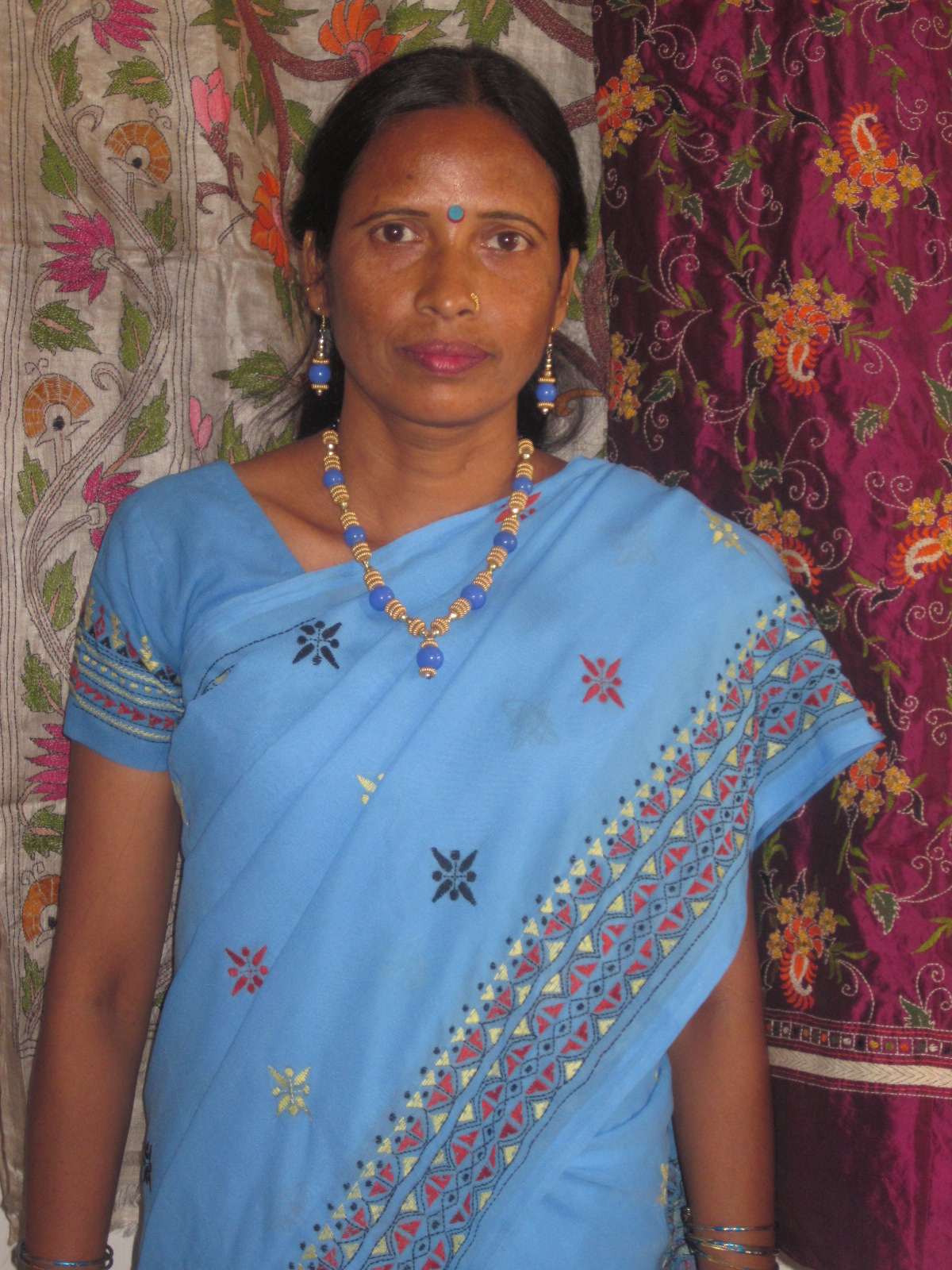
My friend at Delhi Haat

Vaishnav Jana ~ Bhajan


Vaishnav Jan To Tene Kahiye (Hindi)

Vaishnav Jan to tene kahiye
Jay peerh paraaye janneyray
Par dukkhey upkar karey teeyey, man abhiman na anney ray
Sakal lokma Sahuney bandhey,
Ninda Na karye kainee ray
Baach kaachh, Man nischal Raakhey, dhan-dhan jananee tainee ray
Samdrishi nay trishna tyagee, par-stree jaynay mat ray
Vivihva thaki asatya na bolay, par-dhan nav jhaley haath ray
Moh maaya vyaayey nahin Jeynay, dridth vairagya jana manma ray
Ram-nam-shoom taalee laagee,
Sakal teerth seyna tanma ray
Vanloohee nay kapat rahit chhay,
Kaam, Krodh nivarya ray
Bhane Narsinhyo tainoo darshan karta kul ekotair taarya re.

English Translation:
Speak only as godlike of the man who feels another’s pain
Who shares another’s sorrow and pride does disdain
Who regards himself lowliest of the low
Speaks not a word of evil against anyone
Blessed is the mother who gave birth to such a son
Who looks upon everyone as his equal,
Lust he has renounced
Who honours women like he honours his mother
Whose tongue knows not the taste of falsehood
Nor covets another’s worldly goods
Who longs not for worldly wealth (or fame)
For he treads the path of renunciation
Ever on his lips is Ram’s holy name
All places of pilgrimage are within him
He has conquered greed, is free of deceit, lust and anger
Through him Narsinh has godly vision
And his generation to come will attain salvation.

Times Change, so do the Tastes…


Old Memories…PINAZ MASANI
A favourite of yesteryears. Does not seem to move as much any more.
Blogged for keep sake of past memories…

Eat, sleep, breathe…dance!~ World Dance Day( April, 29).


This slideshow requires JavaScript.

We Dance…

God’s the choreographer
The world’s a dance floor
Our lives are the rhythm
Emotions are the music
We are the dancers,
We dance in laughter,
We dance in tears,
We dance in madness,
We dance in fears,
Dancing in our lives awake
With ambitions we tap
And with hope we shake
To replicate our dreams.

The dance is one of the many human experiences which cannot be suppressed. Dancing has existed at all times, and among all peoples and races. The dance is a form of expression given to man just as speech, philosophy, painting or music.

Apart from war, dancing is the chief factor making for social solidarity in primitive life. The value of dance as a method of individual and national education was recognized as civilization became increasingly self-conscious. In the Laws Plato remarked that a good education includes knowing how to dance and sing well.

Quotes:

”Let us read and let us dance –
two amusements that will never do any harm to the world.”
~ Voltaire

Dancing is the loftiest, the most moving, the most beautiful of the arts, because it is not mere translation or abstraction from life; it is life itself.
~Havelock Ellis

Talk about dance? Dance is not something to talk about. Dance is to dance.
~Peter Saint James

Mysticism of Sound –Sufi Inayat Khan


A short biographical video about Sufi Inayat Khan, the Indian musician and mystic who brought Sufism to the West in the early 20th century.

Sufi Inayat’s quotes from his book “Mysticism of Sound”.

“A person does not hear sound only through the ears; he hears sound through every pore of his body. It permeates the entire being, and according to its particular influence either slows or quickens the rhythm of the blood circulation; it either wakens or soothes the nervous system. It arouses a person to greater passions or it calms him by bringing him peace. According to the sound and its influence a certain effect is produced. Sound becomes visible in the form of radiance. This shows that the same energy which goes into the form of sound before being visible is absorbed by the physical body. In that way the physical body recuperates and becomes charged with new magnetism.”

“Life is a symphony, and the action of every person in this life is the playing of his particular part in the music.”

“Love produces harmony and harmony creates beauty. Therefore the chief motto in life is ‘Love, harmony and beauty’. Love in all things and beings the beloved God, in harmony with all in the right understanding, and beautify your life by observing the beauty within and without. By love, harmony and beauty you must turn the whole of life into a single vision of divine glory.”

Ayeda Naqvi’s rendition of Hazrat Inayat Khan’s Urdu poem, “Ajab shaan hai”
(English translation below)

Ajab shaan hai, mast e saut e azl kee
(What a unique glory has the one who is attuned to the sound of eternity)
Na parwah rahay, oos ko thal kee na jal kee
(He is not concerned about the (happenings of the) land or the lake (the earth or water)
Usi sur kay, dhiyaani hain roz e azl say
(It is the same sound that we have all been intoxicated by since the beginning of time)
Kay maaray hooay, hain pia kay charan kay
(It is the same sound that brings us to the feet of the Beloved)
Khudaee karain kar kay dikhlaayain dum main
(Let us reflect Him through our breath and our actions …)
Agar dair main hon kay hon ya haram main
(… Whether we are in the temple or in the mosque)
Inayat sada kay fidayee hain saaray
(Oh Inayat, we are all intoxicated by that which is eternal)
Parhain hain azl say pia kay duwaaray
(And since the beginning of time we have been lying at the doorstep of the Beloved)
Jo Us ka hai waisa hee hona hai laazim
(If you come from Him, you are bound to be like Him)
Mijaz aur haqeeqat hain baahim mulaazim
(The inner and the outer world are, after all, one)
Ajab shaan hai, mast e saut e azl kee
(Oh what a unique glory has the one who is attuned to the sound of eternity)
Inayat karo bus bhee tum aur yeh baat
(Oh Inayat, stop talking about such lofty ideals)
Haqeeqat kay charchay, tumhaaree yeh awqaat
(Look at reality and look at your own lowly nature)
Illahi karam ho, kay zara ho khursheed
(Still, if He wishes, He can turn a speck of dust into sunlight)
Karam ho to ho jayay, sar sabz umeed
(And with His blessings, hope becomes evergreen)
Ajab shaan hai, mast e saut e azl kee
(Oh what a unique glory has the one who is intoxicated by the sound of eternity)

World Pulse Delivers Letters to Michelle Bachelet of UN Women | World Pulse


World Pulse Delivers Letters to Michelle Bachelet of UN Women | World Pulse.

Seeing the Unseen through the Third Eye–Human Psychology


Time and again I have thought of how difficult it must be for the conscientious minds to deal with decisions that have a long term impact on the lives of the people. I wonder how can educated responsible people take irresponsible decisions and call them ‘principled’ or based on some well defined ‘laws’ .

There may be professions like school teachers, doctors, judges and religious priests who deal with human life directly and whose decisions are likely to have long term impact to individual or a group . Call their judgements –report cards, diagnosis, verdicts or fatwas respectively—whatever you call them—can make or break the individual or group upon whom it is given.

My personal experience as a mom, have seen first hand, how much impact a sensitive school teacher has on his/her pupils–be the teacher be good in his/her subject or not. A teacher who reassures students in their difficulties or supports them when not doing well, does a long favor on their growth and development, than an accomplished teacher who scolds or reprimands a pupil for not living upto the expectations.

Similarly doctors deal with patients– with all kinds of physical and mental problems—need to be sensitive to thier judgments or the diagnosis of the patients. The evidence in the medical science has proven that those doctors who deal with patients in a humane manner, seeing beyond what is visible and keeping the patient’s psychology in view while giving a diagnosis, not only succeed in developing a better patient–doctor relationship, make patient more compliant and have better chances of successfully treating a patient.

What is common in both such teachers and doctors is their sound training or knowledge of Human Psychology. Thankfully psychology has been incorporated in the curriculum of both the teachers and the doctors. I wonder if judges too undergo a training on the basic know how of human psychology . But certainly religious preists are not—leaving aside some who are naturally inclined towards it.

For religious priests its could be understood very well, that they are an unregulated profession and especially our Mullahs are trained purely to understand only the literal meaning of the laws in the religion. For instance talking of issues like rape, abortions, divorce—the laws are so men oriented—with no consideration to the psychological impact these cold-blooded laws have on womenfolk. Similiarly in the case of blasphemy law— no consideration is given to the fact that it is a ready recipe for anyone to abuse the law for personal vendetta by inciting mindless emotions into people. View it from the eyes of a psychologist—it is an easy terrorizing tool. I think if the maulvis, or priests of any faith, would understand psychology and that the power of love and compassion was far more overpowering than ‘fear psychosis’ in creating better followers of God—they would all end up being Dalai Lamas of their own religions.

Similarly after reading through the text of the judgment of Mukhtara Mai verdict, it becomes really compulsive to think how mandatory the knowledge of Psychology is for the judges too. In fact in some parts it even seems that these learned judges even lack common sense .

“It is unbelievable that the boy for ‘shame’ would not tell the true story, lose the chance of liberty and the sympathies when Maulvi Razzak along with the police had reached the spot for rescuing him, …”

How naive of the judges not to know this simple psychology of the majority of children fallen victim to such incidents, do not disclose it to anyone, be it their parents or close of kin.

And to base as evidence the fact that the lady had no injury marks on her body as a doubt on whether the crime —again compels me to ask the judges to read the psychology of the woman who has been overpowered by four men in dark and being raped—is left with no physical and mental stamina to struggle.

And then failing to consider that many rape victims and their families are not in a state of mind to report the case right minutes after the incident. It takes them a lot of rethinking, and time to gather courage to come forward with the complaint.

Moreover research has proven the presence of effects of stereotypical beliefs and hindsight biases on perceptions of court cases.
The fact that the judge wrote that the victim complained because she could not marry the rapist is one glaring example of the preconceived notion of a judge with Feudal mindset.

If only along with the big fat books on Law, they read in their curriculum, a thin manual on Human Psychology their thinking process would differ.

Judges too are human beings and their mindsets must definitely be a bearing on their judgments too. A dash of training in Human Psychology would come a long way in their profession.

With recent advances in human psychology and many other scientific tools to know the truth from lies, judges still base their knowledge on their archaic principles of ‘witnesses’ and raw ‘evidence’.

Shouldn’t they be looking through the third eye into the unseen evidence of the cases they judge??

Oh! the Souls of the Subcontinent


This slideshow requires JavaScript.


Oh! the souls of the subcontinent,
Let for amity be our energies spent.

Aren’t we neighbours? Shall be forever,
Let being friends be our real endeavour.

How can the love our hearts not seal?
How can the vibes our minds not feel?

It’s not just the past, we both share
Also the culture and faith that we so care

How can my eyes and yours deny,
Shared treasures, that make us sigh!

Himalayas on our heads so stand,
Lofty mountains guarding our land.

The twists and turns in Indus river,
Who’s ancient stories make us shiver.

Enchanting Thar and its golden sands,
Weave beauty in each of its strands.

And then the grand Arabian Sea,
That enthrals both you and me.

How could we now live apart,
We’ve been one, from the start

Oh! those lines on our lands sketched,
Let they not, on our hearts be etched.

IlmanaFasih
Note: An FB friend Rashmi Talwar made ammendment in the last verses with magic words. How could I not accept her suggestion:

How could we now live apart,
We’ve been one, from the ‘very’ start

Oh! those lines on our lands sketched,
Let they not, on our hearts ‘forever’ be etched.