Open up your mind and your potential reaches infinity…

Archive for the ‘India’ Category

Whatever IS will be WAS.


The above heading is a Buddhist saying by Monk Ñanamoli. The  in depth meaning of its essence could not be more powerfully conveyed than by an ancient  Buddhist ritual called dul-tson-kyil-khor ( Mandala of colored powders).

Sometime ago in search for an idea for silk painting I accidentally bumped into a beautiful  handmade creation, which in first hand looked like an intricate colorful geometrical design, called Sand Mandala.

As the name implies, it is a creation made from colored sand. Mandala means a palace. There is much more to it than the eyes can see.

From the Tibetan Buddhist tradition, this is not just a creation of a beautiful sand castle, but a spiritual journey, for which requires a great practice and meditation before embarking on it. Even during the creation , which usually requires 4 monks (bhikkus) who keep chanting hymns and focus all their minds and actions into its creation.

The sand mandala for them is a three dimensional Palace of Imagination in which they enter, and each dot, line, shape and color that they create in it stands for a specific aspect of Buddhist Philosophy. There are many types of Mandalas, and each stand for a unique symbol.

The creation has to be accurate, and the work  between the 4 creators, working on each quadrant,  has to be well coordinated.

Billions of grains of colored sand powder are carefully and accurately placed in its specific location, using two copper conical pipes called chapku, which are gently tapped over the other, to release controlled amount of sand.

The colors for the painting are usually made with naturally colored sand, crushed gypsum (white), yellow ochre, red sandstone, charcoal, and a mixture of charcoal and gypsum (blue). Mixing red and black can make brown, red and white make pink. Other coloring agents include corn meal, flower pollen, or powdered roots and bark. In the ancient times they used colored dust from the lapiz lazulli, emerald, ruby, and corals and other precious stones to get colored dust powder.

It takes from few days to few weeks to create a mandala.

However, the most mind boggling part arrives when the whole intricately built sand mandala is undone ( yes, you read it correct) from outside-in in a rotas wheel movement, never to exist again, by the very monks who created it. This metaphorically implies the impermanence of things.

The dust collected is immersed in a flowing water ( river nearby) symbolizing the transference of the energy of goodwill ( imparted to it during its creation)  and compassion, to the rest of the world. {The whole idea gave me shivers and goose bumps}

Hence, when even  at first look it appears to be an end of a creation, but in the real sense, nothing is ever destroyed forever, just that it is returned to the nature, to rejoin elements.

And this does happen to all animate and inanimate objects on earth, be they complicated  humans,  simple plants, soft clouds or  even lofty mountains.

When Buddha passed away, one of his disciples remarked:

Aniccaa vata sa”nkhaaraa — uppaada vaya dhammino
Uppajjitvaa nirujjhanti — tesa.m vuupasamo sukho.

Impermanent are all component things,
They arise and cease, that is their nature:
They come into being and pass away,
Release from them is bliss supreme.

It compels me to be reminded of Kabir’s doha:

Mati kahe kumar se tu kya rondey mohe,
Ik din aisa ayega main rondoonga tohe.
(The clay says to the Potter: What will you maul me, a day shall come, when I shall maul you).

Or yet in another doha he reminds:

Kaya nahin teri nahin teri,
Mat ker meri meri.
(This existence isn’t yours, don’t call it “It’s mine, it’s mine.”)

And of Bulleh Shah’s kaafi:

Na Kar Bandeya  
Meri Meri
Na Teri Na Meri
Char Dinan Da Mela
Duniya Fair Mitti Di Dheri.
(O people, why  be obsessed with me, mine. Its neither yours nor mine. Its for a while, then we all shall be but a pile of dust).

Indeed, “from dust we were born, and to dust we shall return.”.

A Life’s Journey of my Sister in the Indo-Pak Subcontinent


An open letter to Director General UN Women, on issues and recommendations for women in one’s region.

First published here: http://worldpulse.com/node/34370

Dear Michelle,

I am sure you, jolly well, must be aware, as a woman that despite being more than half of the world’s population, we the female gender, is still considered either a subordinate or a commodity in the hands of men on this earth. The issues faced by us women all over the globe are numerous and it would take many a blogs to even list those issues. Female infanticide, girl child neglect, malnutrition, sexual abuse, illiteracy, economic slavery, women trafficking, domestic abuse, bride burning, moral policing-you name and that issue still exists among a large chunk of this world’s half population.

As India is my homeland and Pakistan the land of my husband and kids, Michelle, I have chosen to love both the countries as much and hence the plight of women in both the countries is very close to my heart. Broadly speaking, the issues faced by the women (my sisters) in both the countries are similar except for some minor differences in the magnitudes or the nomenclature.
I wish to recount here a typical journey that ‘my sister’ i.e. a typical woman lives in the Indian subcontinent right from her conception till her death.

A news of a pregnancy is rejoiced in our communities and right from that moment, the prayers begin wishing for a son. Rarely does one see people who wish for a girl especially in the absence of a male child. Hence the first rejection of her dignity is registered in a very subtle manner, right at her conception.

As the pregnancy progresses many an enthusiastic parents, especially in parts of India, frantically start to investigate for the gender of the baby growing in the womb and if confirmed a female–thanks to the practice of ‘female foeticide’–some of my sisters end up being aborted just for being a girl. Hence their life ends long before it actually is destined to begin, of living in this world.

Among those who open their eyes in this world—not many are in a position to call themselves lucky.

My little sister is raised as a secondary to her male sibling. She is fed once her male siblings or other male members of the household have had their share, and hence she embarks upon the journey of life malnourished right from the outset. From the birth till death she is under the control and command of a male ‘guardian’ be it a father, a brother, a husband or a son.

While her male sibs go out to play, she is asked to stay indoors and help the mother in house chores. And even if her brother is lucky enough to go to school, she is, in many places , told to stay behind looking after the younger sibs, no matter how much she aspires to acquire education. About more than 3 out of 5 of my young sisters from toddlers to adolescence, in Pakistan fall prey to the beastly lust of men and that too known uncles or cousins (in 90% of cases) in the form of sexual abuse, molestation or rape.

As she attains an appropriate ‘age’ the elders decide that it is time for her to move on with matrimony. What is the age of her groom is purely her luck—he could be a young boy of her age or if the parents are lucky to get a good price—then the groom could be as old as her father. The age is no bar. She is by now well trained to not to express her like or dislike and could be subjected to any sort of oppression to make her obey the decision in case she dares to defy.

The marriage for my sister, Michelle, does not by any means, mean liberation from an oppressive father or an authoritarian brother, but a mere transfer of control and command of her life and existence, to her husband. In many a communities in Pakistan, if she opposes, she is subject to severe punishment in the form ‘honor killing’ or else.
And out of those who do get married, a third have to bear the taunts and torture at the hands of the in laws for not bringing enough of the dowry. Some are even doused with kerosene and burnt alive ( ‘Bride burning’) in India and sometimes in Pakistan too.

National Crime Records Bureau (NCRB), India said a total of 7,618 incidents of dowry deaths were in 2006 , in India, an increase of 12.2 percent over 2005.

On the other hand, in many parts of India, and Pakistan, 1 out of 3 of my really poor sisters stay unwillingly single simply because their parents do not have enough to pay for their ‘dowry’. Literally speaking the groom is up for sale with a price tag of dowry.

However not just the poor even the rich sisters of mine in Pakistan meet the same fate. Their Feudal Lord fathers and brothers do not want their lands to be divided by giving the daughter her share. So the daughter is loaded with jewelery , expensive clothes and ‘married to the QURAN’. Yes, Michelle, this is true and I do not exaggerate even a bit.

Once in wedlock , almost half of my married sisters have no control over their own life and body. They cannot decide how many children to bring forth.

Every hour that ticks by, in India, inflicts more brutality on women, with 2 rapes, 2 kidnappings, 4 molestations and 7 incidents of cruelty from husbands and relatives, reveal the latest national crime statistics, National Crime Records Bureau (NCRB).

Similarly, 4 out of 5 women are subject to some kind of domestic abuse—either verbal, economic, psychological or physical violence in Pakistan according to Human Rights Watch.

And the physical violence is not just beating—it could be in the form of physical or sexual violence, torture, mutilation, acid throwing on the face, burning her alive or even strangulating her to death.
And only a minority of cases come into the knowledge of the authorities or in the news, out of which only a handful are proven guilty and punished. Majority of them manipulate to get it seen as an accident and remain Scot free to repeat the same offense with another innocent sister of mine.

We, both in India and Pakistan, are religious communities but unfortunately the onus of upholding religious obligations and principles begins and ends with a woman. She is morally policed and reprimanded if she deviates from the norm, but if the same offense is committed by a man, everyone including our religious leaders turn the other way.

As she grows older, my elderly sister is seen as the embodiment of sacrifice, patience, and morality while the men gallop like stags all over doing as they please. After all it’s a man’s world out there.

She may have worked, however hard, to raise her family or run the household, and is thus called a ‘homemaker’, but she does not get any share in those assets which she assists in her husband amassing in his name. If she is divorced for any valid or invalid reason, she has to walk out of the house with bare hands as all that ‘home’ she has assisted her husband in ‘making’ is entirely his.

She grows old and the command and control shifts from the husband to her son. She is seen as an embodiment of selflessness, sacrifice and patience . The younger girls are shown the glory of her selflessness and asked to emulate her.

Finally, my elderly sister dies a quiet death, without even realizing that she deserved a far better deal in life than was given to her . And hence the relay of her life which began from the passing of a baton from being an obedient daughter to a sacrificing sister to a dutiful wife to a selfless mother, finally ends as a ‘great’ woman into her grave.

This is the typical story of a good 50 % of the women in the subcontinent if not more.

It has been going on for ages and shall go on unless we make some real dent in the situation.

The only way she can come out of this vicious circle is by providing her ‘quality’ EDUCATION.

As a woman gets educated, a whole family including her subsequent generations get educated too. She gets empowered to take the right decisions from the choices in her life—be it her selection of spouse, or her decision to bear how many children or how to raise intellectually superior children.

Education will also empower her to realize that she has her rights too, and not just her duties that are rubbed on her face all her life.

Education will enable her to treat her own daughter as an equal to her son.

Education shall empower her to earn a better livelihood, and make her come out of economic dependence from the men in her life.

Educated woman who is free to make her decisions, is a happy woman and raises a happy family. A happy family brings forth happy citizens. And happy citizens contribute positively not only towards their own homeland but also the whole planet, at large.

Hence, we do not need any rocket science to discover how to empower a woman. Simply ensure her ‘proper and quality education’ and she shall take the reins of her life in her control.

I hope it isn’t asking for a lot, Michelle.

Thank you.

Sincerely,

Dr Ilmana Fasih

9 February 2011

Female foeticide: A curse of modern times


First published as cover story in The Rationale June 2012: http://therationale.org/June_1_ver/Female.html

The first time I personally heard of female foeticide( abortion of female foetus) being practiced in India, was during my clinical posting in the Radiology department as a Medical student in Delhi, in the late 80s. The patient with third pregnancy, and two previous girls, two girls, wanted to know the gender of the baby in the Ultrasound at 6 weeks.

The annoyed registrar had shooed her away, but then shared with us in the doctors room, that : “She will in any case go to a private clinic, get the gender detected and will definitely abort it of found a girl”.

We as students expressed our dismay, a male registrar retorted in humor: “Evil should be nipped in bud.”

Female foeticide, killing the female fetus in the womb, is a modern phenomenon, as compared to the age old existence of Female Infanticide, the killing of the female new born or infant. It began in Asian societies like India and China sometime in the late seventies, coinciding with the campaigns of family planning, easing of medical termination of pregnancy (also called legal abortions) and with availability of the ultrasound machine to monitor pregnancy. Although, there were other tools available for checking the sex of the fetus  through amniocentesis, but was an invasive procedure, and could lead to complications like abortion. Moreover, unlike the Ultrasound, Amniocentesis was not a tool available to the layman, or semi-trained medical professionals to abuse it to their advantage.

As a medical professional and as a female member this very society, one kept hearing of the news of women asking for gender detection, simply to select the baby of their choice

However, it was the 2001 census which shocked the world. It brought forth the hard figures that the practice of female foeticide was not just existent, but flourishing. The overall Indian ratio of 927 girls to 1000 boys in the 0-6 year’s age group, when in the world the ratio was 1045 vs 1000. The statistics were more skewed in the Northern Indian states of Punjab, Haryana, Uttar Pradesh etc than in the Southern states.

And it went on, quietly, unabated, under the cover of legal abortions, and with Ultrasound getting cheaper and more easily available to all levels of health workers. The trend caught up, rose in numbers and spread to other states.
The census reports for the 2011 nailed the speculation that the trend was catching pace, with the stats now being 914 vs 100 for girls vs boys. In some of the states it has gone to as low as in 800s e.g. Uttar Pradesh (899 girls for 1,000 boys), Haryana (830), Punjab (846) and national capital Delhi (866).
The conditional sex ratio for second-order births when the firstborn was a girl, fell from 906 per 1000 boys (99% CI 798—1013) in 1990 to 836 (733—939) in 2005; an annual decline of 0•52% (p for trend=0•002), reported medical journal Lancet in May 2011.

What also came forth in the 2001 census was that it was more of an urban phenomenon and more so practiced by the upper middle class of educated families.

The Urban and Rural ratios being 946 and 900 respectively, to 1000 boys.

“Declines were much greater in mothers with 10 or more years of education than in mothers with no education, and in wealthier households compared with poorer households.” reported a Study published in Lancet, in May 2011.

Better economic conditions and higher education, instead of improving their thinking, enabled their misogynistic mindset to dispense away the extra income, and abuse the modern technology to their advantage. Thus defeating our age old myths of education, and economic circumstances will increase the plight of women. Perhaps our technological knowhow and economic affluence has developed faster than our brains.

The irony is that it is the same communities affluent, well educated, and even God fearing religious strata of society, who celebrates ‘Kanjak’, the day when young girls are worshipped as Goddesses, has now started to kill their own Goddesses in the womb.

Innovations in bypassing the laws:
In the mid 80s some Indian states began passing legislation like the Pre-Natal Diagnostic Techniques (Regulation and Prevention of Misuse) Act, which banned sex determination tests. In the 90s the same act was legislated in the centre too. The Act carries a three-year imprisonment and Rs10, 000 fines for offenders, prohibiting the gender disclosure of the foetus during Ultra sound. However, tens of thousands of Private clinics with cheaper version of Ultrasound machines had mushroomed till then, all over the North Indian cities, performing the gender detection and the abortion of the female foetus as a ‘package’.

There have been reports that certain clinics in small cities display openly billboards with incentives: “Do you want to spend 500 or 50 lakhs” referring to the cost of abortion against the cost of raising a girl child and marrying her off with a dowry.
The gender disclosure law which was an offence, is creatively bypassed, by using code words like: For girl vs boy as:
Jai Mata Di vs Jai Sri Krishna
Pink city Jaipur vs Blue City Jodhpur
Jalebi vs Laddoo.

It is not just the men of the family, but the senior women like the mothers in law who coerce the women to resort to sex selection. Many expectant mothers have to undergo multiple abortions, jeopardising their health before the desired boy is conceived.
Needless to repeat it the mindset of boys being ‘assets ’, kul deepaks (the lamps of heritage) , are looked up as bread winners, carers for the old age, continuation of family name, as a necessity to perform the last rites of the parents.
On the other hand the impression of girls as liabilities, ‘paraya dhan’ (someone else’s wealth), ‘bojh’ (burden) because of the expense involved in marrying them off with a fat dowry, need to protect them physically and morally, and likely to bring disrepute to the family if their morality is lost.

UNPFA report “India Towards Population and Development Goals”(1997), estimates that 48 million women were ‘missing’ from India’s population since the turn of the century. The report further states “If the sex ratio of 1036 females per 1000 males observed in some states of Kerala in 1991 had prevailed in the whole country, the number of would be 455 million instead of the 407 million (in the 1991 census). Thus, there is a case of between 32 to 48 million missing females in the Indian society as of 1991 that needs to be explained.”

According to UNICEF, India tops the list as far as illegal abortions and female foeticides are concerned. Of the 15 million illegal abortions carried out in the world in 1997, India accounted for 4 million, 90% of which were intended to eliminate the girl child.

Another study reported in the Lancet journal indicates that 8-10 million females were aborted during the past 10 years,( from 2001 to 2011) mainly to couples whose firstborn was a girl and among the more well-off families. This number is much bigger than all the men and women killed in genocides put together.
Much to the dismay, a recent report published by Toronto Star, talked of preliminary reports of such skewed ratios, in favour of a boy, in the second and third order births among the Indians settled in Canada.

However, this phenomenon is not just restricted to India; another major country facing the menace of female foeticide is China.

The preference for boys, in China too is tied to their religious belief that male heirs are necessary to carry on the family name and take care of the family spirits. A Chinese family worries that if there is no son no one will look after them and keep them company in the afterlife. Confucius said, “There are three ways of being disloyal to your ancestors. Not carrying on the family name is the worse.”

Chinese parents openly celebrate when they have boys, and some even show disappointment when they have girls. Newborn girls are given names like Pandi (“expecting a boy”), Yanan (“second to a boy”) in hopes the next child will be a boy. Six million women bear the names Lai-di (“call for a brother”) and Ziao-di (“bring a brother”).
“Daughters are like water that splashes out of the family and cannot be gotten back after marriage.”, a Chinese saying resonates with the belief we as South Asians have of girls being a ‘guest’ in their parents homes.

The statistics suggest that China did not have a skewed male: female ratio till the one child norm was enforced. After the enforcement, the rate of abortion of female fetuses increased in China, thereby accelerating a demographic decline after 1979. As most Chinese families are given incentives to have only one child, they would want it to be a son. However later the Law was eased especially for those who had a first girl child, hence giving a legal government sanction to the preference of a boy.
In 2005 figures, 118 boys were born for every 100 girls, up from 110 boys per 100 girls in 2000 and 112 in 1990.

Recently in the past few years, Vietnam has experienced an unusual rapid change in the sex ratio at birth.. The ratio was about 106 male births per 100 female births, in 2000 and has it increased to 112 in 2008.

“Currently, China reports higher sex ratio at birth than Vietnam. However, what is striking in Vietnam is the unusually rapid rise of the SRB [sex ratio at birth] recorded over the last few years.” says a UNFPA representative.

There are no studies existent from Pakistan, but as mentioned in by an investigating journalist in the TV program Lekin by Sana Bucha, there are 3,000 single room clinics existent just in Karachi, with one or two employees, performing illegal abortions, 90% of them being for the female child. This is despite of abortions being illegal in Pakistan, unlike in India or China. This could be just the tip of the iceberg.

A 2005 study estimated that over 90 million females were “missing” from the expected population in Asian countries including China, India, Pakistan, Afghanistan, Burma, South Korea and Taiwan alone, and suggested that sex-selective abortion plays a huge role in this deficit.

Research suggests that instead of economic conditions, like poverty or education, it is the cultural beliefs that play a much larger role in gender preference and sex-selective abortion. To prove this, in places like sub-Saharan Africa, Latin America, and the Caribbean such deviations in sex ratios do not exist in.

As scientific progress furthers and the technology becomes more affordable and available to the common man, the curse of Female feticide, is likely to follow the course it is following currently. There are already available on internet, home monitoring kits, to detect the sex of the new foetus from blood or even urine samples. With abortion techniques getting more medical than surgical, the situation may simply go out of hands of the health personnel even..

The affluent and the educated who perform this would realise its curse only as it will be going to bite them back when their sons will find it extremely daunting task to find brides, and will be forced to stay bachelors.
It is estimated that by 2020 there could be more than 35 million young ‘surplus’ males in China and 25 million in India.

This has actually begun to be seen in smaller scale in various states in India and China. It is already happening that single men are more involved in violence and crimes, resorting to drug addiction and alcoholism, after being frustrated to find a suitable spouse. Women once again are being punished with a rise in rapes, in prostitution demands and through other crimes against them. In some places there have been reports of women being forced to share husbands (polyandry).

In India, the legislation prohibiting gender-selective abortions has so far been evaded easily, and there have hardly been any prosecutions. One wonder what is it that will change the mindsets if education and affluence could not. Would any activism, any mass media campaigns, any icons be able to change this?

My heart shudders to imagine, where and when shall this stop, if at all.
Are we just going to learn it the real hard way?

Dr. Ilmana Fasih
19 May 2012

The mesmerizing Taj


Think Taj Mahal, and to an average Indian, what comes to mind is the information one imbibed during the school about the Mughal Emperor Shah Jahan, and that he had built it in the memory of his beloved wife Mumtaz Mahal. One is also reminded of some’ facts’ that we read in our school history text books i.e. It took 17 years for the construction to complete ( though Taj website info claims that it took less than 10 years), and the misplaced myth that once the architect had completed the construction, his hands were chopped off by the emperor so that it could not be replicated again. However there is no historic documentation of this myth. In fact, there is reference which suggests the contrary.

For foreigner visitors, be they Westerners or from anywhere on the globe, first thing they wish to see when they land in India, is Taj Mahal. For them it is a marvel piece of architecture that symbolises India. A purchase of its mini replica made of alabaster, as a souvenir is mandatory.

However, for the locals, many are superstitious about keeping a replica of TajMahal at home. Some consider it a Mausoleum, while others believe it brings bad omen. Ironically the monument which is known as the most romantic symbol of love in the world, is perceived by the superstitious to have brought bad luck to both Shah Jahan who commissioned it and the architect who designed it.

Many neither superstitious nor romantic, associate it with ShahaJahan’s obsession with extravagant and lavish life style. It is said that the time Taj Mahal was being built ( 1632-1648), Americans were laying the foundation of a great Ivy League institution by the name of Harvard University ( 1636 estb). Hence obvious were the priorities between the two parts of the world.

The fact that the Mausoleum was built for love of Mumtaz Mahal, who died while delivering her 14th baby, at the age of 39, also compels many to question ‘what kind of love was that?’

To many indifferent to above issues, it remains as one of the Wonders of the World. It was in 2001 that New 7 Wonders of the World inititative was begun, and after nearly 100 million votes cast the world over, Taj Mahal was chosen as the top of the New 7 Wonders of the World. However, in 2007, after controversies, form various ends, UNESCO withdrew its support from the initiative.

My personal experience of TajMahal , visitng it as a grown up, was quite unexpected. Having visited a few times in childhood, I did not feel anything special. Hence while visiting again, as an adult, I had expected nothing different.

We entered the initial premises with surroundings made of sand stone.

“Why is there no marble here?”  I wondered while standing in a queue.

There was a thorough pocket search at the entrance, where we had to even dispense away with any chewing gum in the pocket.

It was aound 2 PM, and the sky was overcast, with soft sunlight filtering through the clouds.

As we walked through the gates, there suddenly stood in front of us a mesmerizingly pearly white monument, as if being held on a giant palm instead of the raised platform. It looked like an imagination materialised, and an illusion made visible to the open eyes. And it indeed, appeared to exude the four letter word ‘love’, on whose foundations it was said to have been built.

Beside its merits architecturally, even to my ordinary eye, the first glimpse was hypnotising. The eyes stared for a while without a blink.

As we walked towards the raised platform, it began to rain and got really heavy. As we drew closer, the Taj got bigger, but hazier through the curtain of heavy rain, as if receding into an illusion, shying away from reality. The elusive hazy silhouette began to cast a spell even more.

The slippery rounded edges of the marble stairs up to the platform were a challenge to climb when wet.

In about half an hour, heavy down pour stopped, after having washed off the dust over the marble exterior. As the faint rays of sun reappeared, the washed marble began to glow like the glistening face of Mumtaz Mahal must have been, after coming out fresh from a bath. I instantly, in my wild imaginations, began to correlate the flawless beauty of the King’s beloved Queen , to this marble monument he built for her. He sure must have attempted to match his two loves together—the Taj with the Queen.

Rest of the experience within the Taj interiors were as if walking live through a  dream.

Although the overcast sky prevented us from watching it in the full moon, that is usually is offered on four days in a lunar month.  But from the experience in rain, am sure the experience in a moon light night must certainly be exponentially far more bewitching.

A friend recently messaged this interactive  beautiful video of the Taj, and it instantly brought back the recollections of my own experience.It gives a kind of 3-D effect of the Taj, and helps those who have yet to witness it live, share a tiny fraction of my experience visually.

Please click below to see the interactive video: A MUST SEE >>

http://www.airpano.ru/files/Taj-Mahal-India/2-3

Pangs of an Indian Pakistani


On departure at Indira Gandhi Airport, New Delhi her father, a man with steel nerves, exclaimed with a mask face, in a matter of fact manner,
“Now that you are going across, own the place, own the people, and own the problems the way you have owned the man from there.”

Without a trace of extra humidity in his eyes, he turned back towards the exit, without waiting for her to cross the immigration line for the last time as an Indian. The daughter, with a heavy heart, stopped to watch till the silhouette of her father, her mentor, blurred into the fog of the pre dawn.

Half a day later, the same day, in the same time zone (with a mere difference in half an hour), the same season, she stepped onto a ‘different’  land she was advised to “own”.

The faces, the attires, the language, the snail-pace of the custom officials was quite similar, with only minor difference in salutation of “Namasteji “ there on departure, while “Assalam Aleikum” here at arrival at Jinnah Terminal, Karachi.

But for her the smell at the airport was distinctly different, so was the taste of water she drank from the cooler, and as she moved out, the afternoon breeze that slapped her for the first time was quite hot and humid, unlike the cool breeze she had felt early morning in Delhi. The feeling within was weird, impossible to explain. It was neither regret nor its antonym.

The details of experience that each of the five senses from smell to touch went through, are still afresh as of today.

Today, it is a bit over 22 years from that day of February 19, 1990. A couple of years from now, she would have lived almost as many years as a Pakistani, as she lived as an Indian. A lot has happened in these 22 years. A lot means a lot.

From a dogged patriotic Indian, who cried hysterically on even a hint of anti Indian sentiments from the countless paroxismally patriotic Pakistanis, she gradually graduated into someone who now feels as hurt or happy for Pakistan as for India.

It did not happen overnight.

“You will find a plethora of stupid reasons to with fight each other, and to vent outside anger at home, but for heaven’s sake, never make India-Pakistan as one of those silly reasons. This will neither make India nor Pakistan any Heaven, but will certainly make your home a Hell.”

This singular advice from a cousin uncle in Karachi, in the same situation, did not mean much to her, when it was said. However the golden words found numerous occasions to rebroadcast themselves in her head, pleading reason to maintain sanity.

More than anything else, what must have really transformed her was perhaps the dignity and poise with which her Pakistani spouse literally faced and braved the reciprocal mocking and even bullying from patriotic Indians, relatives or otherwise. If she got perturbed and came to his rescue, he would set her aside with a whisper: “Oral diarrhoea, beyond their control.”

For those who wished to discuss India Pakistan with a level of objectivity, and understanding, they both reversed their roles. They were, and in fact still are, the unsaid ambassadors of the other side in their countries of birth, attempting to bust the myths, and distortions piled up over decades.

However, they still find a sizable ‘visionaries’ on both sides, which never seem to budge from unseen prejudices. Their dogged convictions tend to take comical discourse…

“I know it. I am telling you….”
“How can you be so sure? You haven’t been there. I have lived there.”
“No, but I am sure. I know.”

One wonders if she has still learnt to laugh it off, like her husband. But certainly the pangs of the pain are a lot less.

Not only did they not fight at home on this, they even gave their children the space to choose their preferences through experience. Unlike a typical mother, who would glorify her mother’s side, while demonise her in laws place; it was a conscious effort on her part not to confuse the identity of her kids. It was perhaps as a concerned mother, that she wanted her children to love their homeland as much as she loved hers as a kid.

Seeing is believing, and her two grownups now take pride to announce “We love India, but we own Pakistan” not just in words, but in their actions too.(The wrath the two of them have faced since childhood, because of their parents identities,  till date, would be another saga, best narrated by themselves).

However, not being a super human, what she has really not learnt to laugh off is the message of ‘not’ belonging to Pakistan or to India, which she receives, off and on, bluntly or subtly.

Cricket matches, which boil passions on each side, almost always place her on a pedestal where her allegiance is questioned, at every expression verbal or facial, both home and abroad.

Having strong opinions on political and social issues and a compulsion to vocalize critical views has its own price to pay, if you happen to be a ‘fortunate’ Indian Pakistani. Objectivity is not your prerogative, and to presume “You’re being biased”,  is everyone else’s.  They are always right, and you are always wrong.

“We thought you became a Pakistani”, “Didn’t you give up your nationality?”, “Does it not happens in your India?” “Worry about your Pakistan.” are just few of the judgements that are hurled at her, time and again.

Is it that being a Pakistani by birth, better than being a Pakistani by choice?

Is it that the passport being taken away makes her twenty four years of being born, grown up and groomed as Indian meaningless? Does the soul to be an Indian, also needs a passport?

Or is it that possession of passport of one side bars one to belong to the other side by virtue of birth.

Or is it  being both an Indian Pakistani at the same time, an anathema, worthy of being distrusted?

She would be lying, if she said she accepted these meaningless comments with a big heart. It pains, it really pains. Sometimes it pains a lot more.

Time and again, such off hand comments serve as a reality check for her that ‘no matter how much she may boast that she belongs to both the lands, she is owned by none’.

Going back to her seemingly emotionless father, she was later told by her Mom, on the way back home, he had remarked in a heavy voice:

“The loud mouth that she is, she will certainly be a loss to us, but she will not be a gain, and more of a pain for the other side.”

P.S. This cry is not directed at any single person or incident, but at a pattern of reactions that shoot, off and on, owing to an identical mindset which many many on both sides share. However, it is  the  understanding & acceptance from  friends both ‘real or ‘virtual’ who make our ordeal worthwhile.

Osteoporosis ~ a silent thief


Before reading the information on Osteoporosis below, please take this Pre-Test : https://thinkloud65.wordpress.com/2012/04/15/osteoporosis-the-silent-thief-pre-test/

Osteoporosis literally means porous bones, or thinning of bones.

Calcium is laid down in the bones for strength. However, for various reasons, calcium deposition may becomes less, leading to thinning of bones.

Why a silent theif?

Bones are weight bearing organs.
The thinning of bones can go on for years quietly, without any apparent symptoms, and hence will not be known by the person.  However, the thin bone may suddenly create problem as it breaks. This beginning of  the complications will occur years or decades later. Therefore, it is important to know the thinning of bones well ahead of time, so that the risk of fracture can be prevented.

Gender difference? 

There is  a sudden decrease in bone density in women after menopause, while in men it is gradual with age and with slow fall in male hormone testosterone. Prevalence of Osteoporosis is 1 in 4 in women while 1 in 8 in men.
Especially men who have had certain medical conditions, on medications, chronic smokers and chronic drinkers may be specially vulnerable to Osteoporosis.

MYTH: It is just a myth  that osteoporosis  is a problem only in women. 

Which are the most common sites of fracture?

The three most common sites to fracture from tinning of bones are: are neck of femur( thigh bone), wrist and vertebrae ( back bone).

THE WRIST : Fracture of wrist is the commonest, but not life threatening, but can serve as a warning sign for those who are not aware of their bone density.

THE BACKBONE : The fracture of the vertebrae may give unsightly hump, may reduce the height or have back ache to begin with. And if progressive can make one unable to lead active life.

THE THIGH BONE : As obvious from the picture below, the neck of femur acts like the steel bridge, bearing weiight of the body. If it gets weak, it can fracture easily. This is the most serious of all the three fractures. These fracture immediately make a person bedridden, and about 30% of then die in first year and another 25% remain bed ridden for rest of the life.

How do you assess your Osteoporosis risk ?

Check  if it applies:

• Am I 65 or older?
• Have I broken a bone from a simple fall or bump since age 40?
• Has either my mother or father had a hip fracture?
• Do I smoke?
• Do I regularly drink three or more alcoholic drinks per day?
• Do I have a condition that requires me to use a steroid medication for over 3 months duration?
• Did I have an early menopause, i.e. before age 45?
• Have my periods ever stopped for several months or more (other than for pregnancy or menopause)?
• Have I ever suffered from impotence, lack of sexual desire or other symptoms related to low levels of testosterone (male sex hormone)?
• Do I currently weigh less than 60 kg or 132 lbs?
• Have I lost more than 10% of my body weight since age 25?
• Have I recently had an X-ray that showed a spinal fracture?
• Have I had an X-ray that showed low bone mineral density?
• Do I take any medication that can cause osteoporosis such as an aromatase inhibitor for breast cancer or hormonal treatment (androgen deprivation therapy) for prostate cancer?
• Do I have a medical condition that can cause bone loss or fractures? Eg rheumatoid arthritis, celiac disease, gastric bypass surgery, COPD (chronic obstructive pulmonary disease) or chronic liver disease.

IMPORTANT ADVICE: If you are over 50 and have checked ONE or MORE of the above, most Osteoporosis guidelines recommend that you talk to your DOCTOR  to see if you need a bone mineral density test and about doing a comprehensive fracture risk assessment (with FRAX or CAROC).

REASSURANCE: And in case you are told to have osteoporosis ( significantly low bone density) or osteopenia ( slightly low bone density), it is not a matter to panic but to thank your stars that you have come to know this before any serious fractures or disabilities occurred.  Know that  the problem can  be controlled by advice and medications from a specialist Endocrinologist or Gynecologist.


How can you avoid Osteoporosis ?

• Adequate amounts of calcium
• Adequate amounts of vitamin D
• Regular exercise

Calcium Requirement:

Foods high in Calcium

Milk, cheese and other dairy products are good sources of calcium.

Other foods high in calcium include vegetables like broccoli, kale, chickpeas, French beans, baked beans and red kidney beans as well as dried fruits and nuts like almonds, walnuts, Brazil nuts, hazelnuts and sesame seeds. Fruits like oranges, grapefruits, figs and apricots are also rich in calcium.

Fish like sardines in oil, fried whitebait and tinned salmons contain high amounts of calcium. You will get plenty of calcium from desserts like fruit cheesecake, ice cream, milk custard and canned rice pudding as well as breads and grains like pasta, wholemeal bread, white bread and white rice. Some other sources of calcium are eggs, soybean tofu, cheese macaroni, cheese omelet and lasagna.

If not completed through foods, Calcium requirement should be met with Calcium supplements like Calcium Carbonate or Calcium Phosphate.
You may use the chart below to calculate your calcium intake, roughly.

Vitamin D

 Vitamin D is necessary for your body to absorb calcium. Many people get adequate amounts of vitamin D from sunlight, but this may not be a good source if you live in high latitudes, if you’re housebound, or if you regularly use sunscreen or you avoid the sun entirely because of the risk of skin cancer. Scientists don’t yet know the optimal daily dose of vitamin D. A good starting point for adults is 600 to 800 international units (IU) a day.

Exercise

Exercise can help you build strong bones and slow bone loss. Combine strength training exercises with weight-bearing exercises.

Strength training helps strengthen muscles and bones in your arms and upper spine, and weight-bearing exercises — such as walking, jogging, running, stair climbing, skipping rope, skiing and impact-producing sports — mainly affect the bones in your legs, hips and lower spine.

Swimming, cycling and exercising on machines such as elliptical trainers can provide a good cardiovascular workout, but because such exercises are low impact, they’re not as helpful for improving bone health as weight-bearing exercises are.

Please pray for us too, Mr President !


Just a few weeks ago I was moved to hear an ex Indian Chief Election Commissioner say to Najam Sethi:

“Hamara Makkah Medina to aap ke paas hai.”
(Our Mecca and Madina are with you).

After retirement he had come to visit the holy places of Sikh in Pakistan, the Nankana Sahib and other holy shrines in Pakistan.

Now we hear our  President Zardari  is going to pay a private visit to the Dargah of Hazrat Khwaja Moinuddin Chishti,( RA) at Ajmer on April 8, 2012. This Dargah is an important Holy place for those revering Sufi saints. It is a shrine where 12,000 devotees from all faiths and sects visit each day.

It is a destination that was held in high esteem by the most secular of all Mughal kings, Emperor Akbar. It is said that once Akbar, passing by a village near his capital Agra, heard some minstrels chanting ditties about the glories and virtues of Khwaja Moinuddin Chishti “May his grave be hallowed, who sleeps in Ajmer.”

He expressed his desire to visit the shrine of this great man whose songs were being sung. From then on, he made it a routine to visit the shrine every year.

Not only did he visit to ask for prayers, he even paid visit of thanks to the Dargah for his important military victories.
The most moving expression of his devotion was the journey of this great Mughal King, when he walked bare foot from Agra to Ajmer (346 kms) just to express his gratitude on the birth of his son, who later became Jehangir. He had named him Salim after another sufi saint who was enshrined in Fatehpur Sikri.

Knowing Akbar as not only a great King whose kingdom extended from Kandahar in the west to Bay of Bengal in the East, his most revered quality was his extreme tolerance and acceptance of other religions. He eyed and treated all his subjects which included Hindus, Sikhs, Jains, Buddhists, Zoroastrians and Muslims with an ‘equal tolerance’ policy. Not only did Akbar have Man Singh as his Chief Military Commander, but his Finance Minister was Raja Todar Mal.

With this historical background in perspective, and the fact that the lines across culture and history of India and Pakistan cannot be divided as clearly as the lines that have been drawn across the political border, we can only hope that in his private visit to the Dargah, President Zardari will not only pray for himself, but also for the peace and amity between various ethnic groups and sects that have taken against each other from Karachi to Gilgit in Pakistan.

We also hope and beg to Mr President to please also pray for peace and cooperation between India and Pakistan, and for the greater good of the whole subcontinent. With the unofficial news of business agreements being talked between the two neighbours, one can rejoice with hope that these prayers will be listened at the Dargah soon, and the region where a billion and a half humanity resides, shall see its potential better put to use through trust and trade, rather than through hatred and hindrance.

I am sure as a courtesy, Mr President, during the private lunch with Prime Minister Man Mohan Singh, will suggests to him to pay a visit to his ‘Makkah Medina’ in Pakistan.

How I also wish that they both also think and discuss that the ordinary people too, on both sides, not just hold great reverence to these holy places, but also have burning desires in their hearts to visit with ease, their friends and kin living across the border.


How I wish a day comes when even an ordinary citizen from either side, is able to decide like Mr President, that he needs to make a private visit across the border at the coming weekend, and there he goes with his plans without having to bother about visa, or police inquiry.


These may just be my dreams today, but don’t dreams come true too?


The story of Siachen


With the tragic news of 150 Pakistani soldiers buried alive in an avalanche in the Pakistan base camp at Siachen, it brings back to memory the bitter truths about this conflict.

The glacier:

  • Siachen means ‘the place of wild roses’.
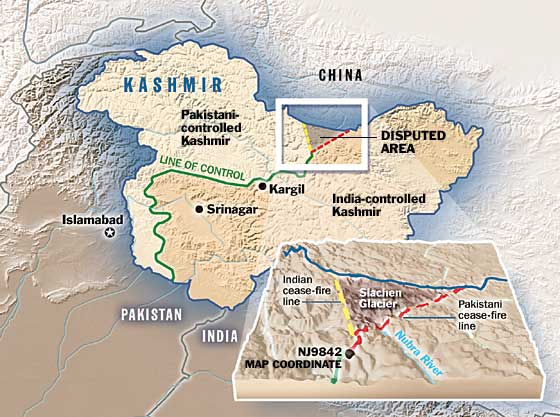
  • Siachen glacier is the great Himalayan watershed that demarcates central Asia from the Indian sub-continent, and that separates Pakistan from China in this region.
  • It is the world’s second longest non-polar glacier, and thus is sometimes referred to as the third pole.
  • It is 70 km long and flows from an altitude of 5750 meters to 3620 meters above sea level.

The conflict:

  • Siachen is known as the world’s highest battlefield between #India & #Pakistan. Troops are deployed at elevations of up to 6,700 metres (22,000 feet) at minus 60 degrees C.
  • Siachen conflict began in 1984 when both India and Pakistan, began sending mountaineers, in an attempt to lay their claims over the area. Several skirmishes took place till 2003 when a cease fire was declared.
  • The roots of the conflict over Siachen lie in the non-demarcations on the map northward to the China boundary beyond NJ9842, which is the line’s “dead end” in the India-Pakistan line of control agreement.
  • The 1949 Karachi agreement and the 1972 Simla agreement presumed that it was not feasible for human habitation to survive north of NJ9842.
  • UN officials presumed there would be no dispute between India and Pakistan over such a cold and barren icy wasteland.
  • The contentious area is only 900 square miles (2,300 km2)
  • Indians control the length and heights of the glacier including the three passes, while the Pakistanis control the glacial valley. As a result, Pakistanis cannot climb up, and Indians cannot come down.
  • Together, the two nations have about 150 manned outposts along the glacier, with some 3,000 troops each.
  • Over 2,000 Pakistani & 4,000 Indian soldiers have died at Siachen conflict. More soldiers have died or handicapped from frost bites, cold and avalanche i.e. harsh weather than combat.
  • Official annual figures for maintaining these outposts are put at $300 and $200 million for India and Pakistan respectively.

The strategic importance:

No matter what India and Pakistan may claim about its strategic importance, Dr. Stephen Cohen, a well-known and respected Washington-based South Asia analyst, considers,

“Siachen conflict is a fight between two bald men over a comb.”

In his view, “Siachen… is not militarily important… They (Indian and Pakistani armies) are there for purely psychological reasons, testing each other’s ‘will’.”

The talks for demilitarisation of Siachen did take place between India and Pakistan in May 2011, but fialed to reach any agreement.

The truth remains that this stretch of icy wasteland holds no political or economic importance to the billion and a half residing on both sides of the border.

Instead of being a battle ground, Siachen should be demilitarized, and to evade the unresolved dispute of AGPL ( actual ground position line) the area could be seen as a ‘common ground’ precious enough to study and conserve the glacier which is under threat due to the climate change. This can easily stand as a symbolic Peace Park. And the billions of rupees used to maintain its cost as outpost for armies should be directed at improvement of the plight of the impoverished peoples on both sides.

Or better still let ordinary youth from both sides of the border play kabaddi in snow.

It’s just a Menopause !


Menopause simply means:
*A woman will not be having periods anymore. Hence she will not be able to get pregnant. It certainly does not mean that she has lost her womanhood or feminity.

Menopause is that point in time when periods stop forever. You can know that you had a menopause, only after a year has passed, and the period has not resumed.
Usual age for menopause is 51 years. (But it can be upto 55 years. Those who have before 40 have early menopause.)
Before the period actually stops, a woman undergoes some change in life symptoms. This period of transition is called PERIMENOPAUSE

Why is it important for you to know about menopause?

The change in menopause can be divided into Short term and Long term.

In the short term:

It is important to know in advance that while approaching menopause a woman undergoes certain physical and psychological symptoms, whose awareness helps her and her family (especially the spouse) to understand her situation and tackle it better.
• Periods start to get more and more irregular about 4-5 years prior to menopause. Some get it scanty, while in some they become heavy due to hormonal imbalance.
• Woman may feel sudden feeling of a heat wave and then sweating, called Hot Flashes. They can come anytime in the day, at night f during sleep, and can be very annoying to the woman. It is mainly because of the fluctuating hormone levels in the body.
• Mood swings may occur, with crying spells and even depression in some.
• Dryness and thinning in the vaginal walls, difficulty in holding capacity of urine,
• Stress, trouble sleeping, forgetfulness and feeling of laziness- if you are not prepared for the menopause mentally and physically.

MYTH 1: That menopause will make a woman less interested in her sexual life. It may happen with some, but for some others, they feel more relaxed as there is no fear of getting pregnant.

MYTH 2: In the late forties when the periods get irregular, many women think they will not get pregnant anymore and get relaxed on using birth control. This often causes them to get pregnant unexpectedly. Hence, do not stop contraception unless periods have completely stopped.

In the long term:


It is very important to  realise that with the present life span of 70+ years now the woman spends at least ( if not more) a third or 40% of their life after menopause. Hence it is important to know how to stay healthy in this period of life.

• A woman becomes as vulnerable to heart disease as any man, as high oestrogens previously protected her from heart attacks or stroke.

• With menopause the bone density goes down rapidly and a woman after some years may develop thinning of bones called Osteoporosis
(Osteoporosis is a serious problem. If not taken care this can have serious after effects. Check for it in the next blog).

What should you do?


Know that menopause is a normal change in a woman’s life and it has to come when you are around 50. Hence better be mentally and physically prepared for it.

What preparations do you need to do?


EASY: If not earlier, when you enter into forties, MAKE A CHANGE IN YOUR LIFESTYLE.

STEP 1: Exercise, exercise, exercise:

Benefits of exercise are too many:
• This make menopausal symptoms less severe
• It will keep heart healthy after menopause
• Prevent bone loss or osteoporosis after the menopause
• Will prevent weight gain after menopause.

STEP 2: Stop smoking, reduce on tea and coffee- as they all increase bone loss, smoking increases risk of heart disease.

STEP 3: Take Vitamin supplements, especially Calcium and Vitamin D. The daily dose required for women around 50 is Calcium 1200 mgs and Vitamin D 800 micrograms.

STEP 4: Keep reminding yourself, menopause hasn’t taken your womanhood away or that you are old. Keep a good sense of humour and consider it a good change.

TIP: It is likely the time when children are older, or may even leave home …so empty nest syndrome can make you feel more depressed. Develop hobbies which will keep you stimulated and stress free. If the children have grown up and you have fewer responsibilities, do think of dedicating some time to public service and giving back to the society.
Hint: teach a poor child, join a social work, etc.

Is there any treatment of menopausal problems?

If tolerable, the symptoms may need no treatment and just reassurance. But if unbearable, you need to SEE A DOCTOR  for advice or medications.
The most immediate problem during the menopause to most women is HOT FLASHES. To minimize them:

• Try to avoid things that may trigger hot flashes, like spicy foods, alcohol, caffeine, stress, being in a hot place.
• Dress in layers, and remove some when you feel a flash starting.
• Use a fan in your home or workplace.
• Try taking slow, deep breaths when a hot flash starts
• There are medications too to help in hot flashes, but for that you need to see a doctor.

For vaginal dryness or discomfort there are water based gels or oestrogen creams, which help, and can v be asked from a doctor’s advice.

The main problem is however the long term bones loss. But this can be prevented too.

  • To keep your bones strong, you need weight-bearing exercise, suchas walking, climbing stairs, or using weights.
  • You can also protect bone health by eating foods rich in calcium and vitamin D, or by taking calcium and vitamin D supplements.
  • Not smoking also helps protect your bones.

Are there Alternative Therapies?  

There are certain herbal and natural remedies too. eg Soy which contain natural phyto oestrogens in foods like Tofu, soya milk, soya beans. There are other names too like black cohosh, Oil of evening primrose etc, but they have not n been well researched. Do talk to your doctor before taking them, in case they clash with your medications.

CAUTION: After you have had a menopause, if ever the period returns, it is not a normal period. It could be something serious causing the bleeding. Hence do not ignore and show to your doctor as soon as possible.

Last of all: Maintain high spirits, and good sense of humor. Do not think this as a negative change in life. Return to your childhood, playfulness is possible. 

When hate or peace become a business


In my last trip to India, I was strolling for window shopping, in one of my favourite spots in New Delhi, when I heard some loud speaker announcements nearby.

I saw a Yogi on a big screen, speaking with utmost tranquility. Some of the words I could recall are:
“Want is always hanging on to the I. When the I itself is dissolving, want also dissolves, disappears.”
And
“How far to heaven? Just open your eyes and look. You are in heaven.”

There were a few other things he spoke. At the first instance all I could think was, ‘Had Kabir been alive, he would have said the same thing.’


As I attempted to take a picture from my mobile phone, a boy intercepted. Wondering if photography was not allowed, I told him “Okay I won’t.”

But he said, “No Didi, there are so many people in the way, I’ll have you take it from a better angle.”

I was quite surprised at his generosity.

While returning, I collected some leaflets from the Art of Living ( Sri Sri’Ravi Shanker’s Organisation) stall, one of which said:

To love someone whom you like is insignificant.
To love someone because they love you is of no consequence.
To love someone whom you do not like means you have learned a lesson in life.
To love someone who blames you for no reason shows that you have learned the Art of Living.

Back home, talking to an old college friend who still lives in Delhi, I mentioned the incident.

She said, “Yes it’s nice, but this is business. Pay fees and attend the classes. What you saw was their marketing section.”

When I heard of his trip to Pakistan and the news about his offer to teach peace to Taleban, I was intrigued, wondering:

‘How would it be taken as an offer by the ilk of Zaid Hamid, Gen Hamid Gul, or the Taleban themselves? Would they again rant of the Hindu agenda or the greater Zionist agenda.’

Instead of the Hindu agenda rant, I saw a couple of positive FB statuses and some tweets on the issue. A tweet worth the mention is:

“Sri Sri has already had a Positive Effect on Taliban! Mullah Omar is now calling himself Mullah Mullah Omar.”
Thankfully, instead of an offence,  it was taken in lighter vain 🙂

Incidentally I happened to chat with the same friend on Facebook , and told her of his trip to Pakistan, and the Taliban offer story.

She said: “Oh come on, he is there to promote his AOL centres, one of which I know is located in the capital city. And again this is the marketing department at work.”

I again muttered to myself, ‘Well nothing wrong with it. One could consider this a social enterprise. We do have an epidemic of hatred in the world and he has provided a therapy for it, but at a price, which will work if it is cost effective.’

He did tour the AOL offices and camps in Karachi, Islamabad and Lahore. But to my utter dismay, before I could start to keep track of his Pakistan trip, and his talks with Taleban, I heard that he was back in India.

Wonder is he wasn’t allowed to approach Taleban, or was it not on the agenda?
I have no clue.

Anyways he did repeat his offer after coming back “There is a lot of violence in Pakistan and people are fed up, they want to live peacefully. If I could be of any help in bringing an end to the vicious cycle of violence, I am ready to talk to the Taliban,”

And that “We are all sufferers of stress, tension, violence and hatred – and small ways of easing out are all that you need,”

There is no doubt that the techniques which he uses for de-stressing are scientifically based.

The primary exercise, which they call Sudarshan Kriya is basically a deep breathing exercise which any psychologist you visit asks you to begin with, on de-stressing. There is a proper technique for it.

I can’t help being amused by the mere visual imagination of Mullah Mullah Omar sitting in a Padma Asana (lotus pose), with hands stretched over the knees, and breathing-in through nose and breathing-out through mouth. 🙂

How I wish that my friend is still proven wrong and some miracle asana (yoga position) comes up which exhales all hatred out of the heads of these radicals.

If that so happens, then I would also secretly whisper in Sri Sri’s ears to develop some Yoga position (asana) in which our politicians extend their arms  in service of  the masses, who vote them in, instead of flexing them, with hands reaching their own pockets.

And so will I also pray to Sri Sri to apply some tilak ( teeka) on the foreheads of our uniformed (on both the sides), so that they start seeing each other as friends and not enemies, and start piling books and medicines for the masses on both sides, instead of arsenals.

I would also beg Sri Sri with folded hands to ‘please please’ make some vibhuti ( spiritual ash) for our diplomats ( on both sides) which when touches their tongues gets them addicted to the taste of peace and makes them feel nauseated just at the sight of visa, passports, police verification etc etc.

Be it a profitable business or social enterprise, there’s no offence, if it is all intended to bring real peace, beyond just a marketing tool.

After all,  all the  chaos and divisions on ground, are also a result of the seeds of intolerance sown by those who consider hatred as their business.