Open up your mind and your potential reaches infinity…

Archive for the ‘CULTURE’ Category

A lifetime encounter with Sain Zahoor~Part 1


Life is really simple, but we insist on making it complicated. ~Confucius

I had read this quote very many times, but had never realised the real essence of it until I met Sain Zahoor.
Little did I know that the two days of my interaction with him would be like a refresher course on Bulleh Shah and would make me so enamoured by his simplicity that all starstudded concerts or hi fi music orchestras, would appear meaningless.

It was the annual RBC Mosaic Festival 2011, in Mississauga. I was given the task to look after the VIP lounge for the artists and other VIPs. I skimmed through the likely VIP list—just one name was enough for me to feel elated–Sain Zahoor. The excited preteen in me actually waited with impatience the moment when I would interact with him.

He arrived on the Gala opening of the festival with his entourage of four modest men. Instantly all the designer clad guests, the ministers, the VVIPS lost their shimmer. All heads turned to see this barely five feet few inches tall, clad in shimmery robe, black turban, a bunch of turquoises and agates around his neck. The aura of his simplicity was mesmerising. His eyes had a mystical depth and serenity in them.

The next evening, before the performance, he walked on the stage, modestly with folded hands, amidst a roar of applause from the spectators, who had come to watch him, sing live, from far flung locales of Ontario.
He began, most humbly, “ I am neither an artist nor a star, I am a faqir (devotee) like my master, Hazrat Hazur Baba Bulleh Shah and I sing to please Allah and to spread the message of peace.”

The instrument he held was the simplest that a musical instrument could be- with a single string, and hence the name Ektara.His ektara is uniquely festooned with mutlicolored tassels of wool, which remind of the memories of back home. And not to forget, he had adorned a bunch of ghungroos ( ankle bells) , which jingled during his whirling and swinging during the performance.

His orchestra, exemplifying simplicity, comprised of four of the most basic instruments —a chimta ( metal tong), a dholak (a desi double headed hand drum) a table( a set of two drums) and a harmonium( a desi accordion). One could hardly believe before he began that this brief ensemble of ‘desi’ instruments would be more than enough to wreck a havoc on the psyches of the listeners.

Needless to say of Bulleh Shah’s poetry that flowed through his intense voice, simply pouring magic into the air. No sooner had he begun that the listeners were transcended into the heights of ecstasy.
As remarked by one of my friends who drove 2 hours to listen to him, “It appears more of a mystical call, than a mere singing of a sufi song.”

We all lost our sense of time, song after song, a span of three hours seemed to have flown in three moments. The magnetised audience did not let him stop. Nor did one notice any fatigue in his voice or spirit, and he went on.

Sain Zahoor’s reverence to his master Baba Bulleh Shah was glaringly obvious through the life he brings to the verses and also by the effort he takes each time to refer to him with a complete “Hazrat Hazur Baba Bulleh Shah.”

With so much of love and devotion, why would he not have that aura and mysticism in his eyes, I told myself.

[To those who do not know him: Sain Zahoor or Saeen Zahur Ahmad is a Sufi singer from Pakistan. He spent his life singing in the Sufi shrines, and had not cut a record until 2006, when he was nominated for the BBC World Music awards based on word of mouth. He emerged as the “best BBC voice of the year 2006”]
Contd…Part 2

Sain Zahoor – BBC 2006 World Music Award – Allah Hoo

I love Red, for Red is Me.


I love red,
For red is me.

Red is the embarrassment
I bring to your face, mother,
By the news of my arrival
Putting  at stake your survival.

Red is the blood that is spilled,
When my dreams are killed,
As I am returned to my tomb
While still asleep in the womb.

Red is the roaring rage
That gets out of cage,
By my sins that bring, father,
A shame to your ‘honour’.

Red is the anger that
Descends in your eyes, brother
When I whisper for my rights
Or spread my wings for a flight

Red is the bundled bride I am,
When passed off as a parcel
From one man, my father
To another, my life partner.

Red is the dot of vermillion
Stamped on my forehead,
That is  for the world to see,
That my man, you own me.

Red is the blush on my cheeks,
A million words of my candor it shrieks
My man when your lust you quench
While in the fantasy of love I drench

Red is the fire set ablaze,
When a truck load of dowry
Fails to fill, my master
The castle of your greed.

Red are the bruises that scream
Of my battered self-esteem,
From the circle of abuse, my protector
You inflict on my being.

This is exactly why I love red,
For every shade of red is me.

Foot note: Dedicate these scribbled verses to millions who face gender discrimination from the day their birth is mourned, to millions more lost through Female feticide, honor killings, victims of violence against women, rape, and any or every form of abuse endured merely for being born a woman. 


Delhi Diary: Gossip on Wheels –2


Continued from the previous post….

Delhi roads, or for that matter roads on any metropolitan city in the world is so very stressfull. If only these vehicles did not share their light hearted smalltalks or gossiped or flirted on the way, they would be having high rates of ‘heart attacks’ like us humans.
Only if we too knew how to wade our ways through chaotic and bumpy roads of life with humour, life would seem much less of a burden.

Again open your ears, shush your mouths and hear them gossip and flirt and romance…..
Madame Maruti: Haaaye teri baat ne dil khush kar diya.

Truck ji: Chal Rani tera Rabb Raakhaa
Mme Maruti: Rani, haan who tou main hun. Thankyou for the dua, yaar.

Auto bhai: “Papa Jaldi Ghar aa Jaana.”
Maruti behn: Bhai, ghar mein bachey wait kar rahe hain, zara safely
chalao.

Another auto bhai: “Mera Bharat Pareshan[My India is Troubled].”
Maruti : Tere jaise careless auto se pareshaan nahi hoga tou kya hoga…India.

Maruti, the advisor: Yar tou kaali ko bhool ja, kamai kar buss…

Romeo Truck: “Kaho na pyaar hai”
Laila Maruti: Kyun, ek baar bol diya na, bar baar kyun boloon, huhh.

Maruti( sharma ke): Awaein, mere kol koi hor kum ni haega..

Truck Dada: “Road King”
Maruti: Tabhi tou itna chaura ho ke chalta hai, sarak pe.

Lalchi Maruti: Hain, to kya ye sara maal vi mera. Haaye meri kismat.

Truck in denial: “Gori fir se hui jawan”
Maruti: Kya bola? Zara apne aap ko sheshey mein tou dekh.

Creepy Truck: Tou hi meri dulhan, tou hi mera dahej
Maruti: Yar mat tang ker, us bichari nai Maruti ko.

Truck ji: Bus peecha karoge, ya kabhi dil mein bhi baithogey
Maruti: Arre, peecha kaun kar raha hai, awein hero mat ban.

Truch ji: Dekho, dekho,dekho,magar pyaar se
Maruti: Yahan marne ki fursat nahin hai, tum pya se dekhne ki baat karte ho.

Maruti: Haan, haan woh to nazar aa raha hai.

JattTruck: Jatt Di Mercedez
Maruti, the sophisticated: To tum bhi koi Jutt se kam nahin ho bhai.

Truck the philospher: Hun Tu Kaun te Main Kaun
Maruti the sufi: O truckeya, tu ki jana main kaun…

Maruti: Hahaha kya baat hai…:D

Haseen Lorry: “Kashmir Ki Kali”
Maruti( jealous): Chal chal zyada ghuroor mat ker apne ooper.

Badtameez Tanker: Zarra Hatt ke Laadli
Maruti( ghussey se): Oye tameez se baat ker…

Filmi Truck: “दुल्हन वही जो पिया मन भाये,
गाड़ी वही जो नोट कमाए”
Dulhan wohi jo piya man bhaye
Gaari wohi jo note kamaye.

Maruti, the feminist: Yaar, aajkal to dulhan bhi note kamaye…

Pendu Truck: Himmat hai to pass ker, warna burdass kar.
Shehri Maruti: Lagta hai gaon se naye naye aaye ho, Dilli shehr mein. 🙂

When we part, we get emotional 😥 :
Maruti: Chal TATA. Kabhi Salam bho ker liya ker…

Jazbati Truck: Milega Mukaddar , Pher milangey
Maruti, (equally emo): Haan kismet hui tou zaroor milenge isi road pe, ek na ek din.

Devdaas Truck: Chalo ek Baar Phir se Ajnabi ban JaayeN
Paro Maruti: *sob sob, sniff sniff* Haan chalo, Khuda Hafiz.

And this is how they meet each day, with gossipping, joking, flirting on the roads and making their way through packed roads. Their spirit and zest to survive is touching.

Maruti remarked: Yess we give space on the roads to these beings too, . Do you Humans do the same with animals?

Maruti taunted: Dont you think there are Supermen amongst you only. We have them too.

Maruti( with proud): We have Superwomen too.

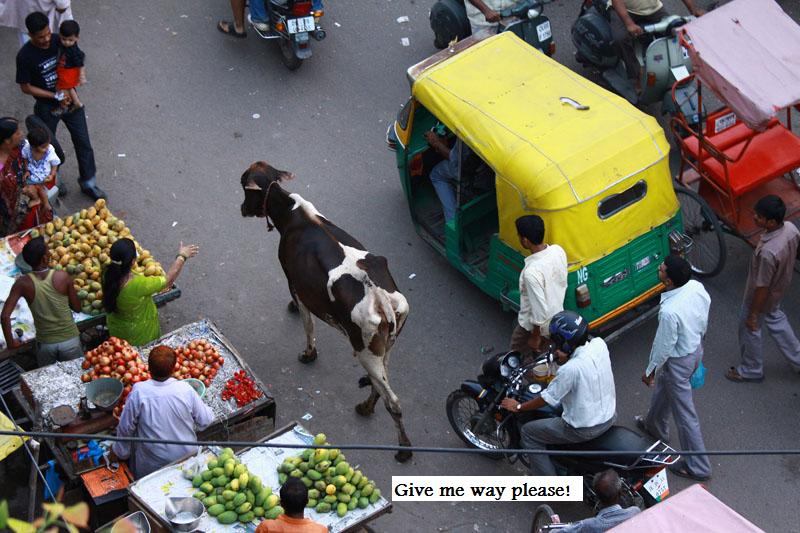
Maruti: See we are considerate for our poor too. And we give them way.

Maruti: We believe in UNITY IN DIVERSITY.

Maruti, the thinker: And we believe in PEACEFUL COEXISTENCE .

Indeed, one thing remarkable about the traffic community is their ‘unity in diversity’. How they coexist with some noisy peace and give way to each other with no vengeance, is worth commending.

We humans need to learn some real ‘good’ lessons from these vehicles.

Delhi Diary: Gossip on Wheels–Part 1


Commuting through the streets of Delhi with almost an hour and a half’s drive each side was no less than a Herculean task. The journey back home, in the evening, would result in a bursting headache.

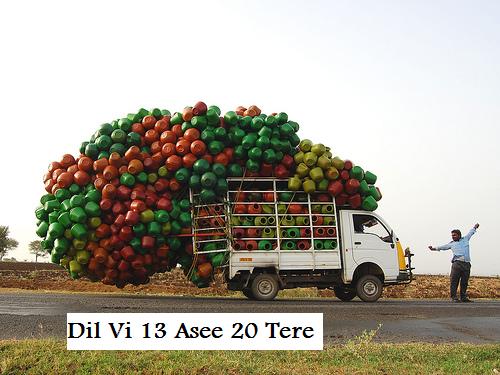
The megacity with hundreds of newly built flyovers and underpasses, still gets choked in its veins at the peak office hours. The traffic is dense, diverse and chaotic. Perhaps when going through licence training they are made to practice to honk horns as much as possible, sworn not to use the dipper and taken pledge not to follow lanes. In fact the dividing lines whether broken white or solid yellow are to be kept exactly in the middle of one’s vehicle—be it a cycle, a cycle rickshaw, auto rickshaw , a car, truck or a tanker.

I felt the dire necessity to have the cake ( wading the traffic all the way each day) and relish it too( enjoy their antics without getting headache).

So I began to hallucinate…

….and began to see and hear all the secret conversations and the relationships the my car had with the traffic around it. I was enlightened now as to why they dive and dodge across the lines ( just like a five year old kid) when another vehicle tries to overtake or chase them. And no wonder why they honk horns so much—in disgust ( just like us humans) when they see injustice .

Oh ! they are all so much like us humans- chaotic and noisy. And like us they gossip, flirt and swear too at each other, on the way.

Only the wise could see that, and I happen to be one of those few. 
I began keeping my eyes and ears open to what was going on between my car and the other fellow vehicles…..

And from then on travelling was fun—after all I am as human as them. and I too love to eavesdrop on what Madame Maruti ( my car) would babble and flirt with fellow trucks and autos along the way.

So from here on just shhhand listen to what Madame Maruti gossips…

Mme Maruti: “Yeah , I know we’ve got to honk the horn for ‘Road Symphony’, but what’s this OK doing in the middle.”

Truck Ji :“Use horn ok please dipper”
Mme Maruti: Hold on, What did you say? Pagla gae ho ?

Mme Maruti: “Kyon? Kya landan se aae ho? Yahan koi dipper wipper nahi janta”.
( Have you come from London, no one knows dipper here).

Mme Maruti: “Yeah only if you had listened to your Mum and been to school, you would know how to say Hallo.”

Mr Truck: “Wait for side.”
Mme Maruti: I’m waiting. But kab takk? ( How long)

We have some of wicked amongst us, just like humans, who can’t wish well for others….
Idealist Maruti: Since when did you become racist, man. Ain’t humans enough?

Burger Truck: “Bad nazar wale tera thobda black.”
Desi Maruti: Lagta hai dost, angrezi filmein zyada dekhne lage ho ?

Dukhi Truck: “चलती है गाड़ी, उड़ती है धूल, जलतें हैं दुश्मन, बिखरतें हैं फूल.”
Chalti hai gari urti hai dhool, jalte hain dushman bikharte hain phool
Maruti, the reformer: Yaar, kabhi kisi ka bhala bhi soch liya karou.( Think of good also sometimes).

Foul mouthed Truck:“बुरी नज़र वाले, तेरे बच्चे जियें, बड़े होकर, देसी शराब पियें”
( Buri nazar wale tere bachey jiyein, Bade ho kar desi sharab piyein).
Maruti, the preacher: O’ bhai, uski to nazar buri hai, per tumhari to soch insaanon ki tarah gandi hai. Uske bachon ney tumhara kya bigada hai?

Mean Truck: बुरी नज़र वाले तू जिए, और तेरा बेटा बड़ा होकर तेरा खून पिए! ( Buri nazar wale tere bachey jiyen, bade ho kar tera khoon piyen).
Maruti, the Gandhian: Arre bhai, kya tum bhi insaan ban gaye jo khoon peene ki baat kar rahe ho ?

Some of us are really kind and thoughtful too:
Maruti: Wah, yeh ki na tum ne sau aane wali baat. 🙂

Saint Truck: Na koi buri nazar
Na kisi ka muh kala,
Sab ka bhala chahta hai
barah tiresath (12-63)wala!

Maruti:Kaash, hamre baqi bhai log bhi aisa hi sochein? Aur insaan bhi 😦

Maruti: Sach keh rahe ho, magar ye insaan ki samajh mein aye to baat hai.

</
Maruti: Wah bilkul theek kaha tum ne.

Our social responsibility, we understand so well. I wish all mankind could think like us too:
Maruti, the samajhdar: Agar insaan ki ye samajh mein aa jae to is duniya ki mushkil hi khatm ho jae.

Maruti, the patriot: Is mehengai ke daur mein, bilkul theek.

Mr Truck: “Ek ya do buss.”
Mme Maruti: “Kya shaadi ya bacheyy?”

Mr Truck:बीवी रहे टिपटॉप
दो के बाद फुल स्टॉप
(Biwi rahe teep taap
Do ke baad fullstap)

Mme Maruti: “Khayal umdah hai, feminist lagtey ho !”

Truck, the Anna Hazare: Sau mein nabbey beimaan, phir bhi mera desh mahaan.
Maruti, the Sonia: Han haan, buss tum hi to ek imaandar ho poore desh mein.

Mr Truck, the poet: शेर दो हों मगर सलीके के,
घर को ऐसी ग़ज़ल बनाना है
(Sher do hon magar saleeqe ke
Ghar ko aisi ghazal bana hai).

Mme Maruti: “Uff, ye ‘sher’ aur ‘ghazal’ se tou Ghalib ki
yaad taza ho gai.”

Truck, the poet: “Malik ki gadi, driver ka pasina, chalti hai road par, banke hassina”
Maruti: Haaye, kya Shayar ban gaya…

Truck Sahab, the wannabe poet: “Fool se kante ache hai jo daman tham lete hain, dost se dushman ache hain jo jal kar bhi naam lete hain”
Maruti, the judgemental: Haaye teri Urdu se tou Hazrat Ghalib pareshan ho jayeinge.

Maruti: “What should I say, you said it all?”

PS: Some less serious gossip in the next blog.

MF WE SHALL MISS YOU !


A lot has been said and written in tributes to MF Hussain, the 'Picasso of India' (as coined by the Forbes).

It would be a mere formality to repeat all that. I write this blog to Offer my admiration for this great icon and whatever little I know about him through some direct and a lot of in direct contact with him.

First thing that comes to my mind when thinking of MF is his silver hair and bare feet, with a rough, white khadder kurta hanging on a lanky, tall skeleton with a brush in his hand. Ninety percent of the times I saw him in this state, whether in the streets of Jama Masjid area or at the airport or in an art gallery.

In his days of struggle, he lived for years in a no star hotel meant for pilgrims called Haji Hotel in Jama Masjid area of Old Delhi .

He began life painting hoardings for cinema for which he recieved few annas per square feet.
As this wasn't enough to make his ends meet, he worked in a toy factory designing toys for a living.

Born in Pandharpur Maharashtra he lost his mother at the age of one and a half years.
The void in his life by the demise of his mother so early, left him searching for a mother figure in beautiful and strong women.
His Mother

As wrote a blogger Shiv Vishvanathan, "For him the mother was the source of reverence, which combined the erotic and the everyday, which gave meaning to his work. Husain saw that eternal feminine in polyphony of people – Indira Gandhi, Mother Teresa, Madhuri Dixit, Tabu and Anushka Sharma. They were stunning women who evoked eternal archetypes".


Mother Teresa

He loved painting women of substance, in all forms -from Goddess Durga, Saraswati to Politician Indira Gandhi to a nun Mother Teresa to actress Madhuri Dixit.


Goddess Saraswati

He did not finish school and his works were his certificates of achievement. Though later he graduated with the top national honours of Padm Shree and Padma Bhushan Awards

He fell for the poise and grace of Madhuri Dixit and watched her film 'Hum Apke hain Kaun” 67 times. After which he immortalised her in his oil canvas. But that wasnt enough for him, so he went on to make a film with her in the lead called Gaj Gamini.

‘Gaja Gamini is a timeless film that explores the woman. The central figure of the film is represented by a mysterious figure called "Gaja Gamini" (Madhuri Dixit), who inspires, arouses, and confuses the common man.’ mentions Wikepedia on Gaj Gamini.

Madhuri plays the roles of 4 awe-inspiring women, two of them well known in history as –Mona Lisa( Leonardo da Vinci) and Shakuntala( Kalidas). Naseeruddin Shah is Leonardo de Vinci.

MF is in'famous' for paintings of women in 'objectionable' forms by some and they made him controversial.

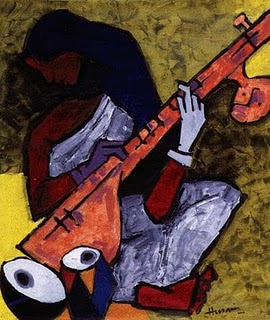
But few people are aware of his Sufi Series of paintings which he painted in the 1970s.

Sufi 1

Sufi 2

Sufi 3

Sufi 4


Sufi 5

Unfortunatley the controversial paintings Naked India, Rape of India and of some Goddesses which though he had painted in the 70s led to his exile to Qatar in the fag end of his life, IN 2010. He took it in a stride and continued his expression through brush unabated.

Such icons are born once in thousand years. Although, Leonardo da Vinci or Picasso did not live in our times but we are lucky that MF Hussain did.

We shall miss you MF.

Treetops vs Grass roots


While reading through the wonderful, insightful Pullitzer Prize winner book Half The Sky, which highlights countless issues related to women all over the globe, one is enlightened of the dynamics of factors which can bring a real change in the lives of women in the world.

Whether it is reduction in maternal mortality, girl trafficking, change in social customs like female genital mutilation or women abuse the change can come only from within. And the secret to that change is ‘girl child education’.

Girl education is the key to women empowerment. Women empowerment in turn is the key to eradicate poverty.

Educating girls is the most effective way to fight poverty. Until women are numerate and literate it is difficult to bring meaningful change and contribute in the country’s economy”, say the authors.

Despite multiple factors playing their roles, studies have shown that, the solution to reduction in population growth, trafficking of women, gender based violence or female genital mutilation is SINGLE and it is girl education.

The local customs, culture, and family dynamics and the various factors which hinder the change need to be well understood . Bringing about a difference entails persistence and perseverance to bring slow and steady change and creating receptive audience at the grassroots level. Innovative ways may be needed to cause that change in thinking before one expects a change in practice.

The roadblocks may not necessarily be just the ‘big’ factors –but even trivial issues which we do not even give a second thought.

And motivation of girls is never an issue. They are always willing. It is the circumstances and the people around them who need to be convinced.

The authors recount, based on research, four cost effective ways to increase school attendance in either genders—
• ‘deworming’ the children( as worm infestation affects physical and intellectual growth),
managing menstruation related issues( providing san napkins and toilets—as many girls don’t attend school during mens due to inconvenience),
• providing Iodised salt( as many communities suffer from Iodine deficiency which leads to brain damage) and
• ‘bribing’ ( providing financial incentives to the girl students for attending school.

The donors often assume that providing the infrastructure, like building schools, or giving books is the ‘way to increase’ educaton. But one may have to go extra mile(s) to ensure that the real purpose behind the building of schools is realised.

The World Bank ,too, points that excessive spending on education bureaucracy and school infrastructure, rather than on teaching staff and supplies, undermines the quality and quantity of schooling.

How to boost up the woman empowerment through education ?

For many of us first thing that occurs is ‘funding’–specifically foreign funding.

It remains a myth that in places with poor resources and conditions the foreign assistance or Aid through big agencies like UN, USAID, US govt.etc.(Treetop solution) is the key to any kind of development.

Rightly did the authors point out that Foreign Aid follows ‘Murphy’s Law’ ( the law states that anything that can go wrong shall go wrong).

The foreign aid may be well intentioned but it does not always work the way it is intended. Some prove to do the exact opposite of what is intended.

Many skeptics like, Peter Bauer and Milton Friedman argued point blank in the 1960s that aid is ineffective.
William Easterly with experience in WB says, aid is often wasted and sometimes does more harm than good.
Rajan and Raghuram published a study in The Review of Eco and Stats that : there is no positive or negative correlation between aid inflows and economic development of a country.

The literature on foreign aid and development strongly suggests that the usefulness of development assistance varies with the quality of a country’s governance and the economic policies it pursues. In countries whose policy environment is highly unfavorable to growth, aid is less likely to be productive and contribute to long-term development.

According to one group of scholars, “in terms of growth prospects and performance, no amount of foreign assistance can substitute for a developing country’s internal policies and incentives for increasing output and improving the efficiency of resource allocation.”

A wonderful example that the book gives of a failed purpose of the Aid is as follows:

A UN Project in Nigeria meant to empower women.
Fact: the women in Nigeria cultivate cassava ( a root like potato) and use it for the household. If in excess they sell it off and save the money and spend it on home and their children.
The Project: It introduced a variety of Cassava which would give three tons per hectare yield instead of the usual 800 kilos per hectare. They had a terrific harvest. But they had problems;
They could not harvest that bulk of the yeild and could not even have the capacity to process them.
The agency introduced processing equipment. But the fruit was bitter and did not taste as well. But with processing of the fruit the problem was dealt.
As a result the project looked a ‘great success’. The women started to earn good money.
But then the men came in and kicked women out of Cassava farming. Why?
Because as per the tradition the women raised staple crops and the men grew cash crops. And when men had extra earnings, they used it for beer. As a result, women had even less income that when they started.

Moral of the story:
The above case proves the futility of a well intentioned Aid, if it is not linked to the local cultural practices. And another point it highlights is that any sort of empowerment of woman can boomrang unless it is accompanied by women education.

Sometimes good intentioned ‘treetop’ efforts can be counterproductive if the ‘grass root’ realities and resources are not taken into consideration.

Eat, sleep, breathe…dance!~ World Dance Day( April, 29).


This slideshow requires JavaScript.

We Dance…

God’s the choreographer
The world’s a dance floor
Our lives are the rhythm
Emotions are the music
We are the dancers,
We dance in laughter,
We dance in tears,
We dance in madness,
We dance in fears,
Dancing in our lives awake
With ambitions we tap
And with hope we shake
To replicate our dreams.

The dance is one of the many human experiences which cannot be suppressed. Dancing has existed at all times, and among all peoples and races. The dance is a form of expression given to man just as speech, philosophy, painting or music.

Apart from war, dancing is the chief factor making for social solidarity in primitive life. The value of dance as a method of individual and national education was recognized as civilization became increasingly self-conscious. In the Laws Plato remarked that a good education includes knowing how to dance and sing well.

Quotes:

”Let us read and let us dance –
two amusements that will never do any harm to the world.”
~ Voltaire

Dancing is the loftiest, the most moving, the most beautiful of the arts, because it is not mere translation or abstraction from life; it is life itself.
~Havelock Ellis

Talk about dance? Dance is not something to talk about. Dance is to dance.
~Peter Saint James

Perception: Something to Think About


Perception: Something to Think About | InspirationHub | Your Daily Infusion!.

A MUST READ…
This is a true story. Joshua Bell playing incognito in the metro station was organized by the Washington Post as part of a social experiment about perception, taste and people’s priorities.
No one knew this, but the violinist was Joshua Bell, one of the greatest musicians in the world. He played one of the most intricate pieces ever written, with a violin worth $3.5 million dollars. Two days before Joshua Bell sold out a theater in Boston where the seats averaged $100.

Said one comment: “If Justin Bieber had stood there playing a triangle they would have had to close the street for people stopping.”

Tchaikovsky’s Swan Lake–a dream ballet ( Act 1).


Tchaikovsky’s first ballet, Swan Lake is considered by many to be one of the greatest classical ballets of all time. Its romance and beauty has allowed the classic ballet to mesmorize audiences for more than 100 years. Tchaikovsky’s Swan Lake (in four Acts) was composed in 1875 as a commission by Vladimir Petrovich Begichev, the intendant of the Russian Imperial Theatres in Moscow. Swan Lake was unsuccessful after its first year of performance. Conductors, dancers and audiences alike thought Tchaikovsky’s music was too complicated and hard to dance too.
It wasn’t until after Tchaikovsky’s death that Swan Lake was revived. Much of the Swan Lake we know of today was a revision by the famous choreographers Petipa and Ivanov.

Plot Summary of Swan Lake:
While hunting, Prince Siegfried sees an amazing swan. As he takes aim to shoot, the swan turns into a beautiful woman. The woman, Odette, tells the prince that she is a princess who has come under the spell of an evil sorcerer. During the day she must be a swan and swim in a lake of tears. At night she is allowed to be a human again. The spell can only be broken if a a virgin prince swears eternal fidelity to her. She tells Prince Siegfried, who happens to be a virgin prince, that if he refuses her she must remain a swan forever.

Prince Siegfried falls madly in love with Odette. However, through a spell by the evil sorcerer, he accidentally proposes to another woman at a party, believing that the woman is really Odette. Princess Odette feels doomed. She threatens to kill herself and throws herself into the lake. The Prince feels terribly sorry and throws himself into the lake with her. In an incredibly touching moment, the two are transformed into lovers in the afterlife.

Act I
Prince Siegfried arrives at his 21st birthday celebration on the palace courtyards to find all of the royal families and townspeople dancing and celebrating, while the young girls are anxiously seeking his attention. During the exquisite celebration, his mother gives him crossbow and informs him that because he is of age now, his marriage will be quickly arranged. Hit with the sudden realization of his future responsibilities, he takes his crossbow and makes haste to the woods with his hunting buddies.

(Other Acts to continue…._
P.S. Have a long time dream to watch this ballet live in theatre !!

Heaven isn’t a Place, it’s a Feeling !


Note from Parents:
She is just a kid who loves music and is good at it, but also loves most things kids love and has a full life. It took 18 months to make this video and it was hard enough to get the film, let alone decent sound in these crowded, noisy environments. Thus we did a montage cover song as all do in these kinds of videos. She is young and it takes great concentration to play such sophisticated songs under such circumstances, but her nature is one of great joy as you can see in our other videos or website.We are not rich and travel and live on a total of 25,000 dollars a year.

This is our little “Mozart” and she is 18 months into a multi year, open ended trip around the world, that started when she was five. She started playing the violin at 23 months old, so we thought it would be fun to mark her unique odyssey by playing her violin around the world at key places.

The beauty that we are seeing and the kindness of people every where, makes this world seem like heaven. This experience has been a great gift to us and we would like to share some of it with you.

Enjoy!

More Info:http://www.soultravelers3.com
FaceBook: SoulTravelers3