Open up your mind and your potential reaches infinity…

Archive for the ‘CULTURE’ Category

Nihari, here and there


The story goes back to two decades ago, when as newlywed and I had just arrived in Karachi.
An aunt ( Phuphi) of my husband invited us for a dinner on some ‘special’ delicacy (in her own words). There were a few other dishes, but all the focus was on the ‘special’ dish.

In the first glance, it looked like a thick curry with some extra large pieces of boneless meatloaves lying in it. Garnished with greens and some baghar, the aroma was appetising, I must admit.

While eating my Phuphi-in-law asked; “Do you know what this is?”
I said, “Some salan (curry) I guess.”

That must have really hurt her. She twisted her mouth with a wicked smile. My husband, too, looked wide eyed at me. So did everyone else present there. They all had that ‘poor her’ expression on their face, which generally Pakistanis had in 1970s, when their austere Indian cousins visited them.

“You don’t know this?” someone asked.
I was regretting to have guessed. It wasn’t the regret of having annoyed the aunt, but of those piercing eyes that were focussed on my ignorance of the dish.

My husband came to my rescue, “Phupho Amma, she isn’t very fond of non vegetarian food. So perhaps she doesn’t have any idea.”

My younger brother in law and a friend teased: “Yeah, bechare Indians don’t get to eat gosht so often, and beef is absolutely a taboo for them. ”

PhuphoAmma charged on me in a mother-in-law tone, “Tum kaisi Dilliwali ho, tum Nihari nahin janteen” (What sort of Delhiite are you, you are not aware of Nihari?)

I screamed before I could check my volume, “Nihari? This is not Nihari.”

Before I could blurt something else, I saw my husband giving me a look to shut up. And like an obedient new wife, I did, but with a huge turmoil within.

Back to our room, my husband assured me that perhaps this was homemade and hence not as delicious as the Khan ki Nihari famous in Karachi. Over a period of few months, we tried Niharis at several places, but I could not find what we in Delhi called  Nihari.

I admit I wasn’t very fond of Nihari till then, nor was I really conscious of Nihari being associated with Delhi. In Delhi, I had heard from my father that Nihari is a Avadhi delicacy, from Lucknow.

Anyways I wasn’t a foodie especially for non vegetarian delicacies, nor a culinary expert, nor did I have any ambitions to be one. It was an open secret at home that I had chosen to be a medical professional, so that it would save me from domestic responsibilities, especially cooking. (It turned out to be an illusion, though. But, that’s another story to tell, anyways)

Knowing very well that I was marrying a goshtkhor( meat-eater) Pakistani who was fond of good food, and who’s mother was a culinary expert, I had made it pretty clear to him that I don’t like to cook.
He had in all sincerity reassured, Anda to fry karna ata hai na? Kaafi hai.”

But as we hunted for the real Nihari, my craving for Dilli ki Nihari became stronger.

After an year and a half when I first visited my parents in Delhi, apart from the million other things on list, one on the top was to go to Jama Masjid and relish ‘the’ Nihari, which is sold right at the corner of Matia Mahal, just a furlong from Dadi Amma’s house.

As the tradition goes, Nihari is cooked  from the special shank meat of the beef, with trots in over two dozen spices, the most dominant being the saunf (anise seeds) which gives it the aroma. on slow heat and takes  several hours to get tender.  Hence usually over night as shab degh. The degh( a giant round bottomed pot)  is opened at certain times only –mostly at dawn around 7am or now, even at dusk (at Maghrib). And one has to be there at the right period of time to be able to grab it, otherwise degh lut chuki hoti hai.(It gets sold out fast).

 True to its name ‘nihari’ means pertaining to daytime, it is usually eaten at breakfast, at dawn.
Many a times I had seen Dadi Amma or any of the phuphis in the household send one of the shagirds ( disciples who come to her for learning Quran), a night earlier, to keep the pan with the shopkeeper. And as the cook would  the degh early next morning, the he would kept aside some in  her reserved pot.

The mere mention on phone of my desire to eat Nihari was enough, Dadi Amma promised to keep it reserved for me. I remember her doing the same for us with Shaadi ka Qorma and sheermal whenever any left overs arrived from a kin’s wedding, knowing that we craved for it. (Aah Dilli ka Qorma is another delicacy, not seen anywhere, which deserves another blog).

At first opportunity, we went to see Dadi Amma and others at our ancestral home in Purani Dilli.

Dadi Amma’s place, is a  house, typical  in the walled city. There is a sehan ( courtyard) at the entrance which leads to a room inside another , both of which used to have spic white chandnis spread wall to wall, and no sign of any furniture.

In addition to sleeping over, eating at Dadi Amma’s place had always been a fascinating experience. With a dastarkhwan( sheet to lay the food)  laid on chandni( the spotless white spread on the floor to sit) covered floor across the length of the room. I wonder why, but as kid, I remember vying for a place at the corner of the spread. Some of the senior family members, referred to the plates, in salees-shusta Urdu, as rakabis. And although it had since long become a routine to use glasses for water, there would always be a couple of silver plated copper katoras sitting on dastarkhwan. (Drinking water in katoras (wide bowl) was an old tradition of purani dilli).

That day too, we sat at the dastarkhwan all set to enjoy Nihari. My agenda was personal, while others were eager to see my husband’s response to Nihari. (Thanks to my negative publicity of Karachi Nihari)

With red glazing, aromatic nihari in sight, we waited till the boy brought in hot crispy nans wrapped in newspaper straight from the tan door in the gali, just a few steps away.

The first bite was like a dream come true to the nerve endings of my olfactory and taste buds. But in just a couple of seconds to my tongue, it was a reign of terror unleashed. The poor tastebuds caught fire and laid their arms in the next few bites. As if in a bid to dampen the fire, the eyes started to pour water. But I had to put a brave front, and no matter how hot the tongue burned, the ego stood firm to confirm, this is the  true “Nihari”.

All ears, including my red hot ones, were dying to hear my ‘Pakistani’ husband’s reaction on the ‘Indian’ dish. Being courteous, he remarked, It is delicious, but a bit hot for my liking.”

However, later when we went home, he revealed lightly, that he still preferred his Karachi ki maghaz Nihari. I was devastated, absolutely.  But soon rationalised that, perhaps his tastebuds, and his brain cells were conditioned to call that thick curry as Nihari. His loss not mine, I consoled myself.

My ego wanted to have this Nihari more often, though a bit less spicy, so I got keen to get its exact recipe. My mother could not believe her ears that a cooking rebel like me was asking for a recipe. She and a phuphi had their recipes to offer, but they all admitted not being experts in the dish.

It is generally a tradition in purani Dilli that women do not cook Nihari at home and when needed, they just get it ready made from outside. Probably apart from convenience, it is because of the non availability of beef and also that it needs to be cooked overnight. In Delhi we have gas cylinders, not gas through a pipeline like in Pakistan. (In the days I lived there, cylinders too were rationed).

My Dadi Amma’s wisdom guided me to go to Rehmatullah (the cook and owner of the restaurant) and get the recipe from him.

Being in a flourishing business, Rehmatullah, was unwilling to part with his secret recipe. However, knowing that I wasn’t living there, he was kind enough to offer some from the readymade mixture of spice powder, that he prepared for his recipe. He was generous, and his masala lasted almost an year, till my mom found a place which sold indigenous masala.

Repeated cooking over the years for friends and family has given enough expertise and repute of being able to cook what most taste buds recognise as good Nihari.

Now I can claim to have mastered the details of the difference between the maghaz nihari they make in Karachi and the nalli nihari that we Dilliwalas have in Delhi. (However, I wonder, if there was any difference in them, earlier).

And now that the froth of my ego has flattened quite a bit, I am able to accept the Karachi one as a different version of Nihari, which acquired its own distinct character after crossing the border.

Unfortunately, now in Delhi, even the Muslims residing outside purani Dilli do not seem to yearn for Nihari during the breakfast, while in Karachi, Nihari seems to have taken the place of a national dish which is available at any hour of the day and at every corner of the city. But it still manages to retain the tag of being a Delhi dish.

Interestingly, instead of suspecting some secret readymade masala, most of my kin and friends from Pakistan attribute ‘my’ Nihari flavour to my Dilliwala origins.

Even more interesting is the secret, that it was in Pakistan that I was made to realise for the first time that I was a Dilliwali. And thanks to the Dilliwala tag that was thrust upon me , I now love it and quite often brag about it.
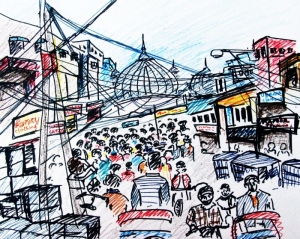
PuraniDilli- sketch by Shilpa Wadhwa

Why can’t most men understand this ?


Looking through the e-papers from the subcontinent, it is hardly ever a day when some incident of rape is not reported. Be it rape of a medical student near the bus stop in New Delhi,  a doctor on duty raped after being drugged in Dera Bugti, a minor girl raped by her dance teacher in Bombay, a girl partying with friends in the posh areas of Karachi, a woman gang raped on the order of a local jirga, in Muzaffargarh.

The scenarios differ, cities differ, but the crime remains the same. The mindset remains identical. Age is no bar. Infancy upwards, one finds all age groups being the victims.

Unfortunately this is one situation which sees no barriers of age, color, creed or class, the world over..

Rapes are on the rise in the subcontinent, too.

The statistics do the speaking here…

In 2010, 489 rape cases were reported in Delhi, India  while 459 in 2009.The figures given by Delhi Police reveal that a woman is raped every 18 hours or molested every 14 hours in the capital.

Similarly in Pakistan, Human Rights Commission of Pakistan, estimates “every two hours a woman is raped in Pakistan and every eight hours a woman is subjected to gang-rape. Another report I came across claimed that at least 100 rapes are committed in Karachi alone everyday according to Additional Police Surgeon (APS. (http://www.freerepublic.com/focus/f-news/2083578/posts).

Needless to say,  majority are not even reported, and just a handful get punished, on either side of the border.

When this is the statistics of two megacities, one can fathom what would be the situation in the other places.

It was worse still to hear responsible men of these cities pass heartless judgements on rape and its victims..

In mid July, Commissioner of Police, Delhi advised women going out late night should be accompanied by a male or a driver, to avoid the risk of being raped.

I remember as a  child, in Delhi asking a friend of my fathers who was a senior police officer, ‘Uncle what do you do ?” And he had replied, “Beta, we protect you and others  in the city.” Probably he was just bluffing.

Almost at the same time , a video circulated on the social network,  in which Karachiite, Munawwar Hussain, the Emir of JI, in a TV interview, surpassed all these responsible individuals and commented that since bringing 4 witnesses for rape is next to impossible, it is better to ‘keep shut’ ones mouth and eyes, on the crime being committed. When the anchor attempted to argue, he simply totted at him the emotional gun of ‘denying’ the writing of Quran. The apathy in his talk and body language for the rape victim was appalling.

Not just our men, but their men also fail to understand…

A few months ago, a police officer from Toronto and a Russian priest from Moscow, had ‘advised’ that women should not “dress like sluts” or “wear miniskirts”, respectively, if they want to avoid rapes.

Not leaving behind  London in this race, Kenneth Clarke, the very justice secretary in UK, passed yet another piece of judgement that the rape committed by unknown offender is a ‘serious’ rape while implying that those committed while on a date isn’t. When the anchor interjected “rape is rape”, he replied: “No it is not”.

I wish all these men of responsibility knew the ‘secret’ of why the rapes occur?
It is certainly not because a woman was dressed so, or walked alone on the street late at night, or was attending a party with her friends. No certainly not. Rapes occur because some men want to rape. Yes it is that simple.

And why would these ‘some’ men want to rape ?
This has a simple answer too., Rape is the culmination of a series of systematic experiences that a boy is exposed to, from infancy to manhood—in which he is told, with or without so many words, that he is stronger, and a woman is not just weaker, but a commodity.

How I wish, more than anything else, these responsible people knew what does rape mean to a woman?
Rape is not merely the breach of a woman’s physical privacy, but is followed by cascade of short- and long-term problems, including physical injury and illness, psychological symptoms, economic costs, and death (National Research Council 1996).
In a summary, a rape victim is an embodiment of a severely disturbed and dysfunctional individual for rest of her life, unless properly rehabilitated.

So long as such a mindset persists, the legislation to punish rape would never be a deterrent.

We need to look towards primary prevention of this crime rather than just struggle for appropriate punishment after a case gets highlighted.

We have to empower our girls with ‘right information’ and break the barrier of rape being a taboo issue in front of these ‘innocent’ minds. It is these innocent minds which make them an easy prey.

A girl should be taught to be assertive. As one of the self help sites on rape prevention says: “ Look up as you walk and stand up straight; pretending as though you have two big panthers on either side of you as you walk may sound silly, but it can help boost confidence. Attackers are more likely to go for those who they think cannot defend themselves.”

They should also be told that over 90% of the perpetrators are known to the victims, even if it is an uncle, a cousin or a friend, if she feels the touch as uncomfortable, she must trust her gut and not let it continue.

Moreover, if we cannot change the mindset of our grown up men, we can at least guide our young sons to respect women and not consider them a commodity that is ‘available’.

Use of neo cortex, a sign of evolution, entails men to be able to restrain their behaviours and train their minds that nothing can be forced upon any woman, without her free will.

For those who cannot change their mindsets, a real need for harshest of punishments to the rapist as a mode of learning is mandatory too.

Till the healthier minds grow up, fear of punishment should be the real deterrent against this heinous crime.

Dr Ilmana Fasih.

A scene from the slutwalk in Delhi in July

Tumi robe nirobe~Rabindrasangeet. Music without borders


In my heart, thou shall, in peace, alight…
Like the glowing moon and the Dame of the Night.

My life, my youth…
My world absolute;
Thou shall draw bright…
Like the Dame of the Night…

Alone shall rise, eyes of thee,
Thy billowing drapes shall protect me.

My pain, my screams,
My success dreams;
Thou shall delight,
Like the Dame of the Night.


About the author, composer of this song:

Rabindranath Tagore (1861-1941) was a Poet, Philosopher, Musician, Writer, Educator, and the first Indian Nobel Laureate for Literature (1913). Tagore has been labelled the “King of Poets” for his beautiful and exquisite poetry. In particular Tagore had a deep love and reverence for nature which he was able to express through lyrical poetry.

Tagore was awarded the Nobel Prize in 1913 for his book Gitanjali. W.B.Yeats in particular was deeply impressed with this work and wrote an introduction. With this honour Tagore became famous in both India and the West. In 1915 Tagore was knighted by King George, however Tagore was to return his knighthood in protest of the Amritsar massacre (1919)

Although Tagore stayed out of politics he remained a good friend of Gandhi. In fact it was Tagore who would often persuade Gandhi to give up his fasts in the interest of the nation.

As a writer, Tagore primarily worked in Bengali, but after his success with Gitanjali, he translated many of his other works into English. He wrote over one thousand poems; eight volumes of short stories; almost two dozen plays and play-lets; eight novels; and many books and essays on philosophy, religion, education and social topics.

As well as literature Tagore had a great love of music, in particular Bengali music. He composed more than two thousand songs, both the music and lyrics. Two of them became the national anthems of India and Bangladesh.

Little Terrorist~a short Film


Little Terrorist tells the moving story of a Pakistani Muslim boy who accidentally crosses the Pakistani-Indian border which is riddled with landmines. He ends up in a strange country that regards him as a terrorist. The old orthodox Hindu Bhola takes him in and hides him from the Indian soldiers. However, traditions and prejudices about Muslims remain an obstacle in the relationship between Bhola and the boy. Ultimately, humanity triumphs over prejudice when Bhola risks his own life to help Jamal cross the border again. This symbolic story of hope is a tale of human solidarity conquering all artificial boundaries.
Ashvin Kumar, the director, was nominated for an Oscar in the Best Live Action Short Film category.
Ashvin Kumar’s Little Terrorist also won first prize for best short film at the Montreal Film Festival.

And was nominated and selected for various other prizes.

Zehaal-e-Miskeen -~Amir Khusrau


Khusrau was a master of  Persian ( which used to be the language of the court) as well as  Brij Bhasha ( the language of the common man) .

Zehaal -e Miskeen is a master piece written in both the languages in Persian (bold) and Brij Bhasha (italics). In the first verse, the first line is in Persian, the second in Brij Bhasha, the third in Persian again, and the fourth in Brij Bhasha. In the remaining verses, the first two lines are in Persian, the last two in Brij Bhasha. The poem expresses the agony of separation from the beloved,  in both the languages with a superb fusion…which to my understanding signifies how different yet similiar is the expression of the agony of separation amongst the elite ( representing Persian) and the common man ( through Braj Bhasha).

Zehal-e miskin makun taghaful, duraye naina banaye batiyan
Ki taab-e hijran nadaram ay jaan, na leho kaahe lagaye chhatiyan.

 Do not overlook my misery by blandishing your eyes,
and weaving tales; My patience has over-brimmed,
O sweetheart, why do you embrace me.

Shaban-e hijran daraz chun zulf wa roz-e waslat cho umr kotah;
Sakhi piya ko jo main na dekhun to kaise kaatun andheri ratiyan.

 Long like curls in the night of separation,
short like life on the day of our union;
My dear, how will I pass the dark dungeon night
without your face before.

Yakayak az dil do chashm-e jadoo basad farebam baburd taskin;
Kise pari hai jo jaa sunaave piyare pi ko hamaari batiyan.

 Suddenly, using a thousand tricks, the enchanting eyes robbed me
of my tranquil mind; Who would care to go
and report this matter to my beloved?

Cho sham’a sozan cho zarra hairan hamesha giryan be ishq aan meh;
Na neend naina na ang chaina na aap aaven na bhejen patiyan.

 Tossed and bewildered, like a flickering candle,
I roam about in the fire of love;
Sleepless eyes, restless body,
neither comes she, nor any message.

 Bahaqq-e roz-e wisal-e dilbar ki daad mara ghareeb Khusrau;
Sapet man ke waraaye raakhun jo jaaye paaon piya ke khatiyan.

 In honour of the day I meet my beloved
who has lured me so long, O Khusrau;
I shall keep my heart suppressed,
if ever I get a chance to get to her trick.


Another beautiful rendition of Zehaal-e-Miskin by Warsi brothers: 

In love with Ghalib , the witty.


Recently I grabbed a book called Yadgar-e-Ghalib, by Altaf Hussain Haali in Urdu, and read bits from it. This has rekindled my fancy for him all the more.

Mirza Ghalib the humourist , is awe inspiring. Leave aside his superb poetry , his wit with which he lived and laughed off the troubles of his tough life, reveals a person extremely fascinating to read and know. He was an open book.

No doubt he indulged in various vices which would easily label him as a reckless person. But the honesty with which he admits all his vices and even laughs at himself makes him an adorable scamp and one feels like a shrewd hypocrite in front of him.

Ghalib teaches us what is it to live with a life of stark poverty, tragedy after tragedy of losing one’s progeny seven times, living off without a source of income and still to be able to maintain sanity and humour to enjoy one’s present day. (Although being a woman I hail and salute his wife as an epitome of patience and forebearance.)

Reading through I learnt what a friend he was. He never procrastinated in replying back to the letters. And many of his friends send him letters that were ‘bearing’ i.e. without a stamp, and he postpaid twice the amount to releases those letters from the postman. His silver tongue and the golden pen, won hearts of his friends and critics alike.

He wrote that he wanted to write a language, that whoever reads his letters gets elated. (Yes Mirza you still make us elated by them.)

His letters talked.( Yes one can hear you talking through them, Mirza)
One of them said:
“sau kos se ba-zaban-e-qalam baatein kiya karo aur hijr mein visaal ke maze liya karo”
(from hundred of miles talk with the tongue of the pen and enjoy the joy of meeting even when you are separated]).

He joked openly about his being a non-conformist and a sinner. When Ghalib bought a house in Gali Qasim Jaan, he wrote,

‘Masjid ke zer saya ek ghar bana liya hai,
yeh banda kamina, humsaya khuda hai’

(I have made my house on the shadow of the mosque; this wicked fellow is now a neighbour of God).
The mosque he was referring to was the Delhi’s famous Jama Masjid.

During Ramzan somebody asked him if he fasted , and he replied : “ek na rakha.”( I did not keep one.).

On yet another hot day in Ramzan, Mirza was playing chess when a friend, Maulana Arzoo came.
Maulana remarked :“I had read in a Hadith that the devil is imprisoned in the month of Ramzan. But today I doubt the validity of the Hadith.”
Mirza retorted: “Sir, the hadith is absolutely correct. But you be aware that this is that den where the devil is imprisoned.”

Making a serious satire at the gluttony that people indulge during the month of Ramadan he said:

Iftaar-e-saum kii jise kuch dast.gaah ho
us shakhs ko zaroor hai rozaa rakha kare

(The one who has the wherewithal to break his fast
that person should indeed keep the fast)

Jis paas roza khol ke khaane ko kuch na ho
roza agar na khaaye to naachaar kya kare

(The one who has nothing to break his fast with
what else can he do but be constrained to ‘eat the fast’)

And on being questioned for not fasting he said:
Ruza mera eman hay Ghalib! Laiken
Khas Khana wa barf aab kahan say laoon?

(Fasting is part of my faith, but from where should I get khus curtains and chill water for it ?).( Correction courtesy Sohail Bhai).

On another occasion, in a letter that he wrote to a friend, in Persian:
“These days Maulana Ghalib (God’s mercy be upon him) is in clover [very happy]. A volume of the Dastaan-i-Amir Hamza has come — about 600 pages of it — and a volume of the same size of Bostan-i-Khayal. And there are seventeen bottles of good wine in the pantry. So I read all day and drink all night.
The man who wins such bliss can only wonder What more had Jamshed? What more Alexander?”

Ghalib often bragged about his reputation as a rake. He was once imprisoned for gambling and later narrated the incident with great fancy.

Once, when someone praised the poetry of the pious Sheikh Sahbai, Ghalib immediately retorted:
“How can Sahbai be a poet? He has never tasted wine, nor has he ever gambled; he has not been beaten with slippers by lovers, nor has he ever seen the inside of a jail”

When someone poked fun at him for being a drunkard and that a wine-bibbers’ prayers are never answered he said with a laugh, outwitting the person:
“My friend, if a man has wine, what else does he need to pray for?”

He did not even spare his ‘economic poverty’ from the wrath of his wit. ( But Mirza, we know you were far richer the many rich then and now)
Qarz kii piite the mai lekin samajhte the kih haan
Rang laavegii hamaarii faaqah-mastii ek din

The King, Bahadur Shah Zafar was planning to go for Hajj and Ghalib heard it. He wrote to the King :
Ghalib, gar is safar maiN mujhay saath lay chalaiN
Haj ka sawaab nazr karooN ga hazoor ki

If he will take me with him on the Pilgrimage
His Majesty may have my share of heavenly reward

He never minced words about his inclination towards practicing the faith.

Jaanataa huun  savaab-e-taa’at-o-zahad 
Par tabiiyat idhar nahiin aatii 

(I am aware of the reward of religious deeds in the next life, but I somehow do not get inclined towards them.)

It isn’t that those who live happy, are not sensitive and pained by the troubles that come their way. Like everyman with a mind and a heart , to be hurt by the whips that life lashes at them, Ghalib too felt his share of pain.

He wrote:
Sozish e batin ke hain ahbab munkir warna yaan
Dil maheet e girya aur lab aashnaa e khanda hai.

(Though my friends give no credence to my inner aches
While my lips are all smile, my heart is but a tearful waste).

Indeed, his wit must have been therapeutic to his own self, but to readers like me it is very addicting.

P.S. I am extremely indebted to Sohail Hashmi bhai, who I know is an expert in Urdu poetry from very young age, has added some other incidents related to the above context:

The house next to a mosque belonged to Kale saheb, a gentleman who was into sufiism and was respected greatly by bahadur shah zafar. In fact the House was given Ghalib on the recommendation of Zafar, Ghalib has refered to the mosque and his house in two other shers

Bhaun paas aankh qibla-e-haajaat Chahiye
Maajid ke zer-e-saayaa kharaabaat chahiye

Dil Khush hua hai Masjid-e-veeraan dekh kar
Meri tarah Khuda ka bhi Khaanaa Kharaab hai

Once during the month of Ramzan, a maulana who was a friend of Ghalib and also a poet went to meet ghalib, ghalib had a a plate of kabaabs in front of him and a glass of Wine besides him.
The maulana said, “Tumhaara roza nahin hai.”
Ghalib said “Hai”
The Maulana asked “Phir yeh sab kya hai”
Ghalib response was, “Roze ko behlaane ka saamaan hai.”

[P.S. His humour on his first love deserves a complete blog in itself, which shall follow later. No his first love wasn’t either ‘women’ or ‘wine’.]

Lal Peeli Ankhiyan~Rajasthani song


Jad jad dekhoon banari lal peeli ankhiyaan
Main ko ni dara sa , bhala hi kado ankhiyaan.

(Whenever I see you, your eyes are red with anger
I am least scared of you, no matter even if you pop out your eyes).

Jaipur sheher se dhola mharo chunri ni lyave
Main ko ni orha sa, bhala hi kado ankhiyan

(You donot get me the dyed dress from Jaipur
I am not going to wear the old one, no matter even if you pop out your eyes).

Amir Khusrau, the maestro of Tarana.


This blog is just an attempt to familiarise the lovers of Amir Khurau to a form of singing, called Tarana, the fascinating  fast paced rendition often intended  to attain trance ( haal),   is attributed to be invented by him. Needless to say his other inventions being Qawwali, seventeen taals, tabla and sitar.

All I get is that Tarana  uses sargams and vocables like na, ta, re, da, ni, odani, tanom, yalali, yalalom shuffled in a fast pace coordinated  by rhythmic percussion from Dhol or Tabla.

A legend says that Amir Khusrau discovered this genre of music by default when   Khusrau at a performance of raga Kadambak by Gopal Naik,  allegedly,  remembered the music but not text. So he created the tarana through a merging of bols from the tabla, the sitar or the mridang.

Since I am absolutely bankrupt in classical music so I would just quote what Ustad Amir Khan Sahib,  a master of Tarana says:

“It is generally believed that Tarana is a composition of meaningless syllables followed sometimes by the bols (words coined to denote the various sounds of instruments) of the tabla and sometimes by Persian poetry. This view is not true. As a matter of fact at the time of the Amir, the texts of the songs used to be in the languages of South India, which were not easily understood by the people of the North. The court language was Persian, which was evidently the language of the contemporary intelligentsia. The Amir naturally thought of composing the texts of songs in the language understood by the intelligentsia. Thus the Tarana was born. The various words used are Dartanaa, Dar Tan Aa, Yala an abbreviation for Ya Allah. Yali for Ya Ali, Dar Aa etc., which when translated would mean:

Yala – Ya Allah

Yali – Ya Ali

O Dani : He knows

Tu Dani : You know.

Tom : I am yours, I belong to you
or   
Main Tum Hun (I am you).

Na Dir Dani : You are the complete wisdom.

Dar – Bheetar, Aandar (inside)

Dara – Andar Aa (get in or come inside)

Dartan – Tanke Aandar (inside the body)

Tanan Dar Aa : Enter my body.

Tanandara – Tanke Aandar Aa (Come inside the body)

Nadirdani – Tu Sabse Adhik Janata Hai (You know more than anyone else)

Tandardani – Tanke Aandarka Jannewala (One who knows what is inside the body)

Another feature of Tarana as sung by many in India is the repetition of certain words at a great speed. The justification for this type is also not to be sought., It is not merely an exhibition of speed or virtuosity at pronouncing words, but the idea is that while in prayer a person goes into a trance, and that in that state of mind he just continues to repeat one word or one set of words.”

( source: http://caferisko.ca/ak/tarana.html)
Yar-e-man bia bia Tarana sung by Konkana Bannerjee.

Main melody:
Yar-e-man bia bia.
Dar Tan tadim,
Ta-nan Ta na dim, Tom Ta Na Na Na
Antara:
Ba labam raseeda jaanum
Fu bia ke zinda maanum
Pas azari ki man na maanum,
Ba cheh kar khahi amud.

which means:

O love, come soon, come at once.
Come and enter my body,
for I am yours, come
Antara:
My life hangs on my lips,
Come thou that I may live again
for if thou shall come when I am no more,
to what avail shall it be.

Also see:http://en.wikipedia.org/wiki/Tarana
http://www.indiaheritage.org/perform/music/h-v-t.htm

Senorita ~Music without borders


[Señorita]Spanish
Quien eres tu? (Who are you?)
Donde has estado? (where have you been?)
He removido cielo y tierra y no te encontre
(I moved heaven and earth and not find you)

Y llegas hoy (but you arrive today)
Tan de repente (So suddenly)
Y das sentido a toda mi vida con tu querer
(and give meaning to my life with your love)

[Farhan Akhtar]Urdu
Na main samjha, na main jaana (I did not understand, nor do I know)
Jo bhi tumne mujhse kahaa hai Senorita(whatever you said to me Senorita)
Magar phir bhi, na jaane kyun(But still I do not know why)
Mujhe sunke, accha laga hai senorita( I likes hearing it, Seniorita)

[Señorita]Spanish
No desvies la mirada (do not look away)
Quedate cerca de mi (stay close to me)

[Abhay]Hindi
Mujhko baahon mein tum ghero( hold me in your arms)
Samjhi na senorita(Did you get it, Seniorita)

[chorus]Hindi
Chaahat ke do pal bhi, mil paaye( Even if one is able to get few moments of love)
Duniya mein yeh bhi kam hai kya( Is it not enough in this world?)
Do pal ko toh aao kho jaaye( Lets get lost in these few moments)
Bhoole hum hota gham hai kya senorita( It made us forget what sadness is Seniorita)
Suno suno senorita kehte hain hum kya( Listen o’ listen Seniorita, to what I say)

[Señorita]Spanish
Jamas podre (i will never)
Interpretar (understand)
El sentido de las palabras que me dedicas
(the meaning of the words you dedicate to me)

[Señorita]Spanish
Pero el calor (but the warmth)
De tu mirar (of your gaze)
Me hace sentir como la mas bella senorita
(Makes me feel like the most beautiful miss)

[Hrithik]Hindi
Nighaahon ne nighaahon se( My gaze to yours)
Kahi armaano ki daastan hai senorita(says the story of our longing, Seniorita)
Yeh chaahat ki, mohabbat ki( Of affection and love)
Saari duniya mein ek hi zubaan hai senorita( There’s only one language in the whole world)

[Abhay Deol]Hindi
Mujhse ab nazar na phero, aao paas tum mere( Do not turn away from me, come near me)

[Hrithik – Abhay]Hindi
Mujhko baahon mein tum ghero( Surround me with your arms)
Samjhi na Senorita( Did you get it, Seniorita).

[chorus]Hindi
Chaahat ke do pal bhi, mil paaye( Even if one is able to get few moments of love)
Duniya mein yeh bhi kum hai kya( Is it not enough in this world?)
Do pal ko toh aao kho jaaye( Lets get lost in these few moments)
Bhoole hum hota gumm hai kya senorita ( It made us forget what sadness is Seniorita)
Suno suno senorita kehte hain hum kya ( Listen o’ listen Seniorita, to what I say)

[Farhan]Hindi
Jo bhi pal beeta (Whatever moments have passed)
Hey senorita (Hey Seniorita)
Har pal tumne hai dil jeeta ( You have won my heart each moment)
Bus itni si toh baat hai( That’s all, that matters)

[Señorita]Spanish
No desvies la mirada (don’t look away)
Quedate cerca de mi (stay close to me)

[Hrithik]Hindi
Mujhko baahon mein tum ghero ( Surround me with your arms)
Samjhi na senorita ( Did you get it, Seniorita).

[chorus]x2 Hindi
Chaahat ke do pal bhi, mil paaye( Even if one is able to get few moments of love)
Duniya mein yeh bhi kam hai kya( Is it not enough in this world?)
Do pal ko toh aao kho jaaye( Lets get lost in these few moments)
Bhoole hum hota gham hai kya senorita( It made us forget what sadness is Seniorita)

A lifetime encounter with Sain Zahoor ~Part 2


Contd..from Part 1

I repeat, these two days were like a trip to the world of Bulleh Shah, his life and philosophy in the company of Sain Zahoor.

Having been over awed by his deep mystical eyes, I had to gather some courage to ask him all the valid and invalid questions I had in my mind.

For most of the questions I pounced at him, he bounced the answers back with verses from Bulleh Shah’s poetry .

I began with an inquiry about the details of how his life began as a devotee, and he remarked that it was destined. He had a great passion for singing sufi songs from a young age, despite the opposition from his peasant parents.

It was his ‘famous dream’ of a hand calling him, that took him at the age of 10 from one Sufi shrine to the other all over Pakistan for next 7 years. At last some indications made him realise that the hand was from a Dargah ( shrine) at Uch Sharif. From there he was ordered to go to the Shrine of Bulleh Shah at Kasur, and reside there.
Learning about Bulleh Shah’s life, he said , he was astonished to know how similar he was to Bulleh Shah in terms of his love for music and it’s opposition from his family.

He recalled how he was first noticed by the professor cum TV producer Dildar Bhatti, on the shrine of Lal Hussain and was called to sing on PTV. The first words that were aired were:

Na Kar Bandeya Meri, Meri,
Na Teri Na Meri,
Char Dinan Da Mela, Duniya
Pher Mitti Di Dheri

( Do not indulge in self,
Life is neither yours nor mine.
It’s a 4 day trip and then shall all be a mound of earth.)
.

He mentioned of the honour he was given as the best folk singer by BBC for the year 2006, an Award in France and a Presidential Award in Pakistan, but what he really takes pride is in how he converted two Japanese boys to follow the path of Sufism and Islam.

He talked of the selflessness one needs to have in devoting one’s life to Sufi singing.

On a question of the purpose of sufi music—he mentioned that music was Sufi’s innovative method to attract common man towards the path of peaceful religion. It served the purpose to diffuse the inter-communal tensions and the hegemony of the orthodox religion that existed in the 16 th or 17th century. He said the music was like a magnet for those who wanted to escape from hatred and were attracted to peace and love. .

He said that even in todays world where there is hatred widespread everywhere, he wishes to contribute for world peace, his bit, through Sufi music, like a drop in the ocean.

Quoting Bulleh Shah he remarked, the eseensce of his life was to spread the message of love:

Masjid Dha Day, Mandir Dha Day
Dha Day Jo Kujh Disda
Par Kissay Da Dil Na Dhawee(n)
Rub Dilaa(n) Wich Wasda

Tear down the Mosque, tear down the temple
Tear down every thing in sight
But don’t (tear down) break anyone’s heart
Because God lives there

While talking, came up the fact that he was unlettered, and when I asked if he did he think that education would bring more awareness and openness in the minds of those who spread hatred he remarked:

Parrh Parrh Aalim Faazil Hoya
Kaddi Apney Aap noo Parrheya hi nahin
Jaa Jaa Warda Mandir Maseetaan
Kaddi Mun Apney Vich tun Wardeya ee Nahin

Reading books over and over you want to be a learned man
but you never study your innerself.
You run to enter mosques and temples
but you never enter into your innerself
.

He took out a paper from his pocket remarking, “This is my ‘parhai’ ( literacy)”, and he tried to read some meaning out of those pictures. It was beyond me, perhaps because I was illiterate in that language.

On asking about his travels he said that his music has take him to over to 35 countries explaining it simply as “ 5 passports have been filled up with with stamps and visas for different countries.”
I asked him of the place that he liked to visit the most?
He remarked with a diplomatic smile:
“Chal Way Bullehya Chal O’thay Chaliyay
Jithay Saaray Annay
Na Koi Saadee Zaat PichHanay
Tay Na Koi Saanu Mannay “

O’ Bulleh Shah let’s go there
Where everyone is blind
Where no one recognizes our caste (or race, or family name)
And where no one believes in us

I asked: “Is really any such place on Earth? “
He retorted: “Why do you need a place on land, if your heart is that place, where you do not differentiate ? Is it not enough ?”

As the time passed and my audacity to ask him personal questions increased, an informal Sain Zahoor with a great sense of humour emerged out too.

While talking to him, I could not meet his gaze. I was staring at his ektara, which he calls tumba.
He remarked: “I think you like my tumba more.”
It was embarrassing, but I retorted without a second thought “Yes, I like it a lot”.
And so he offered to teach me how to hold and play it. It was his idea to click a picture with the tumba in my hand.

We talked about his family and his sons, two of whom were part of the orchestra and the third one sings independently.

I was keen to know about his wife, and asked him if he took his wife with him on the tours.
He just smiled and nodded a ‘No’.
“Doesn’t she get angry on your frequent trips and you don’t take her”, I complained.
He smiled and said : “ I have learnt from Bulleh Shah, how to appease her.”
“How? ” was my obviously inquisitive question.
He narrated with a naughty sparkle in his eyes: “ I sing to her:
‘Bas kar ji hun bas kar ji,
Ik baat asan naal has kar ji.’

and my old lady smiles.

I found the verses very intriguing, so he offered to narrate the whole poem, which indeed was beautiful. And I share the first stanza here…
Bas kar ji hun bas kar ji,
Ik baat asan naal has kar ji.
Tuseen dil mere vich vasde ho,
aiven saathon duur kyon nasde ho.
Naale ghat jaadu dil khasde ho,
hun kit val jaaso nas kar ji.
Bas kar ji hun bas kar ji,

Enough! Now enough!
Smile! Speak to me!
You inhabit my heart.
What is the use of running away?
Using magic, you pulled my heart toward you.
Whom do you run toward now?
Enough! Now enough!

I couldn’t help ask: “Did Bulleh Shah also appease his wife by this poetry?.”
“No he was never married, but he loved his Master Inayat Qadri like a woman loves her beloved.”

And he narrated the interesting story of how Bulleh Shah has once faultered in front of his master by being ‘snobbish’ referring himself as ‘Syed Bulleh”. The master felt offended and disowned Bulleh Shah as a disciple. And his master had set extremely high standards for his disciple, he would not agree to any easy means of appeasement.

Since Bulleh Shah knew appeasing his beloved was no easy task, he dressed himself like a woman, adorned the nath (nose ring), wore ghungroo( ankle bells) and hid behind a veil.
“Why did he have to become a woman?” I asked.
He said “He wanted to show his master that he had given up all his masculine ego and acted like a helpless woman.”

Bulleh Shah sang and danced in front of his master, till the master’s heart melted . He recognised, this extreme devotion could be from none other than BullehShah, so he asked : “Are you Bulleh?”
From behind the veil came the reply: “No master, I am Bhullah( the defaulter).”

He narrated the words which Bulleh Shah used during the appeasement:
Tere ishaq nachaya kar ke thia thia
Tere ishaq ne dira mere ander kita
Bhar ke zehar piala, main taan aape pita
jhabde bohrin we tabiba, nahin taan main mar gai a

Compelled by love, I dance, I dance.
This love has set up camp inside me.
I Physician, come back! my life is ebbing away.
It is I who filled the cup with this poison and drank it.

Come back right away, else I will surely die.
Compelled by love, I dance, I dance.

As the time for the group came to pack up and leave for the Hotel, I joked: “Sain, are you taking back my tumba?”
He smiled and said: “Come to Pakistan, I will give you an identical one, but the condition is that you will have to learn to play it.”

He did not give me the ektara, but the time he gave to answer my unending questions and the interest with which he offered to answer my queries about him, his poetry and Bulleh Shah, I shall chesrish for rest of my life.

Ektara will remain as mine in the memories and the pictures, for sure 🙂