Open up your mind and your potential reaches infinity…

Archive for the ‘Art’ Category

Celebrate the woman inside you !


Published in TheNewsBlog:  http://blogs.thenews.com.pk/blogs/2012/03/08/celebrate-the-woman-inside-you/

While discussing how one should celebrate International Women’s Day this year, a friend said:

“It is not just the abuse outside that we women need to fight, but we have to fight an inside war too.”

I did not quite understand what she really meant, but before I could ask she went on:

“You know what, this Women’s Day I am going to work without make up and jewellery. Just to be with myself.”  

Although I’m not someone who shuns make up and I consider every piece of good jewellery, a work of art, I without getting my friends point completely also agreed with her completely.

Men, women, young or old, who does not want to feel good. But to attach strings to ones external appearance with the feeling of goodness is when the trouble starts.

If the ‘feel good’ feeling is within one’s self esteem, the outer accessories will be for a mere change, not ‘improvement’.

I am often surprised why many agree to Marylyn Monroe’s quote “Every girl should be told that she looks beautiful. I was never told this in the childhood.”  I do not concur.

What every girl should be told is not that her face or pony tail or frock looks pretty but that her mind is beautiful or courage is awesome.

I have never heard someone tell a boy that his shirt or knickers look beautiful, instead they are told that they are strong or courageous. And thus comes the difference in perception of self as one grows up.

Apart from your upbringing, the fault also lies within how a woman is projected in the media as a commodity.  Fairness creams, slimming diets, cosmetic companies, and aesthetic clinics reap profits at the cost of a woman’s battered self esteem.

Is it not ironic that whether we get positive or negative comments on physical appearance, both induce the same anxiety to look better?

I learnt from a teacher who once said, if you compliment someone’s looks, is it not a silent statement to someone who you are not complementing that ‘you are not good looking.”  Hence if you can’t compliment everyone, it is better refrain from complementing at all.

I have a friend’s whose self esteem is so high that she often jokes:

“If anyone ridiculed me saying ‘ugly’ referring to my not so perfect looks I tell them, ‘I wish to hug you; because I know how hard life is for the visually impaired’.”

For many old school feminists wearing makeup and jewellery is anti-feminist and oppressive.  Yes the idea of not being able to leave the house without make up is anti-feminist, and to associate ‘make-up is beauty’ is anti-feminist. What also makes it oppressive is when one’s self worth is tied to one’s looks, hair, skin or size number.

Women who choose to wear or not wear makeup or jewellery are making a decision about how they wish to be perceived. If not conforming to the dictates and demands of society on appearance empowers women, then so be it. A feminist, who goes without make up, is no more or less feminist than a woman who does.

Feminism in my eyes is all about expression of one’s femininity in one’s own unique way. It certainly does not overlap with the standards laid down by someone else.

Adorning jewellery and makeup is an art form of self expression and not a tool to hide one’s flaws in order to look like the model that appears on the cover page of a magazine.

Self image has no bearing on one’s physical appearance. Obsessed with looking better, some women (who may even be extremely beautiful by world’s standards) and even some men get very insecure and suffer from poor self image. In extreme cases it may even be manifested as Body Dimorphic Disorder. The underlying depression and anxiety leads them to resort to dysfunctional eating disorders or unnecessary plastic surgery procedures.

So let people say or think whatever, know that you are beautiful. For beauty isn’t skin deep.

As for me, not just to support my friend, but to support the woman that lives inside me, my external self too will go without   jewellery and make up on International Women’s Day. It is not to show down my good old friends, jewellery or makeup, but to tell them that they may be dear to me but they are not indispensible.

Tip : Celebrate this International Women’s Day in a  way that makes  the inner woman  in you  feel empowered and beautiful.

Gimme all your worries


Published in TheNews Blog : http://blogs.thenews.com.pk/blogs/2012/02/13/%E2%80%9Cgimme-all-your-worries%E2%80%9D/

“What if my boss doesn’t like my work?”

What if I get cancer?

What if I don’t pass the exam?

What if my friends don’t like my dress?

What if Mommy doesn’t come back from work?

Worries! Age, gender and ethnicity, is no bar. From babies to youth to middle aged to the elderly, we all have our share of them – a few valid, some too trivial to warrant a worry but we still do – but loads and loads of them are simply imaginary ones that never become real.

Some of us must have read the famous self help book by Dale Carnegie How to Stop Worrying and Start Living.

Some technologically savvy might have googled ‘How to deal with anxieties’ and got the tips:

  • Prepare for the worst, hope for the best
  • Practice relaxation
  • List your blessing
  • Distract yourself, keep busy
  • Get support

Quite a few of us Moms and Dads must have dealt with worrying kids and must have used our own tools either as healing words, “I understand your concern, but be strong “, or simply giving a tight reassuring hug without saying “I’m beside you.”

Perhaps many of us may even have trivialised “That’s nothing to worry about?” without realising that it adds to their worries rather than help them.

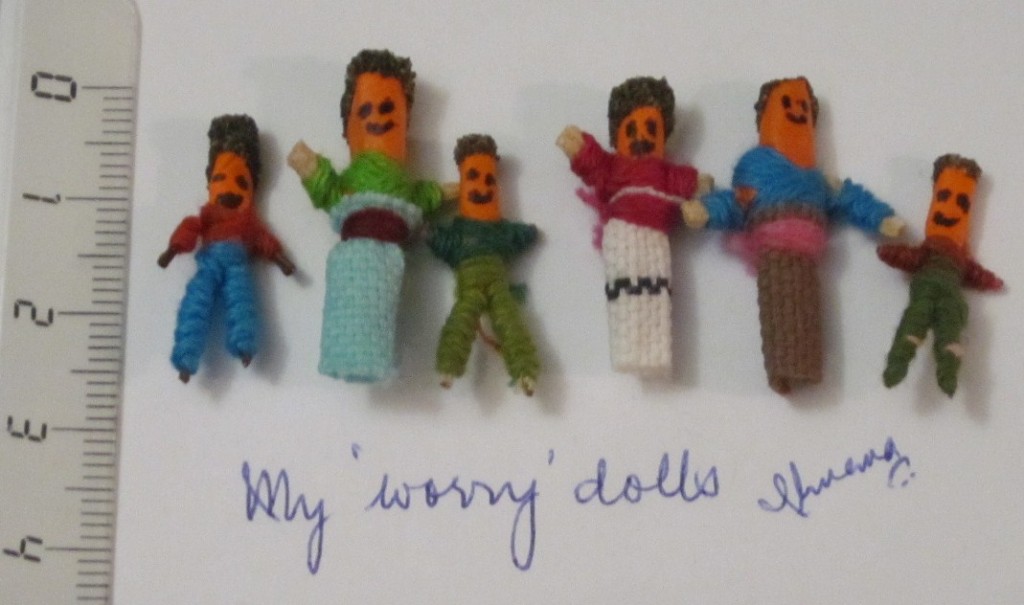
A few days ago while visiting a museum for the Mayan Civilization Exhibition in Toronto; I came across a very simple yet unique and fascinating way of dealing with worries. My attention was drawn to the tiny, barely 2.5- 3cm long set of six miniature dolls placed with a name: “Guatemalan worry dolls”.

On a closer look, they were tiny dolls made out of wrapping cloth or wool over tiny wires shaped as dolls and each one had faces with eyes and a smile drawn on them.

Later as I dug into the details, I learnt that they are an ancient Mayan tradition which is still being practiced by the surviving descendants of the ancient Mayans which live in Central America, specifically in Guatemala.

The dolls usually come in a pack of six handmade dolls and a tiny bag to carry them.

It is said that if the children who worry are told to share their worry with the ‘worry doll’ and place it under the pillow imagining that the doll will take care of that worry. Each doll is told one worry at a time. Many a times parents take away the doll from below the pillow, so that when the kids wake up in the morning thinking that with the doll, the worry too has disappeared. However, sometimes if the worries are recurrent, not removing the doll implies that the doll is working on the ‘worry’ to disappear.

The tradition has been claimed to be scientifically sound and helps kids learn to ‘speak out’ their worries instead of internalising them into long lasting fears. It also gives a subtle message that ‘someone’ cares. It is also know to work as a good tool to inculcate a habit of sound sleep. However, this may work only in those with mild or moderate worries, but not so much in situations of extreme anxiety.

It is claimed that ‘worry dolls’ have also been used in the hospitals, for young and old, to allay anxiety in patients while they undergo surgeries or cancer treatments. Some claim to have used them in class rooms in schools and meeting rooms in offices to cope with stress, and to boost creativity. They are even used for emotional healing in incurable illnesses, dealing with deaths or even heart breaks. I think with the potential they have, there is no dearth of situations where ‘worry dolls’ can be used. Imagination is the limit to utilize them as calming companions.

Though not mentioned in the information on dolls, their ‘tiny’ size taking up seemingly ‘big’ worries must be playing its part in the process of relaxation too.

Apart from the therapeutic value, what fascinated me was the art of making these miniature dolls by wrapping up wool or cloth on wire and giving them a resemblance to someone who ‘cares’.

So aptly was it mentioned in the literature: “Make your own worry dolls at home, just give them a dress, two pairs of limbs and a smiley face? And see them in action. You needn’t be a Picasso or a Freud.”

Horse ‘art’


Horse and man has been friends and companions since time immemorial.

It is said that their association dates back to almost 5,500 years ago. Initially used to carry loads, was later used as the main means of transportation, for wars and then for recreation.

The horse when used in wars needed protected gear like the knight or the soldier mounted on it.

For this horse armour was needed.


In ancient China, relevant to the local culture, the armour had its dragon look:


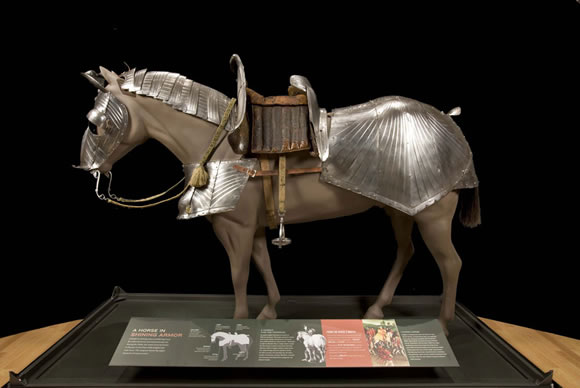
As came the middle ages, and Europeons  used horses for wars as well as transportation their armours were metallic carved plates which  rided on each other to give flexibility:


As times changed, horse use in the wars reduced.  The horse remained as man’s companion and their decorations became less protective and more decorated.

The Arabian horses ( here Moroccan)  had their touch of  embroidered decor:

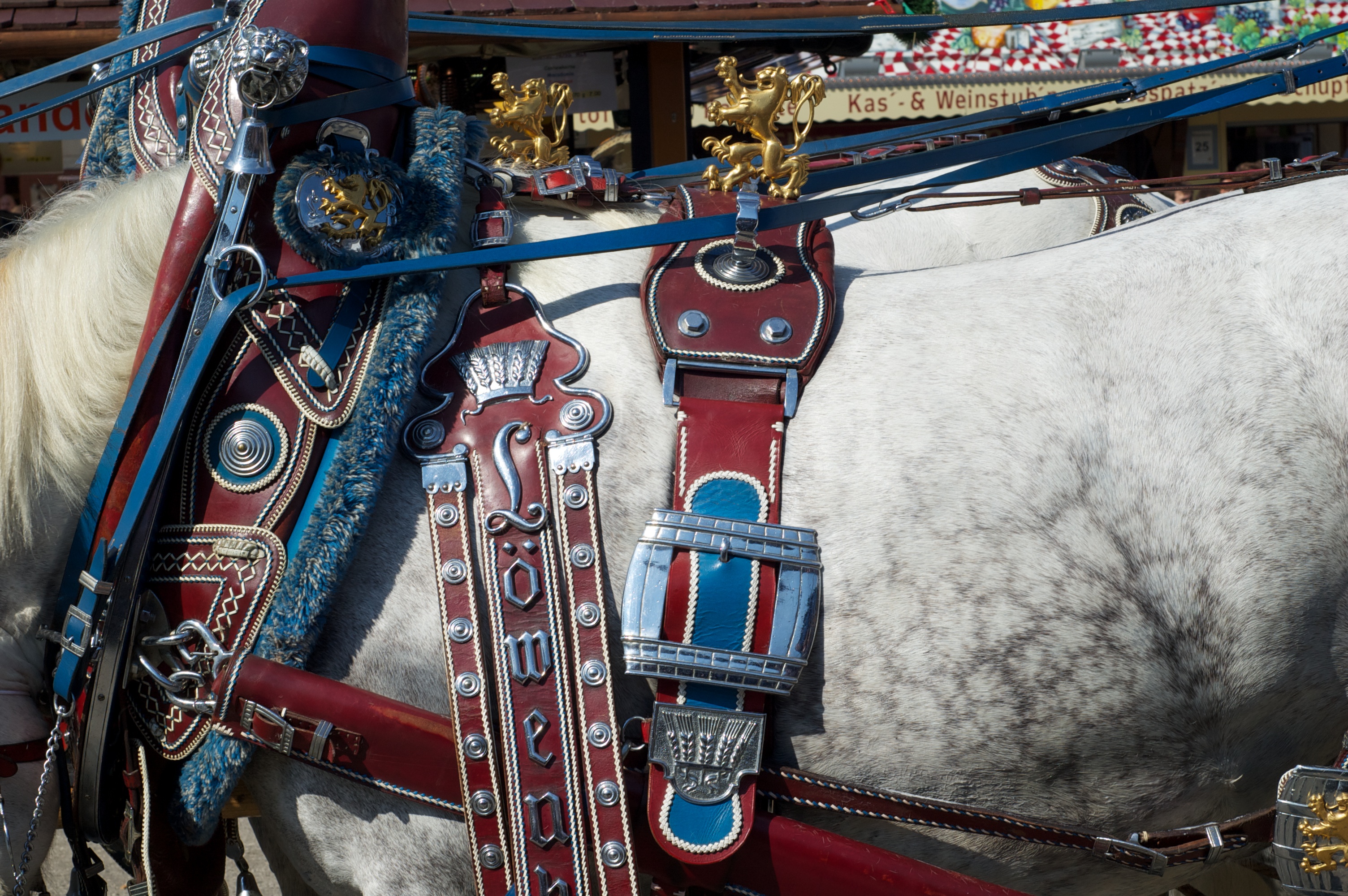
European decorations differed, thus:

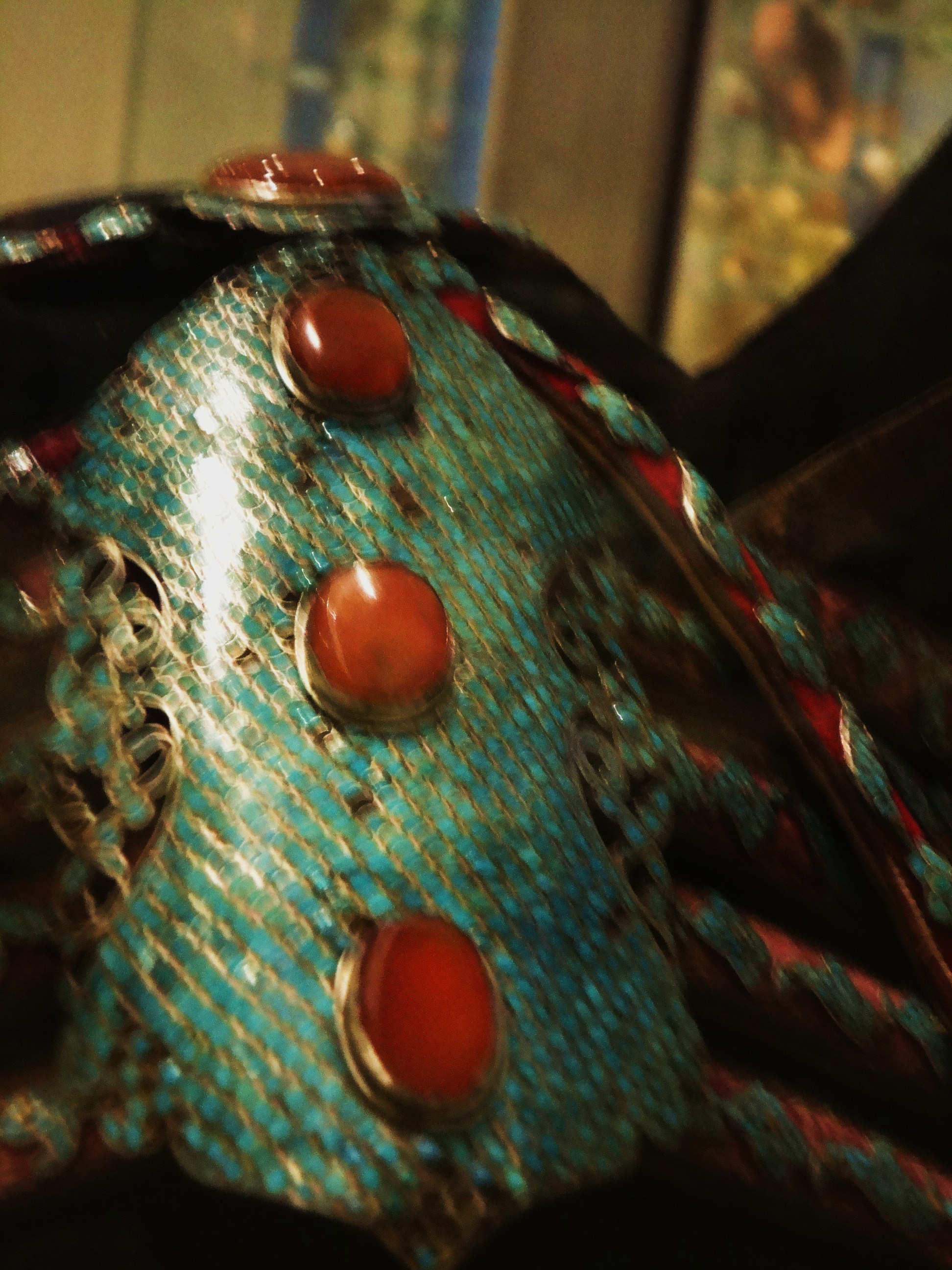
In a recent visit to Royal Ontario Museum I was stunned to see the horse decoration from Iran, which could easily put to envy any woman’s jewellary. This elaborate set of straps and coverings were made of silver, with gold plating,

and inlaid with Iranian turqoise.

The head dress had huge agates giving it a more terrific contrast.


The details of the design were mesmerising:


The austere decorations seen in South Asia using beads, colorful threads and wool tassels have their own charm:


While the Bedoiun horse decor from Egypt still uses  tassles of wool and bead work:

The art of decoration does not end here. The places where other aanimals like camel, ponies are used, they are similarly adorned.

And as buses, trucks and  rickshaws replace animals as the mode of transportation, even they too are as  ferviously bedecked with decorations.
(Details  later…)  

Beautifully meaningful


These are colourful bits with each of a unique shape, size, yet so purposeless, resembling a pile of multicoloured rubble, until….

..magic happens.

And they all   find their right roles in the right places.

Which piece fits best next to the other isn’t necessarily of the same shade or same shape.

What is worth a notice is that they are all connected to each other, someway.

What matters most is that, together, they all make a beautifully meaningful existence.

Arent we all as individuals like the first picture?

*Correction: The magic above did not happen, it was made to happen.

Tiffany lamps have always been my favorites, for they being  beautifully handcrafted, colorful pieces of art, and at the same time  so purposeful too.

P.S. This blog post was inspired by a vibrant and transparent  soul called Geetali Tare, knowing whom is so  beautifully meaningful !

Basant, a festival beyond beliefs


On 27th January, 2012 India celebrates Basant panchami.
In Pakistan, it is celebrated towards the end of February.  

Towards the end of January till early March, the golden harvest of wheat stand tall ready to be harvested sometime in early April.  And wheat is our staple crop.

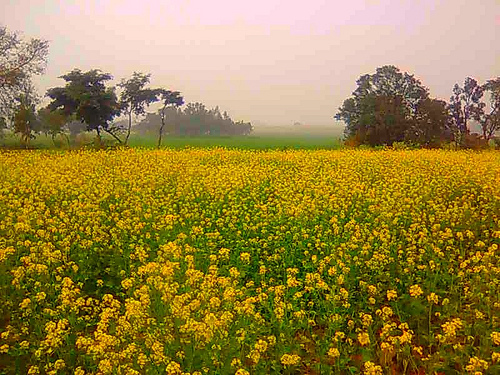
At the same time in Januray February the yellow blooms of mustard ( better known as sarson) sway in the fields, as far as eyes can see. And mustard is a cash crop whose seeds are pressed to extract mustard oil.

To celebrate these awesome blooms as a reward for the fields ploughed and the seeds sown  in October, the farmers rejoice, sing, dance and make merry.

Some of them wear yellow turbans, and their women folk adorning yellow ‘odhnis’ come out to join in the celebrations. It is not hard to imagine that they must be celebrating the blooms, ever since they learnt to farm these crops dating back to centuries.

This is the basic root and the spirit of the tradition of Basant in parts of Indian subcontinent where these crops are grown.

Are wheat, or mustard crops Hindu, Muslim or Sikh?

Vasant in Sanskrit or  Basant in Urdu mean ‘spring’, which heralds the departure of winter and arrival of spring. It symbolizes the time of rejuvenation and arrival of happiness as flowers start to smile through their blossoms.

Yellow, the color of Basant, inspired by mustard blossoms, which matches the shade of sun rays, signifies life and radiance.

Do rays of sun or radiance of happiness differentiate between Hindus, Muslims or Sikhs ?

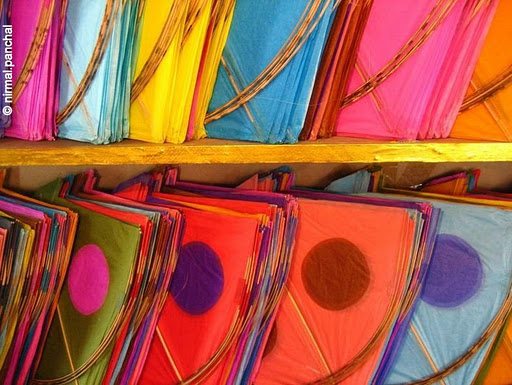
Kite flying , another component of basant, has it’s own interesting tale to tell.

“Kite flying also reveals how the tradition evolved over centuries and in a Ganga Jamuni way.
Kite flying was introduced to the Indian subcontinent by the Chinese traveller Heun Tsang in the 4th Century. Evolving for centuries, it s modification into its current form and popularisation as a sport was made possible by the Nawabs of Avadh. The kite flying during basant celebrations is believed to have been introduced by Maharaja Ranjit Singh in the 18th century.”

Yet another evidence of centuries old and secular celebration of Basant come from poets, Kalidas and Amir Khusro, who have written about the celebrations of Basant in their own unique styles.

Kalidas in a poem Spring writes:
द्रुमाः सपुष्पाः सलिलं सपद्मं
स्त्रियः सकामाः पवनः सुगन्धिः ।
सुखाः प्रदोषा दिवसाश्च रम्याः
सर्वं प्रिये ! चारुतरं वसन्ते
Oh, dear, in Vasanta, Spring, trees are with flowers and waters are with lotuses, hence the breezes are agreeably fragrant with the fragrance of those flowers, thereby the eventides are comfortable and even the daytimes are pleasant with those fragrant breezes, thereby the women are with concupiscence, thus everything is highly pleasing…

AmirKhusro pens down:

Aaj basant manaalay suhaagun,
Aaj basant manaalay;
Anjan manjan kar piya mori,
Lambay neher lagaaye;
Tu kya sovay neend ki maasi,
So jaagay teray bhaag, suhaagun,
Aaj basant manalay…..;
Rejoice, my love, rejoice,
Its spring here, rejoice.
Bring out your lotions and toiletries,
And decorate your long hair.
Oh, you’re still enjoying your sleep, wake-up.
Even your destiny has woken up,
Its spring here, rejoice.

There is an Indian classical  music tune  called Raag Basant Bahaar.

Not to forget, basant in the subcontinent is also associated with a special sweet prepared specially for the occaision –the kesar halwa,
It is a suji ( semolina) halwa with a soft aroma and yellow shade from saffron and garnished with cashew nuts.

Neither the dessert, nor the poetry above nor the music below suggest if Basant is Hindu or Muslim or Sikh.


The same spirit is also replicated by this beautiful ghazal by Malika Pukhraj and Tahira Syed

Lo phir basant aayee…

P.S. Special thanks to Sandeep@stwta a twitter pal for the devnagiri  text of Kalidas poetry.

Continuation of a joint heritage


Published in Aman Ki Asha , in TheNews on December 14, 2011. http://amankiasha.com/detail_news.asp?id=584

Ilmana Fasih recounts some examples of the ‘Ganga Jamuni Tehzeeb’ and centuries’ old, peaceful coexistence beyond religious divides

An otherwise sane looking person I met at a party recently started to spew venom laced with conspiracy theories about “Hindu Muslim animosity”. To top it all, he tried to use my own life to justify his views, insisting that my going

to live in Pakistan after marrying a Pakistani was proof of the natural divide. He refused to accept my views that a peaceful coexistence between people of different faiths is possible or that my going to Pakistan from India was not based on religious reasons.

His hate-filled thoughts kept me sleepless for hours that night. But talking over the phone to my mother in Delhi later, I was cheered up by her mention of Ganga Jamuni Tehzeeb. Our conversation triggered off thoughts about this beautiful, fluid culture that refuses to be boxed up and compartmentalised.

The name Ganga Jamuni Tehzeeb is as beautiful as its spirit. It refers to the centuries’ old, peaceful coexistence between Hindus and Muslims of the subcontinent. Not only did the two faiths borrow cultural practices from each other, but they also exchanged each other’s vocabularies. So much so that now one is hardly able to find any difference between spoken Urdu and spoken Hindi.

The Nawabs of Awadh in north India in the 1700s are considered the pioneers of Ganga Jamuni Tehzeeb. At least, the term was coined in their times. But on ground it existed well before that era.

The starkest example of this syncretic culture is the Purana Hanuman Mandir in Lucknow, which is crowned by an Islamic symbol, a crescent. According to legend, the temple was built by Nawab Saadat Ali Khan to honour the wish of his mother, who had dreamt of building a temple. The tradition of honouring the Nawab’s gesture still continues when the Muslims in the area put up stalls of water during the Bada Mangal festival at the temple, and Hindus manage sabeels (stalls) of sherbet and water during Muharram in reverence for Imam Hussain.

Not far from Lucknow, the rulers of the Hindu holy city of Kashi (also known as Benaras or Varanasi) observed the Azadari (the mourning) during Muharram, wearing black on Ashura. Ustad Bismillah Khan, the renowned Shehnai maestro, began his career as a shehnai player in Vishwanath temple, Kashi. In fact, many of the musicians, Hindu and Muslim, who play in the temples, fast during Ramazan and also observe Vrat during the Hindu Navratras.

Even today, Muslim artisans in Kashi/Varanasi who make Taziyas for Muharram also make effigies of Ravan for Dussehra, a friend tells me. Hindus too participate in Muharram processions and make Taziyas in many cities, notably Lucknow.

Similarly a Sindhi friend talks of the centuries-old peace and harmony between the Hindus and Muslims of Sindh. Adherents of both faiths revere and pray together at the shrine of Jhuley Lal, she says. The shrine walls are inscribed

with Arabic verses as well as Hindu names of Gods. An age-old common greeting of Sindhi Hindus and Muslims is “Jhulelal Bera-Hee-Paar”.

Karachi’s 150-year old cremation ground for Hindus has a Muslim caretaker, although there are many Hindus in the city. This caretaker is responsible for cleaning the statues and lighting the lamps in the temple, and takes care of the urns that contain the ashes of the dead after cremation, until their loved ones immerse the ashes in water.

Cultural practices in Sindh are a fusion of the two cultures. If the Hindus, fervently use Allah as the reference to God, the Muslims touch the feet of their elderly as traditions borrowed from each other’s cultures.

The contribution of Sufi poetry towards this peaceful coexistence, from Kabirdas and Amir Khusro, to Bulleh Shah on the other side, is well known.

Beyond faith, at the cultural level, the Ganga Jamuni Tehzeeb has seen some beautiful creations like the Ghazal style of singing and the classical dance form Kathak.

Kathak’s journey from ancient times to its present form merits a walk-through. The word “katha” comes from “katha” or story telling. It has its roots in ancient times, when storytellers narrated epics or mythological stories like Shakuntala, and the Mahabharata through dance forms in temples. However with the arrival of Mughals, the dance, enticed to come to the courts, developed into a more Persianised form. The Kathak dancers adopted the whirling

from the dervishes to the ‘chakkars’. The rhythm of the footsteps found harmony with the beat of the tabla recently discovered by Amir Khusro. The female Kathakaars (storytellers) abandoned the sari of ancient times for the angarkha and churidar pyjama. The language of narration also transformed from Sanskrit to Brij Bhasha and then Urdu.

There may be more examples of such coexistence and development in other regions of the subcontinent too.

Those who propagate conspiracy theories and narrate stories of hate and disharmony need to know that even with the physical separation between India and Pakistan, the spirit of Ganga Jamuni Tehzeeb lives on. The lack of communication between the two countries, particularly after the 1965 and 1971 wars, has not managed to dampen the natural instincts of sharing these cultures.

Farid Ayaz and Abu Muhammed, the renowned Qawwals from Pakistan continue to sing Bhajans which their gharana has been singing for the last 300 years. On the other side are Wadali brothers who sing Bulleh Shah Kaafis and Naats with the same devotion. Despite all odds, Sheema Kermani and her students in Pakistan have continued to keep the dance forms, not only of Kathak, but also Bharatnatyam and Odissi, alive and known in Pakistan.

The recent collaboration between Zeb and Haniya from Pakistan and Shantanu and Siwanand Kirkire of India yielded the soft melody “Kaho kya khayal hai” in a beautiful blend of Dari and Hindi. I could not help relate it to the Zehaal-e-Miskeen composition by Amir Khusro which was a beautiful fusion of Persian and Brij Bhasha.

And now another peacenik in the form of Shahvar Ali Khan makes a music video titled ‘No Saazish No Jang’ (No Conspiracy, No War). It is heartening to see the visuals, and hear the voices of Quaid-e-Azam Mohammed Ali Jinnah and Bapu Mahatama Gandhi together in the backdrop.

It is not possible to list all collaborations between the two countries and across religious divides, particularly in fields of films, music, health (the most significant being the Heart to Heart initiative by Rotary and Aman ki Asha). But all these initiatives testify to the desire for peace, not hate.

As for me, convinced that each of these efforts towards peaceful coexistence is based on foundations going back centuries, I slide into my bed, comforted by the faith that peace, not hate, will ultimately prevail.
It’s just a matter of time.

Dr Ilmana Fasih is an Indian gynaecologist and health activist married to a Pakistani. Her blog is Blind to Bounds https://thinkloud65.wordpress.com/

Little Terrorist~a short Film


Little Terrorist tells the moving story of a Pakistani Muslim boy who accidentally crosses the Pakistani-Indian border which is riddled with landmines. He ends up in a strange country that regards him as a terrorist. The old orthodox Hindu Bhola takes him in and hides him from the Indian soldiers. However, traditions and prejudices about Muslims remain an obstacle in the relationship between Bhola and the boy. Ultimately, humanity triumphs over prejudice when Bhola risks his own life to help Jamal cross the border again. This symbolic story of hope is a tale of human solidarity conquering all artificial boundaries.
Ashvin Kumar, the director, was nominated for an Oscar in the Best Live Action Short Film category.
Ashvin Kumar’s Little Terrorist also won first prize for best short film at the Montreal Film Festival.

And was nominated and selected for various other prizes.

In love with Ghalib , the witty.


Recently I grabbed a book called Yadgar-e-Ghalib, by Altaf Hussain Haali in Urdu, and read bits from it. This has rekindled my fancy for him all the more.

Mirza Ghalib the humourist , is awe inspiring. Leave aside his superb poetry , his wit with which he lived and laughed off the troubles of his tough life, reveals a person extremely fascinating to read and know. He was an open book.

No doubt he indulged in various vices which would easily label him as a reckless person. But the honesty with which he admits all his vices and even laughs at himself makes him an adorable scamp and one feels like a shrewd hypocrite in front of him.

Ghalib teaches us what is it to live with a life of stark poverty, tragedy after tragedy of losing one’s progeny seven times, living off without a source of income and still to be able to maintain sanity and humour to enjoy one’s present day. (Although being a woman I hail and salute his wife as an epitome of patience and forebearance.)

Reading through I learnt what a friend he was. He never procrastinated in replying back to the letters. And many of his friends send him letters that were ‘bearing’ i.e. without a stamp, and he postpaid twice the amount to releases those letters from the postman. His silver tongue and the golden pen, won hearts of his friends and critics alike.

He wrote that he wanted to write a language, that whoever reads his letters gets elated. (Yes Mirza you still make us elated by them.)

His letters talked.( Yes one can hear you talking through them, Mirza)
One of them said:
“sau kos se ba-zaban-e-qalam baatein kiya karo aur hijr mein visaal ke maze liya karo”
(from hundred of miles talk with the tongue of the pen and enjoy the joy of meeting even when you are separated]).

He joked openly about his being a non-conformist and a sinner. When Ghalib bought a house in Gali Qasim Jaan, he wrote,

‘Masjid ke zer saya ek ghar bana liya hai,
yeh banda kamina, humsaya khuda hai’

(I have made my house on the shadow of the mosque; this wicked fellow is now a neighbour of God).
The mosque he was referring to was the Delhi’s famous Jama Masjid.

During Ramzan somebody asked him if he fasted , and he replied : “ek na rakha.”( I did not keep one.).

On yet another hot day in Ramzan, Mirza was playing chess when a friend, Maulana Arzoo came.
Maulana remarked :“I had read in a Hadith that the devil is imprisoned in the month of Ramzan. But today I doubt the validity of the Hadith.”
Mirza retorted: “Sir, the hadith is absolutely correct. But you be aware that this is that den where the devil is imprisoned.”

Making a serious satire at the gluttony that people indulge during the month of Ramadan he said:

Iftaar-e-saum kii jise kuch dast.gaah ho
us shakhs ko zaroor hai rozaa rakha kare

(The one who has the wherewithal to break his fast
that person should indeed keep the fast)

Jis paas roza khol ke khaane ko kuch na ho
roza agar na khaaye to naachaar kya kare

(The one who has nothing to break his fast with
what else can he do but be constrained to ‘eat the fast’)

And on being questioned for not fasting he said:
Ruza mera eman hay Ghalib! Laiken
Khas Khana wa barf aab kahan say laoon?

(Fasting is part of my faith, but from where should I get khus curtains and chill water for it ?).( Correction courtesy Sohail Bhai).

On another occasion, in a letter that he wrote to a friend, in Persian:
“These days Maulana Ghalib (God’s mercy be upon him) is in clover [very happy]. A volume of the Dastaan-i-Amir Hamza has come — about 600 pages of it — and a volume of the same size of Bostan-i-Khayal. And there are seventeen bottles of good wine in the pantry. So I read all day and drink all night.
The man who wins such bliss can only wonder What more had Jamshed? What more Alexander?”

Ghalib often bragged about his reputation as a rake. He was once imprisoned for gambling and later narrated the incident with great fancy.

Once, when someone praised the poetry of the pious Sheikh Sahbai, Ghalib immediately retorted:
“How can Sahbai be a poet? He has never tasted wine, nor has he ever gambled; he has not been beaten with slippers by lovers, nor has he ever seen the inside of a jail”

When someone poked fun at him for being a drunkard and that a wine-bibbers’ prayers are never answered he said with a laugh, outwitting the person:
“My friend, if a man has wine, what else does he need to pray for?”

He did not even spare his ‘economic poverty’ from the wrath of his wit. ( But Mirza, we know you were far richer the many rich then and now)
Qarz kii piite the mai lekin samajhte the kih haan
Rang laavegii hamaarii faaqah-mastii ek din

The King, Bahadur Shah Zafar was planning to go for Hajj and Ghalib heard it. He wrote to the King :
Ghalib, gar is safar maiN mujhay saath lay chalaiN
Haj ka sawaab nazr karooN ga hazoor ki

If he will take me with him on the Pilgrimage
His Majesty may have my share of heavenly reward

He never minced words about his inclination towards practicing the faith.

Jaanataa huun  savaab-e-taa’at-o-zahad 
Par tabiiyat idhar nahiin aatii 

(I am aware of the reward of religious deeds in the next life, but I somehow do not get inclined towards them.)

It isn’t that those who live happy, are not sensitive and pained by the troubles that come their way. Like everyman with a mind and a heart , to be hurt by the whips that life lashes at them, Ghalib too felt his share of pain.

He wrote:
Sozish e batin ke hain ahbab munkir warna yaan
Dil maheet e girya aur lab aashnaa e khanda hai.

(Though my friends give no credence to my inner aches
While my lips are all smile, my heart is but a tearful waste).

Indeed, his wit must have been therapeutic to his own self, but to readers like me it is very addicting.

P.S. I am extremely indebted to Sohail Hashmi bhai, who I know is an expert in Urdu poetry from very young age, has added some other incidents related to the above context:

The house next to a mosque belonged to Kale saheb, a gentleman who was into sufiism and was respected greatly by bahadur shah zafar. In fact the House was given Ghalib on the recommendation of Zafar, Ghalib has refered to the mosque and his house in two other shers

Bhaun paas aankh qibla-e-haajaat Chahiye
Maajid ke zer-e-saayaa kharaabaat chahiye

Dil Khush hua hai Masjid-e-veeraan dekh kar
Meri tarah Khuda ka bhi Khaanaa Kharaab hai

Once during the month of Ramzan, a maulana who was a friend of Ghalib and also a poet went to meet ghalib, ghalib had a a plate of kabaabs in front of him and a glass of Wine besides him.
The maulana said, “Tumhaara roza nahin hai.”
Ghalib said “Hai”
The Maulana asked “Phir yeh sab kya hai”
Ghalib response was, “Roze ko behlaane ka saamaan hai.”

[P.S. His humour on his first love deserves a complete blog in itself, which shall follow later. No his first love wasn’t either ‘women’ or ‘wine’.]

Cherish whatever makes you unique, ‘cuz you’re really a yawn if it goes. ~Better Midler


Each second we live is a new and unique moment of the universe, a moment that will never be again And what do we teach our children? We teach them that two and two make four, and that Paris is the capital of France. When will we also teach them what they are?

We should say to each of them: “Do you know what you are? You are a marvel. You are unique. In all the years that have passed, there has never been another child like you. Your legs, your arms, your clever fingers, the way you move. You may become a Shakespeare, a Michelangelo, a Beethoven. You have the capacity for anything.”

~ Henry David Thoreau

Amir Khusrau, the maestro of Tarana.


This blog is just an attempt to familiarise the lovers of Amir Khurau to a form of singing, called Tarana, the fascinating  fast paced rendition often intended  to attain trance ( haal),   is attributed to be invented by him. Needless to say his other inventions being Qawwali, seventeen taals, tabla and sitar.

All I get is that Tarana  uses sargams and vocables like na, ta, re, da, ni, odani, tanom, yalali, yalalom shuffled in a fast pace coordinated  by rhythmic percussion from Dhol or Tabla.

A legend says that Amir Khusrau discovered this genre of music by default when   Khusrau at a performance of raga Kadambak by Gopal Naik,  allegedly,  remembered the music but not text. So he created the tarana through a merging of bols from the tabla, the sitar or the mridang.

Since I am absolutely bankrupt in classical music so I would just quote what Ustad Amir Khan Sahib,  a master of Tarana says:

“It is generally believed that Tarana is a composition of meaningless syllables followed sometimes by the bols (words coined to denote the various sounds of instruments) of the tabla and sometimes by Persian poetry. This view is not true. As a matter of fact at the time of the Amir, the texts of the songs used to be in the languages of South India, which were not easily understood by the people of the North. The court language was Persian, which was evidently the language of the contemporary intelligentsia. The Amir naturally thought of composing the texts of songs in the language understood by the intelligentsia. Thus the Tarana was born. The various words used are Dartanaa, Dar Tan Aa, Yala an abbreviation for Ya Allah. Yali for Ya Ali, Dar Aa etc., which when translated would mean:

Yala – Ya Allah

Yali – Ya Ali

O Dani : He knows

Tu Dani : You know.

Tom : I am yours, I belong to you
or   
Main Tum Hun (I am you).

Na Dir Dani : You are the complete wisdom.

Dar – Bheetar, Aandar (inside)

Dara – Andar Aa (get in or come inside)

Dartan – Tanke Aandar (inside the body)

Tanan Dar Aa : Enter my body.

Tanandara – Tanke Aandar Aa (Come inside the body)

Nadirdani – Tu Sabse Adhik Janata Hai (You know more than anyone else)

Tandardani – Tanke Aandarka Jannewala (One who knows what is inside the body)

Another feature of Tarana as sung by many in India is the repetition of certain words at a great speed. The justification for this type is also not to be sought., It is not merely an exhibition of speed or virtuosity at pronouncing words, but the idea is that while in prayer a person goes into a trance, and that in that state of mind he just continues to repeat one word or one set of words.”

( source: http://caferisko.ca/ak/tarana.html)
Yar-e-man bia bia Tarana sung by Konkana Bannerjee.

Main melody:
Yar-e-man bia bia.
Dar Tan tadim,
Ta-nan Ta na dim, Tom Ta Na Na Na
Antara:
Ba labam raseeda jaanum
Fu bia ke zinda maanum
Pas azari ki man na maanum,
Ba cheh kar khahi amud.

which means:

O love, come soon, come at once.
Come and enter my body,
for I am yours, come
Antara:
My life hangs on my lips,
Come thou that I may live again
for if thou shall come when I am no more,
to what avail shall it be.

Also see:http://en.wikipedia.org/wiki/Tarana
http://www.indiaheritage.org/perform/music/h-v-t.htm