Open up your mind and your potential reaches infinity…

Archive for the ‘Art’ Category

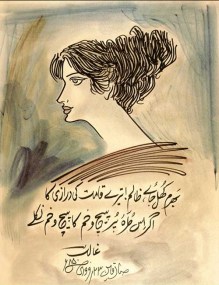
Ayy Ishq Humein Barbaad Na Ker…


Several decades down the road, this nazm and this rendition remain my lifetime favourite by Akhter Shirani
:
:
:
Ay Ishq humaiN barbad na kar, 
O’ Love, smash us not, destroy us not
Barbaad na kar, Nashaad na ker
Smash us not , depress us not
اے عشق نہ چھیڑ آ آ کے ہمیں
Ay Ishq na cheRh aa aa key humaiN
O’ Love disturb us not, again and again
ہم بھولے ہووں کو یاد نہ کر
Hum bhooley huoN ko yaad na kar
Recall us not, the forgotten ones
پہلے ہی بہت ناشاد ہیں ہم
Pehley hi bohut nashaad haiN hum
So disheartened we already are
تو اور ہمیں ناشاد نہ کر
Tuu aur humaiN nashaad na kar
Make us not more disheartened
قسمت کا ستم ہی کم نہیں کچھ
Qismet ka sitam hii kum nahiN kuch
As if the injustice of fate was enough
یہ تازہ ستم ایجاد نہ کر
Yeh tazaa sitam eejaad na kar!
Reinvent not,  this fresh injustice
یوں ظلم نہ کر بیداد نہ کر
Yun zlm na kar beydaad na kar
Inflict not such cruelty and tyranny
اے عشق ہمیں برباد نہ کر- برباد نہ کر
Ae Ishq humaiN barbad na kar, barbad na kar
O’ Love, smash us not, destroy us not


جس دن سے بندھا ہے دھیان تیرا
Jis din se bundhaa hai dhyaan tera
Since the day our thoughts possessed you,
گھبراےؑ ہوےؑ سے رہتے ہیں
Ghabraaye huwe sey rehtey haiN
Anxious we remain
ہر وقت تصور کر کر کے
Har waqt tasawwur kar kar ke
Lost in your imagination 
شرماےؑ ہوے سے رہتے ہیں
Sharmaaye huwe se rehtey haiN
Feeling embarrassed (all the time)
کملاےؑ ہوے پھولوں کی طرح
Kumhlaaye huwe phoolon ki tarha
Like the wilted flowers
کملاےؑ ہوے سے رہتے ہیں
Kumhlaaye huwe se rehetey haiN
Shrivelled up we remain
پامال نہ کر بیداد نہ کر
Paamaal na kar, beydaad na kar
Trample us not, torment us not
اے عشق ہمیں برباد نہ کر- برباد نہ کر
Ae Ishq humaiN barbad na kar, barbad na kar
O’ Love, smash us not , destroy us not
راتوں کو اٹھ اٹھ کر روتے ہیں
Raaton ko uth uth kar roTey haiN
Weeping we wake up at nights
رو رو کے دعایؑں کرتے ہیں
Ro’ ro’ kay duwayin kertey haiN
And plead as we snivel
آنکھوں میں تصور، دل مین خلش
Ankhon main tusawwar, dil mayn khalish
With fantasy in the eyes, regret in the heart
سر دھنتے ہیں، آہنیں بھرتے ہیں
Sar dhundtey haiN anhein burtey haiN
Our head throbs( in pain) and heart sighs  
اے عشق یہ کیسا روگ لگا
Ae Ishq ye kaisa rog Laga
O’ Love, what kind of ailment is this
جیتے ہیں نا ظالم مرتے ہیں
Jeetey hain naa zaalim martey haiN
Neither do we live nor we die
Ye zulm tou ayy jallad na ker
Inflict not this torture, O’ Tyrant
اے عشق ہمیں برباد نہ کر- برباد نہ کر
Ae Ishq humaiN barbad na kar, barbad na kar
O’ Love, smash us not , destroy us not
ان خوابوں سے یوں آزاد نہ کر
In khwabon se yuun azad na kar
Release us not from these delusions
اے عشق ہمیں برباد نہ کر- برباد نہ کر
Ae Ishq humaiN barbad na kar, barbad na kar
O’ Love, smash us not, destroy us not 

English translation attempted most humbly by yours truly. Translation of full nazm will follow.

Kaahe ko byaahi bides ~ Khusrau


Weddings are not complete without the wedding songs in any community.
“Kaahe ko byahi bides” in Braj dialect by Amir Khusrau  is an extremely popular wedding song in the northern Indian subcontinent. There is hardly any wedding where this song is not sung by the women. Since these verses are passed on from one generation to another by word of mouth, every singer picks and chooses different stanzas and sometimes with variance in vocabulary in the verses. I have tried to collect the different verses, and there may still be other lesser known verses too. Shall appreciate if you will share if you have any different ones in the comment box.

It is a plea from a daughter to her father explaining how she is one of the dispensable objects from their household. Through metaphors, though seemingly simple, she makes a gut wrenching comparisons with herself.  Every stanza of the song merits a deep appreciation of that comparison in a different way.


Khwaja ji,
Sun li hamre jiyara ki peerh,

Ankhiyaan se bahe hai neer.

Khwaja  listen to the pain in my heart,
While from my eyes flow out tears. 

Kāhe  ko  byāhe  bides?  
Arre  lakhiyā`  bābul  more?  
Kāhe ko byāhe bides?  

Why did you marry me off to a alien land? 
O’my wealthy  father,
why did you part me from you?  

Hum to bābul torey, bele kī kaliyā`.  
Arre  ghar-ghar  mānge  hai`  jāye.
Lakhiyā`  bābul  more
Kaahe ko byahe bides. 

 
We are just flower-buds from your garden,
Every household  asks for us.
O’my wealthy father,
Why did you part me from you?

Hum to bābul tore angan kī chiṛaiyā.
Arre chuge, piye, urr jāye.
Lakhiyā`  bābul  more
Kaahe ko byahe bides.

We are just birds from your courtyard
We peck on food, drink and then fly away
O’my wealthy father
Why did you part me from you?  

Hum to bābul tore, khūte kī gayīyā`. 
Arre jid haanko hakjaaye.  
Areh  lakhiyā`  bābul  more
Kaahe ko byahi bides.

We are just your tethered cows,
we have to go wherever you drive (send) us.
O’ my wealthy father
Why did you part me from you? .

Tākh bhārī me`ne guṛiye` jo chhoṛī.
Arre  to chhoṛā  saheliyo`  kā sāth.  
Lakhiyā`  bābul  more
Kaahe ko byahe bides. 

I’ve left at home alcoves full of dolls,
and parted from my childhood friends too. 
O’ my wealthy father
Why did you part me from you? 

Mehala`  tale  se  dolā  jo  nikalā.
Are  bīran  ne khaayi  pachhād.  
Lakhiyā`  bābul  more
Kaahe ko byahe bides  

When my palanquin passed beneath the mansion, 
My brother fainted and fell. 
O’my wealthy father,
why did you part me from you? 

Doley ka parda utha ker jo dekha
Na babul na babul ka des reyy
Lakhi babul morey
Kaahe ko byaahe bides?

When I lifted the veil of the palanquin
There was neither father, nor fatherland,
O’my wealthy father
Why do you part me from you?

Bhaiyā ko diyo bābul mehala do mehale.
Areh  ham  ko  diyo  pardesh  re.  
Lakhiyā`  bābul  more
Kaahe ko byahe bides

You gave, two-storied houses to my brother
And to me, you gave a foreign land.  
O’my wealthy father,
why did you part me from you? 

Ghar se tou kayila hum ke vida,
Arre Jiyara se na kariyo judaa,
Lakhiyā`  bābul  more
Kaahe ko byahe bides

You are sending me away from home,
Separate me not from your heart,
O’my wealthy father,
why did you part me from you? 

Khusrau kehat hai`, Aiy merī lāado.  
Arre  dhan  dhan  bhāg  suhāg  re.  
Lakhiyā`  bābul  more
Kaahe ko byahe bides. 

Khusrau says, O my darling daughter –
May your marriage be blessed with everything.  
O my wealthy father,
why did you part me from you?


There are multiple classical and folk versions sung by countless singers. Few of my favorites are here:


A different and very interesting version I found is this sung by Habib Painter >

Waise tou dastoor hai ye purana,
Pii ki nagariya hai dulhan ko jaana
Kehtey  hain Nabi aur Khusrau ka kehna
Doley ka parda utha ker jo dekha
Aya paraya des reyy, ache babul more
Kaahe ko byaahi bides, ache babul more…


Going Home~ Creating safe space is not a rocket science.


It is dark, and quiet,
She is alone,
She is young and beautiful,
Yet she is spontaneous and warm
Because she feels safe.
Doesn’t that feel good?
Whether you are a man or a woman,
to see a fellow human feel secure in your company?
Age, place, dress, time do not matter,
Secure and safe space is everyone’s right.
Can you give that space menfolk?
Yes, you can, and you must.
I know womenfolk will have that space one day,
And I know that day is not too far.

Creating safe space for women
Is not a rocket science.
Its not just possible,
but is very simple
Watch this:
A lovely short film by Vikas Bahl #GoingHome

http://https://www.youtube.com/watch?v=0EDJxs1yJrQ

Sadeqain, the legend~ a special feature in Rung Festival at ROM


Sadeqain needs no introduction to South Asians and to art connoisseurs the world over.

This slideshow requires JavaScript.

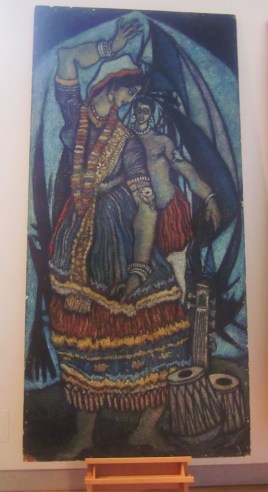
Born as Syed Sadeqain Ahmed Naqvi  in Amroha, India in 1930, Sadeqain rose to became the most accomplished painter and calligrapher Pakistan has ever seen.

A self taught painter,  who still beholds the world with an awe by his quality and volumes of his artwork. It is estimated that Sadequain painted more than 15,000 pieces of artwork consisting of murals, paintings, drawings and calligraphies.

A man who possessed incredible passion and energy for art, donated most of his works to many friends and places. Though priceless as art treasures, his paintings stand a worth of over $1 billion now.

He is credited to have brought a renaissance, ( the reawakening) in the art of Calligraphy. Calling himself a faqir, and belonging to a family of calligraphers he considered calligraphy as a divine gift to him.

This slideshow requires JavaScript.

Asked many times about when did he begin painting, he often said he did not remember how early he started painting. In one of his interviews he remarked, “Perhaps I must be moving my fingers to paint in my mothers womb too.”

His murals cover an area larger than the murals created by Michelangelo and Diego Riviera combined.

The mural titled “Saga of Labor” located at Mangla Dam is credited to be his largest work (approximately 180 x 35 feet). Saga of Labour is Sadeqain’s tribute to the working men and women since early life on Earth. The mural illustrates mankind’s journey from food gatherer to the development of agriculture, handicrafts and machinery. Beginning with Iqbal’s verse on Farhad, this majestic mural ends with Iqbal’s reference to other worlds beyond the stars. It is known to be one of the largest murals in the world.

sadlab2

Sadlab1sadlab3

Sadeqain painted on the poetry of Ghalib, Iqbal and Faiz.

sadeqainghalibSadeqainFaiz

He was also a poet, who composed Rubaiyat (quartains),  then inscribed, and illustrated them. There are over 200 such illustrations collected in Rubaiyat-e-Sadeqain.

A recipient of numerous national and international awards like  Tamgha-e-Imtiaz, Pride of Performance, Sitara-e-Imtiaz, Australian Cultural Award, and Gold Mercury Award, he  won the first prize at the prestigeous Laureate Biennale de Paris.

Sadeqain was described by Le Monde, Paris in 1964 as,  “The multiplicity of Sadequain’s gifts is reminiscent of Picasso.”

He painted till the last days of his life. When he passed away in 1986, he was worjking on the “Arz-o-Samawat” (Earth and the Heavens)  for the ceiling of the Frere Hall, Karachi. With 100 panels spanning an area of 3,200 square feet, Sadeqain could only complete 87 of them.

SadFrere1

sadfrere2

Sadeqain was immensely popular in India and his work is currently graces many locations in India including Delhi, Aligarh, Benaras and Hyderabad.

His painting are the prized possession of New York Metropolitan Museum, Royal Ontario Museum in Toronto, Museum of Modern Art in Paris, and many other locales.

Dr Salman Ahmed, Sadeqain’s nephew has formed Sadeqain Foundation in 2007  with the mission to Discover, Preserve and Promote Sadeqain’s immense works.

I ask him what does he mean by discover Sadeqain’s work?

He responds that the painter was extremely generous and gifted away thousands of works to friends and places where he painted. Hence alot of his art sits with individuals, and many of their heirs do not understand the value of it, or are unable to maintain it. Moreover in the words of Anwar Maqsood, “Sadeqain is one painter who has painted even after his death.” implying that a lot of fake  artwork has been created attributed to him. He envisions to create a Museum of Sadeqain’s art.

We at Rung Festival at ROM were fortunate to have two panels of the original mural by Sadeqain on May 31, and June 1, 2014. The mural called Pakistan was painted by Sadeqain in 2 weeks at a Pakistani Expo in Lusanne, Switzerland in 1966. The mural depicted the cultures of various provinces of Pakistan. In 1975 they were brought to Canada for a Pakistani Expo, and since then 7 of the 9 pieces of the mural reside in the Pakistan Embassy in Ottawa.

The exhibit became the focal point of all visitors to Rung Festival.

RUNG PICS 125RUNG PICS 126


Information & pictures: Courtesy Dr. Salman Ahmed. Sadequain Foundation USA.

The Flawless Purse: Dilemma of Consumerism


In style she clutched a glossy purse,
Tight between her hand and her chest,
Protecting it from falling or
From being scratched,
From the pointed necklace
Around her own neck.
She had saved for years,
And dreamed of even longer
To own this branded gem.
She holds on to it firm,
Yet all tender, all protective,
Like a beautiful relationship,
Between two souls,
Knowing how hurt,
The purse can get,
When there are bruises
And that the purse
shall never be the same,
if held back after it falls.
So precious, and so priceless,
She finally owns a flawless dream.
But oh for the flawed souls,
They come and go in our lives.

ClutchBag

In a gentle way, you can shake the world ~ Gandhi


Once upon a time, there was a wise man who used to go to the ocean to do his writing. He had a habit of walking on the beach before he began his work.

One day, as he was walking along the shore, he looked down the beach and saw a human figure moving like a dancer. He smiled to himself at the thought of someone who would dance to the day, and so, he walked faster to catch up.

As he got closer, he noticed that the figure was that of a young man, and that what he was doing was not dancing at all. The young man was reaching down to the shore, picking up small objects, and throwing them into the ocean.

He came closer still and called out “Good morning! May I ask what it is that you are doing?”

The young man paused, looked up, and replied “Throwing starfish into the ocean.”

“I must ask, then, why are you throwing starfish into the ocean?” asked the somewhat startled wise man.

To this, the young man replied, “The sun is up and the tide is going out. If I don’t throw them in, they’ll die.”

Upon hearing this, the wise man commented, “But, young man, do you not realize that there are miles and miles of beach and there are starfish all along every mile? You can’t possibly make a difference!”

At this, the young man bent down, picked up yet another starfish, and threw it into the ocean. As it met the water, he said,
“It made a difference for that one.”

The story is authored by Loren Corey Eiseley a highly respected anthropologist, science writer, ecologist, and poet.

Moral of the story in Gandhi’s words: In a gentle way, you can shake the world.

Saying it poetically:

If you deny
the power of
one tiny effort,
Light a candle
in the dark,
And watch
the small flame
defy & define
the darkness.

(Inspired from a quote by Anne Franke).
flame

The secret wish of every status quo is, it impatiently awaits to be broken. Don’t believe ! Give it a try.

Ashure’ : Noah’s Pudding


Ammi called me early in the morning on Friday, the day of Ashura( 10th Moharram). Ashura commemorates the day of the battle of Karbala for Muslims.
I knew why did she call that early, as it has been a regular practice since years, I have lost count of
“One request beta.”
“Yes Ammi.”

I knew it but still wanted her to say it.
“Please don’t play music today on Ashura.”

This is all she expects from me. But she does a bit more than just not listen to music. One of her routines is to cook a pot of Khichra( Haleem) and not let anyone touch it, or munch any of the ingredients till the Niyaz is done.

South Asians make Haleem on Ashura, a complete food with multiple ingredients in one: whole wheat, lentils, rice, barley, and meat with a host of rich spices in a lengthy procedure.

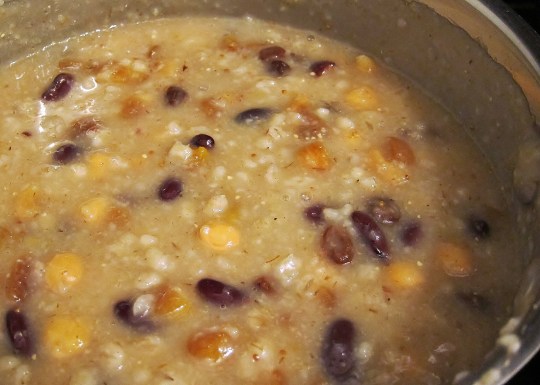
Along the same lines, the Turks make a sweet Haleem, called Ashure or Noah’s Pudding. The ingredients vary from 7 to 10 to 12 varying from whole wheat, beans ( red and white), chick pea, to dry fruits including figs, peaches and nuts like almonds and raisins.

There are multiple legends associated with it.

It is cooked on the day of Ashura ( 10th Moharram) by all communities in Turkey across different sects: Sunnnis (Balkan Sufis), Shias, Alevis and Kurds.

Ashure is then distributed to all in the neighborhood in small bowls, after performing prayers for health and harmony.

Alevites fast for 12 days, and break it on Ashura with this special dish Ashure. Alevis prepare it with 12 ingredients in their version of the dish. They refrain from killing animals or eating meat in these days of fasting.

There is also a different but popular legend of why it came to be known as Noah’s pudding. According to the legend, it was the day when Noah’s Ark came to the banks of Ararat and Noah’s family cooked a dish from all ingredient leftovers in the Ark.

.
As I asked a Turk friend to confirm my list of ingredients, she added:
“The most important ingredient is the ‘Intention’ and the ‘Will’ to make this dish. In Turkish we say ‘Niyet Etmek.’

Asure – Noah’s Pudding
Ingredients
(can be found at any Whole Food Markets or Middle Eastern Store) –
• 1 cup of barley whole wheat
• 1 can of chick peas,soaked & boiled
• 1 can of white kidney beans
• 3/4 cup of black dried currants & raisins
• 3/4 cup of almonds/pistachios
• 6 dried Turkish Figs – cut into small quarter
• 6 dried Turkish Apricots – cut into small quarter
• 2 cups of brown sugar ( or plain white sugar)
• 1 lemon zest or orange
9– 12 cups of cold water/4 tsp rosewater(optional)
Condiments: salt/cloves/cinnamon sticks
Garnishing: Fresh pomegranate

Preparation:
One day Before: Soak 1 cup of barley whole wheat in 3 cups of water the night before. This will allow the barley to soften.
Day of:
1. Drain the soaked barley, pour into a deep cooking pot fill with 8-10 cups of cold water leaving about 2-3 inches of the top. At this time add in, sprinkle some salt, add in the cloves and cinnamon sticks.
2. Over a medium to high bring the pot to broil fior 30-40 minutes. The barley will have cracked open and have become white and soft to touch and taste.
3. In the mean time into a small sauce pan, boil the black currants and in a cup of cold water. Once the color of the water turns dark, drain the currants through a sieve.
4. Once the barley has softened, add in the washed chick peas and kidney beans and stir.
5. Add in the rest of the ingredients – the drained currants, raisins, apricots, figs, and almonds, stirring each time you add in an ingredient. Let this mixture boil for 8-10 minutes.
6. To thicken fast, in a cup of cold water mix the 4 tablespoons of corn starch, leaving no lumps. Add the corn starch into the boiling barley mixture and give it a thoroughly stir. *the corn starch will act as a thickening agent.
7. Add brown sugar to your liking, and again stir thoroughly, continue cooking over medium heat and allow the sugar to dissolve.
8. Finally add in the zest of the lemon or orange and the rose water and let cook for a 5-7 minutes.
9. Let cool for about 15 minutes, ladle into serving bowls. Top with cinnamon, nuts and pomegranate seeds.
Ashure can be served warm, at room temperature or cold.

Ashure is a vegan dessert too.

NoahPudding1Noah's Pudding2

Ashure served with a traditional touch:

NoahPudding0

Kabir & Bulleh Shah- the need of our dark ages.


Depressed and dejected with the ever rising religious extremism, intolerance and hatred in the world at large, helplessness over powers oneself. The only ray of hope left are the few shining stars in this dark sky that shone on our lands several centuries ago. Their golden words still need to be heard and heeded by one and all.

Kabir from India and Bulleh Shah from what is now Pakistan are two voices that spoke of peace and love beyond beliefs and borders. They were shunned in their own times, but if they were reborn now, they would not find much has changed from those days.

Reminscing their poetry, I dare to use them on painting a silk scarf.

The scarf background is black, which represents the dark ages of extremism, intolerance and bigotry that we currently are going through.

The golden messages of the verses are scribbled in golden ink, The verses chosen  relate to the abundance of  knowlege, in this era of information revolution, but the information that still fails to convey the message of peace and tolerance that it should accompany.

The languages have been reversed,
Kabir written in Urdu and Bulleh Shah in Hindi so that both sides are able to read them.

Silk1 001

Bulleh Shah here says:

Parh parh aalim faazil hoya, kadi nafs apne nu parheya ai nayi,
Ja ja werda mandi maseetey, kadi man apne nu wareya ai nayi.

( You read bookes, became learned, but never read (compassion in )your own conscience,
You visited temples and mosques, but never visited (the love)in your own heart.)
KabirBullehShahSilk 003

Kabir says:

Pothi parh parh jag muwa pandit bhaya na koi,
Dhaayi akher prem ka parhe to pandit hoye.

{The whole world read books after books, but no one became learned,
Read two and a half words of love ( peace and compassion), to be a learned}

KabirBullehShahSilk1 001

The peace symbols in the middle of the silk scarf are crisscrossed by chaos and confusion prevalent in our times.
KabirBullehShahSilk 013

KabirBullehShahSilk 014

The edges below the verses represent the hearts interlinked through love and peace, if only we heeded the verses in spirit.

KabirBullehShahSilk 009

It was heartening to see Kabir’s message of love and peace ( coincidentally the same verses that I was scribbling), being presented in another art form, called Dastangoi. I dedicate this piece and the blog to this wonderful  Kabir presentation. 🙂


Harmony and Peace: Exhibition by Jimmy Engineer on TD Mosaic Festival Day #2


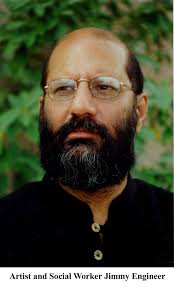
TD Mosaic Festival 2013 day 2 began with the Exhibition of  “Harmony and Peace” series of  paintings by Jimmy Engineer, a renowned Pakistani painter, visiting Canada, especially for the event. The Exhibition shall continue till September, at Promenade Art Gallery.

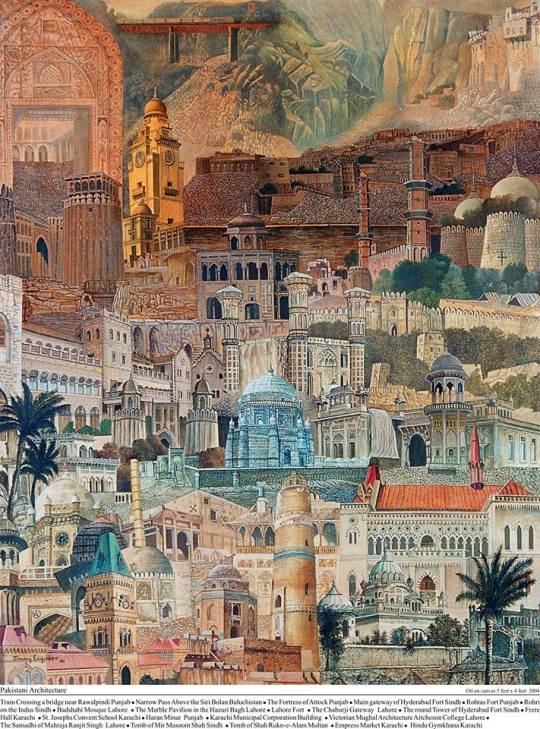
The paintings  by Jimmy Engineer, being showcased in the TD Mosaic Festival 2013 are part of a series of paintings  of Pakistani and world architecture titled as “ Harmony and Peace”.
The idea behind the series is that when different architectural structures from different places in India, Pakistan, Egypt, Uzbekistan, Turkey, China etc can be brought together in one frame, and appear harmonious, why can’t human beings, who possess intelligence, be able to coexist with harmony.

Talking to Jimmy was an enriching experience, to know in depth about the humanist that he is. He prefers to be acknowledged as “a simple mortal who cares for human kingdom with passion.”
His inspiration to Art is Nature, which he considers as his Perfect Master.

Born into a Parsi family, he says he believes in universality of faith. He was inspired by the simplicity and spirituality of Sufi Barkat Ali, from Faisalabad, who he says, bestowed upon him the responsibility to make Pakistan proud, through his Art and social work.

Jimmy says, he meditates, and often gets the visions to paint in his dreams, which he then transforms into canvases.

Jimmy has to his credit 3000 pieces of Art (2000 paintings and 1000 calligraphies), and countless social services, some of which are known, and some he chose to keep unknown. He believes that the highest form of social work is that reaches the needy unseen, devoid of any pomp and show.

As an artist, he has  worked with many mediums including water, oil and pastels be it on canvas, wood or ceramics, and from realism (landscape, still life,) to abstract to calligraphy.

A humble human being that he is, he believes he is extremely blessed, despite never attempting to promote his work. He has received great recognition and respect from the world over, and his art work has made way into private collections in Italy, France, Switzerland, Russia, India, China, England, USA in fact almost in every part of the world, validating his status as an International artist.

Jimmy leads an extremely simple life, and has always directed royalties from his Art work,  including a house, into social causes dear to his heart.

He believes to Walk-a-Cause and has to his credits countless walks to raise awareness on myriad issues, mainly related to helpless and needy individuals, like the special children, widows, orphans, and various health issues.

He walked from Karachi to Khyber all by himself, in one year, which took him through various cities, villages, deserts, and wilderness. He claims that all along the way, people from all walks of lives, supported and helped him, right from Waderas, Chowdharys to dacoits,and the poor. They shared their food and shelters with him. He even encountered poisonous snakes and dangerous animals, but was never harmed by anyone.

“During the walk,” he says, “my fearlessness was challenged by many asking me to enter the cage of lions, which I did, without being harmed by them. “

He says many attributed this to be due to his possession of supernatural powers. But a humble Jimmy thinks, it is his conviction to peace and compassion that leaves him unharmed.

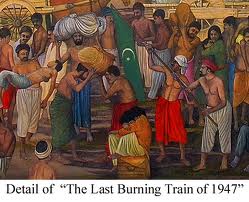
He is a strong believer of Indian Pakistan Peace, and says that he was neither born during the time of partition, nor had read the gory details of it, but sometime in 1973, he had the scenes appear in his dream, which he then painted into the Partition series.

In 2001, he decided to walk for Peace from Islamabad to Delhi, but then stopped at the Wagah border.

“Why did you stop?”  I asked.

“I was walking for the sake of Peace, and to not add more tensions by my act. At reaching the border, and conveying my peace intent, I had conveyed my message.” he replied.

He believes that “Peace between India and Pakistan will come one day, as 99% on both sides are desirous of peace, and it is only 1% or even less do not want it.”

“Amen” , I say aloud, with a firm conviction that the words uttered from such a humble champion of humanity and compassion, will not be left unheard by the God Almighty.

Peace and Harmony series…

Jimmy1

Jimmy2

Partition series…

Jimmy3

Jimmy4

Calligraphy by Jimmy:

Jimmy5

Jimmy Engineer, the artist and social worker par excellance:

Jimmy6

A peep into Truck Art- a chat with ‘truck artist’ Haider Ali


While strolling in a Pakistani Mela,  Khyber to Mehran, in Mississauga I was attracted to a giant canvas partly filled with vibrant colors. As we got closer, we saw a man with was effortlessly making strokes with a brush creating flawless images. Without the initial sketch, even the symmetry was perfect.

That’s truck art.” Screamed my daughter. I stood watching him in awe…not just the perfection, but the speed and the choice of colors. He turned back and in response to our questioning smile, introduced himself as ‘truck artist Haider Ali’ from Karachi. ( The stress was on the first two words).

Haider Ali is visiting Canada on the special sponsorship of the Pakistani Consulate and represented Pakistani Truck Art  in the South Asian Heritage Celebrations called RUNG, at Royal Ontario Museum, Toronto, and Carrasauga Festival in Mississauga in May. Last week he also painted a panel at the Canadian Parliament at Ottawa.

I had a million questions to ask about the Truck Art, so I followed him at the exhibition Moving Art  arranged by a  friend Asma Mahmood at her Promenade Gallery

First of all I wanted to know the history of the origin of truck art:

“It all developed very gradually. In 1950s after partition, the Karachi Port ( Keamari Port) became the main source of trade. It was mainly the camel carts and the donkey carts that carried the goods. The camel carts being bigger, brought goods from the port upto wide roads and then transferred the good were carried on smaller donkey carts, to navigate through the narrow lanes leading to the City Station from where trains carried them to the rest of Pakistan. The painters painted camel, donkey and horse carts , while their animals were adorned with intricate accessories and ornaments made out of beads and wool.
In 1960s, Bedford trucks started to arrive from Luton, England. So the trucks gradually replaced the camel carts. Three  painters which included his father, started to comply to the demands by the truck drivers’ demands to paint the names of their cities, and sometimes for their kids mention on the truck.

  • Mera Sona sheher Chakwal
  • Aao sanam Kashmir chalein
  • Sonu tey Billo di gaddi.

Like the animal cart owners, they considered their trucks as their companions. Perhaps ( speculates Haider Ali), the more imaginative ones wanted their trucks also to be more ornately adorned like these animals. Hence the idea of more detailed motifs developed. The idea got better, and better. The painters started to add more colors, and designs like flowers, birds, scenes, and human figures on the truck. This inspired a competitive spirit, not just between the truck owners but also between the painters, who boasted of their  newer and more creative designs. Thus the art kept evolving, and it still is.”

“In the 60s and 70s the Garden area, which is the hub of truck art in Karachi, used to look like an artists street from Italy or Spain”. says Haider Ali.  Many foreigners used to come and appreciate the art. Many wrote articles on it, as they went back.

Haider ali began learning from his father at the age of 7. After school he used to play around the place where his father painted, and sometime out of curiosity for colors, his father let him put dots or lines on the truck. He learnt mixing of colors, contrasts, and how to make strokes. Seeing his interest and flair in strokes, his father sent him to a friend who used to paint posters for films.

At the age of 22 he decorated a truck for the Smithsonian Institute, Washington D.C. one of the most detailed piece he has painted, The truck still stands there at the institute.

HyderAliSmithsonian

He has exhibited his art on a truck &  vans in London and Luton too:

hyderAliUK

HyderAlivansUK

A bus and a friend ship car in Turkey. The doors of the car below show King Faisal Mosque(Pakistan) on the left  and Blue Dome mosque(Turkey) on the right.

HyderAliTurkey

HyderAliTurkeyBus

There are so many  colors and details to be added. Isn’t it very complicated?

“Each truck is worked by 6-7 group of artists specializing in different areas.When it is our turn to paint,  start from a white painted background, the add details over details. Once painted, a sticker paper is added in lines to reflect the light, called the chamak patti. Then the electrician adds the electric fitting like colorful bulbs , metal workers add the colored chains, and metallic frames to make it more intricate. Even the interiors are explicitly detailed, including the faux leather seats, which  match the motif designs.”

The play of color begins:

HyderAliColors

HyderAliWhiteTruck

HyderAliPredetailsHyderAliDetails

The explicitly detailed interiors:

Elaborate Truck Art Of Pakistan
Asking him about the details of the kind of motifs the truck drivers demand, he says.

The image that stands most popular since time immemorial is Ataullah EsaKhel.  They love his songs, and he has been painted thousands time over.
Ayub Khan was also one of the popular figure among the drivers from KPK na they often comes with: Teri yaad aayi tere jaane ke baad.”
Are there any demands for politicians? Yes few have aslked for Baloch sardars, but mostly it is Ayub Khan. Some have now started to paint

Imran Khan, but I guess now this demand will increase. He has painted the famous Shaheed Benazir Bhutto’s  photo for a few:

HyderAliBB

Film stars?

“Yes Mustafa Qureshi was very much in demand some time ago. Amongst the Bollywood, Mamta Kulkarni with a unique picture of a chain in her mouth( I have asked Haider to look for the picture) is much in demand. He has also made a few of Rani Mukherjee, and one of Aishwarya Rai”.

Any male stars? Shahrukh or Amitabh Bachan?

And he smiles, “No. Not yet.”

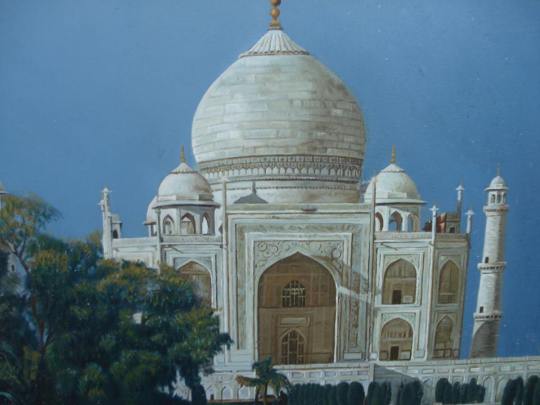
Among the monuments, Minar-e-Pakistan, Faisal Mosque and Khyber Gate are the most popular. Taj Mahal is also demanded by many.( That was a surprise, indeed.)

HyderAliMinarePakistan

HyderAliTaj

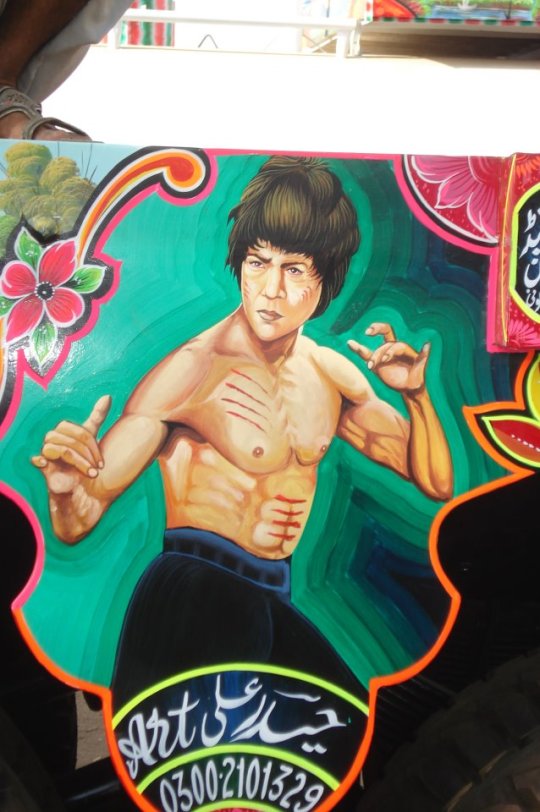
“One driver demanded Bruce Lee on his truck.” smiles Haider Ali.
HyderAliBruceLee

Many want birds, or even sher ( for which he paints a tiger).

HyderAliSher

Haider Ali loves drawing all kinds of birds and their details including falcon, peacocks, partridges, eagles etc.

HyderAliMacawsHyderAliDove

HyderAliPeacocks

Are there any unusual themes that you worked for?

The demand for themes and designs vary with changing times.
For example, in the times of war, in 60s and 70s, there were patriotic slogans with missiles and jet planes.”

HyderAli6

While in the last elections, he painted a truck on demand for Pak Election 2013, by SAMAA TV channel.

hyderAli5

Talking of the slogans, he said calligraphy on trucks is another field and many artists do it as a separate. He loves to do the calligraphy too.

What are your favorite slogans:

Anything that a truck driver demands. Almost all trucks adorn a Masha Allah on the head. If they leave on us, we choose for them.

  • Dekho fasla rakho, warna pya ho jaaega.( Keep distance, otherwise we’ll fall in love)
  • Hum chalein, dushman jalein( As we roll, our rivals envy)
  • Na ghabra ai zaalim paas aney sey, Khuda bhi rooth jata hai kisi ka dil dukhane sey.
    (Don’t be afrais of coming close, even God is displease by those who hurt others.).

Most who get their trick repainted the favorite is:

  • “Waqt ne pher sey dulhan bana diya.” (Time has turned us into a bride again).

Haider Ali’s favorite shair being:

  • Tum ney aisa rabta rakha, na paas aye na door rakha. ( You kept such a relationship, neither came close, nor went too far apart).
  • Zid na ker, assi aap barey ziddi aan. ( Don’t be stubborn, I am the same too).

HyderAli8

Among the famous in Pakistan Tapu Javeri the photographer, had commissioned him to make a panel for his house. Ever since they became friends. Haider Ali pays tribute to his friend by at times changing the famous slogan to:

  • “Tapu yaar tang na ker.”

HyderAliTapu

Can truck art be used to promote Peace for India Pakistan Peace friendship?

Haider says he went to Museum of Peace in India  just 1.5 km from Atari and painted an India Pakistan friendship van. He again has been called to Calcutta this September for a yet undisclosed Project.

HyderAliIndoPakdostiVan

My daughter was curious: “Does NCA or Indus Valley have Truck Art’ in their course? Have yuo ever been to those places?”
He smiles: They don’t consider truck art as an art. However, thanks to Sabeen Mahmood, I have my works on display all the time at T2F. And Lok Virsa.  In Pakistan we are a moving exhibition, 24X7, spreading the message of peace and harmony through colors and slogans. You will not find any hateful message on any truck or bus. Like our designs, our location of exhibit have no bounds.( “Hamre art ko koi qaid nahin hai.” ( Our art knows no bounds neither of ideas, nor of locations).

People copy your ideas?

“Yes, though our art is not considered an art, many designers have copied them on dresses, furniture, crockery etc. They can copy our designs, but can’t copy our ideas and skill. I don’t feel offended. Infinite is the limit of ideas for a ‘truck artist’. No two motifs are identical, no two trucks are same. And they are what they call in art world, ‘custom designed.’. .”

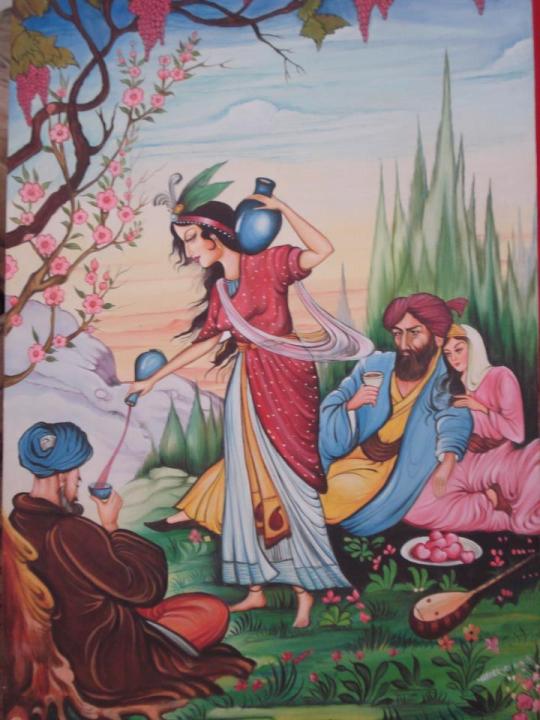
If not painting on truck, Haider Ali loves to make painting depicting stories( owing to his interest and training in painting the film posters when young.

I particularly liked the one of Omar Khayyam:
HyderAliOmarKhayyam

And the Sohni Mahiwal

HyderAliSohniMahiwal

He has a two year old son, who he aspires to be a ‘truck artist’ too, but also wants him to first complete his education, which Haider Ali missed out on. If educated person will come in the truck art, we will get more recognition.

My daughter pointed out how in film BOL the place where trucks are painted was shown as the place where the transgender boy was raped. Haider Ali retorted, “There are good and bad everywhere.” Though there is no dearth of respect and recognition we get world over, wish our Pakistani films and dramas showed the positive side of lives too.

Some more of Haider Ali’s works:

hyderali1

hyderAli0

He invited me to his work shop in Karachi to learn the swift and  steady brush strokes that fascinates me so much. But before I seriously go and master them, I practiced them out on the ‘truck art’ inspired  silk scarves the same evening.
(One in Hindi & the other in Urdu)

TruckArtScarves

TruckArtScarves1