
In spite of diverse approaches of various theological teachings, Kabir noticed that there is one power, all prevading and omnipresent. We may choose to call that power by any name, or in general reference as God, but does that even matter?
How beautifully he presents his vision of that Supreme Power, far beyond the definition by both the monotheists and polytheists:
Ek kahoon to hai nahin, do kahuun to gaari,
Hai jaisa taisa rahe, kahe Kabeer bichari.
{If I say one, He is not( is beyond any definition of shape, size or number. If say two( or more), it a violation too. Let Him be the way He is ( formless, shapeless) & lets not confine Him to any form. Says Kabir after much contemplation}.
Kabir’s vision of that power is incredibly simple and easy to understand. He conveys it through even a simpler language in his couplets (Dohas) and mystic songs. Though simple, it is as revered by the high intellectuals as it is appealing to the unlettered.
Kabira kuan ek hai, paani bharein anek,
Bhandey mein hi bhed hai, pani sab mein ek.
{Kabir, the source of water, the well is one, though many pull water from it.
The faults are in the pitchers, the water within them is exactly the same.}
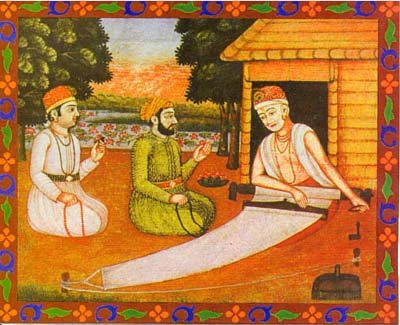
Kabir dares to de-monopolize God from the clutches of the clergy. His preaching to the common man was unconventional and casual. He would sit at his loom weaving, while the people would surround him and discuss the matters of faith and daily life. He weaved the harmony between diametrically opposed faiths, through easy examples, as as his loom weaved the vertical threads to create a beautiful fabric.
Sadhu dekho jag baurana
Sanchi kaho to maran dhawe
Jhoote jag patiyana
Bahute dekhi nemi dharmi
Praat kare asnana
Atam chari pashan puje
Thotha unka gyana.
Bahute dekhe peer auliya
Parhe kitab kurana.
Kare mureed batlawe kabar
Unhun khuda na jaana.
Kahe Kabir sun bhai sadhu,
Dono mein kou na dewana.
O gentleman, see the world has got mad,
I say truth but they run to beat me and believe the fake.
I have seen a lot of religious people who follow the strict routine,
bath early, worship idols, but their knowledge is hollow,
I have seen a lot of preachers who read Quran
And speak to worship graves, but do not understand God.
O gentleman none of them is a passionate lover of God.
Appreciate the simplicity how Kabir sums up the mindless, and illogical world’s thinking is:
Rangi ko narangi kahe, bane doodh ko khoya,
Chalti ko gaari kahe, yeh dekh Kabira roya.
{Call an orange, non-colorful (na-rangi), a delicious milkcake lost(khoya).
Call moving object, as stuck(gaari), laments Kabir.}
Instead of bigotry, he advises people to introspect before point fingers at others:
Bura jo dekhan main chala, bura na miliya koye,
Jab mun jhanka aapna, mujhse bura na koye.
{I went searching for the crooked, I found none,
When looked within, I was the most crooked one}.
There is hardly any issue of the day to day life that Kabir did not touch in his Dohas. He used simple vernacular language, with poetic metaphors from common examples to engage the people around him. As a result, his poetry became so incorporated into the local folklore that it was transferred by word of mouth, generation after generation. He remains one of the most quoted Indian poet in the world.
Kabir was a also family man , married with children and lived a simple life of a weaver. He did not abandon worldly life to become a renunciate ( a sadhu). He chose to live a balanced life as an ordinary man relating to a breadwinner, a family man, a tradesman along with being a mystic and a contemplative.
Kabir was a people’s poet.
“While there is evidence that both Hindus and Muslims were ready to assault Kabir physically during his lifetime, they have since his death been ready to assault each other over the privilege of claiming him as their own. …Some modern commentators have tried to present Kabir as a synthesizer of Hinduism and Islam; but the picture is a false one. While drawing on various traditions as he saw fit, Kabir emphatically declared his independence from both the major religions of his countrymen, vigorously attacked the follies of both, and tried to kindle the fire of similar autonomy and courage in those who claimed to be his disciples.”
~writes Linda Hess in the Introduction to The Bijak of Kabir (1983;2002)
A 700 and some years ago Kabir thought of intercommunal harmony with common origins, common purpose and common destiny of all human beings irrespective of their faith, color or class.
Complete version of the poem( above):
Sadho dekho jag baurana
Saachi kahi tou maran dhawe, jhootey jag patiyana
Hindu kehet hai Ram hamara, Musalman Rehmana
Apas mein dou lare martu hain, maram koi na jana.
Bahut mile mohi nemi dharmi parth kare asnana
Aatam choree pashane puji tinka toota gyana.
Aasan mari dimbh dhari baithe, man mein bahut gumana
Pipar pathar pujan laage, tirath barath bhulana
Mala phire, topi pahire, chhaap tilak anumana
Sakhi sabde gawat bhule, aatam khabar na jana.
Ghar ghar mantra jo den phirat hai, maya ke abhimana
Gurua sahit shishya sab bhure anthkaal pachtana.
Bahut dekhe pir auliya , parhi kitan Qurana
Kare murid, kabar batlabe unhu khuda na jana.
Hindu ki daya, meher Turkan ki, donon ghar se bhagi
Wah kare jibhah, waa jhatka maare, aag dau ghar laagi.
ye vidhihasth chalat hai humko, aap kahawe sayaana,
Kahee Kabir suno bhai Sadho, in mein kaun deewana.
Are we even prepared to think like Kabir, even today,seven centuries later?
I can only take a deep sigh !
Ilmana Fasih
25 December, 2010
0.000000
0.000000


 Blind to Bounds
You must be logged in to post a comment.