Open up your mind and your potential reaches infinity…


Looking through the e-papers from the subcontinent, it is hardly ever a day when some incident of rape is not reported. Be it rape of a medical student near the bus stop in New Delhi,  a doctor on duty raped after being drugged in Dera Bugti, a minor girl raped by her dance teacher in Bombay, a girl partying with friends in the posh areas of Karachi, a woman gang raped on the order of a local jirga, in Muzaffargarh.

The scenarios differ, cities differ, but the crime remains the same. The mindset remains identical. Age is no bar. Infancy upwards, one finds all age groups being the victims.

Unfortunately this is one situation which sees no barriers of age, color, creed or class, the world over..

Rapes are on the rise in the subcontinent, too.

The statistics do the speaking here…

In 2010, 489 rape cases were reported in Delhi, India  while 459 in 2009.The figures given by Delhi Police reveal that a woman is raped every 18 hours or molested every 14 hours in the capital.

Similarly in Pakistan, Human Rights Commission of Pakistan, estimates “every two hours a woman is raped in Pakistan and every eight hours a woman is subjected to gang-rape. Another report I came across claimed that at least 100 rapes are committed in Karachi alone everyday according to Additional Police Surgeon (APS. (http://www.freerepublic.com/focus/f-news/2083578/posts).

Needless to say,  majority are not even reported, and just a handful get punished, on either side of the border.

When this is the statistics of two megacities, one can fathom what would be the situation in the other places.

It was worse still to hear responsible men of these cities pass heartless judgements on rape and its victims..

In mid July, Commissioner of Police, Delhi advised women going out late night should be accompanied by a male or a driver, to avoid the risk of being raped.

I remember as a  child, in Delhi asking a friend of my fathers who was a senior police officer, ‘Uncle what do you do ?” And he had replied, “Beta, we protect you and others  in the city.” Probably he was just bluffing.

Almost at the same time , a video circulated on the social network,  in which Karachiite, Munawwar Hussain, the Emir of JI, in a TV interview, surpassed all these responsible individuals and commented that since bringing 4 witnesses for rape is next to impossible, it is better to ‘keep shut’ ones mouth and eyes, on the crime being committed. When the anchor attempted to argue, he simply totted at him the emotional gun of ‘denying’ the writing of Quran. The apathy in his talk and body language for the rape victim was appalling.

Not just our men, but their men also fail to understand…

A few months ago, a police officer from Toronto and a Russian priest from Moscow, had ‘advised’ that women should not “dress like sluts” or “wear miniskirts”, respectively, if they want to avoid rapes.

Not leaving behind  London in this race, Kenneth Clarke, the very justice secretary in UK, passed yet another piece of judgement that the rape committed by unknown offender is a ‘serious’ rape while implying that those committed while on a date isn’t. When the anchor interjected “rape is rape”, he replied: “No it is not”.

I wish all these men of responsibility knew the ‘secret’ of why the rapes occur?
It is certainly not because a woman was dressed so, or walked alone on the street late at night, or was attending a party with her friends. No certainly not. Rapes occur because some men want to rape. Yes it is that simple.

And why would these ‘some’ men want to rape ?
This has a simple answer too., Rape is the culmination of a series of systematic experiences that a boy is exposed to, from infancy to manhood—in which he is told, with or without so many words, that he is stronger, and a woman is not just weaker, but a commodity.

How I wish, more than anything else, these responsible people knew what does rape mean to a woman?
Rape is not merely the breach of a woman’s physical privacy, but is followed by cascade of short- and long-term problems, including physical injury and illness, psychological symptoms, economic costs, and death (National Research Council 1996).
In a summary, a rape victim is an embodiment of a severely disturbed and dysfunctional individual for rest of her life, unless properly rehabilitated.

So long as such a mindset persists, the legislation to punish rape would never be a deterrent.

We need to look towards primary prevention of this crime rather than just struggle for appropriate punishment after a case gets highlighted.

We have to empower our girls with ‘right information’ and break the barrier of rape being a taboo issue in front of these ‘innocent’ minds. It is these innocent minds which make them an easy prey.

A girl should be taught to be assertive. As one of the self help sites on rape prevention says: “ Look up as you walk and stand up straight; pretending as though you have two big panthers on either side of you as you walk may sound silly, but it can help boost confidence. Attackers are more likely to go for those who they think cannot defend themselves.”

They should also be told that over 90% of the perpetrators are known to the victims, even if it is an uncle, a cousin or a friend, if she feels the touch as uncomfortable, she must trust her gut and not let it continue.

Moreover, if we cannot change the mindset of our grown up men, we can at least guide our young sons to respect women and not consider them a commodity that is ‘available’.

Use of neo cortex, a sign of evolution, entails men to be able to restrain their behaviours and train their minds that nothing can be forced upon any woman, without her free will.

For those who cannot change their mindsets, a real need for harshest of punishments to the rapist as a mode of learning is mandatory too.

Till the healthier minds grow up, fear of punishment should be the real deterrent against this heinous crime.

Dr Ilmana Fasih.

A scene from the slutwalk in Delhi in July

Pāk sarzamīn shād bād
Kishwar-e-hasīn shād bād
Tū nishān-e-`azm-e-`alīshān
Arz-e-Pākistān!
Markaz-e-yaqīn shād bād

Blessed be the sacred land
Happy be the bounteous realm
Thou symbol of high resolve
O Land of Pakistan!
Blessed be thou centre of faith
Pāk sarzamīn kā nizām

Qūwat-e-ukhūwat-e-`awām
Qaum, mulk, sultanat
Pā-inda tābinda bād!
Shād bād manzil-e-murād

The order of this sacred land
Is the might of the brotherhood of the people
May the nation, the country, and the state
Shine in glory everlasting!
Blessed be the goal of our ambition

Parcham-e-sitāra-o-hilāl
Rahbar-e-tarraqqī-o-kamāl
Tarjumān-e-māzī, shān-e-hāl
Jān-e-istiqbāl!
Sāyah-e-Khudā-e-Zū-l-Jalāl

The flag of the crescent and star
Leads the way to progress and perfection
Interpreter of our past, glory of our present
Inspiration of our future!
Shelter of God, the Glorious and Mighty

Written by: Hafiz Jallandhari, 1952
Composer:  Ahmed Ghulam Chagla in 1950
Fisrt played on Radio Pakistan : 13 August 1954.


Jana gana mana ...the national anthem of India was written and composed by Rabindranath  Tagore in 1911.
It was first sung at the Calcutta Session of the Indian National Congress on 27 December 1911. Jana Gana Mana was officially adopted by the Constituent Assembly as the Indian national anthem on January 24, 1950.

There is a controversy that the poem was composed in December 1911, precisely at the time of the Coronation Durbar of George V, and is considered by some to be in praise of King George V and not God.
A British newspaper reported:
“The Bengali poet Babu Rabindranath Tagore sang a song composed by him specially to welcome the Emperor.” (Statesman, Dec. 28, 1911).

However, many historians aver that the newspaper reports cited above were misguided. The confusion arose in British Indian press since a different song, “Badshah Humara” written in Hindi by Rambhuj Chaudhary, was sung on the same occasion in praise of the monarch. The nationalist Indian press stated this difference of events clearly:-
The proceedings of the Congress party session started with a prayer in Bengali to praise God (song of benediction). This was followed by a resolution expressing loyalty to King George V. Then another song was sung welcoming King George V.” (Amrita Bazar Patrika, Dec.28,1911).

Even, Tagore himself in a letter mentioned:
“I should only insult myself if I cared to answer those who consider me capable of such unbounded stupidity as to sing in praise of George the Fourth or George the Fifth as the Eternal Charioteer leading the pilgrims on their journey through countless ages of the timeless history of mankind.” (Purvasa, Phalgun, 1354, p738.)

Jano Gano Mano Adhinaayako Jayo Hey,Bhaarato Bhaagyo Bidhaataa
Panjaabo Sindhu Gujaraato Maraathaa,Draabiro Utkalo Bango
Bindhyo Himaachalo Jamunaa Gangaa, Uchchhalo Jalodhi Tarango
Tabo Shubho Naamey Jaagey, Tabo Shubho Aashisho Maagey
Gaahey Tabo Jayogaathaa
Jano Gano Mangalo Daayako, Jayo Hey Bhaarato Bhaagyo Bidhaataa
Jayo Hey, Jayo Hey, Jayo Hey,Jayo Jayo Jayo, Jayo Hey

English Translation

Oh! the ruler of the minds of people, Victory be to You, dispenser of the destiny of India!
Punjab, Sindh, Gujarat, Maharashtra,Dravida(South India), Orissa, and Bengal,
The Vindhya, the Himalayas, the Yamuna, the Ganges,and the oceans with foaming waves all around
Wake up listening to Your auspicious name, Ask for Your auspicious blessings,
And sing to Your glorious victory.
Oh! You who impart well being to the people!
Victory be to You, dispenser of the destiny of India!
Victory to You, victory to You, victory to You, Victory, Victory, Victory, Victory to You!

Source: http://en.wikipedia.org/wiki/Jana_Gana_Mana_(the_complete_song)


Rabindranath Tagore was a larger than life personality –  poet,  philosopher, playwright, novelist, essayist, painter, composer and educator.

He was the first non Europeon to get a  Nobel Prize in 1911, which he  received as Nobel Prize in Literature for his collection of poems which were initially written in Bengali, but later translated in English by himself.

He is the only person who has the honour of being the lyricist of National Anthems of two countries –namely Jana Gana Mana of India and Shonar Bangla of Bangladesh.

He translated Shakespeare from English to Bengali in his teens. He also translated 100 poems of  saint Kabirdas from Hindi to English in 1930s , hence familiarising Kabir as the most read Indian poet to the west in  those times.

Rabindranath Tagore, was knighted with the title of ‘Sir’ when he won the Nobel Prize in Literature in 1911. However, after the Jallianwala Bagh massacre in 1916, he gave up the knighthood in protest.

He, thrice, refused invitation to visit Canada in protest against the massacre of 376 native Indians in Komagat Maru incident in 1914. However, when he visited Canada at the invitation of National Council of Education to address at the triennial conference, Vancouver he made it a point to make his statement as follows:

“Canada must believe in great ideals. She will have to solve . . . the most difficult of all problems, the race problem.”

Tagore also had the opportunity to interact one on one with another ‘great’ of his times, namely Einstein. Their highly intellectual conversations are documented word to word. An  excerpt from the dialogue of one of the three meetings is as follows:

TAGORE: Melody and harmony are like lines and colors in pictures. A simple linear picture may be completely beautiful; the introduction of color may make it vague and insignificant. Yet color may, by combination with lines, create great pictures, so long as it does not smother and destroy their value. 
EINSTEIN: It is a beautiful comparison; line is also much older than color. It seems that your melody is much richer in structure than ours. Japanese music also seems to be so.

Y B Yeats another Nobel Laureatte oet who later wrote the Introduction of Tagore’s Geetanjili had the chance to read Tagore before he met him. He commented, ” I have carried these manuscripts with me for days, reading it in railway trains, on top of  omnibuses, inrestaurants and often had to close it lest some stranger see how much it moved me.”

Gandhi and Tagore’s differences are famous and still debated. While Gandhi started a non cooperation movement against the British, Tagore remarked,” …there was a thin line between nationalism and xenophobia —besides, hatred of the foreigner could later turn into a hatred of Indians different from oneself.”

He was particularly sceptical of the claim that non-co-operation had or would dissolve Hindu-Muslim differences. And ultimately Tagore was proved right on this issue.

The two  personalities met only twice, but kept a regular communication through articles and letters. And like two great human beings, they kept high regard for each other, despite differences.

Gandhi remarked:  “Gurudev and I early discovered certain differences of outlook between us. Our mutual affection has, however, never suffered by reason 0 f our differences … ” 

Another Nobel Peace Laureatte Aun San Su Kyi is another person who derives inspiration from Tagore. And claims her “most precious lesson” had been from Tagore: “If no one answers your call, walk alone.”( the above poem).

Apart from being a eastern mystic, Tagore was a visionary who articulated ideals of humanism, equality and freedom long before the League of Nations or the Universal Declaration of Human Rights of 1948.  Tagore was  one of the strongest critics of war and colonialism, fascism, and the dangers of narrow-minded nationalism.

In the 1920s, he had already identified racism as the greatest problem in a fast globalizing world.

Perhaps looking at today’s world he was accurate in his prediction, sadly though. 

The following is a popular poem written by Rabindranth Tagore.  The music for the song was also composed by him.

Jodi Tor Dak Soone Keu Na Asse
Tobe Ekla Chalo re
Ekla Chalo Ekla Chalo Ekla Chalore

Jodi Keu Katha Na Kai Ore Ore O Abhaga
Jodi Sabai Thake Mukh Firae Sabai Kare Bhay
Tabe Paran Khule
O Tui Mukh Fute Tor Maner Katha Ekla Balo re

Jodi Sabai Fire Jai Ore Ore O Abhaga
Jodi Gahan Pathe Jabar Kale Keu Feere Na Chay
Tobe Pather Kanta
O Tui Rakta Makha Charan Tale Ekla Dalo re

Jodi Alo Na Dhare Ore Ore O Abhaga
Jodi Jharr Badale Andhar Rate Duar Deay Ghare
Tobe Bajranale
Apaan Buker Panjar Jaliey Nieye Ekla Jalo re

English translation: *Touching words*

If they answer not to thy call WALK ALONE,

If they are afraid and cower mutely facing the wall,
O you unfortunate,
open thy mind and SPEAK OUT ALONE.

If they turn away, and desert you when crossing the wilderness,
O you unfortunate,
trample the thorns under thy tread,
and along the blood-lined track TRAVEL ALONE

If they do not hold up the light when the night is troubled with storm,
O you unfortunate,
with the thunder flame of pain ignite thy own heart
and let it BURN ALONE.


Is there any difference ?


On the night of  14 /15 August 1947 apparently India and Pakistan parted their ways.

With due respect to their independent existence,  is there anything else that can part the two peoples who have the same history, same genetic pool, same climate, same mountains, same rivers, same culture, similar foods, similar fashions, similar aspirations, similar problems, and even similar patriotic songs?

Yeah, we have similar patriotic songs too.

Don’t believe it? Have a look :

And this :

So is there any difference ?

Just the names.

But what’s in a name ?

PAKISTAN INDIA KE LOG ZINDABAD


Published in two parts in  Dateline Islamabad  as an Op-Ed  on 12 and 13 August 2011

Part 1

AUGUST 7 was the 70th death anniversary of Rabindranath Tagore, and I remember his Nobel winning poetry which begins thus:
Where the mind is without fear and the head is held high

Incidentally, I found myself reading something similar in the spirit of this poem — Kamran Rehmat’s eloquent piece Meeting Jens Stoltenberg on the simplicity of Norwegian PM’s life and the minimal security he keeps (Dateline Islamabad, July 28). His rendezvous led me to the memory of the news in 1986, when Olof Palme was murdered while walking back from a cinema at night in Sweden.

“Prime Ministers walk back home?” — that was my instant reaction, then.
There is a reason why Nordic countries are considered the safest places to live. (I wonder if the recent Norwegian episode and its root cause will change that, but that’s beside the point here)

Reading through, one instantly compares them to the traffic standstills or detours one has to face when our politicians are passing.

The instant pop-up in my Third World mindset is — “Come on, those are developed nations and we are merely ‘developing’.”

It takes me back to what I gleaned from the movie The Last Emperor, in 1990, where they showed when the king passed through the streets of ancient China, the common man was asked to turn away their gaze  because their poor eyes weren’t worthy of seeing the emperor.

Perhaps, our politicians in power, too, are emperors in their own right, who live not in forts or castles by name — but their abodes are bedecked no less than castles and protected no less than fortresses. And the feet of the poor common man aren’t worthy
of treading the same street when the emperors pass through it.

But hold on.

I have two personal experiences from this very Third World where the high and mighty navigated with the same freedom and minimal security as the Norwegian or Swedish premiers.

One of them is none other than Mahathir Mohammed of Malaysia. (You might say that Malaysia is not much of a developing country but the reason why they have surged ahead is because of this very man about whom I will narrate a personal
anecdote.)

My family had been visiting Malaysia as tourists in 2002. This is during the last days of Ramadan and we chose to travel to Malaysia to see how their
Muslims celebrated Eid.

On the day of the festival, we went to the Central Mosque in Kuala Lumpur for prayers. Not sure of the timings, we reached the mosque way early and  my husband and son sat in the very first row, right behind the imam.

Meanwhile, I settled with my daughter in the first row of women’s area — ensuring that our men folk were well in sight.

After an hour or so, when the mosque had been reasonably full — no mad rush, mind you — a few men walked up to the front rows and some others started to make way for them. My husband was asked to move a little to the side, which he did. But to his utter surprise, the man for whom his space was being vacated was none other than President Mahathir Mohammed.

Having seen that my husband gave space to him, Mahathir smiled at him. My husband stepped forward, shook hands with him and introduced himself as a Pakistani, who had come to see Eid festivities in Malaysia.

After the prayers, he again turned to my husband and invited him to visit Putrajaya (president’s residence) and partake the open feast which the president hosted each year for his compatriots.

Our joy had no bounds — we almost thought that we were invited to a personal lunch with the president.
After a few hours of strolling in the Eid bazaars in Bukit Bintang (street), listening to the beautiful melodies of Salamat Hariraya (Malaysian Eid greeting), we dressed in our best and headed for Putrajaya.

It was a huge congregation, with tents put up and thousands of Malaysians, of all ethnicities, in a picnic mood and enjoying the ethnic food the Malays serve
on Eid. (To continue)

 Part 2 : 

MY family and I arrived at the Putrajaya (president’s house) and were told by someone that this was the last time the open Eid feast, which enabled the commoners to meet the president, would be held as Mahathir Mohammed had announced to step down.

We saw what looked like a hopelessly long queue on one side of the tent, leading to a door. We were told this was for those who would like to meet the first couple and give their Eid wishes to them. We joined the queue.

My husband told one of the guards that we were from Pakistan and President Mahathir himself had invited us, in an attempt to jump the queue. But the policeman just gave a hospitable smile and no more, which was signal enough for us to stay in the queue. It was a two-hour wait and my kids used it to make a small card out of some paper envelope, with a blue ball point sketching a flag of Pakistan and an Eid greeting.

Finally, our turn came. We shook hands with the first couple and to our utter surprise, he himself told his wife, “They are Pakistanis and have come to see our Eid.”

My kids gave them the card. We hugged them, Pakistani-style and were handed a plastic Tiffin on top of which was inscribed “Thanks from Putrajaya” with traditional Malaysian sweets inside. We got exactly the same box as everyone else and approximately, the same two or three minutes of chat as other locals.

To cut a long story short, in a fortnight’s stay in Malaysia, we happened to meet their president twice, and that, too, without much difficulty.

The second incident was in Kolkata (then- Calcutta), in late 1979, when I had been visiting the city with my parents, who were attending some conference. My parents chose to commute in bus as that was the most convenient mode to travel in the overcrowded metropolis.

In the middle of one journey, my father turned our attention towards a lean and thin dhoti-clad man who had climbed the bus. That man was Jyoti Basu, who had become the chief minister of West Bengal, just a year or so ago.

My father mentioned it to some of his friends but they weren’t surprised, for it was common knowledge that Basu sometimes boarded buses just to stay connected with hoi polloi.

Basu continued to win the people’s confidence for the next two decades (from 1977 to 2000). A CPI(M) member, he went on to introduce land reforms, giving opportunity to the poor to have their own lands. He brought political stability to the state to the extent when the whole of India was burning— once after Indira Gandhi’s assassination in 1984 following the Operation Blue Star, and the other at the demolition of Babri Masjid in 1992, his administration did not allow any rioting in his state.

Hence, it was not just a coincidence that we saw these men roaming free in public — years of commitment for the common man had made them fearless.

With this chain of thoughts, my mind shifts to the recent switch on-and-off that goes on in the killing fields of Karachi. It does not need a vision of 6/6 to see who all are behind these killing fields.

By all I mean ALL — none is above it. I wonder, with this track record and with the mess that the stake holders of ‘peace’ create, can they have the courage to sail freely among their own public like Mahathir and Basu?

No wonder our streets from Islamabad to Karachi come to a standstill when they sail fearfully on them.

And tragically, it is the common man, who gets labeled as hateful, narrow-minded and divided on ethnic and sectarian lines.

In conclusion, I want to revert to the closing lines of Tagore’s poem, which may serve as a prayer to us:

Into that heaven of freedom, my Father, let my country awake.

The writer is a gynecologist, health activist,
and m-Health entrepreneur, of Indian origin,
married to a Pakistani


Translation:
by Kartar Singh Duggal

Ilmoun bas kari oo yaar
Eko Alif terey darkar

Enough of learning, my friend!
An alphabet should do for you

Ilm n awey wich shumar
Jandi umer, Nahi aytebar
Eko Alif terey darkar
Ilmoun bas kari oo yaar

To it there is never an end
An alphabet should do for you
It’s enough to help you fend.
Enough of learning, my friend!

Ilmoun bas kari oo yaar
Enough of learning, my friend!

Parh parh, likh likh ladain dher
Dher kitabaan, cho pheyr
Kerdey chanan, Wich unheyr
Pecho: “Rah?” tey khabar n satar

You’ve amassed much learning around
The Quran and its commentaries profound
There is darkness amidst lighted ground
Without the guide you remain unsound

Ilmoun bas kari oo yaar
Enough of learning, my friend!

Parh perh shekh mashaikh khawein
Ultey masley gharoon bata dein
Bey ilmaan noon lut lut khawein
Jhotey Sachey karain aqrqr

Learning makes you Sheikh or his minion
And thus you create problem trillion
You exploit oyhers who know not what
Misleading them with wild opinion

Ilmoun bas kari oo yaar
Enough of learning, my friend!

Parh parh nafal namaz guzarien
Achian bangaan changha mari
Manber tey chaRRh waaz pukarein
Keeta teeno ilm khawar

You meditate and you say your prayers
You go and shout at the top of the stairs
You cry reaching the high skies
It’s your avarice which ever belies

Ilmoun bas kari oo yaar
Enough of learning, my friend!

Jed main sabaq Ishq da parhaya
Derya dekh Wahedat da warria
Ghuman gheraan dey wich uRRia
Shah Inayat laya paar

The day I learnt love’s lesson
I plunged into the river of devine passion
An overwhelming gale. I was confused and lost
When Shah Inayat cruised me across

Ilmoun bas kari oo yaar
Enough of learning, my friend!


This blog post is a tribute to the bravado of my#Sikh brothers, who stood up in respect for humanity beyond faith during the #UKriots.

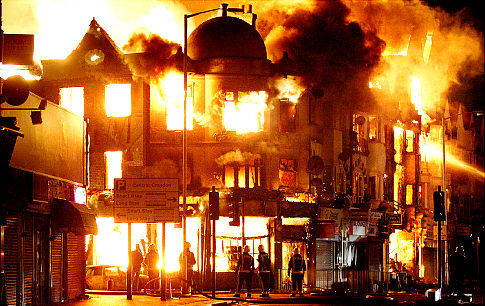
It was devastating to see the peoples power gone berserk in UK riots, as the  arson and looting carried on unabated into the fourth night . Unfortunately against the sheer numbers, the police seemed helpless to control the unruly mob.
While following the  #UKriots on Twitter and BBC News, hashtag #Sikhs started to trend—first World wide and then in UK, London.

A tweet was seen:

Remroum Remi Kanazi
Was afraid #Sikhs trending was going to be some bigoted stream. Thankfully it was this: Sikhs protecting people while they prayed #UKRiots

They came pouring, tweets one after the other with speed getting faster:

Prandha_Swag Harpreeeeezyf.baby
#Sikhs is trending.

Nagra18 Jasraj Nagra
#Sikhs is trending, never thought i’d see the day #proud.

KavelKaur Kavel Kaur
#Sikhs are a world wide trend!!!!

GDS1ngh GD singh
#sikhs trending, fantastic. doing what we do best.

moneyspinner MONEYSPINNER
#sikhs nanak naam chardi kala, tere baane sarbat dha bhala

I googled to check the details and saw Mail Online quote:

Some armed with swords, some carrying hockey sticks, defiant Sikhs stood guard outside their temples last night.
More then 700 men, some in their 80s, took to the streets to protect the homes, businesses and places of worship in Southall, West London.

The tweets went on:

Goggi_Rana Goggi Rana
Sikhs of Britain have displayed the same traits of fearlessness, as their ancestors of yesteryear #Sikhs #SangatTV

UncleWail Wail Al Aun
Thumbs Up for the #Sikhs protecting their #Temple in Toxteth #Liverpool #UKRiots

MissssChrissy Chrissy
Singh Is King… Yep I think so! #sikhs doing it real big today. #LondonRiots #ukriots

Then we heard that they had not only protected their temples but also stood at the mosque guarding while the Muslims prayed ther Taraweeh prayers of Ramadan in South Hall mosque:

A google message read :

Muslims prayed their Tarawee prayers while Sikhs protected he Masjid
Got this from a friend in London.
In a Masjid in Southall London, Muslims were praying their Taravee prayer as the riots were going on, a bunch of Sikhs stood outside the Masjid and protected the Masjid.
The similar thing happened when Sikhs were inside their Gurduwara and some Muslim youngster guarded it on the gate
Great experience, a cousin and a friend of mine reported the same incident.
May ALLAH bless people like them, humanity still remains here, despite the problems

Tweets loaded with emotions, from Muslims and people from other faiths,  too poured in with ovelwhelming enthusiasm:

PMGenerals PMG Anj
Today was an historic day for #hindus #sikhs and #muslims. #unitedwestand all religions teach us to have morals and respect dis proved it! X

dj_aNomAli ∀ℓι . ᄊ乇尺cんለռէ
Sikhs protect Southall mosque while Muslims pray Taraweeh in peace. Much respect to our brothers!! #LondonRiots #Southall #Sikhs #MashAllah

DNSDj Davinder Singh
Actually brings a tear to my eye seeing the #unity between #Sikhsand #Muslims in the fight against this madness. #proudtobesikh

akchishti akchishti
Great sight in my #Birmingham where #Pakistani lads are protecting temples while Sikh lads protecting the mosques

Muslimerican Peter
Imagine a group of rioters turning down a street and suddenly seeing 400 #Sikhs standing in the distance. #wrongturn #ohshit #londonriots

AdamPatel2 Adam Patel
I hear the #sikhs are even protecting the #mosques in Southall so #muslims can read our Tarawih in peace.”>>> BIG LOVE –

And dishearted tweeps begain to take a sigh of relief

xcrimsonstarx Vicki Langfield
The #Sikhs are giving me faith in humanity

Indeed, everyone who followed this trend must have rekindled their faith in humanity. Thanks you my Sikh brothers.

MumzyStranger Mumzy Stranger
Love out to the #Sikh brothers who protected the mosque during prayer time. If we all unite we can and WILL put a STOP to this chaos! M x

And  with these tweets millions or billions of eyes gleamed with hope.

We hope and pray this display of unity and humanity extends to all faiths and communities beyond borders and beliefs…

My mind recalled the verses of Sant Kabirdas which  along with 500 other verses which are included in to the Guru granth Sahib,  are  often heard from  Gurudwaras as Shabad Kirtan :

Avval Allah Noor upaya Qudrat ke sab bandey
(God created light of which all the things were born)
Aik nor ke sab jag upajaya kaun bhale ko mandhe
(From the light, the universe. So who is good and who is bad).

Indeed, I hail my Sikh brothers for living up to the spirits of their faith, their Gurus and their Book.

In return many Muslims also stood up with the Sikhs and helped them form groups which defended their communities and boroughs. Hail Sikh Muslim Solidarity. 

Let this be the beginning of Sikh-Hindu-Muslim-Christian-Jew –other faiths unity for  all faiths believe in one Supreme Power and all faiths belong to  one Humanity’

I dedicate  this tribute to my Sikh brothers with the greeting, which in Punjabi means exactly what Allah u Akbar stands for :

Vaheguru ji ka khalsa, vaheguru ji ki fateh.
(God’s pure and God’s victory )

My brothers,  Rabb Raakhaa

Ilmana Fasih, Aug 10, 2011

P.S.: Please scroll down in the comment box to see the reaction of the Muslim community after 3 Pakistani boys were killed in Birmingham.


This post is dedicated to the inseparable cultures of India and Pakistan. A great example of how India’s Sufi singers (of one faith) sing with devotion the Kafi of a Sufi saint ( of another faith) who’s origins were in what is now Pakistan.

Bulleh Shah is considered as the greatest mystic poet of the Punjab, his compositions have been regarded as “the pinnacle of Sufi literature.” Scholars and dervishes have called him “The Sheikh of Both the Worlds,” “The man of God,” “The Knower of Spiritual Grace” and by other equally edifying titles.

Kartar Singh Duggal, a renowned writer and author of The Mystic Muse: Sain Bulleh Shah writes:
“Bulleh Shah was an evolved soul, a perfect faqir and a true lover. Through the love for his Master he realized the Lord. In his love one finds poignancy, ardor and longing besides sincerity, sacrifice and renunciation. Under the canopy of love he made his offerings of caste and learning. His love for his Master never wavered for a moment despite the fire of separation and longing through which he passed. His writings, as also his life, manifest transcendence of physical love ( of the Master) to divine love ( of the Lord).”

It is said that once Bulleh Shah annoyed his Master due to some indiscretion and he was thrown out of the his Master’s circle( called Daira).

Several months passed; Bulleh begged forgiveness, repented, had other devotees speak to the master,  who would not relent. Suffering the pangs of separation, Bulleh sang soulful Kafis. There are many of them, and the pain in each of them increased, with the passage of time.

One such kafi which is my favourite is :
Bas kar ji hun bas kar ji,
Ik baat asaan naal has kar ji.

Tuseen dil mere vich vasde ho,
Aeven saathon door kyon nhasde ho.
Naale ghat jaadu dil khasde ho,
Hun kit val jaaso nhas kar ji.
Bas kar ji hun bas kar ji.

Tuseen moiyaan nu maar na mukde si,
Khido vaang khoondi nit kutde si.
Gahl kardiyaan da gal ghutde si,
Hun teer lagaaiyo kahs kar ji.
Bas kar ji hun bas kar ji.

Tuseen chapde ho asaan pakare ho,
Asaan naal zulf de jakre ho.
Tusi aje chapan nu takre ho,
Hun jaan na milda nas kar ji.
Bas kar ji hun bas kar ji.

Bulha shauh maen teri bardi haan,
Tera muhk vekhan nu mardi haan.
Nit sau sau mintaaN kardi haan,
Hun baeth pinjar vich ghass kar ji.
Bas kar ji hun bas kar ji.

Enough! Now enough!
Smile! Speak to me!
You inhabit my heart.
Enough! Now enough!

You do not tire of killing the already-slain.
You play with me, a ball thrown over and over again at a stump.
If I speak, you gag me,
You might as well just pierce the arrow right into me!
Enough! Now enough!

If you hide, I will catch you.
I will tie you in my tresses.
You are able to stay hidden for now,
But you will not be able to escape from me.
Enough! Now enough!

Says Bulha, I am your slave.
I die to see your face.
I plead with you a thousand times,
O enter this cage. Occupy it.
Enough! Now enough!
~Translation BY Suman Kashyap

The same Bulleh Shah Kafi sung by Wadali brothers:


Just yesterday was the 70th death anniversary of Rabindranath Tagore, and I remember his Nobel winning poetry which begins as :
“Where the mind is without fear and the head is held high”

Incidentally, today I found myself reading something similar in  spirit of this poem while , enjoying  Kamran Rehmat’s eloquent note  on simplicity of the office of Norwegian PM and the minimal security he keeps.(Kamran Rehmat is  a Pakistani newspaper editor based in Islamabad, who’s writings  are like a new lesson in English language, and each time  leaves one richer in vocabulary).

His note led me to the memory  of the news in 1986, when Olof Palme, was murderd while walking back from a cinema at night, in Sweden. Prime Ministers walk back home, was my reaction then. There is reason why Nordic countries are considered as the safest places to live on Earth. (I wonder if the recent Norwegian incident and it’s  root cause will change that, but that’s beside the point here)

Reading through,  one instantly compares them to the traffic standstills or detours one has to face when our politicans are  passing.

The instant pop up  in my Third World  mindset is–” Come on, those are developed nations and we are merely ‘developing’.”

It takes me back to the peice of knowledge I gained from a movie called The Last Emperor, in 1990,  where they showed that when the King passed through the streets of ancient China, the common man was asked to turn away their gaze because their poor eyes weren’t worthy of seeing the Emperor.

Perhaps our politicians in power too are emperors in their own right who live not in forts or castles by name.  But their abodes are bedecked no less than castles and protected no less than fortresses. And  the feet of the poor  common man arent worthy of treading  the same street when the emperors  pass through it.

But hold on.

I suddenly remember two personal experiences from this very  Third World where their persons in authority navigated with  same freedom and with minimal security as the Norwegian or Swedish PMs.

One of them is none other than Mahathir Mohammed of Malaysia. ( You might just say, that of course Malaysia not all that a developing country. But the reason why they have gone far ahead is because of this very man about whom I will narrate a personal anectode.)

We had been visiting Malaysia as tourists in 2002 . It was the last days of Ramadan and we  chose to travel to Malaysia to see how their Muslims celebrate Eid.On the Eid day we went to the Central Mosque in Kuala Lampur for the Eid prayers. Not sure of the timings, we reached the mosque way early and my husband and son sat in the very first row, right behind the Imam’s seat. While I settled with my daughter in the first row of women’s area , ensuring that our men were well in our sight.

After an hour or so, when the mosque had been reasonably full, ( no mad rush), a few men walked upto the front rows and some others staretd to make place for them. My husband was asked to move a little to the side, which he did. But to his utter surprise, the man for whom his place was being vacated was none other than the President Mahathir Mohammed. Having seen that my husband gave place to him, he smiled at him. So my husband stepped forward, shook hands with him and introduced himself as a Pakistani who had come to see the Eid in Malaysia.

After the prayers, he again turned to my husband and told him, to visit his place called Putrajaya ( president’s residence) and join the open feast which the President hosted each year for his compatriots.

Our joy had no bounds. We almost thought that we were invited to a personal lunch with the President.
After a few hours of strolling on the Eid bazars in  Bukit Bintang (street), listening to the beautiful melodies of Salamat Hariraya( that’s Malaysian way of saying Eid Mubarak) we dressed our best and headed for Putrajaya.

It was a huge congragation there, with tents put up and thousands of Malaysians, of all ethnicities in a picnic mood and enjoying the ethnic food the Malays serve on Eid. We were told by someone that this was the last time this would be held as Mahathir Muhammed has announced to step down,  and  he wouldnt be there next Eid.

We saw a horrendously long queue lined up on one side of the tent leading to a door. We were told, this was  for those who would like to meet the first couple and give their Eid wishes to them. We joined the queue. Living upto the Pakistani style, my husband told one of the gaurds that we are from Pakistan, and the President himself had invited us, in an attmept that this would help us jump the queue. But the policeman just gave a hospitable smile,  his eyes speaking to us to stay put in the queue.

It was a two hour wait, and my kids used it well to make a small card out some  paper envelope, with a blue ball point drew a flag of Pakistan and wrote an Eid card for them.

Finally our turn came, we shook hands with the first couple, and to our utter surprise, he himself told his wife, “They are Pakistanis and have come to see our Eid.” Kids gave them the card. We hugged them in a Pakistan Eid greeting. We were handed over a plastic tiffin box on top of which “Thanks from Putrajaya” while the inside had  Malaysian sweets. We got exactly the same box as everyone else, and roughly the same two or three minutes of chat as other locals.

In Summary, in our two weeks stay in Malaysia, we happened to meet  their President twice, and that too without much difficulty.( Not to speak of how many times we have bumped into any of ours in the whole life).

The second incident was in Calcutta, in late 1979, when I had been visiting the city with my parents, who were  attending some conference. My parents chose to commute in bus , as that was the most  convenient mode  to travel in an overcrowded Calcutta.

In the middle of one journey,  my father turned our attention towards a lean and thin dhoti clad man who had climbed the bus. And this man was Jyoti Basu who had become the Cheif Minister of West Bengal just an year or so ago.

My father mentioned it to some of his friends, but they weren’t surprised, for this was common knowledge that he sometimes boarded the bus just to stay connected with the poeple who elected him.

And then this man carried on to be the elected ChiefMinister of West Bengal for next two decades ( from 1977 TO 2000).  A CPI(M) member, he went on to make land reforms giving opportunity to the poor to have their own lands. He brought political stability to the state and so much so that when the whole of India was burning twice– once after Indira Gandhi’s death in 1984, and the other at the demolition of Babri Masjid in 1992, his heavy handed administration did not let any rioting in his state.

As Wickepedia quotes, “West Bengal became an oasis of communal harmony and secular values under his leadership”
Although a CPI (M) member, in an obituuary published by BBC on his death in 2010, it remarked:
“A Fabian Socialist rather than an orthodox Communist, Jyoti Basu worked by consensus, successfully managing coalitions, while showing a healthy respect for the viewpoints of others.”

“He made Communism look respectable,” according to Sabyasachi Basu Roy Choudhuri, a Calcutta-based political analyst.
Analyst Ashis Chakrabarti said Mr Basu’s success indicated social democracy had a future that Communism did not .
( http://news.bbc.co.uk/2/hi/south_asia/8151230.stm)

Hence, it was not just a coincidence that we saw these men roaming free in public, there were years of commitment, and hard labour for the common man, which made them be  so fearless.

With racing chain of thoughts, my mind shifts to the recent switch on and off, that goes on in Karachi’s killings. It does not need a vision of 6/6 to see who ALL are behind these killing fields. By all I mean ALL, none  is above it. I wonder with this track record and with the mess that the stake holders of  “peace’ create, can they gather the audacity to sail freely among their own public like the above men.

No wonder our streets from Islamabad to Karachi come to a standstill when they sail ‘fearfully’ on them.

And tragically, it is the common man who recieves the blame of being labelled hateful, narrowminded and divided on ethnic or sectarian lines.

I close this note with the closing lines of Tagore’s poem , which may serve as a prayer to us:

“Into that heaven of freedom, my Father, let my country awake.”

Ilmana Fasih