A couple of days ago I met a neighbour outside the house, walking her two cute cocker spaniels. We exchanged New Year Greetings and as a ritual I asked: “So how did you spend your new years eve?”
“Oh I spent my evening feasting with my girls.” she replied
“Lovely, so they all came over to be with you.”
Her face changed color, “Oh no, these girls Sasha and Mori pointing at the two cocker spaniels, picking up the little ones in her arms.
Embarrassed I replied: “Yeah couldn’t be a better new years eve than with one’s pets. I did it too, when the rest of my family went to see the fireworks at midnight, I sat with my cats on the sofa watching TV.”
This triggered off the talk on how we undermine animals and use terms like ‘animal’ or ‘beast’ with a derogatory hint while using words like ‘humane’ as a symbol of compassion.
“I see those TV anchors calling suicide bombs that go off in Pakistan as ‘inhumane’ acts, when in reality they’ve been done by humans themselves, especially those who aspire to be superhuman so that they get a special place in Paradise.”
I could just nod in agreement.
She went on, “Isn’t this all very ‘human’ to kill, for no rhyme or reason?”
Her words echoed for hours. Don’t we use the same terms ‘insaniyat’ for compassion while ‘janwar’ or ‘haiwaaniyat’ for cruelty in Urdu too.
Although, it is common knowledge that even the most dangerous of animals do not harm unless they are hungry or provoked.
Perhaps our ‘hunger’ has gone beyond filling our stomachs. We ‘attack’ others to fill our egos, the egos which never get filled, because there is no bottom. Yes no bottom, because, we do not have any limit to how low we can stoop to gratify our egos.
Often we see and hear of stories where two pets that could have naturally been predator-prey, coexist as friends and in fact the predator acts as a protector of its erstwhile prey.
I saw this live for years in my own home between our cat Nelson and the grey parrot Shakespeare. Shakespeare learnt to mimic the mewing and growl of Nelson. And Nelson would come running to him. They would simply mew, looking into each other’s eyes. No t even once did the cat attempt to attack or touch the grey parrot. The day Nelson passed away and went missing from home, Shakespeare mewed for hours, as if calling out for him, adding to the gloom and shedding tears like a bereaved kid.
It is a bigoted myth that empathy is a higher cognitive function that only apes and humans are blessed with. Perhaps we are more loaded with narcissism than with empathy. Studies on whales show they are extremely emotional. Whale brains have specialised spindle cells which are important for empathy, and rapid gut reactions. Previously, only humans and apes were considered to possess them. An interesting practical example of this is when a 50-foot, 50-ton humpback whale was caught in a net off California’s coast. After rescuers untangled it, the whale swam up to each one of the rescuers, and winked before swimming off. The researchers confirmed this was a gesture of gratitude from the whale.
To study empathy, neuroscientists in McGill University injected acetic acid in the paws of mice causing them pain. The mice who watched their friend writhing in pain became more sensitive and reacted more violently to pain, when injected with the same chemical.
Studies on animals called ‘humans’ show that children who are cruel to animals, are likely to turn to violence later in life. 75% of prison inmates are known to have past history of animal cruelty, says a study.
We need to revisit or swap the meanings of ‘humane’ and ‘beastial’, or ‘insaniyat’ and ‘haiwaniyat’.
It is a saving grace that we do not understand animal language, otherwise it would be very embarrassing to know that every time a suicide bomb, target killing or even animal poaching occurs we would have heard animals scream “What a painfully humane act!”
Published in Aman Ki Asha, The News on January 24, 2012.
Ilmana Fasih shares some stories of building cross-border bridges through the social media
A world without borders was my childhood dream. The desperation and the need for this dream to realise, came out in the open when I embarked on my ‘pyar border paar’ journey, after deciding to tie the knot across the border. I’ve been on two decades of a topsy-turvy ride riddled with visa travails, with the hope-hopelessness cycle going round in vicious circles. Not had I ever dreamt in my wildest of dreams that my hope for a borderless world could be realised in my lifetime. By a ‘borderless’ world, I mean erasing psychological rather than physical borders.
Perhaps on ground it still remains a dream, but on the virtual terrain it has turned into a reality, with the booming world of social media, especially twitter. It is a visa free, passport free utopia where no one is asked their colour, creed or credentials.
It does not take long for one to get addicted to this borderless terrain. The most fascinating thing for me is to see Indo-Pak friendships burgeoning through social media. Thanks to this factor, we can all be a family beyond borders and beliefs, tied with passions common on both sides of the Indo-Pak border.
Indians and Pakistanis wish each other on Eid and Diwali via Twitter and Facebook, and send virtual firecrackers, mithai and biryani across the border.
The #shair hashtag which ‘trended’ on twitter some time back merits a mention. Every day, it attracts Urdu poetry loving twitterati in India and Pakistan. As Rana Safvi , who started this trend, begins to tweet the topic or the poet of the day, other #shair fans start to contribute their tweets with unmatched enthusiasm. So common is the passion for #shair on both sides, that it is almost impossible to identify which side of the border the tweep belongs to.
Rana tweets: “Twitter ne nikamma ker dia, warna aadmi hum bhi aadmi the kaam ke.” #shair
Comes the reply: “140 characters mein baat ker lete hain, DP to DP borderpaar, mulaqat samajh lete hain.
Political differences and arguments also emerge on twitter, but more than anger, what trumps are the vibes of friendship and harmony. The same thrill is felt on facebook too, with some limitations.
Some time back I was approached by two sets of people keen to tell their story of cross-border friendship developed through social media.
One was Ram, a boy in his mid twenties, from West Bengal, India who became friends with Maria, a girl in Punjab, Pakistan through facebook. As their friendship led to a better understanding and respect for each other’s cultures and beliefs, the vibes spilled over to thaw any cold feelings that their families had for the other side. When Ram’s father fell ill and was admitted to hospital, Maria’s mother and sister prayed for his recovery. He recovered, and Ram’s family attributed the recovery to Maria’s family’s prayers (duas).
Now, as Maria is about to be married, Ram’s family is sending her a present as a token of their friendship and gratitude for her family’s prayers. Ram explained that their families had no links to anyone the other side, and hence had no other reason to be warm, but for their friendship.
Maria and Ram have vowed to keep up their friendship even getting married to their respective spouses, and one day, when they can obtain visas, they hope to meet and ensure that any children they have are able to meet each other.
The second story is that of a love-struck couple who prefers to keep their identity and respective nationalities confidential. They contacted me with a request that I should intervene, (having gone through a similar ordeal), and convince the girl’s parents that tying a knot across the border can work out.
Like many others, they ‘met’ through an incidental chat on twitter some six months ago. They then added each other as friends on facebook. The exchange of pictures and other information led them to develop a better understanding of each other, until they reached a point when they decided they needed to share their lives. Both are in their early or mid twenties, and feel they are mature enough to embark on this journey.
The hope and enthusiasm that they had attached to my help made it hard for me to explain that I would prefer to stay away, and that they needed to deal with the situation themselves. Life is as such a struggle, and with a cross-border union, it gets tougher. Hence, let this be the first hurdle they need to cross together, before embarking on the real lifelong journey.
The couple cited the Shoaib Akhtar-Sania Mirza marriage as an example, but the girl’s parents pointed out that they were ordinary people, not stars. Hence they chose me, an ordinary Indian woman married to an ordinary Pakistani man to plead their case.
With this borderless world of twitter and face book, it is easy to predict that in future, there will be more virtual friendships which people will want to turn into real relationships.
As I explained to them, I would want everyone to appreciate that such decisions are never taken either in a haste or without realising the pros and cons of this life changing decision. Life is tough in any case, it gets tougher, and more so, after an Indo-Pak adventure. Since there are decisions which when taken can effectively be non-reversible. The decision of one of the spouses to forego his or her passport for the other side cannot be reversed, whether the marriage works or not. Secondly, when the couple has children, their nationality is one or the other. So if the marriage fails, the woman may have to suffer a lot in terms of losing her children, if the children happen to have the father’s nationality (or vice versa).
I have personally seen a couple of cases in which things did not work out and the mother and children were left stranded across the border, unable to meet again at all. I also know a woman, who is bearing all her husband’s abuses including his second marriage, only because she does not want to lose the children who have the father’s nationality. Moreover, her children are very young, and she can’t think of separation, as she has no family support or financial standing in her husband’s country, for which she left her own.
All this is certainly not intended to dissuade anyone from daring to cross the love border. But those who think of it should be fully informed of all the issues involved before embarking on this toughest exam of one’s real life.
The young twitter couple I mentioned is adamant that they want to tie the knot and transition their relationship from the virtual to the real world. I wish them good luck in their future journey.
The writer is an Indian gynaecologist and health activist married to a Pakistani. She blogs at
//thinkloud 65.wordpress.com/
A large study from McMaster University Canada, and some researches in India and Pakistan have come to a know that: • We the South Asians have 5-6 times higher risk of Coronary Heart Disease than Europeans, Africans or other ethnic populations • The Heart disease in South Asians occurs at a premature age ( below 40 years of age) and are at a younger age group at the time of Hospitalisation. • We the South Asians by the virtue of our genes are predisposed to Heart disease which then gets compounded by our un healthy lifestyle. • The South Asians also have a higher incidence of Diabetes, High Blood Pressure and High Cholesterol levels as compared to other communities.
What exactly happens in a coronary heartdisease?
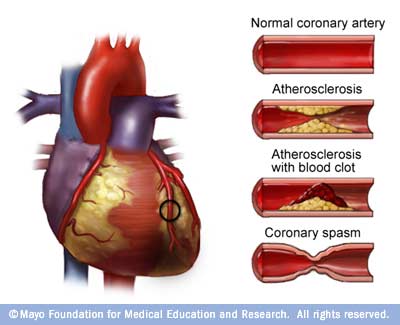
The heart muscle which works every second of our life, is supplied oxygen by coronary arteries. As the ageing occurs or due to excess fat or smoking or other reasons the fat starts to deposit causing the arteries to narrow down. As a result the blood supply to the heart decreases.
In situations like stress or heavy work, when heart muscles need more oxygen, the inadequate supply cause chest pain. This pain is called angina. If a person rests, this can be reversed.
If this lack of oxygen is prolonged it leads to permanent damage to the heart muscle which we call Heart attack ( medical name is Myocardial Infarction).
We often hear others talking of percent block in the heart arteries. It simply describes to what extent the heart coronaries are blocked, as shown in the picture.
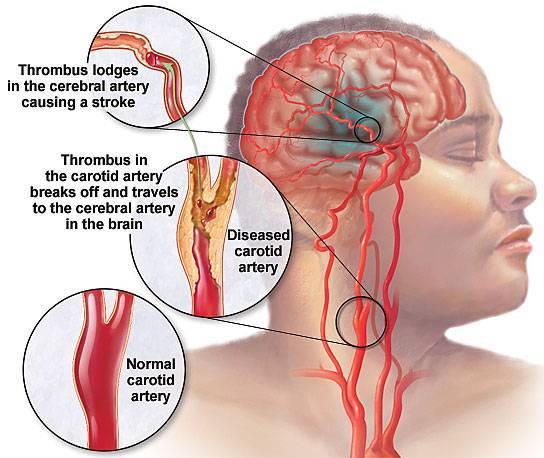
The same mechanism occurs in the brain, when the brain arteries get narrowed down by the same reasons. This damage to the brain leads to stroke.
How do we know if it is a heart attack?
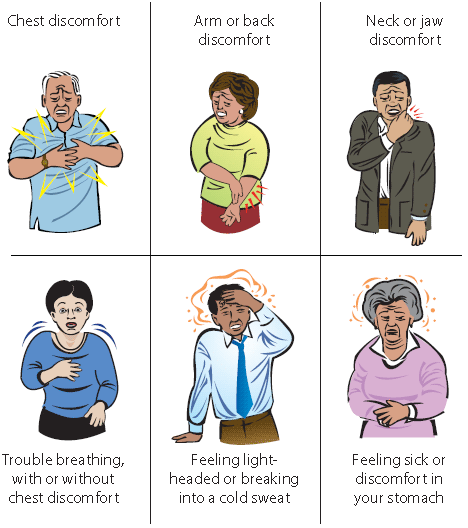
The symptoms of heart attack can vary. The typical symptoms are given as in the picture below:
And…
However there could be unusual signs too.
Anxiety, denial or even the thought that ‘it could be a heart attack’ can be a symptom.
Hence anytime you feel unwell, and your inner voice calls for a fear, don’t delay and consult a doctor immediately.
Why do we need to worry about the heart disease?
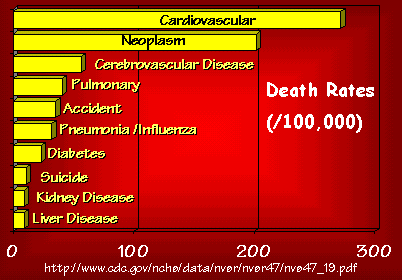
Heart disease medically known as Ischaemic Heart Disease is the top killer for the people in South Asia.
Audio in Urdu/Hindi Part 1:
What should we do to prevent Heart disease?
We cannot change our ethnicity, age, gender, Family history.
But then the good news is that there are certain factors which we can modify, so that we can minimise the chances of developing this problem, early in our life. The studies have proven that if we follow a healthy life style, we may be able to delay these problems by as much as 10 to 15 years.
The preventive steps to be taken are in fact a repeat of the steps in Health Living blog.
Step 1:Be physically active—We need minimum of 30 min of exercise each day or 150 min of moderate exercise at least 5 days a week to keep the heart fit.
You should know what should be your target heart rate while doing different types of activities. You gain the most benefits and lessen the risks when you exercise in your target heart rate zone.
(For more details about your target heart rate related to the type of exercise can be seen in this link: http://getfitwithval.com/target-heart-rate-chart/)
Step 2: Maintain a healthy weight and waist circumference.
We discussed Weight and importance of BMI in previous blog >> Living a healthy lifestyle.
Two recent studies have found that to asses one’s risk of Heart Disease the best measure is the ‘ waist circumference’.
(One of the reasons for using waist circumference is that it directly measures increased fat mass around your organs, fat known as visceral fat.)
Please note below the normal limits waist circumference in our South Asian men and women. And also not that we need to have them less than the other ethnicities to keep healthy.
Waist circumference Men Women
South Asian heritage 90cms 80cms
Caucasians, Africans 104cms 90cms
See the video to learn how to measure the waist circumference accurately:
(For details of weight BMI refer to the previous blog on healthy living)
Step 3: Eat a healthy low fat diet: Our second blog was all about healthy eating. Please refer to the blog >> Eating your way to good health.
Step 4: Know and control your Blood Pressure
Do you know what your BP, last measured is?
Do you know what the normal range of Blood Pressure is?
It is important to check BP regularly and ask the doctor how much was the reading, and preferably note it down on a card. So that when it is repeated, you can compare from the previous reading.
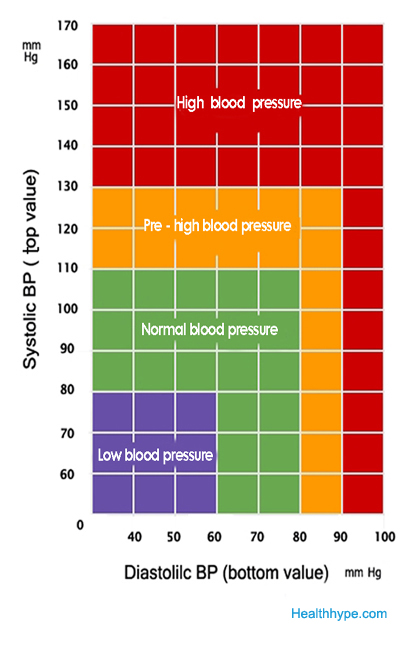
An ideal BP must be below 140/90 mmHg.
Above this will cause more effort for the heart muscles to pump the blood through the arteries.
The picture below shows the BP measuring instrument and some basics on Bloos pressure measurement.
Caution: Thanks to another doctor friend, Kavita Desai’s reminder, it is very important to understand that if you measure it at home, the correct method to record accurate Blood Pressure should be learnt.You can learn it from your doctor, hands on or check on the net. (Please refer to the link in the comment box for it).
In case the blood pressure is different, you must know what are the range of abnormal readings and the terms used for them.
In case your Blood Pressure is high you must consult a specialist to get it in control either by Lifestyle change, or by medication. Do not be apprehensive of BP medication if you are advised.
Myth: It is a myth that BP medications are harmful. Fact: In fact blood pressure if not controlled is more harmful and can cause damage to kidneys, eyes and even lead to brain haemorrhage.
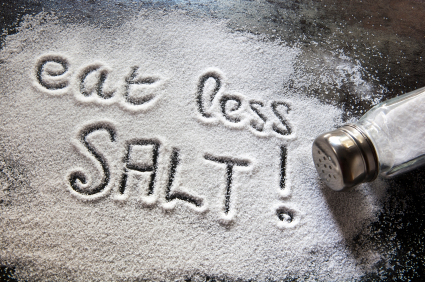
T o keep the BP in control, limit the intake of salt too.( The daily allowance of salt is 2300mg=1tsp salt).
Step 5: Know and control your Cholesterol
Do you know what your total cholesterol level is?
Do you know it is important to know the LDL ( bad cholesterol) and HDL( good cholesterol) levels too?
There are two kinds of fat: Saturated fats are not heart healthy, since they are most known for raising your LDL cholesterol (“bad” cholesterol). Unsaturated fats are heart-healthy fats – they have the ability to lower LDL cholesterol and raise HDL cholesterol (“good” cholesterol).
Cholesterol levels are generally related to our diet intake. But South Asians have cholesterol problems which run in families called as familial Hyperlipidemias.
Hence get your cholesterol check regularly from an early age and keep it under control through life style change or through medication under Doctor’s supervision.
Exercise help reduce bad cholesterol and raises good cholesterol.
Do you know that the oils you use can contain different proportions of saturated and unsaturated fats?
The more the unsaturated fat, the healthier is the oil.
Please decide for yourself which oils are the best for heart health:
Step 6: If you are a Diabetic manage and keep in control your Blood Sugar levels.
Diabetes causes hardening of the arteries (atherosclerosis). And hence can damage the arteries of the heart too. The nerves also get damaged, so when a diabetic gets heart attack, may be without any pain symptoms known as silent heart attack.
It is very important that if you are diabetic, to keep the blood sugar under control and know that poor control can lead to heart, kidney and other problems
( A detail on DM will follow next ).
Step 7: Cut down on unhealthy habits:
Reduce your Alcohol intake
Stop smoking as smoking causes heart vessels to get brittle and hence early heart attacks
Stress also raises blood pressure and heart disease.
A rigorous effort to maintain these steps can help reduce the chances of heart disease and delay by 10-15 years.
Don’t delay: Please be sure of the symptoms of heart disease, and even if you are lean and thin, or have no previous symptoms. If chest pain or any other symptoms occur, or even if you just fear it could be heart attack, do not delay medical advice.
It may not be serious, but if it is timely check up, it can save life.
So please stay fit, active , eat healthy and be stress free to minimize your risk of a heart attack.
If you love quality life, love and take care of your HEART ❤
On 27th January, 2012 India celebrates Basant panchami.
In Pakistan, it is celebrated towards the end of February.
Towards the end of January till early March, the golden harvest of wheat stand tall ready to be harvested sometime in early April. And wheat is our staple crop.
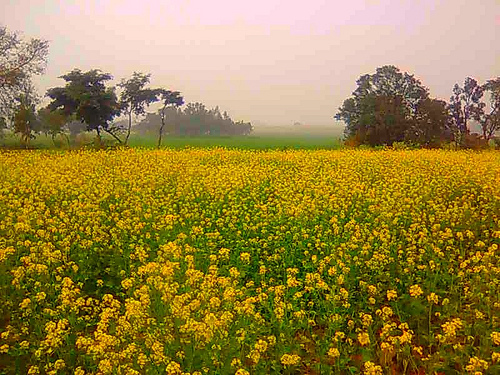
At the same time in Januray February the yellow blooms of mustard ( better known as sarson) sway in the fields, as far as eyes can see. And mustard is a cash crop whose seeds are pressed to extract mustard oil.
To celebrate these awesome blooms as a reward for the fields ploughed and the seeds sown in October, the farmers rejoice, sing, dance and make merry.
Some of them wear yellow turbans, and their women folk adorning yellow ‘odhnis’ come out to join in the celebrations. It is not hard to imagine that they must be celebrating the blooms, ever since they learnt to farm these crops dating back to centuries.
This is the basic root and the spirit of the tradition of Basant in parts of Indian subcontinent where these crops are grown.
Are wheat, or mustard crops Hindu, Muslim or Sikh?
Vasant in Sanskrit or Basant in Urdu mean ‘spring’, which heralds the departure of winter and arrival of spring. It symbolizes the time of rejuvenation and arrival of happiness as flowers start to smile through their blossoms.
Yellow, the color of Basant, inspired by mustard blossoms, which matches the shade of sun rays, signifies life and radiance.
Do rays of sun or radiance of happiness differentiate between Hindus, Muslims or Sikhs ?
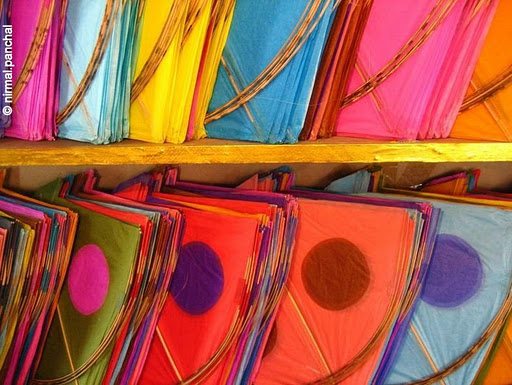
Kite flying , another component of basant, has it’s own interesting tale to tell.
“Kite flying also reveals how the tradition evolved over centuries and in a Ganga Jamuni way. Kite flying was introduced to the Indian subcontinent by the Chinese traveller Heun Tsang in the 4th Century. Evolving for centuries, it s modification into its current form and popularisation as a sport was made possible by the Nawabs of Avadh. The kite flying during basant celebrations is believed to have been introduced by Maharaja Ranjit Singh in the 18th century.”
Yet another evidence of centuries old and secular celebration of Basant come from poets, Kalidas and Amir Khusro, who have written about the celebrations of Basant in their own unique styles.
Kalidas in a poem Spring writes:
द्रुमाः सपुष्पाः सलिलं सपद्मं
स्त्रियः सकामाः पवनः सुगन्धिः ।
सुखाः प्रदोषा दिवसाश्च रम्याः
सर्वं प्रिये ! चारुतरं वसन्ते “Oh, dear, in Vasanta, Spring, trees are with flowers and waters are with lotuses, hence the breezes are agreeably fragrant with the fragrance of those flowers, thereby the eventides are comfortable and even the daytimes are pleasant with those fragrant breezes, thereby the women are with concupiscence, thus everything is highly pleasing…
AmirKhusro pens down:
Aaj basant manaalay suhaagun, Aaj basant manaalay; Anjan manjan kar piya mori, Lambay neher lagaaye; Tu kya sovay neend ki maasi, So jaagay teray bhaag, suhaagun, Aaj basant manalay…..; Rejoice, my love, rejoice, Its spring here, rejoice. Bring out your lotions and toiletries, And decorate your long hair. Oh, you’re still enjoying your sleep, wake-up. Even your destiny has woken up, Its spring here, rejoice.
There is an Indian classical music tune called Raag Basant Bahaar.
Not to forget, basant in the subcontinent is also associated with a special sweet prepared specially for the occaision –the kesar halwa, It is a suji ( semolina) halwa with a soft aroma and yellow shade from saffron and garnished with cashew nuts.
Neither the dessert, nor the poetry above nor the music below suggest if Basant is Hindu or Muslim or Sikh.
The same spirit is also replicated by this beautiful ghazal by Malika Pukhraj and Tahira Syed
Lo phir basant aayee…
P.S. Special thanks to Sandeep@stwta a twitter pal for the devnagiri text of Kalidas poetry.
Maya Khan & SAMAA TV asked for a constructive criticism. There it is…
“Maya Khan did it in good faith. Her concern was the safety of girls,” said a friend over telephone while discussing the much talked about show by anchor Maya Khan.
Well even if I presume her intentions were ‘noble’, the method of hounding young couples under the eye of a camera was certainly not just inappropriate, but highly deplorable. And now in a new video she talks about her ‘good intentions and the worries the parents have about girls who are lured into ‘wrong’ acts‘.
“Ab ager aap ye samajhte hain ke Maa Baap ye fikr na karein ke unki bachiyaan kahan hain to is barey mein main kyaa keh sakti hoon.”
It is the duty of a society as a whole and of the parents to guide our growing teens about the ethics and risks involved in relationships. Our culture is at the cross roads of modernism and conservatism. Many of us have conveniently picked up that part of modern culture which suits our personal interests, but stay glued to the old conservative dogmas otherwise.
As a friendly mother of two university-going kids, I am quite aware of the mixed trends and risks that surround my new generation kids in Pakistan.
It is very normal for boys and girls to form clandestine relationships when parents are unduly strict. This leads to many girls ending up in a trap caught between the parents and the boy and if the boy is taking her for a ride, he uses her vulnerable position to his advantage, as seen in many cases reported and unreported in Pakistan.
I certainly do not think this holds true for the majority, but it does happen with quite a few. The girl is forced to comply to the demands of intimacy by the opportunistic male counterpart. In that situation,especially in places like Pakistan, where there is gender selective judgement of ‘character’, she does not have many options. Seeking refuge with her parents and escaping the boy will eventually result in the same disastrous situation, in her head, and so she chooses the troubled path.
How do we deal with this? Do we go around with a broom stick microphone and witch hunt like Maya Khan? Certainly not.
In the west, these things along with sex education are taught to the students in middle school, while they are going through the most stressful times of their lives—puberty. Unfortunately in our society this is not done nor is it possible in the foreseeable future, thanks to our preconceived negative notions about this three letter word ‘sex’.
It is the duty of parents to play their part. They should open up their minds and place themselves in the shoes of their growing boys and girls. And to be understanding about the many complicated issues of the heart and mind.
What is needed is to empower our girls with the knowledge of how to save themselves from pressures of giving in to undue demands of a physical compromise, if they are not a willing partner to it. Boys also need to know that they cannot force upon their girlfriend any demand, be it as trivial as holding her hand, if she is not willing for it. The boy must be able to respect her ‘values’ in the relationship.
The girls should be given confidence, and taught how to stave off undue pressure or abuse of any sort in a girl-boy relationship. It is also important to reassure them that if they have made a mistake befriending someone who is abusive, they must come and confide into anyone who they trust-be it a sister, friend or even mother. I tell my kids, in such a case if you come and confide in me, “I may get angry or a lot angry, but perhaps it will save you from further unnecessary abuse.”
It is a myth that talking to your children openly about relationships will make them indulge more. Perhaps, if they know their parents understand them they will be more confident in taking responsible decisions. Once you have informed them, let them take their own decisions. Do not dictate to them.
I tell my kids, “If you take a decision which is wrong in my eyes, I may feel hurt, but it is ultimately you who will have to live with it. When you choose your decisions, you choose their consequences too. So be mindful and do what you think is right.” So far, so good.
Keywords to parents:Keep lines of communication with kids, educate them and then trust them while they make informed choices. Do not control their decision making.
Message to future Maya Khans: if you really wish these girls well, please call experts in the studio, and let them give tips to the parents, boys and girls about how to handle relationships. It will save you from a lot of running around in the park, unnecessarily.
Listening to the stories and anectodes of Mehboob-e-Ilahi( Beloved of God) was a norm as kids. A Mamoo, an ardent follower of Sufism, who lived in Jaipur was the source. If he ever happened to pass by Delhi, visit to the ‘Dargah’ was a mandatory. And when in Delhi, he had to visit his sister too i.e. my mother.
He brought meethi kheels (sugar coated puffballs) every time he came from Dargah, and was ever willing to narrate to us the stories of love between Mehbub-e-Ilahi and his favourite disciple.
On the other hand I saw my not so religious father’s( who also hailed from a Maulvi family) love for Amir Khusrau’s Persian poetry, and a tall tower of audio cassettes he had piled up next to his music system.
Honestly for years until early teens I did not know who Mehboob-e-Ilahi or that disciple were and where the Dargah was. We never visited. All I knew, Ammi went with Mamoojan a few times.
Once , when during a story time, Mamoojan was corrected by my father, about a Persian verse by Amir Khusro, did I realise that there was a correlation.
“Such a great poet had a Pir?” was my instant jerky reaction. Pirs in my mental dictionary had a negative meaning and image.
Equally instant was my father’s reaction: “ Hazrat Nizamuddin was a great scholar, it’s the people later who made him a Pir, and now have opened a whole business in his name.”
Mamoojan just gave a slight smile, and as always drowned again in his love for Mehboob-e-Ilahi, continued the story.
It was then to reinforce the great bond that existed between Hazrat Nizamuddin and Amir Khusrau, did he tell of these incidents, which now I can quote with the Persian verses he might have mentioned.
Just to make it clear, most of the stories have been passed on as word of mouth, and hence I call them anectodes.
Anectode 1:
When Hazrat Nizamuddin passed away Amir Khusrau was away, in some other city, attending to the orders of a King. As he learnt of the sad news he rushed back and went straight to the fresh grave of his master.There he rolled in the mud and tore off his clothes in agony. Then came these words:
Gori sove sej par mukh per dale kes Chal Khusro ghar aapne, rain (not saanjh) bhaee chahu des. The lovely maiden lies finally on a wreath of flowers, her tresses covering her face, O Khusro, turn back home now, dusk has set in all over.”
Amir Khusrau was never the same after his Pir’s death. And it was only in six months that Amir Khusrau also passed away.
He was, as per the desire of the disciple and Pir both, buried close by. This is now known as a “chabootra-e-yaar’ ( the pedestal of friend).
One can see this as a raised platform with red sandstone carved fence, around the grave.
The Pir also reciprocated his disciple’s love and affection, and is believed to have remarked: “If shariyat would allow me, I would want Khusrau and I to be buried in the same grave.”
His followers believe that Hz Nizamuddin instructed that “Those who visit my grave should first pay respect at Khusrau’s .”
Anectode 2:
Amir Khusrau was away for a royal trip. A disciple of Hz Nizamuddin came to him asking for some souvenir from his Pir. Since the Pir had nothing to offer, he asked the disciple to take away his slippers.
Incidentally, on the way the disciple and Amir Khusrau’s paths crossed each other. And Khusrau remarked:
Shaikh mi aayad, Bu-e Shaikh mi aayad”.
(I smell my master, I smell my master).
On knowing that the man had in possession the slippers of his Pir, Khusrau gave away all his wealth that he had on him and bought back those slippers.
Anectode 3:
The two were sitting at the bank of river Yamuna in Delhi when Hz Nizamuddin (wearing a cap crooked way), saw some men taking a dip in the river with a reverence as a worship. He remarked: Har qaum raast raahay, deenay wa qibla gaahay (Every sect has a faith, a qibla which they turn to.)
Pat came the reply from Khusrau: Men qibla raast kardam, ber terf-e kajkulaahay. (I have straightened my qibla in the direction of this crooked cap)
Anectode 4:
It is the most interesting of all anectodes, and if true (I do not doubt, but these stories have been passed through word of mouth), then it is remarkable to have this quality of Persian and Brij Bhasha poetry from an eight year old.
It is said that Khusrau’s mother brought her eight year old son to the place where Hazrat Nizamuddin ( a renowned scholar and respectable man) resided.
Instead of entering the premises Khusrau sat outside and narrated: Tu aan shahi ke ber aiwan-e qasrat Kabutar gar nasheenad, baaz gardad Ghareeb-e mustamand-e ber der aamed Be-yaayad andaroon, ya baaz gardad You are a king at the gate of whose palace, even a pigeon becomes a hawk. A poor traveller has come to your gate, should he enter, or should he return?
And that Hazrat Nizamuddin who himself was 23 then, came out (some say he sent out servants) and replied: Be-yaayad andaroon mard-e haqeeqat Ke ba ma yek nafas hamraaz gardad Agar abla buvad aan mard-e naadan Azaan raah-e ke aamad baaz gardad Oh you the man of reality, come inside, so you become for a while my confidant, but if the one who enters is foolish , then he should return the way he came.
Hearing this Khusrau knew that he has come to the right place and hence entered into his guidance.
Having reread Khusrau, several times over since then, I have came across some of the records, which go further to say that- telling his mother of his excitement to have found the Pir, Khusrau composed these beautiful verses: Aaj rung hai hey maa rung hai ri Moray mehboob kay ghar rang hai ri Sajan milaavra, sajan milaavra, Sajan milaavra moray aangan ko Aaj rung hai…….. Mohay pir paayo Nijamudin aulia Nijamudin aulia mohay pir payoo Des bades mein dhoondh phiree hoon Toraa rung man bhayo ri……, Jag ujiyaaro, jagat ujiyaaro, Main to aiso rang aur nahin dekhi ray Main to jab dekhun moray sung hai, Aaj rung hai hey maan rung hai ri. What a glow everywhere I see, Oh mother, what a glow; I’ve found the beloved, yes I found him, In my courtyard; I have found my pir Nizamuddin Aulia. I roamed around the entire world, looking for an ideal beloved; And finally this face has enchanted my heart. The whole world has been opened for me, Never seen a glow like this before. Whenever I see now, he is with me, Oh beloved, please dye me in yourself; Dye me in the colour of the spring, beloved; What a glow, Oh, what a glow.
In my ignorance, I bluntly asked Mamoojan,”What was so great in Hazrat Nizamuddin that even an accomplished man like Amir Khurau revered him so much?”
I remember Mamoojan reply, “He was a great pious man, a Wali. That is why he was called Mehboob-e-Ilahi ( the beloved of Allah)”.
To tell you the truth, I wasn’t entirely convinced then, but then years later, while getting into the colors of Amir Khusrau’s poetry, I did my own research.
I found that Hazrat Nizamuddin was a great scholar of Quran. He was truly a very pious man, who prayed a lot and fasted each day of the week.
There were free meals ( langar) at his residence, each day, in which Amir Khusrau actively took part.
He led a very simple, austere life, wore at times torn clothes, and ate extremely simple food.
But what really convinced me of why Amir Khusrau revered him so much was this incident of Hazrat Nizamuddin , which so speaks volumes of the greatness of this Pir of Amir Khusrau:
Once some of the staunchest of enemies of Hazrat Nizamuddin, threw thorn on the way he was to pass. He walked over them, bare feet, without any complaint. And with his sole bleeding, he prayed that every thorn that had pierced him become a red rose( like the color of his oozing blood) in the grave of the thrower.
Mehboob-e-Ilahi that he was, he is said to have remarked: “If a man places a thorn in your way, and you place a thorn in his way, soon there will be thorns everywhere.”
With all this in the background, now this poetry by Amir Khusrau sounds even more melodious…
Kabir leaves no examples to teach and stress to human beings, in his own simple ways, the lessons of humility, tolerance and open mindedness.
In other verses, as in previous post, he gives examples from the living world, like animals, or even from trees, rivers and oceans.
In the verses mentioned below, he picks the most modest of examples, to highlight their good traits. But realisng that they too have downsides, moves on to gentler ones among them. And ultimately makes us realise, it is only ‘the ONE’ truly devoid of flaws.
In a way, there is a subtle message here, that in one’s pursuit to be better, there is always room for further betterment, and despite all our efforts in the direction, it is only the ONE who is perfect.
Rorha hoi rahu baat ka, taji paakhand abhimaan. Aisa je jana hoi rahe, taahi mile bhagwaan.
O dear, be as humble as the pebble on the path. Giving up all snobbery and ego. Only if you are humble can you realise Him.
Rorha bhaya to kya bhaya, panthi ko dukh deh. Harijan aisa chahiye, jyoon dharani ki kheh.
Kabir rethinks. What if you are a pebble, as it too can get unkind and hurt the feet of the fellow travellers on the path. So be like the soil on Earth, soft and gentle.
Kheh bhayi to kya bhaya, urhi-urhi laage ang. Harijan aiasa chahiye, jyu paanee sabrang.
Again Kabir rethinks. What if you become soil? It flies with slight breeze and spoils others ( a little adversity may cause our evil nature to surface and cause harm to others). So just be like water – it is without color (without prejudice), but it can take whatever color easily ( be open minded).
Panee bhaya to kya bhaya, taataa-seeraa hoy. Harijan aisa chahiye, Hari jaiasa hi hoy.
Once again Kabir rethinks. What if you are water? The water gets furious with heat and even becomes too cold with indifference.
So just strive to be as Tolerant, Kind and and Merciful, always as your Lord.
Talk of desi food and mouth waters, nose hallucinates of exotic smell of desi food-of Qorma, Bihari Kebabs, Parathas or ears ring with sizzling melody of jalebis, samosas, bhaturas being fried.
And eyes vision the ultilmate combo of : jalebi samosa and chai :
Indeed, our cuisine is the crowning glory of our culture. Curry dishes have acquired the status of national dish in Great Britain. Mughlai is a globally coveted cuisine..
I have hardly met any non-desi , who on mention of South Asian food, does not express a liking for Biryani.
The awesomeness of South Asian Cuisine :
More than just the exotic flavours and tastes, the spices that go into the food have been proven as time tested home remedies ( Grand Ma’s home remedies). The haldi(turmeric), aniseed(saunf), dal chini( cinnamon), ajwain( asafoetida), lalmirch( chilli powder) etc the commonly used spices, also serve as anti oxidants, antuflu, anti inflammatory or antiseptics.
Turmeric, a kind of curcumin, is known to prevent Alzheimer’s disease and hence it’s low prevalence in the subcontinent. A study found that those who ate curry once a month or more scored better on cognitive tests than those who ate curry rarely or never.
The king of fruits Mango, contains phenols which has a high antioxidant, anticancer capabilities along with being a rich source of Vit A, E, Selenium and Iron. (The diabetics should avoid it due to high sugar content.)
However, South Asian Cuisine has it’s down side too.
The main culprits being that most of the delicacies are calorie dense, and are cooked high amount of saturated or trans fats.
Our method of cooking like deep frying, the additions of baghars, tarkas are faulty. We tend to overcook our meals , which along with reheating depletes it of its nutrients.
The savory snacks, like the namkeens, namakparas, samosas etc. are generally fried and laden with high salt content. While the sweets are rich, prepared from fat and thick sugar syrup. Eg Gulab Jamun, jalebis, Carrot Halwa etc.
Our meals are large in serving portions .
Our desi restaurants and take away meals are known for their liberal use of ghee and oil, not only in curries but also on naans (breads).
Many of our households have a high intake of meats, avoiding vegetables. This leads to deficiency in certain nutrients like Folic Acid and excess of Homogentisic Acid which is a cause of Heart Attacks. The lack of fibre in the meats increases the risk of colon cancer too.
A study claims most meat eaters in Pakistan take red meat (mutton and beef) 68% times and the rest white meat ( chicken and fish) .( Ref 2) Red meat is known to raise the risk of Cardiovascular diseases and cancer and the risk of dying in next 10 years is raised. ( 2. Ref below)
The research found that a single meal of Indian curry in Britain has more fat than the recommendation for the entire day.
Example: Imagine a typical feast: Raita, Poppadam for a starter, a Lamb Qorma and two Butter Naans for main course, and a Gajar Halwa for dessert – is a meal with over 1800 calories! When the average calorie for a day are about 2500 for a man and 2000 for women.
A BAD NEWS is that along with the faulty diet, we South Asians have been endowed with vulnerable genetic makeup which makes up 5-6 times more vulnerable to heart disease, and other chronic diseases like DM and HT as compared to other races.
(Please read the above ^^ sentence once again, and understand it).
As a result of the genetic and lifestyle, there is a epidemic of Diabetes, and Heart diseases in SouthAsians. Hence there is a dire need to make changes in our diet habits to prevent early heart and chronic diseases.
(The topics of CV Diseases and DM, HT shall be dealt in detail in the separate blogs).
AUDIO ( in Hindi/Urdu):
We cant change our ethnicity or our genes, but the GOOD NEWS is that with slight modifications in the cooking methods and choice of ingredients, we can change the quality of our food without much change in the taste. .And hence can substantially reduce the risk of above diseases.
Let’s give it a try, for the sake of our healths.
What should we do ?
Step ONE: We need to know what is our calorie requirement: Our age and activity level determines our caloric requirement which can be calculated from the chart.
Place the cursor on the weight and your activity level to check ur calorific requirement.
If you are over weight then place the curser on your target weight ( the weight you wish to have or need to reduce to). Consider the calories that is required for the weight you desire.
Knowledge of the caloric requirement can give an idea whether we are falling short, meeting or exceeding the requirements.
Step TWO: We must know what the various food groups are and how much of their proportions need to be taken for a healthy diet:
To make it easier, the pyramid has been altered into a shopping pyramid, which hints at the amount of foods we need to buy from the different groups of food.
However in order to make it more simple and visually more easy to understand what our proportions should be now a Portion Plate has been devised
Step THREE: You must spread your meals into 4-6 times per day. A good breakfast is a must. The lunch and Dinner should not be very heavy. In between the meals, take snacks like fresh fruits, vegetables, nuts etc.
This spreading out of meals over the day leads to maintained blood sugar levels and prevents in weight gain.
Step FOUR: While eating or later try to assess the calories you have taken in your plate. For this refer to the chart below the article. ( Unfortunately,very few of our recipes come with their calories and nutrient details).
Better still would be to make a list of all the foods as you eat and check the list at the end of the day. You will be surprised to see how much you ate, when you thought otherwise.
Step FIVE: Once in a week after a healthy eating all week, treat yourself to comfort desi food too… Nihari, Rasgullas, Kulfi aah !!!
Tips on what healthy changes can you make in our foods:
1. Replace red meat with more frequent white meat like chicken and fish. While taking red meat, prefer lean meat and trim the visible fat.
2. For those who do not afford meat, Dal chawal is an excellent source of Protien and the two eaten together supplement each others missing Amino acids.
3. Egg is also an excellent and cheap source of good quality protein. The notion that it is high in cholesterol is proven wrong by research.
4. If a recipe needs some oil/butter/ghee, use canola or olive oil in small quantity. Make a habit of brushing or spraying the oil in the pan instead of pouring. First heat the utensil, then add (preferably spray) oil. A heated pan spreads the oil better.
(PS see about Canola Oil on internet and decide about it’s efficacy through evidence. If unsure prefer CORN OIL ).
5. Substitute baking, barbecue or grill for frying, if possible.
6. Avoid too many reheating of the food as it destroys the nutritive value of foods.
7. Add more of green vegetables, as salads along with the meat.
8. Wash the vegetables with water containing potassium permanganate to remove infections, fertilisers and pesticides. Then rinse them with clean water.
9. Do not overcook the vegetables, leave them crunchy. Overcooked mushy vegetables lose taste and nutrients.
10. Onion should be cut and kept for at least 15 minutes before serving as oxidation helps quercetin, an important phytochemical and antioxidant to get activated.
11. Use skim or low fat varieties of all dairy products (milk, yogurt, cheese, butter, cream, ice cream)
12. Salads, sandwiches, fresh fruits are best fast foods, instead of the conventional ones.
13. When you go to a restaurant, give instructions to add only very small quantities of oils for cooking.
14. Make a habit to check the labels on the foods bought from the Supermarkets. Don’t be carried away by the words ‘No Cholesterol’ on labels. Majority of vegetable products are cholesterol free. It is the fat content of the item which matters.
15. Avoid eating while watching TV. You eat a lot and you don’t know while watching TV.
16. Never use pots and pans made of lead or aluminum. Lead can lead to severe digestive disorders. Aluminum vessels can cause high levels of aluminum in the brain tissue that may lead to Alzheimer’s disease.
Tips for Vegetarians:
Vegetarians should know that they need to be very careful about their food being balanced in different groups of food. Vegetarian diet is found to be low in proteins, calcium, vitamin B12, iron and zinc.
Vegetarian diet may lack proteins. Hence it is important to include beans, dals, nuts and dairy products for proteins. Dairy products like milk, yogurt are a high calcium source.
Vitamin B12 is an essential vitamin whose deficiency can cause permanent nerve damage. It is found d only in animals source. So vegetarian are not able to get this in their food. Hence in order to get enough Vit B12, they need to either eat Vit B12 fortified food, or supplements of Vit B12.
Food for thought:
Last but not the least, we South Asians follow an age old tradition of preparing multiple varieties dishes especially in festivals, weddings or during the month of Ramadan.
However if we limit the number of dishes, we not just cut the cost, the labour but also reduce unnecessary intake of calories. The cost saved could instead be given to the less fortunate amongst us who cannot afford a complete two meals a day.
It is important to realise the hunger and malnourishment all around us. Our culture, our faiths and above all humanity demands that we are empathetic towards them.
We must ensure that we do not cook excess that goes into the garbage. There is nothing wrong being a food lover, but only if we imagine that those deprived desire and dream of decent meals too. And we can certainly share a meal or two with them too.
Just think…
And yes, happy healthy eating.
Audio in Hindi/Urdu
Reference:
1. Researchers TP Ng, PC Chiam, T Lee, HC Chua, L Lim, EH Kua published an article in the American Journal of Epidemiology in 2006 entitled “Curry consumption and cognitive function in the elderly.
2. http://www.gilanifoundation.com/homepage/30years/30YearsOfPollingOnEatingHabitsOfPakistanis.pdf
3. conducted by “Which” magazine (Feb 2010) of Britain
4. In the study, a research team led by Rashmi Sinha, Ph.D., from the National Cancer Institute in Rockville, Maryland, looked at more than 500,000 people who were aged 50 to 71 when they enrolled in the National Institutes of Health-AARP Diet and Health study).
P.S.: When writing any information, it is my utmost ‘responsibility ‘ to give only information which is scientifically researched and evidence-based through research. I do not give any personal opinions or grom my ‘gut’ feelings. Thanks. 🙂
P.S. Thanks in advance to Dr Babar Khan, Farhan Masoosd and Zawaf for the RTs.
The most painful truth that I have ever had to face in my entire life: “Arfa Karim passed away”.
In a composed manner, true to the dignity of being the father of Arifa, he said:
“She came to us for a very short time, but taught us a great deal.”
Battling with life for several weeks on a ventilator, and amidst millions of hands raised in prayer for her survival, Arifa Karim finally bid a good bye.
Initially it was a reaction of intense anger and pain as I had protested with God, calling it unfair.
I really don’t know what the wisdom of God behind this was. Is it that she was too good to be worthy of this messy world? I am too moved to think rationally at this point of time.
Arfa Karim, becoming a youngest Microsoft professional at 9, and did what I could not do till today, at 5 times her age.
She was an inspiration and a role model to the girls of Pakistan.
Not only was she the above mentioned, but also a wonderful, bubbly girl who had geat aspirations for herself as well as for her country.
I remember watching an interview of her years ago in which she said:
“Mera ye aim hai ke main jahan bhi jaoon, Parrh likh ker Pakistan aaon aur apne mulk ko serve karoun.” (My aim is that wherever I go for studies, I shall return and serve my country Pakistan).
More so, she was an awesome poet, an eloquent speaker, and was bestowed with a wonderful voice of a singer too.
At 9, after she met Bill Gates she scribbled a poem on him:
Born in October 1955 Proggraming was his only aim of life
Started proggraming at the age of 13 In his work he was really very keen
Entered Harvard in 1973 Thought more than a child could think to be
In 1975 begun Microsoft With children he’s very soft
At the end I would just like to say I like Bill Gates in every way
Yes another beautiful one, reflecting her compassion …
‘White Rose’
In the storm Stands the white rose tumultuous waves of destruction abound her
Yet tall is the white rose strong in the face Of the sensed doom around her And she does not bow down
Pure is the white rose In the compost earth growing eternal strength in the nights that so hurt
I see not the white rose She is so far away But I long to protect her But only the words can I say
So I send her my words And my poets heart To help her when there is hope to see her through
Be Strong little flower Your heart will guide true And as long as you want I will always talk to you
Ironically the last three stanzas resonate with how all of us felt while she struggled with the ventilator…all we could send her were our words and wishes, standing far away…
Alas, we lost…
Why? I know not.
I can only offer her the ghazal and with the same pain, that Mirza Ghalib wrote when his son passed away:
Lazim tha ke dekho mera rasta koi din aur Tanha gaye kyun ab raho tanha koi din aur
Mit jayega sar, ger tera patther na ghisega Hoon der pe tere nasiya farsa koi din aur
Aaye ho kal aur aaj hi kete ho ke jaaoon Mana ke hamesha nahin , acha koi din aur
Jaate hue kehte ho qayamat ko milenge Kyaa khoob ! Qayamat ka hai goya koi din aur
Nadaan ho jo kehte ho kyun jeete hain Ghalib Qismat main hai marne ki tamanna koi din aur.
RIP our darling, you left us miserably broken and tearful…
Today is auspicious, for India. Yes it is despite being Friday the 13th.
Today India completed one full year of being Polio free.
It was on January 13, 2011 that the last child with Polio was diagnosed. After that all weekly tests from sewer samples, where polio is generally found, have been coming clear. No cases or samples have been reported positive since then.
WHO states “If the data comes clear over the next few weeks, then India, for the first time will show unshaded in the WHO polio maps.”
It is certainly a moment to rejoice for India, while keeping it’s fingers crossed for some more weeks and a lot extra vigilant for the next few years.
And knowing that it is a country with huge population of 1.2 billion with population as culturally diverse as any diversity, this is indeed a matter of great pride. It is a moment that one does not get to witness in history very often. Last when India along with the whole world witnessed something similar was in 1975 when Earth was declared Small Pox free.
“It’s not a miracle — it’s good science and an awful lot of elbow grease.” says Dr Bruce Aylward, the assistant director general of Polio, WHO.
Certainly being a huge bunch of a multi cultural, multilingual diaspora that India is, along with poverty, ignorance and myths against Polio vaccines it certain must have been a mammoth task to even dream and then realise that dream of a Polio-free India.
Poliomyelitis is a viral disease which attacks the nerve cells in the spinal cord which leads to the paralysis usually of a lower limb or leg. It cripples the children at a very young age. It is mostly spread by direct person to person contact, through the feco-oral route i.e. through phlegm, through the infected mucus or phlegm from nose, mouth or through infected feces. Once affected, however there is no treatment of the disease. Polio immunization through vaccine either as oral drops or injections is the only way to prevent it.
Why do I write all this? Is it to show off my Indian connection?
No certainly not, but to let us Pakistanis know that after today, or maybe in a few weeks more, after India officially says quits, only three countries shall remain ‘Polio endemic’ -Afghanistan, Nigeria and our own Pakistan.
Yes it really hurts that what India has achieved for it’s 1.2 billion, Pakistan could not achieve for it’s 180 million. It hurts that Sudan could do it, Myanmar could do it, but Pakistan could not.
It hurts even more to know that 194 cases were reported in Pakistan in 2011. Two of them were just confirmed today one from KhyberPakhtunkhwa and another from Sindh, sadly.
Most of the areas affected are the conflict zones where there is rampant poverty, ignorance and ill health.
The executive summary of the document said and I quote:“Poliovirus is continuing to cripple children in Pakistan because of the failure to reach all children with sufficient doses of vaccine. The reasons for this include inadequate Government oversight and ownership, access problems due to security particularly in the Federally Administered Tribal Areas (FATA), operational and planning challenges, and the failure to identify and i nclude all high risk underserved population groups.”
Next it states: “the President of Pakistan has directed the immediate development of an emergency action plan for polio eradication in Pakistan.”
And that the Armed Forces have also been pretty active in some of the unreachable areas, by helping the government in making the vaccination of children with polio drops possible.
I hope all these efforts, both by the government and the armed forces, are able to trickle down till the last beneficiary and that a genuine change on ground is visible.
One can only wait to see if the claims that 2012 will show a decrease in the Polio cases in Pakistan.
The same report also mentions that along with India even Nigeria too has the potential to eradicate Polio in near future.
Further reading from the report shudders my soul: “This would leave Pakistan as the single largest threat to global polio eradication, and isolate the country in a world that wants to protect its citizens from the last remaining reservoir of wild poliovirus.”
After reading this, with a depressed mind within a dizzy head, I appeal to all the powerful and mighty in Pakistan to please rise above wrangling and infighting and please pay attention to the poor masses of Pakistan, who have been long ignored in this battle of egos.
Let all forces work with harmony so that not just Polio be eradicated, but power shortages and poverty be controlled, and let the people prevail.
Dr Ilmana Fasih
13 Jan 2012










 Blind to Bounds
You must be logged in to post a comment.