Written in the context of Rimsha Masih, the 11 year old accused for blasphemy, and sent to jail for that:
In the Land of the Pure, A minor has dared an act impure. Her feeble mind, designed a devil, Her tiny hands, enacted an act so evil. Divine here are the laws that reign, Virtuous is the blazing anger insane. Swords of revenge are laid bare, Dream to live, she better not dare.
Forgotten, is the kindness to minors, That Prophet(pbuh) had preached. Ignored, is the lesson of forgiveness. The Holy Book has revealed. Dismissed, is the spirit of mercy, The Supreme Power upholds. For in the Land of the Pure, A minor has dared an act impure.
Happening adjacent to Square one, is also Mosaic Film Festival, with an impressive line up of select and Award winning films being screened, from all over the globe.
I had marked in my calendar, long before the festival began, to sneak out of my volunteer arena and watch one of the two Premiered movies in the current festival, Saving Face..
The Mosaic audience is fortunate to be the only Canadian audience to have been treated to a full 54 minute director’s version of Saving Face, instead of the usually running 25 minute short film.
My interest was not just its Academy Award (Oscar Award)crown, but also the issue it highlights, of acid burns in Pakistan, or to be fair in the rest of the subcontinent too.
The ease of availability of the strongest of acids, at no price, and the super speed with which it disfigures the life of the victim, both literally and metaphorically, makes it a handy tool in the hands of its ego-bruised perpetrators. As bluntly put by Dr Jawad,
“Guns need a licence, but acid throwing needs none.”
The film revolves around the real stories of two unfortunate, yet courageous women, Zakiaand Rukhsana, for whom the roles they performed were scripted ruthlessly by none other than their own husbands. Almost near psychopaths that these men were, they did not even appear to have any remorse on their actions, in retrospect. Perhaps, had they been in possession of even a streak of humanity, they would not have resorted to this premeditated act.
On the other hand were the two courageous women, who despite of all their miseries, decided not just to live with their heads held high, but to carry on with their missions.
Zakia,after being severely disfigured, came out to get justice, and to fight for legislation against the perpetrators of acid burns. The severity of her burns, had made the reconstruction of her face impossible, as Dr Jawad stated the limitations of plastic surgery,
“After all we are not Gods”.
However where there is a will, there is a way.
Not only was the legislation passed on the punishment for acid throw, and she even saw her husband get two life imprisonments. The reward in return to her was a new lease of life through a prosthesis, which gave her a new face, at least for the outside world.
On the other hand, like majority of helpless women and mothers, Rukhsana, after all the trauma, had chosen to patch up and return to her husband. However, her generous forgiveness was returned back with a brick wall being built between her and her children. Despite the series of misfortunes that destiny had offered her, she chose to continue on with her new pregnancy, and postpone her surgery until delivery. A hope to start a new life with a new baby, rekindled a new desire in her love to live.
I could not hold back tears, when Zakia walked out on the street, for the first time after years, with face revealed and saying, “There is hope in this life again.” Or when Rukhsana holding her new baby boy remarked: “I want him grow up to be a doctor like you, and not like his father.”
I salute them both, for being a true embodiment human resilience, in the face of worst of tortures, and still bouncing back to life with hope. It is this hope that has kept this world revolving for centuries.
Hats off to Dr Jawad, Shairmeen Obeid Chinoy, Daniel Young and the entire team, for saving their own faces too, and for inspiring a passion in others, to come forward and help, in millions worldwide.
The appeal for donations for the cause, by the Festival organisers, saw many signing off cheques and pledges for the cause, at the end of the film.
Perhaps we all need to save our own faces, and do our own bits for this cause and for women abuse at large, whether by screening this film, writing about it, or simply teaching one’s own sons to treat their women with dignity as they grow up.
Towards evening, as the time for Shafqat Amanat Ali’s concert approached on the third day of Mosaic Festival 2012, there was a visible increase in the hustle bustle in the Celebration Square. Before he could even come, the lawns were full.
Dressed casually, Shafqat walked on the stage amidst cheers, after being e introduction by none other than Sohail Rana.
The first song ‘ankhon ke sagar, le doobe humein‘, was enough to drown the crowd into a Shafqat frenzy.
Then followed the khamaj “mora sayyan mo se boley naa,”which transformed the mood of an excited crowd into that of a sombre ecstasy.
Having talked to Shafqat in the waiting room, prior to the show, he had mentioned of his conviction for Indo Pak cross cultural exchange.
He had promised, “As such we artists contribute a great deal towards that, but I would consider myself very fortunate to support anyone who works towards making it into a reality.”
Carrying on that conviction in the crowd, he dedicated the third song, Ye Hausla, towards “India Pakistan Peace” amidst an uproar of applause for his dedication. By just this third song, the crowd had been immensely electrified. The words were powerful and seemed to reiterate his promise even more strongly.
“Ye hausla kaise jhukey, ye arzoo kaisey rukey. Manzil mushkil to kya, dhundla ye saahil to kya…”
I noticed a lady, sitting on the front most rows, reciting every song of his, verse by verse.
“You seem to be his diehard fan?” I asked.
Pat came her reply, “Yes, I love the imagination with which he brings fusion of different genres in his music. Though many of them are coming from Bollywood, but are yet not cliché’ Bollywood. It touches the strings of the heart. “ Sapna, as she introduced herself, is a new immigrant from Delhi, and takes pride, that she knows all the songs he has sung so far.
In the conversation earlier, Shafqat had told about his family’s experimentation with different kinds of music. He mentioned of how his father Ustad Amanat Ali Khan, excelled in Ghazal singing despite being earlier dissuaded as not deemed suitable to his classical background of Patiala gharana. He referenced the experimentation of his brother, Asad Amanat Ali’s with various forms, including Punjabi.
A soft spoken Shafqat Amanat Ali, to me was contrary to the image I had of him through his “Rockstar Ustad” image. I had expected I would meet a loud, talkative, rock star personality. Diametrically contrary to my image, he was extremely soft, and sombre not just in voice, but expressions and body language too.
Most of my questions, some serious, and some not so serious, were mostly answered by him with a uniform sobriety, with just a slight smile on the question, “Why did you take up a degree in Political Science?”
The smile followed with a simple answer, that “he was the first one to go to the University, from his family, and hence, without much direction being given, he followed, what his friends chose to study.”
Being a musician, to him was inevitable, as this is how kids in his gharana are trained from a very early age. “They are left with little choice to do anything else.”
If he is not doing music, what does he do? “I watch a list of movies, and sleep”, replied Shafqat.
We had been told by his manager that he loves food, especially desi food. So came my obvious question: “What’s your favourite food?” “Biryani Saag” , was the instant reply, but with a quizzed expression on me, he preferred to explain, as “a relative unknown dish, being his favourite dish. It is cooked on occasions and in special deghs, by the cooks.”
The manager also revealed Shafqat’s love for nature. He reminisced of the time, when due to a beautiful foggy weather in Malaysia, they went for a walk, and during that stroll composed one of his most beautiful songs. “Tell us something in this blog that you have never shared before, but would wish to.”I asked.
With an expression of hurt he shared, “ I was a rejected singer on PTV, and ….”.
However it hurt me too, to have asked that, so I switched instantly to, “What special message would you give to Mosaic Festival?” And his instantly opened arms and a flying kiss towards all the Mosaic volunteers standing around, did all the talking.
Back to the concert, each song that followed, further mesmerised the crowd . Half way through the concert, the jam packed crowd was completely electrified. The radiation of enthusiasm could not hold back an interactive Shafqat’s energy too, and he chose to come down into more proximity to his fans, shaking hands, giving them hugs and sharing the mic with them to sing.
Before he began the folk song “Main nai jana pardes biharwa’, he paid a tribute to Tufail Niazi, the great folk singer, considering himself fortunate to have re sung the song.
After almost a dozen melodious renditions, and with time to close, the crowd was too charged to let him go that easily. Amidst almost everyone screaming “one more” and “Eid Mubarak”, a bunch of threesome fans near the stage were screaming:
“Shafqat tussi great ho”…and out of modesty with no smiles he replied “Eidi chahiye?”
They were right behind me, so I turned and asked, “Any specific reason you say so, or is it just for more songs?”
Each one of the young girls, Chhavi, Saumya and Esha had different replies, which they literally had to scream out, due to the cheers all around. “He’s versatile and very powerful.”
“Most soulful singer.”
“Kudos to him for bringing classical back to the youth.”
To convince the crowd, that it was time to leave, he even tried to parody “Aaj gaane ki zid na karo, dekho pit jaoge, aisi baatein kiya na karo”,but the verses fell unheard on the screaming crowd.
As I tweeted and posted a picture of the crowd on the face book :
Ilmana Fasih @ZEEMANA Electrified crowd at #ShafqatAmanatAli concert #MosaicFest2012http://yfrog.com/kibnaboj
Almost instantly came a reply tweet from Pakistan:
akeelchaudhry @akeelchaudhry One of the finest singers I must say “@ZEEMANA: Electrified crowd at#ShafqatAmanatAli concert #MosaicFest2012 http://yfrog.com/kibnaboj “
Just the way how an incredibly electrifying evening should come to a close, the last song, which he chose to sing, did actually help to pacify an emotionally charged crowd.
It was perhaps the most touching of his songs, I had ever heard. After hearing it live, at the close, meant, it would linger much longer in the head.
And as I walked back home after the concert, and unknowingly, I kept humming it all the way.
“Kuch ajab khel kartar key, morey Saeen Gharib Nawaz key, Ek ko deeno mulak khajaney, ek bhikaari anaaj key. “
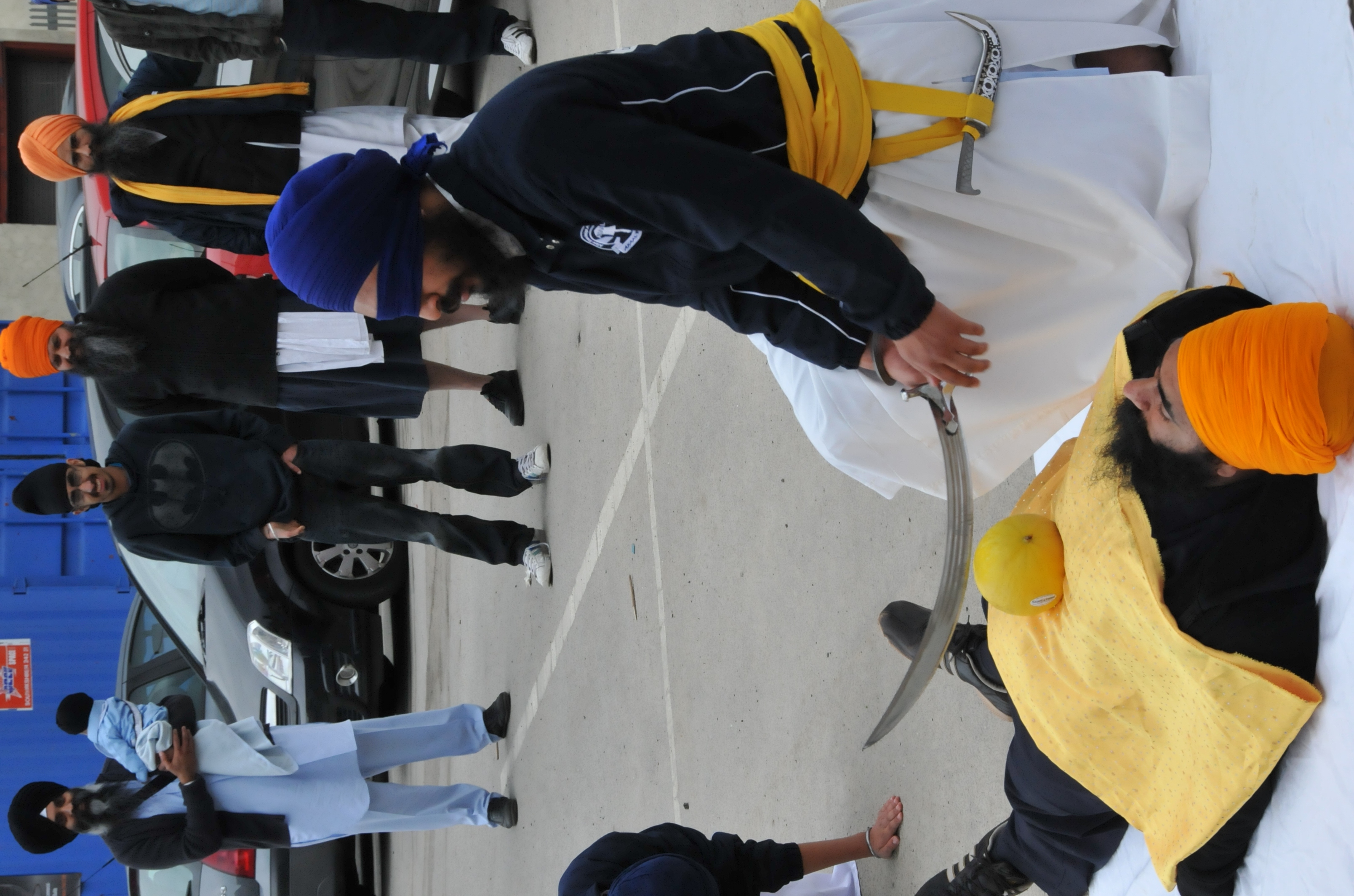
There was a brief performance today, at the Opening Ceremony, of Gatka, the Sikh martial arts by, the Shaheed Bhai Mani Singh Ji Gatka Akhara performers, who have come from UK to perform for the Mosaic festival 2012.
Theirs is a purely volunteer organisation, by dedicated enthusiasts who wish to learn the art for a passion.
The currently visiting group has 9 trained performers, ranging from ages 14-40 years.
The senior most person, is the Pehredar or the guardian, who guards the swords, and there is need to seek his permission before touching the swords.
Sikh martial art, Gatka, is a 500 year old art and is passed on from generation to generation.
Sitting with the group, in the wonderful breeze outdoors, at Celebration Square, their ustad (the leader of the group), Jaskeerth Singh, and shared interesting information about Gatka. He himself began the training at the age of five years, and at seven went in one his summer vacations went from UK to Amritsar for intense 10 week training for the art in DamDami Taksal School which teaches not just the martial art, but also the correct pronunciation of the recitation of the Holy book, Guru Granth Sahib Ji. The Gatka tradition of a martial heritage originated, with Guru Angad Dev Ji the second Guru, who created wrestling arenas, as he wanted the Sikhs to be physically fit. However by the sixth Guru, Guru Hargobind Sahib Ji’s time, it had to be used in the warfare, after his father, Guru Arjan Dev Ji was tortured for a week and eventually martyred. Although the sword use was taught earlier too, but was never brought in practice.
The instruments used in the Gatka are not only the Kirpan, (the sword) and Dhaal, the shield, but for the novice, they use the Sottee, the stick. Another interesting weapon used is a circularly woven ropes called Chakri, which is designed to catch the arrows.
And it is not just a physical display of the sword, but a spiritual training too. Each of their performance begins with a detailed Ardas (supplication prayer) as follows:
Pritham Bhagauthi Simar Ke… (Before we begin, we remember the sword).
Then follows a supplication to God, the sword, and the mention of their 11 Gurus.
This is followed by the narration of Sikh History, their sacrifices and the bravado.
I was particularly inquisitive as to why they mentioned the name of sword, along with that of the God, and not of Gurus, preceding it.
To this the Ustad Jaskeerth explained: “The sword is the giver and taker of life, like God. The concept is hard to explain, but the reverence of the sword, hence, is extremely high. “
They narrated two important stories from the Sikh history related to Gatka, and its use in warfare.
The first story is that of Baba Deep Singh Ji , during the times of Guru Gobind Singh Ji, who used Gatka, in the warfare, to prevent further desecration to the Golden Temple. Prior to going into battle, Baba Deep Singh Ji promised to continue fighting until he freed the Golden Temple from the oppressors. When he came face to face with the Mughal general Jehan Khan, he was beheaded by the general. But since he had promised to go and protect the Golden Temple, he was given, the sword in his right hand, and the head in his left hand, and his started to say Ardas ( prayers), while he continued his battle towards the Temple and beheaded the Mughal general too.
“This is not a legend, but a true story which has been documented by the Mughals too.”
Second story from the history is of Guru Gobind Singh Ji, when in the Battle of Chamkaur; only 40 Sikhs were left to fight a huge army, of 125.000 men. So he deputed 5 Sikh warriors to fight them at a time, until all were defeated.
During the performance of Gatka, nowadays too, they do display this symbolically, by having one person confront many opponents.
Do they allow only Sikhs to join the Gatka group now? “No it is open to all, from any faith or color or community. Despite being used by Sikh Gurus, to defend themselves, and their faith,” he said, “we believe in inclusivity, following the saying s of our Gurus.”
He quoted the Gurus:
“Recognise the human race as one.” Guru Gobind Singh ji.
“There is no Hindu Muslim, we are all from one God. “ Guru Nanak Dev ji.
Not just performing in local Gurudwaras, Jaskeerth Singh said he had taught Gatka in “Royal Armouries Museum too.”
I noticed they have two girls in their group.
“Back in UK, our group has almost same ratio of boys and girls.”
He quoted Guru Nanak dev ji : “Why do we call her bad, when she gives birth to the greatest of Kings in the world.”
Hence, whatever a man, can do, women can do even better.
“They perform the same acts as the boys.”He said, as the two, ladies one his wife and the other the 14 year old youngest member of the group smiled.
“There was a famous woman Sikh warrior, Mata Bhag Kaur, in the times of Guru Gobind Singh ji”, added his wife.
Today they just gave a brief display and look forward to an elaborate performance on Sunday, and want to have 3 brave volunteers from among the audience, as Jaskeerat Singh plans to perform an act blind folded. He wouldn’t share any more details, and insists,
“Please tell everyone to come on Sunday, and watch it.”
With quite a good idea of the background of this, ‘war tested’ Sikh martial art, I know, watching them perform again on Sunday would be extremely exciting.
Hence please do come to watch them on Sunday at 4:30PM, at Celebration Square.
Mosaic Fest 2012opened up on 16th August 2012, in Mississauga Art Gallery, with a substantial poise.
Yes, it was the “Woman of Substance walk”, in partnership with Indiva,a renowned Fashion House from Yorkville.
What was thrilling was the scintillating line of beautiful models, from among the women who make a difference in our Community. With the same poise and grace, that they have walked on the ramp of their professional lives, did these stunning models display the ensembles they were wearing from the renowned South Asian designers like Malani Ramani, Rohit Bal, Satya Paul, Ashley Robello, to name a few, all brought to display courtesy Wendy Dias, of INDIVA.
The models line up of distinguisghed women, merits them all to be acknowledged for their accomplishmnets:
1.Linda Thomas: Ex. Dir. of Mississauga Arts gallery, a grandmom .
2. Indira Naidoo Harris: A journalist, a former Liberal candidate.
3.Shehla Khan: Engineer,with Canadian Nuclear Industry, designed Union Station, TO, and Karachi Airport.
4. Zehra Abbas: Founder, Ex Dir of YGTA, A youth led NPO, mobilising youth for Social Justice through arts.
5. Viera Kononenkova: A financial consultant
6. Angelie Sood: Host on XM Radio, heads a NPO ‘Share your light’ for the underprevilleged children
7. Salima Syereh Virani: Editor-in-Chief of MyBindi, SA hub for arts entertainment and lifestyle.
8.Atiya Khan: An ex-model in Pakistan, and now in direction & production in Canada. Promotes Sufism.
9. Surbhi Guleria Joshi : Co-founder of a Marketting Consulting Firm
10.: Bonnie Crombie: An elected councillor, from Ward-5, a community leader.
11. Anu Vithal : an entrepreneur, and Mosaic festival Director.
A few of them walk down the isle here, without giving any clue to their not being professional models:
Talking later to Bonnie Crombie, the politician, I asked her, “How did Bonnie, the model feel, walking on the ramp?” ‘Well it was an extremely exciting experience, and an honour to be walking down the red carpet, along with other distinguished women from the Community, whose resumes and accomplishments in real lives are far more elaborate than the dresses they were displaying.”Said Bonnie almost instantly.
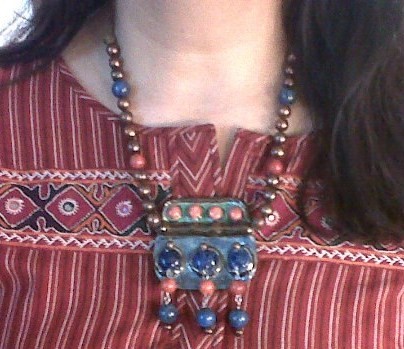
Show casing on the sidelines was the Artist of Mosaic 2012, Misbah Ahmed,displaying her stunning pieces of hand crafted jewellary. It was mostly crafted of porcelain, visibly painfully hand painted, each piece was a unique piece of craft.
“It looks a real hard work”I could guess. “I haven’t slept for a week” said Misbah, modestly.
It was hard to choose, which ones to pick for a photo for the blog, and even harder still, which ones, not to buy. Though I went there as a blogger, but ended up becoming one her clients too.
Mosaic Musaira :
At the other side, the Amphitheatre had An Urdu-Hindi-Punjabi Mushaira,The Azadi Mushaira, by Canadian South Asian poets. They shared their poetry, amids the da’ads ( applauds), on diverse topis from love to peace to humour.
Some of the verses, form very few poets, that I could note down, while being engrossed in their narrations are here:
Sandeep Singh, shared his poem on ‘Aeena’. I share a few verses of his Hindi kavita poem): Tasveer dikhayi deti hai ek, shaksh ki ghar Aaine mein Thoda jana sa lagta hai, kuch pehle dekha aaine mein…….. Shuruaat mein to aksar us se, nazarein mil jaya karti thi Koi baat chubh gayi hai meri, hai nazar churata aaine mein! ………….. Socha ki badal daaloon nata, aise ranjeeda mehmanon se Yeh soch makaan badal dale, par tha wahi wahan aaine mein!
…………..
Uzma Mahmood, who came to Canada from Lahore, in 1993, also a Homeopathic doctor and mortagae agent, narrated: Guzre huwe zamane ke hawale mein reh gaye Ab who tamasha dekhne walon mein reh gaye. Khamosh lab se baat ki tardeed main ne ki Tab unke sab khwab sawalon mein reh gaye. Itna taweel pehle na tha daur-e-intwezar Wade naye visal ke sawalon mein reh gaye. Karbne gaye the Alam-e-arwah ka safr Who log jo asman waalon mein reh gaye. Masroofiyat ne kerne ki taufeeq jab na di Uzma who mere kaam khayalon mein reh gaye.
Poonam Jain Kaslimwal,who works at peel district School board recited her Hindi Kavita: Rat thehri chandni munder pe Poocha main ne, tu kaun desh se aai hai Bata to zara kya koi sandesa laai hai Muskurai, ithlai bole Kyun kya hai koi us oppaar Jo tujhe yaad kerta hai Main ne kaha pata nahin Per sochna bahut achha lagta hai.
Though I had gone there to blog about it, but seeing them recite, I too plunged to recite my poem on India Pakistan peace, in my debut Mushaira.
A few of its verses are:
Nafrat ki gathri ko mein ney Phenk diya hai gireh laga ker Hasrat se ab khol rahi hoon Yaadon bharey iss thailey ko Pyaar ki taaza hawa lagaane Aman ki roshan dhoop dikhane.
Tum bhi aao, kholo apni Saari gaanthein, saare bull Tum bhi apne jholey mein se Bujhe huwe woh deep nikalo Un yaadon ke, un baaton ke Un qisson ke, jo itne zyada Dohratey the jab Nana Dada Chehre unke damka jaate the Ankhein unki chamka detey the….
Film Festival: As part of the Film Festival for Mosaic, with a line up of some really wonderful films, the visitors were treated with Reload and Jab We met.
Think of summers, desi happenings, Celebration Square,Mississauga, and the name that rings almost instantly in one’s head is Mosiac Festival.
Yes, Mosaic Festival 2012, is back for the seventh time, to the city of Mississauga.
Whether it is a revisit of one’s soul to the rich culture of South Asia, sitting thousands of miles away the mainland, or just a free of cost, fun packed, evenings loaded with desiness, Mosaic has them all.
For me personally, Mosaic is a pilgrimage to my ‘desi to the core’ identity.
To my utmost thrill, this very identity through images was the theme of exhibition “Image and Identity”, with which Mosaic has come back in 2012, with a bang.
The photo exhibition of Canada based artists was all about their ‘identity’, as they see it. And was curated by Asma Mahmood, and Ali Adil Khan.
Exactly the way South Asia is a mosaic of various faiths and sub ethnicities, bound loosely by a common culture, the exhibition too depicted the various ways different Canada based South Asians associate themselves to their desi identity-be it through their faith, customs, values or even the social issues unique to the region.
In words describing it, on the exhibition flyer were,
”This exhibition presents images that initiate the dialogue between the particular ability of the art of photography to narrate a story and capture the essence of an image that portrays beliefs, and feelings of the subject and its surroundings.”
Walking through some of the mages, that I could get hold of, you would realise what all I wrote above was just an understatement.
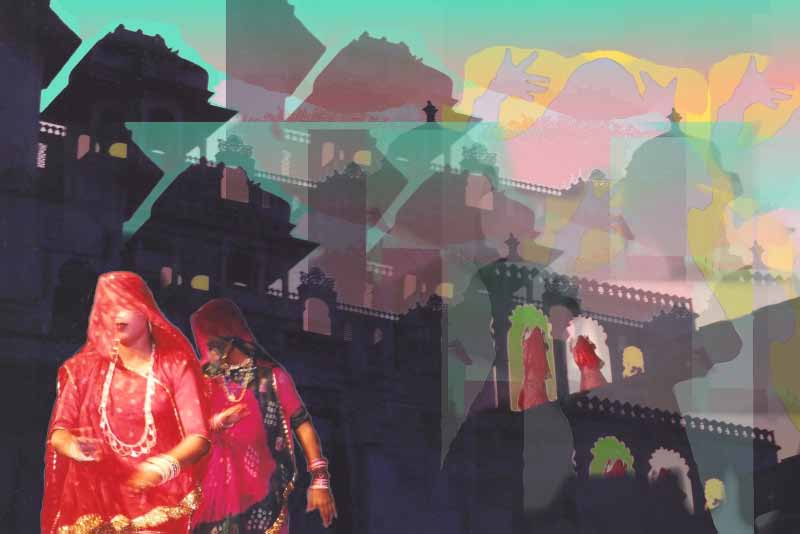
Beginning with the kaleidoscope of cultures that South Asian identity is so intertwined with, is a collage of colors by P. Mansaram:
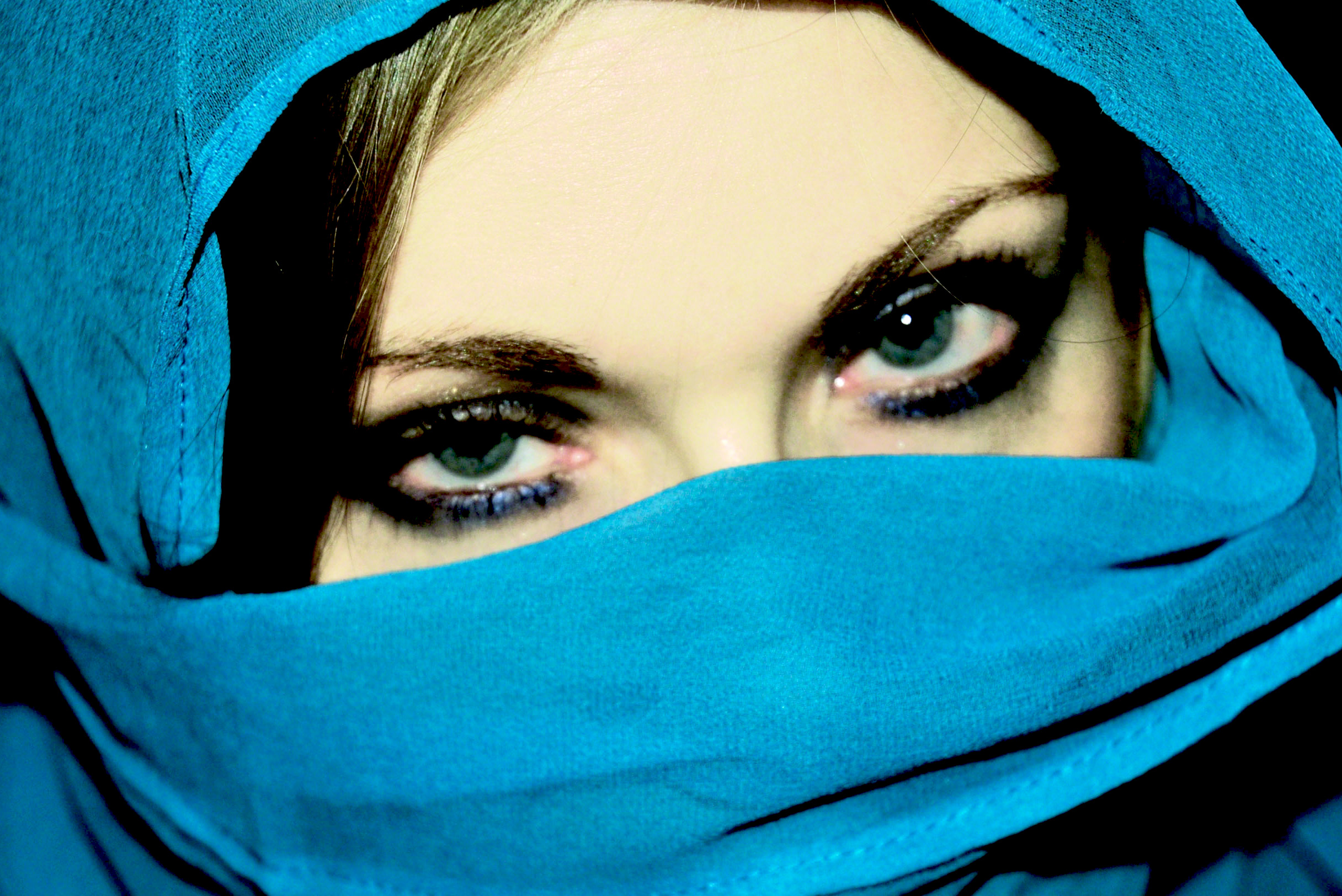
Niqab by Fouzia Baloch, who came to Canada, as an year old infant, and calls herself an ‘evolved and empowered’ woman, but however, could not evade the identity, that millions of women back home are associated with-a veil. The veil could be just the physical cover behind their yet to be realized potentials, or metaphorically a ‘veil of ignorance’ that these women have to their rights as equal humans.
Akshay Batra who is relatively a new immigrant to Canada, reminisces the solace he got while visiting the mountaneous resort of Dharamshala, in North India, which is also home to the Dalai Lama, and has many Buddhist temples. The picture here is of a woman, in the tranquil environs of one of these temples
A Human Cage~ captured in Dhaka by ….. . And the picture here does the speaking, for itself.
No South Asian can evade the reality of horrors caused by the Kashmir Conflict, which has led to 3 wars, numerous conflicts, and hostilities in the region. And here, after a little, uncorrupted, unpoliticed toddler, sticks out a lotus, begging for peace. ‘A Kashmiri boy‘.
Are the two sides listening?
The next series tell a whole story of a million words through images. This is a bitter reality, that cuts across all cultures, faiths and regions in South Asia.
As narrated by Asif Reza the photographer, these pictures are a part of a larger series, he had exhibit in one of the posh art galleries of Karachi, Pakistan.
And to the utter disbelief of the visitors, the pictures he had taken were from a location, merely 100 metres away from the place of exhibit.
The exhibit, he said was to ‘open the eyes’ of the rich and the fortunate to the ‘invisible’ world of the ‘have nots’ who simply co-exist with them. He described the former group as living in their own ‘bubbles’, with apathetic ‘blinders’ on.
Why did he choose children? “Well because it’s their life that matters the most, they are our treasures.”
The smiles on their faces, and the twinkle in their eyes, are only transient. The moment, they will realizes that all that life has to offer them is the ‘ narrow alleys’ of opportunities, under the prevailing circumstances, they would all be gone, only to be replaced by a life full of hopes vanished, and dreams shattered.
Thinking in terms of sheer numbers put together, the 65% of youth ( below 35yrs of age) that constitute our 1.6 billion South Asians from Pakistan, India and Bangladesh, they form a billion strong, almost one seventh of the polulation on earth. If allowed to realize their potential, they could be a tremendous human resource.
One could only wish if some sense could be drilled in minds of the power greedy, that instead of fighting each other, we the South Asians, need to fight the common enemies of ill health, poverty, hunger, inequality….
Sigh !
However, this is just a showcase, that Mosiac took off with. There is a great, more positive part of our desi identities,, including from music, dance, poetry, movies to food, clothes and jewellary that is promised in Mosaic Festival from 16-19 August, 2012.
All of you are cordially invited :).
The heading was the best tweet, I found on #waterkit. ( Courtesy: Urooj Zia).
There have been few moments in my ‘virtual’ life, when Tweets have been so hilarious.
#waterkit hashtag was tragically comical.
Based upon the dialogues exchanged in an epic TV program on this invention, I could not help summarise it this way:
Ye qissa hai Physics key balatkar ka Aur Waterkit se chalne waali ek car ka Jab mil baithe syaane chaar Do minister, ek scientist, ek Engr Waqar
Dikhaya aisa duniya ko chamatkar Petrol , Bijli sub huwe bekaar Karwayein kyun Auto-specialists se inspection Kya kee hai kisi ne pehle aisee invention
Mamoo ban gaye anchors Talat-o-HamidMir Aur Dr AtaUrRehman huwe lakeer ke faqeer PhDiyaan sabki ho gayein fuzool Koora huwe Thermodynamics ke usool
Theory nahin hum practical ko maante hain “Water is H20”, kya aap ye raz jaante hain Wikipedia se hum ne kiya hai confirm H2O se Hydrogen nikalne ka irada hai firm.
Faqat jahalat ki rail-pail hai Sub moh-maya ka khel hai. Duniya hansegi to hansti rahey, Gumrahi ki gari buss chalti rahey.
If seeing this ^^^ picture, your eyes twinkled, lips curved into a wide grin, your mouth began to water and it flashed back the awesome memories of your alma mater, please stand up !
And to those who find the above sentence a gross exaggeration, and cynical, I don’t blame you. For you are an alien to this experience.
To the first group, know you are a Delhiite and more specifically went to DU as a student. And you don’t even need to be explained what DU stands for. But for the latter, btw, it stands for Delhi University .
What fish n chips is to London, or hamburger is to Mc Donalds, this luscious snack is to Delhi. This is the finger food we all relished ( I wonder if they still do) in cramped Delhi University cafetarias, without realising its awesomeness.
Being away from Delhi now for over two decades, the gold test for me to check whoever claims “I am from Delhi.” is the mention of the clue word “Bread Pakora”.If instead of a wide eyed expression screaming ‘wierdo’, the return expression is an instant wholesome grin, you know the claim is authentic. You don’t even need to double check them.
To give you another evidence of my cynical attachment to a bread pakora, it was only for the ‘Bread pakore ki kasam’ tag line, that got me watch, Band Baja Baraat twice.
In the good old simple days of limited pocket money, and even more limited options in the DU cafes, this large sized, yummy snack with a hot cup of chai came in handy and filling in the lunch hour, for an affordable Rs 5/-
Just as in some other part of the world, mustard compliments hotdogs, our austere bread pakora came proudly partnered to even more austere yet yummy Kaddu Ketchup(Pumpkin ketchup). And the two stayed married to each other, no matter how much the arrogant branded ketchups belittled it , on TV ads of our days: “Thora ketcup try karo?” “Ketchup hota kaddoo bhara” “Is mein kaddoo nahin zara, Raseele tamataron se tayyar, Volfarm .”
( If I still remember it correctly) .
Whenever I get into my “Ayy mere pyaare watan, tujh pe dil qurban”mode, all I do is take two slices of bread, spread one with hot chilli sauce, other with green mint coriander chutney, sandwich them with mashed potatoes, or even cottage cheese, cut them in two triangles, coat each of them in a chick pea batter, and fry them. And with a steaming cup of tea, I transport myself back to the DU student days.
Find it weird? No worries, most of my family too, quietly radiates that subtle expression of “Whats so great about bread pakora?”.
But I have learnt to not take notice of them, and not even take any offense.
They know not what they are missing !
Believe it or not, I find it the awesomest finger food, for it carries with it a flavour of my past memories too.
In January 2012, India was declared to have not reported a single case of Polio for over a year. Knowing its vast area, huge population, diverse terrain and socio economic disparity, to have achieved this was a mammoth achievement. My joy of the news was terminated, before it began, when I realised how far Pakistan was from this goal, especially after 173 cases being diagnosed in the past year , and a few almost recently. My heart shuddered to question, “How long would this take Pakistan to reach that goal of being Polio free?”
However June 2012 and early July brought forth a new wave of hope, when the UNICEF’s Regional Director, Karin Hulshoff, wrote in a newspaper of her excitement and optimism with which the work of Polio eradication was progressing in Pakistan. According to a report by a scientific group, there were only 22 cases in the past six months as compared to 58 the same time last year. Owing to the introduction of a new bivalent vaccine, there have been better results, with Pakistan approaching the hopeful day of eradication faster. She stressed that now more emphasis should be given to the coverage of missed cases, or those never vaccinated earlier. “Even one child missed is a lost opportunity to eradicate polio from Pakistan forever”. Hence to not miss any case, the program was geared up everywhere and in the FATA too.
The same time was the case of Dr Afridi for spying came to light. It is sad, media also misreported, and many among the common masses still believe that Dr Afridi was associated with Polio campaign, though the truth remains that he was collecting samples for the hepatitis C virus.
The coincidental increase in the activities of Polio campaign to speed up the Polio eradication, and Dr Afridi’s spying mission led many to misunderstand that there was some conspiracy against the tribal region, through Polio vaccination. There could be no two opinions about abusing the trust of the people on health workers for one’s vested interests. It is extremely deplorable. But should one or more such Dr Afridis succeed in putting the health of 240,000 innocent children at risk?
How about the tribal elders instead, recruit their own trusted workers to give the two drops of Polio to their innocent kids and secure not just the future of kids, but also their own reputation as being concerned and caring for the humanity?
However, the ban by the tribal elders for the July16-18 Polio drive was to ask for a total stop of drones. Drones are a tragedy, and are inhuman, especially the loss of innocent lives of children are deplorable, but to use one’s own children as a first line of defence, and deprive them of their right to be safe from a crippling disease, is as unfortunate. I wish the tribal elders who are genuinely concerned about the lives of their common people killed by drones, understood, if their community stays burdened with ill health, they shall be unable to defend themselves either from extremism or any outside aggression, but also get more isolated in the international community.
Can there be no stronger, yet humanitarian ways to protest for stopping of drones, which does not tarnish the image of the tribal men and women?
Shahid Afridi’s inclusion into the Polio campaign is a welcome, and rekindles the hope to see the dream of a Polio free Pakistan come true, sooner than I had feared. Shahid Afridi has stood up for a great service to his own tribal children. He is a true hero and a true humanist; who has roots from the tribal area. In a tweet he remarked:
Afridi vs Polio @AfridivsPolio #Pakistan is my country and to #SpeakUpAgainstPolioBan is my duty.
At the same time it is hurting to see people of tribal areas being ridiculed ( though rightly so) internationally for their decision
“Oh yes, I see it, polio vaccines for kids and drone attacks, there is a close relation. CRAZY! #speakupagainstpolioban.”
Or see the decision as illogical:
“Its like cutting your own hand as your protest against a theft, or lashing yourself against the fornication by a foe.”
Another tweep saw how the decision is ultimately going in favour of the aggressors who are being protested against:
They are killing children through drone attacks and these people are trying to make their children crippled for life. It is fulfilment of aggressor’s interests both ways.
Children from the tribal areas are as dear to us as anywhere else in Pakistan. We dream of seeing them Polio free too, and be healthy in every way. We are equally hurt at the drones attacks on the innocent.
I repeat, there can be innumerable stronger ways of protest to make international community notice the aggression and causalities caused by drones, instead of making innocent humanity, whether by killing the health personnel or innocent human beings, or depriving the children of Polio vaccine, a symbol of their protest. This simply leads to tragic loss of credibility and lack of sympathy from the international community. The image of the fellow Pakistanis living in tribal areas, including their elders being tarnished by such decisions hurts, because we know they are as human as any one of us, in Pakistan.
At the same time politicians across the board, remain criminally silent to the issue. Even the kids are not spared now, from being used as bait for political agendas.
However, I insist I still dream for a Polio free Pakistan from Karachi to FATA.
Think Taj Mahal, and to an average Indian, what comes to mind is the information one imbibed during the school about the Mughal Emperor Shah Jahan, and that he had built it in the memory of his beloved wife Mumtaz Mahal. One is also reminded of some’ facts’ that we read in our school history text books i.e. It took 17 years for the construction to complete ( though Taj website info claims that it took less than 10 years), and the misplaced myth that once the architect had completed the construction, his hands were chopped off by the emperor so that it could not be replicated again. However there is no historic documentation of this myth. In fact, there is reference which suggests the contrary.
For foreigner visitors, be they Westerners or from anywhere on the globe, first thing they wish to see when they land in India, is Taj Mahal. For them it is a marvel piece of architecture that symbolises India. A purchase of its mini replica made of alabaster, as a souvenir is mandatory.
However, for the locals, many are superstitious about keeping a replica of TajMahal at home. Some consider it a Mausoleum, while others believe it brings bad omen. Ironically the monument which is known as the most romantic symbol of love in the world, is perceived by the superstitious to have brought bad luck to both Shah Jahan who commissioned it and the architect who designed it.
Many neither superstitious nor romantic, associate it with ShahaJahan’s obsession with extravagant and lavish life style. It is said that the time Taj Mahal was being built ( 1632-1648), Americans were laying the foundation of a great Ivy League institution by the name of Harvard University ( 1636 estb). Hence obvious were the priorities between the two parts of the world.
The fact that the Mausoleum was built for love of Mumtaz Mahal, who died while delivering her 14th baby, at the age of 39, also compels many to question ‘what kind of love was that?’
To many indifferent to above issues, it remains as one of the Wonders of the World. It was in 2001 that New 7 Wonders of the World inititative was begun, and after nearly 100 million votes cast the world over, Taj Mahal was chosen as the top of the New 7 Wonders of the World. However, in 2007, after controversies, form various ends, UNESCO withdrew its support from the initiative.
My personal experience of TajMahal , visitng it as a grown up, was quite unexpected. Having visited a few times in childhood, I did not feel anything special. Hence while visiting again, as an adult, I had expected nothing different.
We entered the initial premises with surroundings made of sand stone.
“Why is there no marble here?” I wondered while standing in a queue.
There was a thorough pocket search at the entrance, where we had to even dispense away with any chewing gum in the pocket.
It was aound 2 PM, and the sky was overcast, with soft sunlight filtering through the clouds.
As we walked through the gates, there suddenly stood in front of us a mesmerizingly pearly white monument, as if being held on a giant palm instead of the raised platform. It looked like an imagination materialised, and an illusion made visible to the open eyes. And it indeed, appeared to exude the four letter word ‘love’, on whose foundations it was said to have been built.
Beside its merits architecturally, even to my ordinary eye, the first glimpse was hypnotising. The eyes stared for a while without a blink.
As we walked towards the raised platform, it began to rain and got really heavy. As we drew closer, the Taj got bigger, but hazier through the curtain of heavy rain, as if receding into an illusion, shying away from reality. The elusive hazy silhouette began to cast a spell even more.
The slippery rounded edges of the marble stairs up to the platform were a challenge to climb when wet.
In about half an hour, heavy down pour stopped, after having washed off the dust over the marble exterior. As the faint rays of sun reappeared, the washed marble began to glow like the glistening face of Mumtaz Mahal must have been, after coming out fresh from a bath. I instantly, in my wild imaginations, began to correlate the flawless beauty of the King’s beloved Queen , to this marble monument he built for her. He sure must have attempted to match his two loves together—the Taj with the Queen.
Rest of the experience within the Taj interiors were as if walking live through a dream.
Although the overcast sky prevented us from watching it in the full moon, that is usually is offered on four days in a lunar month. But from the experience in rain, am sure the experience in a moon light night must certainly be exponentially far more bewitching.
A friend recently messaged this interactive beautiful video of the Taj, and it instantly brought back the recollections of my own experience.It gives a kind of 3-D effect of the Taj, and helps those who have yet to witness it live, share a tiny fraction of my experience visually.
Please click below to see the interactive video: A MUST SEE >>






 Blind to Bounds
You must be logged in to post a comment.