“A woman cannot use contraception without the husband’s permission.”
I wish men ever got pregnant and had to raise children the way mothers do to realize what a travesty of injustice this clause by Council of Islamic Ideology, Pakistan is. It should be the other way round….men must have the permission from women for not using contraception.
There is little consolation that contraception is not an ‘as big an issue here like in Catholicism'(as often compared by the apologists), but if Allah (SWT) allows it, I am sure the Almighty has granted this right to women knowing they are the ones who bear the children in their wombs and raise them. Making husbands be the police over contraception is injustice and no where in any holy texts can this be found. Why is it a rocket science that this is simply a patriarchal attempt by opportunistic men to control women?
Having worked in a conservative community in Makkah, Saudi Arabia in the field of ObGyn/Family Medicine for 14 years, I know exactly what this means.
Here is a true story, which I remember even the details of.
A 40/41 year old woman with 5 children, eldest in his late teens came to me asking for contraception. After discussion on pros & cons, she decided to choose a pill that was appropriate for her age. Half an hour later, her husband, in early 60s banged the clinic door open and showed me the medication in his hand asking: “What is this?” I told him “This is a medication for women.” Him: “Is this contraceptive?” Me: “Yes.” He threw it in my dustbin and warned me that if I prescribed a contraceptive again, he will complain against me. He closed my door back and I was later told that he dragged his wife to the car pulling her by her head scarf.
An year and a half later, the woman had a new baby.
Three years after the child was born this man suddenly died of brain hemorrhage at 67. The lady was left with 6 children, 2 of them not even in their teens. And she was the second of the three wives he had left behind. I saw her all the years, until I left the job, and I know in how much misery this woman in her mid to late forties was going through raising children as a widow on 1500 Saudi Riyals stipend as a widow.
(BTW this is one of several stories I personally encountered).
It is easy for men to dictate not to use contraception but it is extremely hard for women to raise children when men take decisions but do not follow through with responsibilities arising out of it.
Decision to bear children and their number must ideally be a joint responsibility. The woman must have a voice in that decision making instead of being forced upon her.
Weddings are not complete without the wedding songs in any community. “Kaahe ko byahi bides” in Braj dialect by Amir Khusrau is an extremely popular wedding song in the northern Indian subcontinent. There is hardly any wedding where this song is not sung by the women. Since these verses are passed on from one generation to another by word of mouth, every singer picks and chooses different stanzas and sometimes with variance in vocabulary in the verses. I have tried to collect the different verses, and there may still be other lesser known verses too. Shall appreciate if you will share if you have any different ones in the comment box.
It is a plea from a daughter to her father explaining how she is one of the dispensable objects from their household. Through metaphors, though seemingly simple, she makes a gut wrenching comparisons with herself. Every stanza of the song merits a deep appreciation of that comparison in a different way.
Khwaja ji,
Sun li hamre jiyara ki peerh, Ankhiyaan se bahe hai neer.
Khwaja listen to the pain in my heart, While from my eyes flow out tears.
Kāhe ko byāhe bides? Arre lakhiyā` bābul more? Kāhe ko byāhe bides?
Why did you marry me off to a alien land? O’my wealthy father,
why did you part me from you?
Hum to bābul torey, bele kī kaliyā`. Arre ghar-ghar mānge hai` jāye. Lakhiyā` bābul more
Kaahe ko byahe bides. We are just flower-buds from your garden, Every household asks for us.
O’my wealthy father,
Why did you part me from you?
Hum to bābul tore angan kī chiṛaiyā. Arre chuge, piye, urr jāye.
Lakhiyā` bābul more
Kaahe ko byahe bides.
We are just birds from your courtyard We peck on food, drink and then fly away
O’my wealthy father Why did you part me from you?
Hum to bābul tore, khūte kī gayīyā`. Arre jid haanko hakjaaye. Areh lakhiyā` bābul more
Kaahe ko byahi bides.
We are just your tethered cows,
we have to go wherever you drive (send) us.
O’ my wealthy father
Why did you part me from you? .
Tākh bhārī me`ne guṛiye` jo chhoṛī. Arre to chhoṛā saheliyo` kā sāth. Lakhiyā` bābul more
Kaahe ko byahe bides.
I’ve left at home alcoves full of dolls, and parted from my childhood friends too. O’ my wealthy father
Why did you part me from you?
Mehala` tale se dolā jo nikalā. Are bīran ne khaayi pachhād. Lakhiyā` bābul more
Kaahe ko byahe bides
When my palanquin passed beneath the mansion, My brother fainted and fell. O’my wealthy father, why did you part me from you?
Doley ka parda utha ker jo dekha Na babul na babul ka des reyy Lakhi babul morey Kaahe ko byaahe bides?
When I lifted the veil of the palanquin There was neither father, nor fatherland, O’my wealthy father Why do you part me from you?
Bhaiyā ko diyo bābul mehala do mehale. Areh ham ko diyo pardesh re. Lakhiyā` bābul more
Kaahe ko byahe bides
You gave, two-storied houses to my brother And to me, you gave a foreign land. O’my wealthy father, why did you part me from you?
Ghar se tou kayila hum ke vida, Arre Jiyara se na kariyo judaa, Lakhiyā` bābul more
Kaahe ko byahe bides
You are sending me away from home, Separate me not from your heart, O’my wealthy father, why did you part me from you?
Khusrau kehat hai`, Aiy merī lāado. Arre dhan dhan bhāg suhāg re. Lakhiyā` bābul more
Kaahe ko byahe bides.
Khusrau says, O my darling daughter – May your marriage be blessed with everything. O my wealthy father, why did you part me from you?
There are multiple classical and folk versions sung by countless singers. Few of my favorites are here:
A different and very interesting version I found is this sung by Habib Painter >
Waise tou dastoor hai ye purana, Pii ki nagariya hai dulhan ko jaana Kehtey hain Nabi aur Khusrau ka kehna Doley ka parda utha ker jo dekha Aya paraya des reyy, ache babul more Kaahe ko byaahi bides, ache babul more…
کافر عشقم، مسلمانی مرا در کار نیست ہر رگ من تار گشتہ، حاجت زُنار نیست از سر بالین من برخیز ای نادان طبیب دردمند عشق را دارو بہ جز دیدار نیست ناخدا بر کشتی ما گر نباشد، گو مباش ما خدا داریم ما را ناخدا در کار نیست خلق میگوید کہ خسرو بتپرستی میکند آری! آری! میکنم! با خلق ما را کار نیست
Kafir-e-ishqam musalmani mara darkaar neest
Har rag-e mun taar gashta hajat-e zunnaar neest;
Az sar-e baaleen-e mun bar khez ay naadaan tabeeb
Dard mand-e ishq ra daroo bajuz deedaar neest;
Nakhuda dar kashti-e maagar nabashad go mubaash
Makhuda daareem mara nakhuda darkaar neest;
Khalq mi goyad ki Khusrau but parasti mi kunad
Aarey aarey mi kunam ba khalq mara kaar neest.
Translation:
I am an infidel of love: the creed of Muslims I do not need;
Every vein of mine has become taunt like a wire,
the (Christian/Magian) girdle I do not need.
Leave my bedside, you ignorant physician!
The only cure for the patient of love is the sight of his beloved –
other than this, no medicine does he need.
If there be no pilot in our boat, let there be none:
We have God in our midst: the sea we do not need.
The people of the world say that Khusrau worships idols.
So he does, so he does; the world he does not need.
The singer: Janki Bai(1880-1934) was a celebrity singer of her times in Allahabad. She has 150 song records to her credit in the early years of gramophone. More about her here > http://scroll.in/article/729320/why-singer-jankibai-of-allahabad-was-always-associated-with-the-number-56
The word Nowruz meaning New Day, is the most anticipated and favorite celebration for Persians. It occurs exactly on the Spring Equinox. This occasion has been renowned in one form or another by all the major cultures of ancient Mesopotamia. Sumerians, 3000 BC, Babylonians, the ancient kingdom of Elam in Southern Persia and Akaddians in the second millennium BC, all celebrated this festival. What we celebrate today as Norooz (Also spelled Now Ruz, Norooz or Norouz) has been around for at least 3000 years and is deeply rooted in the rituals and traditions of the Zoroastrians of the Sassanian period.
It’s no secret that Persians love any excuse to celebrate. But of all the many reasons to celebrate, Norouz, The Persian New Year, is by far the most important and dear in the hearts of Iranians around the globe. Literally translating to “A New Day,” Norouz marks the first day of Spring (March 21st) and the beginning of the year in the Persian calendar.
Originally a Zoroastrian holiday, Norouz has been celebrated for at least 3,000 years. The most significant aspect of Norouz is the fact that it is a non-religious and non-ethnic celebration. Norouz brings together several hundred million diverse peoples spanning from Iran to northwest China, India and Central Asian republics,Turkey and Eastern Europe, Iraq and westward to Egypt; all celebrating this joyous holiday which represents new Beginnings, and the start of Spring.
Sofreh Haft Seen
In harmony with the rebirth of nature, the Persian new year celebration starts on the first day of Spring, illustrated by a beautiful spread Haft Seen:
A symbolic illustration of Norouz is the “Haft Seen” (Persian translation of “Seven S”), a ceremonial table spread, including at least seven items whose names start with the letter “S” in the Persian alphabet; hence the name “Haft Seen” or “Seven S”. The spread itself is usually a beautifully crafted and decorated fabric such as “Termeh.”
At the specific time of Vernal Equinox (when the sun is observed to be directly over the equator) which varies every year, the family gathers around Haft Seen holding hands. At the moment of transition into the New Year or “Sal Tahvil,” family members embrace each other and eat a sweet…for a sweet year! This is followed by exchanges of “Aydi” (cash gifts exchanged) and having the traditional new year dish “Sabzi-polo and Mahi” (herbed rice and white fish).
The Most Common Haft Seen Items:
Sib (Apple): Red apples representing health and natural beauty.
Sabzeh (Sprouts): Wheat, barley or lentils sprouts growing in a dish,
symbolizing the fertility of the land in the Spring and the rebirth of nature.
Samanu: Common wheat sprouts are transformed and given new life as
this sweet and creamy pudding, representing the reward of patience.
Sir (Garlic): Displayed in beautifully decorated dishes, garlic represents
good health, and is believed to chase away evil spirits.
Sumac: A popular Persian spice used as a symbol to wish for some zest
in life in the new year.
Senjed (Oleaster): The Senjed or wild olives represent love and compassion.
Sombol (Hyacinth): Hyacinth is placed in the Haft Seen to signify the beauty
and fragrance of Spring, and the rebirth of nature.
Sekkeh (coin): Coins representing wealth and hopes for prosperity.
Serkeh (vinegar): The vinegar also placed in a beautiful bowl or decorative
container is a symbol for maturity, and the wisdom and patience that comes
with age.
Other items not starting with letter “S”, but included because of their symbolic
meaning and cultural significance include:
Mirror: The mirror is usually set at the top center of the Haft Seen,
representing self-reflection.
Candles: Lit candles are more commonly set on each side of the mirror
and represent enlightenment and happiness.
Gold Fish: One of the most fun traditions of Norouz is buying the gold
fish for Haft Seen. The gold fish are used to represent joy and movement.
Holy or Poetry Book: Religious families will often place their holy book
in the center of the Haft Seen. Others opt for famous poetry books such
as Divan of Hafiz or Shahnameh.
Eggs: Usually, one for each member of the family, artfully decorated eggs
are used to represent the human race, as well as, fertility.
Sweets: Traditional Persian sweets are another popular item for the Haft Seen.
The pastries are a symbol for a sweet life and are meant to be eaten
during the celebration.
Seville orange: Floating in a bowl of water, it represents the earth
floating in space.
Haji Firouz (Persian: حاجی فیروز / هاجی فیروز – Hāji Firuz) or Khwaja Piruz (Persian: خواجه پیروز – Xwāje Piruz),[1] also spelled Hajji Firouz, is a fictional character in Iranian folklore who appears in the streets by the beginning of Nowruz. His face is covered in soot, and he is clad in bright red clothes and a felt hat. He dances through the streets while singing and playing a tambourine, and is the companion of Amu Nowruz(“Uncle Nowruz”).
(Source & further details: here >> https://en.wikipedia.org/wiki/Hajji_Firuz).
Lyrics: Beškan Beškan Beškan beškan e, beškan! (It’s a snap-snap, snap!) Man nemi-škanam, beškan! (I won’t snap, snap!) Injā beškanam, yār gele dāre (If I snap here, this one will complain) Unjā beškanam, yār gele dāre (If I snap there, that one will complain) In siāh e bičāre če qad howsele dāre! (How patient this poor man is!)
Bonfire:
People traditionally jump over bonfires, shouting “Zardie man az to, sorkhie to as man,”which means “May my pallor be yours and your red glow be mine.” The flames symbolically take away the unpleasant things from the last year.
Following is my favorite song Nasim-e-Farvardin( The breeze of Spring) by Marzieh , an ode to arrival of Spring:
As my fascination and exploration of war art continues, and I discover one powerful artwork after the other, this piece is one of the earliest and is considered as one of the most impactful of art pieces of its time.
The Apotheosis of War (above) was painted by Vasily Vereshchagin in 1871 as an aftermath of a war. The painting in oil on canvas depicts death, destruction and devastation symbolized by skulls, vultures, barren trees and deserted town in the background. The painter inscribed on the frame: ‘Dedicated to all great conquerors, past, present and those yet to come.’
A closer look:
Vasily Vershchegin was one of the most celebrated war painter of his times in Europe and Russia. In an exhibition in Berlin in 1881, a German Filed Marshal visited his exhibition. As Vasily brought him to this painting, the Field Marshal did not like how war was depicted in the painting. He issued orders to his soldiers to not see the exhibition. Austrians and his fellow countrymen Russians were also deeply offended. He was banned to exhibit and even to publish pictures of his art in books. In anger and frustration he burnt down three of his paintings.
Vasily wrote on war: “Does war have two sides – one that is pleasant and attractive and the other that is ugly and repulsive? No, there is only one war, that attempts to force the enemy to kill, injure, or take as many people prisoner as possible, while the stronger adversary beats the weaker until the weaker pleads for mercy.”
Horrors of war obsessed him. “I loved the sun all my life, and wanted to paint sunshine. When I happened to see warfare and say what I thought about it, I rejoiced that I would be able to devote myself to the sun once again. But the fury of war continued to pursue me,”
He travelled far and wide, and painted avidly on nature, beauty, humanity, miseries and oppression. In 1884 he travelled to India and painted ‘The Mausoleum of Taj Mahal’. The painting not only reflects Taj’s beauty but also succeeds to capture the tranquility the monument exudes when seen in real life.
Notice the facial expressions and body language of each of these 4 individuals seen in the picture. Try to guess what could be the story, before you read the context.
The email said: “Abdul Raheem, an Afghan soldier who lost both his hands in war, received a pair of hands from Joseph of Kerala who had suffered brain death. Joseph’s wife and daughter are looking at the hands that once caressed them. The transplant surgery was performed by Dr Subramanian Iyer (blue shirt) of the Amrita Hospital, Kerala.
A Hindu doctor – a Christian organ-donor – a Muslim recipient. This is #humanity.”
“We do not need guns and bombs to bring peace, we need love and compassion.”
― Mother Teresa
A cold, wet, February night in Canada for #LongestNightPeel made me appreciate what #homelessness means and what the homeless go through, physically and emotionally, every day, every night. Sleeping in the car, there was loneliness, it was cold, it was wet, there was limited space, there were lights flashing from outside and passers by were peeping in. And it might as well have been dangerous too if we did not have 5 cars parked next to each other.
We are blessed we all had warm homes awaiting us, loved ones praying for us, friends sending text messages for strength and family eager for us to come back safe in the morning.
Lone homeless humans who sleep in cars or huddle in sleeping bags in public spaces, on pavements don’t have that luxury of accompanied cars for company or for safety. And they are pushed from parking lot to parking lot by security guards as it is against the bylaws to park your car after hours or to sleep in public places. They don’t even have loved ones praying for them or concerned for them, and there are no warm human arms or hearts or beds to return to.
As I lay there, the clocks slowed down, giving an endless opportunity to ponder on the mysteries of creation, on how equal opportunities remains just a good idea and the burning question on why Father Fortune favors some and not some others? It brought home the power of phrases, “to be in others shoes” and “how blessed we are”.
It was an experience of a life time. Now, every day as I will sleep in the warmth of my bed, it will have a different meaning. Gandhi’s words,“Poverty is the worst form of violence.” will haunt even more.
Thanks to United Way of Peel Region family that gave me this opportunity to experience what is hard to imagine otherwise.
With more power to the kind hearts who strive beyond petty divides of borders, beliefs, skin color, ethnicity etc for a just, safe and inclusive world, I salute you all. ❤
Context:
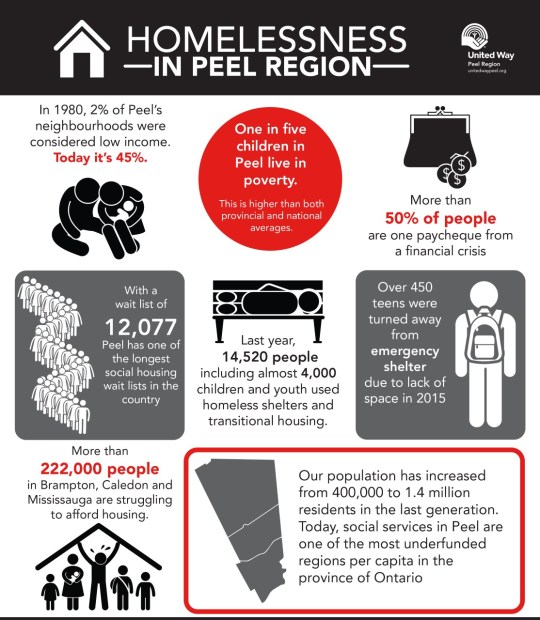
Some hard stats on poverty and homelessness in Peel:
There is acute shortage of shelters for the homeless in Peel Region, Ontario, Canada. 450 youth are refused a bed each year. In order to raise awareness against homelessness, to ask for more government support to shelters, to push for policies that alleviate poverty, develop affordable housing and to raise funds to support programs for the homeless, United Way of Peel Region organized #LongestNightPeel Initiative. Sixty community members slept in their cars on February 19, 2016 and have so far raised over $51,000, while the funds are still being collected. Peel Community is compassionate and generous, they heard our appeal. With yet another step towards a diverse yet inclusive Peel…
I end with a quote from Gandhi: “Whenever you are in doubt or when the self becomes too much with you, try the following experiment: Recall the face of the poorest and most helpless person you have ever seen and ask yourself if the step you contemplate is going to be for any use to him or to her … Then you will find your doubts and your self melting away.”
I bandage my heart with a woman’s patience in adversity.
I bandage it with the upright posture of a Syrian woman who is not bent by bereavement, poverty, or displacement as she rises from the banquets of death and carries on shepherding life’s rituals.
She prepares for a creeping, ravenous winter and gathers the heavy firewood branches, stick by stick from the frigid wilderness.
She does not cut a tree, does not steal, does not surrender her soul to weariness, does not ask anyone’s charity, does not fold with the load, and does not yield midway.
I bandage my heart with the determination of that boy they hit with an electric stick on his only kidney until he urinated blood. Yet he returned and walked in the next demonstration.
I bandage it with the steadiness of a child’s steps in the snow of a refugee camp, a child wearing a small black shoe on one foot and a large blue sandal on the other, wandering off and singing to butterflies flying in the sunny skies, butterflies and skies seen only by his eyes.
I bandage it with December’s frozen tree roots, trees that have sworn to blossom in March or April.
I bandage it with the voice of reason that was not affected by a proximate desolation.
I bandage it with veins whose warm blood has not yet been spilled on the surface of our sacred soil.
I bandage it with what was entrusted by our martyrs, with the conscience of the living, and with the image of a beautiful homeland envisioned by the eyes of the poor.
I bandage it with the outcry: “Death and not humiliation.”
A 75 year old Syrian Christian lady from Hama, works with my friend’s home as a cook. Apart from the fact that she makes amazing Syrian food, my friend has employed her to support her financially. Not sure how she came here(as I have not interrogated her), but I know my friend worked hard to get her husband from Syria. The old man was served two deportation orders failing to obtain asylum until about six months ago, the Canadians accepted his application after he was diagnosed with lung cancer. The gentleman is going through treatment now here in Canada.
My friend is also working to get her widowed daughter, with two sons 21 and 22 years old who are stuck in Syria. Her daughter’s husband had died in Syria 3 years ago from some medical ailment, failing to get treatment. My friend is working through a nearby mosque she attends to raise funds to call the family as privately sponsored refugees.
Each time I meet her and inquire about her daughter and sons, she has only sad stories to share, of their struggle back home. According to her is no employment, no school and no medical care available where they live currently.
The dedication with which she cooks in my friends house is touching, knowing how hard it is for her own close kin back home.
In my endeavor to look for how Syrians at home and abroad are coping with the conflict, I have been referred to some very creative Syrians who are expressing their pain and agony through various artforms. This only bears witness to the amazing intellect in the Syrian nation, caught in a filthy regional hegemony war.
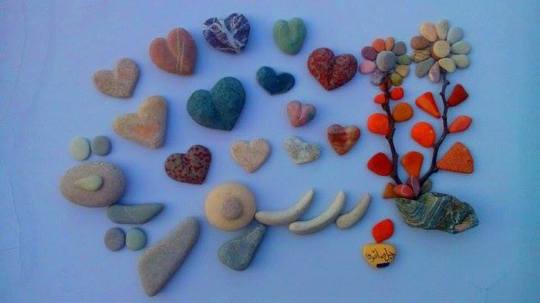
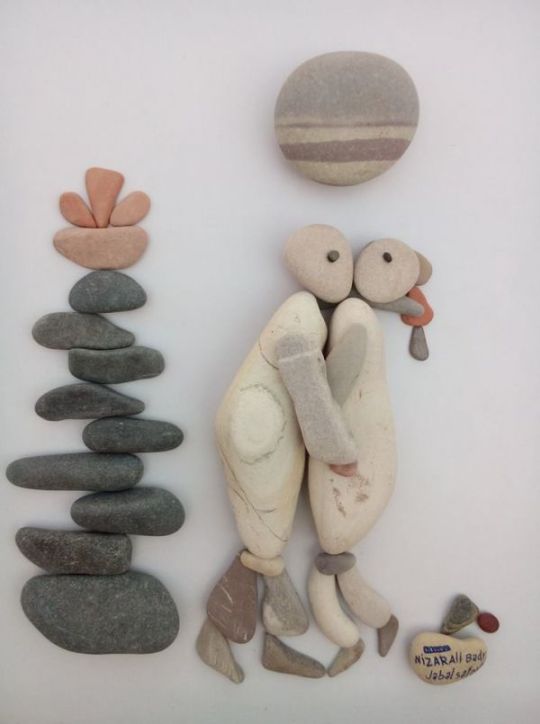
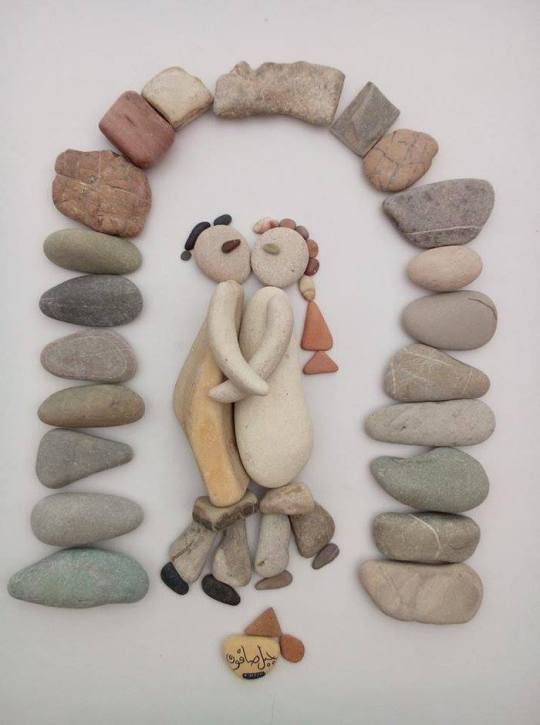
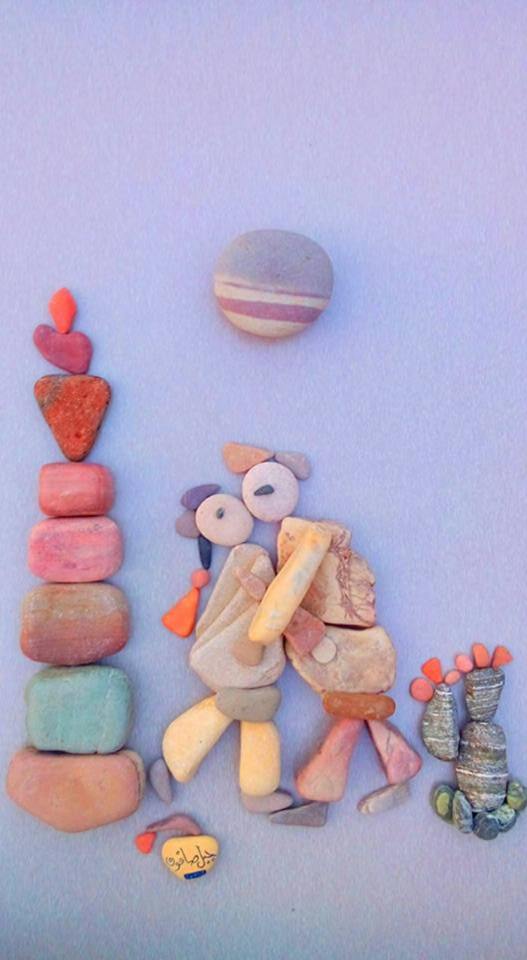
Nizar Ali Badr a stone sculptor from #Latakia, #Syria now residing in Turkey makes stones sculptures telling #Syrian story of torture, war and refugees.
Simple assembly of stones speak of the complex emotions, which words would fail to convey at times.
In his words: “I love dust and stones from.Syria. My message is a humanitarian message.”
Some of his works that portray peace and love are also extremely pleasing.
They say miracles do happen and stones do speak. May these powerful stony expressions somehow turn into prayers for peace in Syria.
Amen.
Last week we welcomed in an event three Syrian families who had barely arrived 48 hours ago. Their weather beaten faces were all glowing with smiles.
I asked a 7 year old girl, “What do you like best in Canada?”
She replied with the widest possible grin, “The warmth.”
I thought she meant the hospitality.
Her mom explained with a twinkle in her eyes, “We were living in tents for 2 years. She grew up not knowing that in extreme cold there can be clothes thick enough and home warm enough to avoid cold weather.”
I hugged the mom tight.
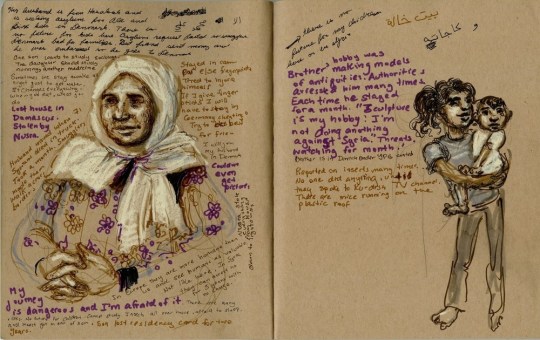
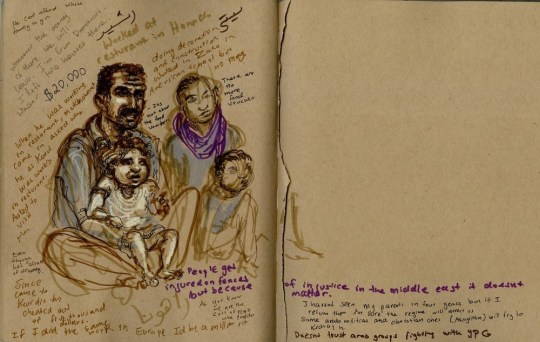
Below are a few mind blowing illustrations of Syrian Kurds by Molly Crabapple, a medical illustrator by proffession. Molly had gone to work with Doctors Without Borders in a Kurdish Syrian Refugee Camp. She illustrated not only their images but also their dreams and fears in words.
Every piece is like reading a novel, that touches somewhere deep. Kindly take time to read the small print too.
For past 5 years, I thought we had been a brave family to have immigrated to far away Canada. We came with a comfort of enough preparation in spirit and in kind.
Never in my mind did I imagine I would be working closely in different capacities for refugees from Syria. The experience of meeting and getting to know some of them has been an incredibly humbling experience.
Refugee was only a word we had often heard and thought understood it’s meaning very well. Knowing its implications, and associating names and faces to this word has been an experience that struggles to find adequate expressions in words.
May Canada and we Canadians be a source of peace and warmth to these new Canadians and all those that arrive in weeks from now.








 Blind to Bounds
You must be logged in to post a comment.