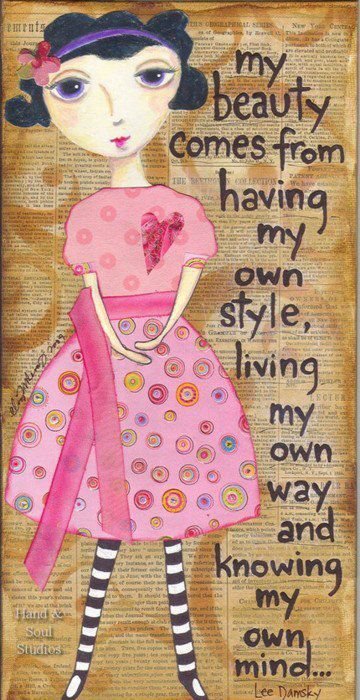
Open up your mind and your potential reaches infinity…

Archive for the ‘Women’ Category

Are we lollipops?


It is a matter of pride that I was born a girl, despite knowing very well how tough life continues to be for women from birth till their death, and from east end of the globe to the west.

From parental upbringing  to interaction outside, from  house chores to professional job, from  status at home to  dignity at work, women are given second class treatment in most places. We form more than 50 % of the whole world’s seven billion, but still struggle to make ourselves being perceived as more than an object.

Whether in the name of faith, culture, or physical vulnerability, women are shown their worth  merely as an Adam’s rib.

A few days ago , I came across a picture which got me nauseated.

It had an  added  caption ” Would you like to be a covered lollipop or an exposed one?”

And to add more to my horror, many women and girls seemed to be nodding in agreement with their comments.

Do we really have to compare ourselves to lollipops ?

Does a lollipop have a mind of it’s own ?

Does a lollipop become a scientist like Marie Curie or a Prime Minister like Benazir Bhutto or an astronaut like Kalpana Chawla ?

Do lollipops even become strong caring mothers, supporting wives or sincere friends ?

But we women folk do. So we better stop this idiocy about covered or uncovered lollipops, please.

Everyone has a right to choose what should one wear, or not to wear, and so does a woman, whether she chooses to wear a hijab or not. Many women willingly  choose to wear it as a part of their religious duty. But there are many who go for  it because they consider themselves safer wearing one. Sadly, that is a myth.

If it was just exposure, or physical attraction, which made girls vulnerable, why would girls as young a ten years, two years or even six months  be abused, molested or raped ?

It may make one feel less exposed physically, but the real safety comes from a strong mind. A strong mind comes from awareness.  And awareness comes from quality education.

It is naïve to expect that things will change, only when men will change. They need to change too, but if women get empowered, men will change themselves.

If women really wish to make women abuse a history, they need to empower themselves with right education and independent thinking.  And then they need to pass on that information to other women folk .

Challenging oppression does not mean to be a rebel. It does not mean to hate men folk, nor does it mean to detest womanhood. It simply means to have your own mind and stand on your own two feet, with hijab or without.

P.S. In this  16Days of campaign of Violence  against Women, try to teach at least one weak woman to become strong  through Education, for herself and for her family. 

Domestic Violence and helplessness


Here are three stories from my experience, which I personally saw growing with time.

They all had two things in common.One, that they were all  classical examples of domestic abuse, and secondly, that I was helpless in being of any help to them.

Ahmed was a 55 years old Pakistani man living in the neighbourhood. We did not know his wife for months, till when he once asked my husband if I could see her, because she was pregnant and had some complaints. Zubeida, his wife came to visit me as a patient.

With a toddler in her lap, she seemed way younger than her husband. After several visits it was revealed that she was his second wife and almost 25 years younger to him and he had married her 3 years ago. Ahmed had lived in US in his youth and married a local there. They had 3 kids and were together for 12 years after which they got divorced. He moved to the Middle East and ran a restaurant there. Now decided to marry Zubeida, from his clan, who had been a widow with three young children. So parents married her off to Ahmed, a well off businessman, while her three children, 6, 4 and 1, ( when she married) were being taken care by her parents. By the second marriage Zubeida had a 2 year old boy and was now pregnant again.

On being asked, that I never saw her in the neighbourhood, she revealed that when her husband went to work, he put a lock outside the house. And that she was instructed to not talk to anyone in the neighbourhood and tell details of their life. She wasn’t allowed to have a domestic help either.

She confided that she missed her little kids who were in Pakistan. She barely talked to them once a month because her husband didn’t like when she cried while talking to them on phone. She hadn’t seen them since she came  there, three years ago. Her husband insisted that now she should be content with the kids that she is having from him.

On being informed that this was ‘abusive’, she justified that her husband had suffered a lot at the hands of that American woman, who claimed half of his property at divorce, and took away the custody of the kids. And hence, his trust on women has been eroded.
“He always provided me with good clothes, and if I did not cook, he brought food from his restaurant.”

She said her parents were happy that despite having been widowed with three kids, she was lucky to have found a nice husband. So they do not like when she complains that she misses her older kids. She also did not want to be Thankless to God for the same.
After she delivered, I never heard from her until she was pregnant again for the third time.

Misbah (a local ), was a doctor herself.  She had married a Mutawwah (a mullah) , as his second wife, making all the justifications and necessary quotations from the religion for her act. And also narrating the virtues of marrying a religious person. Despite all the warnings from all of us at work, she went ahead.

For six months, it was sheer honeymoon for her, and she was the most obedient a wife could be. If he asked her to quit her work in the middle to see him, she would throw a sick leave and go. If he demanded her to cook something in the middle of the night, she would comply happily, for she thought she had to win his heart, over the first wife.

It was heartbreaking to see a bold friend of ours lose all her personality all of a sudden. News that she was pregnant transcended her to the seventh sky.

Six months into her pregnancy, she was devastated to discover her husband married a third time. On protesting, her husband stopped visiting her. She again resorted back to the same vicious cycle of pleasing him to draw his attention in competition with the other two wives. And the demands to please him kept multiplying exponentially. The extent his demands were such that if she talked on telephone for longer than his liking, he would leave and go to one other wife.

The complaint that, “she wasn’t paying attention to me”.

And so dutiful was he, that he never shared a penny from his own pocket with our friend, and possibly with the other two wives too, who were all working women.

We cried ‘he’s abusive’, but she wasn’t ready to accept it.

Her simple argument, “He never hits me, and that it is my duty to please my husband”.
We were left helpless.

Saira was a Indian nurse, who had come to work in the gulf. From the first month of the marriage, she handed over every penny of her salary to her husband. They were to save money to buy a land back home. Even a small demand of a dress, would need her to beg him for hours before he complied. And when they did buy the piece of land it was in his name.

For Saira, it was “Okay, because he is the man of the house. “

However, 12 years after their marriage, her husband fell in love with her own best friend, and they got married secretly. When Saira came to know, she was pregnant with her second child. From then on, she refused to hand him the salary, and this is where her physical abuse began.

Putting a brave front, she refused to comply. So his next demand was that she quit the job. She almost left the job, until we all colleagues intervened and convinced her not to.

She did ultimately, but the cycle of physical violence kept on unabated. Our cries to the people of authority were of no avail, for it was justified to have more than one wife and she was unreasonable, in being angry about it. Hence, his resorting to physical violence was justified.

Saira was unwilling to take any step to walk out on him because despite all the miseries, she still “loved him”.

Saira’s family, too, was of the opinion, “Men are all like this, women have to bear it always. “

These are just a handful of stories, from the barrage of incidences of domestic violence I have come across during my work experience.

For most women, if they were not being hit, they were not being abused. Emotional, financial or any other form of violence except physical was no abuse.

Unfortunately, in most of the cases it was the ignorance or denial on the part of sufferer, or the cover given to it through religious or cultural practices, or lack of the necessary infrastructure to lodge a complaint, that one felt helpless and miserable seeing these women continue to suffer.

And to tell you the truth, with them, I suffered too.

PS: The names of the women have been changed.

Next Blog to follow soon: Myths and Facts about Domestic Violence

Alf Leila O’Leila ~Um Kulthoom


The opening lines of this 45 minute song are:

Ya Habeebi,
My sweetheart.
Illeil wi samah, wi ingomo iw amaro, amaro wi saharo.
The night and its sky, its stars, its moon, moon and keeping awake all night.
Winta wana, ya habeebi ana, ya hayati ana.
You and me my sweetheart, my life.

-And the closing lines:

Ya habeebi yalla in3eish fi 3yoon illeil, . Winool lilshams ta3ali, ta3ali ba3di sana, mosh abli sana.
My sweetheart let us live in the eyes of the night and tell the sun come over, come after one year not before.
Fi leilate hob hilwa, bi alfi leila iw Leila, 
In a sweet night of love, in one thousand and one nights.
Bikolli il3omr, howa il3omri eih ghair Leila zayyi illeila.
They say it is the life. What is life, but a night like tonight, like tonight.

Fortunatley I grew up listening to Umm Kulthoom  and the tales of her live performances from my Professor father. I saw my father 90% times surrounded by books, but whenever he played Umm Kulsoom’s audios on the deck, in his leisure time, it was hard to envision he was the same man. I feel the poverty of expression to describe my feelings…

He would often exclaim that he got three things from his stay in Cairo in the early sixties—his PhD, a knowledge of Arabic, in the flawless Egyptian accent and love for Umm Kulsoom.

In the  1950s and 60s her concerts were broadcast once a week  on Radio.

“On Thursday nights, the streets of Cairo would empty as people gathered around radio sets to hear the great singer.”  I heard my father repeat this a countless times said with a twinkle in his eyes.

And infact, in honour of those broadcasts, Radio Egypt still broadcasts her songs every first Thursday at 10 pm.

It is hard in words to describe her charisma.  But listening to her enchanting Enta Omri,  Alf Leila o Leila and other songs over and over,  it wasn’t hard to imagine the euphoria that was created in her concerts.

Umm Kulthum was, indeed, a master at casting a spell over her audiences.

Maker of a documentary on her, ‘A Voice Like Egypt ’ Virginia Danielson says “Umm Kulthum’s concerts were famous for the spontaneous cheers that would break out whenever her performance seemed to close the gap between poetry and emotion. Poetry is a deeply revered art form in the Middle East.”

She gives an example. “When you hear Umm Kulthum sing, “I’m afraid your heart belongs to somebody else,” in the song “Ana Fe Entezarak,” she nails that anguish.  And the way she treats the word ‘somebody else,’ which is ‘inse’en,’ is just heartrending. You can hear the feeling of the poem come through in the way that she sings it.”

Her music had a unique quality called ‘tarab’ ( best translated as enchantment).

“Tarab is a concept of enchantment,” Danielson says. “It’s usually associated with vocal music, although instrumental music can produce the same effect, in which the listener is completely enveloped in the sound and the meaning in a broad experiential sense, and is just completely carried away by the performance.”

Part of tarab is the idea that listeners are as important as singers; that there’s a powerful, spiritual exchange between them that is crucial to the performance.

“But what it refers to is the experience of really being carried away by the music. People would tell preposterous stories about getting up and leaving the house and not knowing where they were going, and just all kinds of experiences of completely forgetting your troubles, completely being outside yourself, having been transported by the experience.”

Bob Dylan remarked; “She’s great. She really is. Really great.”

She was referred to as the Lady by  Charles de Gaulle and  Salvadore Dali, Jean Paul Satre, Bono were among  her fans.

Lastly, do envy me for having been nourished on this music since very young :).

Heart Health presentation at Aurat Health Services for South Asian Community


A Heart Health presentation done on behalf of  Aurat Health Services ffor the South Asian Community at CPR and AED Event, Mississauga, Ontario.

Why can’t most men understand this ?


Looking through the e-papers from the subcontinent, it is hardly ever a day when some incident of rape is not reported. Be it rape of a medical student near the bus stop in New Delhi,  a doctor on duty raped after being drugged in Dera Bugti, a minor girl raped by her dance teacher in Bombay, a girl partying with friends in the posh areas of Karachi, a woman gang raped on the order of a local jirga, in Muzaffargarh.

The scenarios differ, cities differ, but the crime remains the same. The mindset remains identical. Age is no bar. Infancy upwards, one finds all age groups being the victims.

Unfortunately this is one situation which sees no barriers of age, color, creed or class, the world over..

Rapes are on the rise in the subcontinent, too.

The statistics do the speaking here…

In 2010, 489 rape cases were reported in Delhi, India  while 459 in 2009.The figures given by Delhi Police reveal that a woman is raped every 18 hours or molested every 14 hours in the capital.

Similarly in Pakistan, Human Rights Commission of Pakistan, estimates “every two hours a woman is raped in Pakistan and every eight hours a woman is subjected to gang-rape. Another report I came across claimed that at least 100 rapes are committed in Karachi alone everyday according to Additional Police Surgeon (APS. (http://www.freerepublic.com/focus/f-news/2083578/posts).

Needless to say,  majority are not even reported, and just a handful get punished, on either side of the border.

When this is the statistics of two megacities, one can fathom what would be the situation in the other places.

It was worse still to hear responsible men of these cities pass heartless judgements on rape and its victims..

In mid July, Commissioner of Police, Delhi advised women going out late night should be accompanied by a male or a driver, to avoid the risk of being raped.

I remember as a  child, in Delhi asking a friend of my fathers who was a senior police officer, ‘Uncle what do you do ?” And he had replied, “Beta, we protect you and others  in the city.” Probably he was just bluffing.

Almost at the same time , a video circulated on the social network,  in which Karachiite, Munawwar Hussain, the Emir of JI, in a TV interview, surpassed all these responsible individuals and commented that since bringing 4 witnesses for rape is next to impossible, it is better to ‘keep shut’ ones mouth and eyes, on the crime being committed. When the anchor attempted to argue, he simply totted at him the emotional gun of ‘denying’ the writing of Quran. The apathy in his talk and body language for the rape victim was appalling.

Not just our men, but their men also fail to understand…

A few months ago, a police officer from Toronto and a Russian priest from Moscow, had ‘advised’ that women should not “dress like sluts” or “wear miniskirts”, respectively, if they want to avoid rapes.

Not leaving behind  London in this race, Kenneth Clarke, the very justice secretary in UK, passed yet another piece of judgement that the rape committed by unknown offender is a ‘serious’ rape while implying that those committed while on a date isn’t. When the anchor interjected “rape is rape”, he replied: “No it is not”.

I wish all these men of responsibility knew the ‘secret’ of why the rapes occur?
It is certainly not because a woman was dressed so, or walked alone on the street late at night, or was attending a party with her friends. No certainly not. Rapes occur because some men want to rape. Yes it is that simple.

And why would these ‘some’ men want to rape ?
This has a simple answer too., Rape is the culmination of a series of systematic experiences that a boy is exposed to, from infancy to manhood—in which he is told, with or without so many words, that he is stronger, and a woman is not just weaker, but a commodity.

How I wish, more than anything else, these responsible people knew what does rape mean to a woman?
Rape is not merely the breach of a woman’s physical privacy, but is followed by cascade of short- and long-term problems, including physical injury and illness, psychological symptoms, economic costs, and death (National Research Council 1996).
In a summary, a rape victim is an embodiment of a severely disturbed and dysfunctional individual for rest of her life, unless properly rehabilitated.

So long as such a mindset persists, the legislation to punish rape would never be a deterrent.

We need to look towards primary prevention of this crime rather than just struggle for appropriate punishment after a case gets highlighted.

We have to empower our girls with ‘right information’ and break the barrier of rape being a taboo issue in front of these ‘innocent’ minds. It is these innocent minds which make them an easy prey.

A girl should be taught to be assertive. As one of the self help sites on rape prevention says: “ Look up as you walk and stand up straight; pretending as though you have two big panthers on either side of you as you walk may sound silly, but it can help boost confidence. Attackers are more likely to go for those who they think cannot defend themselves.”

They should also be told that over 90% of the perpetrators are known to the victims, even if it is an uncle, a cousin or a friend, if she feels the touch as uncomfortable, she must trust her gut and not let it continue.

Moreover, if we cannot change the mindset of our grown up men, we can at least guide our young sons to respect women and not consider them a commodity that is ‘available’.

Use of neo cortex, a sign of evolution, entails men to be able to restrain their behaviours and train their minds that nothing can be forced upon any woman, without her free will.

For those who cannot change their mindsets, a real need for harshest of punishments to the rapist as a mode of learning is mandatory too.

Till the healthier minds grow up, fear of punishment should be the real deterrent against this heinous crime.

Dr Ilmana Fasih.

A scene from the slutwalk in Delhi in July

I am a Woman~by Helen Reddy~Music without borders


I Am Woman

-Artist: Helen Reddy from “Helen Reddy’s Greatest Hits”: EMI ST 11467
-peak Billboard position # 1 for 1 week in 1972
-Words and Music by Helen Reddy and Ray Burton

I am woman, hear me roar
In numbers too big to ignore
And I know too much to go back an’ pretend
’cause I’ve heard it all before
And I’ve been down there on the floor
No one’s ever gonna keep me down again

CHORUS
Oh yes I am wise
But it’s wisdom born of pain
Yes, I’ve paid the price
But look how much I gained
If I have to, I can do anything
I am strong (strong)
I am invincible (invincible)
I am woman

You can bend but never break me
’cause it only serves to make me
More determined to achieve my final goal
And I come back even stronger
Not a novice any longer
’cause you’ve deepened the conviction in my soul

CHORUS

I am woman watch me grow
See me standing toe to toe
As I spread my lovin’ arms across the land
But I’m still an embryo
With a long long way to go
Until I make my brother understand

Oh yes I am wise
But it’s wisdom born of pain
Yes, I’ve paid the price
But look how much I gained
If I have to I can face anything
I am strong (strong)
I am invincible (invincible)
I am woman
Oh, I am woman
I am invincible
I am strong

FADE
I am woman
I am invincible
I am strong
I am woman

History of the song:

“I am Woman” reached #1 on the Billboard charts in December 1972. The song was the first #1 hit on the Billboard chart by an Australian-born artist and the first Australian-penned song to win a Grammy Award .In her acceptance speech for Best Female Performance, Reddy famously thanked “God, because She makes everything possible”.

It sold more than a million copies, and has been played more than a million times on US radio.

National Organization for Women founder Betty Friedan was later to write that in 1973, a gala entertainment night in Washington DC at the NOW annual convention closed with the playing of “I Am Woman”. “Suddenly,” she said, “women got out of their seats and started dancing around the hotel ballroom and joining hands in a circle that got larger and larger until maybe a thousand of us were dancing and singing, ‘I am strong, I am invincible, I am woman.’ It was a spontaneous, beautiful expression of the exhilaration we all felt in those years, women really moving as women.”

To Reddy, the song’s message reaches beyond feminism. “It’s not just for women. It’s a general empowerment song about feeling good about yourself, believing in yourself. When my former brother-in-law, a doctor, was going to medical school he played it every morning just to get him going.”

Source: http://en.wikipedia.org/wiki/I_Am_Woman

The cost of crossing the ‘love’ border ~Indo-Pak Visa Part 2


Published in Aman Ki Asha blog by The News/Jang Group on August 03, 2011 http://www.amankiasha.com/detail_news.asp?id=509

For years after the Indian Consulate in Karachi was closed down, a cousin of mine (an Indian married to a Pakistani) whose parents live in Jaipur, followed the following trail year after year. She would travel from Karachi where she lives, to Islamabad to obtain an Indian visa. If successful, she would travel back to Karachi to pack up. She and her family would then travel to Lahore by train, and cross the Wagah-Atari border. They would then take a train from Amritsar to Delhi and then another to Jaipur. With 3 children, she could not afford air travel every year. 

The entire ordeal required her to travel over 4600 kilometres and several days in summer vacations, when in reality, the smallest distance between Jaipur and Karachi is only 1066 kilometres (through Khokrapar Munabao) and the train journey is just a 3-4 hours long.

I understood the real nightmare of this struggle some years ago when I had to travel from Karachi to Islamabad to get a visa for my father-in-law for his medical treatment in India.

My husband and I sat outside the Indian consulate in Islamabad for two days, sharing benches with people who had mostly come all the way from Karachi or Hyderabad. Most had been sitting there every day from 9 am to 5 pm for as long as 15 to 20 days at a stretch. The majority appeared to be daily wage earners, the poor and with no resources to take short cuts, like us, to obtain a visa – we had the parchi (‘slip’) that would expedite the visa process.

A lady and her husband, a carpenter hailing from Lalukhet in Karachi, had been sitting there every day for almost 20 days, from morning till the consulate closed in the evening, without any clue about whether they would be granted a visa or not. The embassy issues a limited number of visas each day. Names come up on a given day, their luck as unpredictable as a lottery. The more resourceful among the applicants jump the line, pushing these poor people to the back of the queue.

This couple had spent so much money on the travel from Karachi to Islamabad that they could not afford even a cup of tea from the tea stall outside the embassy, which caters to visa seekers. Every day the carpenter and his wife brought with them homemade rotis and pickle for lunch. I asked the woman how long she would sit there, and she replied with certainty: “When the money runs out, I will go back home whether I get the visa or not”.

She had applied after hearing that her mother was on her deathbed and had asked to see her one last time. She had been married for over twenty years but had been able to visit her native Hyderabad, Deccan, only once, and that too 12 years ago.

Her marriage had been a stroke of fate when her husband, a cousin from Pakistan, visited them. The poor family had been facing tough times, and found this as opportunity to make their daughter’s life better, as the cousin’s family was more prosperous. (How was she duped into marrying an already married man is another story for another time). 

This story is all too common to many families in the lower middle class strata who marry across the border; their girls are hardly able to visit their parents a handful of times in their lifetime, mostly due to not being able to afford the time, expenses and resources involved in obtaining the visa.

They resign themselves to their fate and learn to live with just memories of home. It is only when another sibling is about to get married; or a parent is ill; or dying, that they gather all their means and courage to try to obtain a visa to go to their erstwhile homeland.

The procedure has been somewhat modified now, so that people in other cities can apply for Indian visas through a courier service, without having to travel to Islamabad. But applicants still have no idea how long the process will take. A friend who wanted to attend her parents’ 50th wedding anniversary celebrations in India received a reply after an anxious six month wait, saying that her application papers were incomplete. Some don’t hear any news for a year or more; others don’t get any response at all.

Over the last two decades I have seen a see-saw situation. Things seem to move towards easing the procedure, then suddenly something occurs and the whole change is reset from the start.
A silver lining is that the Khokrapar-Munabao line, suspended since 1965, has been revived, reducing unnecessary distance for many.

I hope and wish that the latest news about easing of the borders does not remain restricted to the artists who travel on exchange programmes or businessmen attending conferences, but is extended to this voiceless, resigned group of poor, invisible women who marry across borders. I am afraid they are the group most likely to be forgotten when the categories are laid down for easing visa procedures.

Most will never be able to raise their own voice and will resign to their fate of seeing their parents or first of kin, barely a few times in their entire lives, after they cross the ‘love’ border in matrimony.
On their behalf, I beg the authorities concerned to hear the silent wails of these women and to ease the visa process making it easier for them too, so that they may see their parents and families more often.

Ilmana Fasih

The writer is an Indian gynaecologist and women’s health activist, married to a Pakistani. She blogs at https://thinkloud65.wordpress.com/

Cross-border couples and their visa travails ~Indo-Pak Visa Part 1


Published in Aman ki Asha blog The News/Jang Group on July 27, 2011

“A marriage license doesn’t come with a job description or a set of instructions. There is definitely some ‘assembly’ required. In fact, putting together a marriage can be likened to assembling an airplane in flight” – Patricia Love

Every marriage needs a lot of reassembling in social, psychological and emotional terms. But when marriages take place across the Indo-Pak border they also involve a lot of political reassembling.

Indo-Pak marriages are different from other cross-border marriages – such unions between people from these two neighbouring countries are far tougher and more challenging than marriages across oceans between people with vast cultural differences. The distance between India and Pakistan does not entail crossing oceans or even cultures but one has to cross huge mountains of hurdles in terms of legal and bureaucratic formalities.

With the pendulous political love-hate relationship that exists between the two countries, marrying and staying happily married across the border (‘pyar border paar’) is no small feat. It takes a tough mind and resilient heart to brave the challenges.

There are personal challenges involved in every marriage. But the additional challenges in Indo-Pak marriages include taking certain decisions which may be painful. As a patriotic and a proud Indian, it was hard for me to surrender my Indian passport and apply for a Pakistani. Not that I had any grudges against the latter, but to give up your national identity is an experience you have to live, to know how it feels.

You might ask why would an educated woman change her nationality? The answer is simple. No one coerced me. I did it for the desire to have a peaceful family life and for the sake of our children (who were to arrive later).

My British, Canadian and Filipino friends married to Pakistanis live without any problems in Pakistan, using their original passports. But for an Indian this is not possible.
I did quite a bit of homework before taking this life-changing decision. I knew of instances where people in this situation had retained their nationalities, leading to many practical and political challenges. Most of them advised me to swallow this bitter pill and make the change, but finally, it was entirely my own decision.

In Pakistan, the ID cards of both parents are required to obtain documents for children like B-form, passport, and ID card. A mother with an Indian passport would mean inviting trouble, with more errands from office to office, or one section officer to another, to get ‘no objection certificates’ or NOCs.

Obtaining a visa to visit family across the border is any case a Herculean task if you don’t have connections in the high offices. And for a family like ours living in a third country I would, if I had maintained my Indian nationality, have to go through the gruelling process of obtaining a Pakistani visa each time we were to visit Pakistan. By giving up my nationality and becoming a Pakistani, I thought at least we have to struggle for the visa on one side only, when my children and husband want to visit India.

Unfortunately, my having been a born Indian, lived there for 23 years, and having parents still living there, does not mean that my husband and children will be given any extra consideration when they apply for an Indian visa. I know this is also the case for Pakistani women who are married and live in India. The visa policies work on a reciprocal basis.

Our visa troubles are not a once in a while exercise, but an annual struggle. The struggle which I have been undertaking for the past twenty years, almost each year, to visit my ageing parents exactly the way any married woman aspires to visit her family. As the time nears for the visa application, I always shudder with the apprehension of “What if…”

Families like ours have no choice but to face this ordeal every time they want to visit ‘home’. Visas may be sometimes facilitated and expedited for artists going on a cultural exchange or for businessmen but the procedure, the requirements, the scrutiny, the hurdles are all exactly the same for people like us. We have to stand in the same queue as those applying for a visit visa for a conference or meeting (there is no ‘tourist’ visa between our two countries), to visit to meet distant relatives once or maybe twice in a lifetime.

Each time I stand in front of the visa submission window of the Consulate of the country where I was born, which I still love and own as I did then, I feel as if I am being punished for my audacious decision to marry across border. My counterparts across the border must be feeling the same, I am sure.

Once, I was exceptionally lucky: I obtained an Indian visa while sipping a cup of coffee in the office of the Consul General, when the Consulate was in Karachi. The CG turned out to be my father’s student. We followed the usual application procedure of course, but he expedited it. Then, as we left, a plainclothes official intercepted my husband and asked for our purpose of having visited the CG’s room. He said that our car’s plate number had been noted and that we must not repeat this again.

All told, in the 21 years of my marriage I have been lucky that despite the hurdles and the painful waiting times, I have not faced any serious disappointments in ultimately obtaining a visa for India.

The only time I faced a major setback was after the Kargil war, when tensions were so high that I could not visit my parents for three years, despite running from pillar to post, pulling various influential strings. Then, not even ‘high connections’ were willing to go out of their way to help me. However, for a vast majority of women from India married to Pakistanis, especially those living in Pakistan, it is by no means a smooth sailing.

Ilmana Fasih

The writer is an Indian gynaecologist and women’s health activist, married to a Pakistani. She blogs at https://thinkloud65.wordpress.com/

Poems by Attiya Dawood


Picture by Abro Khuda Bux

Here’s a translation of some poems by a Sindhi feminist poet Attiya Dawood

A strange woman in the mirror

The strange woman in the mirror, what is she thinking?
I ask her: what is it? She avoids me.
I paint my lips red, she begins to sob.
When I look her in the eyes, she asks me questions
which are even more strange.
Home, husband, children….. I have all that makes up happiness
But I don’t know what she wants.

If Only I knew Nothing

The experienced mind understands everything.
If I keep all my thoughts with me
And put them under lock and key,
Clever eyes come to know everything.
I should put the glasses of ignorance on them.
My sensitive heart
I should refuse ever to consider
All the observations and experiences of the past
Inscribed on my mind
I should wipe it away.
My intelligence becomes a curse for me…
If only I knew nothing.
Holding your hand
I would have continued walking in a dream.
Whatever stories you told me
I would have listened on like a child.
Taking my mind as your kite
You could have given me any direction, any wind
And I would have obeyed.
My intelligence becomes a curse for me…
If only I knew nothing.

A bone-weary truth

Truth is the basis of my creation.
No matter how many times in the name of truth
My being was chopped and cut,
Each time like the amoebae,
Every piece of the portioned-off being
Has become a being by itself.
Whenever I was put on the scaffold in the name of truth
Each time I have taken a new birth,
But this dying and being born every minute
Has made me bone-weary.
I want you, my friend
To take away my being from the cross.
Come in front of me,
Whisper sweet nothings in my ears,
Turn the shackles of hypocrisy
into bangles for my hands,
Love me with such a crushing deceit
That my soul not be able to bear it
And free itself
From my tired being.

About the author:
Attiya Dawood is a voice from the goths and villages of rural Sindh. It is a voice of pain and harrowing anguish. As a rural Sindhi woman she finds deprivation everywhere: she faces oppression piled on oppression. As a woman, oppression of women by men, as a Third World woman, oppression and exploitation by the advanced capitalist countries. As a rural woman she is marginalised in favour of the voice of the first person singular – I, but they are not autobiographical the events written about are not necessarilly drawn from her own life. The poems may be considered a form of dramatic monologue in which she assumes the voice and persona of a suffering woman and articulates the anguish arising out of some concrete situation.
English translations are by Asif Aslam

Source: Courtesy Abro Khuda Bux
http://attiyadawood.com/

I love Red, for Red is Me.


I love red,
For red is me.

Red is the embarrassment
I bring to your face, mother,
By the news of my arrival
Putting  at stake your survival.

Red is the blood that is spilled,
When my dreams are killed,
As I am returned to my tomb
While still asleep in the womb.

Red is the roaring rage
That gets out of cage,
By my sins that bring, father,
A shame to your ‘honour’.

Red is the anger that
Descends in your eyes, brother
When I whisper for my rights
Or spread my wings for a flight

Red is the bundled bride I am,
When passed off as a parcel
From one man, my father
To another, my life partner.

Red is the dot of vermillion
Stamped on my forehead,
That is  for the world to see,
That my man, you own me.

Red is the blush on my cheeks,
A million words of my candor it shrieks
My man when your lust you quench
While in the fantasy of love I drench

Red is the fire set ablaze,
When a truck load of dowry
Fails to fill, my master
The castle of your greed.

Red are the bruises that scream
Of my battered self-esteem,
From the circle of abuse, my protector
You inflict on my being.

This is exactly why I love red,
For every shade of red is me.

Foot note: Dedicate these scribbled verses to millions who face gender discrimination from the day their birth is mourned, to millions more lost through Female feticide, honor killings, victims of violence against women, rape, and any or every form of abuse endured merely for being born a woman.