Open up your mind and your potential reaches infinity…

Archive for the ‘Social Issues’ Category

Stress~the silent killer


You are not alone. Stress is a phenomenon affecting all people from all walks of life, in all countries.

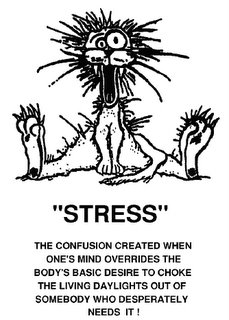
Stress is man’s psycho-emotional response to everyday challenging issues and its overload of demands, in excess to his capacity to cope.
What causes stress? 

Stress can  be caused by multiple reasons that occur in everyday life,  like  unexpected turns and twists in career, relationship problems in family or outside, financial losses, fear of disease or death, even a small tiff with near and dear ones may cause stress.

As goes the saying, “There is no stress either before birth or after death”

How does stress affect us?

The manifestation of stress depending upon its intensity or duration. It begins in the head, but descends down to affect the whole body. There can be a healthy body only when there is a healthy mind. It may manifest outwardly as:

  • Insomnia
  • Involuntary weight loss or gain
  • Irritability
  • Anxiety
  • Anger/ Rage

Stress being silent operator, most people do not realize that they are dangerously living with it, till they suffer from its grave after affects.
And when prolonged without intervention can lead to serious issues like:

  • Bodyache/Backaches ( all pains seem exaggerated in stress)
  • Asthma ( not all but some asthmatic attacks are result of psychogenic stress)
  • Hypertension
  • Stomach ulcers
  • Diabetes
  • Heart (cardiovascular) diseases.
  • Depression
  • Suicides.
Studies show: Stress is a major contributing factors either directly or indirectly, to coronary artery disease, cancer, respiratory disorders, injuries due to accidents, cirrhosis of the liver and suicides.

DO YOU KNOW?  

One American is reported to be dying every minute due to stress related cardiac arrest. The medical costs due to direct or indirect consequences of stress alone have been estimated in the United States at well over 1 billion US dollars per year.

A person tries to commit suicide in China every two minutes, giving the country one of the highest suicide rates in the world. These have positive correlation with high intensity stress, owing to an ultra modern life style in a highly competitive environment.

What should you NOT do during stress:

 Smoking
 Drinking too much
 Overeating or under eating
 Long hours in front of the TV or computer
 Withdrawing from friends, family, and activities
 Using pills or drugs to relax
 Sleeping too much
 Procrastinating
 Keeping toobusy to avoid facing problems
 Taking out your stress on others (lashing out, angry outbursts, physical violence)
 Carry your office work or stress at home.

KNOW THAT: “Anger is an acid that can do more harm to the vessel in which it is stored than to anything on which it is poured.” ~Mark Twain

How to control Stress:

The key principle to follow in case of stress would be to ignore what cannot be controlled and to control what cannot be ignored.

Face the music: For managing stress there can be two approaches ‘fight’ or ‘flight’. Either face the music or escape it. You cannot wish away stress. It is and will be an integral part of modern and increasingly competitive society.

Stay in control: Do not let the stress to control you. Keep stress under check through will power, proper cultivation of mind, cultivation of positive psyche and meditation.

Be an optimist: Optimistic outlook, cheerful temperament, positive attitude, cultivating sympathy, self discipline, all help to keep mind in good shape. Session with God can be a kind of divine-de-stressor.

Eat Healthy: By having a healthy diet, doing regular exercise, and getting enough sleep your body will be able to cope with the stress.

Move forward: Do not needlessly get tied to the past, get over hangover of the last night and start the morning with a hope for a bright day and brighter tomorrow.
Think of pleasant past, enjoy your present and plan for a future with cheers.

Be a home pigeon: Make home your love nest, where office does not exist. Parents, wife, children are your love companions. Reserve Sundays and holiday for spending time with your loved ones, for relaxation and recreation. Your family is the last line of defense against stress.

Tickle your funny bone: Include humor in your life. Laugh away the oddities of life.

Love yourself: Have a me time. Listen to music, see movies, read favorite authors, cultivate hobbies.

Be a social animal: Invite friends over at home, eat together, laugh together, spend week ends or vacations out with friends.

BOTTOM LINE: You can yourself pose to CALM down stress, what ‘CALMPOSE’ cannot do. 🙂

This text of this blog is generously contributed by Dr Raminderjit Singh. Thank you, Doc 🙂
A closer look into polygamy


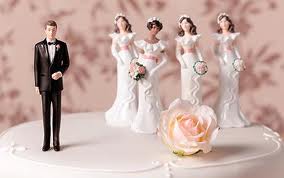
P.S: This piece is written purely as a  personal observation on personal impact of Polygamy on the lives of women concerned, without judging the theological, or general social implications of Polygamy.

I was raised by a father, who for some personal reasons intensely hated the idea of even teasing one’s wife for another ‘shaadi’. He insisted this was a sadistic joke.

And with this in the background I landed as a newlywed in a place where ‘other’ wife  was not only talked about with much thrill, but polygamy was quite often practiced in real.

Several times in the beginning I was snubbed for my disapproval of it, by the pious, for it being allowed and mentioned in Islam  in so many words- one, two, three or four.

One of the relatively polite friends explained; “See in their society, this is the norm, so they don’t mind. I know of co-wives living in absolute harmony. Since we are not used to this, we find it strange and get critical.” This coming from a non judgemental, desi friend born and bred in west, I had no reason to doubt.

For the first few years, as a stay home Mom of two little kids, all I heard was the men’s side of the story. In a very matter of fact, non threatening manner, my husband would tell me the juicy comments that were hurled at him. “Young, handsome man, with only one wife, look at me I’m 65, and have three.”

Age was no bar, and talking of multiple wives or of planning to take more was the favourite ‘boy-talk’, more so for those on the wrong side of age.

On replying to some random patient’s off the cuff marriage proposal, that he was married, my husband was preached, “So what, I am not asking you to divorce her. Allah has allowed you to keep up to four.”

Even while visiting parents for a long holiday relatives would question, “So might your husband not marry someone in your absence? It’s so common there.”

Thank God, insecurity never came close to me. Not because it could not happen, or that it was allowed in Islam but because, if he had to, my fears would not stop him.

As I joined back work, I incidentally landed to work in  a community where polygamy was more common, than not, especially for the middle aged and elderly men. They usually had two or three and few even had four wives. The eldest wife would be almost their age, as they generally married very young, but the others would be years or many times several decades younger to them.

However, the outlook of polygamy being acceptable by the women in that society, totally turned out to be a mere myth. Almost all women, whether unlettered or educated, housewives or working, young or old, urban or rural, who had other co wives were nowhere near normal in accepting the ‘other woman, or in many cases other women.

Except for one curious case, where the first wife had been through hell after her husband got the second. When he married the third, she came to me (being my patient), rejoicing, “The second one is screaming and crying. Now will she know what hell I went through when she came in?”
The third wife was almost as old as the daughter of the first wife, but they ended up being great friends, all conniving against the middle one.

Rest all of them, I knew were tragic sagas or epitomes of jealousy. The anger and jealousy corroded not just their individual selves, but their families too.

Complains of the other doing a ‘sahar’ ( black magic) was the most frequent. Curious, and unbelievable accusations were hurled by them at each other.

Once, a young lady in her early thirties came hysterical complaining that her womb and vagina were filled with worms after the younger one did ‘sahar’ on her. I took the history and she was most consistent in describing  the symptoms, and explaining them in explicit details.
“Why would she do this?” I asked
“Because she does not want me to get pregnant.”
On examination, when nothing positive came out, she rejoiced claiming that it was because before coming here, she had visited the Sheikh, who made for her dua and gave her something to eat. Instead of thanking me for finding nothing, she kept praising the sheikh for his instant miracle.

Was she lying? No

Was she insane?  No.

This was simply the manifestation of morbid jealousy, which usually occurs among the co-wives or suspicious wives. Her jealousy had induced the delusions of such sort in her mind.

( By definition: Morbid jealousy aka Othello Syndrome or Delusional jealousy, is a psychiatric disorder in which a person holds a strong delusional belief that their spouse or sexual partner is being unfaithful without having any, very little, or insignificant proof to back up their claim.)

For more strong hearted, there was always a tug of war as to who would grab the attention and money from her husband more. Unfortunately for them the attention meant the number of nights he spent with her as compared to the other co-wives.

Spying on each other was a routine, and they frequently inquired:

“The other one had an appointment with you yesterday. Is she pregnant?”
or
“Why was she here? Is there anything wrong with her?”


It took some time before I learnt the flawless trick of how to evade such questions without offending them.

A friendly patient, recently divorced, in a conversation requested: “Look for me a Pakistani man.”
Before I could even think out an answer she continued, “How about your husband”.
Although this one was purely uttered in humour, for them such talk was not a taboo.

What I personally observed was that as a direct result of polygamy, marital discord, domestic abuse and divorces were frequent too.

A husband talking to another woman was generally taken with suspicion. Many of them were even paranoid.

However, they had a reason to, since deciding to take a second or a third wife was as easy as deciding to buy another car on top of the old one. All it required was certain amount of money to pay as dower to the father of the bride.

It even had its economic toll, when one man with average wage was to fend for a family larger than normal, and even when he had surplus money, instead of improving the plight of the home, he would prefer to   finance another wedding for himself.

Many smart women manipulated the situation by never letting their husband have enough money to even think of a second one.

Broadly speaking it kept the women constantly in a hyper vigil, anxious state. This certainly took its toll on the children too. They got entangled in the cross politics at home, and many of them, especially girls  grew up disliking their fathers, and hating step mothers. Jealousies corroded the families and individual values.

Once, on discussing about our family life, keeping our savings in a common pool, for a future project, one of the colleagues, who was herself a second wife remarked:

“I wish I was from a culture like yours, where I lived with my husband as a cooperative wife and not as a spend thrift, or as a guard, constantly on high alert. I wouldn’t care even if I was from a poor country like Pakistan.”

OsteoArthritis ~the wear and tear joint disease


Osteoarthritis (OA) is the commonest form of arthritis that occurs as a result of wear and tear of the joint.
As the protective cushion over the bones within the joints, called cartilage, gets worn out gradually, the symptoms get worse. The joints begin to crackle, get stiff, then pain and ultimately cause limited mobility.

Note: This is different from Rheumatoid Arthritis, which occurs in young age, and is less common, but more severe.

Which Joints?

It can occur in any joint, but the most commonly affected are those joints that are used the most- of hands, lower back, knees and hip.

What happens to the joints?

In knee joint:

In the spine:

What can a damaged joint do?
From stiffness, the joints progress to pain off and on, then more lasting pain, ultimately leading to limitation of joint movement, and restricted mobility. The damaged joint can cause blockage of blood supply to the joints, bleeding in the joint or permanent bone impairment.

Although there are pain killers, acupuncture, physiotherapy which can reduce pain, or even surgical procedures like joint replacements, which can improve joint function, but it is the wisest to slow the wear and tear ahead of time.

Risks that are associated with increased wear and tear osteoarthritis are:

Older age.
Gender: Women are more likely to develop osteoarthritis, though it isn’t clear why.
Bone deformities: Some people are born with malformed joints or defective cartilage, which can increase the risk of osteoarthritis.
Joint injuries:Injuries from sports or from an accident, hasten the wear and tear, and hence OA.
Obesity: It is common sense that heavier the weight, faster and worse is the wear and tear.
Sedentary lifestyle as the more the activity, the more nourished is the cartilage.
Occupational: Jobs that cause repetitive stress of a particular joint also increase the wear and tear-like the joints of hands in typists, computer users, knees n those who stand for long like the policemen, etc.
Other diseases.: Diabetes, underactive Thyroid, Gout or Paget’s disease of bone can increase the wear and tear OA.

How can we slow down the wear and tear of joints?

OA is not inevitable with old age one follows a healthy life style. However,  cannot avoid age related wear and tear, but one can certainly minimize the damage caused by misuse of our joints.

You can be a best friend of your joints if you:

1 – Maintain Your Ideal Body Weight : A force of 3-6 times a person’s body weight is exerted across the knee while walking e.g.being 10 pounds overweight increases the force on the knee by 30-60 lbs with each step taken while walking. The force across the hip is, at most, 3 times the body weight. Losing weight reduces stress on the joints substantially.

2 – Exercise Regularly and Participate in Regular Physical Activity For optimal joint health, it’s recommended that people perform 30 minutes of moderately strenuous exercise at least 5 days a week. It’s an established fact that regular exercise has health benefits

3 – Protect Your Joints: There are several joint protection principles, which if followed, will help to conserve energy and preserve joint function. The advice is quite simple, but you must be mindful of proper movements and recognize body signals (e.g., pain). Good posture and proper body mechanics is important.
Check the various Joint protection techniqueshttp://www.spectrumrehab.net/Articles/joint-protection-techniques.html

4 – Avoid Repetitive Stress on the Joints: Signs of repetitive stress include too many uninterrupted repetitions of an activity or motion, unnatural or awkward motions, overexertion, incorrect posture, and muscle fatigue. Unfortunately most of them are occupational and hard to avoid. Hence one has to create innovative ways to avoid them.
{Clue: Search on internet prevention of joint stress specific to your occupation}.

5 – Listen to Your Pain: This recommendation seems so obvious, yet people don’t always do it. Learning to view pain as a signal that you are overdoing it and that it’s time to rest requires conscious effort. Balancing rest and activity is optimal for healthy joints. It’s part of self-management to learn not to overuse your joints and to learn not to push past your limits. Consider that the pain is like a stop sign.

6 – Avoid Injury to Joints: Previous joint injury is recognized as a common cause of osteoarthritis. In joints burdened by improper alignment due to injury, articular cartilage wears away and osteoarthritis can begin to develop. Avoid injury if at all possible — and if you do injure a joint, seek treatment immediately.

Myths about OsteoArthritis:

slide-1

Reflections of a little mind !


For years as a little girl I did not know the exact literal meaning of the word ‘socialite’.

Having seen pictures in the centre pages of magazines, I knew they were pretty, mostly in full make up which looked so natural, nearly always dressed nicely and almost always wore the most enviable jewellery one could imagine.
Honestly, at times I did not even find them pretty, but everyone, in their hi-fi circles thought them ‘beautiful’ or stunning’. Not quite sure if they thought them beautiful or just called them beautiful on their face. But yes the magazines did quote them ‘good looking.’

I also wondered why they took so much pride in being called “Heyy sexy!”  Weren’t they annoyed or scared, when someone called them that?  Perhaps they did not have to travel in crowded buses, or pass through quiet alleys after dusk, where if they were ever hurled that same phrase, it would have taken life out of their limbs and made them run for their life. So how would they know that?

I also wondered what was it that made them be called ‘socialites’. Did they do social work?  But I never saw any mention of that in those glamour magazines they made regular appearances in.

Imagine, I did not even have the common sense to guess they did a lot of social events like throwing birthday parties, barbecues, celebrations, bashes and sometimes even parties without any reasons to earn that title. I wonder perhaps I envied how come they were able to hop from one party to another like butterflies. And how is it that their parties always got coverage in those glossy magazines, when it wasn’t even a fund raiser for a cause?

As a little girl I also wondered, “Didn’t they ever get bored of just enjoying, partying, wearing nice dresses all the time? Weren’t they ever bored of being happy go lucky and smiley all the time?”


“If it is all a hullabaloo because they are rich, then why and how did they get rich?” I always wondered as a little girl.

I was stupid enough not to understand they had rich parents, who let them do all this. But then how could I know this, because my parents weren’t anything close to rich. They didn’t even let me have enough pocket money for buying a puff pastry in the school cafeteria, I just had to suffice with a sasta samosa, that too once in a while.

I actually wondered how their Moms and Dads raised them, “Didn’t they have to study hard to grow up, to be ‘something’ in life?”
I could guess they didn’t have to get good grades in school; just an expensive school’s name where they’ve been was enough of a merit for them.

If there was twitter then, I am sure I would have wondered why they had so many followers while they barely followed back only a hundredth of them.

And the tweets they tweeted were just too ordinary to be given so much attention.

With tweets showing off like

“Went into my helicopter to Las Vegas”,

“Ate a red velvet cake with fresh cream”,

“Wearing a ******** (big brand) pink dress” with a Fickr image of it.

Well I would certainly have wondered how was that 10k dress any better than my pink lace frock I wore on my 6th birthday, which Ammi just tailored herself after buying the lace from a bumper sale.

I would even would have wondered why some serious people were so very concerned to clarify what their tweets meant, when on rare occasions their tweets weren’t that clear and straight forward:

Example
Socialtie: Went to a spa, had a massage and got adjusted.
A follower: Adjusted?
😀

Well, perhaps I wasn’t made of that material to fathom the depth of what a socialite is meant to be. And, understand,  I was just a little girl then.

But tell you a secret; I still cannot get the sense of the purpose of this word Socialite.

It’s just a Menopause !


Menopause simply means:
*A woman will not be having periods anymore. Hence she will not be able to get pregnant. It certainly does not mean that she has lost her womanhood or feminity.

Menopause is that point in time when periods stop forever. You can know that you had a menopause, only after a year has passed, and the period has not resumed.
Usual age for menopause is 51 years. (But it can be upto 55 years. Those who have before 40 have early menopause.)
Before the period actually stops, a woman undergoes some change in life symptoms. This period of transition is called PERIMENOPAUSE

Why is it important for you to know about menopause?

The change in menopause can be divided into Short term and Long term.

In the short term:

It is important to know in advance that while approaching menopause a woman undergoes certain physical and psychological symptoms, whose awareness helps her and her family (especially the spouse) to understand her situation and tackle it better.
• Periods start to get more and more irregular about 4-5 years prior to menopause. Some get it scanty, while in some they become heavy due to hormonal imbalance.
• Woman may feel sudden feeling of a heat wave and then sweating, called Hot Flashes. They can come anytime in the day, at night f during sleep, and can be very annoying to the woman. It is mainly because of the fluctuating hormone levels in the body.
• Mood swings may occur, with crying spells and even depression in some.
• Dryness and thinning in the vaginal walls, difficulty in holding capacity of urine,
• Stress, trouble sleeping, forgetfulness and feeling of laziness- if you are not prepared for the menopause mentally and physically.

MYTH 1: That menopause will make a woman less interested in her sexual life. It may happen with some, but for some others, they feel more relaxed as there is no fear of getting pregnant.

MYTH 2: In the late forties when the periods get irregular, many women think they will not get pregnant anymore and get relaxed on using birth control. This often causes them to get pregnant unexpectedly. Hence, do not stop contraception unless periods have completely stopped.

In the long term:


It is very important to  realise that with the present life span of 70+ years now the woman spends at least ( if not more) a third or 40% of their life after menopause. Hence it is important to know how to stay healthy in this period of life.

• A woman becomes as vulnerable to heart disease as any man, as high oestrogens previously protected her from heart attacks or stroke.

• With menopause the bone density goes down rapidly and a woman after some years may develop thinning of bones called Osteoporosis
(Osteoporosis is a serious problem. If not taken care this can have serious after effects. Check for it in the next blog).

What should you do?


Know that menopause is a normal change in a woman’s life and it has to come when you are around 50. Hence better be mentally and physically prepared for it.

What preparations do you need to do?


EASY: If not earlier, when you enter into forties, MAKE A CHANGE IN YOUR LIFESTYLE.

STEP 1: Exercise, exercise, exercise:

Benefits of exercise are too many:
• This make menopausal symptoms less severe
• It will keep heart healthy after menopause
• Prevent bone loss or osteoporosis after the menopause
• Will prevent weight gain after menopause.

STEP 2: Stop smoking, reduce on tea and coffee- as they all increase bone loss, smoking increases risk of heart disease.

STEP 3: Take Vitamin supplements, especially Calcium and Vitamin D. The daily dose required for women around 50 is Calcium 1200 mgs and Vitamin D 800 micrograms.

STEP 4: Keep reminding yourself, menopause hasn’t taken your womanhood away or that you are old. Keep a good sense of humour and consider it a good change.

TIP: It is likely the time when children are older, or may even leave home …so empty nest syndrome can make you feel more depressed. Develop hobbies which will keep you stimulated and stress free. If the children have grown up and you have fewer responsibilities, do think of dedicating some time to public service and giving back to the society.
Hint: teach a poor child, join a social work, etc.

Is there any treatment of menopausal problems?

If tolerable, the symptoms may need no treatment and just reassurance. But if unbearable, you need to SEE A DOCTOR  for advice or medications.
The most immediate problem during the menopause to most women is HOT FLASHES. To minimize them:

• Try to avoid things that may trigger hot flashes, like spicy foods, alcohol, caffeine, stress, being in a hot place.
• Dress in layers, and remove some when you feel a flash starting.
• Use a fan in your home or workplace.
• Try taking slow, deep breaths when a hot flash starts
• There are medications too to help in hot flashes, but for that you need to see a doctor.

For vaginal dryness or discomfort there are water based gels or oestrogen creams, which help, and can v be asked from a doctor’s advice.

The main problem is however the long term bones loss. But this can be prevented too.

  • To keep your bones strong, you need weight-bearing exercise, suchas walking, climbing stairs, or using weights.
  • You can also protect bone health by eating foods rich in calcium and vitamin D, or by taking calcium and vitamin D supplements.
  • Not smoking also helps protect your bones.

Are there Alternative Therapies?  

There are certain herbal and natural remedies too. eg Soy which contain natural phyto oestrogens in foods like Tofu, soya milk, soya beans. There are other names too like black cohosh, Oil of evening primrose etc, but they have not n been well researched. Do talk to your doctor before taking them, in case they clash with your medications.

CAUTION: After you have had a menopause, if ever the period returns, it is not a normal period. It could be something serious causing the bleeding. Hence do not ignore and show to your doctor as soon as possible.

Last of all: Maintain high spirits, and good sense of humor. Do not think this as a negative change in life. Return to your childhood, playfulness is possible. 

Traditional Chinese Wedding vs Desi


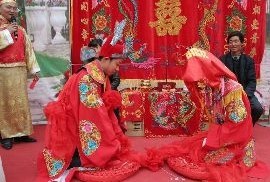
Befriending a Chinese colleague closely has busted a lot of myths with which I grew, primarily them being reserved or unfriendly. Going though her wedding pictures ( which took place 27 years ago in Shanghai), I could not with hold my surprise, of the similarity between their wedding and our desi one , in terms of similarity of rituals, elaborate celebrations and expenditure.

“Our weddings are extremely elaborate and interesting.”  remarked my friend.

Exactly like us desis, Chinese believe that marriages are arranged in Heaven, and merely completed on Earth. They believe the predestined couple is tied with red string in the Heaven, long before the marriage occurs on Earth.

For them too, it is a union between two families, not just two individuals.

The traditional Chinese too have elaborate rituals of sending marriage proposals to the girls family. Once decided, it is a must for the two families to consult the fortune teller ( as a Jyotishi in Hindu wedding) about the auspicious date for the wedding.

The invitation cards are as elaborate and showy as ours.


Red color is overwhelmingly predominant in every Chinese wedding, as it represents luck and happiness.

The celebrations begin days before the actual ceremony.

Days before the wedding, the bride is expected to stay away from the eyes of the general public, in isolation.

The groom’s family brings gifts to the bride’s home days before the wedding,  while the bride’s family returns the gifts along with clothes and gifts to the groom, his parents and unmarried siblings.


Like us desis, the bride’s side is also expected to deliver dowry and money to the grooms home, the amount of which  states the dignity and position of the bride’s family.

On the day of the wedding day, as  she gets ready, the bride goes through a hair combing ceremony where a ‘lucky’ woman, mostly a married woman ( = our suhagan) combs her hair 4 times. Each stroke carries a special meaning. The first combing blessed the marriage to last a lifetime; the second, a harmonious marriage; the third, many children and grandchildren ; and the fourth, good health and fortune.


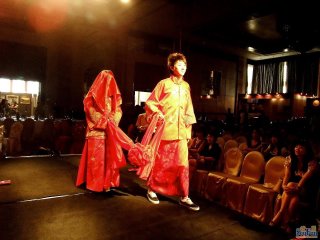
The bride adorns a red gown, red shoes and covers her face with a red veil.

However, the groom, unlike our groom, wears red robe, red sash. A capping ceremony like our ‘sehra bandi’ takes place where his head is covered with cypress leaves by the father.


Amidst the banging of gongs, drums and firecrackers, ( like an Indian baraat),  the groom leaves for the bride’s house in a procession.


As the groom steps in the brides house, the brides sisters & friends stop his way and bargain for entry towards the bride.

The bride leaves her home for the wedding arena under a red umbrella to ward off evil.

However the basic difference between the desi and Chinese wedding is the main ceremony.

They do not have any written contract or chanting of verses.
The couple goes on its knees and bows thrice- for the Heavens, the ancestors and their parents. They even bow to each other in a gesture of promising faithfulness to each other. There are no spoken vows.


Like us desis, the banquet is extremely elaborate, with 9 or 10 course meals.

However unlike us, each meals signifies something. First course is pig which signifies virginity, followed by others eg   fish & seafood for wealth and abundance,  pigeon for peaceful marriage, and whole chicken head for togetherness.

For details in the 10 courses: http://www.boneats.ca/2010/08/food-culture-chinese-wedding-banquets.html


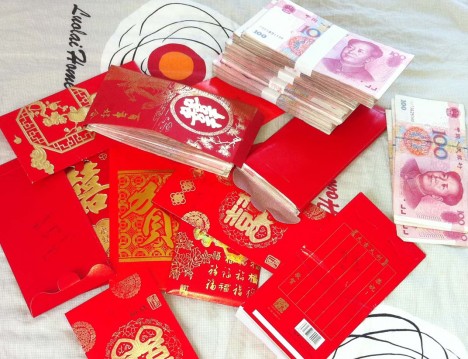
The preferred presents like us desis are generally in  cash, which has to be placed  in red envelopes called Hongbao. The amount of money given varies upon the closeness of the giver to the bride-groom.


After the ceremony and the feast, the bride serves her  in laws  tea, holding with both hands, showing a gesture of her service and faithfulness to her new family.


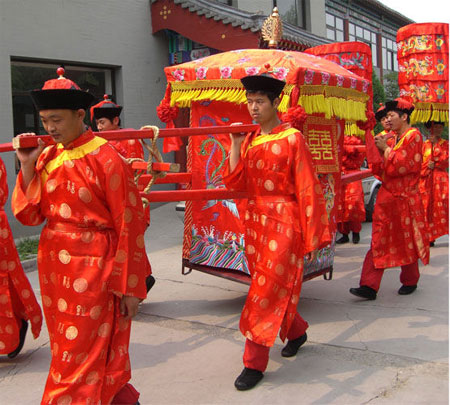
What excited me most was to know that like our old tradition, the Chinese bride also leaves for her husbands home in a hand held  carriage quite like our doli.


Although now only a few girls like this tradition, and now this has largely been been replaced by more posh mode of transport i.e. a car which is mostly extensively decorated with fresh red roses.


Some of the rich who can afford prefer a red car itself.


The ‘bridal bed’ as it is called is arranged quite a few days in advance in an elaborate ceremony, taking care the direction of the bed. The details here too depend upon the affordability of the groom. However all have traditional red bedding and are spread with fruits on it, which signify fertility— red dates, litchis and longans.

In the next morning, the bride gets up early to prepare meals for the new family.

Three days later she visits her parents along with her husband, as a special guest.

The picture that inspired me to write this blog ( Courtesy Tahir Hashmi) was this, which reminded me of the Hindu wedding’s pheras:


“Many of the Chinese youngsters are now  getting more fond of  traditional wedding, after two decades of having had more modern weddings.” added my friend.

(Special thanks to my friend Jenny for the details & helping dish out pictures)

Smart Art


With smoking zones shrinking more and more in public spaces, poor puffers barely get the ground to stand on,  in this smoking alley in a Hotel. They can’t even raise their heads to blow off the smoke, all for the roving eyes ‘looking down’ upon them,  from the roof top. Wouldn’t be wrong to say,  “Roof has been taken away from smoker’s heads.”


The artist paints with his hands, what he sees through  his heart.  The artist here sees no wall,  but a passage right through it. Quite like  when Napoleon’s Army questioned how would they cross Alps, he replied, “There are no Alps.”


And then the epic Palestine-Israel  wall and it’s art of resistance. This speaks volumes of the hope that artists paint  on the canvas of  hopelessness. Paintbrush is their weapon, ideas their gunpowder.


This slideshow requires JavaScript.


How I wish we all envisioned  in front of us, “There are no walls.”

P.S. Please click over the pictures to see them larger and with greater details.

When hate or peace become a business


In my last trip to India, I was strolling for window shopping, in one of my favourite spots in New Delhi, when I heard some loud speaker announcements nearby.

I saw a Yogi on a big screen, speaking with utmost tranquility. Some of the words I could recall are:
“Want is always hanging on to the I. When the I itself is dissolving, want also dissolves, disappears.”
And
“How far to heaven? Just open your eyes and look. You are in heaven.”

There were a few other things he spoke. At the first instance all I could think was, ‘Had Kabir been alive, he would have said the same thing.’


As I attempted to take a picture from my mobile phone, a boy intercepted. Wondering if photography was not allowed, I told him “Okay I won’t.”

But he said, “No Didi, there are so many people in the way, I’ll have you take it from a better angle.”

I was quite surprised at his generosity.

While returning, I collected some leaflets from the Art of Living ( Sri Sri’Ravi Shanker’s Organisation) stall, one of which said:

To love someone whom you like is insignificant.
To love someone because they love you is of no consequence.
To love someone whom you do not like means you have learned a lesson in life.
To love someone who blames you for no reason shows that you have learned the Art of Living.

Back home, talking to an old college friend who still lives in Delhi, I mentioned the incident.

She said, “Yes it’s nice, but this is business. Pay fees and attend the classes. What you saw was their marketing section.”

When I heard of his trip to Pakistan and the news about his offer to teach peace to Taleban, I was intrigued, wondering:

‘How would it be taken as an offer by the ilk of Zaid Hamid, Gen Hamid Gul, or the Taleban themselves? Would they again rant of the Hindu agenda or the greater Zionist agenda.’

Instead of the Hindu agenda rant, I saw a couple of positive FB statuses and some tweets on the issue. A tweet worth the mention is:

“Sri Sri has already had a Positive Effect on Taliban! Mullah Omar is now calling himself Mullah Mullah Omar.”
Thankfully, instead of an offence,  it was taken in lighter vain 🙂

Incidentally I happened to chat with the same friend on Facebook , and told her of his trip to Pakistan, and the Taliban offer story.

She said: “Oh come on, he is there to promote his AOL centres, one of which I know is located in the capital city. And again this is the marketing department at work.”

I again muttered to myself, ‘Well nothing wrong with it. One could consider this a social enterprise. We do have an epidemic of hatred in the world and he has provided a therapy for it, but at a price, which will work if it is cost effective.’

He did tour the AOL offices and camps in Karachi, Islamabad and Lahore. But to my utter dismay, before I could start to keep track of his Pakistan trip, and his talks with Taleban, I heard that he was back in India.

Wonder is he wasn’t allowed to approach Taleban, or was it not on the agenda?
I have no clue.

Anyways he did repeat his offer after coming back “There is a lot of violence in Pakistan and people are fed up, they want to live peacefully. If I could be of any help in bringing an end to the vicious cycle of violence, I am ready to talk to the Taliban,”

And that “We are all sufferers of stress, tension, violence and hatred – and small ways of easing out are all that you need,”

There is no doubt that the techniques which he uses for de-stressing are scientifically based.

The primary exercise, which they call Sudarshan Kriya is basically a deep breathing exercise which any psychologist you visit asks you to begin with, on de-stressing. There is a proper technique for it.

I can’t help being amused by the mere visual imagination of Mullah Mullah Omar sitting in a Padma Asana (lotus pose), with hands stretched over the knees, and breathing-in through nose and breathing-out through mouth. 🙂

How I wish that my friend is still proven wrong and some miracle asana (yoga position) comes up which exhales all hatred out of the heads of these radicals.

If that so happens, then I would also secretly whisper in Sri Sri’s ears to develop some Yoga position (asana) in which our politicians extend their arms  in service of  the masses, who vote them in, instead of flexing them, with hands reaching their own pockets.

And so will I also pray to Sri Sri to apply some tilak ( teeka) on the foreheads of our uniformed (on both the sides), so that they start seeing each other as friends and not enemies, and start piling books and medicines for the masses on both sides, instead of arsenals.

I would also beg Sri Sri with folded hands to ‘please please’ make some vibhuti ( spiritual ash) for our diplomats ( on both sides) which when touches their tongues gets them addicted to the taste of peace and makes them feel nauseated just at the sight of visa, passports, police verification etc etc.

Be it a profitable business or social enterprise, there’s no offence, if it is all intended to bring real peace, beyond just a marketing tool.

After all,  all the  chaos and divisions on ground, are also a result of the seeds of intolerance sown by those who consider hatred as their business.

O’ the wandering mind ~Kabir


Kabir has hardly spared any animate and inanimate examples to ridicule the bigots who have great illusions about their self image and through their beliefs repeatedly,  make a fool of themselves.
In the same spirit, I came across yet another simple yet interest verses.

Poem 1: 

Apanpo aap hi bisaro.
Says Kabir, they  fall prey to their  own illusions and forget the essence of our existence.

Jaise sonha kaanch mandir me, bharamat bhunki paro.
Just as dog who enters the house of mirrors, goes crazy barking at the images, considering them different. This is a very curious satire on those bigots who bark at other bigots, thinking they are different, but in essence are reflections of each other.

Jyo kehari bapu nirakhi koop jal, pratima dekhi paro.
A lion looks deep into the well, and mistakes his own reflection as another lion, and jumps into it. This also satires on the ‘lions’ of different faiths, who are such egoists, that they destroy themselves, in challenging other ‘lions’ in the business. The current sectarian bigots could be appropriate here.

Aisehi madgaj phaTik sila par, dasanani aani aro.
An elephant, so proud of its strength, bangs his head against the rock, and hits it with his teeth. Here rocks could be interpreted as hard, rock like beliefs which they bang their heads against.

MarakaT muThi swad na bisare, ghar-ghar naTat phiro.
A greedy monkey for whom the food in the pot is not enough, and goes from home to home asking for more. This is perhaps reference to looking outwards, though we could easily content with what is with us.

Kah Kabir lalani ke suwana, tohi kaune pakaro.
Says Kabir, their logic is as impossible to catch as the parrot of a village girl. Here he gives a satire of those who keep repeating mindlessly like a parrot, with no logic what so ever.

And then in contrast to the satire, many verses of Kabir bring home the message through simple, day to day examples, of how should we be viewing our beliefs, and the essence of our existence.

Poem 2: 

Man tu maanat kyu na mana re.
O’ the wandering mind, why don’t you understand?

Kaun kahan ko, kaun sunan ko, dooja kaun jana re.
Who is worth to speak or to listen, when there is ONE truth.
Here he refers to perhaps the various claimants of ONE, and give it different names and forms.
( The next verse makes it clearer)

Darapan me pratibimb jo bhase, aape chahu disi soi.
He is all round in every atom, the way there is a reflection in every mirror.
( This could be compared to the idea of sheesh mahal—made of tiny mirrors all around one image is seen in each and every tiny mirror)

Dubidha mite, ek jab howe, tau lakh paawe koi.
If you get ONE truth, you will get contentment worth a million, and the confusion of mind will go away.

Jaise jal se hem banat hai, hem ghoom jal hoi.
The way ice is first made of water, then returns back to the same water.

Taise yah tat wahu tat so, phir yah aru wah soi.
In the same way, we are all come from that truth, and unto the same truth we have to return to.

Jo samajhe so khari kahat hai, na samajhe to khoTi.
Those who get this, call this a stark truth. Those ignorant who don’t get this, consider it falsehood.

Kah Kabir khara pakh tyaage, waaki mati hai moTi.
Says Kabir, one who gives up the essence of truth, his brain is thick ( stubborn).

It is remarkable how Kabir talks of evils of bigotry, unity of mankind and the true spirit of secular spirits, rising above the superfluous divisions in the dark ages.

Or perhaps, we are living in darker ages.

Indeed, it is a long road, before Kabir’s examples and teachings become irrelevant to the current times.

The Kabir bhajan below, again, gives some more examples through which he challenges the bigots. Note the translation subtitles. This is my favourite tranquillising Kabir song. 

Lawn ki kahani, meri zubani ( The story of Lawn in my words)


Published in TheNews Blog : http://blogs.thenews.com.pk/blogs/2012/03/21/story-of-a-lawn-hater/

Designer lawn, designer lawn, designer lawn!

Every Sana, Nida and Hina is coming out with designer lawns.

Thankfully never a fan of lawn as a material, it does not awaken the woman in me.

However I remember my mother, who lives in Delhi, where summers are really biting, once came back from a trip to Pakistan in mid 80s, all excited, for having discovered a wonder cloth. She is a woman with sensitive skin, and sweat rash (garmee daaney, as we call it in desi jargon) was what she had to struggle with each Delhi summer.
Fed up of wearing starched Khadis (hand spun cotton) and malmals (muslin) in the sweltering heat, she said she found something which was soft, low maintenance, colorfast and did not need any starching. The picture she painted with her descriptions and expressions got me really curious to open up her suitcase and dig out the jewel, basically to choose which one was mine.

The result that came out of that digging was so befitting to the Hindi idiom “Khoda pahaar per nikla chooha aur woh bhi mara hua”
(From the digging came out a dead rat).

The first look of it was totally unappealing –bold designs on the shirt piece, with its giant replicas on the dupatta. Didn’t need to check the third of the half a dozen three piece suits she brought.

“What’s wrong with your taste? Ammi you’ll wear this?”

“They are so comfortable. And most of all they are so reasonable. One suit costs just Rs 225.”


She didn’t even bother to comment about my ‘taste’ rant.

From then on, I saw her pass all the worst days of summers in lawn suits. And when I got married in Pakistan (perhaps she must have prayed for this secretly for her own vested interests) all she wanted from me each visit was…”bring lawn ke suits, so that meri garmiyaan nikal jaayein.”

I remember from 1990 onwards, buying them for Ammi from Rs 250, Rs 450, Rs500, then Rs1000,  1200, 2500, and last I got for her was Rs 3500. Agree that with time, along with the prices, the designs evolved too. And they certainly got better.

But each time, Ammi felt uneasy with the price escalation. At the 3500 one she told me, “Enough, I don’t need a dress at this exorbitant price just to soak my sweat.”

And now with the advent of designer tag they have graduated to even five digit prices (at the higher end). And they usually begin from 4,000 going upto 12,000, I am told.

I remember some 2 years ago, hearing two cousins talking of outlets where they got the same designs as the big brands copied at much lower prices.

“The original is so expensive, so I buy the duplicate ones.”

“Even the previous year’s designs are available at cheaper price,” said the other.

Yes, but you know there is a teacher in my school who thinks she is very  smart. She instantly recognizes, ‘ye to pichle saal ka design hai’. So I can’t wear that. But woh kaminee tou isko bhi pehchaan jaati hai, ke ye duplicate hai.’

“Why do you need to copy? Or in fact wear designer lawn at all”, I asked.

She rubbished my question and moved on to some other topic.

This is certainly not to act snobbish, but I certainly find it hard to fathom the compulsion to owe one’s allegiance to these ‘disposable’ pieces of cloth which are so short term that they become obsolete the next season.

If I have so much money to spare( 5-7,000+ on a dress) , I will perhaps invest in a piece I can cherish for longer, and if you ask my secret desire, it would be on something I can pass on to my daughter. And indeed I have done exactly by getting hold of  some beautiful pieces with  Baluchi, Afghani or Sindhi hand embroideries.

Dump my hard earned money into a casual wear lawn suit which won’t last the next summer—no way.

In the background of so much disinterest for the designer fad, I was made to see this disgusting ad ( see the bottom pic) by a twitter pal.

And this perhaps was the boiling point of my emotions,  for the ‘designer lawn’ and hence I decided to blog my disdain for them.

With all the designer hype or price escalation, the brand had the audacity to show their product with coolies in the background.

What did they wish to relate to?

Was it the quality of attire in comparison? Oh ! Theirs is so simple, non designer unlike mine. Yet in my two dim visioned eyes, the poor men’s is the rawest of  cottons.

Or

Was it about the worth of one’s labour? Oh look at us, how much we get for the every drop of sweat we shed in the labor for those ‘designs’. 

Or

Was it about the matching colors?

But then, Buddhist monks and  Hindu sadhus too wear the color similar to the woman’s. With ‘Muslims’ as their major market, it was too much of a risk to take.

Oh,  yes, the coolies do not prick anyone’s sensitivity, so were  pretty risk free to have as a background.

Kudos to the imaginative  Advertising Company that thought of this ad and flexibility of the Designer Textile Company that approved of it and owned it.

To me personally this was absolutely nauseating…akin to showing middle finger to the poor fellows in the background.

So rightly had someone commented: “Thank you for hiding their faces with your brand name.”

Hats off to the Feudal mindset, yet another common man’s commodity, the lawn, has turned into an elitist product. Of course in business jargon this is called as ‘value addition’. So what if it gets unaffordable to the vast majority, at least it looks coool ( with a triple o) !

How I wish we did some value addition to Islam too, in Pakistan?

On a second thought, haven’t we?

With the  tags of suicide bombs, Ahmedi hate, Shia kafir rants, we have made it a brand which ordinary Muslims like me find hard to afford.