Open up your mind and your potential reaches infinity…

Archive for the ‘Peace’ Category

Footprints, theirs and ours


Published in two parts in  Dateline Islamabad  as an Op-Ed  on 12 and 13 August 2011

Part 1

AUGUST 7 was the 70th death anniversary of Rabindranath Tagore, and I remember his Nobel winning poetry which begins thus:
Where the mind is without fear and the head is held high

Incidentally, I found myself reading something similar in the spirit of this poem — Kamran Rehmat’s eloquent piece Meeting Jens Stoltenberg on the simplicity of Norwegian PM’s life and the minimal security he keeps (Dateline Islamabad, July 28). His rendezvous led me to the memory of the news in 1986, when Olof Palme was murdered while walking back from a cinema at night in Sweden.

“Prime Ministers walk back home?” — that was my instant reaction, then.
There is a reason why Nordic countries are considered the safest places to live. (I wonder if the recent Norwegian episode and its root cause will change that, but that’s beside the point here)

Reading through, one instantly compares them to the traffic standstills or detours one has to face when our politicians are passing.

The instant pop-up in my Third World mindset is — “Come on, those are developed nations and we are merely ‘developing’.”

It takes me back to what I gleaned from the movie The Last Emperor, in 1990, where they showed when the king passed through the streets of ancient China, the common man was asked to turn away their gaze  because their poor eyes weren’t worthy of seeing the emperor.

Perhaps, our politicians in power, too, are emperors in their own right, who live not in forts or castles by name — but their abodes are bedecked no less than castles and protected no less than fortresses. And the feet of the poor common man aren’t worthy
of treading the same street when the emperors pass through it.

But hold on.

I have two personal experiences from this very Third World where the high and mighty navigated with the same freedom and minimal security as the Norwegian or Swedish premiers.

One of them is none other than Mahathir Mohammed of Malaysia. (You might say that Malaysia is not much of a developing country but the reason why they have surged ahead is because of this very man about whom I will narrate a personal
anecdote.)

My family had been visiting Malaysia as tourists in 2002. This is during the last days of Ramadan and we chose to travel to Malaysia to see how their
Muslims celebrated Eid.

On the day of the festival, we went to the Central Mosque in Kuala Lumpur for prayers. Not sure of the timings, we reached the mosque way early and  my husband and son sat in the very first row, right behind the imam.

Meanwhile, I settled with my daughter in the first row of women’s area — ensuring that our men folk were well in sight.

After an hour or so, when the mosque had been reasonably full — no mad rush, mind you — a few men walked up to the front rows and some others started to make way for them. My husband was asked to move a little to the side, which he did. But to his utter surprise, the man for whom his space was being vacated was none other than President Mahathir Mohammed.

Having seen that my husband gave space to him, Mahathir smiled at him. My husband stepped forward, shook hands with him and introduced himself as a Pakistani, who had come to see Eid festivities in Malaysia.

After the prayers, he again turned to my husband and invited him to visit Putrajaya (president’s residence) and partake the open feast which the president hosted each year for his compatriots.

Our joy had no bounds — we almost thought that we were invited to a personal lunch with the president.
After a few hours of strolling in the Eid bazaars in Bukit Bintang (street), listening to the beautiful melodies of Salamat Hariraya (Malaysian Eid greeting), we dressed in our best and headed for Putrajaya.

It was a huge congregation, with tents put up and thousands of Malaysians, of all ethnicities, in a picnic mood and enjoying the ethnic food the Malays serve
on Eid. (To continue)

 Part 2 : 

MY family and I arrived at the Putrajaya (president’s house) and were told by someone that this was the last time the open Eid feast, which enabled the commoners to meet the president, would be held as Mahathir Mohammed had announced to step down.

We saw what looked like a hopelessly long queue on one side of the tent, leading to a door. We were told this was for those who would like to meet the first couple and give their Eid wishes to them. We joined the queue.

My husband told one of the guards that we were from Pakistan and President Mahathir himself had invited us, in an attempt to jump the queue. But the policeman just gave a hospitable smile and no more, which was signal enough for us to stay in the queue. It was a two-hour wait and my kids used it to make a small card out of some paper envelope, with a blue ball point sketching a flag of Pakistan and an Eid greeting.

Finally, our turn came. We shook hands with the first couple and to our utter surprise, he himself told his wife, “They are Pakistanis and have come to see our Eid.”

My kids gave them the card. We hugged them, Pakistani-style and were handed a plastic Tiffin on top of which was inscribed “Thanks from Putrajaya” with traditional Malaysian sweets inside. We got exactly the same box as everyone else and approximately, the same two or three minutes of chat as other locals.

To cut a long story short, in a fortnight’s stay in Malaysia, we happened to meet their president twice, and that, too, without much difficulty.

The second incident was in Kolkata (then- Calcutta), in late 1979, when I had been visiting the city with my parents, who were attending some conference. My parents chose to commute in bus as that was the most convenient mode to travel in the overcrowded metropolis.

In the middle of one journey, my father turned our attention towards a lean and thin dhoti-clad man who had climbed the bus. That man was Jyoti Basu, who had become the chief minister of West Bengal, just a year or so ago.

My father mentioned it to some of his friends but they weren’t surprised, for it was common knowledge that Basu sometimes boarded buses just to stay connected with hoi polloi.

Basu continued to win the people’s confidence for the next two decades (from 1977 to 2000). A CPI(M) member, he went on to introduce land reforms, giving opportunity to the poor to have their own lands. He brought political stability to the state to the extent when the whole of India was burning— once after Indira Gandhi’s assassination in 1984 following the Operation Blue Star, and the other at the demolition of Babri Masjid in 1992, his administration did not allow any rioting in his state.

Hence, it was not just a coincidence that we saw these men roaming free in public — years of commitment for the common man had made them fearless.

With this chain of thoughts, my mind shifts to the recent switch on-and-off that goes on in the killing fields of Karachi. It does not need a vision of 6/6 to see who all are behind these killing fields.

By all I mean ALL — none is above it. I wonder, with this track record and with the mess that the stake holders of ‘peace’ create, can they have the courage to sail freely among their own public like Mahathir and Basu?

No wonder our streets from Islamabad to Karachi come to a standstill when they sail fearfully on them.

And tragically, it is the common man, who gets labeled as hateful, narrow-minded and divided on ethnic and sectarian lines.

In conclusion, I want to revert to the closing lines of Tagore’s poem, which may serve as a prayer to us:

Into that heaven of freedom, my Father, let my country awake.

The writer is a gynecologist, health activist,
and m-Health entrepreneur, of Indian origin,
married to a Pakistani
Avval Allah, Nur upaya, qudrat de sab bandey…


This blog post is a tribute to the bravado of my#Sikh brothers, who stood up in respect for humanity beyond faith during the #UKriots.

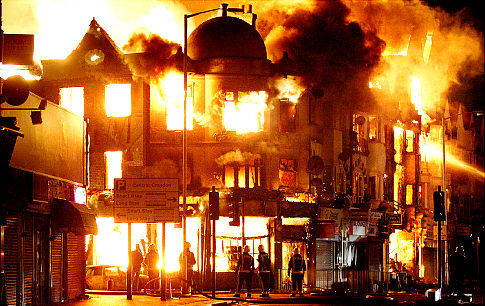
It was devastating to see the peoples power gone berserk in UK riots, as the  arson and looting carried on unabated into the fourth night . Unfortunately against the sheer numbers, the police seemed helpless to control the unruly mob.
While following the  #UKriots on Twitter and BBC News, hashtag #Sikhs started to trend—first World wide and then in UK, London.

A tweet was seen:

Remroum Remi Kanazi
Was afraid #Sikhs trending was going to be some bigoted stream. Thankfully it was this: Sikhs protecting people while they prayed #UKRiots

They came pouring, tweets one after the other with speed getting faster:

Prandha_Swag Harpreeeeezyf.baby
#Sikhs is trending.

Nagra18 Jasraj Nagra
#Sikhs is trending, never thought i’d see the day #proud.

KavelKaur Kavel Kaur
#Sikhs are a world wide trend!!!!

GDS1ngh GD singh
#sikhs trending, fantastic. doing what we do best.

moneyspinner MONEYSPINNER
#sikhs nanak naam chardi kala, tere baane sarbat dha bhala

I googled to check the details and saw Mail Online quote:

Some armed with swords, some carrying hockey sticks, defiant Sikhs stood guard outside their temples last night.
More then 700 men, some in their 80s, took to the streets to protect the homes, businesses and places of worship in Southall, West London.

The tweets went on:

Goggi_Rana Goggi Rana
Sikhs of Britain have displayed the same traits of fearlessness, as their ancestors of yesteryear #Sikhs #SangatTV

UncleWail Wail Al Aun
Thumbs Up for the #Sikhs protecting their #Temple in Toxteth #Liverpool #UKRiots

MissssChrissy Chrissy
Singh Is King… Yep I think so! #sikhs doing it real big today. #LondonRiots #ukriots

Then we heard that they had not only protected their temples but also stood at the mosque guarding while the Muslims prayed ther Taraweeh prayers of Ramadan in South Hall mosque:

A google message read :

Muslims prayed their Tarawee prayers while Sikhs protected he Masjid
Got this from a friend in London.
In a Masjid in Southall London, Muslims were praying their Taravee prayer as the riots were going on, a bunch of Sikhs stood outside the Masjid and protected the Masjid.
The similar thing happened when Sikhs were inside their Gurduwara and some Muslim youngster guarded it on the gate
Great experience, a cousin and a friend of mine reported the same incident.
May ALLAH bless people like them, humanity still remains here, despite the problems

Tweets loaded with emotions, from Muslims and people from other faiths,  too poured in with ovelwhelming enthusiasm:

PMGenerals PMG Anj
Today was an historic day for #hindus #sikhs and #muslims. #unitedwestand all religions teach us to have morals and respect dis proved it! X

dj_aNomAli ∀ℓι . ᄊ乇尺cんለռէ
Sikhs protect Southall mosque while Muslims pray Taraweeh in peace. Much respect to our brothers!! #LondonRiots #Southall #Sikhs #MashAllah

DNSDj Davinder Singh
Actually brings a tear to my eye seeing the #unity between #Sikhsand #Muslims in the fight against this madness. #proudtobesikh

akchishti akchishti
Great sight in my #Birmingham where #Pakistani lads are protecting temples while Sikh lads protecting the mosques

Muslimerican Peter
Imagine a group of rioters turning down a street and suddenly seeing 400 #Sikhs standing in the distance. #wrongturn #ohshit #londonriots

AdamPatel2 Adam Patel
I hear the #sikhs are even protecting the #mosques in Southall so #muslims can read our Tarawih in peace.”>>> BIG LOVE –

And dishearted tweeps begain to take a sigh of relief

xcrimsonstarx Vicki Langfield
The #Sikhs are giving me faith in humanity

Indeed, everyone who followed this trend must have rekindled their faith in humanity. Thanks you my Sikh brothers.

MumzyStranger Mumzy Stranger
Love out to the #Sikh brothers who protected the mosque during prayer time. If we all unite we can and WILL put a STOP to this chaos! M x

And  with these tweets millions or billions of eyes gleamed with hope.

We hope and pray this display of unity and humanity extends to all faiths and communities beyond borders and beliefs…

My mind recalled the verses of Sant Kabirdas which  along with 500 other verses which are included in to the Guru granth Sahib,  are  often heard from  Gurudwaras as Shabad Kirtan :

Avval Allah Noor upaya Qudrat ke sab bandey
(God created light of which all the things were born)
Aik nor ke sab jag upajaya kaun bhale ko mandhe
(From the light, the universe. So who is good and who is bad).

Indeed, I hail my Sikh brothers for living up to the spirits of their faith, their Gurus and their Book.

In return many Muslims also stood up with the Sikhs and helped them form groups which defended their communities and boroughs. Hail Sikh Muslim Solidarity. 

Let this be the beginning of Sikh-Hindu-Muslim-Christian-Jew –other faiths unity for  all faiths believe in one Supreme Power and all faiths belong to  one Humanity’

I dedicate  this tribute to my Sikh brothers with the greeting, which in Punjabi means exactly what Allah u Akbar stands for :

Vaheguru ji ka khalsa, vaheguru ji ki fateh.
(God’s pure and God’s victory )

My brothers,  Rabb Raakhaa

Ilmana Fasih, Aug 10, 2011

P.S.: Please scroll down in the comment box to see the reaction of the Muslim community after 3 Pakistani boys were killed in Birmingham.

Where the mind is without fear and the head is held high.


Just yesterday was the 70th death anniversary of Rabindranath Tagore, and I remember his Nobel winning poetry which begins as :
“Where the mind is without fear and the head is held high”

Incidentally, today I found myself reading something similar in  spirit of this poem while , enjoying  Kamran Rehmat’s eloquent note  on simplicity of the office of Norwegian PM and the minimal security he keeps.(Kamran Rehmat is  a Pakistani newspaper editor based in Islamabad, who’s writings  are like a new lesson in English language, and each time  leaves one richer in vocabulary).

His note led me to the memory  of the news in 1986, when Olof Palme, was murderd while walking back from a cinema at night, in Sweden. Prime Ministers walk back home, was my reaction then. There is reason why Nordic countries are considered as the safest places to live on Earth. (I wonder if the recent Norwegian incident and it’s  root cause will change that, but that’s beside the point here)

Reading through,  one instantly compares them to the traffic standstills or detours one has to face when our politicans are  passing.

The instant pop up  in my Third World  mindset is–” Come on, those are developed nations and we are merely ‘developing’.”

It takes me back to the peice of knowledge I gained from a movie called The Last Emperor, in 1990,  where they showed that when the King passed through the streets of ancient China, the common man was asked to turn away their gaze because their poor eyes weren’t worthy of seeing the Emperor.

Perhaps our politicians in power too are emperors in their own right who live not in forts or castles by name.  But their abodes are bedecked no less than castles and protected no less than fortresses. And  the feet of the poor  common man arent worthy of treading  the same street when the emperors  pass through it.

But hold on.

I suddenly remember two personal experiences from this very  Third World where their persons in authority navigated with  same freedom and with minimal security as the Norwegian or Swedish PMs.

One of them is none other than Mahathir Mohammed of Malaysia. ( You might just say, that of course Malaysia not all that a developing country. But the reason why they have gone far ahead is because of this very man about whom I will narrate a personal anectode.)

We had been visiting Malaysia as tourists in 2002 . It was the last days of Ramadan and we  chose to travel to Malaysia to see how their Muslims celebrate Eid.On the Eid day we went to the Central Mosque in Kuala Lampur for the Eid prayers. Not sure of the timings, we reached the mosque way early and my husband and son sat in the very first row, right behind the Imam’s seat. While I settled with my daughter in the first row of women’s area , ensuring that our men were well in our sight.

After an hour or so, when the mosque had been reasonably full, ( no mad rush), a few men walked upto the front rows and some others staretd to make place for them. My husband was asked to move a little to the side, which he did. But to his utter surprise, the man for whom his place was being vacated was none other than the President Mahathir Mohammed. Having seen that my husband gave place to him, he smiled at him. So my husband stepped forward, shook hands with him and introduced himself as a Pakistani who had come to see the Eid in Malaysia.

After the prayers, he again turned to my husband and told him, to visit his place called Putrajaya ( president’s residence) and join the open feast which the President hosted each year for his compatriots.

Our joy had no bounds. We almost thought that we were invited to a personal lunch with the President.
After a few hours of strolling on the Eid bazars in  Bukit Bintang (street), listening to the beautiful melodies of Salamat Hariraya( that’s Malaysian way of saying Eid Mubarak) we dressed our best and headed for Putrajaya.

It was a huge congragation there, with tents put up and thousands of Malaysians, of all ethnicities in a picnic mood and enjoying the ethnic food the Malays serve on Eid. We were told by someone that this was the last time this would be held as Mahathir Muhammed has announced to step down,  and  he wouldnt be there next Eid.

We saw a horrendously long queue lined up on one side of the tent leading to a door. We were told, this was  for those who would like to meet the first couple and give their Eid wishes to them. We joined the queue. Living upto the Pakistani style, my husband told one of the gaurds that we are from Pakistan, and the President himself had invited us, in an attmept that this would help us jump the queue. But the policeman just gave a hospitable smile,  his eyes speaking to us to stay put in the queue.

It was a two hour wait, and my kids used it well to make a small card out some  paper envelope, with a blue ball point drew a flag of Pakistan and wrote an Eid card for them.

Finally our turn came, we shook hands with the first couple, and to our utter surprise, he himself told his wife, “They are Pakistanis and have come to see our Eid.” Kids gave them the card. We hugged them in a Pakistan Eid greeting. We were handed over a plastic tiffin box on top of which “Thanks from Putrajaya” while the inside had  Malaysian sweets. We got exactly the same box as everyone else, and roughly the same two or three minutes of chat as other locals.

In Summary, in our two weeks stay in Malaysia, we happened to meet  their President twice, and that too without much difficulty.( Not to speak of how many times we have bumped into any of ours in the whole life).

The second incident was in Calcutta, in late 1979, when I had been visiting the city with my parents, who were  attending some conference. My parents chose to commute in bus , as that was the most  convenient mode  to travel in an overcrowded Calcutta.

In the middle of one journey,  my father turned our attention towards a lean and thin dhoti clad man who had climbed the bus. And this man was Jyoti Basu who had become the Cheif Minister of West Bengal just an year or so ago.

My father mentioned it to some of his friends, but they weren’t surprised, for this was common knowledge that he sometimes boarded the bus just to stay connected with the poeple who elected him.

And then this man carried on to be the elected ChiefMinister of West Bengal for next two decades ( from 1977 TO 2000).  A CPI(M) member, he went on to make land reforms giving opportunity to the poor to have their own lands. He brought political stability to the state and so much so that when the whole of India was burning twice– once after Indira Gandhi’s death in 1984, and the other at the demolition of Babri Masjid in 1992, his heavy handed administration did not let any rioting in his state.

As Wickepedia quotes, “West Bengal became an oasis of communal harmony and secular values under his leadership”
Although a CPI (M) member, in an obituuary published by BBC on his death in 2010, it remarked:
“A Fabian Socialist rather than an orthodox Communist, Jyoti Basu worked by consensus, successfully managing coalitions, while showing a healthy respect for the viewpoints of others.”

“He made Communism look respectable,” according to Sabyasachi Basu Roy Choudhuri, a Calcutta-based political analyst.
Analyst Ashis Chakrabarti said Mr Basu’s success indicated social democracy had a future that Communism did not .
( http://news.bbc.co.uk/2/hi/south_asia/8151230.stm)

Hence, it was not just a coincidence that we saw these men roaming free in public, there were years of commitment, and hard labour for the common man, which made them be  so fearless.

With racing chain of thoughts, my mind shifts to the recent switch on and off, that goes on in Karachi’s killings. It does not need a vision of 6/6 to see who ALL are behind these killing fields. By all I mean ALL, none  is above it. I wonder with this track record and with the mess that the stake holders of  “peace’ create, can they gather the audacity to sail freely among their own public like the above men.

No wonder our streets from Islamabad to Karachi come to a standstill when they sail ‘fearfully’ on them.

And tragically, it is the common man who recieves the blame of being labelled hateful, narrowminded and divided on ethnic or sectarian lines.

I close this note with the closing lines of Tagore’s poem , which may serve as a prayer to us:

“Into that heaven of freedom, my Father, let my country awake.”

Ilmana Fasih

Tumi robe nirobe~Rabindrasangeet. Music without borders


In my heart, thou shall, in peace, alight…
Like the glowing moon and the Dame of the Night.

My life, my youth…
My world absolute;
Thou shall draw bright…
Like the Dame of the Night…

Alone shall rise, eyes of thee,
Thy billowing drapes shall protect me.

My pain, my screams,
My success dreams;
Thou shall delight,
Like the Dame of the Night.


About the author, composer of this song:

Rabindranath Tagore (1861-1941) was a Poet, Philosopher, Musician, Writer, Educator, and the first Indian Nobel Laureate for Literature (1913). Tagore has been labelled the “King of Poets” for his beautiful and exquisite poetry. In particular Tagore had a deep love and reverence for nature which he was able to express through lyrical poetry.

Tagore was awarded the Nobel Prize in 1913 for his book Gitanjali. W.B.Yeats in particular was deeply impressed with this work and wrote an introduction. With this honour Tagore became famous in both India and the West. In 1915 Tagore was knighted by King George, however Tagore was to return his knighthood in protest of the Amritsar massacre (1919)

Although Tagore stayed out of politics he remained a good friend of Gandhi. In fact it was Tagore who would often persuade Gandhi to give up his fasts in the interest of the nation.

As a writer, Tagore primarily worked in Bengali, but after his success with Gitanjali, he translated many of his other works into English. He wrote over one thousand poems; eight volumes of short stories; almost two dozen plays and play-lets; eight novels; and many books and essays on philosophy, religion, education and social topics.

As well as literature Tagore had a great love of music, in particular Bengali music. He composed more than two thousand songs, both the music and lyrics. Two of them became the national anthems of India and Bangladesh.

That the truth has a tongue…~a poem


Just a minute long poem narrates the decades of pain and suffering of innocent kids who have no reason to bear this.

All your armies ..
all your fighters ..
all your tanks ..
and all your soldiers ..
against a boy ..
holding a stone ..
standing there ..
all alone ..
in his eyes ..
I see the sun ..
in his smile ..
I see the moon ..
and I wonder ..
I only wonder ..
who is weak ? ..
and who is strong ? ..
who is right ? ..
and who is wrong ? ..
and I wish ..
I only wish ..
that the truth ..
has a tongue :

Little Terrorist~a short Film


Little Terrorist tells the moving story of a Pakistani Muslim boy who accidentally crosses the Pakistani-Indian border which is riddled with landmines. He ends up in a strange country that regards him as a terrorist. The old orthodox Hindu Bhola takes him in and hides him from the Indian soldiers. However, traditions and prejudices about Muslims remain an obstacle in the relationship between Bhola and the boy. Ultimately, humanity triumphs over prejudice when Bhola risks his own life to help Jamal cross the border again. This symbolic story of hope is a tale of human solidarity conquering all artificial boundaries.
Ashvin Kumar, the director, was nominated for an Oscar in the Best Live Action Short Film category.
Ashvin Kumar’s Little Terrorist also won first prize for best short film at the Montreal Film Festival.

And was nominated and selected for various other prizes.

The cost of crossing the ‘love’ border ~Indo-Pak Visa Part 2


Published in Aman Ki Asha blog by The News/Jang Group on August 03, 2011 http://www.amankiasha.com/detail_news.asp?id=509

For years after the Indian Consulate in Karachi was closed down, a cousin of mine (an Indian married to a Pakistani) whose parents live in Jaipur, followed the following trail year after year. She would travel from Karachi where she lives, to Islamabad to obtain an Indian visa. If successful, she would travel back to Karachi to pack up. She and her family would then travel to Lahore by train, and cross the Wagah-Atari border. They would then take a train from Amritsar to Delhi and then another to Jaipur. With 3 children, she could not afford air travel every year. 

The entire ordeal required her to travel over 4600 kilometres and several days in summer vacations, when in reality, the smallest distance between Jaipur and Karachi is only 1066 kilometres (through Khokrapar Munabao) and the train journey is just a 3-4 hours long.

I understood the real nightmare of this struggle some years ago when I had to travel from Karachi to Islamabad to get a visa for my father-in-law for his medical treatment in India.

My husband and I sat outside the Indian consulate in Islamabad for two days, sharing benches with people who had mostly come all the way from Karachi or Hyderabad. Most had been sitting there every day from 9 am to 5 pm for as long as 15 to 20 days at a stretch. The majority appeared to be daily wage earners, the poor and with no resources to take short cuts, like us, to obtain a visa – we had the parchi (‘slip’) that would expedite the visa process.

A lady and her husband, a carpenter hailing from Lalukhet in Karachi, had been sitting there every day for almost 20 days, from morning till the consulate closed in the evening, without any clue about whether they would be granted a visa or not. The embassy issues a limited number of visas each day. Names come up on a given day, their luck as unpredictable as a lottery. The more resourceful among the applicants jump the line, pushing these poor people to the back of the queue.

This couple had spent so much money on the travel from Karachi to Islamabad that they could not afford even a cup of tea from the tea stall outside the embassy, which caters to visa seekers. Every day the carpenter and his wife brought with them homemade rotis and pickle for lunch. I asked the woman how long she would sit there, and she replied with certainty: “When the money runs out, I will go back home whether I get the visa or not”.

She had applied after hearing that her mother was on her deathbed and had asked to see her one last time. She had been married for over twenty years but had been able to visit her native Hyderabad, Deccan, only once, and that too 12 years ago.

Her marriage had been a stroke of fate when her husband, a cousin from Pakistan, visited them. The poor family had been facing tough times, and found this as opportunity to make their daughter’s life better, as the cousin’s family was more prosperous. (How was she duped into marrying an already married man is another story for another time). 

This story is all too common to many families in the lower middle class strata who marry across the border; their girls are hardly able to visit their parents a handful of times in their lifetime, mostly due to not being able to afford the time, expenses and resources involved in obtaining the visa.

They resign themselves to their fate and learn to live with just memories of home. It is only when another sibling is about to get married; or a parent is ill; or dying, that they gather all their means and courage to try to obtain a visa to go to their erstwhile homeland.

The procedure has been somewhat modified now, so that people in other cities can apply for Indian visas through a courier service, without having to travel to Islamabad. But applicants still have no idea how long the process will take. A friend who wanted to attend her parents’ 50th wedding anniversary celebrations in India received a reply after an anxious six month wait, saying that her application papers were incomplete. Some don’t hear any news for a year or more; others don’t get any response at all.

Over the last two decades I have seen a see-saw situation. Things seem to move towards easing the procedure, then suddenly something occurs and the whole change is reset from the start.
A silver lining is that the Khokrapar-Munabao line, suspended since 1965, has been revived, reducing unnecessary distance for many.

I hope and wish that the latest news about easing of the borders does not remain restricted to the artists who travel on exchange programmes or businessmen attending conferences, but is extended to this voiceless, resigned group of poor, invisible women who marry across borders. I am afraid they are the group most likely to be forgotten when the categories are laid down for easing visa procedures.

Most will never be able to raise their own voice and will resign to their fate of seeing their parents or first of kin, barely a few times in their entire lives, after they cross the ‘love’ border in matrimony.
On their behalf, I beg the authorities concerned to hear the silent wails of these women and to ease the visa process making it easier for them too, so that they may see their parents and families more often.

Ilmana Fasih

The writer is an Indian gynaecologist and women’s health activist, married to a Pakistani. She blogs at https://thinkloud65.wordpress.com/

Poems by Attiya Dawood


Picture by Abro Khuda Bux

Here’s a translation of some poems by a Sindhi feminist poet Attiya Dawood

A strange woman in the mirror

The strange woman in the mirror, what is she thinking?
I ask her: what is it? She avoids me.
I paint my lips red, she begins to sob.
When I look her in the eyes, she asks me questions
which are even more strange.
Home, husband, children….. I have all that makes up happiness
But I don’t know what she wants.

If Only I knew Nothing

The experienced mind understands everything.
If I keep all my thoughts with me
And put them under lock and key,
Clever eyes come to know everything.
I should put the glasses of ignorance on them.
My sensitive heart
I should refuse ever to consider
All the observations and experiences of the past
Inscribed on my mind
I should wipe it away.
My intelligence becomes a curse for me…
If only I knew nothing.
Holding your hand
I would have continued walking in a dream.
Whatever stories you told me
I would have listened on like a child.
Taking my mind as your kite
You could have given me any direction, any wind
And I would have obeyed.
My intelligence becomes a curse for me…
If only I knew nothing.

A bone-weary truth

Truth is the basis of my creation.
No matter how many times in the name of truth
My being was chopped and cut,
Each time like the amoebae,
Every piece of the portioned-off being
Has become a being by itself.
Whenever I was put on the scaffold in the name of truth
Each time I have taken a new birth,
But this dying and being born every minute
Has made me bone-weary.
I want you, my friend
To take away my being from the cross.
Come in front of me,
Whisper sweet nothings in my ears,
Turn the shackles of hypocrisy
into bangles for my hands,
Love me with such a crushing deceit
That my soul not be able to bear it
And free itself
From my tired being.

About the author:
Attiya Dawood is a voice from the goths and villages of rural Sindh. It is a voice of pain and harrowing anguish. As a rural Sindhi woman she finds deprivation everywhere: she faces oppression piled on oppression. As a woman, oppression of women by men, as a Third World woman, oppression and exploitation by the advanced capitalist countries. As a rural woman she is marginalised in favour of the voice of the first person singular – I, but they are not autobiographical the events written about are not necessarilly drawn from her own life. The poems may be considered a form of dramatic monologue in which she assumes the voice and persona of a suffering woman and articulates the anguish arising out of some concrete situation.
English translations are by Asif Aslam

Source: Courtesy Abro Khuda Bux
http://attiyadawood.com/

Senorita ~Music without borders


[Señorita]Spanish
Quien eres tu? (Who are you?)
Donde has estado? (where have you been?)
He removido cielo y tierra y no te encontre
(I moved heaven and earth and not find you)

Y llegas hoy (but you arrive today)
Tan de repente (So suddenly)
Y das sentido a toda mi vida con tu querer
(and give meaning to my life with your love)

[Farhan Akhtar]Urdu
Na main samjha, na main jaana (I did not understand, nor do I know)
Jo bhi tumne mujhse kahaa hai Senorita(whatever you said to me Senorita)
Magar phir bhi, na jaane kyun(But still I do not know why)
Mujhe sunke, accha laga hai senorita( I likes hearing it, Seniorita)

[Señorita]Spanish
No desvies la mirada (do not look away)
Quedate cerca de mi (stay close to me)

[Abhay]Hindi
Mujhko baahon mein tum ghero( hold me in your arms)
Samjhi na senorita(Did you get it, Seniorita)

[chorus]Hindi
Chaahat ke do pal bhi, mil paaye( Even if one is able to get few moments of love)
Duniya mein yeh bhi kam hai kya( Is it not enough in this world?)
Do pal ko toh aao kho jaaye( Lets get lost in these few moments)
Bhoole hum hota gham hai kya senorita( It made us forget what sadness is Seniorita)
Suno suno senorita kehte hain hum kya( Listen o’ listen Seniorita, to what I say)

[Señorita]Spanish
Jamas podre (i will never)
Interpretar (understand)
El sentido de las palabras que me dedicas
(the meaning of the words you dedicate to me)

[Señorita]Spanish
Pero el calor (but the warmth)
De tu mirar (of your gaze)
Me hace sentir como la mas bella senorita
(Makes me feel like the most beautiful miss)

[Hrithik]Hindi
Nighaahon ne nighaahon se( My gaze to yours)
Kahi armaano ki daastan hai senorita(says the story of our longing, Seniorita)
Yeh chaahat ki, mohabbat ki( Of affection and love)
Saari duniya mein ek hi zubaan hai senorita( There’s only one language in the whole world)

[Abhay Deol]Hindi
Mujhse ab nazar na phero, aao paas tum mere( Do not turn away from me, come near me)

[Hrithik – Abhay]Hindi
Mujhko baahon mein tum ghero( Surround me with your arms)
Samjhi na Senorita( Did you get it, Seniorita).

[chorus]Hindi
Chaahat ke do pal bhi, mil paaye( Even if one is able to get few moments of love)
Duniya mein yeh bhi kum hai kya( Is it not enough in this world?)
Do pal ko toh aao kho jaaye( Lets get lost in these few moments)
Bhoole hum hota gumm hai kya senorita ( It made us forget what sadness is Seniorita)
Suno suno senorita kehte hain hum kya ( Listen o’ listen Seniorita, to what I say)

[Farhan]Hindi
Jo bhi pal beeta (Whatever moments have passed)
Hey senorita (Hey Seniorita)
Har pal tumne hai dil jeeta ( You have won my heart each moment)
Bus itni si toh baat hai( That’s all, that matters)

[Señorita]Spanish
No desvies la mirada (don’t look away)
Quedate cerca de mi (stay close to me)

[Hrithik]Hindi
Mujhko baahon mein tum ghero ( Surround me with your arms)
Samjhi na senorita ( Did you get it, Seniorita).

[chorus]x2 Hindi
Chaahat ke do pal bhi, mil paaye( Even if one is able to get few moments of love)
Duniya mein yeh bhi kam hai kya( Is it not enough in this world?)
Do pal ko toh aao kho jaaye( Lets get lost in these few moments)
Bhoole hum hota gham hai kya senorita( It made us forget what sadness is Seniorita)

A lifetime encounter with Sain Zahoor ~Part 2


Contd..from Part 1

I repeat, these two days were like a trip to the world of Bulleh Shah, his life and philosophy in the company of Sain Zahoor.

Having been over awed by his deep mystical eyes, I had to gather some courage to ask him all the valid and invalid questions I had in my mind.

For most of the questions I pounced at him, he bounced the answers back with verses from Bulleh Shah’s poetry .

I began with an inquiry about the details of how his life began as a devotee, and he remarked that it was destined. He had a great passion for singing sufi songs from a young age, despite the opposition from his peasant parents.

It was his ‘famous dream’ of a hand calling him, that took him at the age of 10 from one Sufi shrine to the other all over Pakistan for next 7 years. At last some indications made him realise that the hand was from a Dargah ( shrine) at Uch Sharif. From there he was ordered to go to the Shrine of Bulleh Shah at Kasur, and reside there.
Learning about Bulleh Shah’s life, he said , he was astonished to know how similar he was to Bulleh Shah in terms of his love for music and it’s opposition from his family.

He recalled how he was first noticed by the professor cum TV producer Dildar Bhatti, on the shrine of Lal Hussain and was called to sing on PTV. The first words that were aired were:

Na Kar Bandeya Meri, Meri,
Na Teri Na Meri,
Char Dinan Da Mela, Duniya
Pher Mitti Di Dheri

( Do not indulge in self,
Life is neither yours nor mine.
It’s a 4 day trip and then shall all be a mound of earth.)
.

He mentioned of the honour he was given as the best folk singer by BBC for the year 2006, an Award in France and a Presidential Award in Pakistan, but what he really takes pride is in how he converted two Japanese boys to follow the path of Sufism and Islam.

He talked of the selflessness one needs to have in devoting one’s life to Sufi singing.

On a question of the purpose of sufi music—he mentioned that music was Sufi’s innovative method to attract common man towards the path of peaceful religion. It served the purpose to diffuse the inter-communal tensions and the hegemony of the orthodox religion that existed in the 16 th or 17th century. He said the music was like a magnet for those who wanted to escape from hatred and were attracted to peace and love. .

He said that even in todays world where there is hatred widespread everywhere, he wishes to contribute for world peace, his bit, through Sufi music, like a drop in the ocean.

Quoting Bulleh Shah he remarked, the eseensce of his life was to spread the message of love:

Masjid Dha Day, Mandir Dha Day
Dha Day Jo Kujh Disda
Par Kissay Da Dil Na Dhawee(n)
Rub Dilaa(n) Wich Wasda

Tear down the Mosque, tear down the temple
Tear down every thing in sight
But don’t (tear down) break anyone’s heart
Because God lives there

While talking, came up the fact that he was unlettered, and when I asked if he did he think that education would bring more awareness and openness in the minds of those who spread hatred he remarked:

Parrh Parrh Aalim Faazil Hoya
Kaddi Apney Aap noo Parrheya hi nahin
Jaa Jaa Warda Mandir Maseetaan
Kaddi Mun Apney Vich tun Wardeya ee Nahin

Reading books over and over you want to be a learned man
but you never study your innerself.
You run to enter mosques and temples
but you never enter into your innerself
.

He took out a paper from his pocket remarking, “This is my ‘parhai’ ( literacy)”, and he tried to read some meaning out of those pictures. It was beyond me, perhaps because I was illiterate in that language.

On asking about his travels he said that his music has take him to over to 35 countries explaining it simply as “ 5 passports have been filled up with with stamps and visas for different countries.”
I asked him of the place that he liked to visit the most?
He remarked with a diplomatic smile:
“Chal Way Bullehya Chal O’thay Chaliyay
Jithay Saaray Annay
Na Koi Saadee Zaat PichHanay
Tay Na Koi Saanu Mannay “

O’ Bulleh Shah let’s go there
Where everyone is blind
Where no one recognizes our caste (or race, or family name)
And where no one believes in us

I asked: “Is really any such place on Earth? “
He retorted: “Why do you need a place on land, if your heart is that place, where you do not differentiate ? Is it not enough ?”

As the time passed and my audacity to ask him personal questions increased, an informal Sain Zahoor with a great sense of humour emerged out too.

While talking to him, I could not meet his gaze. I was staring at his ektara, which he calls tumba.
He remarked: “I think you like my tumba more.”
It was embarrassing, but I retorted without a second thought “Yes, I like it a lot”.
And so he offered to teach me how to hold and play it. It was his idea to click a picture with the tumba in my hand.

We talked about his family and his sons, two of whom were part of the orchestra and the third one sings independently.

I was keen to know about his wife, and asked him if he took his wife with him on the tours.
He just smiled and nodded a ‘No’.
“Doesn’t she get angry on your frequent trips and you don’t take her”, I complained.
He smiled and said : “ I have learnt from Bulleh Shah, how to appease her.”
“How? ” was my obviously inquisitive question.
He narrated with a naughty sparkle in his eyes: “ I sing to her:
‘Bas kar ji hun bas kar ji,
Ik baat asan naal has kar ji.’

and my old lady smiles.

I found the verses very intriguing, so he offered to narrate the whole poem, which indeed was beautiful. And I share the first stanza here…
Bas kar ji hun bas kar ji,
Ik baat asan naal has kar ji.
Tuseen dil mere vich vasde ho,
aiven saathon duur kyon nasde ho.
Naale ghat jaadu dil khasde ho,
hun kit val jaaso nas kar ji.
Bas kar ji hun bas kar ji,

Enough! Now enough!
Smile! Speak to me!
You inhabit my heart.
What is the use of running away?
Using magic, you pulled my heart toward you.
Whom do you run toward now?
Enough! Now enough!

I couldn’t help ask: “Did Bulleh Shah also appease his wife by this poetry?.”
“No he was never married, but he loved his Master Inayat Qadri like a woman loves her beloved.”

And he narrated the interesting story of how Bulleh Shah has once faultered in front of his master by being ‘snobbish’ referring himself as ‘Syed Bulleh”. The master felt offended and disowned Bulleh Shah as a disciple. And his master had set extremely high standards for his disciple, he would not agree to any easy means of appeasement.

Since Bulleh Shah knew appeasing his beloved was no easy task, he dressed himself like a woman, adorned the nath (nose ring), wore ghungroo( ankle bells) and hid behind a veil.
“Why did he have to become a woman?” I asked.
He said “He wanted to show his master that he had given up all his masculine ego and acted like a helpless woman.”

Bulleh Shah sang and danced in front of his master, till the master’s heart melted . He recognised, this extreme devotion could be from none other than BullehShah, so he asked : “Are you Bulleh?”
From behind the veil came the reply: “No master, I am Bhullah( the defaulter).”

He narrated the words which Bulleh Shah used during the appeasement:
Tere ishaq nachaya kar ke thia thia
Tere ishaq ne dira mere ander kita
Bhar ke zehar piala, main taan aape pita
jhabde bohrin we tabiba, nahin taan main mar gai a

Compelled by love, I dance, I dance.
This love has set up camp inside me.
I Physician, come back! my life is ebbing away.
It is I who filled the cup with this poison and drank it.

Come back right away, else I will surely die.
Compelled by love, I dance, I dance.

As the time for the group came to pack up and leave for the Hotel, I joked: “Sain, are you taking back my tumba?”
He smiled and said: “Come to Pakistan, I will give you an identical one, but the condition is that you will have to learn to play it.”

He did not give me the ektara, but the time he gave to answer my unending questions and the interest with which he offered to answer my queries about him, his poetry and Bulleh Shah, I shall chesrish for rest of my life.

Ektara will remain as mine in the memories and the pictures, for sure 🙂