Just a few weeks ago I was moved to hear an ex Indian Chief Election Commissioner say to Najam Sethi:
“Hamara Makkah Medina to aap ke paas hai.” (Our Mecca and Madina are with you).
After retirement he had come to visit the holy places of Sikh in Pakistan, the Nankana Sahib and other holy shrines in Pakistan.
Now we hear our President Zardari is going to pay a private visit to the Dargah of Hazrat Khwaja Moinuddin Chishti,( RA) at Ajmeron April 8, 2012. This Dargah is an important Holy place for those revering Sufi saints. It is a shrine where 12,000 devotees from all faiths and sects visit each day.
It is a destination that was held in high esteem by the most secular of all Mughal kings, Emperor Akbar. It is said that once Akbar, passing by a village near his capital Agra, heard some minstrels chanting ditties about the glories and virtues of Khwaja Moinuddin Chishti “May his grave be hallowed, who sleeps in Ajmer.”
He expressed his desire to visit the shrine of this great man whose songs were being sung. From then on, he made it a routine to visit the shrine every year.
Not only did he visit to ask for prayers, he even paid visit of thanks to the Dargah for his important military victories.
The most moving expression of his devotion was the journey of this great Mughal King, when he walked bare foot from Agra to Ajmer (346 kms) just to express his gratitude on the birth of his son, who later became Jehangir. He had named him Salim after another sufi saint who was enshrined in Fatehpur Sikri.
Knowing Akbar as not only a great King whose kingdom extended from Kandahar in the west to Bay of Bengal in the East, his most revered quality was his extreme tolerance and acceptance of other religions. He eyed and treated all his subjects which included Hindus, Sikhs, Jains, Buddhists, Zoroastrians and Muslims with an ‘equal tolerance’ policy. Not only did Akbar have Man Singh as his Chief Military Commander, but his Finance Minister was Raja Todar Mal.
With this historical background in perspective, and the fact that the lines across culture and history of Indiaand Pakistan cannot be divided as clearly as the lines that have been drawn across the political border, we can only hope that in his private visit to the Dargah, President Zardari will not only pray for himself, but also for the peace and amity between various ethnic groups and sects that have taken against each other from Karachi to Gilgit in Pakistan.
We also hope and beg to Mr President to please also pray for peace and cooperation between India and Pakistan, and for the greater good of the whole subcontinent. With the unofficial news of business agreements being talked between the two neighbours, one can rejoice with hope that these prayers will be listened at the Dargah soon, and the region where a billion and a half humanity resides, shall see its potential better put to use through trust and trade, rather than through hatred and hindrance.
I am sure as a courtesy, Mr President, during the private lunch with Prime Minister Man Mohan Singh, will suggests to him to pay a visit to his ‘Makkah Medina’ in Pakistan.
How I also wish that they both also think and discuss that the ordinary people too, on both sides, not just hold great reverence to these holy places, but also have burning desires in their hearts to visit with ease, their friends and kin living across the border.
How I wish a day comes when even an ordinary citizen from either side, is able to decide like Mr President, that he needs to make a private visit across the border at the coming weekend, and there he goes with his plans without having to bother about visa, or police inquiry.
These may just be my dreams today, but don’t dreams come true too?
Kabir has hardly spared any animate and inanimate examples to ridicule the bigots who have great illusions about their self image and through their beliefs repeatedly, make a fool of themselves.
In the same spirit, I came across yet another simple yet interest verses.
Poem 1:
Apanpo aap hi bisaro. Says Kabir, they fall prey to their own illusions and forget the essence of our existence.
Jaise sonha kaanch mandir me, bharamat bhunki paro. Just as dog who enters the house of mirrors, goes crazy barking at the images, considering them different. This is a very curious satire on those bigots who bark at other bigots, thinking they are different, but in essence are reflections of each other.
Jyo kehari bapu nirakhi koop jal, pratima dekhi paro. A lion looks deep into the well, and mistakes his own reflection as another lion, and jumps into it. This also satires on the ‘lions’ of different faiths, who are such egoists, that they destroy themselves, in challenging other ‘lions’ in the business. The current sectarian bigots could be appropriate here.
Aisehi madgaj phaTik sila par, dasanani aani aro. An elephant, so proud of its strength, bangs his head against the rock, and hits it with his teeth. Here rocks could be interpreted as hard, rock like beliefs which they bang their heads against.
MarakaT muThi swad na bisare, ghar-ghar naTat phiro. A greedy monkey for whom the food in the pot is not enough, and goes from home to home asking for more. This is perhaps reference to looking outwards, though we could easily content with what is with us.
Kah Kabir lalani ke suwana, tohi kaune pakaro. Says Kabir, their logic is as impossible to catch as the parrot of a village girl. Here he gives a satire of those who keep repeating mindlessly like a parrot, with no logic what so ever.
And then in contrast to the satire, many verses of Kabir bring home the message through simple, day to day examples, of how should we be viewing our beliefs, and the essence of our existence.
Poem 2:
Man tu maanat kyu na mana re. O’ the wandering mind, why don’t you understand?
Kaun kahan ko, kaun sunan ko, dooja kaun jana re. Who is worth to speak or to listen, when there is ONE truth. Here he refers to perhaps the various claimants of ONE, and give it different names and forms.
( The next verse makes it clearer)
Darapan me pratibimb jo bhase, aape chahu disi soi. He is all round in every atom, the way there is a reflection in every mirror. ( This could be compared to the idea of sheesh mahal—made of tiny mirrors all around one image is seen in each and every tiny mirror)
Dubidha mite, ek jab howe, tau lakh paawe koi. If you get ONE truth, you will get contentment worth a million, and the confusion of mind will go away.
Jaise jal se hem banat hai, hem ghoom jal hoi. The way ice is first made of water, then returns back to the same water.
Taise yah tat wahu tat so, phir yah aru wah soi. In the same way, we are all come from that truth, and unto the same truth we have to return to.
Jo samajhe so khari kahat hai, na samajhe to khoTi. Those who get this, call this a stark truth. Those ignorant who don’t get this, consider it falsehood.
Kah Kabir khara pakh tyaage, waaki mati hai moTi. Says Kabir, one who gives up the essence of truth, his brain is thick ( stubborn).
It is remarkable how Kabir talks of evils of bigotry, unity of mankind and the true spirit of secular spirits, rising above the superfluous divisions in the dark ages.
Or perhaps, we are living in darker ages.
Indeed, it is a long road, before Kabir’s examples and teachings become irrelevant to the current times.
The Kabir bhajan below, again, gives some more examples through which he challenges the bigots. Note the translation subtitles. This is my favourite tranquillising Kabir song.
Horse and man has been friends and companions since time immemorial.
It is said that their association dates back to almost 5,500 years ago. Initially used to carry loads, was later used as the main means of transportation, for wars and then for recreation.
The horse when used in wars needed protected gear like the knight or the soldier mounted on it.
For this horse armour was needed.
In ancient China, relevant to the local culture, the armour had its dragon look:
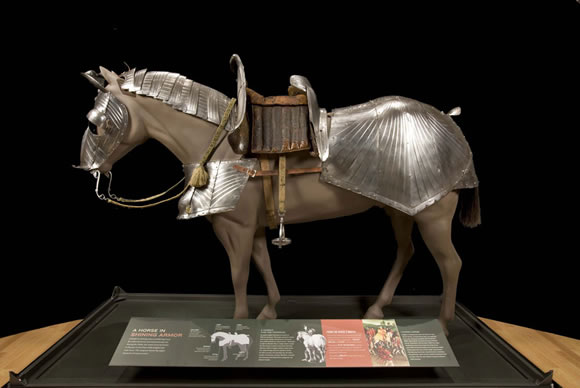
As came the middle ages, and Europeons used horses for wars as well as transportation their armours were metallic carved plates which rided on each other to give flexibility:
As times changed, horse use in the wars reduced. The horse remained as man’s companion and their decorations became less protective and more decorated.
The Arabian horses ( here Moroccan) had their touch of embroidered decor:
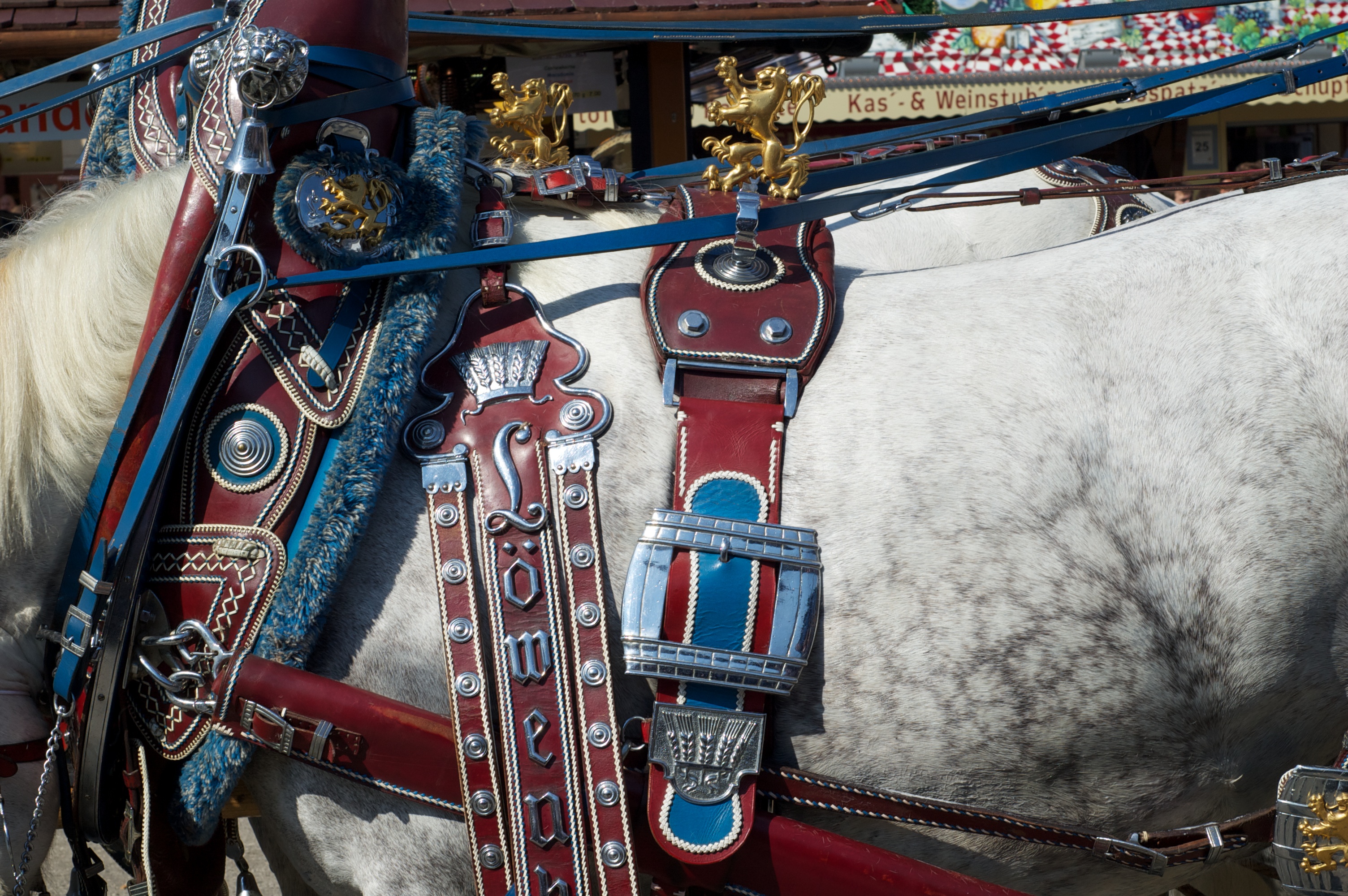
European decorations differed, thus:
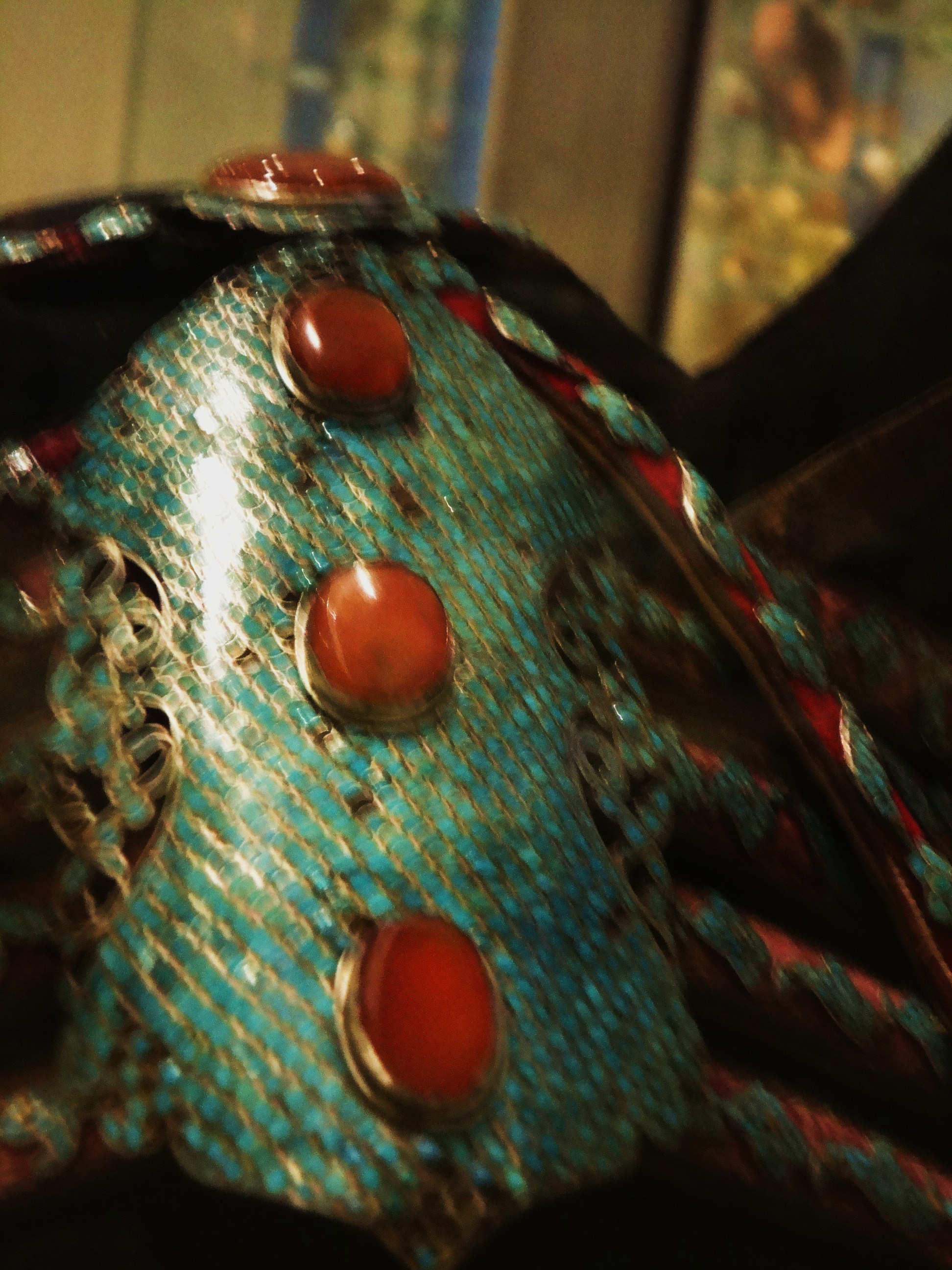
In a recent visit to Royal Ontario Museum I was stunned to see the horse decoration from Iran, which could easily put to envy any woman’s jewellary. This elaborate set of straps and coverings were made of silver, with gold plating,
and inlaid with Iranian turqoise.
The head dress had huge agates giving it a more terrific contrast.
The details of the design were mesmerising:
The austere decorations seen in South Asia using beads, colorful threads and wool tassels have their own charm:
While the Bedoiun horse decor from Egypt still uses tassles of wool and bead work:
The art of decoration does not end here. The places where other aanimals like camel, ponies are used, they are similarly adorned.
And as buses, trucks and rickshaws replace animals as the mode of transportation, even they too are as ferviously bedecked with decorations. (Details later…)
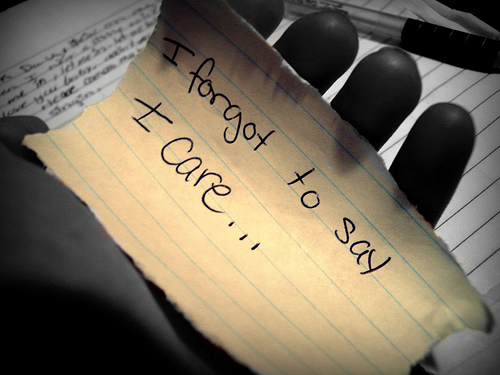
Valentine’s Day isn’t just about expensive gifts, teddy bears, chocolates or red roses to girlfriends. It’s about making any of your loved ones ( whosoever they may be) feel that they matter.
And to make anyone feel that you care, fortunately does not take loads of money. In fact it does not cost anything but a tender caring heart.
I planned to write a humorous blog on the ‘extortion day’ that men generally call Valentines day, with a few jokes.
But when a friend sent in an email mentioning about the idea of ‘heart prints’, it was too touching to just shoo off this day in a joke. Hence without adding any of my non serious words I share the sentimental caring words a friend wrote in her email.
Sharon shared:
“We leave fingerprints on whatever our hands touch. On walls, on furniture, on doorknobs, dishes and books, as we touch we leave our identity. Each day we have the wonderful opportunity to leave prints on the hearts of those who are entrusted to our care.”
Elizabeth Barrett Browning wrote in one of her famous poems: “How do I love thee? Let me count the ways.”
We might say: “How can we touch hearts? Show us the ways.”
The ways that we leave heart prints can be summed up in the word LOVE.
In his meditations, St. La Salle was very fond of quoting St. Paul. In his First Letter to Corinthians, St. Paul describes love. He writes of a love that touches hearts.
How might we describe this love? We might say:
“May we leave heart prints by dealing patiently with others.
May we leave heart prints by being kind to others.
May we leave heart prints by never being jealous or boastful, or arrogant or rude.
In our dealings with others, may we leave heart prints by not insisting on our own way.”
When we are not irritable or resentful or rejoice at wrong, but rejoice in the right, we leave heart prints.
So, in all of our dealings with others, let us leave heart prints.
And if someone should say: “I felt your touch,” that might be miracle enough. “
Continuing with a serious note, perhaps an look of concern, a nod that we understand, a bend to lend an ear, a few words of compassion or just a caring glance that turns a grimace into a grin are all ways to leave heart prints.
Coming back to my not so serious words, well I wouldn’t leave this page without caring words for my men friends for whom this day proves to be more of an extortion day. Here goes my empathy for the impoverished pockets:
Conversation during an expensive candle light dinner on Valentine’s Day:
Girl (blushing) : “Do you love me with all your heart and soul?”
Boy (”the bill’ on his mind): “Mmm hmm.”
Girl( flushing ): “Do you think I’m the most beautiful girl in the world?”
Boy( still thinking of the ‘ the bill’) : “Mmm hmm.”
Girl(slushing): “Do you think my cheeks are like rose petals & my eyes like gazelle’s?”
Boy( ” the bill’ thoughts persist) : “Mmm hmm.”
Girl( gushing) : “Oh dear, you say the most beautiful things in the world!”
With no offence meant to anyone, but I hope to leave some grins on the grimaced faces :).
“When I miss her, I go to her closet to sense my daughter’s fragrance.” Arfa Karim‘s Mom said on her 17th birthday.
The words from the teary eyed mother gave me goose bumps.
She was certainly not talking about the perfumes that Arfa adorned, but the odour that she inherently possessed by virtue of her HLA (genetic) type. This was the smell Arfa’s mom associated her with ever since she held her in her arms soon after her birth (even though the mother may not be aware of it, consciously.)
This reminded me of a research paper I read years ago which said the first bond that a mother and child have after birth is through the sense of smell. Babies from the time of birth learn to identify their mother through a strong sense of smell. It is said that within 24 hours, a mother is able to identify her baby’s odour too. A research claims that within 50 hours, infants were able to differentiate between the smell of their mother’s nipple from that of another lactating woman. Studies have shown that when a mother’s nipple from one breast was washed off, 22 out of 30 babies chose to suckle the unwashed side, because of the familiar odour.
Little toddlers, unaware of relationships, differentiate their siblings from friends subconsciously through odours.
It is common knowledge that animals identify and claim their territory through the sense of smell. Dogs smell their masters, and cannot be deceived even by a look alike.
Each one us is endowed with a unique fragrance or scientifically an ‘odour’ type. Our smells are coded by the genes of a group of molecules called the HLA Complex. Our odour type determines the various social cues we receive in the society in the form of attractiveness, favourable or unfavourable social reactions, and even sexual arousal. Furthermore the role of pheromones, the odour producing hormones in animals and humans as a medium for sexual attraction is also well known.
In an interesting study a group of women were asked to smell men’s T-shirts and choose the odour they liked. Majority of them chose the odour type which was different from theirs, hence from a different genetic pool. Perhaps this is nature’s way to create more variation.
In another similar study, women were asked to smell men’s T-shirts and were asked to rate them according to pleasantness. The men who had infectious diseases, (most probably sexually transmitted disease’) were in more than half of the cases labelled ‘putrid’. That’s another one of nature’s ways to minimise the transmission of infections.
My kids often mention:
‘Oh this smell reminds me of Karachi’, or of Delhi or even of ‘that’ person. Though never a subject of research perhaps every place along with its unique sights and sounds, has its own distinct set of smells too. The smells could be related to its fauna or even the food habits there. My mother often remarks; ‘The soil at every place smells different while the water in every place tastes different.’
A Vietnamese friend who recently visited her native place remarked, Hanoi has its unique smell, and it’s even funny how their embassy here smelt the same. Perhaps it’s the fish sauce!
We do spend a handsome amount on buying scents. And many rich and famous spend a fortune in creating a ‘signature’ smell of their own.
Ironically the sense of smell – though a subtle and powerful sense of perception – is subconsciously the least significant in our lives. We may feel empathy for those who are deprived of a sense of sight or sound, but often either ignore or even mock those with loss of smell. Not many of us even know that some people are born with their sense of smell missing. This condition is known as Anosmia. How incomplete their lives must be. We all have experienced small periods of Anosmia or Hyposmia when our noses get blocked during the common cold. We all know how tasteless even the most delicious of foods seem, with a blocked nose. This simply reinforces the hidden fact that before actually tasting, it is the smell which judges the true taste of food.
Hence, our sense of smell and the odours of others, animate or inanimate creates a great bond and sense of belonging.
One can very well imagine how much Arfa’s Mom must be feeling the presence of Arfa in everything that is associated with her. Though Arfa’s sight and sound may have left, her smell shall linger in the place and possessions she has left behind.
On 27th January, 2012 India celebrates Basant panchami.
In Pakistan, it is celebrated towards the end of February.
Towards the end of January till early March, the golden harvest of wheat stand tall ready to be harvested sometime in early April. And wheat is our staple crop.
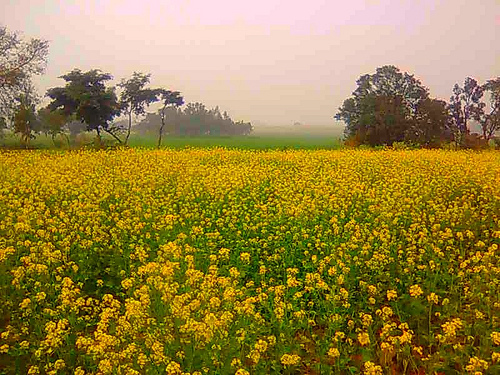
At the same time in Januray February the yellow blooms of mustard ( better known as sarson) sway in the fields, as far as eyes can see. And mustard is a cash crop whose seeds are pressed to extract mustard oil.
To celebrate these awesome blooms as a reward for the fields ploughed and the seeds sown in October, the farmers rejoice, sing, dance and make merry.
Some of them wear yellow turbans, and their women folk adorning yellow ‘odhnis’ come out to join in the celebrations. It is not hard to imagine that they must be celebrating the blooms, ever since they learnt to farm these crops dating back to centuries.
This is the basic root and the spirit of the tradition of Basant in parts of Indian subcontinent where these crops are grown.
Are wheat, or mustard crops Hindu, Muslim or Sikh?
Vasant in Sanskrit or Basant in Urdu mean ‘spring’, which heralds the departure of winter and arrival of spring. It symbolizes the time of rejuvenation and arrival of happiness as flowers start to smile through their blossoms.
Yellow, the color of Basant, inspired by mustard blossoms, which matches the shade of sun rays, signifies life and radiance.
Do rays of sun or radiance of happiness differentiate between Hindus, Muslims or Sikhs ?
Kite flying , another component of basant, has it’s own interesting tale to tell.
“Kite flying also reveals how the tradition evolved over centuries and in a Ganga Jamuni way. Kite flying was introduced to the Indian subcontinent by the Chinese traveller Heun Tsang in the 4th Century. Evolving for centuries, it s modification into its current form and popularisation as a sport was made possible by the Nawabs of Avadh. The kite flying during basant celebrations is believed to have been introduced by Maharaja Ranjit Singh in the 18th century.”
Yet another evidence of centuries old and secular celebration of Basant come from poets, Kalidas and Amir Khusro, who have written about the celebrations of Basant in their own unique styles.
Kalidas in a poem Spring writes:
द्रुमाः सपुष्पाः सलिलं सपद्मं
स्त्रियः सकामाः पवनः सुगन्धिः ।
सुखाः प्रदोषा दिवसाश्च रम्याः
सर्वं प्रिये ! चारुतरं वसन्ते “Oh, dear, in Vasanta, Spring, trees are with flowers and waters are with lotuses, hence the breezes are agreeably fragrant with the fragrance of those flowers, thereby the eventides are comfortable and even the daytimes are pleasant with those fragrant breezes, thereby the women are with concupiscence, thus everything is highly pleasing…
AmirKhusro pens down:
Aaj basant manaalay suhaagun, Aaj basant manaalay; Anjan manjan kar piya mori, Lambay neher lagaaye; Tu kya sovay neend ki maasi, So jaagay teray bhaag, suhaagun, Aaj basant manalay…..; Rejoice, my love, rejoice, Its spring here, rejoice. Bring out your lotions and toiletries, And decorate your long hair. Oh, you’re still enjoying your sleep, wake-up. Even your destiny has woken up, Its spring here, rejoice.
There is an Indian classical music tune called Raag Basant Bahaar.
Not to forget, basant in the subcontinent is also associated with a special sweet prepared specially for the occaision –the kesar halwa, It is a suji ( semolina) halwa with a soft aroma and yellow shade from saffron and garnished with cashew nuts.
Neither the dessert, nor the poetry above nor the music below suggest if Basant is Hindu or Muslim or Sikh.
The same spirit is also replicated by this beautiful ghazal by Malika Pukhraj and Tahira Syed
Lo phir basant aayee…
P.S. Special thanks to Sandeep@stwta a twitter pal for the devnagiri text of Kalidas poetry.
Listening to the stories and anectodes of Mehboob-e-Ilahi( Beloved of God) was a norm as kids. A Mamoo, an ardent follower of Sufism, who lived in Jaipur was the source. If he ever happened to pass by Delhi, visit to the ‘Dargah’ was a mandatory. And when in Delhi, he had to visit his sister too i.e. my mother.
He brought meethi kheels (sugar coated puffballs) every time he came from Dargah, and was ever willing to narrate to us the stories of love between Mehbub-e-Ilahi and his favourite disciple.
On the other hand I saw my not so religious father’s( who also hailed from a Maulvi family) love for Amir Khusrau’s Persian poetry, and a tall tower of audio cassettes he had piled up next to his music system.
Honestly for years until early teens I did not know who Mehboob-e-Ilahi or that disciple were and where the Dargah was. We never visited. All I knew, Ammi went with Mamoojan a few times.
Once , when during a story time, Mamoojan was corrected by my father, about a Persian verse by Amir Khusro, did I realise that there was a correlation.
“Such a great poet had a Pir?” was my instant jerky reaction. Pirs in my mental dictionary had a negative meaning and image.
Equally instant was my father’s reaction: “ Hazrat Nizamuddin was a great scholar, it’s the people later who made him a Pir, and now have opened a whole business in his name.”
Mamoojan just gave a slight smile, and as always drowned again in his love for Mehboob-e-Ilahi, continued the story.
It was then to reinforce the great bond that existed between Hazrat Nizamuddin and Amir Khusrau, did he tell of these incidents, which now I can quote with the Persian verses he might have mentioned.
Just to make it clear, most of the stories have been passed on as word of mouth, and hence I call them anectodes.
Anectode 1:
When Hazrat Nizamuddin passed away Amir Khusrau was away, in some other city, attending to the orders of a King. As he learnt of the sad news he rushed back and went straight to the fresh grave of his master.There he rolled in the mud and tore off his clothes in agony. Then came these words:
Gori sove sej par mukh per dale kes Chal Khusro ghar aapne, rain (not saanjh) bhaee chahu des. The lovely maiden lies finally on a wreath of flowers, her tresses covering her face, O Khusro, turn back home now, dusk has set in all over.”
Amir Khusrau was never the same after his Pir’s death. And it was only in six months that Amir Khusrau also passed away.
He was, as per the desire of the disciple and Pir both, buried close by. This is now known as a “chabootra-e-yaar’ ( the pedestal of friend).
One can see this as a raised platform with red sandstone carved fence, around the grave.
The Pir also reciprocated his disciple’s love and affection, and is believed to have remarked: “If shariyat would allow me, I would want Khusrau and I to be buried in the same grave.”
His followers believe that Hz Nizamuddin instructed that “Those who visit my grave should first pay respect at Khusrau’s .”
Anectode 2:
Amir Khusrau was away for a royal trip. A disciple of Hz Nizamuddin came to him asking for some souvenir from his Pir. Since the Pir had nothing to offer, he asked the disciple to take away his slippers.
Incidentally, on the way the disciple and Amir Khusrau’s paths crossed each other. And Khusrau remarked:
Shaikh mi aayad, Bu-e Shaikh mi aayad”.
(I smell my master, I smell my master).
On knowing that the man had in possession the slippers of his Pir, Khusrau gave away all his wealth that he had on him and bought back those slippers.
Anectode 3:
The two were sitting at the bank of river Yamuna in Delhi when Hz Nizamuddin (wearing a cap crooked way), saw some men taking a dip in the river with a reverence as a worship. He remarked: Har qaum raast raahay, deenay wa qibla gaahay (Every sect has a faith, a qibla which they turn to.)
Pat came the reply from Khusrau: Men qibla raast kardam, ber terf-e kajkulaahay. (I have straightened my qibla in the direction of this crooked cap)
Anectode 4:
It is the most interesting of all anectodes, and if true (I do not doubt, but these stories have been passed through word of mouth), then it is remarkable to have this quality of Persian and Brij Bhasha poetry from an eight year old.
It is said that Khusrau’s mother brought her eight year old son to the place where Hazrat Nizamuddin ( a renowned scholar and respectable man) resided.
Instead of entering the premises Khusrau sat outside and narrated: Tu aan shahi ke ber aiwan-e qasrat Kabutar gar nasheenad, baaz gardad Ghareeb-e mustamand-e ber der aamed Be-yaayad andaroon, ya baaz gardad You are a king at the gate of whose palace, even a pigeon becomes a hawk. A poor traveller has come to your gate, should he enter, or should he return?
And that Hazrat Nizamuddin who himself was 23 then, came out (some say he sent out servants) and replied: Be-yaayad andaroon mard-e haqeeqat Ke ba ma yek nafas hamraaz gardad Agar abla buvad aan mard-e naadan Azaan raah-e ke aamad baaz gardad Oh you the man of reality, come inside, so you become for a while my confidant, but if the one who enters is foolish , then he should return the way he came.
Hearing this Khusrau knew that he has come to the right place and hence entered into his guidance.
Having reread Khusrau, several times over since then, I have came across some of the records, which go further to say that- telling his mother of his excitement to have found the Pir, Khusrau composed these beautiful verses: Aaj rung hai hey maa rung hai ri Moray mehboob kay ghar rang hai ri Sajan milaavra, sajan milaavra, Sajan milaavra moray aangan ko Aaj rung hai…….. Mohay pir paayo Nijamudin aulia Nijamudin aulia mohay pir payoo Des bades mein dhoondh phiree hoon Toraa rung man bhayo ri……, Jag ujiyaaro, jagat ujiyaaro, Main to aiso rang aur nahin dekhi ray Main to jab dekhun moray sung hai, Aaj rung hai hey maan rung hai ri. What a glow everywhere I see, Oh mother, what a glow; I’ve found the beloved, yes I found him, In my courtyard; I have found my pir Nizamuddin Aulia. I roamed around the entire world, looking for an ideal beloved; And finally this face has enchanted my heart. The whole world has been opened for me, Never seen a glow like this before. Whenever I see now, he is with me, Oh beloved, please dye me in yourself; Dye me in the colour of the spring, beloved; What a glow, Oh, what a glow.
In my ignorance, I bluntly asked Mamoojan,”What was so great in Hazrat Nizamuddin that even an accomplished man like Amir Khurau revered him so much?”
I remember Mamoojan reply, “He was a great pious man, a Wali. That is why he was called Mehboob-e-Ilahi ( the beloved of Allah)”.
To tell you the truth, I wasn’t entirely convinced then, but then years later, while getting into the colors of Amir Khusrau’s poetry, I did my own research.
I found that Hazrat Nizamuddin was a great scholar of Quran. He was truly a very pious man, who prayed a lot and fasted each day of the week.
There were free meals ( langar) at his residence, each day, in which Amir Khusrau actively took part.
He led a very simple, austere life, wore at times torn clothes, and ate extremely simple food.
But what really convinced me of why Amir Khusrau revered him so much was this incident of Hazrat Nizamuddin , which so speaks volumes of the greatness of this Pir of Amir Khusrau:
Once some of the staunchest of enemies of Hazrat Nizamuddin, threw thorn on the way he was to pass. He walked over them, bare feet, without any complaint. And with his sole bleeding, he prayed that every thorn that had pierced him become a red rose( like the color of his oozing blood) in the grave of the thrower.
Mehboob-e-Ilahi that he was, he is said to have remarked: “If a man places a thorn in your way, and you place a thorn in his way, soon there will be thorns everywhere.”
With all this in the background, now this poetry by Amir Khusrau sounds even more melodious…
Kabir leaves no examples to teach and stress to human beings, in his own simple ways, the lessons of humility, tolerance and open mindedness.
In other verses, as in previous post, he gives examples from the living world, like animals, or even from trees, rivers and oceans.
In the verses mentioned below, he picks the most modest of examples, to highlight their good traits. But realisng that they too have downsides, moves on to gentler ones among them. And ultimately makes us realise, it is only ‘the ONE’ truly devoid of flaws.
In a way, there is a subtle message here, that in one’s pursuit to be better, there is always room for further betterment, and despite all our efforts in the direction, it is only the ONE who is perfect.
Rorha hoi rahu baat ka, taji paakhand abhimaan. Aisa je jana hoi rahe, taahi mile bhagwaan.
O dear, be as humble as the pebble on the path. Giving up all snobbery and ego. Only if you are humble can you realise Him.
Rorha bhaya to kya bhaya, panthi ko dukh deh. Harijan aisa chahiye, jyoon dharani ki kheh.
Kabir rethinks. What if you are a pebble, as it too can get unkind and hurt the feet of the fellow travellers on the path. So be like the soil on Earth, soft and gentle.
Kheh bhayi to kya bhaya, urhi-urhi laage ang. Harijan aiasa chahiye, jyu paanee sabrang.
Again Kabir rethinks. What if you become soil? It flies with slight breeze and spoils others ( a little adversity may cause our evil nature to surface and cause harm to others). So just be like water – it is without color (without prejudice), but it can take whatever color easily ( be open minded).
Panee bhaya to kya bhaya, taataa-seeraa hoy. Harijan aisa chahiye, Hari jaiasa hi hoy.
Once again Kabir rethinks. What if you are water? The water gets furious with heat and even becomes too cold with indifference.
So just strive to be as Tolerant, Kind and and Merciful, always as your Lord.
Shams Ul Anwar’s statement of ‘waiting to receive the body parts of my daughter’ moved me. It really moved everyone.
Rarely do I take more than a few seconds to figure out what status to write, but this time I wrote and rewrote at least 5 times before posting on Twitter and Facebook : “He isn’t just one. There are many more #ShamsUlAnwars in Baluchistan, Parachanar, Hazara and where not… in #Pakistan.”
I read it with a flicker of scepticism on facts in the story: “he saved a man from planting a bomb.” It occurred to me “Why did this not make news?”
Next I read “his two sons were kidnapped and one son was sent back in pieces with a recorded CD of the act.”
“How come it didn’t make it to the news?” I again questioned.
Then came the last rhetoric that it is Jan 11 and a few hours left to the deadline of Jan 12 for his daughter’s turning into pieces.
I thought again, “Why did he have to wait for the last hours?”
But I just blamed the devil in me for questioning it. And felt nauseated. Really nauseated
It was one of those rare occasions when one saw EVERY Pakistani status on facebook pouring out compassion.
Without naming them, from journalists, intellectuals, values upholding serious youngsters, all of whom I hold in high esteem, to even the Paris Hilton-ish socialites and fun loving teenagers who generally post only songs and light hearted statuses were all visibly shaken. Those who generally seem oblivious to the calamities occurring anywhere on the globe, or not giving a second thought to the suffering flood victims right in their backyard, were all posting bank accounts.
So overzealous were the intentions to donate that Beena Sarwar and others had to issue an appeal to avoid payment into the direct account and lest it would escalate the demand from the perpetrators and make kidnap for ransom an attractive option for criminals. It was only through her elaborate status that an emotionally moved me, could rationalise that these could be the possibilities too.
The vague imageless impression of the girl lingered in my head through the sleep. First thing I did jumping out of bed was to start the laptop to check what happened.
The girl was recovered. There weren’t as many rejoicing statuses, but people moved on to their usual statuses. It simply signified they felt truly happy with the developments. When you are really happy deep inside, you generally don’t show it off as an outburst, and stay calmly contented.
And then in the middle of the day, as if another emotional bomb was dropped.
Twitter started to talk of the possibility of the story being fraudulent. At that moment I felt for a split of a second, “Was it really silly of me to believe it? “
But then I realised it was better to have believed and empathised rather than have blown it off as a fluke. What if it had turned out to be correct, or even half correct? The guilt then would have been worse, and quite unforgiving. As such I hate to reach a point of apathy when no pain of others looks real.
Later then , while searching on the net I came across this blog post on LUBP. Instead of digging into what fraudulent culture and mindsets, from top to bottom, gave Shams Ul Anwar the audacity to make up such a story, the author punned at the compassion of the empathising ‘urban elites’ as ‘promoting their shallow philanthropic credentials’.
And then the author did have to take it out on Imran Khan too, for which he had the compulsive urge to mention a blog by name of one of the key members of the opposite camp for settling a score.
Agreed, that there is no denial of the ‘ignored authentic stories of the Baloch, Pashtun and Shia target killings by army and its Jihadi-sectarian proxies’.
But how does this wrong negate the empathy of thousands for the story? How does the empathy for a horrifying story become ‘superficial’ ?
I fail to understand. Perhaps they are right.
Neither the Baloch nor the Shias of Parachanar and Hazara killings deserve empathy, nor did the story of Madina Anwar’s until proven fraudulent.
The only rant that really deserves merit is the ‘victimisation’ rant and ‘coup, coup’ wolf cry that the followers of the party whose agenda LUBP pursues.
This is the only unfairness in the world that deserves all the outpouring and sympathy. After all they are the ‘Feudal and the ruling ‘elite’.
What the hell is empathy got to do with an ordinary Madina Anwar or the ‘people’ who are killed whether in Hazara, in Parachanar, or Balochistan or even who die a million deaths each day in the flood affected areas of Sind or elsewhere in Pakistan, due to lack of basic necessities of life?
Yes, next time when they rant ‘coup , coup’ (whether true or false), despite their non compliance to the parliamentary resolutions or court orders, please all of you cry in pain.














 Blind to Bounds
You must be logged in to post a comment.