Open up your mind and your potential reaches infinity…

Archive for the ‘Music’ Category

Jana Gana Mana~Tagore


Jana gana mana ...the national anthem of India was written and composed by Rabindranath  Tagore in 1911.
It was first sung at the Calcutta Session of the Indian National Congress on 27 December 1911. Jana Gana Mana was officially adopted by the Constituent Assembly as the Indian national anthem on January 24, 1950.

There is a controversy that the poem was composed in December 1911, precisely at the time of the Coronation Durbar of George V, and is considered by some to be in praise of King George V and not God.
A British newspaper reported:
“The Bengali poet Babu Rabindranath Tagore sang a song composed by him specially to welcome the Emperor.” (Statesman, Dec. 28, 1911).

However, many historians aver that the newspaper reports cited above were misguided. The confusion arose in British Indian press since a different song, “Badshah Humara” written in Hindi by Rambhuj Chaudhary, was sung on the same occasion in praise of the monarch. The nationalist Indian press stated this difference of events clearly:-
The proceedings of the Congress party session started with a prayer in Bengali to praise God (song of benediction). This was followed by a resolution expressing loyalty to King George V. Then another song was sung welcoming King George V.” (Amrita Bazar Patrika, Dec.28,1911).

Even, Tagore himself in a letter mentioned:
“I should only insult myself if I cared to answer those who consider me capable of such unbounded stupidity as to sing in praise of George the Fourth or George the Fifth as the Eternal Charioteer leading the pilgrims on their journey through countless ages of the timeless history of mankind.” (Purvasa, Phalgun, 1354, p738.)

Jano Gano Mano Adhinaayako Jayo Hey,Bhaarato Bhaagyo Bidhaataa
Panjaabo Sindhu Gujaraato Maraathaa,Draabiro Utkalo Bango
Bindhyo Himaachalo Jamunaa Gangaa, Uchchhalo Jalodhi Tarango
Tabo Shubho Naamey Jaagey, Tabo Shubho Aashisho Maagey
Gaahey Tabo Jayogaathaa
Jano Gano Mangalo Daayako, Jayo Hey Bhaarato Bhaagyo Bidhaataa
Jayo Hey, Jayo Hey, Jayo Hey,Jayo Jayo Jayo, Jayo Hey

English Translation

Oh! the ruler of the minds of people, Victory be to You, dispenser of the destiny of India!
Punjab, Sindh, Gujarat, Maharashtra,Dravida(South India), Orissa, and Bengal,
The Vindhya, the Himalayas, the Yamuna, the Ganges,and the oceans with foaming waves all around
Wake up listening to Your auspicious name, Ask for Your auspicious blessings,
And sing to Your glorious victory.
Oh! You who impart well being to the people!
Victory be to You, dispenser of the destiny of India!
Victory to You, victory to You, victory to You, Victory, Victory, Victory, Victory to You!

Source: http://en.wikipedia.org/wiki/Jana_Gana_Mana_(the_complete_song)
Rabindranath Tagore ~If they answer not to thy call WALK ALONE,


Rabindranath Tagore was a larger than life personality –  poet,  philosopher, playwright, novelist, essayist, painter, composer and educator.

He was the first non Europeon to get a  Nobel Prize in 1911, which he  received as Nobel Prize in Literature for his collection of poems which were initially written in Bengali, but later translated in English by himself.

He is the only person who has the honour of being the lyricist of National Anthems of two countries –namely Jana Gana Mana of India and Shonar Bangla of Bangladesh.

He translated Shakespeare from English to Bengali in his teens. He also translated 100 poems of  saint Kabirdas from Hindi to English in 1930s , hence familiarising Kabir as the most read Indian poet to the west in  those times.

Rabindranath Tagore, was knighted with the title of ‘Sir’ when he won the Nobel Prize in Literature in 1911. However, after the Jallianwala Bagh massacre in 1916, he gave up the knighthood in protest.

He, thrice, refused invitation to visit Canada in protest against the massacre of 376 native Indians in Komagat Maru incident in 1914. However, when he visited Canada at the invitation of National Council of Education to address at the triennial conference, Vancouver he made it a point to make his statement as follows:

“Canada must believe in great ideals. She will have to solve . . . the most difficult of all problems, the race problem.”

Tagore also had the opportunity to interact one on one with another ‘great’ of his times, namely Einstein. Their highly intellectual conversations are documented word to word. An  excerpt from the dialogue of one of the three meetings is as follows:

TAGORE: Melody and harmony are like lines and colors in pictures. A simple linear picture may be completely beautiful; the introduction of color may make it vague and insignificant. Yet color may, by combination with lines, create great pictures, so long as it does not smother and destroy their value. 
EINSTEIN: It is a beautiful comparison; line is also much older than color. It seems that your melody is much richer in structure than ours. Japanese music also seems to be so.

Y B Yeats another Nobel Laureatte oet who later wrote the Introduction of Tagore’s Geetanjili had the chance to read Tagore before he met him. He commented, ” I have carried these manuscripts with me for days, reading it in railway trains, on top of  omnibuses, inrestaurants and often had to close it lest some stranger see how much it moved me.”

Gandhi and Tagore’s differences are famous and still debated. While Gandhi started a non cooperation movement against the British, Tagore remarked,” …there was a thin line between nationalism and xenophobia —besides, hatred of the foreigner could later turn into a hatred of Indians different from oneself.”

He was particularly sceptical of the claim that non-co-operation had or would dissolve Hindu-Muslim differences. And ultimately Tagore was proved right on this issue.

The two  personalities met only twice, but kept a regular communication through articles and letters. And like two great human beings, they kept high regard for each other, despite differences.

Gandhi remarked:  “Gurudev and I early discovered certain differences of outlook between us. Our mutual affection has, however, never suffered by reason 0 f our differences … ” 

Another Nobel Peace Laureatte Aun San Su Kyi is another person who derives inspiration from Tagore. And claims her “most precious lesson” had been from Tagore: “If no one answers your call, walk alone.”( the above poem).

Apart from being a eastern mystic, Tagore was a visionary who articulated ideals of humanism, equality and freedom long before the League of Nations or the Universal Declaration of Human Rights of 1948.  Tagore was  one of the strongest critics of war and colonialism, fascism, and the dangers of narrow-minded nationalism.

In the 1920s, he had already identified racism as the greatest problem in a fast globalizing world.

Perhaps looking at today’s world he was accurate in his prediction, sadly though. 

The following is a popular poem written by Rabindranth Tagore.  The music for the song was also composed by him.

Jodi Tor Dak Soone Keu Na Asse
Tobe Ekla Chalo re
Ekla Chalo Ekla Chalo Ekla Chalore

Jodi Keu Katha Na Kai Ore Ore O Abhaga
Jodi Sabai Thake Mukh Firae Sabai Kare Bhay
Tabe Paran Khule
O Tui Mukh Fute Tor Maner Katha Ekla Balo re

Jodi Sabai Fire Jai Ore Ore O Abhaga
Jodi Gahan Pathe Jabar Kale Keu Feere Na Chay
Tobe Pather Kanta
O Tui Rakta Makha Charan Tale Ekla Dalo re

Jodi Alo Na Dhare Ore Ore O Abhaga
Jodi Jharr Badale Andhar Rate Duar Deay Ghare
Tobe Bajranale
Apaan Buker Panjar Jaliey Nieye Ekla Jalo re

English translation: *Touching words*

If they answer not to thy call WALK ALONE,

If they are afraid and cower mutely facing the wall,
O you unfortunate,
open thy mind and SPEAK OUT ALONE.

If they turn away, and desert you when crossing the wilderness,
O you unfortunate,
trample the thorns under thy tread,
and along the blood-lined track TRAVEL ALONE

If they do not hold up the light when the night is troubled with storm,
O you unfortunate,
with the thunder flame of pain ignite thy own heart
and let it BURN ALONE.


Avval Allah, Nur upaya, qudrat de sab bandey…


This blog post is a tribute to the bravado of my#Sikh brothers, who stood up in respect for humanity beyond faith during the #UKriots.

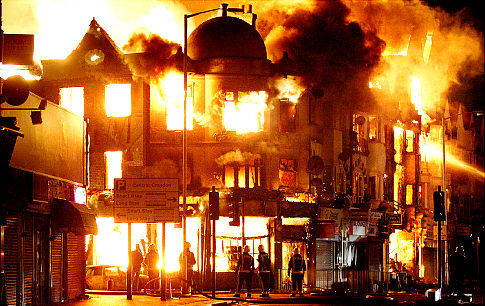
It was devastating to see the peoples power gone berserk in UK riots, as the  arson and looting carried on unabated into the fourth night . Unfortunately against the sheer numbers, the police seemed helpless to control the unruly mob.
While following the  #UKriots on Twitter and BBC News, hashtag #Sikhs started to trend—first World wide and then in UK, London.

A tweet was seen:

Remroum Remi Kanazi
Was afraid #Sikhs trending was going to be some bigoted stream. Thankfully it was this: Sikhs protecting people while they prayed #UKRiots

They came pouring, tweets one after the other with speed getting faster:

Prandha_Swag Harpreeeeezyf.baby
#Sikhs is trending.

Nagra18 Jasraj Nagra
#Sikhs is trending, never thought i’d see the day #proud.

KavelKaur Kavel Kaur
#Sikhs are a world wide trend!!!!

GDS1ngh GD singh
#sikhs trending, fantastic. doing what we do best.

moneyspinner MONEYSPINNER
#sikhs nanak naam chardi kala, tere baane sarbat dha bhala

I googled to check the details and saw Mail Online quote:

Some armed with swords, some carrying hockey sticks, defiant Sikhs stood guard outside their temples last night.
More then 700 men, some in their 80s, took to the streets to protect the homes, businesses and places of worship in Southall, West London.

The tweets went on:

Goggi_Rana Goggi Rana
Sikhs of Britain have displayed the same traits of fearlessness, as their ancestors of yesteryear #Sikhs #SangatTV

UncleWail Wail Al Aun
Thumbs Up for the #Sikhs protecting their #Temple in Toxteth #Liverpool #UKRiots

MissssChrissy Chrissy
Singh Is King… Yep I think so! #sikhs doing it real big today. #LondonRiots #ukriots

Then we heard that they had not only protected their temples but also stood at the mosque guarding while the Muslims prayed ther Taraweeh prayers of Ramadan in South Hall mosque:

A google message read :

Muslims prayed their Tarawee prayers while Sikhs protected he Masjid
Got this from a friend in London.
In a Masjid in Southall London, Muslims were praying their Taravee prayer as the riots were going on, a bunch of Sikhs stood outside the Masjid and protected the Masjid.
The similar thing happened when Sikhs were inside their Gurduwara and some Muslim youngster guarded it on the gate
Great experience, a cousin and a friend of mine reported the same incident.
May ALLAH bless people like them, humanity still remains here, despite the problems

Tweets loaded with emotions, from Muslims and people from other faiths,  too poured in with ovelwhelming enthusiasm:

PMGenerals PMG Anj
Today was an historic day for #hindus #sikhs and #muslims. #unitedwestand all religions teach us to have morals and respect dis proved it! X

dj_aNomAli ∀ℓι . ᄊ乇尺cんለռէ
Sikhs protect Southall mosque while Muslims pray Taraweeh in peace. Much respect to our brothers!! #LondonRiots #Southall #Sikhs #MashAllah

DNSDj Davinder Singh
Actually brings a tear to my eye seeing the #unity between #Sikhsand #Muslims in the fight against this madness. #proudtobesikh

akchishti akchishti
Great sight in my #Birmingham where #Pakistani lads are protecting temples while Sikh lads protecting the mosques

Muslimerican Peter
Imagine a group of rioters turning down a street and suddenly seeing 400 #Sikhs standing in the distance. #wrongturn #ohshit #londonriots

AdamPatel2 Adam Patel
I hear the #sikhs are even protecting the #mosques in Southall so #muslims can read our Tarawih in peace.”>>> BIG LOVE –

And dishearted tweeps begain to take a sigh of relief

xcrimsonstarx Vicki Langfield
The #Sikhs are giving me faith in humanity

Indeed, everyone who followed this trend must have rekindled their faith in humanity. Thanks you my Sikh brothers.

MumzyStranger Mumzy Stranger
Love out to the #Sikh brothers who protected the mosque during prayer time. If we all unite we can and WILL put a STOP to this chaos! M x

And  with these tweets millions or billions of eyes gleamed with hope.

We hope and pray this display of unity and humanity extends to all faiths and communities beyond borders and beliefs…

My mind recalled the verses of Sant Kabirdas which  along with 500 other verses which are included in to the Guru granth Sahib,  are  often heard from  Gurudwaras as Shabad Kirtan :

Avval Allah Noor upaya Qudrat ke sab bandey
(God created light of which all the things were born)
Aik nor ke sab jag upajaya kaun bhale ko mandhe
(From the light, the universe. So who is good and who is bad).

Indeed, I hail my Sikh brothers for living up to the spirits of their faith, their Gurus and their Book.

In return many Muslims also stood up with the Sikhs and helped them form groups which defended their communities and boroughs. Hail Sikh Muslim Solidarity. 

Let this be the beginning of Sikh-Hindu-Muslim-Christian-Jew –other faiths unity for  all faiths believe in one Supreme Power and all faiths belong to  one Humanity’

I dedicate  this tribute to my Sikh brothers with the greeting, which in Punjabi means exactly what Allah u Akbar stands for :

Vaheguru ji ka khalsa, vaheguru ji ki fateh.
(God’s pure and God’s victory )

My brothers,  Rabb Raakhaa

Ilmana Fasih, Aug 10, 2011

P.S.: Please scroll down in the comment box to see the reaction of the Muslim community after 3 Pakistani boys were killed in Birmingham.

Tumi robe nirobe~Rabindrasangeet. Music without borders


In my heart, thou shall, in peace, alight…
Like the glowing moon and the Dame of the Night.

My life, my youth…
My world absolute;
Thou shall draw bright…
Like the Dame of the Night…

Alone shall rise, eyes of thee,
Thy billowing drapes shall protect me.

My pain, my screams,
My success dreams;
Thou shall delight,
Like the Dame of the Night.


About the author, composer of this song:

Rabindranath Tagore (1861-1941) was a Poet, Philosopher, Musician, Writer, Educator, and the first Indian Nobel Laureate for Literature (1913). Tagore has been labelled the “King of Poets” for his beautiful and exquisite poetry. In particular Tagore had a deep love and reverence for nature which he was able to express through lyrical poetry.

Tagore was awarded the Nobel Prize in 1913 for his book Gitanjali. W.B.Yeats in particular was deeply impressed with this work and wrote an introduction. With this honour Tagore became famous in both India and the West. In 1915 Tagore was knighted by King George, however Tagore was to return his knighthood in protest of the Amritsar massacre (1919)

Although Tagore stayed out of politics he remained a good friend of Gandhi. In fact it was Tagore who would often persuade Gandhi to give up his fasts in the interest of the nation.

As a writer, Tagore primarily worked in Bengali, but after his success with Gitanjali, he translated many of his other works into English. He wrote over one thousand poems; eight volumes of short stories; almost two dozen plays and play-lets; eight novels; and many books and essays on philosophy, religion, education and social topics.

As well as literature Tagore had a great love of music, in particular Bengali music. He composed more than two thousand songs, both the music and lyrics. Two of them became the national anthems of India and Bangladesh.

Little Terrorist~a short Film


Little Terrorist tells the moving story of a Pakistani Muslim boy who accidentally crosses the Pakistani-Indian border which is riddled with landmines. He ends up in a strange country that regards him as a terrorist. The old orthodox Hindu Bhola takes him in and hides him from the Indian soldiers. However, traditions and prejudices about Muslims remain an obstacle in the relationship between Bhola and the boy. Ultimately, humanity triumphs over prejudice when Bhola risks his own life to help Jamal cross the border again. This symbolic story of hope is a tale of human solidarity conquering all artificial boundaries.
Ashvin Kumar, the director, was nominated for an Oscar in the Best Live Action Short Film category.
Ashvin Kumar’s Little Terrorist also won first prize for best short film at the Montreal Film Festival.

And was nominated and selected for various other prizes.

I am a Woman~by Helen Reddy~Music without borders


I Am Woman

-Artist: Helen Reddy from “Helen Reddy’s Greatest Hits”: EMI ST 11467
-peak Billboard position # 1 for 1 week in 1972
-Words and Music by Helen Reddy and Ray Burton

I am woman, hear me roar
In numbers too big to ignore
And I know too much to go back an’ pretend
’cause I’ve heard it all before
And I’ve been down there on the floor
No one’s ever gonna keep me down again

CHORUS
Oh yes I am wise
But it’s wisdom born of pain
Yes, I’ve paid the price
But look how much I gained
If I have to, I can do anything
I am strong (strong)
I am invincible (invincible)
I am woman

You can bend but never break me
’cause it only serves to make me
More determined to achieve my final goal
And I come back even stronger
Not a novice any longer
’cause you’ve deepened the conviction in my soul

CHORUS

I am woman watch me grow
See me standing toe to toe
As I spread my lovin’ arms across the land
But I’m still an embryo
With a long long way to go
Until I make my brother understand

Oh yes I am wise
But it’s wisdom born of pain
Yes, I’ve paid the price
But look how much I gained
If I have to I can face anything
I am strong (strong)
I am invincible (invincible)
I am woman
Oh, I am woman
I am invincible
I am strong

FADE
I am woman
I am invincible
I am strong
I am woman

History of the song:

“I am Woman” reached #1 on the Billboard charts in December 1972. The song was the first #1 hit on the Billboard chart by an Australian-born artist and the first Australian-penned song to win a Grammy Award .In her acceptance speech for Best Female Performance, Reddy famously thanked “God, because She makes everything possible”.

It sold more than a million copies, and has been played more than a million times on US radio.

National Organization for Women founder Betty Friedan was later to write that in 1973, a gala entertainment night in Washington DC at the NOW annual convention closed with the playing of “I Am Woman”. “Suddenly,” she said, “women got out of their seats and started dancing around the hotel ballroom and joining hands in a circle that got larger and larger until maybe a thousand of us were dancing and singing, ‘I am strong, I am invincible, I am woman.’ It was a spontaneous, beautiful expression of the exhilaration we all felt in those years, women really moving as women.”

To Reddy, the song’s message reaches beyond feminism. “It’s not just for women. It’s a general empowerment song about feeling good about yourself, believing in yourself. When my former brother-in-law, a doctor, was going to medical school he played it every morning just to get him going.”

Source: http://en.wikipedia.org/wiki/I_Am_Woman

Zehaal-e-Miskeen -~Amir Khusrau


Khusrau was a master of  Persian ( which used to be the language of the court) as well as  Brij Bhasha ( the language of the common man) .

Zehaal -e Miskeen is a master piece written in both the languages in Persian (bold) and Brij Bhasha (italics). In the first verse, the first line is in Persian, the second in Brij Bhasha, the third in Persian again, and the fourth in Brij Bhasha. In the remaining verses, the first two lines are in Persian, the last two in Brij Bhasha. The poem expresses the agony of separation from the beloved,  in both the languages with a superb fusion…which to my understanding signifies how different yet similiar is the expression of the agony of separation amongst the elite ( representing Persian) and the common man ( through Braj Bhasha).

Zehal-e miskin makun taghaful, duraye naina banaye batiyan
Ki taab-e hijran nadaram ay jaan, na leho kaahe lagaye chhatiyan.

 Do not overlook my misery by blandishing your eyes,
and weaving tales; My patience has over-brimmed,
O sweetheart, why do you embrace me.

Shaban-e hijran daraz chun zulf wa roz-e waslat cho umr kotah;
Sakhi piya ko jo main na dekhun to kaise kaatun andheri ratiyan.

 Long like curls in the night of separation,
short like life on the day of our union;
My dear, how will I pass the dark dungeon night
without your face before.

Yakayak az dil do chashm-e jadoo basad farebam baburd taskin;
Kise pari hai jo jaa sunaave piyare pi ko hamaari batiyan.

 Suddenly, using a thousand tricks, the enchanting eyes robbed me
of my tranquil mind; Who would care to go
and report this matter to my beloved?

Cho sham’a sozan cho zarra hairan hamesha giryan be ishq aan meh;
Na neend naina na ang chaina na aap aaven na bhejen patiyan.

 Tossed and bewildered, like a flickering candle,
I roam about in the fire of love;
Sleepless eyes, restless body,
neither comes she, nor any message.

 Bahaqq-e roz-e wisal-e dilbar ki daad mara ghareeb Khusrau;
Sapet man ke waraaye raakhun jo jaaye paaon piya ke khatiyan.

 In honour of the day I meet my beloved
who has lured me so long, O Khusrau;
I shall keep my heart suppressed,
if ever I get a chance to get to her trick.


Another beautiful rendition of Zehaal-e-Miskin by Warsi brothers: 

Lal Peeli Ankhiyan~Rajasthani song


Jad jad dekhoon banari lal peeli ankhiyaan
Main ko ni dara sa , bhala hi kado ankhiyaan.

(Whenever I see you, your eyes are red with anger
I am least scared of you, no matter even if you pop out your eyes).

Jaipur sheher se dhola mharo chunri ni lyave
Main ko ni orha sa, bhala hi kado ankhiyan

(You donot get me the dyed dress from Jaipur
I am not going to wear the old one, no matter even if you pop out your eyes).

Amir Khusrau, the maestro of Tarana.


This blog is just an attempt to familiarise the lovers of Amir Khurau to a form of singing, called Tarana, the fascinating  fast paced rendition often intended  to attain trance ( haal),   is attributed to be invented by him. Needless to say his other inventions being Qawwali, seventeen taals, tabla and sitar.

All I get is that Tarana  uses sargams and vocables like na, ta, re, da, ni, odani, tanom, yalali, yalalom shuffled in a fast pace coordinated  by rhythmic percussion from Dhol or Tabla.

A legend says that Amir Khusrau discovered this genre of music by default when   Khusrau at a performance of raga Kadambak by Gopal Naik,  allegedly,  remembered the music but not text. So he created the tarana through a merging of bols from the tabla, the sitar or the mridang.

Since I am absolutely bankrupt in classical music so I would just quote what Ustad Amir Khan Sahib,  a master of Tarana says:

“It is generally believed that Tarana is a composition of meaningless syllables followed sometimes by the bols (words coined to denote the various sounds of instruments) of the tabla and sometimes by Persian poetry. This view is not true. As a matter of fact at the time of the Amir, the texts of the songs used to be in the languages of South India, which were not easily understood by the people of the North. The court language was Persian, which was evidently the language of the contemporary intelligentsia. The Amir naturally thought of composing the texts of songs in the language understood by the intelligentsia. Thus the Tarana was born. The various words used are Dartanaa, Dar Tan Aa, Yala an abbreviation for Ya Allah. Yali for Ya Ali, Dar Aa etc., which when translated would mean:

Yala – Ya Allah

Yali – Ya Ali

O Dani : He knows

Tu Dani : You know.

Tom : I am yours, I belong to you
or   
Main Tum Hun (I am you).

Na Dir Dani : You are the complete wisdom.

Dar – Bheetar, Aandar (inside)

Dara – Andar Aa (get in or come inside)

Dartan – Tanke Aandar (inside the body)

Tanan Dar Aa : Enter my body.

Tanandara – Tanke Aandar Aa (Come inside the body)

Nadirdani – Tu Sabse Adhik Janata Hai (You know more than anyone else)

Tandardani – Tanke Aandarka Jannewala (One who knows what is inside the body)

Another feature of Tarana as sung by many in India is the repetition of certain words at a great speed. The justification for this type is also not to be sought., It is not merely an exhibition of speed or virtuosity at pronouncing words, but the idea is that while in prayer a person goes into a trance, and that in that state of mind he just continues to repeat one word or one set of words.”

( source: http://caferisko.ca/ak/tarana.html)
Yar-e-man bia bia Tarana sung by Konkana Bannerjee.

Main melody:
Yar-e-man bia bia.
Dar Tan tadim,
Ta-nan Ta na dim, Tom Ta Na Na Na
Antara:
Ba labam raseeda jaanum
Fu bia ke zinda maanum
Pas azari ki man na maanum,
Ba cheh kar khahi amud.

which means:

O love, come soon, come at once.
Come and enter my body,
for I am yours, come
Antara:
My life hangs on my lips,
Come thou that I may live again
for if thou shall come when I am no more,
to what avail shall it be.

Also see:http://en.wikipedia.org/wiki/Tarana
http://www.indiaheritage.org/perform/music/h-v-t.htm

Senorita ~Music without borders


[Señorita]Spanish
Quien eres tu? (Who are you?)
Donde has estado? (where have you been?)
He removido cielo y tierra y no te encontre
(I moved heaven and earth and not find you)

Y llegas hoy (but you arrive today)
Tan de repente (So suddenly)
Y das sentido a toda mi vida con tu querer
(and give meaning to my life with your love)

[Farhan Akhtar]Urdu
Na main samjha, na main jaana (I did not understand, nor do I know)
Jo bhi tumne mujhse kahaa hai Senorita(whatever you said to me Senorita)
Magar phir bhi, na jaane kyun(But still I do not know why)
Mujhe sunke, accha laga hai senorita( I likes hearing it, Seniorita)

[Señorita]Spanish
No desvies la mirada (do not look away)
Quedate cerca de mi (stay close to me)

[Abhay]Hindi
Mujhko baahon mein tum ghero( hold me in your arms)
Samjhi na senorita(Did you get it, Seniorita)

[chorus]Hindi
Chaahat ke do pal bhi, mil paaye( Even if one is able to get few moments of love)
Duniya mein yeh bhi kam hai kya( Is it not enough in this world?)
Do pal ko toh aao kho jaaye( Lets get lost in these few moments)
Bhoole hum hota gham hai kya senorita( It made us forget what sadness is Seniorita)
Suno suno senorita kehte hain hum kya( Listen o’ listen Seniorita, to what I say)

[Señorita]Spanish
Jamas podre (i will never)
Interpretar (understand)
El sentido de las palabras que me dedicas
(the meaning of the words you dedicate to me)

[Señorita]Spanish
Pero el calor (but the warmth)
De tu mirar (of your gaze)
Me hace sentir como la mas bella senorita
(Makes me feel like the most beautiful miss)

[Hrithik]Hindi
Nighaahon ne nighaahon se( My gaze to yours)
Kahi armaano ki daastan hai senorita(says the story of our longing, Seniorita)
Yeh chaahat ki, mohabbat ki( Of affection and love)
Saari duniya mein ek hi zubaan hai senorita( There’s only one language in the whole world)

[Abhay Deol]Hindi
Mujhse ab nazar na phero, aao paas tum mere( Do not turn away from me, come near me)

[Hrithik – Abhay]Hindi
Mujhko baahon mein tum ghero( Surround me with your arms)
Samjhi na Senorita( Did you get it, Seniorita).

[chorus]Hindi
Chaahat ke do pal bhi, mil paaye( Even if one is able to get few moments of love)
Duniya mein yeh bhi kum hai kya( Is it not enough in this world?)
Do pal ko toh aao kho jaaye( Lets get lost in these few moments)
Bhoole hum hota gumm hai kya senorita ( It made us forget what sadness is Seniorita)
Suno suno senorita kehte hain hum kya ( Listen o’ listen Seniorita, to what I say)

[Farhan]Hindi
Jo bhi pal beeta (Whatever moments have passed)
Hey senorita (Hey Seniorita)
Har pal tumne hai dil jeeta ( You have won my heart each moment)
Bus itni si toh baat hai( That’s all, that matters)

[Señorita]Spanish
No desvies la mirada (don’t look away)
Quedate cerca de mi (stay close to me)

[Hrithik]Hindi
Mujhko baahon mein tum ghero ( Surround me with your arms)
Samjhi na senorita ( Did you get it, Seniorita).

[chorus]x2 Hindi
Chaahat ke do pal bhi, mil paaye( Even if one is able to get few moments of love)
Duniya mein yeh bhi kam hai kya( Is it not enough in this world?)
Do pal ko toh aao kho jaaye( Lets get lost in these few moments)
Bhoole hum hota gham hai kya senorita( It made us forget what sadness is Seniorita)