Open up your mind and your potential reaches infinity…

Archive for the ‘India’ Category

Nihari, here and there


The story goes back to two decades ago, when as newlywed and I had just arrived in Karachi.
An aunt ( Phuphi) of my husband invited us for a dinner on some ‘special’ delicacy (in her own words). There were a few other dishes, but all the focus was on the ‘special’ dish.

In the first glance, it looked like a thick curry with some extra large pieces of boneless meatloaves lying in it. Garnished with greens and some baghar, the aroma was appetising, I must admit.

While eating my Phuphi-in-law asked; “Do you know what this is?”
I said, “Some salan (curry) I guess.”

That must have really hurt her. She twisted her mouth with a wicked smile. My husband, too, looked wide eyed at me. So did everyone else present there. They all had that ‘poor her’ expression on their face, which generally Pakistanis had in 1970s, when their austere Indian cousins visited them.

“You don’t know this?” someone asked.
I was regretting to have guessed. It wasn’t the regret of having annoyed the aunt, but of those piercing eyes that were focussed on my ignorance of the dish.

My husband came to my rescue, “Phupho Amma, she isn’t very fond of non vegetarian food. So perhaps she doesn’t have any idea.”

My younger brother in law and a friend teased: “Yeah, bechare Indians don’t get to eat gosht so often, and beef is absolutely a taboo for them. ”

PhuphoAmma charged on me in a mother-in-law tone, “Tum kaisi Dilliwali ho, tum Nihari nahin janteen” (What sort of Delhiite are you, you are not aware of Nihari?)

I screamed before I could check my volume, “Nihari? This is not Nihari.”

Before I could blurt something else, I saw my husband giving me a look to shut up. And like an obedient new wife, I did, but with a huge turmoil within.

Back to our room, my husband assured me that perhaps this was homemade and hence not as delicious as the Khan ki Nihari famous in Karachi. Over a period of few months, we tried Niharis at several places, but I could not find what we in Delhi called  Nihari.

I admit I wasn’t very fond of Nihari till then, nor was I really conscious of Nihari being associated with Delhi. In Delhi, I had heard from my father that Nihari is a Avadhi delicacy, from Lucknow.

Anyways I wasn’t a foodie especially for non vegetarian delicacies, nor a culinary expert, nor did I have any ambitions to be one. It was an open secret at home that I had chosen to be a medical professional, so that it would save me from domestic responsibilities, especially cooking. (It turned out to be an illusion, though. But, that’s another story to tell, anyways)

Knowing very well that I was marrying a goshtkhor( meat-eater) Pakistani who was fond of good food, and who’s mother was a culinary expert, I had made it pretty clear to him that I don’t like to cook.
He had in all sincerity reassured, Anda to fry karna ata hai na? Kaafi hai.”

But as we hunted for the real Nihari, my craving for Dilli ki Nihari became stronger.

After an year and a half when I first visited my parents in Delhi, apart from the million other things on list, one on the top was to go to Jama Masjid and relish ‘the’ Nihari, which is sold right at the corner of Matia Mahal, just a furlong from Dadi Amma’s house.

As the tradition goes, Nihari is cooked  from the special shank meat of the beef, with trots in over two dozen spices, the most dominant being the saunf (anise seeds) which gives it the aroma. on slow heat and takes  several hours to get tender.  Hence usually over night as shab degh. The degh( a giant round bottomed pot)  is opened at certain times only –mostly at dawn around 7am or now, even at dusk (at Maghrib). And one has to be there at the right period of time to be able to grab it, otherwise degh lut chuki hoti hai.(It gets sold out fast).

 True to its name ‘nihari’ means pertaining to daytime, it is usually eaten at breakfast, at dawn.
Many a times I had seen Dadi Amma or any of the phuphis in the household send one of the shagirds ( disciples who come to her for learning Quran), a night earlier, to keep the pan with the shopkeeper. And as the cook would  the degh early next morning, the he would kept aside some in  her reserved pot.

The mere mention on phone of my desire to eat Nihari was enough, Dadi Amma promised to keep it reserved for me. I remember her doing the same for us with Shaadi ka Qorma and sheermal whenever any left overs arrived from a kin’s wedding, knowing that we craved for it. (Aah Dilli ka Qorma is another delicacy, not seen anywhere, which deserves another blog).

At first opportunity, we went to see Dadi Amma and others at our ancestral home in Purani Dilli.

Dadi Amma’s place, is a  house, typical  in the walled city. There is a sehan ( courtyard) at the entrance which leads to a room inside another , both of which used to have spic white chandnis spread wall to wall, and no sign of any furniture.

In addition to sleeping over, eating at Dadi Amma’s place had always been a fascinating experience. With a dastarkhwan( sheet to lay the food)  laid on chandni( the spotless white spread on the floor to sit) covered floor across the length of the room. I wonder why, but as kid, I remember vying for a place at the corner of the spread. Some of the senior family members, referred to the plates, in salees-shusta Urdu, as rakabis. And although it had since long become a routine to use glasses for water, there would always be a couple of silver plated copper katoras sitting on dastarkhwan. (Drinking water in katoras (wide bowl) was an old tradition of purani dilli).

That day too, we sat at the dastarkhwan all set to enjoy Nihari. My agenda was personal, while others were eager to see my husband’s response to Nihari. (Thanks to my negative publicity of Karachi Nihari)

With red glazing, aromatic nihari in sight, we waited till the boy brought in hot crispy nans wrapped in newspaper straight from the tan door in the gali, just a few steps away.

The first bite was like a dream come true to the nerve endings of my olfactory and taste buds. But in just a couple of seconds to my tongue, it was a reign of terror unleashed. The poor tastebuds caught fire and laid their arms in the next few bites. As if in a bid to dampen the fire, the eyes started to pour water. But I had to put a brave front, and no matter how hot the tongue burned, the ego stood firm to confirm, this is the  true “Nihari”.

All ears, including my red hot ones, were dying to hear my ‘Pakistani’ husband’s reaction on the ‘Indian’ dish. Being courteous, he remarked, It is delicious, but a bit hot for my liking.”

However, later when we went home, he revealed lightly, that he still preferred his Karachi ki maghaz Nihari. I was devastated, absolutely.  But soon rationalised that, perhaps his tastebuds, and his brain cells were conditioned to call that thick curry as Nihari. His loss not mine, I consoled myself.

My ego wanted to have this Nihari more often, though a bit less spicy, so I got keen to get its exact recipe. My mother could not believe her ears that a cooking rebel like me was asking for a recipe. She and a phuphi had their recipes to offer, but they all admitted not being experts in the dish.

It is generally a tradition in purani Dilli that women do not cook Nihari at home and when needed, they just get it ready made from outside. Probably apart from convenience, it is because of the non availability of beef and also that it needs to be cooked overnight. In Delhi we have gas cylinders, not gas through a pipeline like in Pakistan. (In the days I lived there, cylinders too were rationed).

My Dadi Amma’s wisdom guided me to go to Rehmatullah (the cook and owner of the restaurant) and get the recipe from him.

Being in a flourishing business, Rehmatullah, was unwilling to part with his secret recipe. However, knowing that I wasn’t living there, he was kind enough to offer some from the readymade mixture of spice powder, that he prepared for his recipe. He was generous, and his masala lasted almost an year, till my mom found a place which sold indigenous masala.

Repeated cooking over the years for friends and family has given enough expertise and repute of being able to cook what most taste buds recognise as good Nihari.

Now I can claim to have mastered the details of the difference between the maghaz nihari they make in Karachi and the nalli nihari that we Dilliwalas have in Delhi. (However, I wonder, if there was any difference in them, earlier).

And now that the froth of my ego has flattened quite a bit, I am able to accept the Karachi one as a different version of Nihari, which acquired its own distinct character after crossing the border.

Unfortunately, now in Delhi, even the Muslims residing outside purani Dilli do not seem to yearn for Nihari during the breakfast, while in Karachi, Nihari seems to have taken the place of a national dish which is available at any hour of the day and at every corner of the city. But it still manages to retain the tag of being a Delhi dish.

Interestingly, instead of suspecting some secret readymade masala, most of my kin and friends from Pakistan attribute ‘my’ Nihari flavour to my Dilliwala origins.

Even more interesting is the secret, that it was in Pakistan that I was made to realise for the first time that I was a Dilliwali. And thanks to the Dilliwala tag that was thrust upon me , I now love it and quite often brag about it.
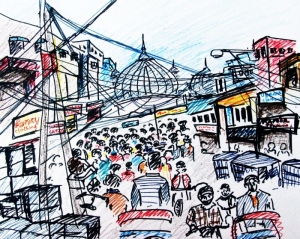
PuraniDilli- sketch by Shilpa Wadhwa
Jana Gana Mana~Tagore


Jana gana mana ...the national anthem of India was written and composed by Rabindranath  Tagore in 1911.
It was first sung at the Calcutta Session of the Indian National Congress on 27 December 1911. Jana Gana Mana was officially adopted by the Constituent Assembly as the Indian national anthem on January 24, 1950.

There is a controversy that the poem was composed in December 1911, precisely at the time of the Coronation Durbar of George V, and is considered by some to be in praise of King George V and not God.
A British newspaper reported:
“The Bengali poet Babu Rabindranath Tagore sang a song composed by him specially to welcome the Emperor.” (Statesman, Dec. 28, 1911).

However, many historians aver that the newspaper reports cited above were misguided. The confusion arose in British Indian press since a different song, “Badshah Humara” written in Hindi by Rambhuj Chaudhary, was sung on the same occasion in praise of the monarch. The nationalist Indian press stated this difference of events clearly:-
The proceedings of the Congress party session started with a prayer in Bengali to praise God (song of benediction). This was followed by a resolution expressing loyalty to King George V. Then another song was sung welcoming King George V.” (Amrita Bazar Patrika, Dec.28,1911).

Even, Tagore himself in a letter mentioned:
“I should only insult myself if I cared to answer those who consider me capable of such unbounded stupidity as to sing in praise of George the Fourth or George the Fifth as the Eternal Charioteer leading the pilgrims on their journey through countless ages of the timeless history of mankind.” (Purvasa, Phalgun, 1354, p738.)

Jano Gano Mano Adhinaayako Jayo Hey,Bhaarato Bhaagyo Bidhaataa
Panjaabo Sindhu Gujaraato Maraathaa,Draabiro Utkalo Bango
Bindhyo Himaachalo Jamunaa Gangaa, Uchchhalo Jalodhi Tarango
Tabo Shubho Naamey Jaagey, Tabo Shubho Aashisho Maagey
Gaahey Tabo Jayogaathaa
Jano Gano Mangalo Daayako, Jayo Hey Bhaarato Bhaagyo Bidhaataa
Jayo Hey, Jayo Hey, Jayo Hey,Jayo Jayo Jayo, Jayo Hey

English Translation

Oh! the ruler of the minds of people, Victory be to You, dispenser of the destiny of India!
Punjab, Sindh, Gujarat, Maharashtra,Dravida(South India), Orissa, and Bengal,
The Vindhya, the Himalayas, the Yamuna, the Ganges,and the oceans with foaming waves all around
Wake up listening to Your auspicious name, Ask for Your auspicious blessings,
And sing to Your glorious victory.
Oh! You who impart well being to the people!
Victory be to You, dispenser of the destiny of India!
Victory to You, victory to You, victory to You, Victory, Victory, Victory, Victory to You!

Source: http://en.wikipedia.org/wiki/Jana_Gana_Mana_(the_complete_song)

Footprints, theirs and ours


Published in two parts in  Dateline Islamabad  as an Op-Ed  on 12 and 13 August 2011

Part 1

AUGUST 7 was the 70th death anniversary of Rabindranath Tagore, and I remember his Nobel winning poetry which begins thus:
Where the mind is without fear and the head is held high

Incidentally, I found myself reading something similar in the spirit of this poem — Kamran Rehmat’s eloquent piece Meeting Jens Stoltenberg on the simplicity of Norwegian PM’s life and the minimal security he keeps (Dateline Islamabad, July 28). His rendezvous led me to the memory of the news in 1986, when Olof Palme was murdered while walking back from a cinema at night in Sweden.

“Prime Ministers walk back home?” — that was my instant reaction, then.
There is a reason why Nordic countries are considered the safest places to live. (I wonder if the recent Norwegian episode and its root cause will change that, but that’s beside the point here)

Reading through, one instantly compares them to the traffic standstills or detours one has to face when our politicians are passing.

The instant pop-up in my Third World mindset is — “Come on, those are developed nations and we are merely ‘developing’.”

It takes me back to what I gleaned from the movie The Last Emperor, in 1990, where they showed when the king passed through the streets of ancient China, the common man was asked to turn away their gaze  because their poor eyes weren’t worthy of seeing the emperor.

Perhaps, our politicians in power, too, are emperors in their own right, who live not in forts or castles by name — but their abodes are bedecked no less than castles and protected no less than fortresses. And the feet of the poor common man aren’t worthy
of treading the same street when the emperors pass through it.

But hold on.

I have two personal experiences from this very Third World where the high and mighty navigated with the same freedom and minimal security as the Norwegian or Swedish premiers.

One of them is none other than Mahathir Mohammed of Malaysia. (You might say that Malaysia is not much of a developing country but the reason why they have surged ahead is because of this very man about whom I will narrate a personal
anecdote.)

My family had been visiting Malaysia as tourists in 2002. This is during the last days of Ramadan and we chose to travel to Malaysia to see how their
Muslims celebrated Eid.

On the day of the festival, we went to the Central Mosque in Kuala Lumpur for prayers. Not sure of the timings, we reached the mosque way early and  my husband and son sat in the very first row, right behind the imam.

Meanwhile, I settled with my daughter in the first row of women’s area — ensuring that our men folk were well in sight.

After an hour or so, when the mosque had been reasonably full — no mad rush, mind you — a few men walked up to the front rows and some others started to make way for them. My husband was asked to move a little to the side, which he did. But to his utter surprise, the man for whom his space was being vacated was none other than President Mahathir Mohammed.

Having seen that my husband gave space to him, Mahathir smiled at him. My husband stepped forward, shook hands with him and introduced himself as a Pakistani, who had come to see Eid festivities in Malaysia.

After the prayers, he again turned to my husband and invited him to visit Putrajaya (president’s residence) and partake the open feast which the president hosted each year for his compatriots.

Our joy had no bounds — we almost thought that we were invited to a personal lunch with the president.
After a few hours of strolling in the Eid bazaars in Bukit Bintang (street), listening to the beautiful melodies of Salamat Hariraya (Malaysian Eid greeting), we dressed in our best and headed for Putrajaya.

It was a huge congregation, with tents put up and thousands of Malaysians, of all ethnicities, in a picnic mood and enjoying the ethnic food the Malays serve
on Eid. (To continue)

 Part 2 : 

MY family and I arrived at the Putrajaya (president’s house) and were told by someone that this was the last time the open Eid feast, which enabled the commoners to meet the president, would be held as Mahathir Mohammed had announced to step down.

We saw what looked like a hopelessly long queue on one side of the tent, leading to a door. We were told this was for those who would like to meet the first couple and give their Eid wishes to them. We joined the queue.

My husband told one of the guards that we were from Pakistan and President Mahathir himself had invited us, in an attempt to jump the queue. But the policeman just gave a hospitable smile and no more, which was signal enough for us to stay in the queue. It was a two-hour wait and my kids used it to make a small card out of some paper envelope, with a blue ball point sketching a flag of Pakistan and an Eid greeting.

Finally, our turn came. We shook hands with the first couple and to our utter surprise, he himself told his wife, “They are Pakistanis and have come to see our Eid.”

My kids gave them the card. We hugged them, Pakistani-style and were handed a plastic Tiffin on top of which was inscribed “Thanks from Putrajaya” with traditional Malaysian sweets inside. We got exactly the same box as everyone else and approximately, the same two or three minutes of chat as other locals.

To cut a long story short, in a fortnight’s stay in Malaysia, we happened to meet their president twice, and that, too, without much difficulty.

The second incident was in Kolkata (then- Calcutta), in late 1979, when I had been visiting the city with my parents, who were attending some conference. My parents chose to commute in bus as that was the most convenient mode to travel in the overcrowded metropolis.

In the middle of one journey, my father turned our attention towards a lean and thin dhoti-clad man who had climbed the bus. That man was Jyoti Basu, who had become the chief minister of West Bengal, just a year or so ago.

My father mentioned it to some of his friends but they weren’t surprised, for it was common knowledge that Basu sometimes boarded buses just to stay connected with hoi polloi.

Basu continued to win the people’s confidence for the next two decades (from 1977 to 2000). A CPI(M) member, he went on to introduce land reforms, giving opportunity to the poor to have their own lands. He brought political stability to the state to the extent when the whole of India was burning— once after Indira Gandhi’s assassination in 1984 following the Operation Blue Star, and the other at the demolition of Babri Masjid in 1992, his administration did not allow any rioting in his state.

Hence, it was not just a coincidence that we saw these men roaming free in public — years of commitment for the common man had made them fearless.

With this chain of thoughts, my mind shifts to the recent switch on-and-off that goes on in the killing fields of Karachi. It does not need a vision of 6/6 to see who all are behind these killing fields.

By all I mean ALL — none is above it. I wonder, with this track record and with the mess that the stake holders of ‘peace’ create, can they have the courage to sail freely among their own public like Mahathir and Basu?

No wonder our streets from Islamabad to Karachi come to a standstill when they sail fearfully on them.

And tragically, it is the common man, who gets labeled as hateful, narrow-minded and divided on ethnic and sectarian lines.

In conclusion, I want to revert to the closing lines of Tagore’s poem, which may serve as a prayer to us:

Into that heaven of freedom, my Father, let my country awake.

The writer is a gynecologist, health activist,
and m-Health entrepreneur, of Indian origin,
married to a Pakistani

Avval Allah, Nur upaya, qudrat de sab bandey…


This blog post is a tribute to the bravado of my#Sikh brothers, who stood up in respect for humanity beyond faith during the #UKriots.

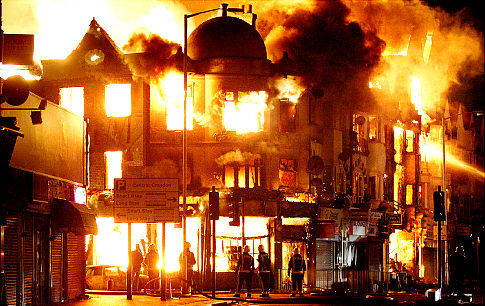
It was devastating to see the peoples power gone berserk in UK riots, as the  arson and looting carried on unabated into the fourth night . Unfortunately against the sheer numbers, the police seemed helpless to control the unruly mob.
While following the  #UKriots on Twitter and BBC News, hashtag #Sikhs started to trend—first World wide and then in UK, London.

A tweet was seen:

Remroum Remi Kanazi
Was afraid #Sikhs trending was going to be some bigoted stream. Thankfully it was this: Sikhs protecting people while they prayed #UKRiots

They came pouring, tweets one after the other with speed getting faster:

Prandha_Swag Harpreeeeezyf.baby
#Sikhs is trending.

Nagra18 Jasraj Nagra
#Sikhs is trending, never thought i’d see the day #proud.

KavelKaur Kavel Kaur
#Sikhs are a world wide trend!!!!

GDS1ngh GD singh
#sikhs trending, fantastic. doing what we do best.

moneyspinner MONEYSPINNER
#sikhs nanak naam chardi kala, tere baane sarbat dha bhala

I googled to check the details and saw Mail Online quote:

Some armed with swords, some carrying hockey sticks, defiant Sikhs stood guard outside their temples last night.
More then 700 men, some in their 80s, took to the streets to protect the homes, businesses and places of worship in Southall, West London.

The tweets went on:

Goggi_Rana Goggi Rana
Sikhs of Britain have displayed the same traits of fearlessness, as their ancestors of yesteryear #Sikhs #SangatTV

UncleWail Wail Al Aun
Thumbs Up for the #Sikhs protecting their #Temple in Toxteth #Liverpool #UKRiots

MissssChrissy Chrissy
Singh Is King… Yep I think so! #sikhs doing it real big today. #LondonRiots #ukriots

Then we heard that they had not only protected their temples but also stood at the mosque guarding while the Muslims prayed ther Taraweeh prayers of Ramadan in South Hall mosque:

A google message read :

Muslims prayed their Tarawee prayers while Sikhs protected he Masjid
Got this from a friend in London.
In a Masjid in Southall London, Muslims were praying their Taravee prayer as the riots were going on, a bunch of Sikhs stood outside the Masjid and protected the Masjid.
The similar thing happened when Sikhs were inside their Gurduwara and some Muslim youngster guarded it on the gate
Great experience, a cousin and a friend of mine reported the same incident.
May ALLAH bless people like them, humanity still remains here, despite the problems

Tweets loaded with emotions, from Muslims and people from other faiths,  too poured in with ovelwhelming enthusiasm:

PMGenerals PMG Anj
Today was an historic day for #hindus #sikhs and #muslims. #unitedwestand all religions teach us to have morals and respect dis proved it! X

dj_aNomAli ∀ℓι . ᄊ乇尺cんለռէ
Sikhs protect Southall mosque while Muslims pray Taraweeh in peace. Much respect to our brothers!! #LondonRiots #Southall #Sikhs #MashAllah

DNSDj Davinder Singh
Actually brings a tear to my eye seeing the #unity between #Sikhsand #Muslims in the fight against this madness. #proudtobesikh

akchishti akchishti
Great sight in my #Birmingham where #Pakistani lads are protecting temples while Sikh lads protecting the mosques

Muslimerican Peter
Imagine a group of rioters turning down a street and suddenly seeing 400 #Sikhs standing in the distance. #wrongturn #ohshit #londonriots

AdamPatel2 Adam Patel
I hear the #sikhs are even protecting the #mosques in Southall so #muslims can read our Tarawih in peace.”>>> BIG LOVE –

And dishearted tweeps begain to take a sigh of relief

xcrimsonstarx Vicki Langfield
The #Sikhs are giving me faith in humanity

Indeed, everyone who followed this trend must have rekindled their faith in humanity. Thanks you my Sikh brothers.

MumzyStranger Mumzy Stranger
Love out to the #Sikh brothers who protected the mosque during prayer time. If we all unite we can and WILL put a STOP to this chaos! M x

And  with these tweets millions or billions of eyes gleamed with hope.

We hope and pray this display of unity and humanity extends to all faiths and communities beyond borders and beliefs…

My mind recalled the verses of Sant Kabirdas which  along with 500 other verses which are included in to the Guru granth Sahib,  are  often heard from  Gurudwaras as Shabad Kirtan :

Avval Allah Noor upaya Qudrat ke sab bandey
(God created light of which all the things were born)
Aik nor ke sab jag upajaya kaun bhale ko mandhe
(From the light, the universe. So who is good and who is bad).

Indeed, I hail my Sikh brothers for living up to the spirits of their faith, their Gurus and their Book.

In return many Muslims also stood up with the Sikhs and helped them form groups which defended their communities and boroughs. Hail Sikh Muslim Solidarity. 

Let this be the beginning of Sikh-Hindu-Muslim-Christian-Jew –other faiths unity for  all faiths believe in one Supreme Power and all faiths belong to  one Humanity’

I dedicate  this tribute to my Sikh brothers with the greeting, which in Punjabi means exactly what Allah u Akbar stands for :

Vaheguru ji ka khalsa, vaheguru ji ki fateh.
(God’s pure and God’s victory )

My brothers,  Rabb Raakhaa

Ilmana Fasih, Aug 10, 2011

P.S.: Please scroll down in the comment box to see the reaction of the Muslim community after 3 Pakistani boys were killed in Birmingham.

Buss ker ji hun buss ker ji~Bulleh Shah


This post is dedicated to the inseparable cultures of India and Pakistan. A great example of how India’s Sufi singers (of one faith) sing with devotion the Kafi of a Sufi saint ( of another faith) who’s origins were in what is now Pakistan.

Bulleh Shah is considered as the greatest mystic poet of the Punjab, his compositions have been regarded as “the pinnacle of Sufi literature.” Scholars and dervishes have called him “The Sheikh of Both the Worlds,” “The man of God,” “The Knower of Spiritual Grace” and by other equally edifying titles.

Kartar Singh Duggal, a renowned writer and author of The Mystic Muse: Sain Bulleh Shah writes:
“Bulleh Shah was an evolved soul, a perfect faqir and a true lover. Through the love for his Master he realized the Lord. In his love one finds poignancy, ardor and longing besides sincerity, sacrifice and renunciation. Under the canopy of love he made his offerings of caste and learning. His love for his Master never wavered for a moment despite the fire of separation and longing through which he passed. His writings, as also his life, manifest transcendence of physical love ( of the Master) to divine love ( of the Lord).”

It is said that once Bulleh Shah annoyed his Master due to some indiscretion and he was thrown out of the his Master’s circle( called Daira).

Several months passed; Bulleh begged forgiveness, repented, had other devotees speak to the master,  who would not relent. Suffering the pangs of separation, Bulleh sang soulful Kafis. There are many of them, and the pain in each of them increased, with the passage of time.

One such kafi which is my favourite is :
Bas kar ji hun bas kar ji,
Ik baat asaan naal has kar ji.

Tuseen dil mere vich vasde ho,
Aeven saathon door kyon nhasde ho.
Naale ghat jaadu dil khasde ho,
Hun kit val jaaso nhas kar ji.
Bas kar ji hun bas kar ji.

Tuseen moiyaan nu maar na mukde si,
Khido vaang khoondi nit kutde si.
Gahl kardiyaan da gal ghutde si,
Hun teer lagaaiyo kahs kar ji.
Bas kar ji hun bas kar ji.

Tuseen chapde ho asaan pakare ho,
Asaan naal zulf de jakre ho.
Tusi aje chapan nu takre ho,
Hun jaan na milda nas kar ji.
Bas kar ji hun bas kar ji.

Bulha shauh maen teri bardi haan,
Tera muhk vekhan nu mardi haan.
Nit sau sau mintaaN kardi haan,
Hun baeth pinjar vich ghass kar ji.
Bas kar ji hun bas kar ji.

Enough! Now enough!
Smile! Speak to me!
You inhabit my heart.
Enough! Now enough!

You do not tire of killing the already-slain.
You play with me, a ball thrown over and over again at a stump.
If I speak, you gag me,
You might as well just pierce the arrow right into me!
Enough! Now enough!

If you hide, I will catch you.
I will tie you in my tresses.
You are able to stay hidden for now,
But you will not be able to escape from me.
Enough! Now enough!

Says Bulha, I am your slave.
I die to see your face.
I plead with you a thousand times,
O enter this cage. Occupy it.
Enough! Now enough!
~Translation BY Suman Kashyap

The same Bulleh Shah Kafi sung by Wadali brothers:

Where the mind is without fear and the head is held high.


Just yesterday was the 70th death anniversary of Rabindranath Tagore, and I remember his Nobel winning poetry which begins as :
“Where the mind is without fear and the head is held high”

Incidentally, today I found myself reading something similar in  spirit of this poem while , enjoying  Kamran Rehmat’s eloquent note  on simplicity of the office of Norwegian PM and the minimal security he keeps.(Kamran Rehmat is  a Pakistani newspaper editor based in Islamabad, who’s writings  are like a new lesson in English language, and each time  leaves one richer in vocabulary).

His note led me to the memory  of the news in 1986, when Olof Palme, was murderd while walking back from a cinema at night, in Sweden. Prime Ministers walk back home, was my reaction then. There is reason why Nordic countries are considered as the safest places to live on Earth. (I wonder if the recent Norwegian incident and it’s  root cause will change that, but that’s beside the point here)

Reading through,  one instantly compares them to the traffic standstills or detours one has to face when our politicans are  passing.

The instant pop up  in my Third World  mindset is–” Come on, those are developed nations and we are merely ‘developing’.”

It takes me back to the peice of knowledge I gained from a movie called The Last Emperor, in 1990,  where they showed that when the King passed through the streets of ancient China, the common man was asked to turn away their gaze because their poor eyes weren’t worthy of seeing the Emperor.

Perhaps our politicians in power too are emperors in their own right who live not in forts or castles by name.  But their abodes are bedecked no less than castles and protected no less than fortresses. And  the feet of the poor  common man arent worthy of treading  the same street when the emperors  pass through it.

But hold on.

I suddenly remember two personal experiences from this very  Third World where their persons in authority navigated with  same freedom and with minimal security as the Norwegian or Swedish PMs.

One of them is none other than Mahathir Mohammed of Malaysia. ( You might just say, that of course Malaysia not all that a developing country. But the reason why they have gone far ahead is because of this very man about whom I will narrate a personal anectode.)

We had been visiting Malaysia as tourists in 2002 . It was the last days of Ramadan and we  chose to travel to Malaysia to see how their Muslims celebrate Eid.On the Eid day we went to the Central Mosque in Kuala Lampur for the Eid prayers. Not sure of the timings, we reached the mosque way early and my husband and son sat in the very first row, right behind the Imam’s seat. While I settled with my daughter in the first row of women’s area , ensuring that our men were well in our sight.

After an hour or so, when the mosque had been reasonably full, ( no mad rush), a few men walked upto the front rows and some others staretd to make place for them. My husband was asked to move a little to the side, which he did. But to his utter surprise, the man for whom his place was being vacated was none other than the President Mahathir Mohammed. Having seen that my husband gave place to him, he smiled at him. So my husband stepped forward, shook hands with him and introduced himself as a Pakistani who had come to see the Eid in Malaysia.

After the prayers, he again turned to my husband and told him, to visit his place called Putrajaya ( president’s residence) and join the open feast which the President hosted each year for his compatriots.

Our joy had no bounds. We almost thought that we were invited to a personal lunch with the President.
After a few hours of strolling on the Eid bazars in  Bukit Bintang (street), listening to the beautiful melodies of Salamat Hariraya( that’s Malaysian way of saying Eid Mubarak) we dressed our best and headed for Putrajaya.

It was a huge congragation there, with tents put up and thousands of Malaysians, of all ethnicities in a picnic mood and enjoying the ethnic food the Malays serve on Eid. We were told by someone that this was the last time this would be held as Mahathir Muhammed has announced to step down,  and  he wouldnt be there next Eid.

We saw a horrendously long queue lined up on one side of the tent leading to a door. We were told, this was  for those who would like to meet the first couple and give their Eid wishes to them. We joined the queue. Living upto the Pakistani style, my husband told one of the gaurds that we are from Pakistan, and the President himself had invited us, in an attmept that this would help us jump the queue. But the policeman just gave a hospitable smile,  his eyes speaking to us to stay put in the queue.

It was a two hour wait, and my kids used it well to make a small card out some  paper envelope, with a blue ball point drew a flag of Pakistan and wrote an Eid card for them.

Finally our turn came, we shook hands with the first couple, and to our utter surprise, he himself told his wife, “They are Pakistanis and have come to see our Eid.” Kids gave them the card. We hugged them in a Pakistan Eid greeting. We were handed over a plastic tiffin box on top of which “Thanks from Putrajaya” while the inside had  Malaysian sweets. We got exactly the same box as everyone else, and roughly the same two or three minutes of chat as other locals.

In Summary, in our two weeks stay in Malaysia, we happened to meet  their President twice, and that too without much difficulty.( Not to speak of how many times we have bumped into any of ours in the whole life).

The second incident was in Calcutta, in late 1979, when I had been visiting the city with my parents, who were  attending some conference. My parents chose to commute in bus , as that was the most  convenient mode  to travel in an overcrowded Calcutta.

In the middle of one journey,  my father turned our attention towards a lean and thin dhoti clad man who had climbed the bus. And this man was Jyoti Basu who had become the Cheif Minister of West Bengal just an year or so ago.

My father mentioned it to some of his friends, but they weren’t surprised, for this was common knowledge that he sometimes boarded the bus just to stay connected with the poeple who elected him.

And then this man carried on to be the elected ChiefMinister of West Bengal for next two decades ( from 1977 TO 2000).  A CPI(M) member, he went on to make land reforms giving opportunity to the poor to have their own lands. He brought political stability to the state and so much so that when the whole of India was burning twice– once after Indira Gandhi’s death in 1984, and the other at the demolition of Babri Masjid in 1992, his heavy handed administration did not let any rioting in his state.

As Wickepedia quotes, “West Bengal became an oasis of communal harmony and secular values under his leadership”
Although a CPI (M) member, in an obituuary published by BBC on his death in 2010, it remarked:
“A Fabian Socialist rather than an orthodox Communist, Jyoti Basu worked by consensus, successfully managing coalitions, while showing a healthy respect for the viewpoints of others.”

“He made Communism look respectable,” according to Sabyasachi Basu Roy Choudhuri, a Calcutta-based political analyst.
Analyst Ashis Chakrabarti said Mr Basu’s success indicated social democracy had a future that Communism did not .
( http://news.bbc.co.uk/2/hi/south_asia/8151230.stm)

Hence, it was not just a coincidence that we saw these men roaming free in public, there were years of commitment, and hard labour for the common man, which made them be  so fearless.

With racing chain of thoughts, my mind shifts to the recent switch on and off, that goes on in Karachi’s killings. It does not need a vision of 6/6 to see who ALL are behind these killing fields. By all I mean ALL, none  is above it. I wonder with this track record and with the mess that the stake holders of  “peace’ create, can they gather the audacity to sail freely among their own public like the above men.

No wonder our streets from Islamabad to Karachi come to a standstill when they sail ‘fearfully’ on them.

And tragically, it is the common man who recieves the blame of being labelled hateful, narrowminded and divided on ethnic or sectarian lines.

I close this note with the closing lines of Tagore’s poem , which may serve as a prayer to us:

“Into that heaven of freedom, my Father, let my country awake.”

Ilmana Fasih

Little Terrorist~a short Film


Little Terrorist tells the moving story of a Pakistani Muslim boy who accidentally crosses the Pakistani-Indian border which is riddled with landmines. He ends up in a strange country that regards him as a terrorist. The old orthodox Hindu Bhola takes him in and hides him from the Indian soldiers. However, traditions and prejudices about Muslims remain an obstacle in the relationship between Bhola and the boy. Ultimately, humanity triumphs over prejudice when Bhola risks his own life to help Jamal cross the border again. This symbolic story of hope is a tale of human solidarity conquering all artificial boundaries.
Ashvin Kumar, the director, was nominated for an Oscar in the Best Live Action Short Film category.
Ashvin Kumar’s Little Terrorist also won first prize for best short film at the Montreal Film Festival.

And was nominated and selected for various other prizes.

The cost of crossing the ‘love’ border ~Indo-Pak Visa Part 2


Published in Aman Ki Asha blog by The News/Jang Group on August 03, 2011 http://www.amankiasha.com/detail_news.asp?id=509

For years after the Indian Consulate in Karachi was closed down, a cousin of mine (an Indian married to a Pakistani) whose parents live in Jaipur, followed the following trail year after year. She would travel from Karachi where she lives, to Islamabad to obtain an Indian visa. If successful, she would travel back to Karachi to pack up. She and her family would then travel to Lahore by train, and cross the Wagah-Atari border. They would then take a train from Amritsar to Delhi and then another to Jaipur. With 3 children, she could not afford air travel every year. 

The entire ordeal required her to travel over 4600 kilometres and several days in summer vacations, when in reality, the smallest distance between Jaipur and Karachi is only 1066 kilometres (through Khokrapar Munabao) and the train journey is just a 3-4 hours long.

I understood the real nightmare of this struggle some years ago when I had to travel from Karachi to Islamabad to get a visa for my father-in-law for his medical treatment in India.

My husband and I sat outside the Indian consulate in Islamabad for two days, sharing benches with people who had mostly come all the way from Karachi or Hyderabad. Most had been sitting there every day from 9 am to 5 pm for as long as 15 to 20 days at a stretch. The majority appeared to be daily wage earners, the poor and with no resources to take short cuts, like us, to obtain a visa – we had the parchi (‘slip’) that would expedite the visa process.

A lady and her husband, a carpenter hailing from Lalukhet in Karachi, had been sitting there every day for almost 20 days, from morning till the consulate closed in the evening, without any clue about whether they would be granted a visa or not. The embassy issues a limited number of visas each day. Names come up on a given day, their luck as unpredictable as a lottery. The more resourceful among the applicants jump the line, pushing these poor people to the back of the queue.

This couple had spent so much money on the travel from Karachi to Islamabad that they could not afford even a cup of tea from the tea stall outside the embassy, which caters to visa seekers. Every day the carpenter and his wife brought with them homemade rotis and pickle for lunch. I asked the woman how long she would sit there, and she replied with certainty: “When the money runs out, I will go back home whether I get the visa or not”.

She had applied after hearing that her mother was on her deathbed and had asked to see her one last time. She had been married for over twenty years but had been able to visit her native Hyderabad, Deccan, only once, and that too 12 years ago.

Her marriage had been a stroke of fate when her husband, a cousin from Pakistan, visited them. The poor family had been facing tough times, and found this as opportunity to make their daughter’s life better, as the cousin’s family was more prosperous. (How was she duped into marrying an already married man is another story for another time). 

This story is all too common to many families in the lower middle class strata who marry across the border; their girls are hardly able to visit their parents a handful of times in their lifetime, mostly due to not being able to afford the time, expenses and resources involved in obtaining the visa.

They resign themselves to their fate and learn to live with just memories of home. It is only when another sibling is about to get married; or a parent is ill; or dying, that they gather all their means and courage to try to obtain a visa to go to their erstwhile homeland.

The procedure has been somewhat modified now, so that people in other cities can apply for Indian visas through a courier service, without having to travel to Islamabad. But applicants still have no idea how long the process will take. A friend who wanted to attend her parents’ 50th wedding anniversary celebrations in India received a reply after an anxious six month wait, saying that her application papers were incomplete. Some don’t hear any news for a year or more; others don’t get any response at all.

Over the last two decades I have seen a see-saw situation. Things seem to move towards easing the procedure, then suddenly something occurs and the whole change is reset from the start.
A silver lining is that the Khokrapar-Munabao line, suspended since 1965, has been revived, reducing unnecessary distance for many.

I hope and wish that the latest news about easing of the borders does not remain restricted to the artists who travel on exchange programmes or businessmen attending conferences, but is extended to this voiceless, resigned group of poor, invisible women who marry across borders. I am afraid they are the group most likely to be forgotten when the categories are laid down for easing visa procedures.

Most will never be able to raise their own voice and will resign to their fate of seeing their parents or first of kin, barely a few times in their entire lives, after they cross the ‘love’ border in matrimony.
On their behalf, I beg the authorities concerned to hear the silent wails of these women and to ease the visa process making it easier for them too, so that they may see their parents and families more often.

Ilmana Fasih

The writer is an Indian gynaecologist and women’s health activist, married to a Pakistani. She blogs at https://thinkloud65.wordpress.com/

Cross-border couples and their visa travails ~Indo-Pak Visa Part 1


Published in Aman ki Asha blog The News/Jang Group on July 27, 2011

“A marriage license doesn’t come with a job description or a set of instructions. There is definitely some ‘assembly’ required. In fact, putting together a marriage can be likened to assembling an airplane in flight” – Patricia Love

Every marriage needs a lot of reassembling in social, psychological and emotional terms. But when marriages take place across the Indo-Pak border they also involve a lot of political reassembling.

Indo-Pak marriages are different from other cross-border marriages – such unions between people from these two neighbouring countries are far tougher and more challenging than marriages across oceans between people with vast cultural differences. The distance between India and Pakistan does not entail crossing oceans or even cultures but one has to cross huge mountains of hurdles in terms of legal and bureaucratic formalities.

With the pendulous political love-hate relationship that exists between the two countries, marrying and staying happily married across the border (‘pyar border paar’) is no small feat. It takes a tough mind and resilient heart to brave the challenges.

There are personal challenges involved in every marriage. But the additional challenges in Indo-Pak marriages include taking certain decisions which may be painful. As a patriotic and a proud Indian, it was hard for me to surrender my Indian passport and apply for a Pakistani. Not that I had any grudges against the latter, but to give up your national identity is an experience you have to live, to know how it feels.

You might ask why would an educated woman change her nationality? The answer is simple. No one coerced me. I did it for the desire to have a peaceful family life and for the sake of our children (who were to arrive later).

My British, Canadian and Filipino friends married to Pakistanis live without any problems in Pakistan, using their original passports. But for an Indian this is not possible.
I did quite a bit of homework before taking this life-changing decision. I knew of instances where people in this situation had retained their nationalities, leading to many practical and political challenges. Most of them advised me to swallow this bitter pill and make the change, but finally, it was entirely my own decision.

In Pakistan, the ID cards of both parents are required to obtain documents for children like B-form, passport, and ID card. A mother with an Indian passport would mean inviting trouble, with more errands from office to office, or one section officer to another, to get ‘no objection certificates’ or NOCs.

Obtaining a visa to visit family across the border is any case a Herculean task if you don’t have connections in the high offices. And for a family like ours living in a third country I would, if I had maintained my Indian nationality, have to go through the gruelling process of obtaining a Pakistani visa each time we were to visit Pakistan. By giving up my nationality and becoming a Pakistani, I thought at least we have to struggle for the visa on one side only, when my children and husband want to visit India.

Unfortunately, my having been a born Indian, lived there for 23 years, and having parents still living there, does not mean that my husband and children will be given any extra consideration when they apply for an Indian visa. I know this is also the case for Pakistani women who are married and live in India. The visa policies work on a reciprocal basis.

Our visa troubles are not a once in a while exercise, but an annual struggle. The struggle which I have been undertaking for the past twenty years, almost each year, to visit my ageing parents exactly the way any married woman aspires to visit her family. As the time nears for the visa application, I always shudder with the apprehension of “What if…”

Families like ours have no choice but to face this ordeal every time they want to visit ‘home’. Visas may be sometimes facilitated and expedited for artists going on a cultural exchange or for businessmen but the procedure, the requirements, the scrutiny, the hurdles are all exactly the same for people like us. We have to stand in the same queue as those applying for a visit visa for a conference or meeting (there is no ‘tourist’ visa between our two countries), to visit to meet distant relatives once or maybe twice in a lifetime.

Each time I stand in front of the visa submission window of the Consulate of the country where I was born, which I still love and own as I did then, I feel as if I am being punished for my audacious decision to marry across border. My counterparts across the border must be feeling the same, I am sure.

Once, I was exceptionally lucky: I obtained an Indian visa while sipping a cup of coffee in the office of the Consul General, when the Consulate was in Karachi. The CG turned out to be my father’s student. We followed the usual application procedure of course, but he expedited it. Then, as we left, a plainclothes official intercepted my husband and asked for our purpose of having visited the CG’s room. He said that our car’s plate number had been noted and that we must not repeat this again.

All told, in the 21 years of my marriage I have been lucky that despite the hurdles and the painful waiting times, I have not faced any serious disappointments in ultimately obtaining a visa for India.

The only time I faced a major setback was after the Kargil war, when tensions were so high that I could not visit my parents for three years, despite running from pillar to post, pulling various influential strings. Then, not even ‘high connections’ were willing to go out of their way to help me. However, for a vast majority of women from India married to Pakistanis, especially those living in Pakistan, it is by no means a smooth sailing.

Ilmana Fasih

The writer is an Indian gynaecologist and women’s health activist, married to a Pakistani. She blogs at https://thinkloud65.wordpress.com/

In love with Ghalib , the witty.


Recently I grabbed a book called Yadgar-e-Ghalib, by Altaf Hussain Haali in Urdu, and read bits from it. This has rekindled my fancy for him all the more.

Mirza Ghalib the humourist , is awe inspiring. Leave aside his superb poetry , his wit with which he lived and laughed off the troubles of his tough life, reveals a person extremely fascinating to read and know. He was an open book.

No doubt he indulged in various vices which would easily label him as a reckless person. But the honesty with which he admits all his vices and even laughs at himself makes him an adorable scamp and one feels like a shrewd hypocrite in front of him.

Ghalib teaches us what is it to live with a life of stark poverty, tragedy after tragedy of losing one’s progeny seven times, living off without a source of income and still to be able to maintain sanity and humour to enjoy one’s present day. (Although being a woman I hail and salute his wife as an epitome of patience and forebearance.)

Reading through I learnt what a friend he was. He never procrastinated in replying back to the letters. And many of his friends send him letters that were ‘bearing’ i.e. without a stamp, and he postpaid twice the amount to releases those letters from the postman. His silver tongue and the golden pen, won hearts of his friends and critics alike.

He wrote that he wanted to write a language, that whoever reads his letters gets elated. (Yes Mirza you still make us elated by them.)

His letters talked.( Yes one can hear you talking through them, Mirza)
One of them said:
“sau kos se ba-zaban-e-qalam baatein kiya karo aur hijr mein visaal ke maze liya karo”
(from hundred of miles talk with the tongue of the pen and enjoy the joy of meeting even when you are separated]).

He joked openly about his being a non-conformist and a sinner. When Ghalib bought a house in Gali Qasim Jaan, he wrote,

‘Masjid ke zer saya ek ghar bana liya hai,
yeh banda kamina, humsaya khuda hai’

(I have made my house on the shadow of the mosque; this wicked fellow is now a neighbour of God).
The mosque he was referring to was the Delhi’s famous Jama Masjid.

During Ramzan somebody asked him if he fasted , and he replied : “ek na rakha.”( I did not keep one.).

On yet another hot day in Ramzan, Mirza was playing chess when a friend, Maulana Arzoo came.
Maulana remarked :“I had read in a Hadith that the devil is imprisoned in the month of Ramzan. But today I doubt the validity of the Hadith.”
Mirza retorted: “Sir, the hadith is absolutely correct. But you be aware that this is that den where the devil is imprisoned.”

Making a serious satire at the gluttony that people indulge during the month of Ramadan he said:

Iftaar-e-saum kii jise kuch dast.gaah ho
us shakhs ko zaroor hai rozaa rakha kare

(The one who has the wherewithal to break his fast
that person should indeed keep the fast)

Jis paas roza khol ke khaane ko kuch na ho
roza agar na khaaye to naachaar kya kare

(The one who has nothing to break his fast with
what else can he do but be constrained to ‘eat the fast’)

And on being questioned for not fasting he said:
Ruza mera eman hay Ghalib! Laiken
Khas Khana wa barf aab kahan say laoon?

(Fasting is part of my faith, but from where should I get khus curtains and chill water for it ?).( Correction courtesy Sohail Bhai).

On another occasion, in a letter that he wrote to a friend, in Persian:
“These days Maulana Ghalib (God’s mercy be upon him) is in clover [very happy]. A volume of the Dastaan-i-Amir Hamza has come — about 600 pages of it — and a volume of the same size of Bostan-i-Khayal. And there are seventeen bottles of good wine in the pantry. So I read all day and drink all night.
The man who wins such bliss can only wonder What more had Jamshed? What more Alexander?”

Ghalib often bragged about his reputation as a rake. He was once imprisoned for gambling and later narrated the incident with great fancy.

Once, when someone praised the poetry of the pious Sheikh Sahbai, Ghalib immediately retorted:
“How can Sahbai be a poet? He has never tasted wine, nor has he ever gambled; he has not been beaten with slippers by lovers, nor has he ever seen the inside of a jail”

When someone poked fun at him for being a drunkard and that a wine-bibbers’ prayers are never answered he said with a laugh, outwitting the person:
“My friend, if a man has wine, what else does he need to pray for?”

He did not even spare his ‘economic poverty’ from the wrath of his wit. ( But Mirza, we know you were far richer the many rich then and now)
Qarz kii piite the mai lekin samajhte the kih haan
Rang laavegii hamaarii faaqah-mastii ek din

The King, Bahadur Shah Zafar was planning to go for Hajj and Ghalib heard it. He wrote to the King :
Ghalib, gar is safar maiN mujhay saath lay chalaiN
Haj ka sawaab nazr karooN ga hazoor ki

If he will take me with him on the Pilgrimage
His Majesty may have my share of heavenly reward

He never minced words about his inclination towards practicing the faith.

Jaanataa huun  savaab-e-taa’at-o-zahad 
Par tabiiyat idhar nahiin aatii 

(I am aware of the reward of religious deeds in the next life, but I somehow do not get inclined towards them.)

It isn’t that those who live happy, are not sensitive and pained by the troubles that come their way. Like everyman with a mind and a heart , to be hurt by the whips that life lashes at them, Ghalib too felt his share of pain.

He wrote:
Sozish e batin ke hain ahbab munkir warna yaan
Dil maheet e girya aur lab aashnaa e khanda hai.

(Though my friends give no credence to my inner aches
While my lips are all smile, my heart is but a tearful waste).

Indeed, his wit must have been therapeutic to his own self, but to readers like me it is very addicting.

P.S. I am extremely indebted to Sohail Hashmi bhai, who I know is an expert in Urdu poetry from very young age, has added some other incidents related to the above context:

The house next to a mosque belonged to Kale saheb, a gentleman who was into sufiism and was respected greatly by bahadur shah zafar. In fact the House was given Ghalib on the recommendation of Zafar, Ghalib has refered to the mosque and his house in two other shers

Bhaun paas aankh qibla-e-haajaat Chahiye
Maajid ke zer-e-saayaa kharaabaat chahiye

Dil Khush hua hai Masjid-e-veeraan dekh kar
Meri tarah Khuda ka bhi Khaanaa Kharaab hai

Once during the month of Ramzan, a maulana who was a friend of Ghalib and also a poet went to meet ghalib, ghalib had a a plate of kabaabs in front of him and a glass of Wine besides him.
The maulana said, “Tumhaara roza nahin hai.”
Ghalib said “Hai”
The Maulana asked “Phir yeh sab kya hai”
Ghalib response was, “Roze ko behlaane ka saamaan hai.”

[P.S. His humour on his first love deserves a complete blog in itself, which shall follow later. No his first love wasn’t either ‘women’ or ‘wine’.]