It is dark, and quiet, She is alone, She is young and beautiful, Yet she is spontaneous and warm Because she feels safe. Doesn’t that feel good? Whether you are a man or a woman, to see a fellow human feel secure in your company? Age, place, dress, time do not matter, Secure and safe space is everyone’s right. Can you give that space menfolk? Yes, you can, and you must. I know womenfolk will have that space one day, And I know that day is not too far.
Creating safe space for women
Is not a rocket science.
Its not just possible,
but is very simple
Watch this:
A lovely short film by Vikas Bahl #GoingHome
Sadeqainneeds no introduction to South Asians and to art connoisseurs the world over.
This slideshow requires JavaScript.
Born as Syed Sadeqain Ahmed Naqvi in Amroha, India in 1930, Sadeqain rose to became the most accomplished painter and calligrapher Pakistan has ever seen.
A self taught painter, who still beholds the world with an awe by his quality and volumes of his artwork. It is estimated that Sadequain painted more than 15,000 pieces of artwork consisting of murals, paintings, drawings and calligraphies.
A man who possessed incredible passion and energy for art, donated most of his works to many friends and places. Though priceless as art treasures, his paintings stand a worth of over $1 billion now.
He is credited to have brought a renaissance, ( the reawakening) in the art of Calligraphy. Calling himself a faqir, and belonging to a family of calligraphers he considered calligraphy as a divine gift to him.
This slideshow requires JavaScript.
Asked many times about when did he begin painting, he often said he did not remember how early he started painting. In one of his interviews he remarked, “Perhaps I must be moving my fingers to paint in my mothers womb too.”
His murals cover an area larger than the murals created by Michelangelo and Diego Riviera combined.
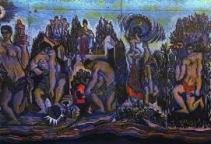
The mural titled “Saga of Labor” located at Mangla Dam is credited to be his largest work (approximately 180 x 35 feet). Saga of Labour is Sadeqain’s tribute to the working men and women since early life on Earth. The mural illustrates mankind’s journey from food gatherer to the development of agriculture, handicrafts and machinery. Beginning with Iqbal’s verse on Farhad, this majestic mural ends with Iqbal’s reference to other worlds beyond the stars. It is known to be one of the largest murals in the world.
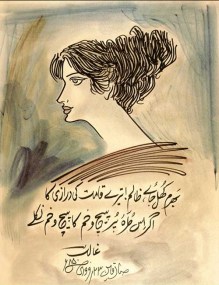
Sadeqain painted on the poetry of Ghalib, Iqbal and Faiz.
He was also a poet, who composed Rubaiyat (quartains), then inscribed, and illustrated them. There are over 200 such illustrations collected in Rubaiyat-e-Sadeqain.
A recipient of numerous national and international awards like Tamgha-e-Imtiaz, Pride of Performance, Sitara-e-Imtiaz, Australian Cultural Award, and Gold Mercury Award, he won the first prize at the prestigeous Laureate Biennale de Paris.
Sadeqain was described by Le Monde, Paris in 1964 as, “The multiplicity of Sadequain’s gifts is reminiscent of Picasso.”
He painted till the last days of his life. When he passed away in 1986, he was worjking on the “Arz-o-Samawat” (Earth and the Heavens) for the ceiling of the Frere Hall, Karachi. With 100 panels spanning an area of 3,200 square feet, Sadeqain could only complete 87 of them.
Sadeqain was immensely popular in India and his work is currently graces many locations in India including Delhi, Aligarh, Benaras and Hyderabad.
His painting are the prized possession of New York Metropolitan Museum, Royal Ontario Museum in Toronto, Museum of Modern Art in Paris, and many other locales.
Dr Salman Ahmed, Sadeqain’s nephew has formed Sadeqain Foundation in 2007 with the mission to Discover, Preserve and Promote Sadeqain’s immense works.
I ask him what does he mean by discover Sadeqain’s work?
He responds that the painter was extremely generous and gifted away thousands of works to friends and places where he painted. Hence alot of his art sits with individuals, and many of their heirs do not understand the value of it, or are unable to maintain it. Moreover in the words of Anwar Maqsood, “Sadeqain is one painter who has painted even after his death.” implying that a lot of fake artwork has been created attributed to him. He envisions to create a Museum of Sadeqain’s art.
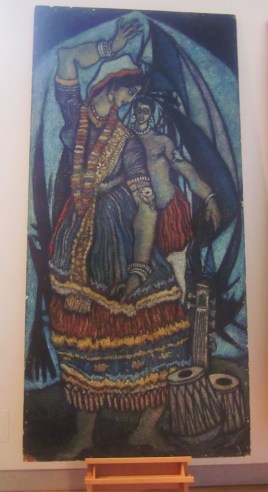
We at Rung Festival at ROM were fortunate to have two panels of the original mural by Sadeqain on May 31, and June 1, 2014. The mural called Pakistanwas painted by Sadeqain in 2 weeks at a Pakistani Expo in Lusanne, Switzerland in 1966. The mural depicted the cultures of various provinces of Pakistan. In 1975 they were brought to Canada for a Pakistani Expo, and since then 7 of the 9 pieces of the mural reside in the Pakistan Embassy in Ottawa.
The exhibit became the focal point of all visitors to Rung Festival.
Information & pictures: Courtesy Dr. Salman Ahmed. Sadequain Foundation USA.
Reshma who originally hailed from Bikaner Rajasthan here sings a ‘maand’ or a welcome song in Rajasthani language for the arrival of the beloved. (Have attempted to translate the verses from my basic knowledge of the language).
Kesariya baalam o’saa, padhaaro mhaare des rey
Oh my saffron beloved, Come to my abode.
Thaare aayo dujaan Barishme mere Your arrival shall bring life in me
Saajan aaye o’ sakhi, Main kayeen manwa vikraan, Thaari paryo gaj motiyaan, Aur ooper nayn dharaan. My beloved shall come my friend How can I keep my mind sane,
I shall spread pearls on the tray, And keep my eyes on them.
Kesariya baalam o’saa, padhaaro mhaare des rey
Oh my saffron beloved, Come to my abode.
Sajan sajan main karaan Sajan jeev jari Choorley per moondshaan Aur vachaan ghari ghari. I utter “Beloved, Beloved.” “Beloved” is embedded on my tongue, Shall weave his name on my bracelet, And watch it over and over.
Kesariya baalam o’saa, padhaaro mhaare des rey
Oh my saffron beloved, Come to my abode.
Awan saavan keh gayo dhola Ker gaya khol anek Bin taagan taa gash gayee Mhaari anganiya ree rey. Shall come in the rains, he promised, Played many cruel jokes on me, Without the rope of his swing, My courtyard is deserted.
Kesariya baalam o’saa, padhaaro mhaare des rey
Oh my saffron beloved, Come to my abode.
Depressed and dejected with the ever rising religious extremism, intolerance and hatred in the world at large, helplessness over powers oneself. The only ray of hope left are the few shining stars in this dark sky that shone on our lands several centuries ago. Their golden words still need to be heard and heeded by one and all.
Kabir from India and Bulleh Shah from what is now Pakistan are two voices that spoke of peace and love beyond beliefs and borders. They were shunned in their own times, but if they were reborn now, they would not find much has changed from those days.
Reminscing their poetry, I dare to use them on painting a silk scarf.
The scarf background is black, which represents the dark ages of extremism, intolerance and bigotry that we currently are going through.
The golden messages of the verses are scribbled in golden ink, The verses chosen relate to the abundance of knowlege, in this era of information revolution, but the information that still fails to convey the message of peace and tolerance that it should accompany.
The languages have been reversed,
Kabir written in Urdu and Bulleh Shah in Hindi so that both sides are able to read them.
Bulleh Shah here says:
Parh parh aalim faazil hoya, kadi nafs apne nu parheya ai nayi, Ja ja werda mandi maseetey, kadi man apne nu wareya ai nayi.
( You read bookes, became learned, but never read (compassion in )your own conscience, You visited temples and mosques, but never visited (the love)in your own heart.)
Kabir says:
Pothi parh parh jag muwa pandit bhaya na koi, Dhaayi akher prem ka parhe to pandit hoye.
{The whole world read books after books, but no one became learned, Read two and a half words of love ( peace and compassion), to be a learned}
The peace symbols in the middle of the silk scarf are crisscrossed by chaos and confusion prevalent in our times.
The edges below the verses represent the hearts interlinked through love and peace, if only we heeded the verses in spirit.
It was heartening to see Kabir’s message of love and peace ( coincidentally the same verses that I was scribbling), being presented in another art form, called Dastangoi. I dedicate this piece and the blog to this wonderful Kabir presentation. 🙂
Published in Express Tribune Blogs here > http://blogs.tribune.com.pk/story/33221/you-can-play-holi-too-even-if-you-are-muslim/
Phagwa, more commonly known as Holi, celebrated on the full moon day of Phalgun, is a festival that heralds the arrival of spring. Played with dry and wet color, it is a symbolic expression for the changing temperatures and the blossoming fields.
Since very young, on the morning of Holi, I saw my Muslim parents being called at the gates of our house in Delhi, by a group of faces immersed in colors, who all looked almost identical. As my parents walked out, they were enthusiastically smeared with color by the crowd, and they too lost their identity with crowd. It left no clue as to who was who, when they roared together with laughter and excitement. As we siblings grew up, we joined in too, with our set of friends.
Holi, as I envision it, is a perfect way to depict a spirit of universal brotherhood beyond color, creed, caste or social status.
If taken in it’s true spirits, Holi never was and never is meant to be a religious festival to be celebrated by a select faith.
Though, like other religious festivals, it too claims a legend with a victory of the good over the evil ( The Story of Holika). However, from the context of its current celebration, it is said to have begun by the love duo Krishna and Radha.
Krishna as a young boy, being extremely dark complexioned, complained to his mother Yashoda, why was he dark, while his beloved Radha fair?
The conversation between a complaining son, and his doting mother, is narrated beautifully, in a famous folk song:
(Krishna asks mother Yashoda: “Why am I dark, while Radha is so fair?” Mother smiles and replies: “Listen my dear, the fair Radha’s kohl eyes have swept you with their magic, and hence are you so dark.)
And one day teasingly to console Krishna she is said to have told him: “What’s in a color? Go and smear Radha’s face with any color you like.”
And Krishna out of love for Radha, smeared her with red color( gulaal).
Legend claims that thus began the playing of colors ( Holi khelna), between Krishna and Radha along with her friends referred to as Gopis.
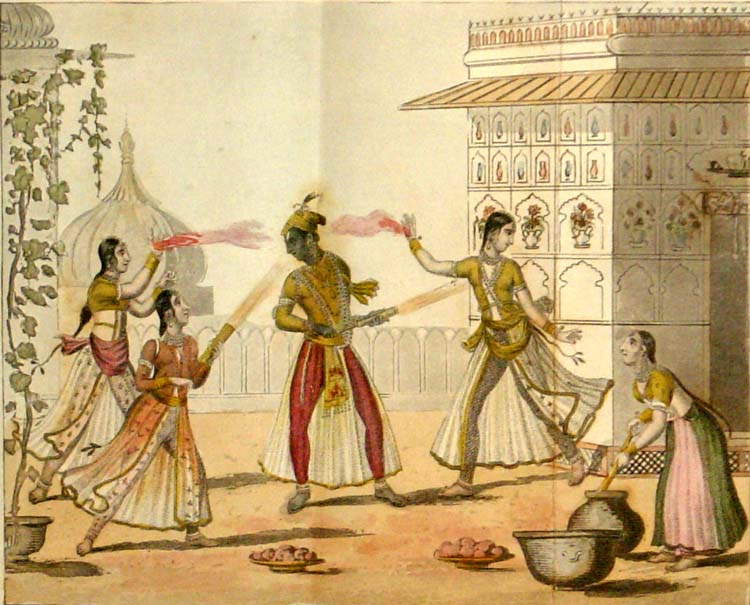
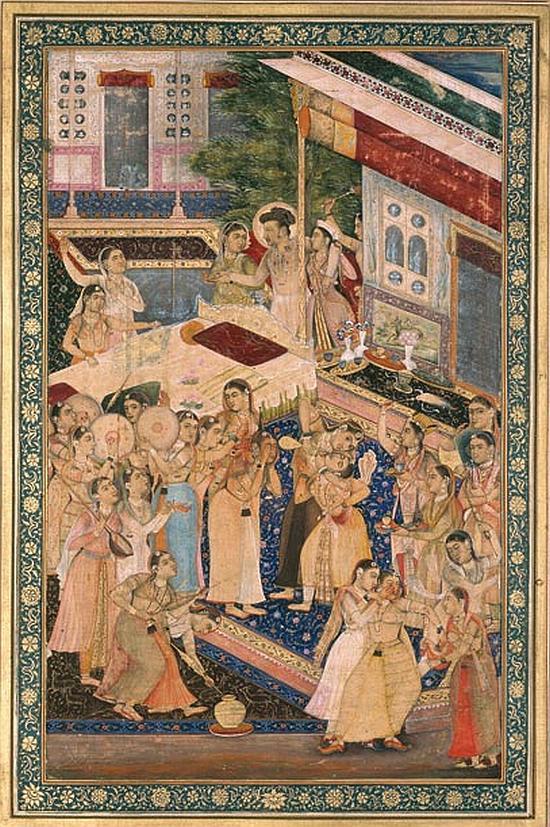
Their romance with playing Holi has been immortalized in many miniature painting s:
Another one, with in Mughal art:
Mughal Emperors too fancied Holi, for its association with color and romance. They brought the practice of playing Holi to their courts and palaces.
Akber is no surprise, knowing his secular conviction and a Hindu Queen, Joda Bai.
Jehangir, the romantic art connoisseur, is documented to have played Holi with his Queen Noor Jehan in his palace and called it Eid-e-Gulabi. It isnt hard to imagine the ecstatic aroma and aura that must have been created in the palace by red gulaal, rose petals ( gulab paashi) and rose water (aab paashi)being sprinkled during the royal play.
Auranzeb’sfancy for the colors of Holi came as a surprise to me. Writes Lane Poole in biography Auranzeb: “During his time there used to be several groups of Holi singers who besides reciting libertine lyrics also indulged in salaciousness, accompanied by various musical instruments.”
Bahadur Shah Zafar’s verses on Holi now are sung as part of the phaag ( folk songs of Holi). One of the most sung verses being:
Kyo Mo Pe Rang Ki Maari Pichkaari Dekho Kunwar Ji Doongi Mein Gaari (Why drench me with color spray,
now my prince, I will swear at you)
Bahut Dinan Mein Haath Lage Ho Kaise Jane Doon Aaj Phagwa To Son Ka Tha Peeth Pakad Kar Loon.
(After long have you come in my hands, how will I let you go?
Today is Holi, and perfect time to catch hold of you)
This is Mughal Emperor Jehangir playing Holi in his palace:
Sufi poets too eulogized the Radha Krishna romance and Holi, when expressing their love for their revered Sufi Saints or even God.
To begin with Sufi poets, it is Shah Niaz’s‘sHori Ho Rahi hai, (immortalized by Abida Parveen):
Holi hoye rahi hai Ahmad Jiya ke dwaar Hazrat Ali ka rang bano hai Hassan Hussain khilaar Aiso holi ki dhoom machi hai chahoon or pari hai pukaar Aiso anokho chatur khiladi rang deeyon sansaar “Niaz” pyaara bhar bhar chidke ek hi raang sahas pichkaar.
(Holi is happening at beloved, Ahmed’s (saww) doorsteps. Color has become of Hazrat Ali (as) and Hasan (as), Hussain (as) are playing. It has become such a bustling scene of Holi that it has become talk of the town, people are calling others from all over, What unique and clever players (Hasan and Hussain) that they colored the entire world. Niaz (the poet) sprinkles bowlfuls of color all around, the same color that comes out of thousands of pichkaaris ( spray guns).)
{Thanks to Ali Rehman @Baahirezaman for the translation}.
Bulleh Shah also played Holi with his Master:
Hori khailoongi keh kar Bismillah Naam nabi ki rattan charhi, bond pari Illalah Rang rangeli ohi khilawe, jo sakhi howe fana fi Allah
(I shall play Holi, beginning with the name of Allah. The name of Prophet is enveloped with light, He only makes us play with colors, who annihilates with Allah)
Amir Khusro relates to Holi through multiple fascinating ways, in various places. Khusrau refers not just to the color, or the play but of the birth place of Krishna Mathura in the famous Aaj Rung hai rey:
Gokal dekha, Mathra dekha, par tosa na koi rang dekha Ey main dhoond phiri hoon Des bides mein dhoond phiri hoon,
Purab dekha pacham dekha uttar dekha dakkan dekha Re main dhoond phiri hoon Des bides mein dhoond phiri hoon,
Tora rang man bhaayo Moinuddin Mohe apne hi rang mein rang le Khwaja ji Mohe rang basanti rang de Khwaja Ji Mohe apne hi rang mein rang de
{In summary: I saw Gokul, Mathura ( bith place of Krishna) and even East to West I roamed, but I did not find anyone with a color like yours. My heart is enamored by your color, hence color me in your shade, my master.}
Another lesser know verse I came across is:
Khelooongi Holi, Khaaja ghar aaye, Dhan dhan bhaag hamarey sajni, Khaaja aaye aangan merey..
( I shall play Holi as Khaaja has come to my home,
Blessed is my fortune, O’ friend,
as Khaaja has come to my courtyard.)
Needless to repeat, there are ample such examples. No matter how much one may attempt, it is impossible to separate the two inter-meshed cultures coexistent for centuries in the subcontinent. These celebrations of culture are all about love and inclusion, and absolutely nothing about hate and discrimination.
Let’s celebrate then, with an open heart !
Here is the link to Amir Khusrau’s Kheloongi Holi, Khaaja ghar aaye:
Which meat loving South Asian doesn’t relish them ? In fact, Maulana Abul Kalam Azadhas called them, the ‘finest’ kebabsin his food memoirs.
I grew up watching on very special occasions, my mother prepare and barbeque these Kebabs very diligently on and with much effort, on a charcoal grill. All I remember was that it was a great hard work. And hence, for many, Behari Kebabs is a delicacy to be eaten in restaurants, as cooking them at home is very cumbersome.
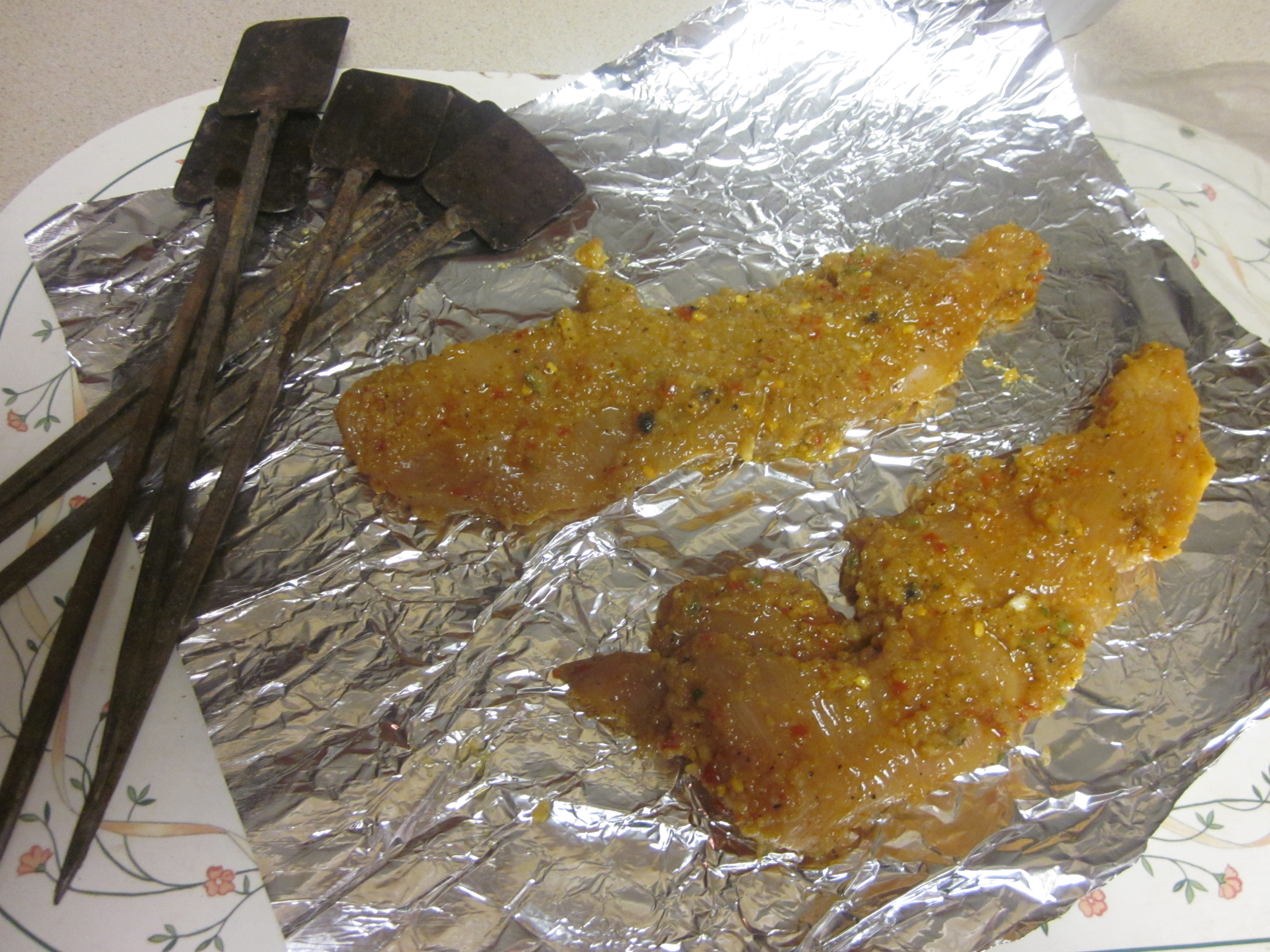
I too believed so, till once, I thought of experimenting them in the convenience of my kitchen, in the electric oven. I made them with wooden skewers, and the first attempt wasn’t bad at all. Second time, it was for a dinner party, and the guests could not believe they were homemade, till my husband showed them the oven, tray and the wooden skewers on which they were made.
I moved on, more confident. Got custom made, iron skewers that fit my tray size in the oven. As I have moved cities, these iron skewers have obediently moved with me too.
Warning: Instead of red meat, I make them here with white meat, and instead of a charcoal grill, I grill them in an oven. Nevertheless, can assure you, they are a different delicacy in their own right.
Ingredients:
Chicken breasts 1 kg
( each sliced into 4 thin fillet)
Onions: 4 medium sized
Ginger : 100gms
Garlic: One whole,
(peeled into cloves)
Green Papaya: 100gms.
Spices: Cumin, coriander, and red chilli powders, and salt to taste.
Mustard Oil- 1 Cup
Fried Browned onions: 2tbsp
(P.S. Some add yogurt, but I don’t.)
Method:
All the ingredients except the chicken breasts are made into a paste in the grinder. Pour the paste into a wide bowl, and mix in Mustard oil.
Add the chicken fillet in the paste and marinate them for preferably overnight to 24 hours.
As they are ready to be cooked, spread out each marinated fillet inside a plastic bag, one by one.
Once arranged 4-5 fillets, fold to close the open end of the plastic bag, And pound them with a wooden pound to make them softer, and such that the spice paste seeps into the fillet..
Take them out of the plastic bag, one by one, to mount on the iron skewers. My skewers seen here are about a feet long, specially made to fit my baking tray.
Mount the fillets on the skewers, piercing the iron rod, through the flesh of the fillets at 2-3 inches apart, then gathering them closer.
Arrange the skewers on the baking tray adjacent to each other.
When completed, place them in a preheated oven, at 225 degrees C for 30 minutes.
Once ready, place a burning coal on the side of the tray, and douse it with oil to bellow smoke. Cover the tray, and close the oven, immediately, for the smoky aroma to be absorbed in the Kebabs.
When ready, serve them hot, with pickled onions, yogurt sauce and chutneys. Naans and parathas go equally well with these Kebabs.
The children are fond of taking the left overs to school, rolled in a naan as Kebab rolls.
P.S. The blog has been diligently made for a Kebab loving and Kebab cooking fellow Delhiite Parshu Narayanan. 🙂
As the dates approach, the excitement is increasing. The event is “Celebrate India, Pakistan Independence Days for Peace, Aug 14-15, 2012” — on Facebook at http://on.fb.me/LcHOeU.
As more people join the event page, those who joined earlier are getting to know each other better. They share common interests in music, culture, poetry. Some discuss pains and pleasures common to India and Pakistan. Many who met as strangers on the event page have added each other as Facebook friends and continue their exchanges elsewhere.
The idea is based on the “Pray for Peace between India and Pakistan Day” initiated by Swati Sharan in Toronto, asking Indians and Pakistanis to “Save the Date! Pray for 30 seconds in your own style for peace between India and Pakistan”, on December 18, 2011 (randomly picked). This led to some 200,000 souls around the world praying for this cause, not only via social media but at community centres and ashrams.
Inspired by the idea, a discussion began on twitter about celebrating Aug 14-15 together as “Interdependence Days”, instead of just wishing each other for Independence. “What is this celebration for if we can’t party together?” asked Shivam Vij, an IndoPak peace voice from Delhi, almost a year ago.
The Pakistan Youth Alliance, inspired by the prayers and their own Peace Parade in Lahore on August 14 last year which ended with wishing their friends in India at midnight on August 15, decided to take it further. The idea caught on and within a few days, many groups joined with more ideas and support.
Some have been going to Wagah border on Aug 14-15 for years, lighting candles to wish their neighbours for Independence Day. The Confederation of Voluntary Organisations (COVA) based in Hyderabad, Deccan has been organising events in different parts of India. This year they will celebrate Aug 14-15 with interfaith prayers and a video conference between youth across the border.
The Internet and Facebook allows those who are not physically able to join an event to participate virtually. And so, with leadership and support from Aman ki Asha, other groups and individuals have joined in this year.
Swati Sharan of Pray for Peace between India and Pakistan continues her quest through meditation and prayer. “I hope that wherever people are, they will take this power (of prayer) that they have in their hands and use it,” she says.
The Pakistan Youth Alliance (PYA), with its team leader Shumail Zaidi in Karachi plans an iftar with orphans and physically challenged children, along with a fun packed evening of imaginary India and Pakistan teams playing tug of war, Antakshari, and other games, followed by a prayer.
“We at PYA want the youth bulge on both sides of the borders to understand the importance of sustainable peace based on common ground. Enough of wars and hatred; let’s move forward to make one-fifth of humanity an epitome of progress, prosperity and equality,” says Ali Abbas Zaidi who heads PYA. Believing that his generation, youth on both sides of the border, can be ‘game-changers’ towards a better South Asia, “together we can, and together we must,” he insists.
Another youth initiative, Romancing The Border, is working to build a movement to increase positive engagement between India and Pakistan. It includes innovative tools such as e-cards with positive messages. “We don’t know if RTB will make a difference, but it brought 80 of us together from around the globe. We cared. We will continue to do so. We all came for a peaceful South Asia,” says one message.
For Independence day this year, RTB is planning a “Google Hangout” between Indians and Pakistanis aiming to set a world record for the longest running virtual meet-up between conflict boundaries.
The Journal for Pakistan Medical Students plans a teleconferenced get-together for volunteer editors on both sides, to take forward for the idea of peace and cooperation in healthcare through medical research.
“There is no other option but peace between India and Pakistan, if we are to fight mutual enemies like malaria, cholera, dengue, hepatitis, maternal mortality…,” says Dr Anis Rehman, a JPMS co-founder.
The South Asian community in Canada, including eminent professors from the University of Toronto at Mississauga (UTM) and Mc Master University are celebrating Aug 14-15 with the launch of Pledge for Peace – a website to provide an ongoing, long-term platform for Indians and Pakistanis, aiming for “lasting peace and friendship between the two peoples”. The website will invite pledges from around the world to make a chain of peace and launch an online game for youth, Cricket for Peace, to be inaugurated jointly at UTM by the Hindu Students Council and PYA.
Other joint collaborations beyond Aug 14-15 are planned. Mumbai Marathon is organising the “Every Step Counts” run between Amristar and Lahore on November 9, 2012, to commemorate the birthday of Allama Mohammad Iqbal, Pakistan’s national poet. Runners will start from Golden Temple, Amritsar and end at Iqbal’s tomb at Badshahi Mosque, Lahore, to commemorate the man “who gave us the beautiful song Sare Jahan Sey Acha,” says team leader Swaminathan Subramanyam. “Why do we do this? Because as we look for peace between our two countries, EVERY STEP COUNTS.”
Pakistan’s Pedal for Peace group are organising their Lahore to Amritsar bicycle tour to coincide with Every Step Counts’ November 9 event. “We cycle from one city to another in order to spread the message of peace, tolerance and to urge people to solve social issues hampering our growth” says Abdul Basit Khwaja of Pedal for Peace.
Those who are unable to physically join an event are invited to dedicate some time to peace on Aug 14-15 this year, wherever they may be: light a candle, meditate, pray, fly a kite, cook a meal, make a piece of artwork or write a poem dedicated to peace between the two countries.
Let’s make peace more visible than conflict, this Independence Day. Happy India Pakistan Peace celebrations!
Dr Ilmana Fasih is an Indian gynaecologist and health activist married to a Pakistani. She blogs at Blind to Bounds https://thinkloud65.wordpress.com
The conscience-shaking brutal rape and subsequent death of the anonymous student from Delhi is not India’s issue alone and the grief is not for one case alone By Ilmana Fasih
As thousands of people on both sides of the India Pakistan border mourned the death of the Delhi gang rape victim, someone commented on Aman ki Asha Facebook group: “Well, the Delhi rape proceeds from a common mindset. The negatives unite us just as well as the positives.”
“Sometimes, calamities unite us more,” came a response.
The conscience-shaking brutal rape and subsequent death of the anonymous student from Delhi (who is referred to by different names by various sections of the media) has made us rethink how common our pains are.
Beyond this tragic incident, looking through the e-newspapers from the subcontinent, there is hardly a day without some incident of rape being reported.Be it the gruesome gang-rape of a medical student at a bus stop in a megacity, or a six-year-old girl raped by local goons in a village, or a girl raped while partying with friends in the posh area of another city, or a teenager gang-raped and then asked to patch up by accepting money or marrying one of the rapists in a town. Can you guess which side of the border each case belongs to? The scenarios differ, cities differ, but the crime remains the same. The mindset stays identical. Age is no bar. Infancy upwards, one finds women and children of all age groups being subjected to rape and sexual abuse.
Unfortunately this is one situation where the human race seems to have achieved a “no barriers of age, color, creed or class”, the world over.
Hard to digest, but rapes are on a steep rise in the subcontinent.
In 2011, 568 rape cases were reported in Delhi, and 459 in 2009 (National Crime Reports Bureau) .The figures given by Delhi Police reveal that a woman is raped every 18 hours or molested every 14 hours in the capital.
Similarly in Pakistan, Human Rights Commission of Pakistan, estimates that “every two hours a woman is raped in Pakistan and every eight hours a woman is subjected to gang-rape”.
The Additional Police Surgeon, quoted in a 2008 newspaper report, estimated that at least 100 rapes are committed in Karachi alone every 24 hours, although most are un-reported.
If these are the statistics of two megacities, one can fathom what would be the situation in the other smaller towns and villages. It is well known that the majority of the rapes in India, Pakistan and other South Asian countries are never reported, and just a handful of the perpetrators are ever punished.
The tragedy is amplified when inane solutions are offered like: “Women should not go out late at night” or “Women going out late night should be accompanied by a male.” In the ‘Delhi gang rape’ case, the solution of an accompanying man clearly failed.
Women are advised not to wear western clothes, or more ridiculous “not to eat chow mein” or “not to carry mobile phones with cameras”. Some even advise women to not report the attack “if there are not enough witnesses”.
But none of this well-meaning advice takes into account why rapes occur. It is not because the woman was dressed so, or walked alone on the street late at night, or was attending a party with her friends or ate a certain kind of food. No. Rape occurs because some men want to rape. And why do ‘some’ men want to rape and not others? Rape is the culmination of a series of systematic experiences that a man is exposed to, from infancy to manhood- in which he is told, with or without so many words, that he is stronger, and a woman is not just weaker, but a commodity at his disposal. Rape is a way to display power and superiority.
So long as this mindset persists, legislation and punishment will never be enough of a deterrent. This tends to get overlooked in all the outrage at the gruesome details of the Delhi gang rape, that has led to demands for the severest of punishments, even public hanging for the perpetrators.
Without undermining that tragedy it is important to remind ourselves of the countless cases of rape and sexual harassment that are routine on both sides of the divide. Those who survive suffer psychological trauma, often far from the media limelight, mostly in silence.
Rape survivors are often pressured by the police or local goons to hush up the matter either, to accept money, or worse still, marry the rapist. Many commit suicide, or live with permanent scars. The rapists often roam scot free, posing a threat to the survivor who does not even dare to raise her head for justice.
Insisting on the death penalty in an isolated case that has shaken people cannot be a solution. Studies have shown that the certainty of punishment, rather than its severity, is a greater deterrent to crime.
We also need to look towards at preventing this crime rather than just push for a punishment after a case gets highlighted.
Foremost, each of us, irrespective of gender, which empathises with the Delhi student who was gang-raped, or any other faceless rape victim, needs to strive to ensure every woman in our sphere of influence feels secure and gets due respect. One of the signs of evolution in human beings is the neo cortex which enables us to restrain behaviour and train our minds. We need to use it to ensure that we don’t force anything upon any woman – or indeed anyone in a more vulnerable position.
Secondly, we need to empower girls with the right information and stop making rape a taboo issue for their ‘innocent’ minds. It is more important to teach a girl to be assertive than to try and ‘protect’ her. “Look up as you walk and stand up straight; pretending as though you have two big panthers on either side of you as you walk may sound silly, but it can help boost confidence,” suggests a self help site on rape prevention. “Attackers are more likely to go for those who they think cannot defend themselves.”
Given that over 90% of the perpetrators are known to the victims, girls (and boys) must be taught that if they feel uncomfortable with anyone’s touch – even if it is an uncle, a cousin or a friend – they must trust their gut and not let it continue. Thirdly, if we cannot change the mindset of some grown men, we can at least guide our sons, right from babyhood, to respect women and not consider them a commodity that is ‘available’. Last but certainly not the least, for those who cannot change their mindsets, a real need for certainty and not the severity of punishment to the rapist, as a mode of deterrence, is mandatory.
Shocked after the demise of the Delhi paramedical student, I tweeted: “Her sacrifice must no go in vain. Let us rise to make violence against women a history.” Knowing the scale of the menace, this may be wishful thinking, but we need to keep striving to make it a reality.
The writer is an Indian gynaecologist married to a Pakistani, a proud Indian Pakistani dreaming of a peaceful, healthy and prosperous South Asia.
ilmana_fasih@hotmail.com.
She tweets @zeemana
Wednesday, January 02, 2013
A tribute to Delhi gang raped girl, inititially known as Amanat, Nirbhaya or Damini:
One advice by a Good Samaritan couple has come a long way for me, as an Indian Pakistani. Just a few days after being married, the couple of a similar kind advised, “Don’t quarrel over India or Pakistan; you will not be able to make any country a Heaven, but will make your own home a Hell.”
The exercise was easier said than done, but with few hard lessons, I ultimately decided that instead of acting an all patriotic for one side and holding a dagger against the other, I need to uphold objectivity, and a shield against the emotional daggers hurled from both sides. And this is how I could actually see how similar are both the people and their problems, and that both deserve to be seen with fairness. Hence to empathize with them of both became remained the only option. This is how I found my ‘eighteenth camel’,which to many of my friends is still an impossible option i.e. to love both India and Pakistan as much.
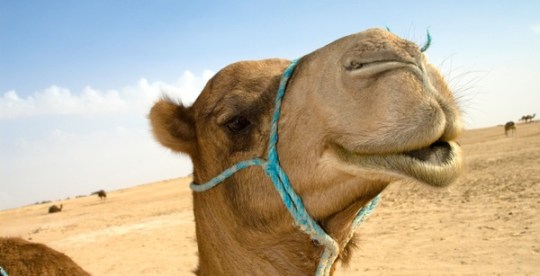
Just to narrate the context of ‘eighteenth camel’, the phrase is based on an Arab parable.
“There was an old Bedouin who had three sons, and all the treasure he had were17 camels. While dying he left a will to give one half of the camels to the oldest son, one third to the second and one-ninth to the third son. After his death, the sons began to quarrel, and since there was no way they could divide 17 camels into half, one third, or one ninth, none of them could have their share from the pie. They approached a wise woman, and asked her to solve the problem. She was nonplussed too, and thought really hard. She sincerely wanted to solve the problem, even if it meant her sacrificing something from her side. So she decided to give one of her camels to them, so that it becomes `18, and now each one could easily get their share as the number was divisible by all –one half, one third and one ninth. The sons were very excited and they began the mathematics. The one with half the share took nine camels, the one with a third took six, and the one with a ninth took his two. To their surprise, they realized that after adding their shares, it was again 17 (9+6+2) and they were left with one camel. Since they were so content with their fair shares and at the generosity of the wise woman, that all of them with consensus decided to return the camel to her and that too with gratitude.”
So obvious from the story, even by finding my eighteenth camel, I did not lose anything.
From the India-Pakistan perspective, if we as common masses consider ourselves as the wise woman, and make an effort to find the eighteenth camel, we too would lose nothing, at all. Our love for our own country cannot in anyway be compromised. Giving a flicker of thought, that instead of harboring a venomous hate for the other side, we need think of them being as human as us– with same rogue elements, and vested interests trying to sabotage the peace process.
It would be unfair to generalize both sides as hate mongers, and I know firsthand that both aspire for peace as much.
But come a conflict, deliberate or accidental, between India and Pakistan, media takes the lead, with magniloquence of the ‘breaking news’. And the TV channels start to balderdash every few minutes, repeatedly beating sensationalism into the eardrums of the masses. And responding to its cries, the sleeping patriotic Bheemas in us suddenly wake up hungry, desperate to chew up the other side. Even before the facts come up, the mainstream media and the individuals on social media throw themselves into convulsions, frothing hatefully.
Haven’t we seen this circus both sides, all too often? Are we not yet fed up of this drama occurring day in and day out, sucking up our positive energies?
Can we as helpless masses be a solution? As above, I repeat, yes, we can be the ‘eighteenth camel’, being the unified voice of peace.
“Secret to peace is us, the humanity.”says an anthropologist Willaim Ury
We on the subcontinent are a billion and a half humanity, out of which two thirds are the youngsters who are or yet to embark on a journey of adulthood, and there lay decades of life ahead for them. Imagine if each day or each week, they simply indulge in barrage of hate waves either in sympathy for a Siachen, or Godra or Mumbai or even Zeeshan Abbasi? How will they be able to grow as productive individuals with such frequent doses of hatred?
Says poet EE Cummings “Hatred bounces.”
Aren’t we seeing it bouncing higher and higher with each incident?
Both sides have their own fair share of problems to wrestle with, and most of them are identical. Name it and we both have them– religious extremism, corruption, poverty, ill-health, ignorance, women abuse, and the list goes on…
Should we not be aligning with each other, and be the unified voice of peace? And with numbers on our side, we can show to the vested interests that we want to live with dignity, with prosperity and with peace, and that our voice matters.
Being eighteenth camels for peace, do we lose anything? No.
Think Norway. What occurs to your mind?
A beautiful country up in the north, where it snows, its all peaceful, no crime. No?
Think Africa. What crops up in the same head?
Poverty, AIDS, famine, a picture of a starved kid pops up in imagination, and for some well informed perhaps they think of it’s corrupt leaders. Yes?
BTW, don’t you know Africa is not a country but a second largest continent? It comprises of 57 countries, each with a distinct culture, language and of course like any other country, each of them have their distinct problems.
So will it be justified to summarize all these sovereign states with just four or five issues, that too very negative.
Why did this stereotyping occur?
The answer is simple. Disinformation.
How?
Of course through the various advertisements from the social sector, that with all their good intentions wish to collect funds for development in the continent. And the media, that through its good intentions tries to highlight to the world the grave issues they face. However, despite their good intentions, they end up creating a negative stereotype.
Ever thought what must Africans be thinking or feeling of this stereotyping of them?
It is not that such issues do not exist, they do, but then this is not all, about Africa.
To highlight this negative stereotyping, without lashing out in anger, a group has come out with an extremely creative and cheeky parody called “Africa for Norway” with the message:
“ Imagine if every person in Africa saw the “Africa for Norway” video and this was the only information they ever got about Norway. What would they think about Norway?”
Also imagine if they also used picture of a Norwegian child shivering in cold, without permission from those concerned?
Here is the parody “Africa for Norway” :
What message do they want to convey through this initiative? 1.Fundraising should not be based on exploiting stereotypes. 2. We want better information about what is going on in the world, in schools, in TV and media. 3.Media: Show respect. 4.Aid must be based on real needs, not “good” intentions.
For more details on the brilliant project click>> Radi-Aid .
Coming closer to home, who would know more about stereotype than Pakistanis and Muslims with a “My name is Khan and I am not a terrorist.”being their holy passport to the outside world.
On a personal note:
Growing up as a minority Muslim in a metropolitan New Delhi, India, I came across some curious stereotypes:
How many wives does your father have?
Why doesn’t your mother wear a burqa or why doesn’t your father have a beard?
Is you father a professor of Urdu in Delhi University?
Do you eat Biryani everyday?
Equally ridiculous questions were asked when I came two decades ago, as a newly married immigrant to the megacity Karachi in Pakistan:
Are you a Hindu? (On wearing a saree and bindi together, and being of Indian origin).
Did you have Hindu friends?
Did you ever eat food in Hindu households?
Kya India mein VCR hota hai? (Are there VCRs in India?) ( The last curious query sounds hilarious 😀 now, but it almost got me crying as a new immigrant. Those were the days when India had only Fiat, Ambassador or Maruti cars, no Sony TVs and yes, not even StarPlus channels 🙂 ).
Not sure if these stereotypes were also created through media !















 Blind to Bounds
You must be logged in to post a comment.