Open up your mind and your potential reaches infinity…

Archive for the ‘CULTURE’ Category

Traditional Chinese Wedding vs Desi


Befriending a Chinese colleague closely has busted a lot of myths with which I grew, primarily them being reserved or unfriendly. Going though her wedding pictures ( which took place 27 years ago in Shanghai), I could not with hold my surprise, of the similarity between their wedding and our desi one , in terms of similarity of rituals, elaborate celebrations and expenditure.

“Our weddings are extremely elaborate and interesting.”  remarked my friend.

Exactly like us desis, Chinese believe that marriages are arranged in Heaven, and merely completed on Earth. They believe the predestined couple is tied with red string in the Heaven, long before the marriage occurs on Earth.

For them too, it is a union between two families, not just two individuals.

The traditional Chinese too have elaborate rituals of sending marriage proposals to the girls family. Once decided, it is a must for the two families to consult the fortune teller ( as a Jyotishi in Hindu wedding) about the auspicious date for the wedding.

The invitation cards are as elaborate and showy as ours.


Red color is overwhelmingly predominant in every Chinese wedding, as it represents luck and happiness.

The celebrations begin days before the actual ceremony.

Days before the wedding, the bride is expected to stay away from the eyes of the general public, in isolation.

The groom’s family brings gifts to the bride’s home days before the wedding,  while the bride’s family returns the gifts along with clothes and gifts to the groom, his parents and unmarried siblings.
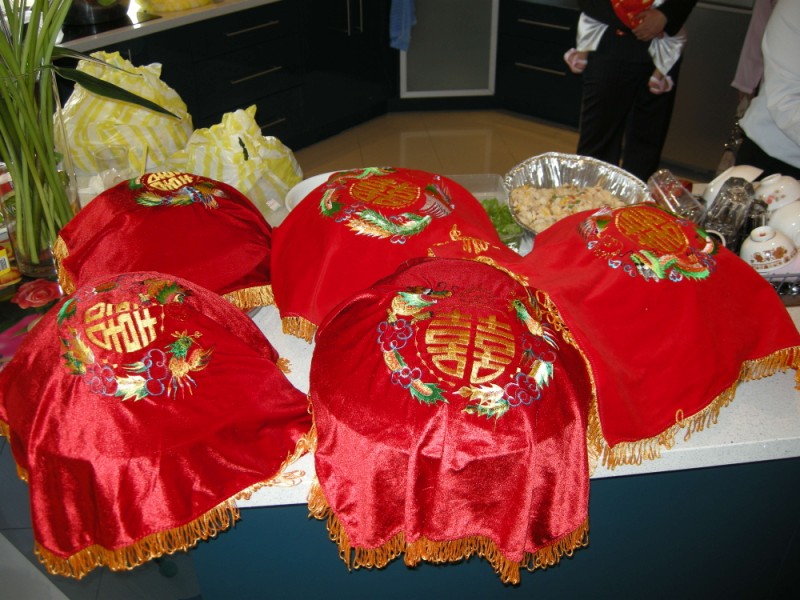


Like us desis, the bride’s side is also expected to deliver dowry and money to the grooms home, the amount of which  states the dignity and position of the bride’s family.

On the day of the wedding day, as  she gets ready, the bride goes through a hair combing ceremony where a ‘lucky’ woman, mostly a married woman ( = our suhagan) combs her hair 4 times. Each stroke carries a special meaning. The first combing blessed the marriage to last a lifetime; the second, a harmonious marriage; the third, many children and grandchildren ; and the fourth, good health and fortune.


The bride adorns a red gown, red shoes and covers her face with a red veil.

However, the groom, unlike our groom, wears red robe, red sash. A capping ceremony like our ‘sehra bandi’ takes place where his head is covered with cypress leaves by the father.


Amidst the banging of gongs, drums and firecrackers, ( like an Indian baraat),  the groom leaves for the bride’s house in a procession.


As the groom steps in the brides house, the brides sisters & friends stop his way and bargain for entry towards the bride.

The bride leaves her home for the wedding arena under a red umbrella to ward off evil.

However the basic difference between the desi and Chinese wedding is the main ceremony.

They do not have any written contract or chanting of verses.
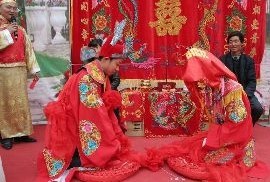
The couple goes on its knees and bows thrice- for the Heavens, the ancestors and their parents. They even bow to each other in a gesture of promising faithfulness to each other. There are no spoken vows.


Like us desis, the banquet is extremely elaborate, with 9 or 10 course meals.

However unlike us, each meals signifies something. First course is pig which signifies virginity, followed by others eg   fish & seafood for wealth and abundance,  pigeon for peaceful marriage, and whole chicken head for togetherness.

For details in the 10 courses: http://www.boneats.ca/2010/08/food-culture-chinese-wedding-banquets.html


The preferred presents like us desis are generally in  cash, which has to be placed  in red envelopes called Hongbao. The amount of money given varies upon the closeness of the giver to the bride-groom.
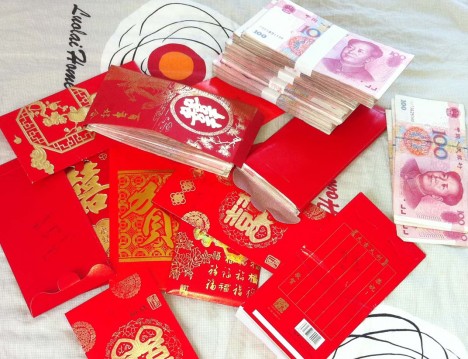


After the ceremony and the feast, the bride serves her  in laws  tea, holding with both hands, showing a gesture of her service and faithfulness to her new family.


What excited me most was to know that like our old tradition, the Chinese bride also leaves for her husbands home in a hand held  carriage quite like our doli.
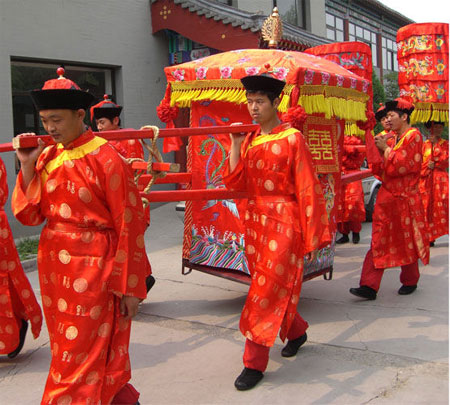


Although now only a few girls like this tradition, and now this has largely been been replaced by more posh mode of transport i.e. a car which is mostly extensively decorated with fresh red roses.


Some of the rich who can afford prefer a red car itself.


The ‘bridal bed’ as it is called is arranged quite a few days in advance in an elaborate ceremony, taking care the direction of the bed. The details here too depend upon the affordability of the groom. However all have traditional red bedding and are spread with fruits on it, which signify fertility— red dates, litchis and longans.

In the next morning, the bride gets up early to prepare meals for the new family.

Three days later she visits her parents along with her husband, as a special guest.

The picture that inspired me to write this blog ( Courtesy Tahir Hashmi) was this, which reminded me of the Hindu wedding’s pheras:
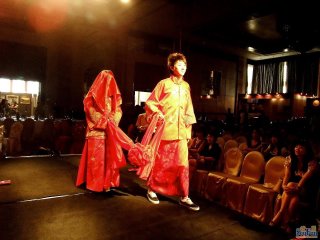
 

“Many of the Chinese youngsters are now  getting more fond of  traditional wedding, after two decades of having had more modern weddings.” added my friend.

(Special thanks to my friend Jenny for the details & helping dish out pictures)

Lawn ki kahani, meri zubani ( The story of Lawn in my words)


Published in TheNews Blog : http://blogs.thenews.com.pk/blogs/2012/03/21/story-of-a-lawn-hater/

Designer lawn, designer lawn, designer lawn!

Every Sana, Nida and Hina is coming out with designer lawns.

Thankfully never a fan of lawn as a material, it does not awaken the woman in me.

However I remember my mother, who lives in Delhi, where summers are really biting, once came back from a trip to Pakistan in mid 80s, all excited, for having discovered a wonder cloth. She is a woman with sensitive skin, and sweat rash (garmee daaney, as we call it in desi jargon) was what she had to struggle with each Delhi summer.
Fed up of wearing starched Khadis (hand spun cotton) and malmals (muslin) in the sweltering heat, she said she found something which was soft, low maintenance, colorfast and did not need any starching. The picture she painted with her descriptions and expressions got me really curious to open up her suitcase and dig out the jewel, basically to choose which one was mine.

The result that came out of that digging was so befitting to the Hindi idiom “Khoda pahaar per nikla chooha aur woh bhi mara hua”
(From the digging came out a dead rat).

The first look of it was totally unappealing –bold designs on the shirt piece, with its giant replicas on the dupatta. Didn’t need to check the third of the half a dozen three piece suits she brought.

“What’s wrong with your taste? Ammi you’ll wear this?”

“They are so comfortable. And most of all they are so reasonable. One suit costs just Rs 225.”


She didn’t even bother to comment about my ‘taste’ rant.

From then on, I saw her pass all the worst days of summers in lawn suits. And when I got married in Pakistan (perhaps she must have prayed for this secretly for her own vested interests) all she wanted from me each visit was…”bring lawn ke suits, so that meri garmiyaan nikal jaayein.”

I remember from 1990 onwards, buying them for Ammi from Rs 250, Rs 450, Rs500, then Rs1000,  1200, 2500, and last I got for her was Rs 3500. Agree that with time, along with the prices, the designs evolved too. And they certainly got better.

But each time, Ammi felt uneasy with the price escalation. At the 3500 one she told me, “Enough, I don’t need a dress at this exorbitant price just to soak my sweat.”

And now with the advent of designer tag they have graduated to even five digit prices (at the higher end). And they usually begin from 4,000 going upto 12,000, I am told.

I remember some 2 years ago, hearing two cousins talking of outlets where they got the same designs as the big brands copied at much lower prices.

“The original is so expensive, so I buy the duplicate ones.”

“Even the previous year’s designs are available at cheaper price,” said the other.

Yes, but you know there is a teacher in my school who thinks she is very  smart. She instantly recognizes, ‘ye to pichle saal ka design hai’. So I can’t wear that. But woh kaminee tou isko bhi pehchaan jaati hai, ke ye duplicate hai.’

“Why do you need to copy? Or in fact wear designer lawn at all”, I asked.

She rubbished my question and moved on to some other topic.

This is certainly not to act snobbish, but I certainly find it hard to fathom the compulsion to owe one’s allegiance to these ‘disposable’ pieces of cloth which are so short term that they become obsolete the next season.

If I have so much money to spare( 5-7,000+ on a dress) , I will perhaps invest in a piece I can cherish for longer, and if you ask my secret desire, it would be on something I can pass on to my daughter. And indeed I have done exactly by getting hold of  some beautiful pieces with  Baluchi, Afghani or Sindhi hand embroideries.

Dump my hard earned money into a casual wear lawn suit which won’t last the next summer—no way.

In the background of so much disinterest for the designer fad, I was made to see this disgusting ad ( see the bottom pic) by a twitter pal.

And this perhaps was the boiling point of my emotions,  for the ‘designer lawn’ and hence I decided to blog my disdain for them.

With all the designer hype or price escalation, the brand had the audacity to show their product with coolies in the background.

What did they wish to relate to?

Was it the quality of attire in comparison? Oh ! Theirs is so simple, non designer unlike mine. Yet in my two dim visioned eyes, the poor men’s is the rawest of  cottons.

Or

Was it about the worth of one’s labour? Oh look at us, how much we get for the every drop of sweat we shed in the labor for those ‘designs’. 

Or

Was it about the matching colors?

But then, Buddhist monks and  Hindu sadhus too wear the color similar to the woman’s. With ‘Muslims’ as their major market, it was too much of a risk to take.

Oh,  yes, the coolies do not prick anyone’s sensitivity, so were  pretty risk free to have as a background.

Kudos to the imaginative  Advertising Company that thought of this ad and flexibility of the Designer Textile Company that approved of it and owned it.

To me personally this was absolutely nauseating…akin to showing middle finger to the poor fellows in the background.

So rightly had someone commented: “Thank you for hiding their faces with your brand name.”

Hats off to the Feudal mindset, yet another common man’s commodity, the lawn, has turned into an elitist product. Of course in business jargon this is called as ‘value addition’. So what if it gets unaffordable to the vast majority, at least it looks coool ( with a triple o) !

How I wish we did some value addition to Islam too, in Pakistan?

On a second thought, haven’t we?

With the  tags of suicide bombs, Ahmedi hate, Shia kafir rants, we have made it a brand which ordinary Muslims like me find hard to afford.

Learning the art of peaceful protest from Gandhi’s Dandi (Salt) March


This is a unique and simple story that changed the course of Indian Independenc movement. No destruction, no chaos, just a peaceful protest for a cause.
Though it is impossible to summarize it in a few words…

‘On March 12, 1930, Gandhi along with the protesters set out, on foot, for the coastal village of Dandi some 240 miles from their starting point in Sabarmati, to protest against salt-tax.

He issued a warning before he began: “Those who fear the government can leave, only those who are prepared for jail going and receiving bullets should follow me tomorrow morning.”

The procession was at least two miles in length.

On April 6th he picked up a lump of mud and salt (some say just a pinch, some say just a grain) and boiled it in seawater to make the commodity which no Indian could legally produce–SALT.

He implored his thousands of followers to begin to make salt wherever, along the seashore, “was most convenient and comfortable” to them.

There was also simultaneous boycotts of imported cloth and asked to wear khaddar.

The effects of the salt march were felt across India. Thousands of people made salt, or bought illegal salt.

Gandhi was later arrested.

This incident is considered to be the apex of Gandhi’s political appeal, as the march mobilized many new follwers from all of Indian society and the march came to the world’s attention.’

Today is the 82nd Anniversary of the Dandi Salt March.

The original footage of the March ( Courtesy Geetali Taare)

Celebrate the woman inside you !


Published in TheNewsBlog:  http://blogs.thenews.com.pk/blogs/2012/03/08/celebrate-the-woman-inside-you/

While discussing how one should celebrate International Women’s Day this year, a friend said:

“It is not just the abuse outside that we women need to fight, but we have to fight an inside war too.”

I did not quite understand what she really meant, but before I could ask she went on:

“You know what, this Women’s Day I am going to work without make up and jewellery. Just to be with myself.”  

Although I’m not someone who shuns make up and I consider every piece of good jewellery, a work of art, I without getting my friends point completely also agreed with her completely.

Men, women, young or old, who does not want to feel good. But to attach strings to ones external appearance with the feeling of goodness is when the trouble starts.

If the ‘feel good’ feeling is within one’s self esteem, the outer accessories will be for a mere change, not ‘improvement’.

I am often surprised why many agree to Marylyn Monroe’s quote “Every girl should be told that she looks beautiful. I was never told this in the childhood.”  I do not concur.

What every girl should be told is not that her face or pony tail or frock looks pretty but that her mind is beautiful or courage is awesome.

I have never heard someone tell a boy that his shirt or knickers look beautiful, instead they are told that they are strong or courageous. And thus comes the difference in perception of self as one grows up.

Apart from your upbringing, the fault also lies within how a woman is projected in the media as a commodity.  Fairness creams, slimming diets, cosmetic companies, and aesthetic clinics reap profits at the cost of a woman’s battered self esteem.

Is it not ironic that whether we get positive or negative comments on physical appearance, both induce the same anxiety to look better?

I learnt from a teacher who once said, if you compliment someone’s looks, is it not a silent statement to someone who you are not complementing that ‘you are not good looking.”  Hence if you can’t compliment everyone, it is better refrain from complementing at all.

I have a friend’s whose self esteem is so high that she often jokes:

“If anyone ridiculed me saying ‘ugly’ referring to my not so perfect looks I tell them, ‘I wish to hug you; because I know how hard life is for the visually impaired’.”

For many old school feminists wearing makeup and jewellery is anti-feminist and oppressive.  Yes the idea of not being able to leave the house without make up is anti-feminist, and to associate ‘make-up is beauty’ is anti-feminist. What also makes it oppressive is when one’s self worth is tied to one’s looks, hair, skin or size number.

Women who choose to wear or not wear makeup or jewellery are making a decision about how they wish to be perceived. If not conforming to the dictates and demands of society on appearance empowers women, then so be it. A feminist, who goes without make up, is no more or less feminist than a woman who does.

Feminism in my eyes is all about expression of one’s femininity in one’s own unique way. It certainly does not overlap with the standards laid down by someone else.

Adorning jewellery and makeup is an art form of self expression and not a tool to hide one’s flaws in order to look like the model that appears on the cover page of a magazine.

Self image has no bearing on one’s physical appearance. Obsessed with looking better, some women (who may even be extremely beautiful by world’s standards) and even some men get very insecure and suffer from poor self image. In extreme cases it may even be manifested as Body Dimorphic Disorder. The underlying depression and anxiety leads them to resort to dysfunctional eating disorders or unnecessary plastic surgery procedures.

So let people say or think whatever, know that you are beautiful. For beauty isn’t skin deep.

As for me, not just to support my friend, but to support the woman that lives inside me, my external self too will go without   jewellery and make up on International Women’s Day. It is not to show down my good old friends, jewellery or makeup, but to tell them that they may be dear to me but they are not indispensible.

Tip : Celebrate this International Women’s Day in a  way that makes  the inner woman  in you  feel empowered and beautiful.

Gimme all your worries


Published in TheNews Blog : http://blogs.thenews.com.pk/blogs/2012/02/13/%E2%80%9Cgimme-all-your-worries%E2%80%9D/

“What if my boss doesn’t like my work?”

What if I get cancer?

What if I don’t pass the exam?

What if my friends don’t like my dress?

What if Mommy doesn’t come back from work?

Worries! Age, gender and ethnicity, is no bar. From babies to youth to middle aged to the elderly, we all have our share of them – a few valid, some too trivial to warrant a worry but we still do – but loads and loads of them are simply imaginary ones that never become real.

Some of us must have read the famous self help book by Dale Carnegie How to Stop Worrying and Start Living.

Some technologically savvy might have googled ‘How to deal with anxieties’ and got the tips:

  • Prepare for the worst, hope for the best
  • Practice relaxation
  • List your blessing
  • Distract yourself, keep busy
  • Get support

Quite a few of us Moms and Dads must have dealt with worrying kids and must have used our own tools either as healing words, “I understand your concern, but be strong “, or simply giving a tight reassuring hug without saying “I’m beside you.”

Perhaps many of us may even have trivialised “That’s nothing to worry about?” without realising that it adds to their worries rather than help them.

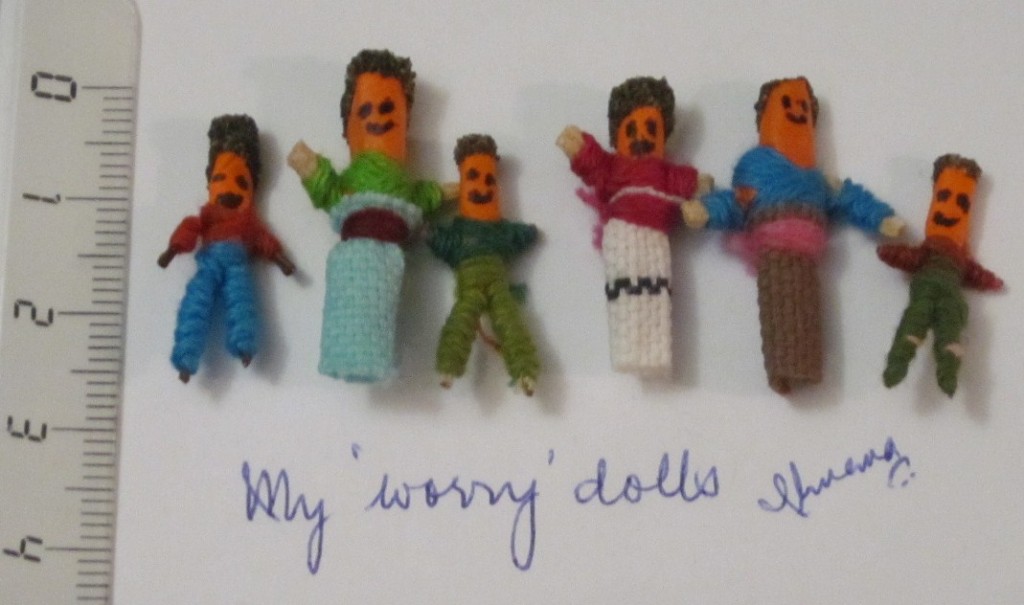
A few days ago while visiting a museum for the Mayan Civilization Exhibition in Toronto; I came across a very simple yet unique and fascinating way of dealing with worries. My attention was drawn to the tiny, barely 2.5- 3cm long set of six miniature dolls placed with a name: “Guatemalan worry dolls”.

On a closer look, they were tiny dolls made out of wrapping cloth or wool over tiny wires shaped as dolls and each one had faces with eyes and a smile drawn on them.

Later as I dug into the details, I learnt that they are an ancient Mayan tradition which is still being practiced by the surviving descendants of the ancient Mayans which live in Central America, specifically in Guatemala.

The dolls usually come in a pack of six handmade dolls and a tiny bag to carry them.

It is said that if the children who worry are told to share their worry with the ‘worry doll’ and place it under the pillow imagining that the doll will take care of that worry. Each doll is told one worry at a time. Many a times parents take away the doll from below the pillow, so that when the kids wake up in the morning thinking that with the doll, the worry too has disappeared. However, sometimes if the worries are recurrent, not removing the doll implies that the doll is working on the ‘worry’ to disappear.

The tradition has been claimed to be scientifically sound and helps kids learn to ‘speak out’ their worries instead of internalising them into long lasting fears. It also gives a subtle message that ‘someone’ cares. It is also know to work as a good tool to inculcate a habit of sound sleep. However, this may work only in those with mild or moderate worries, but not so much in situations of extreme anxiety.

It is claimed that ‘worry dolls’ have also been used in the hospitals, for young and old, to allay anxiety in patients while they undergo surgeries or cancer treatments. Some claim to have used them in class rooms in schools and meeting rooms in offices to cope with stress, and to boost creativity. They are even used for emotional healing in incurable illnesses, dealing with deaths or even heart breaks. I think with the potential they have, there is no dearth of situations where ‘worry dolls’ can be used. Imagination is the limit to utilize them as calming companions.

Though not mentioned in the information on dolls, their ‘tiny’ size taking up seemingly ‘big’ worries must be playing its part in the process of relaxation too.

Apart from the therapeutic value, what fascinated me was the art of making these miniature dolls by wrapping up wool or cloth on wire and giving them a resemblance to someone who ‘cares’.

So aptly was it mentioned in the literature: “Make your own worry dolls at home, just give them a dress, two pairs of limbs and a smiley face? And see them in action. You needn’t be a Picasso or a Freud.”

Horse ‘art’


Horse and man has been friends and companions since time immemorial.

It is said that their association dates back to almost 5,500 years ago. Initially used to carry loads, was later used as the main means of transportation, for wars and then for recreation.

The horse when used in wars needed protected gear like the knight or the soldier mounted on it.

For this horse armour was needed.


In ancient China, relevant to the local culture, the armour had its dragon look:


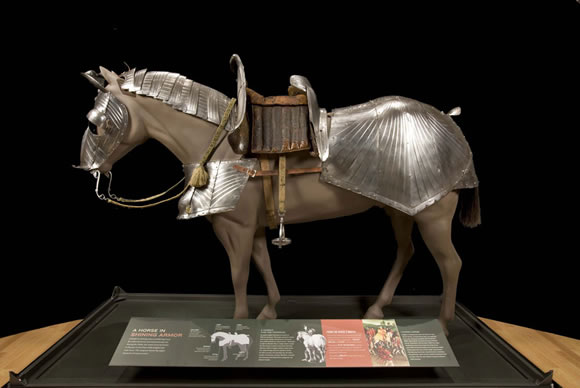
As came the middle ages, and Europeons  used horses for wars as well as transportation their armours were metallic carved plates which  rided on each other to give flexibility:


As times changed, horse use in the wars reduced.  The horse remained as man’s companion and their decorations became less protective and more decorated.

The Arabian horses ( here Moroccan)  had their touch of  embroidered decor:

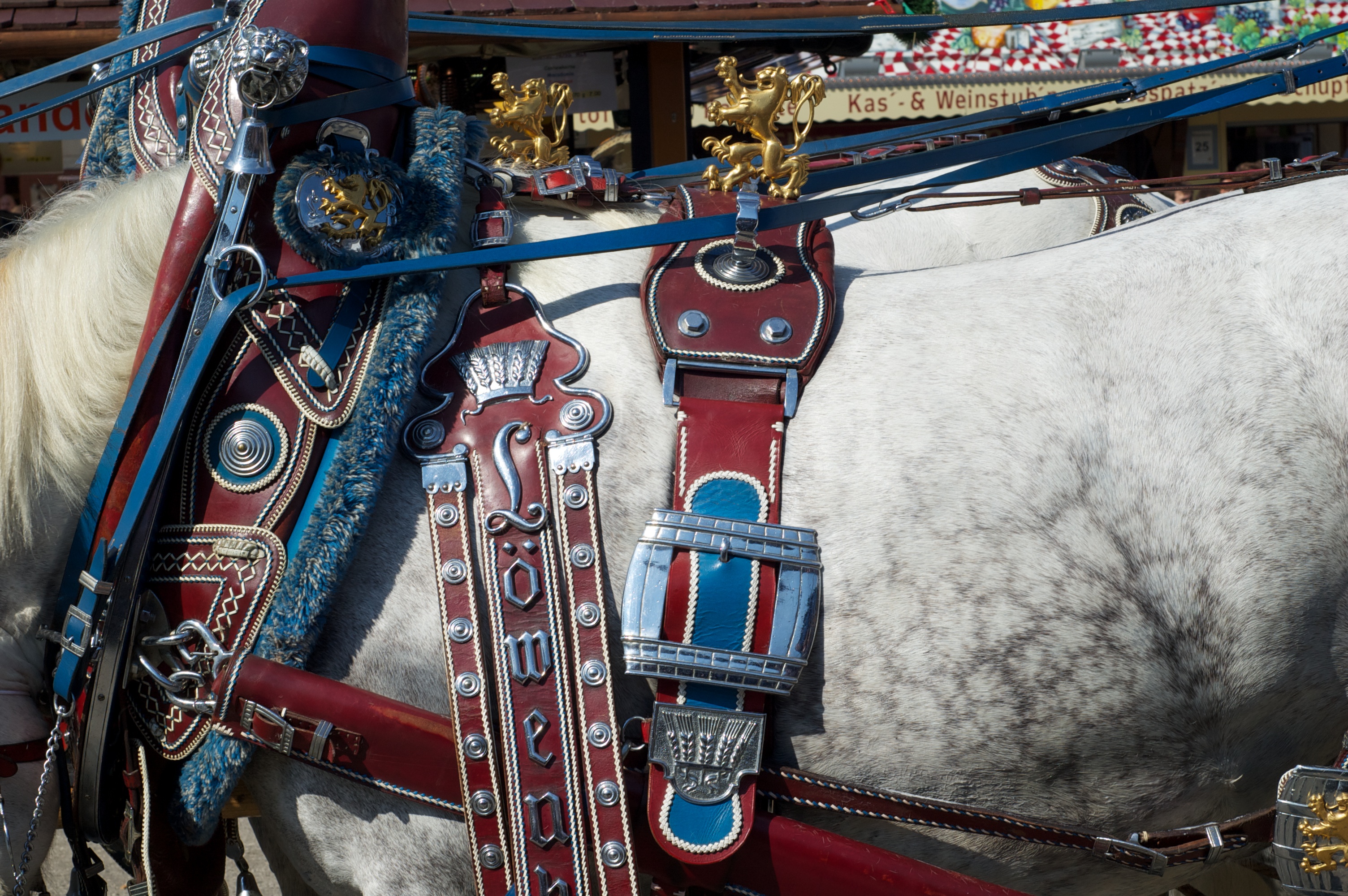
European decorations differed, thus:

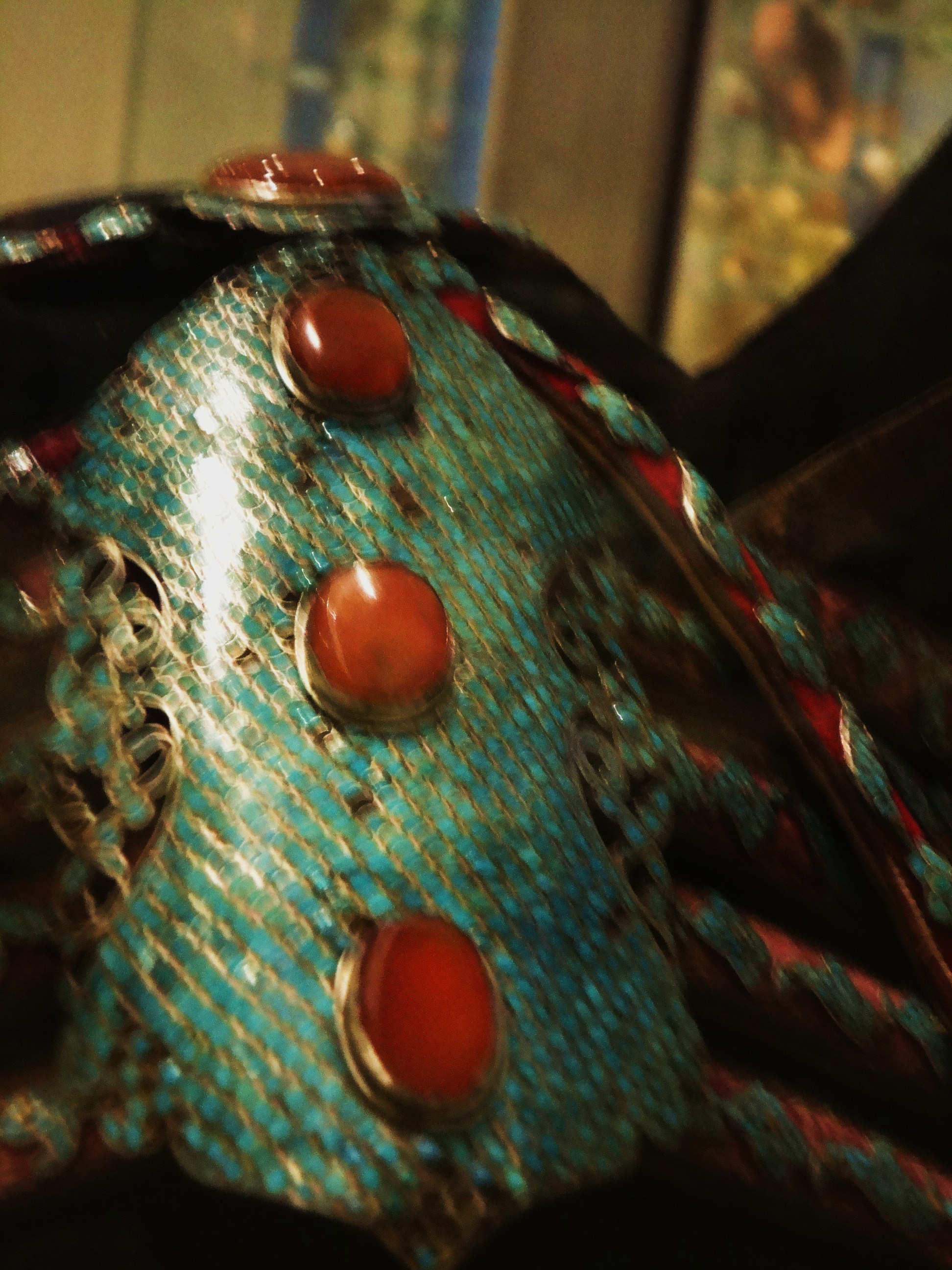
In a recent visit to Royal Ontario Museum I was stunned to see the horse decoration from Iran, which could easily put to envy any woman’s jewellary. This elaborate set of straps and coverings were made of silver, with gold plating,

and inlaid with Iranian turqoise.

The head dress had huge agates giving it a more terrific contrast.


The details of the design were mesmerising:


The austere decorations seen in South Asia using beads, colorful threads and wool tassels have their own charm:


While the Bedoiun horse decor from Egypt still uses  tassles of wool and bead work:

The art of decoration does not end here. The places where other aanimals like camel, ponies are used, they are similarly adorned.

And as buses, trucks and  rickshaws replace animals as the mode of transportation, even they too are as  ferviously bedecked with decorations.
(Details  later…)  

Basant, a festival beyond beliefs


On 27th January, 2012 India celebrates Basant panchami.
In Pakistan, it is celebrated towards the end of February.  

Towards the end of January till early March, the golden harvest of wheat stand tall ready to be harvested sometime in early April.  And wheat is our staple crop.

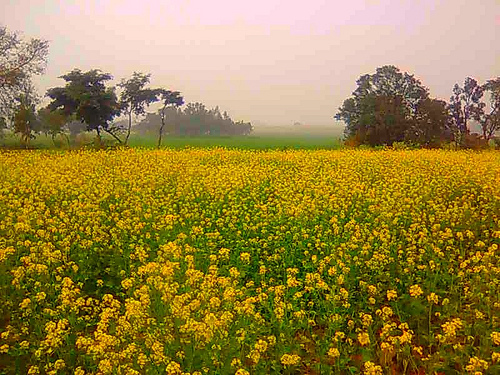
At the same time in Januray February the yellow blooms of mustard ( better known as sarson) sway in the fields, as far as eyes can see. And mustard is a cash crop whose seeds are pressed to extract mustard oil.

To celebrate these awesome blooms as a reward for the fields ploughed and the seeds sown  in October, the farmers rejoice, sing, dance and make merry.

Some of them wear yellow turbans, and their women folk adorning yellow ‘odhnis’ come out to join in the celebrations. It is not hard to imagine that they must be celebrating the blooms, ever since they learnt to farm these crops dating back to centuries.

This is the basic root and the spirit of the tradition of Basant in parts of Indian subcontinent where these crops are grown.

Are wheat, or mustard crops Hindu, Muslim or Sikh?

Vasant in Sanskrit or  Basant in Urdu mean ‘spring’, which heralds the departure of winter and arrival of spring. It symbolizes the time of rejuvenation and arrival of happiness as flowers start to smile through their blossoms.

Yellow, the color of Basant, inspired by mustard blossoms, which matches the shade of sun rays, signifies life and radiance.

Do rays of sun or radiance of happiness differentiate between Hindus, Muslims or Sikhs ?

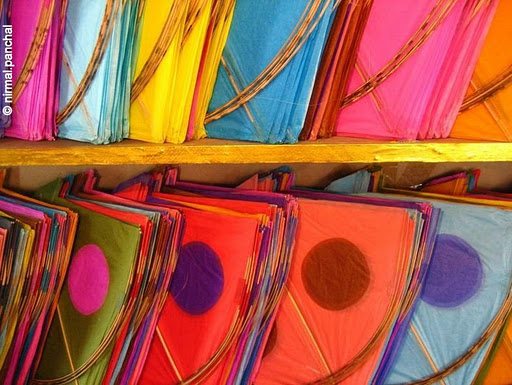
Kite flying , another component of basant, has it’s own interesting tale to tell.

“Kite flying also reveals how the tradition evolved over centuries and in a Ganga Jamuni way.
Kite flying was introduced to the Indian subcontinent by the Chinese traveller Heun Tsang in the 4th Century. Evolving for centuries, it s modification into its current form and popularisation as a sport was made possible by the Nawabs of Avadh. The kite flying during basant celebrations is believed to have been introduced by Maharaja Ranjit Singh in the 18th century.”

Yet another evidence of centuries old and secular celebration of Basant come from poets, Kalidas and Amir Khusro, who have written about the celebrations of Basant in their own unique styles.

Kalidas in a poem Spring writes:
द्रुमाः सपुष्पाः सलिलं सपद्मं
स्त्रियः सकामाः पवनः सुगन्धिः ।
सुखाः प्रदोषा दिवसाश्च रम्याः
सर्वं प्रिये ! चारुतरं वसन्ते
Oh, dear, in Vasanta, Spring, trees are with flowers and waters are with lotuses, hence the breezes are agreeably fragrant with the fragrance of those flowers, thereby the eventides are comfortable and even the daytimes are pleasant with those fragrant breezes, thereby the women are with concupiscence, thus everything is highly pleasing…

AmirKhusro pens down:

Aaj basant manaalay suhaagun,
Aaj basant manaalay;
Anjan manjan kar piya mori,
Lambay neher lagaaye;
Tu kya sovay neend ki maasi,
So jaagay teray bhaag, suhaagun,
Aaj basant manalay…..;
Rejoice, my love, rejoice,
Its spring here, rejoice.
Bring out your lotions and toiletries,
And decorate your long hair.
Oh, you’re still enjoying your sleep, wake-up.
Even your destiny has woken up,
Its spring here, rejoice.

There is an Indian classical  music tune  called Raag Basant Bahaar.

Not to forget, basant in the subcontinent is also associated with a special sweet prepared specially for the occaision –the kesar halwa,
It is a suji ( semolina) halwa with a soft aroma and yellow shade from saffron and garnished with cashew nuts.

Neither the dessert, nor the poetry above nor the music below suggest if Basant is Hindu or Muslim or Sikh.


The same spirit is also replicated by this beautiful ghazal by Malika Pukhraj and Tahira Syed

Lo phir basant aayee…

P.S. Special thanks to Sandeep@stwta a twitter pal for the devnagiri  text of Kalidas poetry.

Continuation of a joint heritage


Published in Aman Ki Asha , in TheNews on December 14, 2011. http://amankiasha.com/detail_news.asp?id=584

Ilmana Fasih recounts some examples of the ‘Ganga Jamuni Tehzeeb’ and centuries’ old, peaceful coexistence beyond religious divides

An otherwise sane looking person I met at a party recently started to spew venom laced with conspiracy theories about “Hindu Muslim animosity”. To top it all, he tried to use my own life to justify his views, insisting that my going

to live in Pakistan after marrying a Pakistani was proof of the natural divide. He refused to accept my views that a peaceful coexistence between people of different faiths is possible or that my going to Pakistan from India was not based on religious reasons.

His hate-filled thoughts kept me sleepless for hours that night. But talking over the phone to my mother in Delhi later, I was cheered up by her mention of Ganga Jamuni Tehzeeb. Our conversation triggered off thoughts about this beautiful, fluid culture that refuses to be boxed up and compartmentalised.

The name Ganga Jamuni Tehzeeb is as beautiful as its spirit. It refers to the centuries’ old, peaceful coexistence between Hindus and Muslims of the subcontinent. Not only did the two faiths borrow cultural practices from each other, but they also exchanged each other’s vocabularies. So much so that now one is hardly able to find any difference between spoken Urdu and spoken Hindi.

The Nawabs of Awadh in north India in the 1700s are considered the pioneers of Ganga Jamuni Tehzeeb. At least, the term was coined in their times. But on ground it existed well before that era.

The starkest example of this syncretic culture is the Purana Hanuman Mandir in Lucknow, which is crowned by an Islamic symbol, a crescent. According to legend, the temple was built by Nawab Saadat Ali Khan to honour the wish of his mother, who had dreamt of building a temple. The tradition of honouring the Nawab’s gesture still continues when the Muslims in the area put up stalls of water during the Bada Mangal festival at the temple, and Hindus manage sabeels (stalls) of sherbet and water during Muharram in reverence for Imam Hussain.

Not far from Lucknow, the rulers of the Hindu holy city of Kashi (also known as Benaras or Varanasi) observed the Azadari (the mourning) during Muharram, wearing black on Ashura. Ustad Bismillah Khan, the renowned Shehnai maestro, began his career as a shehnai player in Vishwanath temple, Kashi. In fact, many of the musicians, Hindu and Muslim, who play in the temples, fast during Ramazan and also observe Vrat during the Hindu Navratras.

Even today, Muslim artisans in Kashi/Varanasi who make Taziyas for Muharram also make effigies of Ravan for Dussehra, a friend tells me. Hindus too participate in Muharram processions and make Taziyas in many cities, notably Lucknow.

Similarly a Sindhi friend talks of the centuries-old peace and harmony between the Hindus and Muslims of Sindh. Adherents of both faiths revere and pray together at the shrine of Jhuley Lal, she says. The shrine walls are inscribed

with Arabic verses as well as Hindu names of Gods. An age-old common greeting of Sindhi Hindus and Muslims is “Jhulelal Bera-Hee-Paar”.

Karachi’s 150-year old cremation ground for Hindus has a Muslim caretaker, although there are many Hindus in the city. This caretaker is responsible for cleaning the statues and lighting the lamps in the temple, and takes care of the urns that contain the ashes of the dead after cremation, until their loved ones immerse the ashes in water.

Cultural practices in Sindh are a fusion of the two cultures. If the Hindus, fervently use Allah as the reference to God, the Muslims touch the feet of their elderly as traditions borrowed from each other’s cultures.

The contribution of Sufi poetry towards this peaceful coexistence, from Kabirdas and Amir Khusro, to Bulleh Shah on the other side, is well known.

Beyond faith, at the cultural level, the Ganga Jamuni Tehzeeb has seen some beautiful creations like the Ghazal style of singing and the classical dance form Kathak.

Kathak’s journey from ancient times to its present form merits a walk-through. The word “katha” comes from “katha” or story telling. It has its roots in ancient times, when storytellers narrated epics or mythological stories like Shakuntala, and the Mahabharata through dance forms in temples. However with the arrival of Mughals, the dance, enticed to come to the courts, developed into a more Persianised form. The Kathak dancers adopted the whirling

from the dervishes to the ‘chakkars’. The rhythm of the footsteps found harmony with the beat of the tabla recently discovered by Amir Khusro. The female Kathakaars (storytellers) abandoned the sari of ancient times for the angarkha and churidar pyjama. The language of narration also transformed from Sanskrit to Brij Bhasha and then Urdu.

There may be more examples of such coexistence and development in other regions of the subcontinent too.

Those who propagate conspiracy theories and narrate stories of hate and disharmony need to know that even with the physical separation between India and Pakistan, the spirit of Ganga Jamuni Tehzeeb lives on. The lack of communication between the two countries, particularly after the 1965 and 1971 wars, has not managed to dampen the natural instincts of sharing these cultures.

Farid Ayaz and Abu Muhammed, the renowned Qawwals from Pakistan continue to sing Bhajans which their gharana has been singing for the last 300 years. On the other side are Wadali brothers who sing Bulleh Shah Kaafis and Naats with the same devotion. Despite all odds, Sheema Kermani and her students in Pakistan have continued to keep the dance forms, not only of Kathak, but also Bharatnatyam and Odissi, alive and known in Pakistan.

The recent collaboration between Zeb and Haniya from Pakistan and Shantanu and Siwanand Kirkire of India yielded the soft melody “Kaho kya khayal hai” in a beautiful blend of Dari and Hindi. I could not help relate it to the Zehaal-e-Miskeen composition by Amir Khusro which was a beautiful fusion of Persian and Brij Bhasha.

And now another peacenik in the form of Shahvar Ali Khan makes a music video titled ‘No Saazish No Jang’ (No Conspiracy, No War). It is heartening to see the visuals, and hear the voices of Quaid-e-Azam Mohammed Ali Jinnah and Bapu Mahatama Gandhi together in the backdrop.

It is not possible to list all collaborations between the two countries and across religious divides, particularly in fields of films, music, health (the most significant being the Heart to Heart initiative by Rotary and Aman ki Asha). But all these initiatives testify to the desire for peace, not hate.

As for me, convinced that each of these efforts towards peaceful coexistence is based on foundations going back centuries, I slide into my bed, comforted by the faith that peace, not hate, will ultimately prevail.
It’s just a matter of time.

Dr Ilmana Fasih is an Indian gynaecologist and health activist married to a Pakistani. Her blog is Blind to Bounds https://thinkloud65.wordpress.com/

Do it anyways


I wasn’t so, not so long ago. But after all the chaos pertaining to hatred, intolerance and self-righteousness all around, I have come to believe that the only way to have real  ‘peace’ is if we donot reciprocate hate with hate or evil with evil.

The following words by Kent M Keith which inspired even Mother Teresa, hold the key to peace in this world, perhaps:

The Paradoxical Commandments

People are illogical, unreasonable, and self-centered.
Love them anyway.

If you do good, people will accuse you of selfish ulterior motives.
Do good anyway.

If you are successful, you win false friends and true enemies.
Succeed anyway.

The good you do today will be forgotten tomorrow.
Do good anyway.

Honesty and frankness make you vulnerable.
Be honest and frank anyway.

The biggest men and women with the biggest ideas can be shot down by the smallest men and women with the smallest minds.
Think big anyway.

People favor underdogs but follow only top dogs.
Fight for a few underdogs anyway.

What you spend years building may be destroyed overnight.
Build anyway.

People really need help but may attack you if you do help them.
Help people anyway.

Give the world the best you have and you’ll get kicked in the teeth.
Give the world the best you have anyway.

Bulleh Shah, the daring secularist!


In the times when  the whole world is going through an era of hatred, intolerance and extremism and Pakistan seems to be synonymous to all these words, what could be a better tribute to Bulleh Shah but to show to the world that there existed a daring secularist on this land almost 250 years ago.

Here I make a feeble attempt to write about Bulleh Shah, from  what little I know of him as a secularist : 


Bulleh Shah (1680-1757), was a sufi, who  lived in the heart of  Punjab, in Kasur,  as a  contemporary of Guru Gobind Singh, a reformer and mystic in his own right. Both of them had to face the wrath of a radical Muslim Mughal Emperor Aurangzeb in their life.

Not very different from the state of our current world, ridden with extremism and hatred towards other faiths , even 250 years ago, the subcontinent  was plunged in deep turmoil.  But Bulleh Shah, who thought far ahead of his times, dared to challenge the prevailing hatred and religious bigotry.  

He lamented:

“Ulte hor zamane aaye,
Hun asaan bhed sajjan de paaye.
kaa(n) laggad nun maaran lagge, 
chiriyan jurre khaaye 
iraqiyan nun chabuk paunde, 
gade khood khavaye
aapneyan vich ulfat naahee,
ke-he chaachche taaye 
piyo putran ittfaak naa kaahee, 
dheeyan naal naa maaye 
sachcheyan nun hun milde dhakke, 
jhoothe kol bahaaye 
agle jaaye bankaale baithe, 
pichliyan farash vichaye 
Bullah jina hukam hazooron andaa, 
tina nun kaun hataaye.” 

“Perverse times have come,
I know the mystery of the beloved
crows have begun to hunt hawks, 
and sparrows feed on falcons
horses bear the whipping, 
while donkeys graze on lush green
no love is lost between relatives, 
be they younger or elder uncles
There is no accord between fathers and sons,
Nor any between mothers and daughters
The truthful ones are being pushed about,
the tricksters are seated close by
The front liners have become wretched,
the back benchers sit on carpets
Those in tatters have turned into kings,
the kings have taken to begging
O Bulleh, that which is His command
who can alter His decree.” 

Despite being a terror that Aurangzeb was, Bulleh Shah audaciously defied him not once but several times :

When Aurangzeb banned the music and dance, declaring it  as haram in Islam–Bulleh Shah, following instructions from his teacher, defiantly  went from village to  village in Punjab, singing and dancing to his Kafis.

As Aurangzeb beheaded Guru Tegh Bahadur, Bulleh Shah dared to call the slain Sikh leader as Ghazi, a religious warrior.

” Kitay Tegh Bahadur Ghazi hay ” 

Bulleh Shah hailed the revolutionary spirit of Guru Gobind Singh, calling him  a ‘protector’ of those who believed in right to follow their religious belief. He said in a subtle satire:

Nah Karoon Ab Kee,
Nah Karoon Baat Tab Kee.
Gar Na Hotey Guru Gobind Singh,
Sunat Hoti Sab Kee.

I talk about neither yesterday nor tomorrow;
I talk about today.
Had Gobind Singh not been there,
They would all be under Islamic sway.

Hence, mentioning that had the tenth Guru not been there, Auranzeb would’ve forced all to convert to Islam( implying Sunnat as circumcision).

Not only did he oppose the persecution of Sikhs in his times, he also advised Banda Bahadur not to avenge Auranzeb’s cruelty by killing innocent muslims.

Referring to the plight of his times in Punjab, and referring to the apathy of the onlookers, he wrote:

The Mughals quaff the cup of poison.
Those with coarse blankets are up.
The genteel watch it all in quiet,
They have a humble pie to sup.
The tide of the times is in spate.
The Punjab is in a fearsome state.
We have to share the hell of a fate.

(According to KS Duggal here ‘coarse blankets’ is referred to Sikhs) .

Bulleh Shah, in solidarity with Sikhs,  is said to have visited a Sikh temple at  Makhowal  at the time of Guru Tegh Bahahdur. He saw people engrossed in ‘ Kar Seva’ (service to the temple,  construction etc), ‘Kirtan’ (the morning singing of prayer) and ‘Langar’ ( the free distribution of meals ) by the devotees. Impressed by their devotion through service,  he remarked:

Ett khrikka ( sound of bricks during construction work)
Duppar vajje ( sound of dholaki during kirtan)
Nale balle chulla (langar).
Enhi galin Rabb raji rehanda
Nale rehanda Bulleh.

Aurangzeb  was  arrogant  not just to non Muslims, he even did not attempt to hide his hatred towards his own  brother Dara Shikoh for following the Shia sect of Islam. And he had heartlessly got  GuruTeghBahadur killed in public, in Delhi and also eliminated his brother DaraShikoh for his beliefs.

Bulleh Shah , on the contrary,  being a true and fearless secularist, rejected  the discrimination between faiths- be Hindu-Muslim -Sikhs or sects- Shia-Sunnis ,and wrote:

Neither Hindu nor Muslim,
Sacrificing pride, let us sit together.
Neither Sunni nor Shia,
Let us walk the road of peace.
We are neither hungry nor replete,
Neither naked nor covered up.
Neither weeping nor laughing,
Neither ruined nor settled,
We are not sinners or pure and virtuous,
What is sin and what is virtue, this I do not know.
Says Bulhe Shah, one who attaches his self with the lord.
Gives up both hindu and muslim. 

While he did not spare those who monopolised their faith:

“Lumpens live in the Hindu temples
And sharks in the Sikh shrines.
Musclemen live in the Muslim mosques
And lovers live in their clime.”

And even dared to compare their clergy to ‘barking dogs’ and ‘crowing roosters’.

Not very different from the current times, wherein ‘secularism’ is still perceived as  Ladeeniyat ( atheism)), he too was labelled as an apostate for his secualr stance. To which he taunted:

Bulleh-a aashiq hoyiyon Rabb da,
Hoai Malamat Lakh Tenon Kafir Kafir aakhdey,
toon aaho aaho aakh
A lover of God?
They’ll make much fuss;
They’ll call you a Kafir 
You should say -yes, yes.

Learning from Bulleh Shah and  Kabirdas, and knowing the history of subcontinent,  today I too gather courage to defy Iqbal’s  verses :

Juda ho deen siyasat se tou reh jati hai Changezi .
When religion is separated from politics, it is reduced to brutality.

I say: Jurey jo  deen siyasat se tou ho jata hai Changezi…
When religion enjoins politics, it becomes brutal.

If after this you call me a traitor: I should say yes, yes.


 P.S. My two penny: 

Recently talking to a friend from Bhopal, about extremism in Pakistan,  I felt disheartened to know that all she knew Bulleh Shah was that  Abida Parveen sang him and that too in the context of his love poetry. And was oblivious to his humanist and secularist stance.

It is so unfortunate that even today, many in India ( besides Punjab) and elsewhere in the world, people who know Kabirdas and Amir Khusrow backwards,  have barely heard of Bulleh Shah except in context of  his love poetry.

Even my  first exposure to Bulleh Shah’s poetry was through the verses…Bulleh ki jana main kaun...that too as a song sung by Rabbi Sher Gill. And I wondered and found the words wierd…not aware of the context. However, after having read some ‘bit’ of his history and his Kafis, it all makes sense now.

What wonders me most is that though in India, we read Kabirdas from grade Six, I never ever heard of  Bulleh Shah’s mention in any Indian history text books. What is more unfortunate that even in Pakistan, school text books never taught Bulleh Shah whether in history or in literature.

I still  consider Rabbi Sher Gill as the one who let me be familiar with Bulleh Shah’s name, to begin with. Besides many other sources…my special thanks to KSDuggal’s Mystic Muse,  Saeen Zahoor for telling stories of Bulleh Shah, the blogs Sufi Poetry, of Raza Rumi ‘s and Syed Ali Abbas Zaidi’s, who I stalked to learn about Bulleh Shah’s poetry and history.

Na maen momin vich maseet aan
Na maen vich kufar diyan reet aan
Na maen paakaan vich paleet aan
Na maen moosa na pharaun.

Bulleh! ki jaana maen kaun

Na maen andar ved kitaab aan,
Na vich bhangaan na sharaab aan
Na vich rindaan masat kharaab aan
Na vich jaagan na vich saun.

Bulleh! ki jaana maen kaun.

Na vich shaadi na ghamnaaki
Na maen vich paleeti paaki
Na maen aabi na maen khaki
Na maen aatish na maen paun

Bulleh!, ki jaana maen kaun

Na maen arabi na lahori
Na maen hindi shehar nagauri
Na hindu na turak peshawri
Na maen rehnda vich nadaun

Bulla, ki jaana maen kaun

Na maen bheth mazhab da paaya
Ne maen aadam havva jaaya
Na maen apna naam dharaaya
Na vich baitthan na vich bhaun

Bulleh , ki jaana maen kaun

Avval aakhir aap nu jaana
Na koi dooja hor pehchaana
Maethon hor na koi siyaana
Bulla! ooh khadda hai kaun

Bulla, ki jaana maen kaun

Not a believer inside the mosque, am I
Nor a pagan disciple of false rites
Not the pure amongst the impure
Neither Moses, nor the Pharoh

Bulleh! to me, I am not known

Not in the holy Vedas, am I
Nor in opium, neither in wine
Not in the drunkard`s craze
Niether awake, nor in a sleeping daze

Bulleh! to me, I am not known

In happiness nor in sorrow, am I
Neither clean, nor a filthy mire
Not from water, nor from earth
Neither fire, nor from air, is my birth

Bulleh! to me, I am not known

Not an Arab, nor Lahori
Neither Hindi, nor Nagauri
Hindu, Turk (Muslim), nor Peshawari
Nor do I live in Nadaun

Bulleh! to me, I am not known

Secrets of religion, I have not known
From Adam and Eve, I am not born
I am not the name I assume
Not in stillness, nor on the move

Bulleh! to me, I am not known

I am the first, I am the last
None other, have I ever known
I am the wisest of them all
Bulleh! do I stand alone?

Bulleh! to me, I am not known