Open up your mind and your potential reaches infinity…

Archive for the ‘Art’ Category

Kheloongi Holi ( I shall play Holi)


Published in Express Tribune Blogs here > http://blogs.tribune.com.pk/story/33221/you-can-play-holi-too-even-if-you-are-muslim/


Phagwa, more commonly known as Holi, celebrated on the full moon day of Phalgun, is a festival that heralds the arrival of spring. Played with dry and wet color, it is a symbolic expression for the changing temperatures and the blossoming fields.

Since very young, on the morning of Holi, I saw my Muslim parents being called at the gates of our house in Delhi, by a group of faces immersed in colors, who all looked almost identical. As my parents walked out, they were enthusiastically smeared with color by the crowd, and they too lost their identity with crowd.  It left no clue as to who was who, when they roared together with laughter and excitement.  As we siblings grew up, we joined in too, with our set of friends.

Holi, as I envision it,  is a perfect way to depict a spirit of universal brotherhood beyond color, creed, caste or social status.

If  taken in it’s true spirits, Holi never was and never is meant to be a religious festival to be celebrated by a select faith.

Though, like other religious festivals, it too claims a legend with a victory of the good over the evil ( The Story of Holika). However, from the context of its current celebration, it is said to have begun by the love duo Krishna and Radha.
Krishna as a young boy, being extremely dark complexioned, complained to his mother Yashoda, why was he dark, while his beloved Radha fair?

The conversation between a complaining son, and  his doting mother,  is  narrated beautifully, in a famous folk song:

Yashomati mayya sey bole Nand Lala,
Radha kyun gori, main kyun kala?
Boli muskaati Mayya, Sun merey pyaare,
Gori gori Radhika ke, nain kajrare,
Kaale nainon waali ney, aisa jadu dala,
Tuu isee liye  kaala.

(Krishna asks mother Yashoda: “Why am I dark, while Radha is so fair?”
Mother  smiles and replies: “Listen my dear, the fair Radha’s kohl eyes have swept you with their magic, and hence are you so dark.)

And one day teasingly to console Krishna she is said to have told him: “What’s in a color? Go and smear Radha’s face with any color you like.”
And Krishna out of love for Radha, smeared her with red color( gulaal).

Legend claims that  thus began  the playing of colors ( Holi khelna), between Krishna and Radha along with her friends referred to as Gopis.

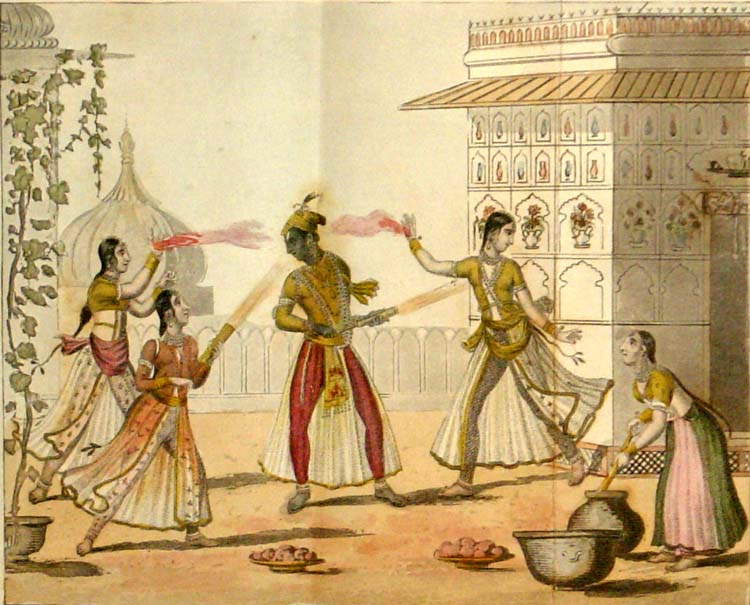
Their romance with playing Holi has been immortalized in many miniature painting s:
HoliRadhaKrishna1

Another one, with in Mughal art:
HoliRadhaKrishna2

Mughal Emperors  too fancied Holi, for its association with color and romance. They brought the practice of playing Holi to their courts and palaces.

Akber is no surprise, knowing his secular conviction and a Hindu Queen, Joda Bai.

Jehangir, the romantic art connoisseur, is documented to have played Holi with his Queen Noor Jehan in his palace and called it Eid-e-Gulabi. It isnt hard to imagine the ecstatic aroma and aura that must have been created in the palace by red gulaal,  rose petals ( gulab paashi) and   rose water (aab paashi) being sprinkled during the royal play.

Auranzeb’s fancy for the colors of Holi came as a surprise to me. Writes Lane Poole in biography Auranzeb: “During his time there used to be several groups of Holi singers who besides reciting libertine lyrics also indulged in salaciousness, accompanied by various musical instruments.”

Bahadur Shah Zafar’s verses on Holi now are sung as part of the phaag ( folk songs of Holi). One of the most sung verses being:

Kyo Mo Pe Rang Ki Maari Pichkaari
Dekho Kunwar Ji Doongi Mein Gaari
(Why drench me with color spray,
now my prince, I will swear at you)

Bahut Dinan Mein Haath Lage Ho Kaise Jane Doon
Aaj Phagwa To Son Ka Tha Peeth Pakad Kar Loon.
(
After long have you come in my hands, how will I let you go?
Today is Holi, and perfect time to catch hold of you)

This is Mughal Emperor Jehangir playing Holi in his palace:
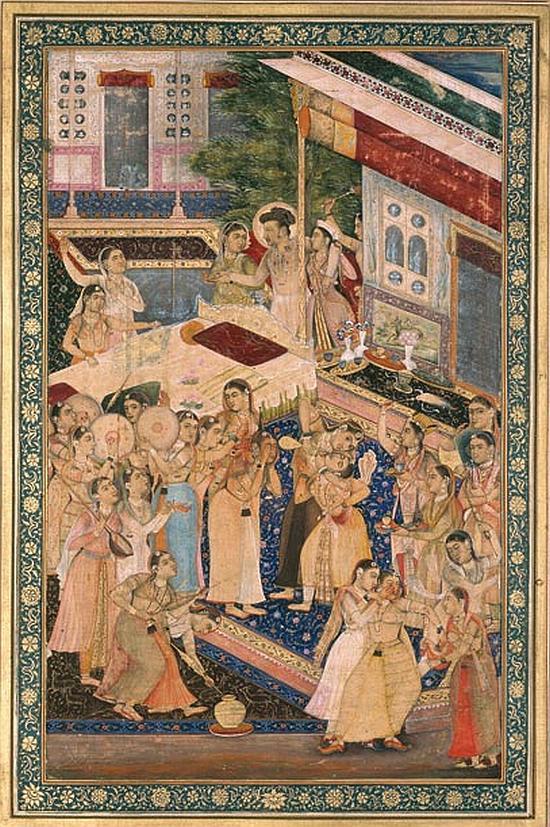
HoliJehangir

Sufi poets too eulogized the Radha Krishna romance and Holi, when expressing their love for their revered Sufi Saints or even God.

To begin with  Sufi poets, it is Shah Niaz’s ‘s Hori Ho Rahi hai, (immortalized by Abida Parveen):

Holi hoye rahi hai Ahmad Jiya ke dwaar
Hazrat Ali ka rang bano hai Hassan Hussain khilaar
Aiso holi ki dhoom machi hai chahoon or pari hai pukaar
Aiso anokho chatur khiladi rang deeyon sansaar
“Niaz” pyaara bhar bhar chidke ek hi raang sahas pichkaar.

(Holi is happening at beloved, Ahmed’s (saww) doorsteps.
Color has become of Hazrat Ali (as) and Hasan (as), Hussain (as) are playing.
It has become such a bustling scene of Holi that it has become talk of the town,
people are calling others from all over,
What unique and clever players (Hasan and Hussain) that they colored the entire world.
Niaz (the poet) sprinkles bowlfuls of color all around,
the same color that comes out of thousands of pichkaaris ( spray guns).)
{Thanks to Ali Rehman @Baahirezaman for the translation}.

Bulleh Shah also played Holi with his Master:

Hori khailoongi keh kar Bismillah
Naam nabi ki rattan charhi, bond pari Illalah
Rang rangeli ohi khilawe, jo sakhi howe fana fi Allah

(I shall play Holi, beginning with the name of Allah.
The name of Prophet is enveloped with light,
He only makes us play with colors, who annihilates with Allah)

Amir Khusro  relates to  Holi through multiple fascinating ways, in various places. Khusrau refers  not just to the color, or the play but of  the birth place of Krishna Mathura in the famous Aaj Rung hai rey:

Gokal dekha, Mathra dekha,
par tosa na koi rang dekha
Ey main dhoond phiri hoon
Des bides mein dhoond phiri hoon,

Purab dekha pacham dekha
uttar dekha dakkan dekha
Re main dhoond phiri hoon
Des bides mein dhoond phiri hoon,

Tora rang man bhaayo Moinuddin
Mohe apne hi rang mein rang le Khwaja ji
Mohe rang basanti rang de Khwaja Ji
Mohe apne hi rang mein rang de

{In summary: I saw Gokul, Mathura ( bith place of Krishna) and even East to West I roamed, but I did not find anyone with a color like yours. My heart is enamored by your color, hence color me in your shade, my master.}

Another lesser know verse I came across is:

Khelooongi Holi, Khaaja ghar aaye,
Dhan dhan bhaag hamarey sajni,
Khaaja aaye aangan merey..
( I shall play Holi as Khaaja has come to my home,
Blessed is my fortune, O’ friend,
as Khaaja has come to my courtyard.)

Needless to repeat, there are ample such examples.  No matter how much one may attempt, it is impossible to separate the two inter-meshed   cultures coexistent for centuries in the subcontinent. These celebrations of culture are all about love and inclusion, and absolutely nothing about hate and discrimination.

Let’s celebrate then, with an open heart !

Holi pic

Here is the link to Amir Khusrau’s Kheloongi Holi, Khaaja ghar aaye:

Whatever IS will be WAS.


The above heading is a Buddhist saying by Monk Ñanamoli. The  in depth meaning of its essence could not be more powerfully conveyed than by an ancient  Buddhist ritual called dul-tson-kyil-khor ( Mandala of colored powders).

Sometime ago in search for an idea for silk painting I accidentally bumped into a beautiful  handmade creation, which in first hand looked like an intricate colorful geometrical design, called Sand Mandala.

As the name implies, it is a creation made from colored sand. Mandala means a palace. There is much more to it than the eyes can see.

From the Tibetan Buddhist tradition, this is not just a creation of a beautiful sand castle, but a spiritual journey, for which requires a great practice and meditation before embarking on it. Even during the creation , which usually requires 4 monks (bhikkus) who keep chanting hymns and focus all their minds and actions into its creation.

The sand mandala for them is a three dimensional Palace of Imagination in which they enter, and each dot, line, shape and color that they create in it stands for a specific aspect of Buddhist Philosophy. There are many types of Mandalas, and each stand for a unique symbol.

The creation has to be accurate, and the work  between the 4 creators, working on each quadrant,  has to be well coordinated.

Billions of grains of colored sand powder are carefully and accurately placed in its specific location, using two copper conical pipes called chapku, which are gently tapped over the other, to release controlled amount of sand.

The colors for the painting are usually made with naturally colored sand, crushed gypsum (white), yellow ochre, red sandstone, charcoal, and a mixture of charcoal and gypsum (blue). Mixing red and black can make brown, red and white make pink. Other coloring agents include corn meal, flower pollen, or powdered roots and bark. In the ancient times they used colored dust from the lapiz lazulli, emerald, ruby, and corals and other precious stones to get colored dust powder.

It takes from few days to few weeks to create a mandala.

However, the most mind boggling part arrives when the whole intricately built sand mandala is undone ( yes, you read it correct) from outside-in in a rotas wheel movement, never to exist again, by the very monks who created it. This metaphorically implies the impermanence of things.

The dust collected is immersed in a flowing water ( river nearby) symbolizing the transference of the energy of goodwill ( imparted to it during its creation)  and compassion, to the rest of the world. {The whole idea gave me shivers and goose bumps}

Hence, when even  at first look it appears to be an end of a creation, but in the real sense, nothing is ever destroyed forever, just that it is returned to the nature, to rejoin elements.

And this does happen to all animate and inanimate objects on earth, be they complicated  humans,  simple plants, soft clouds or  even lofty mountains.

When Buddha passed away, one of his disciples remarked:

Aniccaa vata sa”nkhaaraa — uppaada vaya dhammino
Uppajjitvaa nirujjhanti — tesa.m vuupasamo sukho.

Impermanent are all component things,
They arise and cease, that is their nature:
They come into being and pass away,
Release from them is bliss supreme.

It compels me to be reminded of Kabir’s doha:

Mati kahe kumar se tu kya rondey mohe,
Ik din aisa ayega main rondoonga tohe.
(The clay says to the Potter: What will you maul me, a day shall come, when I shall maul you).

Or yet in another doha he reminds:

Kaya nahin teri nahin teri,
Mat ker meri meri.
(This existence isn’t yours, don’t call it “It’s mine, it’s mine.”)

And of Bulleh Shah’s kaafi:

Na Kar Bandeya  
Meri Meri
Na Teri Na Meri
Char Dinan Da Mela
Duniya Fair Mitti Di Dheri.
(O people, why  be obsessed with me, mine. Its neither yours nor mine. Its for a while, then we all shall be but a pile of dust).

Indeed, “from dust we were born, and to dust we shall return.”.

Mosaic Festival 2012~Day 1 : Fashion Show & Mushaira


Mosaic Fest 2012 opened up on 16th August 2012, in Mississauga Art Gallery, with a substantial poise.

Yes, it was the “Woman of Substance walk”, in partnership with Indiva,  a renowned Fashion House from Yorkville.

What was thrilling was the scintillating line of beautiful models, from among the  women who make a difference in our Community. With the same poise and grace, that they have walked on the ramp of their professional lives, did these stunning models display the ensembles they were wearing from the renowned South Asian designers like Malani Ramani, Rohit Bal, Satya Paul, Ashley Robello, to name a few, all brought to display courtesy Wendy Dias, of  INDIVA.

The models line up of distinguisghed women, merits them all to be acknowledged for their accomplishmnets:
1.Linda Thomas: Ex. Dir. of Mississauga Arts gallery, a grandmom .
2. Indira Naidoo Harris: A journalist, a former Liberal candidate.
3.Shehla Khan: Engineer,with Canadian Nuclear Industry, designed Union Station, TO, and Karachi Airport.
4. Zehra Abbas: Founder, Ex Dir of YGTA, A youth led NPO, mobilising youth for Social Justice through arts.
5. Viera Kononenkova: A financial consultant
6. Angelie Sood: Host on XM Radio, heads a NPO ‘Share your light’ for the underprevilleged children
7. Salima Syereh Virani: Editor-in-Chief of MyBindi, SA hub for arts entertainment and lifestyle.
8.Atiya Khan: An ex-model in Pakistan, and now in direction & production in Canada. Promotes Sufism.
9. Surbhi Guleria Joshi : Co-founder of a Marketting Consulting Firm
10.: Bonnie Crombie: An elected councillor, from Ward-5, a community leader.
11. Anu Vithal : an entrepreneur, and Mosaic festival Director.

A few of them walk down the isle here, without giving any clue to their not being professional models:


Talking later to Bonnie Crombie, the politician, I asked her, “How did Bonnie, the model feel, walking on the ramp?”
‘Well it was an extremely exciting experience, and an honour to be walking down the red carpet, along with other distinguished women from the Community, whose resumes and accomplishments in real lives are far more elaborate than the dresses they were displaying.” Said Bonnie almost instantly.

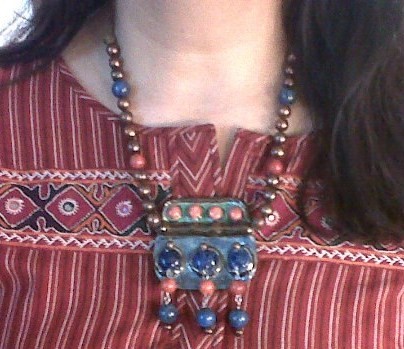
Show casing on the sidelines was the Artist of Mosaic 2012, Misbah Ahmed, displaying her stunning pieces of hand crafted jewellary. It was mostly crafted of porcelain, visibly painfully hand painted, each piece was a unique piece of craft.

“It looks a real hard work” I could guess.
“I haven’t slept for a week”
said Misbah, modestly.

It was hard to choose, which ones to pick for a photo  for the blog, and even harder still, which ones, not to buy. Though I went there as a blogger, but ended up becoming one her clients too.


Mosaic Musaira :
At the other side, the Amphitheatre had An Urdu-Hindi-Punjabi Mushaira, The Azadi Mushaira, by  Canadian South Asian poets. They shared their poetry, amids the da’ads ( applauds),  on diverse topis from love to peace to humour.

Some of the verses, form very few poets, that I could note down, while being engrossed in their narrations are here:

Sandeep Singh, shared his poem on ‘Aeena’ . I share a few verses of his  Hindi kavita poem):
Tasveer dikhayi deti hai ek, shaksh ki ghar Aaine mein
Thoda jana sa lagta hai, kuch pehle dekha aaine mein……..
Shuruaat mein to aksar us se, nazarein mil jaya karti thi
Koi baat chubh gayi hai meri, hai nazar churata aaine mein!
…………..
Socha ki badal daaloon nata, aise ranjeeda mehmanon se
Yeh soch makaan badal dale, par tha wahi wahan aaine mein!

…………..

Uzma Mahmood, who came to Canada from Lahore, in 1993,  also a Homeopathic doctor and mortagae agent, narrated:
Guzre huwe zamane ke hawale mein reh gaye
Ab who tamasha dekhne walon mein reh gaye.
Khamosh lab se baat ki tardeed main ne ki
Tab unke sab khwab sawalon mein reh gaye.
Itna taweel pehle na tha daur-e-intwezar
Wade naye visal ke sawalon mein reh gaye.
Karbne gaye the Alam-e-arwah ka safr
Who log jo asman waalon mein reh gaye.
Masroofiyat ne kerne ki taufeeq jab na di
Uzma who mere kaam khayalon mein reh gaye.

Poonam Jain Kaslimwal, who works at peel district School board recited her Hindi Kavita:
Rat thehri chandni munder pe
Poocha main ne, tu kaun desh se aai hai
Bata to zara kya koi sandesa laai hai
Muskurai, ithlai bole
Kyun kya hai koi us oppaar
Jo tujhe yaad kerta hai
Main ne kaha pata nahin
Per sochna bahut achha lagta hai.

Though I had gone there to blog about it, but seeing them recite, I too plunged to recite  my poem on India Pakistan peace, in my debut Mushaira.
A few of its verses are:

Nafrat ki gathri ko mein ney
Phenk diya hai gireh laga ker
Hasrat se ab khol rahi hoon
Yaadon bharey iss thailey ko
Pyaar ki taaza hawa lagaane
Aman ki roshan dhoop dikhane.

Tum bhi aao, kholo apni
Saari gaanthein, saare bull
Tum bhi apne jholey mein se
Bujhe huwe woh deep nikalo
Un yaadon ke, un baaton ke
Un qisson ke, jo itne zyada
Dohratey the jab Nana Dada
Chehre unke damka jaate the
Ankhein unki chamka detey the….

Film Festival : As part of the Film Festival for Mosaic, with a line up of some really wonderful films,  the visitors were  treated with Reload and Jab We met.

With a lot more to come on the remaining three days : http://www.cre8iv80studio.com/index.asp

The mesmerizing Taj


Think Taj Mahal, and to an average Indian, what comes to mind is the information one imbibed during the school about the Mughal Emperor Shah Jahan, and that he had built it in the memory of his beloved wife Mumtaz Mahal. One is also reminded of some’ facts’ that we read in our school history text books i.e. It took 17 years for the construction to complete ( though Taj website info claims that it took less than 10 years), and the misplaced myth that once the architect had completed the construction, his hands were chopped off by the emperor so that it could not be replicated again. However there is no historic documentation of this myth. In fact, there is reference which suggests the contrary.

For foreigner visitors, be they Westerners or from anywhere on the globe, first thing they wish to see when they land in India, is Taj Mahal. For them it is a marvel piece of architecture that symbolises India. A purchase of its mini replica made of alabaster, as a souvenir is mandatory.

However, for the locals, many are superstitious about keeping a replica of TajMahal at home. Some consider it a Mausoleum, while others believe it brings bad omen. Ironically the monument which is known as the most romantic symbol of love in the world, is perceived by the superstitious to have brought bad luck to both Shah Jahan who commissioned it and the architect who designed it.

Many neither superstitious nor romantic, associate it with ShahaJahan’s obsession with extravagant and lavish life style. It is said that the time Taj Mahal was being built ( 1632-1648), Americans were laying the foundation of a great Ivy League institution by the name of Harvard University ( 1636 estb). Hence obvious were the priorities between the two parts of the world.

The fact that the Mausoleum was built for love of Mumtaz Mahal, who died while delivering her 14th baby, at the age of 39, also compels many to question ‘what kind of love was that?’

To many indifferent to above issues, it remains as one of the Wonders of the World. It was in 2001 that New 7 Wonders of the World inititative was begun, and after nearly 100 million votes cast the world over, Taj Mahal was chosen as the top of the New 7 Wonders of the World. However, in 2007, after controversies, form various ends, UNESCO withdrew its support from the initiative.

My personal experience of TajMahal , visitng it as a grown up, was quite unexpected. Having visited a few times in childhood, I did not feel anything special. Hence while visiting again, as an adult, I had expected nothing different.

We entered the initial premises with surroundings made of sand stone.

“Why is there no marble here?”  I wondered while standing in a queue.

There was a thorough pocket search at the entrance, where we had to even dispense away with any chewing gum in the pocket.

It was aound 2 PM, and the sky was overcast, with soft sunlight filtering through the clouds.

As we walked through the gates, there suddenly stood in front of us a mesmerizingly pearly white monument, as if being held on a giant palm instead of the raised platform. It looked like an imagination materialised, and an illusion made visible to the open eyes. And it indeed, appeared to exude the four letter word ‘love’, on whose foundations it was said to have been built.

Beside its merits architecturally, even to my ordinary eye, the first glimpse was hypnotising. The eyes stared for a while without a blink.

As we walked towards the raised platform, it began to rain and got really heavy. As we drew closer, the Taj got bigger, but hazier through the curtain of heavy rain, as if receding into an illusion, shying away from reality. The elusive hazy silhouette began to cast a spell even more.

The slippery rounded edges of the marble stairs up to the platform were a challenge to climb when wet.

In about half an hour, heavy down pour stopped, after having washed off the dust over the marble exterior. As the faint rays of sun reappeared, the washed marble began to glow like the glistening face of Mumtaz Mahal must have been, after coming out fresh from a bath. I instantly, in my wild imaginations, began to correlate the flawless beauty of the King’s beloved Queen , to this marble monument he built for her. He sure must have attempted to match his two loves together—the Taj with the Queen.

Rest of the experience within the Taj interiors were as if walking live through a  dream.

Although the overcast sky prevented us from watching it in the full moon, that is usually is offered on four days in a lunar month.  But from the experience in rain, am sure the experience in a moon light night must certainly be exponentially far more bewitching.

A friend recently messaged this interactive  beautiful video of the Taj, and it instantly brought back the recollections of my own experience.It gives a kind of 3-D effect of the Taj, and helps those who have yet to witness it live, share a tiny fraction of my experience visually.

Please click below to see the interactive video: A MUST SEE >>

http://www.airpano.ru/files/Taj-Mahal-India/2-3

Moin Bhai Dilliwala, a tribute to Moin Akhter


As if the year passed in a stroke. It is hard to come to terms that one year has passed since Moin Akhter left us.

A stand up comedian who took the art to a level whose altitude is hard for any other actor  to surmount.

As a family friend there are countless small and big moments to cherish,  which are no less pleasant and hilarious, than his performances.

Actions speak louder than words, hence Moin in action, not words is the best way to pay tribute to him.

I pay homage to this monument of Comedy called Moin Akhter through my favourite piece.

The episode touched me, and related to me in more than one way.

First it was one of the million brilliant performances as a Dilliwala by Moin Bhai, who often chose to speak to me exclusively in a Dilli wali wisko, jisko dialect.
Being a Delhiite, what could be more pleasing, than see his genius turn into ‘mere sheher wala’ at a flicker, both on and off the screen.

Secondly, being an Indian-Pakistani, this Indo-Pak collaboration where Moin acts as a Dilliwala who migrated to Karachi,Pakistan, and the brilliant comedian Javed Jaffery representing a Dilliwala residing in Delhi, India, I found it so close to my own life.

Thirdly, it is a perfect example to showcase how the two Delhi cultures survive thousands of miles apart, and yet distorted  in their own ways.

Fourthly, the interaction between these two Dilliwalas also showcases the ground reality of how the two countries relate to each other in a love-hate relationship through cricket.

Last but certainly the most important reason, why  I emotionally fell for the episode, is the of Indo-Pak visa, and how the Indian Dilliwala,  used cricket as an easy way out to jump the grueling process of obtaining a visa to meet his near and dear ones on the other side of the border.

For those who have to go through this ordeal can very well relate to how the visa process acts as a heartless wall between the loved ones conjoined in heart, yet separated by the political border.

Friend or no friend of Moin Bhai, Dilliwala or no Dilliwala, cricket match new or old, I am sure everyone will be as thrilled to watch it as I am even after having viewed it over a dozen  times previously. (Many will  find it exaggerated, but perhaps comedy is always so  🙂 ).

P.S. My special apologies to my non-Urdu/ Hindi understanding Blog followers and friends.  I wish I could translate the episode, and could share with you the thrill of watching the pure genius, the king of stand up comedy in Pakistan, who was also a personal friend, mimic like a typical  resident of the walled city of Old-Delhi, my city.

Part-1


Part-2

Sitar, Sarod and Santoor


If  “Music is wine” the following three intoxicationg  instrumental pieces do live up to these remarks by Beethoven.


Sitar by Pandit Ravi Shanker  


Sarod by Ustad Amjad Ali Khan : 


Santoor by Pandit Shiv Kumar Sharma: 

“How does one put the spiritual significance of music on paper?  Music transcends all languages and barriers and is the most beautiful communicative skill one can have. Music makes us all experience different emotions or the Navarasa as we call it. Different types of music, whether it is vocal or instrumental, Eastern or Western, Classical or Pop or folk from any part of the world can all be spiritual if it has the power to stir the soul of a person and transcend time for the moment. It makes one get goose-bumps in the body and mind and equates the highest mental orgasm and the release of grateful tears! ”
~ Pt. Ravi Shanker.

In philosophy :

“Music is a moral law. It gives soul to the universe, wings to the mind, flight to the imagination, and charm and gaiety to life and to everything.”
~Plato

Traditional Chinese Wedding vs Desi


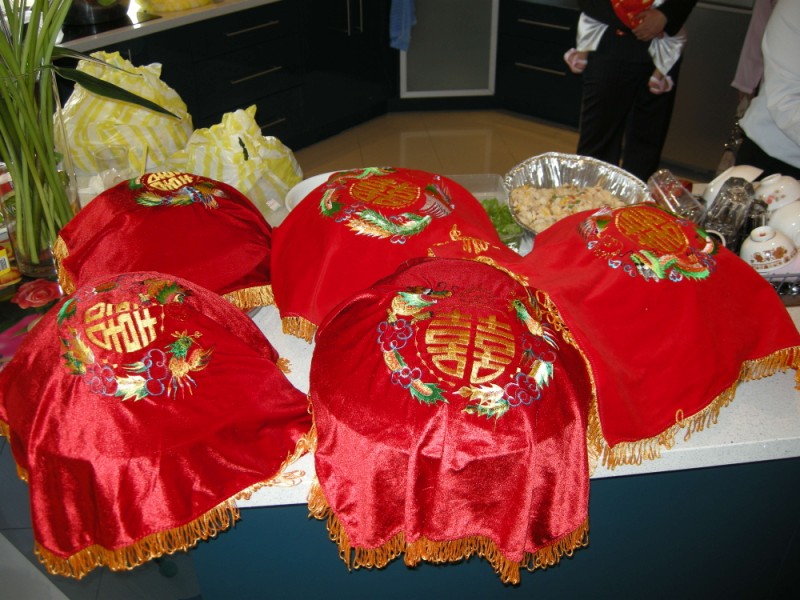
Befriending a Chinese colleague closely has busted a lot of myths with which I grew, primarily them being reserved or unfriendly. Going though her wedding pictures ( which took place 27 years ago in Shanghai), I could not with hold my surprise, of the similarity between their wedding and our desi one , in terms of similarity of rituals, elaborate celebrations and expenditure.

“Our weddings are extremely elaborate and interesting.”  remarked my friend.

Exactly like us desis, Chinese believe that marriages are arranged in Heaven, and merely completed on Earth. They believe the predestined couple is tied with red string in the Heaven, long before the marriage occurs on Earth.

For them too, it is a union between two families, not just two individuals.

The traditional Chinese too have elaborate rituals of sending marriage proposals to the girls family. Once decided, it is a must for the two families to consult the fortune teller ( as a Jyotishi in Hindu wedding) about the auspicious date for the wedding.

The invitation cards are as elaborate and showy as ours.


Red color is overwhelmingly predominant in every Chinese wedding, as it represents luck and happiness.

The celebrations begin days before the actual ceremony.

Days before the wedding, the bride is expected to stay away from the eyes of the general public, in isolation.

The groom’s family brings gifts to the bride’s home days before the wedding,  while the bride’s family returns the gifts along with clothes and gifts to the groom, his parents and unmarried siblings.


Like us desis, the bride’s side is also expected to deliver dowry and money to the grooms home, the amount of which  states the dignity and position of the bride’s family.

On the day of the wedding day, as  she gets ready, the bride goes through a hair combing ceremony where a ‘lucky’ woman, mostly a married woman ( = our suhagan) combs her hair 4 times. Each stroke carries a special meaning. The first combing blessed the marriage to last a lifetime; the second, a harmonious marriage; the third, many children and grandchildren ; and the fourth, good health and fortune.


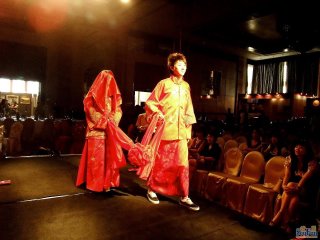
The bride adorns a red gown, red shoes and covers her face with a red veil.

However, the groom, unlike our groom, wears red robe, red sash. A capping ceremony like our ‘sehra bandi’ takes place where his head is covered with cypress leaves by the father.


Amidst the banging of gongs, drums and firecrackers, ( like an Indian baraat),  the groom leaves for the bride’s house in a procession.


As the groom steps in the brides house, the brides sisters & friends stop his way and bargain for entry towards the bride.

The bride leaves her home for the wedding arena under a red umbrella to ward off evil.

However the basic difference between the desi and Chinese wedding is the main ceremony.

They do not have any written contract or chanting of verses.
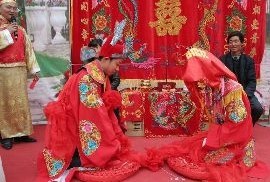
The couple goes on its knees and bows thrice- for the Heavens, the ancestors and their parents. They even bow to each other in a gesture of promising faithfulness to each other. There are no spoken vows.


Like us desis, the banquet is extremely elaborate, with 9 or 10 course meals.

However unlike us, each meals signifies something. First course is pig which signifies virginity, followed by others eg   fish & seafood for wealth and abundance,  pigeon for peaceful marriage, and whole chicken head for togetherness.

For details in the 10 courses: http://www.boneats.ca/2010/08/food-culture-chinese-wedding-banquets.html


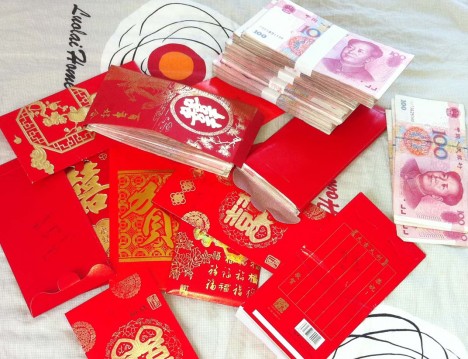
The preferred presents like us desis are generally in  cash, which has to be placed  in red envelopes called Hongbao. The amount of money given varies upon the closeness of the giver to the bride-groom.


After the ceremony and the feast, the bride serves her  in laws  tea, holding with both hands, showing a gesture of her service and faithfulness to her new family.


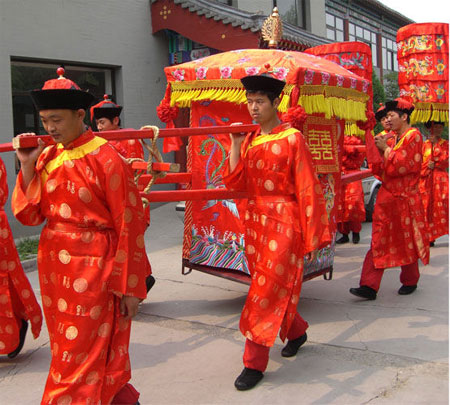
What excited me most was to know that like our old tradition, the Chinese bride also leaves for her husbands home in a hand held  carriage quite like our doli.


Although now only a few girls like this tradition, and now this has largely been been replaced by more posh mode of transport i.e. a car which is mostly extensively decorated with fresh red roses.


Some of the rich who can afford prefer a red car itself.


The ‘bridal bed’ as it is called is arranged quite a few days in advance in an elaborate ceremony, taking care the direction of the bed. The details here too depend upon the affordability of the groom. However all have traditional red bedding and are spread with fruits on it, which signify fertility— red dates, litchis and longans.

In the next morning, the bride gets up early to prepare meals for the new family.

Three days later she visits her parents along with her husband, as a special guest.

The picture that inspired me to write this blog ( Courtesy Tahir Hashmi) was this, which reminded me of the Hindu wedding’s pheras:


“Many of the Chinese youngsters are now  getting more fond of  traditional wedding, after two decades of having had more modern weddings.” added my friend.

(Special thanks to my friend Jenny for the details & helping dish out pictures)

Smart Art


With smoking zones shrinking more and more in public spaces, poor puffers barely get the ground to stand on,  in this smoking alley in a Hotel. They can’t even raise their heads to blow off the smoke, all for the roving eyes ‘looking down’ upon them,  from the roof top. Wouldn’t be wrong to say,  “Roof has been taken away from smoker’s heads.”


The artist paints with his hands, what he sees through  his heart.  The artist here sees no wall,  but a passage right through it. Quite like  when Napoleon’s Army questioned how would they cross Alps, he replied, “There are no Alps.”


And then the epic Palestine-Israel  wall and it’s art of resistance. This speaks volumes of the hope that artists paint  on the canvas of  hopelessness. Paintbrush is their weapon, ideas their gunpowder.


This slideshow requires JavaScript.


How I wish we all envisioned  in front of us, “There are no walls.”

P.S. Please click over the pictures to see them larger and with greater details.

When hate or peace become a business


In my last trip to India, I was strolling for window shopping, in one of my favourite spots in New Delhi, when I heard some loud speaker announcements nearby.

I saw a Yogi on a big screen, speaking with utmost tranquility. Some of the words I could recall are:
“Want is always hanging on to the I. When the I itself is dissolving, want also dissolves, disappears.”
And
“How far to heaven? Just open your eyes and look. You are in heaven.”

There were a few other things he spoke. At the first instance all I could think was, ‘Had Kabir been alive, he would have said the same thing.’


As I attempted to take a picture from my mobile phone, a boy intercepted. Wondering if photography was not allowed, I told him “Okay I won’t.”

But he said, “No Didi, there are so many people in the way, I’ll have you take it from a better angle.”

I was quite surprised at his generosity.

While returning, I collected some leaflets from the Art of Living ( Sri Sri’Ravi Shanker’s Organisation) stall, one of which said:

To love someone whom you like is insignificant.
To love someone because they love you is of no consequence.
To love someone whom you do not like means you have learned a lesson in life.
To love someone who blames you for no reason shows that you have learned the Art of Living.

Back home, talking to an old college friend who still lives in Delhi, I mentioned the incident.

She said, “Yes it’s nice, but this is business. Pay fees and attend the classes. What you saw was their marketing section.”

When I heard of his trip to Pakistan and the news about his offer to teach peace to Taleban, I was intrigued, wondering:

‘How would it be taken as an offer by the ilk of Zaid Hamid, Gen Hamid Gul, or the Taleban themselves? Would they again rant of the Hindu agenda or the greater Zionist agenda.’

Instead of the Hindu agenda rant, I saw a couple of positive FB statuses and some tweets on the issue. A tweet worth the mention is:

“Sri Sri has already had a Positive Effect on Taliban! Mullah Omar is now calling himself Mullah Mullah Omar.”
Thankfully, instead of an offence,  it was taken in lighter vain 🙂

Incidentally I happened to chat with the same friend on Facebook , and told her of his trip to Pakistan, and the Taliban offer story.

She said: “Oh come on, he is there to promote his AOL centres, one of which I know is located in the capital city. And again this is the marketing department at work.”

I again muttered to myself, ‘Well nothing wrong with it. One could consider this a social enterprise. We do have an epidemic of hatred in the world and he has provided a therapy for it, but at a price, which will work if it is cost effective.’

He did tour the AOL offices and camps in Karachi, Islamabad and Lahore. But to my utter dismay, before I could start to keep track of his Pakistan trip, and his talks with Taleban, I heard that he was back in India.

Wonder is he wasn’t allowed to approach Taleban, or was it not on the agenda?
I have no clue.

Anyways he did repeat his offer after coming back “There is a lot of violence in Pakistan and people are fed up, they want to live peacefully. If I could be of any help in bringing an end to the vicious cycle of violence, I am ready to talk to the Taliban,”

And that “We are all sufferers of stress, tension, violence and hatred – and small ways of easing out are all that you need,”

There is no doubt that the techniques which he uses for de-stressing are scientifically based.

The primary exercise, which they call Sudarshan Kriya is basically a deep breathing exercise which any psychologist you visit asks you to begin with, on de-stressing. There is a proper technique for it.

I can’t help being amused by the mere visual imagination of Mullah Mullah Omar sitting in a Padma Asana (lotus pose), with hands stretched over the knees, and breathing-in through nose and breathing-out through mouth. 🙂

How I wish that my friend is still proven wrong and some miracle asana (yoga position) comes up which exhales all hatred out of the heads of these radicals.

If that so happens, then I would also secretly whisper in Sri Sri’s ears to develop some Yoga position (asana) in which our politicians extend their arms  in service of  the masses, who vote them in, instead of flexing them, with hands reaching their own pockets.

And so will I also pray to Sri Sri to apply some tilak ( teeka) on the foreheads of our uniformed (on both the sides), so that they start seeing each other as friends and not enemies, and start piling books and medicines for the masses on both sides, instead of arsenals.

I would also beg Sri Sri with folded hands to ‘please please’ make some vibhuti ( spiritual ash) for our diplomats ( on both sides) which when touches their tongues gets them addicted to the taste of peace and makes them feel nauseated just at the sight of visa, passports, police verification etc etc.

Be it a profitable business or social enterprise, there’s no offence, if it is all intended to bring real peace, beyond just a marketing tool.

After all,  all the  chaos and divisions on ground, are also a result of the seeds of intolerance sown by those who consider hatred as their business.

Lawn ki kahani, meri zubani ( The story of Lawn in my words)


Published in TheNews Blog : http://blogs.thenews.com.pk/blogs/2012/03/21/story-of-a-lawn-hater/

Designer lawn, designer lawn, designer lawn!

Every Sana, Nida and Hina is coming out with designer lawns.

Thankfully never a fan of lawn as a material, it does not awaken the woman in me.

However I remember my mother, who lives in Delhi, where summers are really biting, once came back from a trip to Pakistan in mid 80s, all excited, for having discovered a wonder cloth. She is a woman with sensitive skin, and sweat rash (garmee daaney, as we call it in desi jargon) was what she had to struggle with each Delhi summer.
Fed up of wearing starched Khadis (hand spun cotton) and malmals (muslin) in the sweltering heat, she said she found something which was soft, low maintenance, colorfast and did not need any starching. The picture she painted with her descriptions and expressions got me really curious to open up her suitcase and dig out the jewel, basically to choose which one was mine.

The result that came out of that digging was so befitting to the Hindi idiom “Khoda pahaar per nikla chooha aur woh bhi mara hua”
(From the digging came out a dead rat).

The first look of it was totally unappealing –bold designs on the shirt piece, with its giant replicas on the dupatta. Didn’t need to check the third of the half a dozen three piece suits she brought.

“What’s wrong with your taste? Ammi you’ll wear this?”

“They are so comfortable. And most of all they are so reasonable. One suit costs just Rs 225.”


She didn’t even bother to comment about my ‘taste’ rant.

From then on, I saw her pass all the worst days of summers in lawn suits. And when I got married in Pakistan (perhaps she must have prayed for this secretly for her own vested interests) all she wanted from me each visit was…”bring lawn ke suits, so that meri garmiyaan nikal jaayein.”

I remember from 1990 onwards, buying them for Ammi from Rs 250, Rs 450, Rs500, then Rs1000,  1200, 2500, and last I got for her was Rs 3500. Agree that with time, along with the prices, the designs evolved too. And they certainly got better.

But each time, Ammi felt uneasy with the price escalation. At the 3500 one she told me, “Enough, I don’t need a dress at this exorbitant price just to soak my sweat.”

And now with the advent of designer tag they have graduated to even five digit prices (at the higher end). And they usually begin from 4,000 going upto 12,000, I am told.

I remember some 2 years ago, hearing two cousins talking of outlets where they got the same designs as the big brands copied at much lower prices.

“The original is so expensive, so I buy the duplicate ones.”

“Even the previous year’s designs are available at cheaper price,” said the other.

Yes, but you know there is a teacher in my school who thinks she is very  smart. She instantly recognizes, ‘ye to pichle saal ka design hai’. So I can’t wear that. But woh kaminee tou isko bhi pehchaan jaati hai, ke ye duplicate hai.’

“Why do you need to copy? Or in fact wear designer lawn at all”, I asked.

She rubbished my question and moved on to some other topic.

This is certainly not to act snobbish, but I certainly find it hard to fathom the compulsion to owe one’s allegiance to these ‘disposable’ pieces of cloth which are so short term that they become obsolete the next season.

If I have so much money to spare( 5-7,000+ on a dress) , I will perhaps invest in a piece I can cherish for longer, and if you ask my secret desire, it would be on something I can pass on to my daughter. And indeed I have done exactly by getting hold of  some beautiful pieces with  Baluchi, Afghani or Sindhi hand embroideries.

Dump my hard earned money into a casual wear lawn suit which won’t last the next summer—no way.

In the background of so much disinterest for the designer fad, I was made to see this disgusting ad ( see the bottom pic) by a twitter pal.

And this perhaps was the boiling point of my emotions,  for the ‘designer lawn’ and hence I decided to blog my disdain for them.

With all the designer hype or price escalation, the brand had the audacity to show their product with coolies in the background.

What did they wish to relate to?

Was it the quality of attire in comparison? Oh ! Theirs is so simple, non designer unlike mine. Yet in my two dim visioned eyes, the poor men’s is the rawest of  cottons.

Or

Was it about the worth of one’s labour? Oh look at us, how much we get for the every drop of sweat we shed in the labor for those ‘designs’. 

Or

Was it about the matching colors?

But then, Buddhist monks and  Hindu sadhus too wear the color similar to the woman’s. With ‘Muslims’ as their major market, it was too much of a risk to take.

Oh,  yes, the coolies do not prick anyone’s sensitivity, so were  pretty risk free to have as a background.

Kudos to the imaginative  Advertising Company that thought of this ad and flexibility of the Designer Textile Company that approved of it and owned it.

To me personally this was absolutely nauseating…akin to showing middle finger to the poor fellows in the background.

So rightly had someone commented: “Thank you for hiding their faces with your brand name.”

Hats off to the Feudal mindset, yet another common man’s commodity, the lawn, has turned into an elitist product. Of course in business jargon this is called as ‘value addition’. So what if it gets unaffordable to the vast majority, at least it looks coool ( with a triple o) !

How I wish we did some value addition to Islam too, in Pakistan?

On a second thought, haven’t we?

With the  tags of suicide bombs, Ahmedi hate, Shia kafir rants, we have made it a brand which ordinary Muslims like me find hard to afford.